Python Web Development Services for Scalable Applications
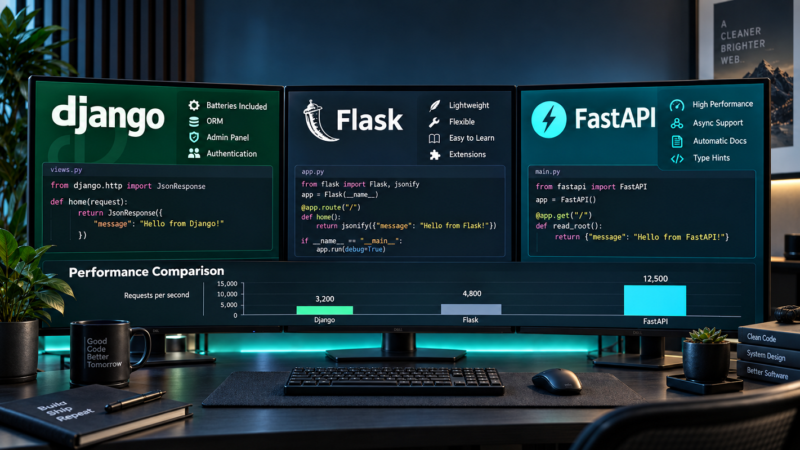
Modern Python web development services cover the end-to-end design, engineering, deployment, and maintenance of scalable web applications. Development teams typically leverage full-stack frameworks like Django, microframeworks like Flask, or high-performance asynchronous tools like FastAPI depending on system requirements.
However, scalable delivery relies on more than just the programming language; it requires a robust backend foundation including efficient databases, caching layers, task queues, observability, and automated infrastructure.
For startups, SaaS platforms, and enterprise teams, hiring specialized Python web development services offers a practical pathway to building or modernizing production-ready applications. Python’s ecosystem supports flexible delivery models, ranging from rapid MVP prototyping to distributed microservices architectures.
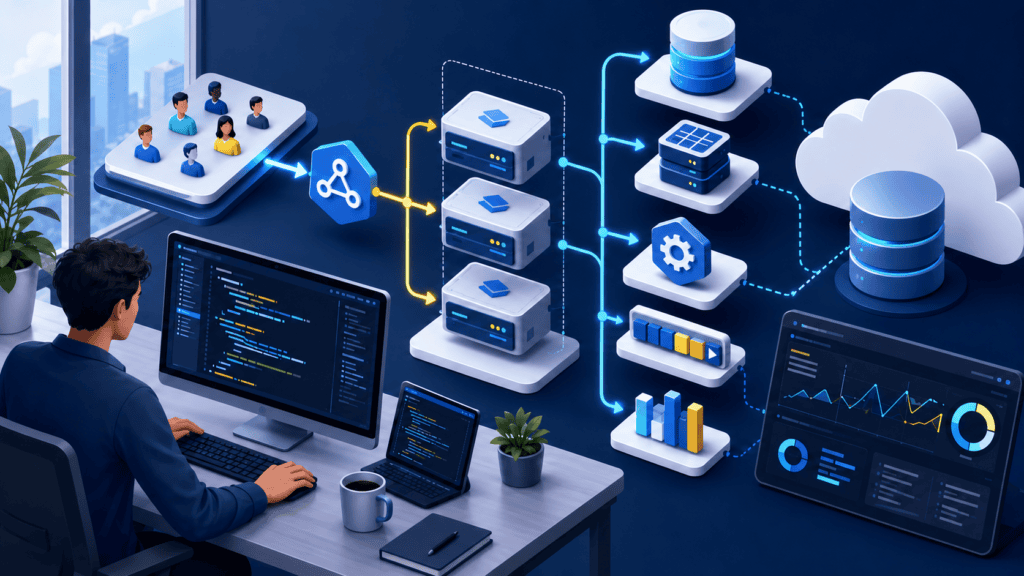
Choosing Python is only the first step. To handle real-world traffic, system architectures must sustain database demand, mitigate third-party failures, pass security compliance, and streamline deployment pipelines without inflating operational costs.
This guide explores what comprehensive Python web development services entail, compares Django, Flask, and FastAPI for scaling, outlines modern backend architecture patterns, and provides an actionable framework for evaluating development partners.
What Are Python Web Development Services?
Python web development services encompass professional, end-to-end engineering for planning, architecting, building, integrating, deploying, securing, and maintaining web systems that rely on Python for server-side logic.
Depending on project scope, Python web development services can cover an entire web platform from end to end or target specific architectural components:
- Backend & API Development: Designing scalable RESTful APIs, GraphQL endpoints, and microservices using frameworks like Django, Flask, or FastAPI.
- Integrations & Data Pipelines: Building secure webhooks, third-party API integrations, ETL pipelines, and asynchronous background task processing.
- Frontend Integration: Connecting Python server logic to modern frontend stacks (React, Vue, Next.js) or utilizing server-side rendering (SSR) templates.
- Infrastructure & Ops: Setting up containerized deployments (Docker/Kubernetes), CI/CD pipelines, database optimization, caching, and cloud infrastructure management.
A capable Python web development services provider connects technical execution directly to measurable business goals. In a high-performance backend system, “scalability” is defined by hitting strict SLAs for traffic concurrency, sub-second API latency, high availability, threat mitigation, and predictable infrastructure cost—not simply selecting a trendy framework or cloud provider.
What Is Included in Python Web Development Services?
| Service Domain | Core Scope & Deliverables |
| Product Discovery & Architecture | Technical requirements gathering, system design diagrams, capacity planning, stack selection (Django vs. Flask vs. FastAPI), and Architecture Decision Records (ADRs). |
| Data & Application Architecture | Relational/NoSQL database modeling, schema migration planning, domain-driven design (DDD), and data flow mapping. |
| User Experience & Frontend | UX prototyping, responsive web design, and seamless integration between frontend frameworks (React, Next.js, Vue) and Python backends. |
| Python Backend Engineering | Business logic implementation, asynchronous task processing (Celery/Redis, Dramatiq), caching layers (Redis/Memcached), and ORM optimization. |
| API Development & Gateway | RESTful APIs, GraphQL schema design, real-time WebSockets, webhook management, and API gateway routing. |
| Infrastructure & CI/CD | Cloud infrastructure provisioning (IaC via Terraform), Docker containerization, Kubernetes orchestration, and automated CI/CD deployment pipelines. |
| Quality Assurance & Testing | Automated testing suites (pytest, unittest), integration testing, end-to-end (E2E) testing, and load/stress testing (Locust). |
| Security & Data Privacy | Application hardening (OWASP standards), authentication/authorization (OAuth2, JWT), encryption at rest/in transit, and compliance prep (GDPR, SOC 2). |
| Observability & Maintenance | Centralized logging, Application Performance Monitoring (APM via Datadog/Sentry), uptime alerts, security patching, and automated backup strategies. |
Why Python Is Used for Scalable Web Applications
Python is widely adopted for high-scale backend engineering because it provides a mature ecosystem that integrates seamlessly with modern databases, distributed systems, asynchronous task queues, and data-processing workloads.
However, Python’s runtime alone does not make an application scalable—scalability is an architectural property achieved through the right choice of framework, caching strategies, horizontal scaling patterns, and infrastructure design.
When choosing Python web development services, engineering teams select Python primarily due to its framework versatility, allowing the technical stack to directly match specific workload demands:
- Django (Batteries-Included Security & Speed): Django provides a complete, battle-tested suite of built-in components—including user authentication, object-relational mapping (ORM), database migrations, and an administrative panel. This eliminates the need to assemble core infrastructure from scratch. Additionally, Django includes out-of-the-box defenses against common web vulnerabilities like Cross-Site Scripting (XSS), Cross-Site Request Forgery (CSRF), and SQL Injection.
- Flask (Modular Flexibility): Flask features a minimal core footprint, giving architects total control over component selection. It allows engineering teams to plug in specialized libraries for routing, database management, and authentication—ideal for microservices or lightweight applications where boilerplate overhead must be minimized.
- FastAPI (High-Performance Async APIs): Built on ASGI (Asynchronous Server Gateway Interface), FastAPI uses standard Python type hints to deliver exceptional execution speed and concurrency. According to its core specifications, FastAPI natively supports OpenAPI schemas and automatically generates interactive API documentation (Swagger/ReDoc), making it the premier choice for API-first architectures and high-throughput microservices.
The Trade-Off: While Python’s ecosystem offers unmatched flexibility across full-stack platforms and targeted microservices, flexibility places greater demand on system design. Achieving long-term performance requires rigorous backend architecture, disciplined dependency management, extensive automated testing (e.g., pytest), and continuous operational monitoring.
Where Python Web Development Services Create Practical Value
Python web development services drive long-term business value by combining engineering flexibility with a unified ecosystem. By leveraging Python across the backend, organizations streamline their tech stack and eliminate architectural silos.
End-to-End Product Development
Engaging Python web development services allows engineering teams to reuse Python skills across the entire backend life cycle—from standard server logic and background task automation to data processing pipelines and native AI/machine-learning integrations. A single unified language stack reduces context-switching overhead, accelerates time-to-market, and simplifies cross-team collaboration.
Strategic Framework Selection
Capable Python web development services leverage the ecosystem’s framework diversity to match specific product requirements:
- Django: Ideal for full-stack, enterprise-grade products needing rapid development, built-in security, and administrative scaffolding out of the box.
- Flask: Best suited for lightweight, modular systems and microservices that require minimal overhead and granular architecture control.
- FastAPI: The standard for high-performance, asynchronous REST APIs and microservices demanding automatic validation, high concurrency, and low latency.
Seamless Integration Capabilities
Modern platforms rarely operate in isolation. Specialized Python web development services capitalize on Python’s mature libraries to build resilient integrations across relational/NoSQL databases, HTTP client protocols, distributed task queues (Celery, Redis), cloud SDKs, complex data pipelines, and third-party SaaS APIs.
Long-Term Codebase Maintainability
While clean code is never automatic, structured Python web development services enforce architectural discipline. Utilizing strict PEP 8 coding standards, explicit type annotations (mypy), comprehensive automated testing (pytest), and clear documentation ensures the codebase remains maintainable, secure, and easy to refactor as the business scales.
Cross-Functional Hiring & Team Scaling
Partnering with a specialized provider for Python web development services provides access to a versatile talent pool. Because Python is the industry-standard language spanning backend API engineering, data engineering, MLOps, infrastructure automation, and quality assurance, teams can scale cross-functional engineering pods smoothly without fragmenting the underlying technology stack.
Which Python Web Development Services Should a Provider Offer?
A comprehensive provider must deliver Python web development services that span the entire application lifecycle—from technical discovery and architecture design to continuous deployment, security hardening, and operational support.
When evaluating vendors, buyers should map their internal capabilities against these core service categories to avoid paying for unnecessary overhead:
                          [ Technical Discovery & Architecture ]
                                            │
        ┌─────────────────────────┬─────────┴──────────┬─────────────────────────┐
        ▼                         ▼                    ▼                         ▼
[ Custom Web Apps ]      [ Backend & APIs ]     [ <a href="https://skilldential.com/best-no-code-development-platforms/?asl_highlight=SaaS+Development&p_asid=1">SaaS Development</a> ]    [ Legacy Modernization ]
        │                         │                    │                         │
        └─────────────────────────┼────────────────────┴─────────────────────────┘
                                  │
                   [ Integration & Automation ]
                                  │
                 [ Performance & Scalability ]
                                  │
                [ DevOps, Security & Maintenance ]
Code language: CSS (css)
Custom Web Application Development
Covers purpose-built web portals, multi-vendor marketplaces, internal operational dashboards, and client-facing platforms. The provider translates complex business workflows into maintainable domain models, role-based access control (RBAC), and testable technical specifications.
- Best For: Businesses whose workflows cannot be served by off-the-shelf software.
- Trade-Off: Provides maximum control and differentiation, but incurs recurring long-term ownership costs for platform maintenance, security patches, and feature updates.
Python Backend and API Development
Delivers core business logic, user authentication pipelines, database abstractions, and API interfaces (REST, GraphQL, WebSockets). Robust API engineering must address semantic versioning, schema validation (e.g., via Pydantic), granular authorization, rate limiting, idempotency, automated documentation (OpenAPI/Swagger), and structured error handling.
- Best For: Mobile app backends, headless CMS architectures, partner integration ecosystems, and multi-channel applications.
- Trade-Off: An API-first architecture maximizes backend reuse across clients, but demands stricter interface governance, continuous testing, and API gateway monitoring.
SaaS Application Development
Tailored for subscription-based products requiring tenant isolation, subscription billing integrations, role hierarchies, automated onboarding flows, usage tracking, administrative back-offices, and audit logs.
- Best For: B2B or B2C software companies selling recurring access to a cloud platform.
- Trade-Off: Selecting a multi-tenant model (shared vs. isolated databases) dictates operational efficiency. Shared infrastructure reduces hosting costs but increases the engineering complexity of data isolation, row-level security, and tenant migrations.
Legacy Modernization and Migration
Replaces monolithic or obsolete backends, decouples tightly bound components into microservices, updates unsupported Python versions (e.g., migrating legacy codebases to modern Python releases), or shifts workloads to containerized cloud environments.
- Best For: Platforms suffering from slow release cycles, frequent downtime, security vulnerabilities, or inflated legacy infrastructure costs.
- Trade-Off: A complete codebase rewrite risks accidentally discarding years of edge-case business logic. Providers should prioritize staged, strangler-fig migrations over “big-bang” rewrites.
Integration and Automation Services
Connects web applications to critical external ecosystem services—including payment gateways (Stripe), identity providers (OAuth/SAML), analytics engines, messaging queues, and internal ERP/CRM systems.
- Best For: Products that rely heavily on third-party SaaS tools or distributed enterprise infrastructure.
- Trade-Off: Offloads complex features to specialized vendors, but introduces external operational dependencies and network failure modes that require circuit breakers, exponential backoff retries, and webhook signature verification.
Performance Engineering and Scalability Services
Focuses on deep system profiling, database query optimization (eliminating $N+1$ query problems), multi-tier caching (Redis/Memcached), asynchronous task execution (Celery/RabbitMQ), load testing (Locust), and infrastructure tuning.
- Best For: Existing Python applications facing high latency, database bottlenecks, unhandled traffic spikes, or excessive monthly cloud bills.
- Trade-Off: Optimizing prematurely adds unnecessary system complexity. Performance engineering must be driven by production telemetry and load test data rather than theoretical bottlenecks.
DevOps, Security, and Managed Maintenance
Establishes automated CI/CD deployment pipelines, Infrastructure-as-Code (Terraform), centralized logging and APM monitoring (Datadog/Sentry), backup recovery protocols, zero-downtime deployments, and ongoing framework updates.
- Best For: Organizations that lack in-house platform engineering, Cloud Ops, or Dedicated AppSec resources.
- Trade-Off: Managed service level agreements (SLAs) relieve operational burden, but necessitate clear access boundaries, security audits, strict data control, and offboarding exit plans.
Django vs. Flask vs. FastAPI: Feature Comparison
Framework selection directly impacts velocity, system architecture, and maintenance overhead when delivering Python web development services.
| Criterion | Django | Flask | FastAPI |
| Core Approach | Full-featured, “batteries-included” web framework | Lightweight, minimal WSGI microframework | High-performance, API-first ASGI framework |
| Built-in Scope | ORM, Auth, Admin Panel, Forms, Templating, Security | Routing, Requests, Responses, Jinja2 Templating | Data Validation, Dependency Injection, OpenAPI Schemas |
| Optimal Use Case | SaaS platforms, multi-tenant portals, complex enterprise apps | Lightweight services, rapid prototypes, bespoke architectures | REST APIs, microservices, async I/O workloads, ML backends |
| Async Support | ASGI-native with async ORM & views (sync fallback via asgiref) | WSGI-bound; handles async views inside sync worker threads | Built natively on ASGI for high-concurrency async execution |
| Core Advantage | Rapid time-to-market via unified, battle-tested conventions | Complete architectural freedom and minimal runtime footprint | Automatic data validation (Pydantic) and auto-generated API docs |
| Key Trade-off | Rigid structure can introduce unnecessary complexity for simple APIs | Requires manual assembly of auth, ORM, and middleware | Full web apps require decoupled frontend/admin components |
Architectural & Operational Considerations
Django: Production-Ready Out of the Box
Django remains the benchmark for full-stack business applications. Its built-in ORM, admin dashboard, and security features (CSRF, XSS protection) significantly reduce initial boilerplate.
However, achieving production readiness still requires configuring WSGI/ASGI application servers (e.g., Gunicorn, Uvicorn), environment secret protection, HTTPS termination, database connection pooling, and centralized logging.
Flask: Controlled Flexibility with WSGI Constraints
Flask provides maximum architectural freedom, making it ideal for custom architectures where engineers prefer choosing their own ORM (e.g., SQLAlchemy) and validation libraries.
While modern Flask supports async def routes, it operates on a WSGI foundation—meaning each request still ties up an individual worker thread. For high-concurrency background operations, Flask requires offloading tasks to an external worker queue (e.g., Celery).
FastAPI: Asynchronous Efficiency for Modern APIs
FastAPI leverages standard Python type hints and Pydantic to deliver built-in request validation and interactive OpenAPI/Swagger documentation out of the box. Designed natively for ASGI, it excels at handling concurrent I/O-bound requests.
However, as noted in FastAPI’s deployment concepts, using an async framework does not eliminate the need for proper production infrastructure—including process replication, memory management, reverse proxies, and TLS termination.
Framework Decision Framework
When engaging Python web development services, framework selection should be governed by operational simplicity and team capability rather than industry hype. Selecting an overly complex architecture prematurely introduces unnecessary operational friction and inflates engineering costs.
                    [ What is the primary product requirement? ]
                                         │
        ┌────────────────────────────────┼────────────────────────────────┐
        ▼                                ▼                                ▼
[ Full-Stack Platform ]          [ Minimal Service ]              [ API-First System ]
(Admin, Auth, Relational Data)   (Microservice, Custom Stack)    (High Concurrency, OpenAPI)
        │                                │                                │
        ▼                                ▼                                ▼
   **Django**                        **Flask**                       **FastAPI**
Code language: CSS (css)
Core Architectural Rules
- Start with the Simplest Architecture: Begin with the simplest framework that satisfies known functional requirements and aligns with your team’s operational strengths. Avoid splitting a system into microservices, writing asynchronous code, or picking a microframework purely under the assumption that it is inherently “more scalable.”
- Monolith vs. Microservices: A cleanly structured, modular Django monolith is consistently easier to scale, profile, debug, and maintain than a loosely governed network of distributed microservices. Monolithic architectures eliminate network latency overhead, simplify transactions, and lower deployment complexity.
- API Boundaries & Multi-Client Support: Conversely, if the core product is an API service designed to support diverse clients (e.g., mobile apps, single-page web frontends, third-party integrations), a typed, API-first framework like FastAPI provides a clearer architectural boundary, stricter request validation, and automatic, interactive contract documentation.
What makes a Python web application scalable?
Building a scalable Python web application requires an end-to-end system design. Python itself does not scale or fail to scale—the underlying application architecture, database layer, caching strategies, and infrastructure patterns determine performance under load.
Before writing code, defining concrete performance metrics—such as concurrent requests per second (RPS), P95/P99 latency limits, recovery point/time objectives (RPO/RTO), and infrastructure cost ceilings—is essential for benchmarking and load testing.
Core Pillars of Python Web Application Scalability
| System Domain | Operational Impact | Key Questions to Evaluate |
| Stateless Application Layer | Enables horizontal scaling by decoupling state from single process instances. | Are sessions, user uploads, and background tasks stored outside local application memory (e.g., in Redis or S3)? |
| Load Balancing & Orchestration | Distributes traffic evenly across application replicas and handles dynamic scaling. | What metric triggers horizontal auto-scaling (CPU, memory, request queue depth), and how quickly are unhealthy instances dropped? |
| Database Design & Tuning | Prevents the database from becoming the primary system bottleneck. | Are slow queries indexed, connections pooled (e.g., PgBouncer), $N+1$ queries eliminated, and read replicas configured? |
| Multi-Tier Caching | Offloads repetitive read operations to keep latencies low. | What data lives in memory (Redis/Memcached), what is the TTL strategy, and how are cache invalidation cascades handled? |
| Asynchronous Task Queues | Offloads slow, retryable, or non-blocking work out of the HTTP request-response cycle. | Are workers (Celery, Dramatiq, RQ) decoupled, idempotent, rate-limited, and backed by dead-letter queues? |
| CDN & Object Storage | Shifts file delivery and static asset serving completely off application servers. | Are user media assets stored in object storage (AWS S3, Cloudflare R2) and cached globally at edge nodes? |
| Observability & Telemetry | Provides real-time visibility into application health, saturation, and bottlenecks. | Are APM metrics, structured JSON logs, distributed traces (OpenTelemetry), and alerting thresholds actively monitored? |
| Release Automation & CI/CD | Eliminates manual deployment risk and enables rapid recovery. | Can the platform handle zero-downtime rolling deployments, automated schema migrations, and instant rollbacks? |
| Resilience & Security Controls | Protects the system against cascading failures, traffic spikes, and malicious vectors. | Are global rate limits, circuit breakers, connection timeouts, and graceful degradation paths implemented? |
Scaling Strategies: Vertical vs. Horizontal
Most production web applications use a hybrid approach—scaling vertically to optimize baseline resource efficiency, and horizontally to absorb variable traffic demand and guarantee high availability.
       [ Single Machine ]
      ┌──────────────────┐
      │  8 vCPU / 16GB   │ ──( Scale Vertically )──► [ Upgraded Machine ] 32 vCPU / 64GB
      └──────────────────┘
               │
      ( Scale Horizontally )
               │
               ▼
     ┌──────────────────┐     ┌──────────────────┐     ┌──────────────────┐
     │  8 vCPU / 16GB   │     │  8 vCPU / 16GB   │     │  8 vCPU / 16GB   │  (Distributed)
     └──────────────────┘     └──────────────────┘     └──────────────────┘
Comparison of Scaling Approaches
| Dimension | Vertical Scaling (Scale Up) | Horizontal Scaling (Scale Out) | Hybrid Strategy (Recommended) |
| Mechanism | Upgrading existing hardware (adding CPU, RAM, NVMe storage). | Spawning additional stateless application instances behind a load balancer. | Sizing nodes for baseline efficiency, autoscaling replicas dynamically. |
| Architectural Impact | Zero code or architecture changes required. | Requires fully stateless backends, externalized state, and distributed locks. | Requires stateless design + resource request tuning. |
| Limits | Hard hardware ceilings; diminishing returns; requires downtime to resize. | Infinite ceiling in theory; bounded by downstream bottlenecks (e.g., DB connections). | Highest ceiling with controlled operational cost. |
| Cost Curve | Exponential cost growth at high-tier server sizes. | Linear cost scaling directly tied to active traffic volume. | Optimal cost-efficiency (pay for scale only during peak loads). |
Key Operational Trade-offs
Vertical Scaling: Simplicity with Hard Ceilings
Scaling up is the fastest initial fix for performance bottlenecks. It allows monolithic applications to handle more concurrent requests without introducing distributed system complexity.
- Trade-off: Hardware limits are reached quickly, top-tier instances carry non-linear costs, and single-point-of-failure (SPOF) risks remain unmitigated.
Horizontal Scaling: Elasticity with Engineering Complexity
Horizontal expansion isolates system instances, preventing a single failure from cascading across the platform.
- Trade-off: Requires decoupling application state from local memory. User sessions must be stored in distributed caches (Redis), static assets in object stores (S3), and database connections pooled via tools like PgBouncer.
Automated Horizontal Scaling (e.g., Kubernetes HPA)
For containerized workloads, orchestrators like Kubernetes utilize the Horizontal Pod Autoscaler (HPA) to dynamically adjust instance counts based on observed CPU, memory, or custom application metrics (e.g., HTTP request rates).
- Prerequisites for Success: Autoscaling functions correctly only when Pod resource requests/limits are accurately defined, application warm-up times are minimal, and downstream infrastructure (databases, caches) can sustain the sudden influx of connections.
Caching Is Not a Universal Fix
Caching reduces redundant server computations and database reads by storing expensive query results in fast, in-memory datastores like Redis or Memcached. Frameworks like Django provide built-in cache backends that allow granular caching—ranging from low-level database query caching and template fragment caching to full-site view caching.
However, caching is an optimization for read-heavy workloads, not a substitute for proper database design. Treating caching as a blanket solution introduces significant system complexity and operational risk:
- The Invalidation Challenge: Cache invalidation is notoriously difficult. Teams must establish precise Time-To-Live (TTL) policies and event-driven invalidation logic. Failing to clear or update cached keys when underlying data changes leads to stale, inconsistent data being served to users.
- Hiding Root Architectural Flaws: Caching a poorly written, unindexed database query masks the underlying performance bottleneck without fixing it. Under heavy write loads—or when cache entries expire simultaneously—the system can suffer from a “thundering herd” problem, slamming the database with unoptimized queries and causing immediate service degradation.
- Cache Stampedes & Dependency Risk: If the cache layer goes down or experiences a cold start, all application traffic falls back directly to the primary database. If the database cannot handle the un-cached load, the entire application will crash.
Best Practices for Python Caching
- Optimize Before Caching: Profile the application first. Fix $N+1$ queries, add missing database indexes, and optimize joins before wrapping calls in a cache layer.
- Define Cache Invalidation Rules Early: Establish clear policies for every cached key. Decide explicitly whether a stale response is acceptable for a given endpoint and for how long.
- Handle Cache Failures Gracefully: Design the application to fall back safely to the primary database with circuit breakers or rate limiting if the cache datastore becomes unreachable or degraded.
Why the Database Determines System Limits
Scaling application servers horizontally is straightforward when instances are stateless. However, the shared database layer remains the ultimate throughput bottleneck for growing web applications because it must maintain data durability, manage concurrent ACID transactions, execute indexes, enforce row/table locks, and guarantee strong data consistency across requests.
Adding application nodes without optimizing the database layer simply accelerates connection exhaustion and query lock contention.
Key Database Bottlenecks in Python Backends
- Connection Exhaustion: Every Python web worker process or thread opens network sockets to the database. Without connection pooling (e.g., PgBouncer for PostgreSQL), application auto-scaling quickly exceeds the database engine’s maximum connection limits (
max_connections), triggering service-wide connection drops. - $N+1$ Query Amplification: Unoptimized ORM calls (such as missing
select_relatedorprefetch_relatedin Django, or omittedjoinedloadin SQLAlchemy) issue exponential database queries for simple nested data fetches, multiplying latency as concurrent user traffic scales. - Long-Running Transactions & Locking: Heavy computations, third-party API calls, or file uploads executed inside an open database transaction hold locks unnecessarily. This causes query queues to back up, leading to deadlocks and cascading application timeouts.
- Missing or Unused Indexes: Full table scans consume CPU and disk I/O exponentially as data volume expands, degrading sub-second queries into multi-second bottlenecks under peak load.
The Evidence-Based Scaling Path
Specialized Python web development services evaluate and resolve database performance sequentially based on telemetry and execution plans before introducing complex distributed database setups:
[ 1. Query Profiling & Indexing ] ──► [ 2. Connection Pooling ] ──► [ 3. Read Replicas ] ──► [ 4. Partitioning & Sharding ]
   (Explain Analyze, ORM Fixes)         (PgBouncer, SQLAlchemy)      (Separate Read/Write DBs)     (Horizontal Data Splitting)
- Inspect Query Plans & Models: Analyze slow query logs using
EXPLAIN ANALYZEto identify missing indexes, unindexed foreign keys, and redundant queries before making infrastructure alterations. - Implement Connection Pooling: Deploy lightweight connection proxies to reuse existing database connections efficiently across ephemeral application workers.
- Separate Read and Write Workloads: Route heavy read queries to read-only replicas using framework routing rules, reserving the primary database node exclusively for write transactions.
- Partition & Shard as a Last Resort: Introduce data partitioning or non-relational datastores (NoSQL) only when single-node relational scale limits are genuinely reached. Architectural shifts should be driven by concrete telemetry rather than trend-driven tech stack changes.
Use Cases That Suit Python Web Development Services
Python excels in applications that require robust backend business logic, flexible API architectures, asynchronous task execution, complex data processing, or heavy third-party integrations. Rather than focusing on industry labels, engineering teams should evaluate Python web development services based on specific technical workload patterns.
Key Workload Patterns & Framework Alignment
| Workload Type | Optimal Python Stack | Why Python Fits | Key Architectural Considerations |
| SaaS Platforms & Web Portals | Django (or Django REST Framework) | Built-in authentication, ORM, admin back-office, and security features accelerate core delivery. | Multi-tenant data isolation, subscription management, usage metering, and audit logging require custom design. |
| API-First & High-Concurrency Platforms | FastAPI | Native ASGI support, high asynchronous throughput, automatic Pydantic data validation, and OpenAPI documentation. | Requires decoupled frontend architectures and standalone administrative tools. |
| AI, ML & Data-Intensive Applications | FastAPI / Django + Celery | Direct, low-overhead integration with native Python AI/ML and data pipelines (PyTorch, TensorFlow, Pandas, NumPy). | Heavy model inference must be offloaded to asynchronous background workers or dedicated GPU microservices. |
| Lightweight Microservices & Webhooks | Flask | Minimal core footprint with zero unnecessary dependencies or ORM overhead for lightweight tasks. | Requires manual setup of database connectors, authentication middleware, and input validation libraries. |
| Integration & Automation Hubs | Python + Celery / Dramatiq | Extensive ecosystem of SDKs, HTTP clients, webhooks, and distributed task queues. | Demands idempotency, exponential backoff retries, rate limiting, and circuit breaker patterns to handle third-party outages. |
Deep-Dive: Use Case Scenarios
B2B & B2C SaaS Platforms
Python web development services are widely chosen for SaaS products needing rapid time-to-market coupled with complex relational data models. Django provides out-of-the-box user management, role-based access controls (RBAC), and security hardening.
- Trade-off: Billing engine integration (e.g., Stripe, Paddle), tenant database isolation strategies (row-level security vs. separate schemas), and asynchronous background job pipelines (e.g., generating monthly PDF invoices) must be explicitly architected beyond default framework settings.
High-Throughput REST & GraphQL APIs
For mobile backends, headless CMS platforms, and microservice topologies, Python’s ASGI ecosystem delivers sub-second response times and high request concurrency.
- Trade-off: Building an API-first backend separates frontend execution from backend business logic. While this maximizes service reuse across web and mobile platforms, it necessitates continuous contract testing and strict versioning discipline.
AI-Powered Products & Data Platforms
Applications incorporating predictive models, natural language processing, or real-time analytics benefit from keeping web endpoints and data processing layers within the same Python environment.
- Trade-off: Running CPU/GPU-intensive model execution directly inside web request handlers causes severe process blocking. Capable providers decouple web API layers from data workloads using distributed queue architectures.
Specialized Application Patterns for Python Web Development Services
Beyond standard CRUD web applications, specialized workload requirements dictate specific framework boundaries, background processing strategies, and architectural designs.
APIs for Mobile & Partner Ecosystems
When building external APIs, Python web development services leverage FastAPI to establish clear, self-documenting interfaces. By utilizing native Python type hints and Pydantic schemas, FastAPI automatically generates OpenAPI (Swagger/ReDoc) documentation, lowering integration friction for third-party consumers.
- Operational Governance: Auto-generated API specs do not replace explicit contract management. High-throughput external APIs require:
- Semantic Versioning: Path (
/v1/) or header-based deprecation policies. - Rate Limiting & Throttling: Redis-backed token bucket limits at the API Gateway level to protect downstream resources.
- Fine-Grained Authorization: OAuth2 with Scopes or JWT payload validation.
- Semantic Versioning: Path (
Focused Internal Microservices & Integrations
For targeted, internal microservices (e.g., webhook listeners, authentication gateways, or protocol converters), Python web development services often deploy Flask due to its minimal footprint and low runtime overhead.
- Operational Governance: Flask’s minimal core demands disciplined component selection to prevent lightweight microservices from lacking essential security and operational controls:
- Mandatory Middleware: Explicit logging, distributed tracing (OpenTelemetry), and health-check endpoints (
/healthz). - WSGI Deployment Standards: Running under production application servers (Gunicorn/uWSGI) with bounded worker configurations rather than development servers.
- Mandatory Middleware: Explicit logging, distributed tracing (OpenTelemetry), and health-check endpoints (
Data-Intensive & AI-Driven Platforms
Python natively bridges web execution layers with complex data processing pipelines, reporting engines, elastic search indexing, and machine learning (ML) model inference.
[ User HTTP Request ] ──► [ FastAPI / Django Endpoint ] ──► [ Redis / RabbitMQ Queue ]
                                                                      │
                                                                      ▼
[ API Response (202 Accepted) ] ◄───────────────────────── [ Async Celery / Worker Pod ]
                                                                      │
                                                           (Pandas / PyTorch / GPU)
- Compute Offloading Strategy: Running heavy CPU/GPU data computations directly inside synchronous web HTTP request-response cycles causes worker starvation and severe latency spikes. Capable providers decouple compute-heavy workloads by returning rapid HTTP
202 Acceptedstatus codes and offloading the actual processing to asynchronous task queues (Celery, Dramatiq) or standalone worker pools equipped with specialized compute runtimes.
Illustrative Implementation Scenario
The Challenge: A growing startup anticipates steady baseline usage with sudden, multi-fold traffic spikes driven by viral marketing campaigns.
Recommended Initial Release Architecture:
Instead of prematurely deploying a complex microservices mesh, professional Python web development services implement a clean, production-ready modular monolith:
                                [ Cloudflare CDN / WAF ]
                                           │
                                           ▼
                                [ Nginx / Load Balancer ]
                                           │
                                           ▼
                         [ Modular Django Monolith Replicas ]
                         (Gunicorn / Uvicorn ASGI Application)
                                           │
                 ┌─────────────────────────┼─────────────────────────┐
                 ▼                         ▼                         ▼
      [ PostgreSQL Database ]     [ Redis Cache Cluster ]   [ AWS S3 Object Store ]
      (Managed + Read Replicas)   (Session & Task Broker)   (User Media Assets)
                                           │
                                           ▼
                                 [ Celery Worker Pods ]
                                 (Async Email, PDF, Data)
Code language: JavaScript (javascript)- Core Delivery Stack: A modular Django monolith enforcing domain-driven boundaries (e.g., decoupled apps for
/users,/billing,/analytics). - Persistence & Caching: Managed PostgreSQL paired with a Redis cluster for session handling and query caching.
- Asset Offloading: Media uploads and static files served directly via AWS S3 and global CDN edge locations.
- Async Workers: Background jobs (email notifications, payment webhooks, report generation) handled asynchronously via Celery workers.
Strategic Benefit: This architecture minimizes operational maintenance costs and deployment complexity while maintaining high availability. If production telemetry eventually reveals a specific endpoint (such as real-time analytics or image processing) causing a bottleneck, that specific module can be extracted seamlessly into a standalone FastAPI microservice.
How to Evaluate a Python Development Company
Selecting a partner for Python web development services requires looking beyond framework logos, sales pitches, and vague promises of “unlimited scalability.” A capable partner demonstrates technical discipline across the full application lifecycle—from initial system design through to operational readiness, security controls, and clean knowledge transfer.
Provider Evaluation Matrix
Use the following weighted framework to systematically assess prospective engineering partners. Adjust the weightings based on your organization’s specific risk tolerance, product maturity, and in-house technical capabilities:
| Evaluation Area | Suggested Weight | Evidence & Artifacts to Request |
| Requirements & Architecture | 20% | Technical discovery methodology, Architecture Decision Records (ADRs), domain models, system component diagrams, explicit assumption lists, and clear acceptance criteria. |
| Relevant Delivery Experience | 15% | Anonymized code samples, case studies of comparable system challenges, team composition profiles, post-mortem engineering write-ups, and verifiable client references. |
| Security & Data Privacy | 15% | Secure Software Development Lifecycle (SSDLC) documentation, threat modeling practices, automated dependency scanning tools (e.g., Dependabot, Snyk), OWASP compliance controls, and incident response procedures. |
| Testing & Quality Assurance | 15% | Comprehensive test strategy (unit, integration, E2E), code review policies, static analysis configurations (Pylint, Flake8, mypy), load/stress testing reports (Locust), and release gate criteria. |
| Operations & Scalability | 15% | Infrastructure as Code (IaC) scripts, Application Performance Monitoring (APM) setup, automated backup/restore verification logs, zero-downtime deployment strategies, and support SLAs. |
| Communication & Governance | 10% | Sprint reporting formats, change management workflows, technical decision ownership definitions, and clear escalation paths. |
| Ownership & Maintainability | 10% | Full IP assignment terms, system architecture documentation, automated dependency inventory management, structured onboarding/offboarding blueprints, and code handover plans. |
Core Areas to Interrogate
Architecture & System Design Capabilities
Evaluate how the company handles trade-offs. Ask how they determine whether a project requires Django, Flask, or FastAPI, or how they decide between a modular monolith and microservices. Require them to explain how they approach database optimization, query profiling, connection management, and caching strategies before proposing new infrastructure or tools.
Code Quality & Maintenance Discipline
A quality codebase depends on established engineering habits:
- Static Analysis & Type Hinting: Do they enforce type annotations (
mypy) and PEP 8 compliance across all backend code? - Automated Testing: Do they write test suites (
pytest) covering critical business logic, edge cases, and API endpoint contracts? - Dependency Management: How do they handle framework upgrades (e.g., Python runtime updates, Django/FastAPI security patches) and monitor third-party package vulnerabilities?
Security & Operational Readiness
Inquire how the provider operates applications post-launch. Confirm their capabilities in configuring CI/CD deployment pipelines, container orchestration (Docker, Kubernetes), centralized logging, error tracking (Sentry), and infrastructure automation (Terraform). Ensure they have explicit protocols for handling environment secrets, sensitive data handling, database backups, and emergency rollbacks.
Essential Requirements for Engaging Python Web Development Services
When procuring Python web development services, securing a high-performing backend is only half the battle. A successful client-provider partnership depends on establishing explicit operational boundaries, strict security standards, clear intellectual property terms, and verifiable acceptance criteria before code is written.
                           [ Procurement Phase ]
                                     │
       ┌─────────────────────────────┼─────────────────────────────┐
       ▼                             ▼                             ▼
[ 1. Contract & Scope ]    [ 2. Engineering Standards ]   [ 3. Ops & Security Governance ]
 - Fixed Acceptance Gate    - Repo/IP Ownership            - Secret/Identity Management
 - Named Roles & Hours      - CI/CD + pytest Pipelines     - Incident Response & APM
 - Boundary Exclusions      - Static Type Checks (mypy)    - NIST SSDF Alignment
Code language: PHP (php)
Core Procurement & Governance Checklist
| Governance Category | Non-Negotiable Requirements | Evidence / Artifacts to Require |
| Contractual Scope & Governance | Written functional scope, explicit baseline assumptions, explicit feature exclusions, and objective acceptance criteria. | Signed Statement of Work (SOW), Architecture Decision Records (ADRs), Risk Log. |
| Team Composition & Allocations | Named engineering roles (Lead Architect, Backend Engineers, QA, DevOps) with guaranteed weekly availability allocations. | Named staff roster, dedicated hours commitment, escalation path matrix. |
| IP & Repository Ownership | Client-owned Git source control from day one, including dependency inventories and license compliance terms. | Main repository admin access, automated Software Bill of Materials (SBOM), IP assignment clause. |
| Engineering & Quality Controls | Mandatory code reviews, static type checking (mypy), linting (PEP 8), and automated test suites (pytest) blocking releases. | Passing CI/CD pipeline status, minimum test coverage threshold (e.g., >80%), branch protection rules. |
| Production Architecture & Costs | Clear operational environment maps, instance sizing profiles, database specs, and transparent monthly cloud cost models. | IaC scripts (Terraform/Docker), capacity planning breakdown, infrastructure cost forecast. |
| Secret & Identity Controls | Decoupled configuration variables, zero hardcoded secrets, role-based access control (RBAC), and centralized secret stores. | Secret scanning execution logs (GitGuardian/TruffleHog), OAuth2/OIDC implementation verification. |
| Operational & Disaster Recovery | Automated database backup verification, centralized logging, APM telemetry, and structured incident response procedures. | Automated backup restore test logs, Sentry/Datadog dashboards, Runbooks, baseline SLA targets. |
| Knowledge Transfer & Handover | System architecture diagrams, setup guides, API schemas, and structured onboarding/offboarding blueprints. | Developer setup docs, auto-generated OpenAPI (Swagger) endpoints, deployment runbook. |
Security Governance: Leveraging the NIST SSDF Framework
The NIST Secure Software Development Framework (SSDF / SP 800-218) offers a unified vocabulary to set secure software development expectations when hiring external suppliers. Rather than relying on generic security promises, buyers can map their requirements directly to the four core SSDF pillars:
- Prepare the Organization (PO): Define explicit security standards for the Python application, designate security roles, and enforce secure development environments before coding starts.
- Protect the Software (PS): Safeguard source code repositories, prevent unauthorized access, and protect release pipelines using signed builds and strict access controls.
- Produce Well-Secured Software (PW): Enforce static code analysis, manage third-party open-source dependencies (e.g., checking PyPI packages via automated scanners), write secure code, and run vulnerability scans prior to deployment.
- Respond to Vulnerabilities (RV): Establish clear vulnerability disclosure workflows, patch management cadences, and root-cause post-mortems for any production issues.
Advanced Engineering Capabilities for Python Web Development Services
While baseline requirements guarantee software delivery, advanced operational capabilities separate high-velocity engineering partners from standard vendors. Evaluating these nice-to-have capabilities ensures your Python application remains maintainable, cost-effective, and adaptable as your business scales.
High-Value Differentiators Checklist
| Capability | Strategic Value | Concrete Deliverable / Standards |
| Reusable Infrastructure Templates | Accelerates environment provisioning and prevents manual deployment drift. | Battle-tested Terraform modules or AWS CDK blueprints for ECS/EKS, RDS PostgreSQL, Redis, and Cloudflare WAF. |
| Performance Baselines & Capacity Models | Replaces speculative scaling with empirically backed traffic thresholds. | Locust/k6 load test scripts mapping target RPS (Requests Per Second) to specific instance sizes and database IOPS bounds. |
| Architecture Decision Records (ADRs) | Preserves engineering context and trade-off rationales for long-term maintainability. | Standardized Markdown logs (e.g., Nygard template) tracking tech stack choices, ORM constraints, and async migration triggers. |
| Feature Flags & Progressive Delivery | Enables zero-downtime releases, dark launches, and targeted A/B rollouts. | Integration with flags platforms (Unleash, LaunchDarkly, or django-waffle) coupled with blue/green deployment gates. |
| Cost Dashboards & FinOps Optimization | Prevents cloud spend inflation as traffic scales. | Centralized AWS Cost Explorer/GCP Billing dashboards with automated alerting, resource tagging, and connection pool sizing. |
| Accessibility & Internationalization | Ensures regional compliance and broad market reach across web applications. | i18n/l10n patterns using Python gettext, localized Django/FastAPI error responses, and WCAG 2.1 AA compliance scans. |
| Ecosystem Ecosystem Alignment | Reduces integration risk and accelerates third-party middleware implementation. | Prior production experience integrating your specific Auth (Okta/Auth0), Billing (Stripe), Analytics (Segment), or Data Mesh tools. |
How Advanced Capabilities Mitigate System Risk
Architectural Transparency via ADRs
Engineering decisions made during early-stage development directly impact maintenance costs years down the line. Mandating Architecture Decision Records (ADRs) ensures every major design trade-off—such as choosing FastAPI over Django REST Framework, or selecting Celery over Redis Queue—is documented alongside its context, consequences, and rejection rationale.
Empirical Capacity Modeling
A capable Python web development services provider avoids guessing how many application replicas are required during peak sales events. By building capacity models using automated stress-testing scripts (Locust), the team identifies exact system degradation points—such as PostgreSQL connection saturation or Gunicorn worker starvation—before code reaches production.
Progressive Delivery and Risk Reduction
Decoupling code deployment from feature exposure is essential for continuous delivery. Implementing feature flagging mechanisms within Python backends allows engineering teams to merge code to main daily, execute dark launches in production, and instantly toggle off breaking changes without initiating an emergency rollback or deployment pipeline.
Privacy & Data-Governance Checks
Security features embedded within Python frameworks—such as Django’s built-in CSRF protection or FastAPI’s Pydantic validation—do not automatically satisfy regulatory compliance. Regulatory compliance (e.g., GDPR, CCPA, HIPAA, SOC 2) is an operational property of the entire application, its hosting infrastructure, and the vendor’s internal data-handling processes.
When engaging Python web development services, buyers must enforce strict data governance and verify that the provider’s operational practices mirror their specific jurisdictional and industry compliance standards.
Data Governance Verification Matrix
| Verification Area | Operational Requirement | Evidence & Controls to Demand |
| Data Visibility & Scoping | Identify all PII (Personally Identifiable Information), financial records, or confidential data accessible to vendor personnel. | Data Classification Matrix, Data Flow Diagrams (DFDs) detailing entry, storage, and egress points. |
| Geographic Processing | Verify physical data centers, cloud regions, and third-party vendor jurisdictions where data will be stored or processed. | Approved Cloud Region Maps (e.g., AWS eu-central-1 vs us-east-1), Subprocessor Register. |
| Subprocessor Audit | Interrogate third-party tools (APM, logging platforms, external APIs) integrated into the Python codebase. | Vendor Subprocessor List, Data Processing Agreements (DPAs) with third-party SaaS tools (e.g., Datadog, Sentry). |
| Data Retention & Disposal | Define strict lifecycle limits for database records, log files, backups, and temporary background worker stores. | Documented Retention Schedule, Automated Purge/Anonymization Scripts, Certificate of Data Destruction upon contract exit. |
| Access Control & Offboarding | Enforce zero-trust principles for vendor engineers accessing staging, production, or database backups. | Role-Based Access Control (RBAC), Multi-Factor Authentication (MFA), Single Sign-On (SSO), and Offboarding Playbooks. |
Non-Negotiable Security Controls
Least-Privilege & Auditable Access
- Role-Based Provisioning: External development teams must never be granted blanket administrative privileges to production environments or raw database instances. Access should be scoped strictly to read-only or temporary, time-bounded privileges (Just-In-Time access) logged via audit trails.
- Audit Trails: Ensure all system access, code deployments, and configuration changes are logged centrally and immutably (e.g., AWS CloudTrail, GCP Audit Logs).
Secret & Data Protection
- Decoupled Configuration: Ensure database credentials, API keys, and symmetric encryption keys are kept completely out of the Git repository. Use dedicated secret managers (e.g., AWS Secrets Manager, HashiCorp Vault, Doppler).
- Data Masking & Sanitization: Ensure developer staging and local environments use scrubbed, synthetic datasets rather than dumps of production database PII.
Structured Exit & Deletion Protocols
A complete data governance plan must include clear termination procedures:
- Revocation of developer access to source control, cloud infrastructure, and secret management tools within 24 hours of contract end.
- Automated deletion or transfer of all proprietary test data, temporary staging environments, and client documentation.
- Formal handover of root ownership for domain registrants, cloud accounts, third-party APIs, and DNS records.
Long-term support checks
Long-term operational support ensures that a deployed application remains secure, stable, and maintainable over time. A production system requires explicit policies governing language runtimes, framework support windows, security patching SLAs, and operational handovers to prevent tech debt accumulation and vendor lock-in.
Core Areas for Long-Term Support Audits
| Operational Domain | Baseline Requirement | Verification & Audit Criteria |
| Supported Runtime & Frameworks | Deploy on actively supported LTS runtimes (e.g., Python 3.12+ / 3.13 or Django 5.2 LTS). | Check against official EOL schedules to ensure at least 24+ months of vendor security coverage post-launch. |
| Upgrade Cadence & Patching | Scheduled quarterly maintenance windows for non-breaking minor/patch updates. | Automated CI dependency scans (pip-audit, Dependabot) configured with automated PR generation. |
| Vulnerability Response SLAs | Explicit service level agreements (SLAs) for patching critical (CVE) security flaws. | Contractual SLAs: Critical fixes applied within 24–48 hours; high-severity fixes within 7 days. |
| Infrastructure & OS Updates | Clear division of responsibility for OS-level patches, Docker base image updates, and cloud services. | Managed IaC scripts (Terraform/Docker) with automated pipeline triggers for base image rebuilds. |
| Dependency Inventory | Maintain a complete Software Bill of Materials (SBOM) for all production libraries. | Audited pyproject.toml / uv.lock / poetry.lock files locked to specific hash digests. |
| Maintainability & Transferability | Guarantee that an independent engineering team can operate and deploy the codebase. | Successfully verified “clean-room” deployment tests using only delivered code, runbooks, and documentation. |
Framework and Runtime Lifecycle Alignment
Deploying on deprecated or near-End-of-Life (EOL) versions exposes platforms to unpatched security vulnerabilities and compliance audit failures. Providers must commit to supported release tracks:
- Python Runtime: Applications should target stable, actively supported Python runtimes (such as Python 3.12 or 3.13). Avoid building new systems on versions nearing security EOL.
- Web Frameworks: If using Django, prioritize LTS (Long-Term Support) releases (e.g., Django 5.2 LTS, supported through 2028) for long-term production stability. For FastAPI or Flask, pin exact micro-framework versions and Pydantic/SQLAlchemy core dependencies in a locked lockfile (
uv.lockorpoetry.lock).
Operational Transferability & Handover Protocol
To prevent vendor lock-in, the delivery contract must mandate that the application can be fully operated by another competent engineering team without vendor assistance.
                                [ Transferability Gate ]
                                           │
       ┌───────────────────────────────────┼───────────────────────────────────┐
       ▼                                   ▼                                   ▼
[ Reproducible Builds ]         [ Automated Operations ]            [ Comprehensive Documentation ]
 - Lockfile Integrity            - IaC Infrastructure                - Architecture Decision Logs
 - Containerized Local Envs      - Zero-Downtime Deployment          - API Schemas (OpenAPI/Swagger)
 - Clean Pytest Suites           - Automated Backups & Alerts        - Operational Runbooks
- The Clean-Room Deployment Test: Before final contract sign-off, require a third-party or in-house developer to execute a complete environment build, database migration, and deployment onto a fresh cloud instance using only the delivered code repository, configuration files, and documentation.
- Operational Runbooks: The provider must deliver step-by-step documentation for common operational procedures:
- Disaster recovery and database point-in-time restore (PITR) procedures.
- Framework and major dependency upgrade procedures.
- Key rotation playbooks (TLS certificates, database credentials, API tokens).
- Emergency rollback steps for failed code deployments.
Technical & Operational Red Flags
When sourcing Python web development services, identifying technical and operational red flags early prevents costly project failures, vendor lock-in, and security vulnerabilities. A trustworthy development partner provides realistic technical trade-offs, empirical performance benchmarks, and clear operational governance—rather than overpromising and underdelivering.
Red Flag Audit Matrix
| Red Flag | The Hidden Risk | What a Capable Provider Does Instead |
| “Unlimited Scalability” Claims | Promising infinite scale without workload numbers, latency targets, or budget limits indicates a lack of real-world backend engineering experience. | Defines explicit performance SLAs (e.g., handling 2,000 RPS at P95 latency under 200ms within a specified AWS budget). |
| Fixed Tech Stack Before Discovery | Pushing a specific framework (e.g., mandating microservices or FastAPI) before understanding system requirements creates architectural misalignment. | Conducts a technical discovery phase to evaluate domain requirements before selecting between Django, Flask, or FastAPI. |
| Ignoring Database Bottlenecks | Assuming auto-scaling application nodes solves performance issues ignores database locks, connection limits, and unindexed queries. | Profiles database queries (EXPLAIN ANALYZE), implements connection pooling (PgBouncer), and optimizes ORM calls early. |
| Shared Personal Credentials | Sharing production access, SSH keys, or cloud console logins via personal credentials violates basic identity management standards. | Enforces Role-Based Access Control (RBAC), Single Sign-On (SSO), Multi-Factor Authentication (MFA), and Just-In-Time access. |
| Security as a Post-Launch Audit | Treating security as a final penetration test means security flaws are baked deep into the architecture. | Integrates a Secure SDLC (NIST SSDF alignment), static code analysis (mypy/bandit), dependency scanning, and threat modeling during development. |
| No Backup Restore Tests or Rollbacks | Backups are useless if they have never been restored. Lack of rollback plans turns bad deployments into major outages. | Executes regular point-in-time recovery (PITR) restore drills and automates zero-downtime, roll-backable CI/CD deployment pipelines. |
| Proprietary Vendor Lock-In | Using closed-source internal frameworks or withholding infrastructure-as-code scripts traps your product with one vendor. | Delivers 100% open-source, standard Python codebases using open tooling (Terraform, Docker) with complete repository ownership from day one. |
| Vague, Unverifiable Case Studies | Highlighting flashy client logos without verifiable metrics, architecture details, or engineering specifics often masks poor delivery. | Provides detailed technical case studies explaining real engineering challenges, selected trade-offs, and measurable performance outcomes. |
Who Should Buy Python Web Development Services—and Who Should Avoid Them?
Deciding to procure Python web development services should be driven by clear technical alignment, organizational readiness, and long-term operating commitments.
Buying external development expertise bridges critical capabilities when Python is the right stack for the product. Conversely, procuring these services without clear requirements, budget, or internal ownership introduces unnecessary financial and operational risk.
                     [ Evaluate Product Requirements & Ownership ]
                                           │
       ┌───────────────────────────────────┴───────────────────────────────────┐
       ▼                                                                       ▼
[ Strong Candidates ]                                                  [ Avoid or Delay ]
 - Need custom web platforms/SaaS                                       - Standard COTS product fits workflow
 - Need API-first / high async throughput                               - No dedicated internal product owner
 - Python/AI model data integration                                     - Lacks post-launch maintenance budget
 - Internal team needs scaling expertise                                - Fixed team committed to another stack
Code language: JavaScript (javascript)
Candidate Qualification Matrix
| Profile | Procurement Decision | Primary Rationale | Key Technical Focus |
| Early-Stage & Scaling Startups | BUY | Need to launch a secure MVP fast without incurring premature distributed microservice overhead. | Modular Django backend, managed database, object storage. |
| Growing SaaS Platforms | BUY | Need new multi-tenant features, billing engines, async job processing, or performance tuning. | Tenant isolation, Celery/Redis queues, query profiling. |
| Legacy Process Modernization | BUY | Replacing fragile spreadsheets, manual scripts, or unmaintained legacy systems with production backends. | Domain-driven design, data migrations, role-based security. |
| AI / Data-Intensive Products | BUY | Integrating web workflows directly with Python data pipelines, analytics, or ML model inferences. | FastAPI endpoints, async I/O worker pools, Pydantic validation. |
| Standard Workflow Needs | AVOID | A maintained off-the-shelf software (COTS) or SaaS product already satisfies the business process at lower TCO. | Evaluate SaaS platforms before building custom software. |
| Unfunded / No Ownership | DELAY | The organization lacks a dedicated product owner or has zero budget for post-launch hosting, security, and maintenance. | Establish governance, assigned roles, and operational budget first. |
| Non-Python Tech Stack Teams | AVOID / DELAY | Internal engineering is committed to another language (e.g., .NET, Node, Java) and Python creates an isolated silo without a unique benefit. | Align web development with core in-house language expertise. |
Strong Candidates for Python Web Development Services
- Startups Building Evolving Platforms: Startups needing a feature-rich platform (authentication, ORM, admin panel) that can handle rapid iterations without accumulating unmanageable technical debt.
- SaaS Platforms Scaling Core Capabilities: B2B or B2C SaaS applications requiring dedicated backend engineering for multi-tenant data isolation, billing integrations, or background job queues.
- Legacy Workflow Replacement: Organizations modernizing business-critical manual workflows, unmaintained legacy software, or disconnected databases into secure, web-accessible platforms.
- Data-Intensive & AI-Driven Applications: Products that leverage Python’s native ecosystem for data processing, automated pipelines, search indexing, or machine learning model inference.
- Engineering Teams Facing Capability Gaps: In-house teams needing specialized external guidance on backend architecture, database query optimization, security hardening, or cloud infrastructure automation.
When to Avoid or Delay Procurement
- Off-the-Shelf Alternatives Exist: If a commercial off-the-shelf (COTS) product or existing SaaS solution meets 80–90% of business requirements, purchasing a subscription is far more cost-effective than building and maintaining custom software.
- Absence of Internal Product Ownership: External agency engagements routinely fail when the client cannot assign a dedicated product owner empowered to clarify requirements, review deliverables, and make timely decisions.
- Unfunded Post-Launch Operations: Web applications require continuous investment for cloud hosting, database backups, security vulnerability patches, framework upgrades, and bug fixes. Do not build custom software without an operational budget.
- Tech Stack Mismatch: If your internal engineering team operates exclusively in C#, Java, or Go, introducing a one-off Python application creates a maintenance silo unless Python offers a distinct architectural advantage (such as native AI/ML integration).
- Vague “Scalability” Mandates: Delay procurement if “scalability” is being used as a buzzword rather than defined by concrete metrics (e.g., requests per second, concurrency limits, latency SLAs, and infrastructure budget ceilings).
Cost Landscape of Python Web Development Services
Because custom software pricing varies widely based on regional rates, architecture choices, scope boundaries, and ongoing maintenance obligations, evaluating quotes requires normalizing cost proposals into clear tiers and cost components.
Project Scope & Cost Ranges
| Application Complexity | Scope & Architectural Description | Estimated Cost Range (USD) | Estimated Delivery Timeline |
| Basic MVP / Prototype | Simple CRUD backend (FastAPI/Flask), single user role, standard database setup, basic REST endpoints, simple UI template. | $15,000 – $35,000 | 6 to 10 Weeks |
| Standard SaaS / Web App | Full-stack platform (Django), role-based auth, multi-tenant database models, 2–4 third-party APIs, Celery task queues, automated tests. | $45,000 – $90,000 | 3 to 5 Months |
| Complex Platform | Microservices or modular monolith, high-concurrency async execution, real-time analytics, complex data pipelines, dedicated AppSec controls. | $100,000 – $250,000+ | 6 to 12 Months |
| Enterprise Platform | Multi-region cloud infrastructure, legacy system strangulation, stringent compliance (SOC 2, HIPAA, GDPR), 24/7 SLA managed ops. | $250,000 – $500,000+ | 9+ Months |
Global Hourly Rates by Vendor Location
Development rates vary by region, team seniority, and specialization (e.g., general backend vs. AI/data pipelines):
| Region | Mid-Level Engineer Rate | Senior Architect / Lead Rate | Dedicated Agency Rate |
| North America (US & Canada) | $70 – $100 / hr | $120 – $200 / hr | $150 – $250+ / hr |
| Western Europe & UK | $60 – $90 / hr | $90 – $150 / hr | $120 – $195 / hr |
| Eastern Europe (Poland, Ukraine) | $40 – $70 / hr | $70 – $110 / hr | $60 – $110 / hr |
| Latin America (Brazil, Argentina) | $35 – $60 / hr | $65 – $100 / hr | $55 – $95 / hr |
| South / Southeast Asia (India, Vietnam) | $20 – $40 / hr | $45 – $80 / hr | $35 – $75 / hr |
Core Cost Breakdown by Phase
When reviewing a vendor’s Statement of Work (SOW), cost allocations across engineering phases follow predictable ratios:
[ Discovery & Architecture (10–15%) ] ──► [ Frontend & Backend Engineering (45–55%) ]
                                                    │
[ Post-Launch Support (15–20%/yr) ] ◄── [ QA, DevOps & Security (25–30%) ]
Code language: CSS (css)- Discovery & Architecture (10–15% of initial cost): Requirements gathering, technical ADRs, database schema design, and UI/UX wireframes.
- Backend & API Engineering (45–55%): Core Python development, ORM design, API endpoints, integration logic, and task queue setup.
- QA, DevOps & Security Hardening (25–30%): Test suite creation (
pytest), CI/CD pipeline setup, Infrastructure as Code (IaC), performance profiling, and AppSec checks. - Ongoing Maintenance & Hosting (15–20% annually): Hosting charges, third-party SaaS subscriptions, framework updates, dependency security patches, and SLA support retainers.
Hidden Costs & Exclusion Checklist
Initial agency proposals often omit ongoing platform overhead. When evaluating proposals, ensure the vendor explicitly itemizes or clarifies these exclusions:
- Third-Party SaaS & API Costs: Direct billing for transactional email engines (SendGrid), identity verification (Auth0/Okta), payment processors (Stripe), or LLM endpoints (OpenAI/Anthropic).
- Cloud Infrastructure & Managed Services: Hosting costs on AWS, GCP, or Azure (managed PostgreSQL/RDS, Redis clusters, object storage, egress bandwidth, and WAF rules).
- Continuous Maintenance & Upgrades: Annual costs for Python version updates, Django/FastAPI framework upgrades, and PyPI dependency patch management.
- Data Migration Costs: Cleaning, mapping, and migrating legacy datasets or spreadsheets into new relational database schemas.
How should proposals be compared?
Comparing proposals requires normalizing the baseline so you are evaluating identical scope, risks, and operational assumptions across vendors. Comparing headline figures directly is misleading because a low estimate often masks excluded testing, missing documentation, or hidden maintenance obligations.
Step-by-Step Proposal Comparison Framework
                       [ 1. Normalize the Baseline ]
         (Ensure identical requirements, traffic models & constraints)
                                     │
       ┌─────────────────────────────┼─────────────────────────────┐
       ▼                             ▼                             ▼
[ 2. Scope & Exclusions ]   [ 3. Technical Delivery ]   [ 4. Operational TCO ]
- Unassigned client tasks   - Staff seniority & ratios  - Managed hosting costs
- Excluded test pipelines   - Milestone delivery plan   - Retainer & SLA pricing
- Hidden third-party fees   - Risk allowance & changes  - Handover / exit support
Code language: PHP (php)
Enforce a Standardized Proposal Brief
Before evaluating submissions, issue a standardized RFP to every bidder containing the exact same:
- Functional Requirements & Workload Assumptions: Expected concurrent users, Requests Per Second (RPS), database size, and peak traffic patterns.
- Acceptance Criteria & Quality Gates: Minimum test coverage thresholds (
pytest), code linting/typing standards (mypy), and security benchmarks. - Support & SLA Expectations: Post-launch bug fixing windows, maintenance retainers, and response time guarantees.
2. Proposal Comparison Matrix
Use this matrix to line up proposals side-by-side:
| Evaluation Dimension | Proposal A | Proposal B | Proposal C |
| Headline Cost vs. Exclusions | Lump sum or T&M total; list explicitly excluded scope. | Lump sum or T&M total; list explicitly excluded scope. | Lump sum or T&M total; list explicitly excluded scope. |
| Staffing Model & Ratios | Dedicated Senior vs. Junior ratio; allocation hours/week. | Dedicated Senior vs. Junior ratio; allocation hours/week. | Dedicated Senior vs. Junior ratio; allocation hours/week. |
| Milestone & Release Strategy | Delivery phases, sprint cadence, and working code gates. | Delivery phases, sprint cadence, and working code gates. | Delivery phases, sprint cadence, and working code gates. |
| Testing & Quality Assurance | Unit, integration, E2E, and load testing inclusions. | Unit, integration, E2E, and load testing inclusions. | Unit, integration, E2E, and load testing inclusions. |
| Security & Compliance Scope | Threat modeling, dependency scans, and NIST/OWASP alignment. | Threat modeling, dependency scans, and NIST/OWASP alignment. | Threat modeling, dependency scans, and NIST/OWASP alignment. |
| Change Control & Risk Buffer | How out-of-scope requests are estimated, approved, and billed. | How out-of-scope requests are estimated, approved, and billed. | How out-of-scope requests are estimated, approved, and billed. |
| Total Cost of Ownership (TCO) | 12-month projected cost (Build + Hosting + Support). | 12-month projected cost (Build + Hosting + Support). | 12-month projected cost (Build + Hosting + Support). |
Key Normalization Checks
Identify Hidden “Client Tasks”
Proposals often appear artificially cheap because they quietly pass technical labor back to your internal team. Verify who is explicitly assigned to:
- Data cleansing, mapping, and database migrations.
- Third-party API documentation gathering and integration testing.
- Writing acceptance test cases and executing user acceptance testing (UAT).
Evaluate Staffing Seniority
A vendor quoting 500 hours of offshore junior developer time is not equivalent to one quoting 250 hours of senior backend architecture time. Demand a breakdown of named roles, years of experience, and expected weekly allocation.
Uncover Omitted Operational Costs
The cheapest initial build often carries the highest Total Cost of Ownership (TCO) if it lacks automated testing, CI/CD pipelines, documentation, or monitoring. Ensure every quote explicitly accounts for:
- Infrastructure Costs: Managed database fees (RDS), Redis caches, CDN bandwidth, and server sizing.
- Third-Party SaaS Fees: Transactional emails, auth providers, monitoring tools (Sentry/Datadog), and API licenses.
- Post-Launch Handover: Runbook creation, architecture documentation, and onboarding sessions for your internal team.
The One-Page “Acid Test”
Ask each shortlisted vendor to summarize their proposal on a single page covering:
- Target Outcomes,
- Core Deliverables,
- Key Assumptions,
- Explicit Exclusions.
If your team cannot clearly explain what is being delivered and what is excluded from that single page, the scope is not ready for approval.
What should a Python development engagement include?
A well-run Python development engagement treats software engineering as an end-to-end operational lifecycle rather than a simple code delivery task. Every phase must produce concrete artifacts that validate decisions, mitigate risk, and transition technical ownership cleanly.
Phase-by-Phase Engagement Roadmap
  [ 1. Discovery ] ──► [ 2. Architecture ] ──► [ 3. Delivery Planning ] ──► [ 4. Implementation ]
                                                                                   │
  [ 8. Handover ] ◄── [ 7. Launch & Ops ] ◄── [ 6. Prod Readiness ] ◄── [ 5. Validation ]
Code language: CSS (css)| Engagement Phase | Phase Objective | Key Activities & Engineering Focus | Critical Deliverables / Evidence |
| 1. Discovery | Align engineering with business intent | Define user personas, core workflows, compliance needs, traffic targets, and external integrations. | Requirements Traceability Matrix, Risk Log, System Boundary Map. |
| 2. Architecture | Establish technical baseline | Select framework (Django/FastAPI/Flask), database engine, caching, and hosting deployment model. | Architecture Decision Records (ADRs), Data Flow Diagrams (DFDs), Entity Relationship Diagrams (ERDs). |
| 3. Delivery Planning | Structure execution | Divide scope into testable sprint milestones with explicit acceptance criteria and dependencies. | Product Backlog, Milestone Roadmap, Sprint Capacity Model. |
| 4. Implementation | Execute technical build | Write clean, typed Python code backed by version control, automated tests, and code reviews. | Git Repository, Automated Test Suites (pytest), CI/CD Pipeline, Lockfiles (uv.lock). |
| 5. Validation | Verify system readiness | Execute functional, load, security, accessibility, and failure-injection testing under realistic constraints. | Load Test Reports (Locust), Pen-Test Remediation Logs, Acceptance Sign-off. |
| 6. Production Readiness | Prepare operational environment | Harden infrastructure, configure secrets, set up APM, write runbooks, and test backups. | Terraform Scripts, Sentry/Datadog Dashboards, Tested Rollback Plan. |
| 7. Launch & Stabilization | Go live securely | Execute zero-downtime deployment, monitor telemetry, fix immediate defects, and optimize costs. | Post-Launch Telemetry Report, Cost Benchmark Analysis, Incident Logs. |
| 8. Handover & Support | Transition ownership | Transfer credentials, documentation, operational knowledge, and code repository admin rights. | Complete Runbooks, Developer Onboarding Blueprint, Signed Offboarding Audit. |
Web Application Risk & Framework Security Alignment
Relying solely on framework defaults (e.g., built-in Django ORM protection or FastAPI Pydantic validation) does not guarantee a secure platform. A robust Python security program integrates framework controls directly with broader application security standards like the OWASP Top 10:
| OWASP Security Risk Category | Python Context & Risk Vector | Python-Specific Defensive Controls |
| Broken Access Control (A01) | Bypassing endpoint authorization, horizontal privilege escalation (Insecure Direct Object References). | Enforce explicit permission classes (IsAuthenticated, custom REST permissions) or row-level security; avoid implicit authorization assumptions. |
| Security Misconfiguration (A02) | Running with DEBUG=True in production, exposed admin panels, unencrypted S3 buckets, default CORS headers. | Automated environment validation (django-admin check --deploy), explicit CORS allowlists, locked infrastructure templates. |
| Software Supply Chain Failures (A03) | Malicious or vulnerable third-party PyPI packages imported into the codebase. | Lock dependencies with hash checks (uv.lock or poetry.lock), run automated CI dependency scans (pip-audit, Snyk), maintain an SBOM. |
| Cryptographic Failures (A04) | Hardcoded secrets in Git repositories, unhashed passwords, weak TLS settings. | Use dedicated secret managers (AWS Secrets Manager, Vault), enforce Argon2/PBKDF2 password hashing, mandate HTTPS via HSTS. |
| Injection (A05) | Raw SQL queries, unsafe command execution (os.system), template injection. | Use parameterized queries and ORMs exclusively (Django ORM, SQLAlchemy); avoid raw string formatting inside database calls. |
Non-Negotiable Engagement Handover Checklist
An engagement is incomplete until the receiving team can independently build, run, deploy, and maintain the system without vendor intervention:
- Clean-Room Build Verification: A third-party engineer can check out the source code and build a functional local environment using only the delivered configuration, lockfiles, and setup documentation.
- Infrastructure as Code (IaC): Environment provisioning (AWS, GCP, Azure) is completely scripted (Terraform/Docker) rather than manually configured via cloud consoles.
- Disaster Recovery Sign-off: Point-in-time database restoration (PITR) and emergency application rollback scripts have been executed and verified in a staging environment.
- Secrets & IP Transfer: Full administrative control of Git repositories, domain names, cloud management consoles, and API keys transferred via secure password managers, with vendor access completely revoked.
Python Scalability Misconceptions Buyers Must Avoid
When procuring Python web development services, buyers often fall victim to technical hype—treating specific tools or architectural patterns as automatic guarantees of scalability.
Scalability is not a feature you can install; it is an observable, measurable system property achieved through architectural discipline, empirical load testing, and operational readiness.
Here are the five most expensive misconceptions to avoid:
“FastAPI Is Always Faster, So It Is More Scalable”
FastAPI is highly efficient at handling concurrent, I/O-bound workloads (like waiting for database responses or third-party APIs). However, a fast web framework cannot fix a slow backend architecture.
If the application is bottlenecked by unindexed database queries, heavy ML model inference, inefficient JSON serialization, or high network latency, swapping Django for FastAPI will yield zero noticeable performance improvement. End-to-end performance depends on the entire data pipeline, not just the HTTP routing layer.
“Microservices Are Required for Growth”
Distributed microservices solve organizational scaling problems (e.g., separating deployment boundaries across large engineering teams) but introduce severe technical complexity. They add network latency, distributed tracing overhead, complex data consistency challenges, and massive infrastructure costs.
For most growing companies, a well-structured modular monolith (a single application with clearly separated internal domains) is far more economical and easier to maintain. Microservices should only be adopted when specific system components demand completely different scaling profiles or compute resources.
“Asynchronous Code Makes Every Workload Faster”
Async programming (using async/await) is highly effective for I/O-bound operations (like waiting for a network request to resolve). However, it is fundamentally useless for CPU-bound operations (like image processing, complex math, or heavy data parsing).
For CPU-heavy tasks, async code can actually degrade performance by blocking the event loop. In environments like Flask, official documentation clarifies that async views still tie up individual WSGI worker threads, meaning true concurrency requires separate background task queues (e.g., Celery) rather than just async routing.
“Cloud Autoscaling Eliminates Capacity Planning”
Kubernetes (HPA) or AWS Auto Scaling groups react automatically to metric thresholds (like CPU spikes), but they cannot magically fix architectural bottlenecks. Autoscaling application nodes without scaling the underlying database connection pool simply accelerates connection exhaustion, crashing the database faster.
Furthermore, autoscaling is useless if the application takes too long to start up, if there are no defined limits on resource consumption, or if a critical third-party dependency is down.
“Framework Security Features Secure the Entire Application”
Django provides robust, out-of-the-box protections against common web vulnerabilities (like CSRF, XSS, and SQL Injection). However, framework defaults are only one layer of defense.
A secure application requires rigorous infrastructure hardening (TLS termination, WAFs), strict secret management (AWS Secrets Manager), continuous dependency vulnerability scanning (checking PyPI packages), explicit RBAC (Role-Based Access Control), and incident response runbooks. A framework cannot protect a system from weak infrastructure configurations or compromised developer credentials.
Are Python web development services suitable for startups?
Yes. Python is one of the most effective technology stacks for startups because it dramatically accelerates time-to-market.
Frameworks like Django provide out-of-the-box user authentication, administrative dashboards, and security protections, allowing early-stage teams to launch a secure Minimum Viable Product (MVP) quickly.
To manage costs and technical debt, startups should build a clean, modular monolith on managed cloud infrastructure rather than incurring the overhead of premature microservices.
Which Python framework is best for a scalable web application?
There is no single “best” framework; selection depends directly on the system’s core workload:
Django: Ideal for feature-rich SaaS platforms, enterprise portals, and applications requiring complex relational data models, built-in security, and administrative scaffolding.
FastAPI: Best for API-first architectures, mobile app backends, high-concurrency microservices, and AI/ML data integration services requiring automatic OpenAPI documentation and data validation.
Flask: Optimal for lightweight microservices, targeted integration tools, or custom architectures where the engineering team needs complete, granular control over component selection.
Can Django handle high-traffic, production-scale applications?
Yes. Enterprise platforms like Instagram, Pinterest, and Bitbucket rely heavily on Django. However, scaling Django requires proper system architecture—not just framework settings.
Achieving high throughput under heavy load requires optimizing database ORM queries, implementing connection pooling (PgBouncer), offloading heavy reads to Redis caches, decoupling background tasks with Celery workers, and serving static media via CDNs.
Is FastAPI better than Flask for API development?
FastAPI is generally superior for modern API development because it natively supports asynchronous execution (ASGI), utilizes standard Python type hints via Pydantic for automated data validation, and generates interactive OpenAPI (Swagger) documentation automatically. Flask remains a viable alternative for legacy WSGI microservices, lightweight internal tools, or teams with established Flask extensions.
How do I choose a Python web development company?
To select a reliable engineering partner, issue a standardized RFP to compare vendors against identical scope, workload assumptions, and acceptance criteria. Evaluate providers based on verifiable technical evidence:
Architecture & Discovery: Do they document design trade-offs using Architecture Decision Records (ADRs)?
Quality & Security: Do they enforce static type checks (mypy), automated unit testing (pytest), and NIST SSDF / OWASP security standards?
Operational Readiness: Do they deliver Infrastructure as Code (Terraform), centralized telemetry (Datadog/Sentry), runbooks, and a clear, un-siloed handover plan?
In Conclusion
Python web development services offer a flexible, battle-tested foundation for custom web applications, SaaS platforms, API ecosystems, system integrations, and legacy modernizations. Whether selecting Django for its feature-rich environment, Flask for minimal custom architectures, or FastAPI for high-concurrency API platforms, framework selection must follow technical workload requirements—not industry hype.
No single language or framework guarantees scalability out of the box. True system performance is determined by holistic backend design: un-bottlenecked database architectures, multi-tier caching, asynchronous background task queues, Infrastructure as Code, robust observability, and continuous operational testing.
Before engaging an external development partner or requesting proposals, document your core functional requirements:
- Users & Workflows: Key user roles, access control levels, and critical user journeys.
- Workload & Performance Targets: Expected Requests Per Second (RPS), concurrent users, P95/P99 latency bounds, and availability targets.
- Security & Data Sensitivity: Compliance standards (GDPR, SOC 2, HIPAA), encryption needs, and access controls.
- Integrations & Architecture: External SaaS APIs, payment gateways, database engines, and cloud provider preferences.
- Budget & Operating Model: Initial build funding, ongoing hosting/maintenance budget, and internal product ownership assignments.
By evaluating prospective development companies against concrete technical evidence, Architecture Decision Records (ADRs), secure development processes, and verifiable operational runbooks, you ensure your Python application delivers immediate business value and long-term maintainability.