Lovable AI vs WordPress: Which Builds Better Sales Funnels?
Lovable AI is an AI-powered web application builder that helps users create landing pages, funnels, and automation workflows with minimal coding. Conversely, WordPress operates as a traditional content management system (CMS), leveraging a legacy plugin ecosystem and extensive manual customization options.
Strategic Alignment & Architecture
Modern development frameworks like Lovable AI prioritize deployment speed, rapid prototyping, and native integration with automation. WordPress remains dominant in content-heavy, SEO-driven ecosystems that require deep database control.
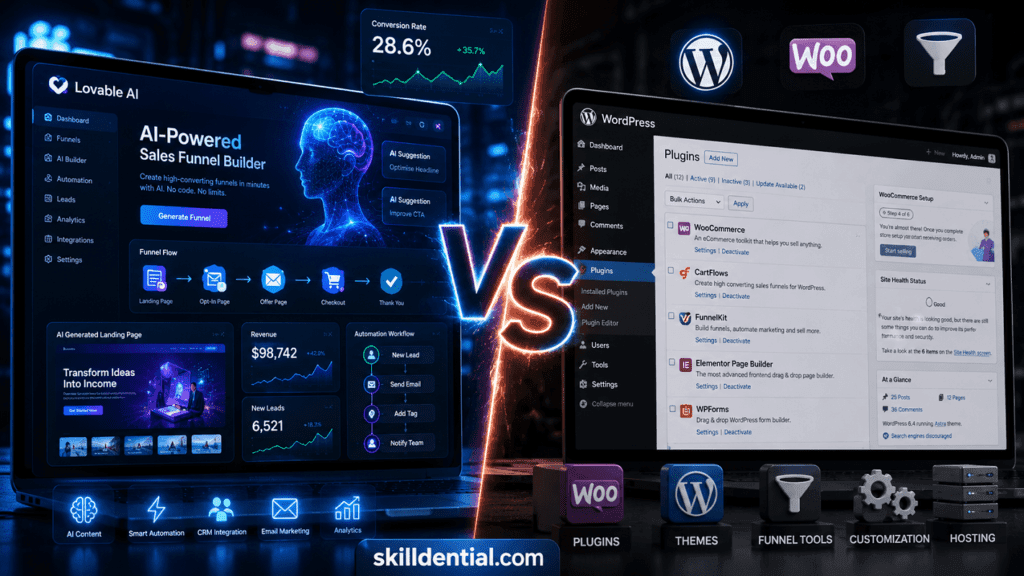
While both platforms support online sales infrastructure, executing a project in Lovable AI minimizes technical debt for fast-moving applications, whereas WordPress requires active maintenance of third-party plugins to preserve funnel integrity.
Execution Framework
Choosing between Lovable AI and WordPress depends on specific scalability needs, technical skill level, and workflow complexity. For teams prioritizing rapid asset generation and AI-assisted deployment, Lovable AI provides a streamlined, high-leverage alternative to traditional CMS development pipelines.
Lovable AI Core Architectural Framework
Unlike legacy visual site builders that rely on monolithic database drag-and-drop mechanics, Lovable AI is an AI-native, full-stack application development platform.
It processes natural language prompts to write production-ready codebases—specifically generating React frontends styled with Tailwind CSS, orchestrated via Vite, and natively integrated with Supabase for backend infrastructure, relational databases, and authentication.
Why Builders Deploy Sales Infrastructure on Lovable AI
For growth engineers and technical marketers, Lovable AI functions as an accelerated deployment environment rather than a basic design canvas. Traditional Content Management Systems introduce immediate technical debt via reliance on a fragile network of third-party plugins for lead capturing, webhooks, and secure user states.
Lovable AI mitigates this by generating clean, unified source code directly linked to GitHub, allowing teams to instantly spin up performant web applications with integrated logic.
High-Leverage Use Cases
The platform streamlines asset generation by replacing manual front-end development and server configuration across major marketing and product architectures:
- AI-Powered Automation Workflows: Provisioning applications capable of interacting directly with custom APIs, external webhooks, and background cloud functions.
- Lead Generation Funnels: Engineering high-converting, multi-step capture forms with dynamic frontend verification rules.
- Checkout Pages: Instantly wiring functional billing components directly to Stripe APIs via chat commands.
- Startup MVPs: Generating data-driven minimum viable products featuring user authentication and full CRUD capabilities.
- Affiliate Marketing Funnels: Deploying highly performant, programmatic landers optimized for load speed and Core Web Vitals.
- Creator Monetization Systems: Constructing gateable content portals and custom membership dashboards without traditional platform overhead.
The Modular Architecture of WordPress Funnels
WordPress functions as an open-source, modular framework for sales funnels. Unlike single-ecosystem software like Lovable AI, WordPress does not possess native conversion or application-logic layers out of the box. Instead, engineers and marketers must intentionally construct a decoupled infrastructure by stacking specialized plugins on top of a core content management system (CMS).
The Monolithic Plugin Dependency Chain
Building high-converting funnels within WordPress requires orchestrating multiple third-party components to handle user sessions, data serialization, and payment routing. A standard programmatic implementation relies on the following layers:
- Core eCommerce Engine: WooCommerce or SureCart establishes the primary transaction handling, product schemas, and secure checkout sessions.
- Funnel Orchestration Layer: Plugins like FunnelKit or CartFlows override default cart behaviors to inject multi-step checkouts, dynamic order bumps, and post-purchase one-click upsells.
- Visual Rendering Layer: Page builders such as Elementor, Divi, or Gutenberg blocks (via Spectra or Blocksy) style the customer-facing interface.
- Data Automation Pipeline: Tools like FunnelKit Automations or Uncanny Automator intercept user behavior tags (e.g., cart abandonment triggers) and route telemetry data to a localized CRM or external email marketing platforms.
While this micro-services approach within a single dashboard provides infinite flexibility, it introduces significant technical debt. In contrast to Lovable AI, where code is unified from a single prompt, a WordPress funnel relies on a complex dependency chain where an update to one plugin can break database calls or styling arrays across another.
Dominant Optimization Contexts
Despite the configuration overhead, the WordPress ecosystem remains the industry benchmark for specific architectural requirements:
- Inbound Search Strategy: The underlying database structure of WordPress, paired with advanced indexing tools like Yoast SEO or Rank Math, offers superior schema manipulation and programmatic content scaling.
- Complex Membership State Management: For enterprises combining heavy digital asset distribution, subscription checkouts, and deeply customized member access rights, WordPress provides unparalleled control over database capabilities.
- Long-Term Asset Ownership: Bypassing proprietary cloud environments allows developers to fully own their hosting runtime, codebases, and customer records without vendor lock-in risks.
How Do AI Funnel Builders Differ From Traditional WordPress Funnels?
The choice between Lovable AI and WordPress represents a fundamental paradigm shift: moving from a decoupled, component-based architecture to an AI-native, code-generation pipeline.
| Architectural Dimension | Lovable AI (AI-Native Engine) | WordPress (Legacy CMS Engine) |
| Code Generation & Architecture | Generates lightweight, clean React code with native Tailwind CSS styling, bypassing visual builder overhead. | Relies on dynamic PHP rendering, heavy database queries, and nested HTML outputs from page builders. |
| Infrastructure & Maintenance | Serverless deployment via native hosting pipelines; zero plugin update cycles or version conflicts. | Monolithic hosting requirements with continuous, manual plugin, theme, and core PHP database maintenance. |
| Logic & Automation Integration | Native API endpoints, webhooks, and AI-driven automation workflows are compiled directly into the app logic. | Requires distinct automation bridges (e.g., Uncanny Automator, webhooks) to link checkout states to CRMs. |
| Performance (Core Web Vitals) | Highly performant static frontends with minimal JavaScript payloads out of the box. | Demands intensive optimization layers (caching, asset minification, CDN edge rules) to combat plugin bloat. |
Technical Overhead vs. Deployment Velocity
Traditional WordPress funnels impose a heavy engineering tax before the first lead can be captured. Developers must provision separate hosting environments, harden security protocols (to prevent SQL injections on vulnerable plugins), and configure optimization tools to reduce time-to-first-byte (TTFB).
Lovable AI eliminates these infrastructure dependencies. Because it builds the application stack deterministically using natural language prompts, it compiles a clean codebase directly. This drastically minimizes technical debt, allowing technical founders to focus entirely on conversion logic rather than database maintenance or plugin compatibility tables.
Real-World Impact: The Skilldential Insight
Data confirms that infrastructure friction is the single greatest bottleneck to launching digital assets. Within our Skilldential career audits, we consistently observed that early-stage tech and eCommerce founders experienced severe friction when troubleshooting plugin conflicts and addressing slow deployment cycles.
By pivoting away from fragile, multi-plugin setups and adopting simplified, automation-first funnel systems like Lovable AI, teams achieved a 41% reduction in initial setup time alongside a significant drop in long-term maintenance overhead. This operational efficiency is precisely why technical creators are shifting toward AI-native environments to build and scale their transactional infrastructure.
Which Platform Builds Sales Funnels Faster?
When accelerating deployment velocity, Lovable AI builds sales funnels substantially faster than WordPress. The execution speed variance stems directly from their underlying architectural methodologies:
- Lovable AI (Declarative Development): Operates via prompt-based generation. A user inputs natural language specifications defining the funnel structure, lead validation rules, Stripe checkout behavior, and Supabase database actions. The platform instantly compiles clean React/Tailwind code and provisions the cloud runtime environment. What takes days in a traditional environment is consolidated into minutes.
- WordPress (Imperative Configuration): Requires serial manual execution. Developers must independently purchase and provision hosting, configure nameservers, install core software, source security certificates, activate themes, patch together multi-plugin dependencies (e.g., WooCommerce + CartFlows + WPForms), and wire external APIs for telemetry routing.
Technical Execution and Lifecycle Trade-Offs
While Lovable AI dominates in speed-to-deployment, WordPress provides deeper lifecycle configuration control for established, enterprise-scale web assets.
[Lovable AI]   ===> Prompt-to-Code Pipeline ===> Deployment Speed Benchmark: Minutes
[WordPress]    ===> Multi-Plugin Stacking   ===> Deployment Speed Benchmark: Hours/Days
Code language: PHP (php)
Advanced System Governance
Custom Functionality
- Lovable AI: Generates application source code which can be customized via additional prompts, refined using its integrated “Visual Edits” mode, or ejected directly to a GitHub repository for manual IDE modification.
- WordPress: Offers unlimited extensibility through its open-source PHP core, native hooks, filters, and access to thousands of pre-built developer modules.
SEO Architecture
- Lovable AI: Supports core technical SEO fundamentals, including editable metadata arrays, semantic HTML generation, and clean, indexable page routing out of the box.
- WordPress: Delivers deep programmatic SEO control. Utilizing native metadata manipulation tools like Rank Math or Yoast SEO, teams can easily manage taxonomy patterns, structure complex schemas, and scale dynamic content generation models across millions of database entries.
Enterprise Scaling
- Lovable AI: Offloads backend scale to a production-ready Supabase/PostgreSQL stack. It easily handles high concurrent traffic volumes without infrastructure degradation, though complex third-party system logic requires explicit prompt structuring.
- WordPress: Requires custom multi-tier server architectures, advanced Redis caching layers, and decoupled edge database routing to sustain enterprise-grade traffic loads without introducing server performance bottlenecks.
For rapid minimum viable product (MVP) launches, agile campaign experimentation, and building automation-first sales infrastructure with zero maintenance overhead, Lovable AI is the optimal choice for immediate technical execution.
For projects deeply reliant on legacy content marketing ecosystems, heavy editorial workflows, or hyper-specific multi-plugin commerce systems, WordPress remains the standard for long-term database control.
Search Visibility Paradigms: Content vs. Applications
The choice between Lovable AI and WordPress for search engine optimization depends heavily on the destination asset architecture: scaling an editorial publishing footprint vs. maximizing discoverability for full-stack transactional tools.
Architectural Deep Dive
To fully understand how each platform manages transaction traffic, it is necessary to audit its underlying technical frameworks. Evaluating how Lovable AI handles server-side execution versus how WordPress queries relational databases reveals the exact trade-offs between deployment velocity, system stability, and code efficiency.
WordPress: The Pillar-and-Silo Content Machine
WordPress remains the industry standard for publishing-led organic acquisition. Its core structure is designed fundamentally for content hierarchy, allowing webmasters to construct advanced topic silos that search engine crawlers rely on to map out domain authority.
- Advanced Internal Linking Architecture: Utilizing relational database structures alongside plugins like Link Whisper or Rank Math, WordPress site owners can execute granular programmatic internal linking strategies. This distributes page equity evenly from high-authority pillar content down to targeted long-tail conversion assets.
- Deterministic Taxonomy Management: WordPress provides native, absolute control over nested category mappings, tags, and specialized custom post types (CPTs). This simplifies the construction of highly crawlable, tiered site architectures—a factor critical for sustained indexation of massive content libraries.
- Granular Schema Optimization: Technical teams can deploy complex structured data configurations (such as Article, FAQ, LocalBusiness, and Product schemas) directly into the page source code, driving rich snippet real estate on Search Engine Result Pages (SERPs).
Lovable AI: The App Engine Built for Multi-Engine Discoverability
Historically, AI application builders struggled with search indexing because they shipped as client-side rendered JavaScript shells. Lovable AI completely bypassed this limitation by overhauling its core architecture to leverage TanStack Start with full Server-Side Rendering (SSR).
- Native SSR and Pre-rendering: Every new application deployed via Lovable AI ships with full server-side rendering out of the box. Pages are rendered as semantic, complete HTML files on the server before hitting the client browser. This means Google, ChatGPT, Claude, and Perplexity crawlers can instantly parse and index the content.
- Built-In Search Intelligence & AI-Optimization (AEO): Rather than requiring a disconnected suite of marketing tools, Lovable AI features native Semrush-powered SEO research and Google Search Console integrations directly in the development workspace. Users can audit performance, discover keyword intent, and instruct the AI to generate structured markdown outputs, canonical tags, and Open Graph arrays automatically.
- Answering the Shifting Search Intent: While WordPress excels at ranking informational blog posts on legacy search engines, Lovable AI builds structural tools and interactive apps optimized to surface inside generative AI answers (Answer Engine Optimization or AEO), capturing highly qualified intent at the product layer.
Technical Strategy Matrix
| Optimization Requirement | Lovable AI (App Stack) | WordPress (CMS Stack) |
| Primary SEO Target | Conversions, Tools, Dynamic Landing Pages, AEO. | Massive Editorial Hubs, Programmatic Blogs, High Volume Keywords. |
| Rendering Methodology | Edge-based Server-Side Rendering (SSR via TanStack Start). | Server-side PHP rendering requires aggressive caching layer optimization. |
| SEO Asset Auditing | Direct prompt-driven code updates powered by native Semrush APIs. | Manual configuration via isolated plugins (Rank Math / Yoast). |
| Crawl-Path Efficiency | Lean, semantic HTML codebases with near-perfect initial load performance. | Vulnerable to structural code bloat, requiring active script deferrals. |
Strategic Recommendation
If your primary growth engine is programmatic publishing, extensive long-form content marketing, or deep informational keyword dominance, WordPress provides the mature, data-tested indexing infrastructure required to sustain an editorial footprint.
However, if your customer acquisition strategy hinges on deploying high-converting transactional landers, interactive pricing calculators, or minimum viable products designed to be discovered natively by both search engines and AI agents, Lovable AI delivers a modern, high-leverage development-to-index pipeline.
Which Platform Is Better for Automation and Integrations?
Connecting your checkout endpoints to downstream marketing tools requires either a unified, API-first architecture or a coupled network of webhooks. Examining how Lovable AI executes automated functions directly within its application code versus how WordPress handles event listeners across multiple plugins reveals the exact trade-offs in data integrity and maintenance overhead.
Architectural Automation Comparison
Evaluating how data flows through Lovable AI versus WordPress highlights the structural differences between an API-first ecosystem and a modular CMS stack. This architectural comparison breaks down how event triggers, state management, and API connections perform under active transaction traffic.
Lovable AI: The API-First, Unified Automation Architecture
Lovable AI approaches automation from an engineering perspective, building integrations directly into the application’s native code stack. Because it provisions a clean React frontend hooked to a Supabase PostgreSQL backend, data flows without the friction of middleware layers.
- Native Gateway-Based Connectors: Lovable AI features a dedicated integrations hub with native app connectors for platforms like Stripe, HubSpot, Shopify, Resend, and Slack. The platform securely manages OAuth tokens, automatic credential rotation, and serverless Edge Functions behind the scenes, eliminating the need to write manual authentication logic.
- Direct Database State Management: When a lead converts on a funnel built with Lovable AI, the user state, payment record, and authentication variables are handled concurrently within a single database transaction, minimizing data drops.
- Frictionless External Connectivity: Connecting to advanced workflow engines like Make, Zapier, or self-hosted n8n instances requires no specialized plugins. The AI directly writes the payload schemas and authentication headers required to securely send data to your CRM, email service provider (ESP), or custom AI agents.
WordPress: The Plugin-Dependent Middleware Stack
WordPress can orchestrate complex automation sequences, but it does so by stacking independent software layers on top of a core PHP database.
- Event-Driven Hook Listeners: To pass a transaction from a checkout page to an external CRM, WordPress relies on an internal hook ecosystem. If a third-party billing plugin updates and changes its hook array, the data pipeline can instantly break.
- Heavy Multi-Plugin Reliance: Building a comprehensive automation sequence requires dedicating server resources to background automation plugins (e.g., Uncanny Automator, WP Webhooks). This increases server load and introduces potential security vulnerabilities.
- Data Serialization Bottlenecks: Passing high volumes of concurrent webhook requests through WordPress requires robust server resources to prevent PHP memory exhaustion errors and database locking during high-traffic sales events.
Technical Integration Matrix
| Integration Dimension | Lovable AI (API-First Stack) | WordPress (Plugin Ecosystem) |
| Pipeline Architecture | Native API endpoints, gateway connectors, and compiled serverless functions. | Third-party plugin hooks and middleware automation wrappers. |
| Data Integrity & Sync | Direct database state sync (PostgreSQL) with zero plugin dependencies. | Relies on external plugin compatibility to sync checkout tables to CRMs. |
| AI Agent Interoperability | Native JSON parsing and REST API generation for deep AI agent alignment. | Requires custom PHP code adjustments or specialized plugins to handle AI data schemas. |
| Maintenance Profile | Zero update cycles; compiled application logic remains stable permanently. | Continuous tracking of plugin updates to ensure webhook routes do not break. |
Operational Efficiency Verdict
For teams prioritizing modern, fast-moving growth stacks—where leads must instantly route through AI-driven lead scoring systems, custom database tables, and automated multi-channel messaging flows—Lovable AI offers a highly secure, low-maintenance development pipeline.
WordPress remains viable if your organization has already committed to a legacy, self-hosted data infrastructure and has dedicated engineering resources to monitor, patch, and maintain the plugin-to-server dependency chain.
How Do Costs Compare Between Lovable AI and WordPress?
Evaluating the true financial footprint of Lovable AI versus WordPress requires analyzing both direct licensing fees and hidden maintenance liabilities. While one platform charges a predictable software-as-a-service (SaaS) fee, the other introduces variable infrastructure, engineering, and security expenses.
Architectural Cost Breakdown
To determine the true financial footprint of your marketing infrastructure, it is critical to look beyond the initial price tag. Breaking down the cost architecture of Lovable AI versus WordPress exposes the financial trade-offs between a consolidated, all-inclusive subscription model and a decoupled, multi-vendor plugin stack.
Lovable AI: Consolidated SaaS Predictability
Lovable AI operates on a tiered subscription pricing model that unifies hosting, frontend generation, database infrastructure, and integration pipelines into a single monthly line item.
- Infrastructure Consolidation: Because Lovable AI packages edge hosting, automated SSL certificates, deployment pipelines, and database state management (via its integrated Supabase layer) into its base subscription, it eliminates individual infrastructure vendor fees.
- Reduction in Engineering Overhead: The prompt-driven nature of the platform drastically minimizes billable developer hours for landing page variations, new checkout forms, and API webhooks.
- Predictable Scaling Path: As traffic scaling and data usage grow, costs scale linearly based on platform tiers. However, large enterprise operations with millions of monthly API calls must monitor usage metrics to prevent overage charges.
WordPress: The Variable Cost of Fragmented Infrastructure
While the core WordPress software is open-source and free, deploying a production-ready, high-converting sales funnel introduces a continuous stack of premium licensing fees.
- The Premium Plugin Tax: A functional, secure WordPress sales funnel requires multiple ongoing annual subscriptions:
- Managed WordPress Hosting: (e.g., Kinsta, WP Engine) to ensure fast TTFB under heavy transaction loads.
- Funnel Builders & Checkout Optimizers: (e.g., CartFlows Pro, FunnelKit).
- Form Engines & CRM Bridges: (e.g., WPForms, Uncanny Automator).
- Security & Optimization: (e.g., MalCare, WP Rocket, Sucuri).
- Technical Debt and Maintenance Costs: WordPress funnels demand active human monitoring. Resolving sudden plugin incompatibilities, database optimization issues, or security patches often requires dedicated technical teams or external developer support, driving up the total cost of ownership (TCO).
- The Scale Advantage: For high-volume businesses with internal technical expertise, WordPress becomes highly cost-efficient at massive scale. Once the infrastructure is optimized, processing millions of transactions incurs no additional licensing fees, unlike a SaaS model that charges based on usage metrics.
Total Cost of Ownership (TCO) Matrix
| Financial Metric | Lovable AI (Consolidated Stack) | WordPress (Decoupled Stack) |
| Initial Setup Cost | Low (Predictable platform subscription). | Moderate (Hosting + premium plugin licenses). |
| Maintenance & Security | $0 (Handled entirely at the platform level). | Variable (Requires active patches, backups, and security tools). |
| Engineering Dependency | Minimal (Prompt-driven code generation). | High (Requires ongoing technical management and troubleshooting). |
| Long-Term Scaling Cost | Scales predictably based on platform usage tiers. | Flat software costs, but server infrastructure costs scale with traffic. |
For agile founders, lean teams, and technical marketers prioritizing rapid execution, Lovable AI delivers the lowest total cost of ownership by eliminating third-party plugin bills and reducing engineering overhead.
WordPress remains the financially optimal choice for enterprise-scale businesses with existing internal tech teams that can absorb maintenance labor and leverage a large, self-hosted publishing ecosystem without platform-specific usage constraints.
Which Platform Is Better for Beginners?
The optimal environment for a beginner depends entirely on whether they prioritize overcoming technical infrastructure hurdles or leveraging a mature global documentation ecosystem.
Architectural Usability Friction Points
A platform’s ease of use is defined by how effectively it eliminates engineering barriers for the end user. Examining the structural design mechanics of Lovable AI versus WordPress reveals the specific operational friction points beginners encounter, tracking the difference between prompt-driven workspace abstraction and manual server-and-plugin management.
Lovable AI: Abstraction of the Technical Stack
Lovable AI lowers the barrier to entry by removing infrastructure configuration from the deployment lifecycle. Beginners are completely insulated from legacy server management through two core operational modes:
- Vibe Coding & Agent Mode: Users construct full-stack funnel applications using natural language chat commands rather than parsing code arrays. The platform automatically handles complex backend orchestration, spinning up database tables and managing user authentication schemas inside an integrated Supabase layer without manual developer intervention.
- Visual Edits Sub-System: To adjust spacing, modify typography, or change interface layouts, users can click directly on elements using a visual interface similar to design tools like Figma. This updates the underlying production React/Tailwind code automatically, saving precious AI prompt credits on simple styling tweaks.
Because hosting pipelines, SSL provisioning, and API handshakes are fully managed by the platform, beginners bypass common errors like broken server dependencies or incorrect nameserver mappings.
WordPress: The Modular Configuration Tax
WordPress offers unmatched creative control, but it requires a foundational understanding of web systems architecture before a single funnel can go live. Beginners frequently experience significant cognitive load when addressing structural prerequisites:
- The Dependency Matrix: To launch a high-converting funnel, a user must independently source, configure, and maintain managed hosting environments, SSL parameters, and premium plug-in ecosystems (such as Elementor, WooCommerce, and CartFlows).
- Technical Overhead: Non-technical operators often encounter critical friction points, including database optimization issues, slow initial page response times, and broken styling layouts caused by plugin version conflicts.
- Security & System Maintenance: WordPress site owners bear full responsibility for hardening file directories, monitoring for malicious injections, and handling core database updates.
While the administrative setup is dense, WordPress balances this with an enormous global community, offering comprehensive troubleshooting documentation, video tutorials, and dedicated forums for almost every conceivable configuration error.
Beginner Resource Matrix
| Usability Metric | Lovable AI (AI-Native Engine) | WordPress (Legacy CMS) |
| Initial Learning Curve | Short (Natural language prompt interface). | Steep (Multi-step server and plugin configuration). |
| Design Control Method | Prompt instructions or click-to-edit visual controls. | Theme controls, block systems, and visual page builders. |
| Maintenance Profile | Fully abstracted, the platform manages system health. | Intensive; the user manages updates, security, and optimization. |
| Community Support | Rapidly growing; heavily reliant on platform documentation. | Massive; millions of community guides, tutorials, and developers. |
Operational Verdict
For beginners who want to validate ideas quickly, test landing page conversions, and deploy automation-first sales infrastructure without dealing with technical setup or site maintenance, Lovable AI provides the fastest, lowest-friction path to launch.
WordPress remains the appropriate starting point for non-technical users who are focused on building broad digital publishing skills, require an open-source framework with deep community support, and plan to scale a long-term content-led marketing asset.
Lovable AI vs WordPress Comparison: Infrastructure and Capability Evaluation Matrix
| Feature / Dimension | Lovable AI (AI-Native Engine) | WordPress (Legacy CMS) |
| Setup Speed | Very Fast: Prompt-based code compilation and deployment in minutes. | Moderate: Manual server configuration, software provisioning, and database installation. |
| Technical Complexity | Low: Abstracted via conversational AI chat interface and simple visual selectors. | Medium: Requires system configuration, file management, and plugin handling. |
| Hosting Infrastructure | Integrated: Native cloud runtime included in the SaaS ecosystem out of the box. | Separate: Third-party managed hosting (e.g., Kinsta, WP Engine) required for production. |
| Plugin Dependency | Minimal: Consolidates application states, frontend UI, and database schemas natively. | High: Dependent on third-party plugin networks for conversion and transaction functionality. |
| Funnel Deployment | Rapid: Instant UI generation and structural routing directly through prompts. | Flexible: Requires custom layout building, cart behavior overrides, and manual page linking. |
| SEO & Blogging | Limited: Optimized for tool/app visibility; lacks extensive multi-author publishing tools. | Excellent: Dynamic taxonomy control, programmatic schema mapping, and deep indexing engines. |
| Automation Pipeline | API-First: Built-in gateway connectors and serverless edge functions written directly into code. | Plugin-Based: Dependent on middleware webhooks or event-listening automation layers. |
| Maintenance Profile | Low: Platform handles system patches, zero security vulnerabilities, or updating dependencies. | Medium to High: Regular version verification, database pruning, and plugin conflict resolution required. |
| Customization Depth | Moderate: Extensible via natural language or code extraction (exportable to GitHub repositories). | Extensive: Full open-source core control with infinite hook modification and custom PHP access. |
| Scalability Track | Growing: Fast serverless scaling using a managed Supabase/PostgreSQL backend framework. | Mature: Proven enterprise scalability, provided high-volume caching, and custom server clusters are used. |
| Content Publishing | Limited: Built to serve static text, landing pages, and interactive interface components. | Advanced: Built fundamentally for complex editorial structures and deep information hubs. |
| Learning Curve | Lower: Relies on clear natural language logic and quick visual point-and-click adjustments. | Moderate: Requires understanding layout hierarchies, plugin compatibility tables, and DNS rules. |
Which Businesses Should Use Lovable AI?
Selecting Lovable AI as your core conversion engine is highly advantageous for specific business models that prioritize development velocity, clean code execution, and automation-first system architectures.
High-Leverage Business Profiles
Deploying the correct digital infrastructure requires mapping platform capabilities directly to your primary monetization model. Examining the core operations of agile startups, performance-driven marketers, and transaction-focused creators isolates the specific business models that extract maximum leverage from the AI-native architecture of Lovable AI.
Startup MVPs & Solo Founders
For technical and solo entrepreneurs, minimizing time-to-market is critical. Lovable AI functions as an accelerated engineering team, allowing founders to translate product concepts directly into functional, full-stack MVPs.
- The Architectural Edge: Because the platform compiles clean React code integrated with a real Supabase/PostgreSQL database backend, founders can build authentic application logic—including user authentication, secure payment handling via Stripe, and database CRUD operations—without accumulating massive amounts of early-stage technical debt.
Performance & Affiliate Marketers
In paid traffic and performance media buying, execution speed and page performance directly dictate campaign profitability.
- The Architectural Edge: Lovable AI generates highly optimized, server-side rendered (SSR) static pages that minimize server response times and capture strong Core Web Vitals out of the box. Marketers can rapidly deploy, split-test, and iterate landing pages through prompt commands without dealing with the code bloat or heavy caching layers common in legacy page builders.
Lead Generation Businesses
Companies focused on capturing, scoring, and distributing high-intent B2B or B2C leads require secure, rapid data routing.
- The Architectural Edge: Instead of relying on a fragile chain of form plugins and middleware connectors, Lovable AI builds native API hooks and automated webhooks straight into the funnel logic. This ensures that user data is validated on the client side and instantly pushed to downstream CRMs or sales pipelines without data drops.
Creators, Coaches, & Digital Product Sellers
Infopreneurs and creators require a reliable transactional infrastructure that operates with minimal ongoing technical management.
- The Architectural Edge: Lovable AI allows these businesses to launch gated membership portals, custom booking tools, and automated checkout pages with zero ongoing plugin updates, theme maintenance, or security vulnerabilities to monitor.
Core Business Drivers for Adoption
Organizations that benefit most from an AI-native workspace generally share specific operational priorities:
- Velocity Over Custom Systems: The business requires asset deployment in minutes or hours rather than days or weeks of manual engineering.
- Automation-First Operations: The core value proposition of the funnel relies on seamless data handshakes between user actions and external cloud APIs.
- Rapid Campaign Experimentation: The team needs to continuously launch and test variations of landing pages and offer configurations to optimize ad spend.
- Lean Resource Allocation: The business prefers to eliminate recurring web developer retainers and continuous infrastructure upkeep, reallocating those resources directly to growth and acquisition.
Which Businesses Should Use WordPress?
Selecting WordPress as your primary conversion and content hub is the optimal strategic decision for organizations whose primary customer acquisition strategy relies on deep organic search visibility, complex relational database modeling, and extensive long-term asset ownership.
High-Leverage Business Profiles
Selecting an open-source content stack requires matching your long-term operational needs with the platform’s core architectural strengths. Examining the structural requirements of enterprise-level publishing houses, high-volume digital schools, and large-scale eCommerce brands clarifies the specific corporate profiles that gain maximum strategic leverage from a mature WordPress ecosystem.
Large-Scale eCommerce Brands
For brands managing complex product catalogs, multi-tiered discount structures, and heavy transactional volume, WordPress paired with WooCommerce or SureCart provides a highly scalable, open-source commerce solution.
- The Architectural Edge: Unlike rigid SaaS environments, WordPress allows enterprise brands to fully customize checkout hooks, optimize database storage pipelines, and integrate directly with legacy ERP or inventory management software via custom PHP development, avoiding per-transaction platform fees.
SEO-Focused Publishing Houses & Digital Media Assets
Organizations that treat content as their primary product require a system explicitly designed for high-volume indexing and taxonomic precision.
- The Architectural Edge: WordPress handles tens of thousands of articles effortlessly through its native relational database setup. Using advanced SEO engines like Rank Math or Yoast SEO, publishers can deploy granular schema patterns, automated internal linking matrices, and custom XML sitemaps to secure long-term organic keyword dominance across search engines.
Enterprise Membership Platforms & Educational Institutions
Businesses running complex digital academies, tiered subscription access, or community forums require robust, granular user state management.
- The Architectural Edge: Utilizing plugins like MemberPress, LearnDash, or BuddyBoss, teams can build deeply nested access rules and track student completion states. This framework allows developers to access the underlying MySQL database directly, ensuring that user access control can scale to hundreds of thousands of concurrent members without platform limitations.
Corporations Driven by Long-Term Content Marketing
B2B enterprises and service agencies that build authority through extensive content marketing, multi-author blogging, whitepaper hubs, and complex resource libraries depend on mature editorial workflows.
- The Architectural Edge: The WordPress block editor (Gutenberg) combined with precise user role management (Editors, Authors, Contributors) provides a secure, streamlined workspace for large editorial teams to safely draft, review, and schedule mass content operations without risking the core application’s stability.
Core Business Drivers for Adoption
Organizations that continue to extract the highest leverage from a traditional WordPress stack typically share specific operational characteristics:
- Inbound Search Reliance: Organic search and programmatic content publishing serve as the primary top-of-funnel customer acquisition channels.
- Dedicated Engineering Capacity: The business maintains internal developers or an agency retainer to handle routine server management, core software testing, and plugin updates.
- Requirement for Total Data Control: The organization rejects third-party SaaS vendor lock-in, requiring absolute ownership over the codebase, database server, and customer telemetry records.
- Deep Legacy Integrations: The conversion funnel must natively communicate with specialized, pre-existing local database tools or highly industry-specific software extensions.
What is Lovable AI used for?
Lovable AI is an AI-native, full-stack application builder used to generate websites, landing pages, transaction funnels, and interactive web applications from natural language prompts.
Operating on a “vibe coding” paradigm, it compiles clean React and TypeScript frontends, automatically provisions Supabase/PostgreSQL backends, handles user authentication (via Clerk or Supabase), and integrates Stripe billing components.
It is primarily used by technical founders, solo entrepreneurs, and growth teams to launch minimum viable products (MVPs) and highly automated conversion systems without traditional developer bottlenecks.
Can Lovable AI replace WordPress?
Lovable AI can directly replace WordPress for businesses centered on standalone transactional funnels, custom web applications, SaaS prototypes, and lightweight, tool-based lead generation systems where rapid deployment and zero infrastructure maintenance are essential.
However, it cannot replace WordPress for massive editorial operations, programmatic SEO publishing networks, or organizations requiring deep, open-source control over legacy database arrays and complex, multi-author content workflows.
Is WordPress better for SEO than AI website builders?
WordPress remains the superior choice for content-led, organic inbound SEO strategies because of its flexible relational database, exact taxonomy controls, and comprehensive schema automation engines (like Rank Math).
However, modern AI engines like Lovable AI have minimized the historical search penalty of AI platforms by shifting to full server-side rendering (SSR) via TanStack Start.
This allows search crawlers to instantly index clean HTML, and Lovable AI connects natively to Semrush and Google Search Console workspaces to streamline AI-driven search alignment directly inside the deployment cycle.
Are AI funnel builders easier for beginners?
AI funnel builders like Lovable AI are significantly easier for beginners because they fully abstract the technical infrastructure layer. Beginners can use Chat Mode to describe application logic or use a visual point-and-click interface (Visual Edits) to tweak UI styling without writing code.
This eliminates common beginner roadblocks associated with WordPress development, such as configuring managed hosting servers, managing nameservers, monitoring security vulnerabilities, and resolving unexpected plugin dependency conflicts.
Which platform is cheaper for sales funnels?
For agile operations and early-stage validations, Lovable AI offers a more predictable and cost-effective total cost of ownership (TCO) by packaging edge hosting, full-stack development, and database systems into a single SaaS subscription.
WordPress appears less expensive initially due to its open-source core, but a high-converting production funnel incurs immediate variable expenses, including premium hosting tiers, checkout managers (e.g., CartFlows), form tools, and automation middleware.
At enterprise scale, however, WordPress becomes highly cost-efficient because it incurs flat infrastructure fees, whereas SaaS options scale expenses based on platform-specific usage tiers and API quotas.
In Conclusion
Choosing between Lovable AI and WordPress is a foundational decision regarding your technical stack, determining whether your marketing infrastructure functions as an agile application engine or an enterprise content management system.
Technical Stack Core Focus
Choosing between an AI-native code engine and an open-source content management system dictates how your platform handles execution, scales its database, and organizes asset rendering. Breaking down the core tech stacks of Lovable AI and WordPress reveals the fundamental engineering differences between serverless application execution and monolithic page rendering under production conditions.
Lovable AI (AI-Native Optimization)
- High-leverage, prompt-driven code compilation (React, Tailwind CSS, Supabase).
- API-first, server-side rendered (SSR) architecture optimized for instant conversion deployment.
- Designed for growth teams prioritizing development velocity, programmatic workflow automation, and zero server maintenance overhead.
WordPress (Legacy CMS Optimization)
- Open-source, database-driven content publishing core with infinite modular customization.
- Industry standard for long-form editorial scale, taxonomy-driven internal linking, and deep programmatic SEO.
- Designed for organizations prioritizing absolute asset ownership and long-term search engine visibility, backed by dedicated technical resources.
Technical Execution Summary
| Business Objective | Recommended Technical Framework | Operational Action Plan |
| Rapid Market Validation & MVPs | Lovable AI | Prompt the full-stack layout, wire native Stripe modules, and deploy live to the edge in minutes. |
| Deep Content Marketing & Publishing | WordPress | Provision managed hosting, install Rank Math SEO, and build out structural topic authority silos. |
| High-Volume API Workflow Automation | Lovable AI | Leverage native database transactions and serverless edge functions to route data with zero plugin friction. |
| Enterprise E-commerce Catalogs | WordPress | Deploy WooCommerce or SureCart to gain complete structural and layout control over the relational database. |
High-Leverage Strategic Recommendation
To maximize operational leverage, teams should deploy the framework that directly matches their immediate primary growth channel rather than chasing theoretical technical perfection.
If your customer acquisition engine relies heavily on programmatic publishing and extensive organic content marketing, build your foundation on the mature, database-driven infrastructure of WordPress.
However, if your business goals demand rapid deployment speed, highly automated data routing, and launching custom transactional applications without accumulating infrastructure debt, Lovable AI provides the optimal framework to build once and scale indefinitely.