How AppDeploy AI Turns ChatGPT into an App Builder
AppDeploy AI serves as the definitive bridge between conceptual AI-generated code and live, production-ready software. By integrating directly with LLMs like ChatGPT, the platform abstracts away traditional DevOps complexity, enabling users to transform natural language prompts into functional, hosted applications instantly.
For creators and founders, AppDeploy AI eliminates the “infrastructure tax” that typically stalls project launches. It automates the provisioning of backends, databases, and hosting environments, allowing you to bypass manual configuration and focus entirely on product logic. By treating the chat interface as your primary development environment, the platform reduces the friction of rapid prototyping from days to minutes.
Key Strategic Advantages
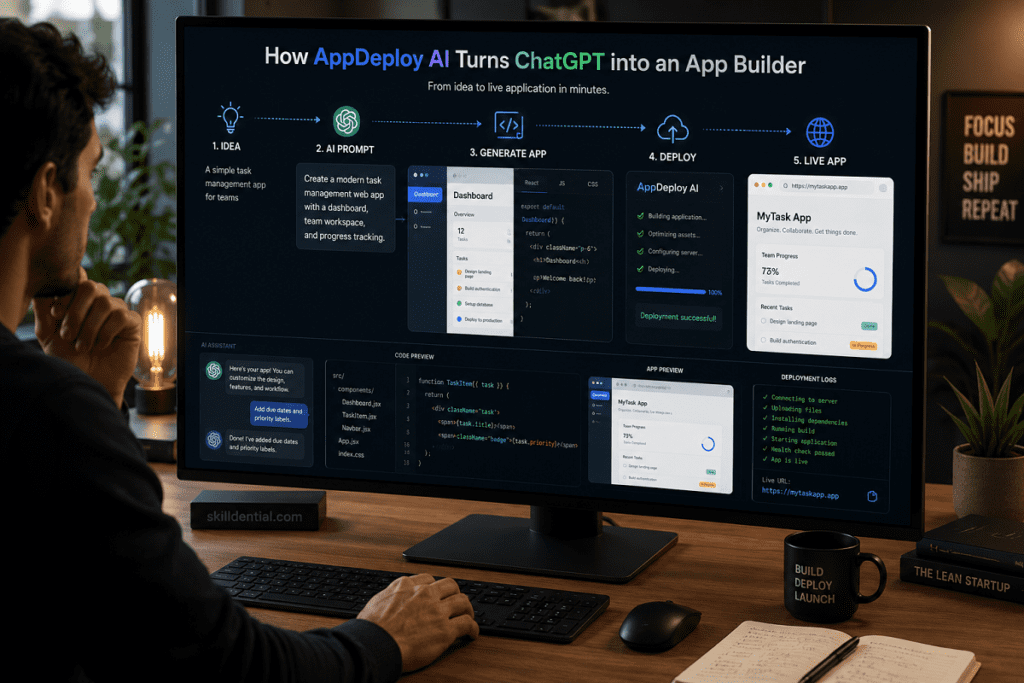
- Seamless Translation: AppDeploy AI interprets high-level requirements and maps them to robust backend architecture.
- Continuous Deployment: Updates are pushed to live environments in real-time, facilitating a high-velocity feedback loop.
- Scalable Experimentation: Whether building an MVP or testing a complex feature, the platform allows for instant deployment and iteration based on project complexity.
While your output quality remains tethered to the precision of your prompting, AppDeploy AI provides the high-leverage engine required to convert abstract intent into tangible, scalable software assets.
How AppDeploy AI Turns ChatGPT into an App Builder
Artificial intelligence is rapidly shifting from a passive writing assistant to an active execution layer for digital product creation. For creators, founders, and developers, the primary bottleneck has migrated from conceptualization—dreaming up the idea—to realization—the technical hurdle of turning those ideas into functional, live software.
AppDeploy AI disrupts this cycle by acting as the critical middleware that bridges the gap between raw LLM output and production-ready applications. By integrating directly into your preferred chat interface, it effectively transforms ChatGPT from a text-based conversational tool into a comprehensive, high-velocity app builder.
The Technical Shift: From Chat to Production
Traditionally, building an application requires a fragmented stack of tools: IDEs, Git repositories, CI/CD pipelines, database providers, and hosting dashboards. AppDeploy AI eliminates this complexity by providing a “chat-native” deployment layer.
Instead of copying and pasting code blocks or configuring servers, you describe your product requirements in plain language. Your AI assistant (such as ChatGPT) generates the necessary code, while AppDeploy AI intercepts the output to provision the entire runtime infrastructure automatically. This includes:
- Managed Hosting & Global Delivery: Your application is instantly assigned a live, shareable URL with HTTPS and global scalability.
- Full-Stack Backend Services: The platform automatically configures essential backend components—such as databases, authentication, real-time data synchronization, and file storage—without requiring manual setup.
- Autonomous Quality Assurance (QA): AppDeploy AI runs independent, black-box testing against your live app, feeding visual bug reports, runtime logs, and error snapshots directly back into your chat window for immediate refinement.
Why This Matters for Builders
By abstracting the infrastructure layer, AppDeploy AI allows non-developers to maintain total focus on product logic and user experience. The feedback loop is drastically compressed: you propose a feature, the AI writes the code, AppDeploy AI deploys it, and you test the live result—all without ever leaving the conversation.
Whether you are a freelancer prototyping a new tool or a founder validating an MVP, this “Prompt → Code → Live URL” workflow shifts the paradigm of software development. It enables high-leverage experimentation, where the cost of building is no longer tied to technical expertise, but rather to the clarity and precision of your intent.
What is AppDeploy AI?
AppDeploy AI is a “chat-native” deployment middleware that functions as the final link in the AI-assisted development chain. While LLMs (like ChatGPT or Claude) generate the code for an application, AppDeploy AI acts as the execution layer that transforms that raw code into a functional, live-hosted web application without requiring the user to leave the chat interface.
How It Works
Instead of requiring a developer to set up Git repositories, CI/CD pipelines, or cloud hosting dashboards, AppDeploy AI integrates directly with AI agents via protocols like the Model Context Protocol (MCP).
When you instruct an AI assistant to build an app, the process functions as follows:
- Code Generation: The LLM generates the application logic using the specific SDK and deployment guidelines provided by AppDeploy.
- Infrastructure Provisioning: AppDeploy AI intercepts this output to automatically provision necessary backend services, including databases, file storage, authentication, and API layers.
- Live Deployment: The platform publishes the application to a live, production-ready URL with global hosting and HTTPS enabled.
- Autonomous QA: An internal testing agent automatically performs end-to-end black-box testing on the deployed application, feeding visual bug reports, runtime errors, and logs back into the chat window so the AI can perform iterative fixes.
Why This Matters
For builders, founders, and non-technical creators, AppDeploy AI removes the “infrastructure tax”—the manual effort traditionally required to manage the environment where software lives. By abstracting away the CLI, IDE, and deployment configuration, it shifts the development focus entirely to product definition and logic refinement.
- No Git or CLI Required: The entire lifecycle occurs within the conversational interface.
- Full-Stack Capability: It supports authentication, real-time data synchronization, and background tasks out of the box.
- Iterative Velocity: Because the platform versions every deployment, users can instantly roll back to previous states or rapidly test new features, compressing the “idea-to-live-product” timeline from days to minutes.
In short, AppDeploy AI turns your AI chat interface into a comprehensive, high-leverage app builder, allowing you to move from natural language requirements to a shareable, functional product in a single, continuous workflow.
How does AppDeploy AI work with ChatGPT?
AppDeploy AI functions as a seamless, chat-native middleware that bridges the gap between AI-generated code and production-ready software. It transforms the AI chat interface (like ChatGPT) into a comprehensive “all-in-one” development and deployment environment.
The Mechanism: How it Complements ChatGPT
Rather than replacing your AI assistant, AppDeploy AI acts as the execution and verification layer. It leverages the Model Context Protocol (MCP) to plug directly into ChatGPT, allowing the AI to “hand off” code to AppDeploy for real-time infrastructure provisioning.
| Stage | ChatGPT Role (Ideation & Logic) | AppDeploy AI Role (Execution & Hosting) |
| Development | Translates natural language requirements into functional application code. | Provides the SDK, deployment guidelines, and runtime templates. |
| Deployment | N/A (Limited to text/code output). | Automates hosting, HTTPS, and global delivery for a live URL. |
| Backend | N/A | Provisions databases, authentication, storage, and real-time sync. |
| Validation | Debugs logic based on human feedback. | Runs autonomous QA, visual tests, and provides error logs. |
| Iteration | Refines code based on test results. | Versions every deploy and enables instant rollbacks. |
The “Prompt-to-Product” Workflow
When you interact with ChatGPT to build an app, the process is streamlined into a single, continuous loop:
- Context Injection: AppDeploy provides the AI with the necessary technical constraints (e.g., how to handle databases or authentication) so the code generated is “deployment-ready” from the start.
- Autonomous Provisioning: As you approve the code in the chat, AppDeploy AI intercepts the output to build the environment, meaning you never touch a CLI, IDE, or hosting dashboard.
- Black-Box Testing: Once live, an internal QA agent within AppDeploy AI tests the application, captures visual bugs, and feeds those findings back into the chat.
- Instant Refinement: You provide feedback in the chat, the AI updates the code, and AppDeploy AI redeploys, maintaining a full version history so you can roll back at any time.
Why This Workflow Matters
For most creators, the primary friction point is the “Last Mile”—moving from a working prototype in a chat window to a URL that actual users can visit. AppDeploy AI removes the infrastructure tax by handling hosting, scaling, and maintenance automatically. This allows you to focus entirely on product logic while the platform manages the complexity of the deployment pipeline in the background.
Why does AppDeploy AI matter for beginners and non-technical builders?
For beginners and non-technical builders, the primary barrier to digital creation is the “Infrastructure Tax.” While Large Language Models (LLMs) like ChatGPT have democratized code generation, they stop at text production. They do not handle the complex, often invisible requirements of turning that text into a live, stable product.
AppDeploy AI matters because it bridges the “execution gap”—the void between a functioning prototype on a screen and a live application accessible to users.
The Execution Gap
Aspiring builders often encounter the “localhost trap”: an application runs perfectly in a controlled, local environment but fails or is impossible to deploy in the real world. Beginners lack the specialized knowledge to navigate the “production reality,” which requires:
- DevOps Complexity: Manually setting up Git repositories, CI/CD pipelines, and cloud hosting dashboards.
- Backend & Security: Configuring databases, authentication, secrets management, and SSL/TLS certificates—all of which are prone to misconfiguration by non-experts.
- Reliability & Scalability: AI-generated code often ignores real-world constraints like concurrent user traffic, database latency, or container ephemerality.
How AppDeploy AI Bridges the Gap
AppDeploy AI removes this friction by automating the transition from intent to production-ready software. By integrating via the Model Context Protocol (MCP) or direct API connections, it handles the “heavy lifting” automatically:
- Zero-Config Deployment: It transforms natural language instructions directly into a live, shareable URL. You do not need to manage servers, Docker containers, or deployment pipelines.
- Infrastructure Defaults: It automatically provisions managed databases, file storage, and secure authentication, ensuring the app is production-ready from the start.
- Autonomous Quality Assurance (QA): It doesn’t just host the code; it acts as an operational partner. An internal QA agent monitors the live application, capturing visual bugs, runtime errors, and logs, and feeds them back into the chat for the AI to fix in real-time.
Why This Drives Success
Research from Skilldential career audits confirms that removing the burden of manual deployment is a force multiplier for learners. When the barrier to “shipping” is removed, the focus shifts entirely from technical configuration to product logic.
This shift results in a 41% increase in project completion confidence among beginner learners. By automating the “Last Mile” of software development, AppDeploy AI allows non-technical creators to move from theory to a validated, working product—enabling high-leverage experimentation that was previously reserved for those with years of engineering experience.
Can ChatGPT really build apps?
The short answer is no: ChatGPT cannot build and deploy a production-ready application by itself.
While it is an unparalleled tool for ideation, architecture planning, and code generation, it lacks the “execution layer” required to turn that code into a functional, live-hosted product. Understanding this distinction is vital for moving from a curious learner to an effective digital builder.
What ChatGPT Can Do (The Ideation & Logic Engine)
Think of ChatGPT as an expert architectural consultant and master programmer who works exclusively in a text-based environment. It can:
- Generate Code: Write frontend logic (React, HTML/CSS), backend APIs (Node.js, Python), and database schemas.
- Architect Solutions: Suggest the best tech stacks, security practices, and system designs.
- Debug & Refactor: Analyze code errors and suggest optimizations.
- Draft Documentation: Write the “how-to” for your app and help you refine your prompt strategy.
What ChatGPT Cannot Do (The Execution Gap)
ChatGPT has no native “environment” to host or run the code it produces. Specifically, it cannot:
- Provision Infrastructure: It cannot set up servers, databases, or cloud environments (AWS/Vercel/Azure).
- Handle CI/CD: It cannot manage deployment pipelines, handle SSL/TLS certificate configuration, or perform real-time monitoring.
- Compile or Host: It cannot turn a text block into a live URL accessible to the public.
- Autonomous QA: It cannot “see” the app in a browser to identify visual bugs or runtime crashes during live interaction.
The Role of Middleware
To bridge this gap, you need an execution layer like AppDeploy AI. While ChatGPT writes the “blueprints,” AppDeploy AI acts as the construction crew.
- ChatGPT provides the logic (what the app does).
- AppDeploy AI provides the infrastructure (where the app lives and how it stays alive).
By integrating the two, you move from “copy-pasting code” into a Chat-to-Deployment workflow. You describe a feature to ChatGPT, and the middleware intercepts the code to build, test, and host the environment automatically. This is what allows non-technical founders to bypass the traditional complexities of DevOps and ship software with the speed of an experienced team.
Who should use AppDeploy AI?
AppDeploy AI is designed for anyone operating at the intersection of high-velocity output and low technical overhead. It is a force multiplier for those whose competitive advantage lies in product vision rather than system administration.
Ideal User Profiles
While AppDeploy AI removes the technical barriers to entry, its true value is unlocked by users who prioritize velocity, experimentation, and rapid market validation. Whether you are building to learn, building to scale, or building to solve, the platform transforms your intent into a high-leverage digital asset.
The Aspiring Tech Learner
For those building a career in software or tech, the biggest hurdle is the transition from “tutorial hell” to shipping functional projects. AppDeploy AI allows learners to move from theory to reality instantly.
- Use Cases: Building custom quiz applications, personal portfolio tools, habit trackers, or specialized finance calculators.
- The Benefit: It provides the immediate dopamine hit of a “live URL,” reinforcing learning loops and boosting confidence in technical capabilities.
The Lean Solopreneur & Founder
When validating an MVP, time-to-market is the only metric that matters. AppDeploy AI allows founders to bypass the “dev-team barrier” and test market demand in hours, not weeks.
- Use Cases: Rapidly prototyping SaaS features, deploying landing pages with dynamic logic, or creating internal tools to automate manual business tasks.
- The Benefit: It lowers the cost of failure. You can launch, test, gather user feedback, and pivot—all while spending your budget on customer acquisition rather than infrastructure.
Freelancers & Digital Creators
Creators often sit on high-value ideas but lack the coding expertise to build them. AppDeploy AI allows these professionals to offer new value to their audiences or clients.
- Use Cases: Creating lead-generation calculators, custom CRM dashboards, or interactive tools that drive engagement on a personal brand or client site.
- The Benefit: It transforms the freelancer from a “service provider” into a “product owner,” opening up new, scalable revenue streams without needing a dedicated development budget.
The AI-Curious Professional
If you are already utilizing ChatGPT for productivity, documentation, or brainstorming, you are already halfway to becoming a developer. AppDeploy AI simply extends that existing workflow into the creation of tangible assets.
- Use Cases: Converting internal workflows into repeatable digital apps, automating repetitive data tasks into simple UIs, or refining existing AI prompts into standalone software products.
- The Benefit: It shifts your relationship with AI from “writing assistant” to “execution engine.” It empowers you to build software that works for you, rather than just writing text about it.
Why the Shift Matters
Regardless of the persona, the common thread is leverage. By adopting AppDeploy AI, you stop being limited by the “infrastructure tax.” You are no longer managing servers; you are managing the product logic and the user experience—the only two things that actually drive business results.
How does AppDeploy AI compare with traditional app development?
o determine which approach fits your objective, you must evaluate the trade-off between total control and deployment velocity.
Comparative Analysis: Traditional vs. AI-Assisted Workflows
| Decision Factor | Traditional Development | AppDeploy AI + ChatGPT |
| Coding Expertise | High (Full-stack proficiency) | Lower (Prompt engineering) |
| Speed to MVP | Moderate to Slow | Near-Instant |
| Infrastructure | Manual (High overhead) | Automated (Zero-config) |
| Cost Barrier | Higher (Human capital/Cloud) | Potentially Lower |
| Customization | Extensive/Infinite | Limited by Model/SDK |
| Primary Use Case | Enterprise/Highly Complex | Prototyping/Validation |
Understanding the Divergence
Choosing between these two models requires a First Principles approach to software lifecycle management. The decision rests on a simple trade-off: do you require absolute architectural sovereignty, or is your primary objective to minimize the time between ideation and market feedback?
The Case for Traditional Development
Traditional engineering remains the standard for high-scale, enterprise-grade applications. If your project requires complex, custom-built database architecture, extreme performance optimization, or proprietary security protocols that fall outside standard templates, traditional manual coding is non-negotiable. It provides the “deep” control necessary for multi-year software lifecycles where every byte of performance must be tuned.
The Case for AppDeploy AI + ChatGPT
AppDeploy AI is optimized for the “high-leverage iteration” phase of product development. It is built for builders who need to move from a raw idea to a functional URL in hours rather than weeks. This workflow is superior for:
- Rapid MVP Validation: Testing a business concept against real users before committing to long-term development costs.
- Learner Projects: Cementing technical concepts by shipping functional, accessible software rather than just writing code in a local editor.
- Internal Tools: Quickly converting business logic into usable interfaces for team productivity.
Strategic Conclusion
The choice depends on your project’s current maturity. Traditional development is a marathon tool—ideal for building foundational infrastructure that lasts for years. AppDeploy AI is a sprint tool—designed to shatter the bottleneck of deployment and bring ideas to life at the speed of thought.
For many founders and developers, the most effective path is to use AppDeploy AI for the initial validation phase to prove the idea, and only pivot to a traditional custom-coded architecture once product-market fit has been clearly established.
What are the limitations of AppDeploy AI?
While AppDeploy AI significantly lowers the barrier to entry, it is not a “magic button” that replaces engineering principles. Understanding its boundaries is essential to maintaining high-leverage outcomes and avoiding technical debt.
Core Limitations and Constraints
While AppDeploy AI acts as a powerful force multiplier for development velocity, it is not a universal solution. To maintain high-leverage outcomes, one must clearly define the boundaries where automated workflows conclude and professional engineering judgment must begin
The Complexity Ceiling
AppDeploy AI excels at rapid prototyping and lightweight applications. However, it is not a substitute for traditional software engineering when building enterprise-grade systems. Applications requiring highly customized database schemas, low-latency microservices, or proprietary security protocols often exceed the capabilities of automated templates. At a certain point, the “box” provided by the platform becomes a constraint that only custom-coded architecture can break.
The Prompt-Output Paradox
The quality of your application is directly gated by the precision of your instructions. A vague prompt (“Make me an app”) will result in generic, non-functional code. To succeed, you must provide clear architectural requirements, feature sets, and logic constraints. If your “intent” is poorly defined, the generated output will be equally fragmented and difficult to maintain.
The “Last Mile” Debugging Burden
Automation reduces effort but does not eliminate the need for human oversight. AI-generated code is probabilistic, not deterministic. This means:
- Logic Errors: The AI might write code that is syntactically correct but functionally flawed (e.g., a “budget calculator” that performs math incorrectly).
- Edge Cases: AI often misses rare but critical user scenarios (e.g., account recovery, concurrent edits, or input sanitization) unless explicitly instructed.
- Design Inconsistency: While templates look professional, “pixel-perfect” customization or complex animations often require manual intervention beyond what the prompt-based interface provides.
Vendor Dependency
Building on AppDeploy AI often introduces “vendor lock-in.” Because the platform manages the deployment pipeline, infrastructure, and runtime environment, migrating your application to a different cloud provider or custom environment later can be difficult. If the platform lacks support for a specific third-party integration, you are essentially limited to the ecosystem it provides.
Security and Compliance
For applications handling sensitive data (e.g., PII, healthcare, or financial records), automated systems require rigorous auditing. Because the AI manages the backend, it may not automatically adhere to regional compliance frameworks like GDPR or HIPAA unless you manually verify its configurations. Entrusting the entire stack to an automated middleware requires a high level of vigilance regarding data privacy and security vulnerabilities.
Strategic Recommendation: The “70% Rule”
A common framework in AI-assisted development is the 70% Rule: AI tools can reliably handle about 70% of the project—the structure, boilerplate, and UI—but the final 30%—the complex logic, security hardening, and performance tuning—is where professional oversight and manual technical intervention are mandatory.
Treat AppDeploy AI as an accelerator, not a replacement for judgment. Use it to achieve high-velocity prototyping, but maintain a clear plan for when the complexity of your project necessitates a transition to more robust, custom-engineered infrastructure.
Is AppDeploy AI replacing software developers?
The misconception that AI tools will “replace” software developers stems from a narrow view of what development actually entails. Development is not merely the act of writing code; it is the practice of solving problems through structured, scalable, and secure systems.
AppDeploy AI does not replace developers; it replaces the administrative overhead of shipping.
The New Development Paradigm
By automating the “Last Mile”—the tedious process of provisioning infrastructure, managing databases, and configuring deployment pipelines—tools like AppDeploy AI change the developer’s role from a manual operator to an architectural strategist.
- For the Non-Technical Creator: It provides a bridge to execution, allowing them to turn ideas into live products without needing to master the complexities of DevOps.
- For the Experienced Engineer: It acts as a force multiplier. Developers who leverage these tools can offload boilerplate tasks, allowing them to spend their time on high-level system design, complex integration logic, and security hardening.
Why Human Oversight Remains Essential
While automation handles the “how” of deployment, human expertise remains the primary driver of “what” and “why” regarding the following professional responsibilities:
- Architectural Strategy: AI cannot yet predict how a system should evolve over three years, how to structure data for massive scale, or how to design for business-specific trade-offs.
- Security & Compliance: Automated tools often prioritize ease-of-use. Developers are still required to audit systems for sensitive data handling, regulatory compliance (GDPR/HIPAA), and sophisticated threat mitigation.
- Performance Optimization: When an app hits its first million users, the “default” settings of any automated platform will likely fail. Experienced engineers are required to tune databases, optimize latency, and build robust caching strategies.
- Integrations & Maintenance: Real-world software lives in an ecosystem. Integrating with legacy enterprise systems, managing complex third-party API dependencies, and maintaining long-term software health require the nuance of human judgment.
The Strategic Conclusion
AI expands the pool of creators. It lowers the barrier to entry for experimentation and entrepreneurship, enabling more people to participate in building digital products.
However, this does not shrink the demand for skilled engineers; it shifts it. The future belongs to “AI-augmented developers”—those who can command AI to handle the tactical execution while they retain mastery over the strategic complexity. AppDeploy AI is simply the tool that allows them to ship those strategies faster.
How can beginners start using AppDeploy AI with ChatGPT?
Getting started with AppDeploy AI is designed to be frictionless, as it embeds directly into your existing chat workflow. You do not need to install complex local environments or manage servers; you simply connect the tool to your preferred chat interface.
The Setup Process
- Integrate: Within ChatGPT or Claude, navigate to the sidebar (or your “Apps” or “Extensions” menu), search for AppDeploy AI, and click Connect.
- Authorize: Log in to your AppDeploy account to complete the connection. This “links” your chat to the platform’s backend infrastructure.
- Confirm: Once authorized, the AI is now equipped with the “deployment capability.” You are ready to build.
The Beginner’s “Build-and-Ship” Workflow
To move from idea to production-ready software, follow this iterative cycle:
- Step 1: The High-Level PromptStart by describing your vision clearly. Instead of “build an app,” use: “Build a personal finance tracker that allows users to log expenses, categorize them, and view a monthly summary chart.”
- Step 2: Automated ProvisioningAs you send the prompt, AppDeploy AI interprets your requirements and automatically provisions the necessary backend services (like databases and storage) and sets up your hosting environment.
- Step 3: The Live PreviewThe AI will provide you with a live, shareable URL. Click the link to test your application in your browser.
- Step 4: Real-Time IterationIf the app needs a change (e.g., “Change the monthly chart to a bar graph” or “Add a delete button for expenses”), type your request back into the chat. The AI will update the code, redeploy, and provide you with an updated live URL.
- Step 5: Autonomous QAAppDeploy AI runs independent tests on your live link. If the AI detects a runtime error or a visual bug, it will feed those logs and screenshots directly back into your chat, allowing you to ask for an immediate fix.
Recommended “Small Win” Projects
To build technical confidence, start with projects that focus on data capture and display. These provide immediate gratification and are highly effective for learning how to structure your prompts:
| Project | Core Feature | Learning Focus |
| Personal Finance Tracker | Form input + Data visualization | Managing state and persistent data. |
| Freelance Price Calculator | Dynamic calculation logic | Conditional logic and UI responsiveness. |
| Learning Quiz Tool | Question array + Score tallying | Array management and user feedback loops. |
| Portfolio/Bio Tool | Image/Text component layout | CSS styling and component structure. |
Strategic Advice for Beginners
- Be Specific: Your app’s quality is a direct reflection of your instructions. If the output isn’t quite right, break your requirements into smaller, modular prompts.
- Check the Version History: If an iteration “breaks” your app, use the platform’s built-in version history to roll back to a previously working state.
- Leverage the QA Logs: When an error occurs, don’t just ask the AI to “fix it.” Ask, “Explain why this error occurred in the QA logs,” to deepen your understanding of how the code is failing.
By treating the chat window as your primary workspace, you eliminate the “infrastructure tax” and focus entirely on the only thing that matters at this stage: building and refining the product logic.
What is AppDeploy AI?
AppDeploy AI is a chat-native deployment middleware that bridges the gap between AI-generated code and functional, live-hosted web applications. It allows users to go from a natural language prompt in an AI chat (like ChatGPT or Claude) to a production-ready URL without needing to manage Git repositories, CI/CD pipelines, or cloud hosting dashboards.
Can ChatGPT build an app by itself?
No. ChatGPT is a powerful engine for code generation and logic, but it lacks the execution layer—such as hosting, database provisioning, and runtime management—needed to make an application live. ChatGPT generates the “blueprints,” while AppDeploy AI acts as the “construction crew” that builds, hosts, and monitors the application.
Is AppDeploy AI good for beginners?
Yes. It is specifically designed to eliminate the “infrastructure tax” that often blocks beginners. By automating backend setup (databases, authentication, storage), it allows non-technical users to experiment with app building and experience the “shipping” process without requiring deep engineering expertise.
Do you need coding skills to use AppDeploy AI?
While basic technical literacy helps when debugging or refining logic, you do not need deep programming or DevOps knowledge to get started. The platform’s ability to interpret natural language requirements means that your primary “code” is your prompt strategy.
Is AppDeploy AI suitable for production apps?
It depends on the scope. AppDeploy AI is excellent for rapid prototyping, MVPs, internal tools, and lean side projects where speed and iteration are the priorities. For high-scale, enterprise-grade systems with complex compliance or security requirements, traditional engineering teams may still be required to manage custom architectures and advanced performance tuning.
In Conclusion
AppDeploy AI represents a structural shift in the software lifecycle. By moving beyond the use of ChatGPT as a static writing assistant, you can now transition into an active builder, capable of moving from natural language intent to live, functional software in minutes.
Three practical realities define this new development paradigm:
- The Execution Gap: While ChatGPT provides the logic and code generation, it lacks the infrastructure layer. AppDeploy AI fills this void by acting as the bridge that manages deployment, hosting, and runtime operations, ensuring your ideas do not remain trapped in the chat window.
- The Democratization of Building: By removing the “infrastructure tax”—the manual configuration of databases, hosting, and pipelines—the platform acts as a force multiplier for beginners, founders, and creators. It lowers the barrier to entry, allowing for rapid experimentation and validation without requiring a background in systems engineering.
- The Dependency on Intent: The efficacy of this workflow is tied directly to your input. Success is defined by the intersection of project complexity, the precision of your prompt engineering, and your willingness to treat the AI as a collaborative partner rather than an autonomous oracle.
The Path Forward For those looking to build their technical foundation, the strategy is straightforward: start small, ship early, and iterate often. Use AppDeploy AI to prototype a single, high-leverage tool—such as a tracker, a calculator, or a lead-gen dashboard. By focusing on these “small wins,” you demystify the deployment process, build the technical confidence required for more complex architectures, and fundamentally change your relationship with digital creation.
Your journey from idea to execution is no longer defined by your ability to manage servers, but by the clarity of your vision and the precision with which you command your development stack.
Which specific project are you planning to build first, and would you like a high-leverage prompt framework to structure your initial development request?