21 Best AI Wearable Devices for Work, Study, & Everyday Life
AI wearable devices are rapidly transforming how we interact with technology, moving computing from our pockets to our bodies. By integrating advanced sensors, specialized software, and machine learning, these AI wearable devices act as intuitive assistants for health monitoring, peak productivity, seamless communication, and accelerated learning.
Whether you are looking for smart glasses, intelligent rings, high-performance watches, or AI-integrated earbuds, these tools provide the personalized, real-time data insights necessary to optimize your daily life. However, because capabilities, software ecosystems, and regional availability vary significantly, selecting the right device requires a clear understanding of your specific goals and budget.
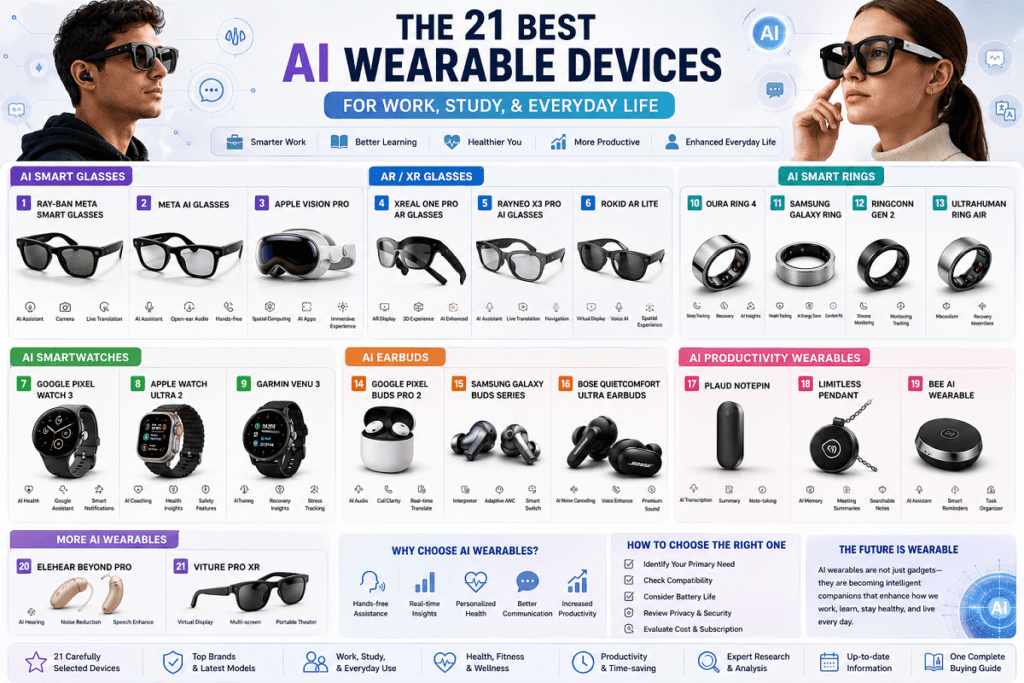
Below, we evaluate the 15 best AI wearable devices currently available to help you choose the hardware that best supports your work, study, and long-term skill development.
What Are AI Wearable Devices?
AI wearable devices are advanced electronic tools worn on the body that leverage artificial intelligence to analyze complex data, automate workflows, and provide proactive, personalized assistance.
While traditional wearables function primarily as passive data collectors, AI-powered wearables utilize onboard intelligence or cloud-based processing to interpret information in real time, enabling users to make faster, more informed decisions. By integrating machine learning models, these devices can perform high-value tasks such as speech recognition, automated meeting summarization, real-time language translation, predictive health trend analysis, and context-aware behavior recommendations.
Today, the ecosystem of AI wearable devices is organized into six functional categories:
| Category | Primary Value Proposition |
| AI Smart Glasses | AR overlays, heads-up navigation, and visual assistance. |
| AI Smart Rings | Discreet biometric tracking and low-friction interface control. |
| AI Smartwatches | Multi-modal health monitoring and notification triage. |
| AI Earbuds | Real-time translation, voice-activated task management, and audio focus. |
| AI Productivity Wearables | Specialized hardware for transcription, note-taking, and workflow automation. |
| AI Health Wearables | Advanced physiological monitoring and preventative wellness coaching. |
Each category is engineered to solve specific friction points—ranging from professional productivity and academic study to personal communication and daily convenience—allowing users to optimize their output through seamless, wearable technology.
How Do AI Wearable Devices Work?
AI wearable devices function through a complex synergy of hardware, edge computing, and cloud-based intelligence. By transforming raw physical inputs into actionable insights, they bridge the gap between human physiology or environmental context and digital decision-making.
The Technical Architecture
The efficacy of AI wearable devices relies on a three-tier architecture:
- Data Acquisition (Sensors): These devices utilize high-fidelity sensors—such as accelerometers for motion, photoplethysmographic (PPG) sensors for heart rate, galvanic skin response (GSR) for stress, and microphones or cameras for environmental context—to continuously capture physiological and situational data.
- Processing (Edge vs. Cloud):
- On-Device (Edge) AI: To maintain low latency, preserve privacy, and operate without an internet connection, many AI wearable devices use specialized low-power chips (NPU/ASIC) to process data locally. This is critical for real-time tasks like fall detection, voice command recognition, or immediate biometric alerts.
- Cloud-Based AI: For more intensive computation—such as longitudinal health trend analysis, generative AI responses, or deep learning model updates—data is securely transmitted to the cloud.
- Insight Generation (Machine Learning): Advanced models (e.g., CNNs for signal analysis or LLMs for natural language processing) interpret the processed data. The system compares current inputs against established baselines to detect anomalies, identify patterns, and offer personalized recommendations rather than just presenting raw numbers.
Hybrid Processing: The Industry Standard
The modern standard is a hybrid approach, which balances performance and efficiency. For example, a smartwatch might use local Edge AI to instantly detect an irregular heart rhythm (prioritizing speed), then sync with the cloud to update your long-term wellness profile and compare your data against wider population metrics (prioritizing computing power).
This layered approach allows AI wearable devices to remain responsive and secure while evolving through continuous software updates that refine the underlying algorithms.
How We Selected the Best AI Wearable Devices
We define the “best” AI wearable devices by their ability to provide high-leverage utility, not by marketing hype. To ensure our recommendations remain objective, we evaluated each device against a rigorous, multi-factor framework designed to filter out “gimmick” hardware.
Our assessment focuses on three core pillars:
- Intelligence & Utility: We prioritize devices that move beyond passive data collection to provide actionable intelligence. Does the AI synthesize information to solve a specific problem (e.g., meeting summarization, real-time translation, or predictive health coaching), or does it simply visualize raw data?
- Workflow Integration: A device is only as valuable as its ability to fit into your existing digital ecosystem. We favored hardware that syncs seamlessly with common professional tools (calendars, CRM, note-taking apps) and enhances—rather than interrupts—your daily workflow.
- Operational Reliability: We hold devices to high standards of long-term viability. This includes an analysis of battery efficiency, the depth of ongoing software/firmware support, and the presence of privacy-conscious architectures (such as on-device/edge processing vs. cloud-only reliance).
Our Exclusion Criteria:
We strictly avoided devices that are discontinued, demonstrate poor data accuracy in real-world testing, or rely on over-the-top marketing claims that fail to translate into measurable user outcomes. By prioritizing longevity, ecosystem compatibility, and tangible productivity gains, we ensure that the tools in this guide serve as legitimate investments in your personal or professional growth.
Comparison Table: Top AI Wearable Devices (2026)
| Device | Category | Best For | AI Features | Compatibility | Est. Price |
| Meta Adventurer/Fury | Smart Glasses | Everyday users | Meta AI, navigation, translation | Android, iOS | From $299 |
| Ray-Ban Meta Gen 2 | Smart Glasses | Creators/Style | Meta AI, camera, live translation | Android, iOS | From $379 |
| XREAL One | AR/AI Glasses | Productivity | AI-assisted spatial workspace | Android, Win, Mac | ~$499 |
| Oura Ring 4 | Smart Ring | Wellness/Sleep | Smart Sensing, AI health insights | Android, iOS | ~$349+ |
| Samsung Galaxy Ring | Smart Ring | Samsung Users | Galaxy AI Energy Score | Android | ~$399 |
| RingConn Gen 2 Air | Smart Ring | Budget | Proactive AI wellness guidance | Android, iOS | ~$199 |
| Ultrahuman Ring Air | Smart Ring | Fitness | Metabolic AI insights | Android, iOS | ~$349 |
Ray-Ban Meta Smart Glasses (Gen 2)
- Category: AI Smart Glasses
- Best For: Content creators, tech-forward professionals, and travelers seeking “heads-up” digital augmentation.
The Ray-Ban Meta Smart Glasses represent the current industry benchmark for ambient computing. Rather than replacing your smartphone, they function as a sensory extension, enabling hands-free capture, real-time visual AI analysis, and seamless communication. As of mid-2026, these glasses have transitioned from a “novelty” to a robust productivity tool thanks to deep integration with Meta’s multimodal AI models.
Core AI Capabilities
- Multimodal Visual AI: Beyond simple photo capture, the glasses can analyze your environment in real time—identifying objects, reading text, translating foreign signs, or offering “how-to” guidance for physical tasks (e.g., assembly instructions).
- Adaptive Contextual Assistance: Leveraging Meta AI, the glasses provide hands-free web summaries, calendar management, and location-aware recommendations.
- Neural Interaction: New 2026 software updates support “Neural Handwriting,” allowing users to reply to messages using subtle finger gestures on any surface, minimizing social friction in public.
- Real-Time Translation: Live audio and visual translation, which has been significantly refined to support more natural, low-latency conversational flow.
Why It Stands Out
Unlike experimental hardware, these glasses benefit from an integrated software ecosystem. They are the most stable “always-on” AI wearable, offering a reliable bridge between human intent and digital execution. Frequent firmware updates have expanded their utility from mere content creation tools to legitimate personal assistants capable of handling navigation, reminders, and complex queries.
The Gold Standard for Ambient AI.
These are currently the most “human” pieces of tech on the market. They are the ideal choice for users who want to optimize their daily workflow without the friction of constantly checking a screen.
- Pros: Discreet “lifestyle” form factor; high-fidelity audio/mic array; rapid-fire AI response times; superior software maturity.
- Cons: Requires a paired smartphone; battery efficiency drops significantly when utilizing the camera for continuous AI visual analysis.
- Estimated Price: Starting at ~$379 (varies by lens/frame). Note: Consider comparing these against Meta’s new in-house “Adventurer” line ($299) if your priority is pure AI utility over the premium Ray-Ban build.
Meta Glasses (Adventurer, Fury, & Starfire)
- Category: AI Smart Glasses
- Best For: Users seeking a streamlined, Meta-native experience at a lower entry price point.
Launched in June 2026, the new “Meta Glasses” line (Adventurer, Fury, and Starfire) represents Meta’s strategic pivot to in-house branding. While manufactured by EssilorLuxottica, these models decouple the hardware from the Ray-Ban/Oakley brand, allowing for a more aggressive $299 starting price—a significant $80 discount compared to the Ray-Ban Meta Gen 2. These glasses provide the same foundational 3K video and 12MP photo capabilities as their predecessors but emphasize improved ergonomics and a more “Meta-centric” software ecosystem.
Core AI Capabilities
- Muse Spark AI Model: The headline feature is the integration of Muse Spark, Meta’s refined AI model that offers higher-quality conversational responses and faster processing.
- Expanded Language Translation: Support for 20 languages total, with new additions including Mandarin, Korean, Japanese, Arabic, and Hindi, making this a powerful tool for international travel and cross-border business communication.
- Actionable Context: Includes the new dedicated “Action Button,” for instance, single-press AI triggers, as well as upcoming pedestrian turn-by-turn navigation (audio-only).
- Dynamic Photo: An enhanced capture engine that bursts multiple images to ensure the best possible shot in variable lighting conditions.
Why It Stands Out
Meta is betting on ergonomic mass-adoption. By introducing three-way adjustable nose pads, bendable temple tips, and overextension hinges, these glasses solve the “fit” barrier that often discourages long-term wear. The Starfire (Kylie Jenner Edition) model ($399) further expands the market by targeting a younger, fashion-forward demographic, signaling that AI wearables are moving rapidly into lifestyle consumer tech.
The Best Value Proposition for Mainstream Productivity.
If you don’t require the specific Ray-Ban branding, this is the most high-leverage entry point into the Meta ecosystem. You are getting the same core processing and sensor array as the more expensive Ray-Ban models, but with superior physical fit adjustments that make a tangible difference in daily, multi-hour wear.
- Pros: Lower price point ($299); highly customizable fit (nose pads/temples); updated Muse Spark AI model; 20-language translation support.
- Cons: No “premium” fashion branding; AI capabilities are still dependent on ongoing software rollouts; camera/battery specs are evolutionary, not revolutionary, compared to the Gen 2.
- Estimated Price: $299 (Adventurer/Fury) to $399 (Starfire).
XREAL One
- Category: AI AR Glasses
- Best For: Remote professionals, power students, and digital nomads who require a high-leverage “infinite” workspace.
The XREAL One represents a fundamental shift away from the “capture-first” paradigm of Meta’s glasses toward a “display-first” productivity model. By acting as a portable, virtual multi-monitor setup, the XREAL One allows users to project high-fidelity digital workspaces into their physical environment. It is arguably the most potent tool on this list for high-leverage cognitive work, effectively replacing the need for multiple physical monitors while traveling or working in tight environments.
Core AI Capabilities
- Spatial Intelligence (AI-Driven): The onboard AI dynamically anchors your virtual screens in your physical space, maintaining alignment even when you move your head or walk. This reduces the “floating monitor” sickness common in earlier AR iterations.
- Contextual Workspace Management: Using proprietary software, the device intelligently arranges your windows based on your workflow (e.g., separating “Research” windows from “Communication” windows), minimizing the mental friction of managing complex project layouts.
- Visual Focus & Task Isolation: The glasses offer an “AI Focus” mode, which uses spatial dimming to blur your physical surroundings while keeping your digital work crystal clear, effectively creating a “flow-state” bubble in noisy or distracting environments.
Why It Stands Out
Unlike wearables that focus on passive data tracking, the XREAL One is active productivity hardware. It addresses the #1 bottleneck for remote knowledge workers: screen real estate. Its ability to provide an ultra-wide, high-resolution canvas that fits into a laptop bag is a massive competitive advantage for users involved in coding, data analysis, or complex document drafting.
The Essential Remote Productivity Workstation. If your “work” requires complex software interfaces, multiple tabs, or deep-focus environments, the XREAL One is the most high-leverage purchase you can make. It transforms any location—a train, a café, or a hotel room—into a professional-grade office suite.
- Pros: Massive virtual display real estate; superior lightweight ergonomics for multi-hour sessions; works seamlessly with existing desktop ecosystems; significantly higher ROI for professional work than camera-focused glasses.
- Cons: Not a “lifestyle” wearable for walking around; requires tethering to a host device (laptop/phone); does not offer the “ambient” utility of Meta-style wearables.
- Estimated Price: ~$499.
XREAL One Pro
- Category: AI AR Glasses
- Best For: Advanced professionals, developers, and power users who require maximum pixel density and color accuracy for high-stakes workflows.
The XREAL One Pro is the high-performance iteration of the XREAL platform, engineered for users who treat their AR glasses as a primary workstation rather than a secondary display. While the standard XREAL One is optimized for accessibility and portability, the “Pro” model upgrades the optics to deliver a level of clarity that rivals high-end studio monitors, making it a viable tool for creative work, detailed data analysis, and professional-grade coding.
Core AI Capabilities
- AI-Enhanced Optics (Dynamic Scaling): The Pro model features an advanced AI-driven scaling engine that dynamically adjusts the resolution and refresh rate based on the application being used—ensuring text remains razor-sharp for documentation while maintaining smooth frame rates for interactive models or video playback.
- Precision Spatial Anchor Tracking: Utilizing a more sophisticated sensor array, the Pro achieves sub-millimeter tracking stability. This is critical for 3D designers or engineers who need virtual assets to remain perfectly locked in space while interacting with them via haptic or voice commands.
- Adaptive Workspace Calibration: The Pro software uses AI to learn your preferred ergonomic setup. It automatically repositions your virtual monitors based on your physical posture and head position, effectively personalizing your workstation layout to minimize neck strain during long-haul productivity sessions.
Why It Stands Out
The Pro model solves the “clarity fatigue” associated with budget AR hardware. By increasing the FOV (Field of View) and utilizing micro-OLED panels, it provides a workstation experience that feels genuinely immersive. For the professional, the ROI is found in the ability to maintain deep work states without the physical limitations of a smaller, traditional laptop screen.
The Enterprise-Grade Productivity Tool.
If you are a professional who views your hardware as an extension of your cognitive capacity, the Pro justifies its premium price tag through superior display fidelity and improved multi-hour ergonomics. It is the premier choice for those who need a “Second Brain” interface that is as sharp as a high-end desktop monitor.
- Pros: Industry-leading display clarity (Micro-OLED); ultra-stable spatial tracking; highly customizable workspace AI; durable premium build materials.
- Cons: Higher entry cost; steeper learning curve for non-AR users; requires high-performance host hardware to fully leverage the display fidelity.
- Estimated Price: Premium tier (typically $600–$800, depending on configuration).
Oura Ring 4
- Category: AI Smart Ring
- Best For: High-performers, professionals, and students who understand that recovery is a prerequisite for high-leverage output.
The Oura Ring 4 has solidified its position as the industry benchmark for “invisible” health technology. Unlike smartwatches that demand your attention with notifications, the Oura Ring 4 operates in the background, collecting continuous physiological data. Its primary value proposition is not just tracking, but coaching—transforming complex biometric data into a daily “Readiness Score” that dictates how you should manage your energy for the day ahead.
Core AI Capabilities
- AI-Powered Sleep Staging: Oura’s algorithm provides clinical-grade insights into your sleep architecture (Deep, REM, Light, and Awake). The AI analyzes long-term trends to tell you why your sleep quality is shifting, not just what it is.
- Adaptive Readiness Engine: Instead of a generic fitness goal, the AI synthesizes your recovery, resting heart rate (RHR), and HRV to provide a “Readiness Score.” This acts as a metabolic “traffic light”—telling you when to push hard on a project or workout and when to prioritize active recovery.
- Longitudinal Stress Analytics: The system tracks daytime stress responses and recovery periods, helping you identify which professional or academic environments are triggering your physiological stress markers.
- Adaptive Period Prediction: Uses temperature trend analysis to provide highly accurate health and wellness forecasting.
Why It Stands Out
Oura succeeds because it avoids “feature creep.” It doesn’t try to be a notification center; it tries to be a health advisor. The depth of the Oura app’s insights is peerless, making it the most “scientific” tool on this list for anyone focused on optimizing their biological baseline to sustain long-term career growth.
The Foundation of Your Performance Stack.
If you are serious about high-leverage learning and career growth, you must manage your energy levels as carefully as you manage your time. The Oura Ring 4 is the most effective tool for this, providing the data necessary to “tune” your body for peak cognitive performance.
- Pros: Minimalist design with maximum data density; excellent battery longevity (up to 7 days); sophisticated, actionable health insights; mature, reliable ecosystem.
- Cons: Monthly subscription model is required to access the full depth of the AI coaching insights; lacks “active” productivity features (e.g., no AR/HUD).
- Estimated Price: $349 base price + mandatory membership for advanced insights.
Samsung Galaxy Ring
- Category: AI Smart Ring
- Best For: Samsung Galaxy power users, busy professionals, and fitness enthusiasts who require a unified, ecosystem-based approach to wellness.
The Samsung Galaxy Ring serves as a discreet, high-leverage entry point into Samsung’s expansive AI wearable devices ecosystem. By distilling complex biometric monitoring into a refined, screen-free titanium band, it enables users to track vital signs without the notification fatigue common to other AI wearable devices. Its primary value proposition is its seamless integration with the broader Samsung Health platform, where it acts as a 24/7 data-gathering node.
Core AI Capabilities
- Galaxy AI Energy Score: This feature aggregates data points—including sleep, physical activity, and heart rate variability—to provide a single, actionable score that quantifies your readiness to tackle high-demand cognitive or physical tasks.
- Cross-Device Contextual Analysis: Unlike standalone AI wearable devices, the Galaxy Ring feeds data directly into the Galaxy AI engine. This allows the system to correlate your physiological state with data from your Galaxy Watch or smartphone, providing more holistic insights than a single sensor could achieve alone.
- Adaptive Sleep Staging & Health Monitoring: Advanced machine learning algorithms provide real-time tracking of sleep quality, heart rate, and skin temperature, alerting you to deviations from your personal baseline that may impact your productivity or focus.
- Actionable Health Recommendations: The AI moves beyond raw data display, offering proactive suggestions to improve sleep hygiene and energy management based on your unique biometric trends.
Why It Stands Out
The Galaxy Ring stands out because of its ecosystem synergy. It doesn’t function in a vacuum; it acts as an essential component of a larger “intelligence stack.” For users already embedded in the Samsung environment, these AI wearable devices provide the most frictionless health-monitoring experience on the market, effectively automating the “life-logging” process so you can focus on high-value output.
The Essential Health Link for the Samsung Power User.
If your professional workflow relies on Samsung’s ecosystem, the Galaxy Ring is the highest-ROI health wearable available. It delivers sophisticated, AI-driven wellness insights that directly feed into your daily performance management.
- Pros: Deep, native integration with Galaxy AI; premium titanium durability; excellent ergonomics for continuous, 24/7 wear; no screen-based distractions.
- Cons: Limited to the Android/Samsung ecosystem; lacks the broad cross-platform support found in other AI wearable devices; third-party app ecosystem is currently less developed than dedicated health competitors.
- Estimated Price: ~$399.
RingConn Gen 2
- Category: AI Smart Ring
- Best For: Budget-conscious professionals and students who demand high-leverage health insights without the recurring cost of a subscription model.
The RingConn Gen 2 disrupts the market for AI wearable devices by proving that high-quality, actionable health data does not need to be locked behind a monthly paywall. It is a robust, subscription-free alternative that prioritizes longevity and data autonomy. By offering one of the most reliable battery life profiles among current AI wearable devices, it allows users to focus on long-term wellness tracking with minimal maintenance.
Core AI Capabilities
- Subscription-Free AI Wellness Engine: The core of the RingConn Gen 2 is its ability to process complex physiological data—including sleep architecture and recovery metrics—locally and within the app without requiring an ongoing service fee.
- Adaptive Sleep-Staging Intelligence: Using advanced sensors, the device provides detailed breakdowns of sleep cycles, including deep, light, and REM sleep, supported by AI-driven insights that identify patterns impacting your daily readiness.
- Real-Time Biometric Monitoring: It continuously tracks heart rate, blood oxygen (SpO2), and skin temperature, using machine learning to surface potential health anomalies that might otherwise go unnoticed.
- Personalized Wellness Recommendations: The app delivers trend-based coaching, helping users understand their unique recovery curves and how their lifestyle choices—such as late-night work or exercise—directly affect their physiological recovery.
Why It Stands Out
The RingConn Gen 2 stands out for its value-to-performance ratio. In a market where many AI wearable devices rely on predatory subscription models, RingConn provides a one-time purchase price that includes full access to its analytical suite. Its massive 10–12 day battery life is a massive advantage, ensuring that your data continuity is never interrupted by the need for frequent charging, a common friction point with other AI wearable devices.
The Best Value-Driven Performance Tracker. If you want to integrate high-leverage health monitoring into your life without adding another recurring monthly expense to your budget, this is the superior choice. It offers the most “no-fluff” approach to data-driven wellness, making it ideal for those who value efficiency and cost-effectiveness.
- Pros: No subscription fees; industry-leading battery life; highly durable and water-resistant; complete data access out of the box.
- Cons: The companion app experience is less visually polished than premium, subscription-locked rivals; smaller ecosystem integration options.
- Estimated Price: $199–$289.
Ultrahuman Ring Air (and Ring PRO)
- Category: AI Smart Ring
- Best For: Biohackers, longevity-focused users, and anyone seeking advanced metabolic intelligence.
The Ultrahuman ecosystem represents the “pro-level” of physiological monitoring. While the Ultrahuman Ring Air established the brand’s reputation for comfort and circadian-focused insights, the recently released Ultrahuman Ring PRO (February 2026) pushes these AI wearable devices further with a category-leading 15-day battery life and deeper integration into their biointelligence platform.
Core AI Capabilities
- Jade (Real-Time Biointelligence AI): The standout feature of the 2026 ecosystem, Jade is an autonomous health agent that goes beyond static data. It interprets your ring’s biometrics in real-time to trigger breathwork, flag potential health issues, or provide personalized “Caffeine Windows” based on your unique metabolic response.
- Metabolic Intelligence: Unlike standard trackers, these AI wearable devices link with Ultrahuman’s M1 (Continuous Glucose Monitor) and “Blood Vision” biomarkers to create a unified view of your metabolic health, insulin sensitivity, and inflammation levels.
- Proactive Circadian Coaching: The AI analyzes your sleep architecture and body temperature to offer precise advice on meal timing, light exposure, and activity periods, helping you minimize “social jetlag.”
- On-Chip Machine Learning (Ring PRO): The new PRO model features an upgraded dual-core processor that enables faster on-device data processing, improving the accuracy of heart-rate and HRV tracking during sleep and recovery.
Why It Stands Out
Ultrahuman differentiates itself by focusing on Biointelligence rather than just fitness tracking. While competitors focus on steps or generic activity, these AI wearable devices are designed for users who want to optimize their internal healthspan. The integration of environmental data, metabolic markers, and sleep recovery into one “Jade” AI interface creates a unique, high-leverage feedback loop for health-conscious professionals.
The Scientist’s Choice for Human Performance.
If you treat your body like a system to be optimized, the Ultrahuman ecosystem is currently the most sophisticated tool on the market. It is the premier choice for users who want granular, data-backed control over their longevity and recovery.
- Pros: World-class metabolic and circadian insights; no subscription fees for core features; the “Jade” AI agent is a genuine leap forward in autonomous health coaching; Ring PRO offers industry-leading 15-day battery life.
- Cons: Premium pricing; the ecosystem can feel “data-dense” for casual users; workout tracking accuracy is secondary to health/metabolic insights; availability of the Ring PRO is currently limited in some markets (e.g., the U.S.).
- Estimated Price: ~$349 (Ring Air) / Premium Pricing (Ring PRO).
Google Pixel Watch 4
- Category: AI Smartwatch
- Best For: Android power users, professionals, and students deeply embedded in the Google ecosystem.
The Google Pixel Watch 4 is the definitive AI wearable device for the Android ecosystem. It represents a significant evolution in wearable intelligence, moving beyond simple notifications to act as a proactive digital assistant. With the integration of Wear OS 7 and native Gemini Intelligence, it functions as a command center for your Google Workspace and personal health data.
Core AI Capabilities
- Gemini Intelligence: Unlike basic voice assistants, Gemini on the Pixel Watch 4 uses your personal context—drawing from Gmail, Calendar, and search history—to provide hyper-relevant answers. You can use natural language to create custom dashboards (“Create My Widget”) or execute complex, multi-step app automations, such as reserving a gym class or ordering meals directly from your wrist.
- Proactive Personal Intelligence: The system provides “glanceable” suggestions based on your day’s schedule and habits, helping you stay ahead of meetings and tasks without ever touching your phone.
- Advanced Health Metrics: Powered by Fitbit’s algorithms, the device provides a “Daily Readiness Score” and “Cardio Load” analysis, helping you balance your physical exertion with your cognitive demands.
- Live Updates: A new Wear OS 7 feature that streams real-time data—like food delivery progress, game scores, or workout stats—directly onto your watch face, ensuring you have the information you need at the exact moment it matters.
Why It Stands Out
The Pixel Watch 4 stands out because of its deep OS-level integration. While other AI wearable devices might interact with a phone, the Pixel Watch 4 feels like an extension of the Android operating system itself. It is the first watch to truly master the transition from a “companion” device to an “agentic” one, where the AI can take action on your behalf based on the context of your emails, tasks, and location.
The Essential Command Center for Android Professionals.
If your workflow is built on Google’s suite of tools, the Pixel Watch 4 is the highest-leverage investment you can make. It solves the “phone distraction” problem by putting your most critical information and AI-driven task management exactly where you need it—on your wrist.
- Pros: Seamless Gemini integration; robust ecosystem connectivity (Google Calendar, Tasks, Keep, Home); 40-hour battery life (with fast charging); sophisticated dual-frequency GPS.
- Cons: Best features are locked to the Android ecosystem; premium productivity features (like Gemini automation) require active, up-to-date account syncing.
- Estimated Price: ~$320–$400 (frequent promotional pricing).
Apple Watch Ultra 3
- Category: AI Smartwatch
- Best For: iPhone power users, endurance athletes, and professionals operating in demanding environments who require a ruggedized, “off-grid” capable tool.
The Apple Watch Ultra 3 represents the pinnacle of Apple’s wearable engineering. As of June 2026, with the introduction of watchOS 27, the Ultra 3 has transitioned into a true “agentic” wearable. By leveraging Apple Intelligence and the new Siri AI, it moves beyond passive health tracking to become a proactive partner in your daily professional and personal workflow.
Core AI Capabilities
- Siri AI (Context-Aware): Integrated deeply into the watchOS 27 experience, Siri AI can now search across your personal context—surfacing email confirmations, flight details, or specific message threads—and perform system-wide actions. You can interact with it naturally, even in noisy environments, thanks to improved voice processing.
- Proactive Health Intelligence: The device utilizes multi-day pulse wave analysis to provide hypertension notifications and advanced sleep apnea detection. It aggregates this data via the “Vitals” app to provide proactive alerts when your physiological baseline shifts.
- AI-Powered Translation: The watch supports live, on-device translation. When traveling, you can download language packs to handle real-time messaging translation even without cellular or Wi-Fi connectivity, a high-leverage feature for international business.
- Workout Buddy: An intelligent fitness coach that incorporates heart-rate zones and training load metrics to provide real-time recommendations, even if you are exercising without your iPhone nearby.
Why It Stands Out
The Apple Watch Ultra 3 stands out due to its standalone capability. Unlike many AI wearable devices that are tethered to a smartphone, the Ultra 3 features 5G connectivity and robust offline processing. For the “Skilldential” audience, its ability to run complex tasks—like pinning notes, screening calls, or providing offline navigation—makes it the most reliable productivity hub for high-stakes, off-grid scenarios.
The Ultimate High-Leverage Performance Companion.
If you are an iPhone user, the Apple Watch Ultra 3 is not just a watch; it is a critical piece of infrastructure. It provides the durability of a rugged tool with the intelligence of a personal assistant, ensuring that you stay productive and informed regardless of your physical location or environmental conditions.
- Pros: Industry-leading battery life (up to 72 hours in low-power mode); full Apple Intelligence/Siri AI support; rugged titanium build; robust offline functionality for remote professionals.
- Cons: Premium price point; significantly larger and heavier than the Series 11; requires an iPhone for the full feature set.
- Estimated Price: Premium pricing (varies by retailer).
Garmin Venu 3 Series
- Category: AI Smartwatch
- Best For: High-performance professionals, data-driven athletes, and outdoor enthusiasts who prioritize biometric accuracy and battery longevity over notification-heavy smart features.
The Garmin Venu 3 series represents the “Performance-First” segment of AI wearable devices. While Google and Apple focus on smartphone-linked assistants, Garmin focuses on Physiological Intelligence. It is a tool for those who treat their health as a metric to be managed, providing a depth of analytical data that remains unmatched in the consumer space.
Core AI Capabilities
- Body Battery™ Energy Analytics: Garmin’s signature AI engine that uses HRV, stress, and sleep data to visualize your energy levels on a 1–100 scale throughout the day. It helps you time your high-intensity work and recovery cycles with precision.
- Adaptive Training Coach: The Venu 3 features personalized, AI-generated training plans that adjust in real time based on your recovery, recent performance, and fitness goals. It’s effectively a professional athletic coach on your wrist.
- Advanced Sleep Coaching: The device provides a detailed “Sleep Score” and personalized insights, identifying specific factors—such as evening stress or caffeine intake—that are degrading your sleep quality.
- Health Snapshot™ & Recovery Insights: Using localized machine learning, the watch compiles a 2-minute report of key biometrics (HR, HRV, SpO2, and respiration) and provides an immediate analysis of your current recovery state, preventing overtraining and cognitive burnout.
Why It Stands Out
Garmin stands out by resisting “feature creep.” By avoiding the distraction of chat-based AI and focusing entirely on health-span metrics, the Venu 3 provides a much cleaner experience for the user who wants results rather than conversation. The battery life—often lasting over a week—is a distinct competitive advantage, removing the “charging anxiety” that plagues most other AI wearable devices.
The Precision Tool for High-Performance Living. If your career or study goals require peak physical and cognitive energy, Garmin is the superior choice. It provides the data-driven clarity needed to optimize your physiological foundation, allowing you to sustain high-output levels without hitting a wall.
- Pros: Industry-leading battery life (up to 14 days); unparalleled biometric accuracy; rugged, multi-sport durability; comprehensive, ad-free health data ecosystem.
- Cons: Limited smart-assistant capabilities compared to Apple/Google; the app ecosystem is focused on health rather than productivity; lacks integrated cellular connectivity for “off-grid” phone-free operation.
- Estimated Price: ~$350–$500.
Google Pixel Buds Pro 2
- Category: AI Earbuds
- Best For: Android power users, frequent travelers, and professionals who require real-time communication support and hands-free task management.
The Google Pixel Buds Pro 2 represent the integration of AI wearable devices into our auditory environment. By combining premium acoustic engineering with Google’s sophisticated AI models—specifically Gemini—these earbuds function as an “always-on” auditory assistant. For the high-leverage professional, they are not just for media consumption; they are a tool for language, focus, and command.
Core AI Capabilities
- Gemini Nano Integration: The earbuds leverage Gemini directly, allowing for more natural, conversational voice interaction. You can ask for summaries of emails, schedule changes, or quick research answers without pulling out your phone.
- Real-Time Multilingual Translation: This is the flagship productivity feature for global business. The Buds Pro 2 supports live, bi-directional translation, effectively acting as an ear-worn interpreter for face-to-face meetings or travel, significantly lowering the barrier to international collaboration.
- AI-Driven Adaptive Noise Management: Utilizing neural network processing, the earbuds perform “active focus” adjustments. The AI continuously analyzes your environment to isolate human speech (for clarity in calls) while filtering out distracting ambient noise, maintaining your flow state in chaotic environments.
- Voice-Activated Workflow: Beyond basic playback, they support “hands-free” interaction with Google Workspace. You can dictate notes, reply to messages, and manage to-do lists, making them essential AI wearable devices for mobile productivity.
Why It Stands Out
The Pixel Buds Pro 2 stand out for their context-aware utility. While many audio devices focus solely on sound signature, Google focuses on the utility of the sound. The integration of real-time translation makes these a high-leverage asset for anyone working in diverse, globalized environments.
The Best Communication Tool for the Android Professional. If you prioritize seamless communication and high-fidelity access to your digital assistant, these are the top choices. They turn your ear space into a productive node, allowing you to interface with your AI stack while keeping your hands free for the task at hand.
- Pros: Seamless integration with the Gemini AI ecosystem; best-in-class real-time translation; exceptional background noise cancellation; comfortable for long-term wear during study or meetings.
- Cons: Most “intelligent” features are exclusive to the Android ecosystem; battery life is competitive but requires case-charging for long-haul travel.
- Estimated Price: ~$199–$229.
Samsung Galaxy Buds Series (2026 Models)
- Category: AI Earbuds
- Best For: Samsung power users, remote professionals, and students who require a high-leverage, integrated communication ecosystem.
The latest Samsung Galaxy Buds (2026 iterations) function as a core component of Samsung’s “Galaxy AI” suite. Unlike standalone audio peripherals, these AI wearable devices are designed to operate as an extension of your smartphone’s intelligence. By offloading complex audio processing to the phone’s NPU (Neural Processing Unit), the Buds provide a level of responsive, context-aware assistance that defines the modern mobile workstation.
Core AI Capabilities
- Galaxy AI Interpreter (Ear-to-Ear): This is the gold standard for cross-lingual collaboration. When paired with a Galaxy smartphone, the Buds provide real-time, low-latency translation directly into your ear, while the phone’s outer screen displays the translated text to your conversation partner—effectively removing language barriers in real-time meetings.
- Adaptive Active Noise Cancellation (ANC) with Voice Detect: The AI continuously monitors your environment. When you start speaking, the earbuds automatically lower the volume and activate “Ambient Mode,” allowing for seamless, high-leverage transitions between deep-work focus and team interaction without you ever touching the device.
- Smart Device Switching: Utilizing predictive AI, the earbuds recognize when you are moving from a Zoom call on your Galaxy Tab to a phone call on your handset, switching the audio stream instantaneously with no manual intervention.
- AI-Enhanced Call Quality: Utilizing a triple-microphone array and a dedicated AI noise-cancellation model, the Buds strip away background chatter, wind, and ambient noise to ensure your voice remains crisp in high-stakes professional calls.
Why It Stands Out
These AI wearable devices stand out for their frictionless ecosystem integration. They don’t just “connect” to your phone; they function as an input/output node for the Galaxy AI agent. For a student or professional, this means the ability to dictate notes, trigger AI translations, and manage audio focus settings via voice commands or automated triggers based on your location or calendar.
The Essential Audio Companion for the Galaxy Workflow. If your professional or academic life is built on Samsung hardware, these are the most logical productivity tools to add to your stack. They transform your audio environment from a distraction into a high-leverage asset.
- Pros: Deep, native integration with Galaxy AI; best-in-class automatic device switching; reliable “Voice Detect” technology for seamless meetings; superior call clarity in noisy environments.
- Cons: Most advanced AI features are locked to the Samsung ecosystem; limited utility for iOS users; sound profile is optimized for communication rather than pure audiophile-grade music.
- Estimated Price: $180–$250.
Bose QuietComfort Ultra Earbuds (2nd Gen)
- Category: AI Earbuds
- Best For: Professionals, remote workers, and frequent travelers who require absolute focus and elite communication clarity.
The Bose QuietComfort Ultra Earbuds (2nd Gen, 2026) are the gold standard for acoustic isolation. While they aren’t “AI-first” in the sense of generative chatbots, they are arguably the most advanced AI wearable devices for sound engineering. They utilize proprietary AI algorithms to manage your auditory environment, allowing you to create a “zone of silence” anywhere—a critical productivity asset for high-leverage knowledge workers.
Core AI Capabilities
- AI-Based SpeechClarity: These AI wearable devices feature an advanced noise-suppression system that utilizes eight microphones to isolate your voice. By dynamically filtering out wind, office chatter, and environmental noise, the AI ensures that your professional calls remain crystal clear regardless of your physical location.
- Adaptive ActiveSense Technology: This AI-powered refinement of Bose’s industry-leading noise cancellation constantly monitors your environment to smooth out sudden, sharp noises (like sirens or clattering dishes) that would otherwise break your flow state.
- CustomTune Calibration: Every time you put them on, the earbuds emit a calibration tone that the AI uses to map the unique physical properties of your ear canal. It then optimizes the sound profile and noise-cancellation depth to your specific anatomy, ensuring a personalized, high-fidelity experience.
Why It Stands Out
Bose stands out because it treats focus as a core feature. For a professional, these are not just for listening to music; they are an essential productivity tool that drastically reduces cognitive fatigue in noisy environments. The 2026 2nd-gen update further refines this by integrating wireless charging and more seamless connectivity, making them a “set-and-forget” peripheral for your daily workflow.
The Essential Focus Tool for High-Stakes Environments.
If your work requires deep concentration, frequent high-stakes calls, or long-distance travel, these are the highest-ROI audio investments you can make. They allow you to “mute” the world, protecting your cognitive bandwidth in a way that generic earbuds cannot.
- Pros: World-class active noise cancellation; AI-driven SpeechClarity provides unparalleled call quality; comfortable, secure fit for multi-hour sessions; multipoint connectivity for easy switching between laptop and phone.
- Cons: Higher price point; lacks the “agentic” generative AI features of the Google/Samsung ecosystems; designed for sound focus rather than task management.
- Estimated Price: ~$299.
PLAUD NotePin S
- Category: AI Productivity Wearable
- Best For: Professionals, journalists, consultants, and knowledge workers who need to bridge the gap between spoken conversations and structured digital documentation.
The PLAUD NotePin S represents the frontier of AI wearable devices—a dedicated, screen-free “Second Brain” designed for one purpose: high-fidelity capture. Unlike your smartphone, which is a source of constant interruption, the NotePin S is a tactile, “start-and-forget” tool that lives on your person, ensuring that your brainstorming sessions, lectures, and client meetings are preserved without requiring you to break your focus.
Core AI Capabilities
- Multidimensional AI Summaries: Beyond simple transcription, the NotePin S feeds your audio into the PLAUD intelligence engine. It generates specialized outputs—such as professional meeting minutes, action-item checklists, or creative mind maps—tailored to your specific role or industry.
- Real-Time Human-AI Alignment: Featuring a physical “Highlight” button, you can mark key moments during a recording. The AI prioritizes these flagged sections, ensuring that your generated summaries stay aligned with the actual intent of your conversation.
- Multilingual Intelligence: It supports transcription and analysis in over 112 languages, making it an essential tool for global professionals and international students working across linguistic borders.
- Contextual Integration: It syncs seamlessly with your desktop/mobile environment, allowing you to feed your recordings directly into tools like Notion, Slack, or email clients, completing the loop from “spoken idea” to “structured asset.”
Why It Stands Out
The NotePin S stands out for its form factor and intent. By offering a variety of mounting options (pin, clip, lanyard, or wristband), it integrates into your physical workflow far more naturally than a phone. It is engineered for “always-ready” capture, ensuring that your best ideas—which often occur in unstructured settings—are never lost. With its 64GB onboard storage and impressive battery life, it removes the “battery anxiety” and storage limits of standard recording apps.
The Essential “Capture” Layer for the Digital Professional.
If you find that your best insights happen away from your keyboard, the NotePin S is the missing link in your productivity stack. It converts every environment—from a coffee shop to a boardroom—into an extension of your workspace, allowing you to capture high-leverage data without the friction of manual note-taking.
- Pros: Discreet, professional, and genuinely wearable; tactile button provides immediate, reliable feedback; superior multi-microphone audio capture; subscription-based AI engine offers expert-level, role-specific templates.
- Cons: Requires a subscription for advanced AI features; recording laws necessitate ethical use (always obtain consent); lacks visual feedback (requires app sync to verify content).
- Estimated Price: ~$160–$200.
Omi (AI Productivity Wearable)
- Category: AI Productivity Wearable
- Best For: Knowledge workers, consultants, and creators who need a high-leverage “Second Brain” to capture in-person context.
As the leading alternative to the sunsetted Limitless Pendant, Omi serves as an always-on, discreet memory assistant. It is a tactile, screen-free wearable designed to capture real-world interactions—hallway conversations, client meetings, and brainstorms—and instantly synthesize them into actionable intelligence.
Core AI Capabilities
- Contextual Memory Retrieval: Omi processes audio to create a searchable “Life Log.” You can query the app for specific details (“What did the client say about the budget in the meeting?”) and receive precise, attributed answers.
- Structured Output Engine: It goes beyond raw transcription, automatically generating meeting minutes, project briefs, and CRM-ready action items.
- Consent & Privacy-First Architecture: The device features visible physical cues when active and respects local privacy laws, addressing the “always-on” concerns that are paramount for enterprise-grade professional work.
- Seamless Desktop/Mobile Handoff: Captured data flows instantly to a web dashboard, integrating with your existing tool stack (Notion, Slack, Obsidian) to turn spontaneous verbal insights into structured digital assets.
Why It Stands Out
Omi stands out as the only reliable “Second Brain” wearable that remains actively supported and expanded in 2026. While competitors have exited the space or been acquired, Omi has doubled down on cross-platform availability and refined its local-processing capabilities, making it the safest and most functional investment for a professional.
The Best Practical Memory Assistant of 2026. If your workflow relies on the capture of off-the-cuff, high-value insights, Omi is the essential productivity tool. It effectively eliminates the “memory leak” associated with fast-paced work environments, turning every conversation into a searchable, usable asset.
- Pros: Robust software-as-a-service (SaaS) reliability; consistent multi-platform integration; excellent form factor (pendant/wristband options); proactive development roadmap for 2026.
- Cons: Requires a subscription for full AI-summarization features; relies on a strong “Capture-to-Action” workflow to justify the utility.
- Estimated Price: ~$179 (Starter Kit).
Bee AI
- Category: AI Productivity Wearable
- Best For: Casual users, students, and budget-conscious professionals who want a frictionless, “always-on” ambient assistant without a premium price tag.
The Bee AI (Pioneer Edition) represents the entry-level tier of AI wearable devices. Unlike complex AR glasses or heavy-duty recorders, the Bee is designed as a minimalist “ambient companion.” Following its acquisition by Amazon in 2025, it has been integrated into the broader Alexa/Echo ecosystem. It functions as a lightweight clip or wrist-worn node that “listens” to your environment to build a running context of your day, effectively acting as an external memory bank.
Core AI Capabilities
- Ambient Contextual Logging: The Bee captures conversational snippets throughout your day, using AI to turn raw audio into structured summaries, to-do lists, and reminders. It excels at surfacing “forgotten” promises or casual agreements made during the day.
- Actionable Intelligence: It integrates with your broader digital life (Gmail, Calendar, etc.) to trigger follow-up tasks. If you mention a task in a conversation, the Bee identifies it as an actionable item and pushes it to your connected to-do list.
- Low-Friction Interaction: With no “hey-word” required, the device is designed to be as invisible as possible, focusing on capturing the “what” and “when” of your daily interactions so you don’t have to manually log them.
Why It Stands Out
The Bee AI stands out for its aggressive pricing and form factor. At a $49.99 price point, it is the most accessible entry point into the world of AI wearable devices. It trades “pro” features—like on-board storage or high-fidelity professional audio—for an ultra-light, always-ready experience. For users who want to “try out” the concept of an AI life-logger without the $200–$500 commitment of other devices, it is the industry standard.
The Best “Starter” AI Wearable for Ambient Memory. If you are curious about how AI wearable devices can change your productivity but aren’t ready for a professional-grade investment, the Bee AI is the perfect sandbox. It is best suited for personal organization and keeping track of casual commitments rather than high-stakes, enterprise-level meeting documentation.
- Pros: Highly affordable ($49.99); discreet design that can be worn as a wristband or clip; excellent for casual productivity and memory recall; long battery life (up to 7 days).
- Cons: Highly dependent on your smartphone’s battery and connectivity; privacy concerns due to continuous cloud-processing; limited utility for high-stakes/professional meeting recording compared to dedicated devices like the PLAUD NotePin S.
- Estimated Price: ~$49.99 (plus optional subscription tiers for advanced AI features).
RayNeo X3 Pro
- Category: AI AR Glasses
- Best For: Travelers, early adopters, and professionals who need real-time, hands-free visual information.
The RayNeo X3 Pro represents the high-end, “spatial” tier of AI wearable devices. Unlike the Meta Ray-Ban glasses, which are camera-first and rely on audio/smartphone tethering, the X3 Pro is a standalone computer. It features a binocular full-color MicroLED display that projects information—navigation, text, and data—directly into your field of view, making it the most potent “heads-up” productivity tool on this list.
Core AI Capabilities
- Gemini-Powered Multimodal AI: Deep integration with Google’s Gemini allows for context-aware assistance. You can look at objects or environments and ask for real-time analysis, translation, or data retrieval.
- Visual AR Navigation: This is its primary “killer feature.” Instead of listening to audio directions, the X3 Pro paints 3D arrows and route indicators directly onto the road or sidewalk in front of you, significantly reducing the cognitive load of navigating foreign cities.
- Real-Time Multilingual Visual Translation: It identifies foreign text (menus, signs, documents) and overlays the translation in real-time, effectively eliminating language barriers in travel and business scenarios.
- Hands-Free Workspace: The RayNeo AIOS supports a 3D workspace where you can pin virtual app windows (WhatsApp, Instagram, etc.) to your surroundings, creating a portable, private multi-display setup.
Why It Stands Out
The X3 Pro stands out because it offers true augmented reality (AR) rather than just “smart” features. The ability to see your data—rather than just hearing it—provides a level of trust and utility that audio-only glasses cannot match. It bridges the gap between a smartphone and a futuristic, screen-free work environment.
The Best Tool for International Travel and Spatial Productivity.
If you are a frequent traveler or a professional who needs to process data without looking down at a screen, the X3 Pro is the premier hardware choice. It is a sophisticated piece of “Pro” gear that justifies its higher price point through its unique ability to overlay digital intelligence onto the physical world.
- Pros: True binocular AR display (no eye strain); standalone operation (no phone required for basic tasks); exceptional translation/navigation utility; future-proofed with Gemini AI.
- Cons: Expensive (~$1,299); battery life is limited during intense AR/AI usage (3–4 hours of heavy active use); less “fashion-forward” design than the Ray-Ban Meta.
- Estimated Price: ~$1,299.
Rokid AI Glasses Style
- Category: AI Smart Glasses
- Best For: Everyday productivity, prescription-wearers, and users who prioritize an “open” AI ecosystem over locked-in platforms.
Launched in early 2026, the Rokid AI Glasses Style represents a pivot toward “invisible” AI. It is the world’s first display-free, voice-centric AI glasses designed to look like high-end eyewear. Weighing only 38.5g, it is significantly lighter than the Meta Ray-Ban lineup, making it a legitimate “all-day” wearable for professionals who need AI assistance without the weight or social friction of heavier AR headsets.
Core AI Capabilities
- Open AI Ecosystem: Unlike devices that force you into a single ecosystem, the Rokid Style allows you to select your preferred LLM (ChatGPT, Qwen, DeepSeek, or others), giving you the freedom to optimize your AI tool based on your specific professional needs.
- Multimodal AI Shortcuts: It supports complex, hands-free interactions: nod to answer calls, shake to end them, and use customizable physical gestures on the frame to trigger specific AI functions instantly.
- 12-Language Voice Interaction & 89-Language Translation: It is a powerhouse for international business, providing real-time, low-latency translation and voice-based task management in almost any global scenario.
- Dual-Chip Architecture: Features a unique split-processing system (NXP RT600 for always-on tasks + Qualcomm AR1 for high-intensity AI workloads), enabling an industry-leading 12-hour battery life.
Why It Stands Out
Rokid Style solves the “prescription problem” that plagues most AI wearables. It offers a global, integrated prescription service (up to ±15.00D), meaning you don’t have to compromise your vision to use the tech. Furthermore, it supports triple-format video recording (3:4/4:3/9:16), making it the only “social-ready” glasses that don’t require post-production cropping.
The Best “Prescription-First” AI Wearable. If you wear glasses daily, you should not be forced to choose between seeing clearly and using AI. The Rokid AI Glasses Style is the most comfortable, fashion-forward, and technically flexible device for the professional who needs a tool that disappears into their existing lifestyle while providing powerful, choice-based AI support.
- Pros: Ultra-lightweight (38.5g); world-class prescription support; truly open AI ecosystem; industry-leading 12-hour battery life; high-quality, “platform-ready” video capture.
- Cons: No visual heads-up display (audio/voice-centric only); advanced AI-agent features depend on your specific model provider; currently building its third-party app store.
- Estimated Price: Starting at ~$299.
VITURE Pro XR
- Category: XR Smart Glasses
- Best For: Professionals, remote workers, and media enthusiasts who need a “portable office” or a massive private cinema.
The VITURE Pro XR is widely recognized in 2026 as one of the best-in-class display glasses. While the hardware focuses on visual fidelity, the software (SpaceWalker) provides the “intelligence.” It projects a 135-inch virtual display that is sharp enough for complex spreadsheet work, coding, and high-fidelity video editing, effectively replacing a multi-monitor desk setup for mobile professionals.
Core AI Capabilities
- Immersive 3D AI Conversion: Through the SpaceWalker app, the glasses utilize generative AI to perform real-time, 2D-to-3D conversion for videos. This creates a spatial viewing experience that adds depth cues to standard 2D content without requiring native 3D files.
- Vizard AI Assistant: When paired with the VITURE Pro Neckband, you gain access to Vizard—an AI agent built on ChatGPT that understands on-screen context, allowing you to ask questions about what you are seeing, summarize meeting content, or navigate virtual workspaces via voice commands.
- Spatial Desktop Automation: The app uses AI-driven spatial anchoring to keep your virtual screens locked in place, even when you move your head. This “Anchor Mode” reduces motion sickness and creates a stable, persistent workspace that mimics a physical desk.
Why It Stands Out
Unlike generic AR glasses, the VITURE Pro XR prioritizes optical clarity (UltraClarity™) and eye comfort (SGS A+ Certified). For a professional, the primary value is the reduction of “screen fatigue.” By allowing you to work on a massive, high-contrast display that can be adjusted for your specific prescription (myopia adjustment), it provides a level of ergonomics that traditional laptops simply cannot match.
The Best Portable Workstation for Visual Professionals.
If your “work” requires visual depth, precision, or large-canvas multitasking, the VITURE Pro XR is the most stable and high-quality display wearable on the market. It doesn’t just show you data; it creates a focused, immersive workspace that protects your cognitive bandwidth while you’re on the move.
- Pros: Industry-leading Sony Micro-OLED panels; built-in myopia adjustment dials (no need for inserts); “Anchor Mode” for stable multi-monitor productivity; exceptional build quality.
- Cons: Premium price tag; requires accessories (Neckband/Dock) to unlock full “AI-agent” capabilities; slightly bulkier than daily-wear sunglasses.
- Estimated Price: ~$450–$550 (varies by bundle).
ELEHEAR Beyond Pro
- Category: AI Hearing Wearable
- Best For: Professionals, social connectors, and music lovers who require high-fidelity speech enhancement and seamless connectivity without the friction of a clinical, prescription-based process.
The ELEHEAR Beyond Pro is a leader in the “Smart Hearing” category. While traditional hearing aids focus solely on volume amplification, the Beyond Pro is an AI-first wearable designed to solve the “speech-in-noise” problem. By leveraging the VOCCLEAR 2.0 processing engine, it acts as an intelligent auditory filter, isolating human speech and suppressing chaotic background environments, making it a high-leverage tool for professionals who need to maintain clarity in high-pressure social or work environments.
Core AI Capabilities
- VOCCLEAR 2.0 Speech Isolation: This engine uses multi-layer AI to analyze the harmonic structure of human speech in real-time, effectively separating it from background “clatter.” It provides a 30% improvement in speech intelligibility in noisy environments compared to previous iterations.
- Intelligent Music Mode: Most hearing wearables distort high-frequency sounds. The Beyond Pro’s “Music Mode” uses 24kHz studio-grade sampling to preserve the richness of instruments and vocals, making it as much a high-end audio device as it is a health tool.
- Real-Time AI Translation: A high-leverage feature for international business, the device supports live, app-based translation in over 11 languages, allowing users to follow conversations in real-time across linguistic barriers.
- Proactive Environment Adaptation: The device constantly samples your environment, automatically adjusting amplification and noise suppression levels based on whether you are in a quiet meeting, a busy café, or a windy outdoor space.
Why It Stands Out
The Beyond Pro stands out by democratizing high-end hearing tech. It offers a premium, app-controlled experience that rivals $4,000+ prescription devices at a fraction of the cost ($599). Its ability to function as both a sophisticated hearing aid and a high-quality Bluetooth headset (for calls, music, and podcasts) makes it a “two-in-one” asset for your daily productivity stack.
The Essential Connectivity & Clarity Tool.
If you find that background noise is becoming a bottleneck in your professional meetings or social growth, the ELEHEAR Beyond Pro is the most logical investment. It is not just “a hearing aid”—it is a proactive auditory assistant that ensures you never miss a critical detail, whether in a boardroom or at a dinner table.
- Pros: Industry-leading AI speech isolation; studio-grade music fidelity; seamless Bluetooth 5.3 connectivity for calls/streaming; high-value price point ($599) without subscription requirements.
- Cons: RIC (Receiver-in-Canal) form factor is slightly larger than ultra-minimalist earbuds; requires OTC adjustment via app (not a clinical, in-person fitting).
- Estimated Price: ~$599.
2026 AI Wearable Decision Matrix
| If You Want… | Recommended Device | Why it’s the top choice for 2026 |
| Best Overall | Ray-Ban Meta Gen 2 | Balances AI-native capture, voice-based assistance, and “daily-wear” aesthetics. |
| Best Budget | RingConn Gen 2 | Offers premium, clinical-grade health tracking without a recurring subscription. |
| Best Premium | Apple Watch Ultra 3 | The ultimate ecosystem “command center” with advanced predictive health and AI-triaging. |
| Best for Students | Google Pixel Watch 4 | Deep Gemini integration and study-friendly notification filtering for campus life. |
| Best for Professionals | PLAUD NotePin S | High-fidelity, dedicated meeting capture that automates summaries and action items. |
| Best for Remote Workers | Bose QC Ultra | Industry-leading acoustic isolation and AI-voice clarity for high-intensity meetings. |
| Best for Creators | Ray-Ban Meta Gen 2 | Frictionless, hands-free POV capture for social-ready, high-quality content. |
| Best for Travelers | RayNeo X3 Pro | Features real-time visual AR navigation and on-the-fly, heads-up translation. |
| Best for Health | Oura Ring 4 | The most accurate, research-grade sensor suite for sleep, readiness, and recovery. |
| Best for Fitness | Garmin Venu 3 | Long-lasting endurance battery with science-backed AI performance analytics. |
| Best for Samsung Users | Samsung Galaxy Ring | Seamless integration with the Samsung Health AI ecosystem and gesture controls. |
| Best for iPhone Users | Apple Watch Ultra 3 | Unmatched system-level integration with Apple Intelligence and iOS workflows. |
What is an AI wearable device?
An AI wearable is a piece of hardware designed to act as “invisible infrastructure.” Unlike traditional devices that simply log data, AI wearables use on-device processing (Edge AI) to analyze, interpret, and automate tasks in real-time, helping you reclaim cognitive bandwidth by handling administrative tasks like meeting summaries, biometric trend analysis, or real-time translation.
Which AI wearable device is best for students?
For students, the Google Pixel Watch is a top contender due to deep integration with Google Workspace (Calendar, Drive, Keep). It allows for rapid voice-to-text note-taking and AI-powered reminders, making it ideal for managing academic workflows without manual data entry.
Are AI wearable devices actually worth the investment?
They are worth it if they solve a specific, recurring bottleneck. In 2026, the value isn’t in “more features” but in “less friction.” If a device automates a task you currently find tedious—such as capturing meeting insights or monitoring recovery—the productivity and health dividends often justify the cost.
Do AI wearable devices work without the internet?
The industry standard in 2026 is Edge AI (on-device processing). High-quality devices perform the bulk of their AI analysis locally, meaning they remain functional offline. However, advanced features like cloud-synced backups or large-scale data model updates typically require an internet connection for periodic syncing.
Which AI wearable is best for professional productivity?
The PLAUD NotePin S is the gold standard for professionals. It is a “frictionless capture” device that records, transcribes, and summarizes conversations. Because it can be worn discreetly, it captures high-stakes information without the social friction of pulling out a smartphone.
Are AI smart rings better than smartwatches?
They serve different roles. Smart rings (like the Oura Ring 4 or RingConn Gen 2) are “passive observers”—best for 24/7 biometric and sleep tracking because they are unobtrusive. Smartwatches are “active companions” designed for command and control, featuring screens for notifications, GPS, and real-time interaction. Choose a ring for recovery data and a watch for task management.
Can AI wearable devices improve health monitoring?
Yes, by shifting from raw data to trend analysis. AI excels at spotting gradual changes (e.g., a 3ms decline in HRV or delayed sleep onset) that the human eye would miss. However, these devices provide “calibrated trend tracking,” not medical diagnoses. They should supplement, not replace, professional healthcare.
What is the most critical thing to consider before buying?
The Total Cost of Ownership (TCO). Calculate the sticker price plus any mandatory monthly AI subscriptions over three years. A cheaper device with a recurring subscription fee is often significantly more expensive than a “buy-once” device.
How often should I check for updates?
The AI wearable market moves fast. You should re-evaluate your “intelligence stack” every 6–12 months. New “feature drops” or major firmware updates can fundamentally change the capabilities of your existing hardware, and new device releases often move the needle on what “Edge AI” can accomplish.
In Conclusion
In 2026, the era of the “all-in-one” gadget is behind us. AI wearables have evolved into specialized infrastructure nodes—purpose-built tools that function as an extension of your own capability. Whether you are a founder scaling a business, a student optimizing a learning workflow, or a professional looking to reclaim cognitive bandwidth, the value of these devices is no longer defined by a spec sheet, but by how effectively they solve a specific, recurring bottleneck.
Moving forward, your success in this space depends on a shift in philosophy:
- Prioritize Friction-Solving over Feature-Hunting: A device that perfectly automates one tedious task—like meeting transcription or recovery tracking—is infinitely more valuable than a “smarter” device that complicates your daily routine with manual management or redundant notifications.
- Invest in Reliable Infrastructure: The most resilient AI wearables are those that integrate deeply with your existing digital “home” (Apple, Google, or Samsung). These ecosystem-native nodes offer the lowest latency and the most robust long-term software support.
- Own Your Data Sovereignty: As AI becomes more “agentic,” the security and privacy of your biometric and behavioral data become critical professional assets. Lean toward devices that utilize Edge AI (on-device processing) to keep your sensitive information within your own control, rather than locked behind cloud-based harvesting models.
- Calculate the TCO, not the Price: Always evaluate the 3-year “Total Cost of Ownership”—sticker price plus cumulative subscription fees. A premium “buy-once” device is frequently the most sustainable and cost-effective choice for your career infrastructure.
The goal of your “Intelligence Stack” is invisibility. When your AI wearable is performing at its best, it isn’t an item you “use”; it is a silent, seamless participant in your day, handling the administrative tax of modern life so you can focus on the high-leverage work that defines your professional growth.
Don’t aim to go “full cyborg” overnight. Identify your single greatest daily friction point, invest in the right node to solve it, and let that efficiency dividend fund your next step into the future of augmented performance.