If you want to master how to use Claude AI for work, business, research, productivity, or software development, a growing library of structured Claude AI courses can help you accelerate your learning curve.
Anthropic, the company behind Claude, offers official resources through Claude Academy, including specialized Claude AI courses for absolute beginners, industry professionals, and technical builders.
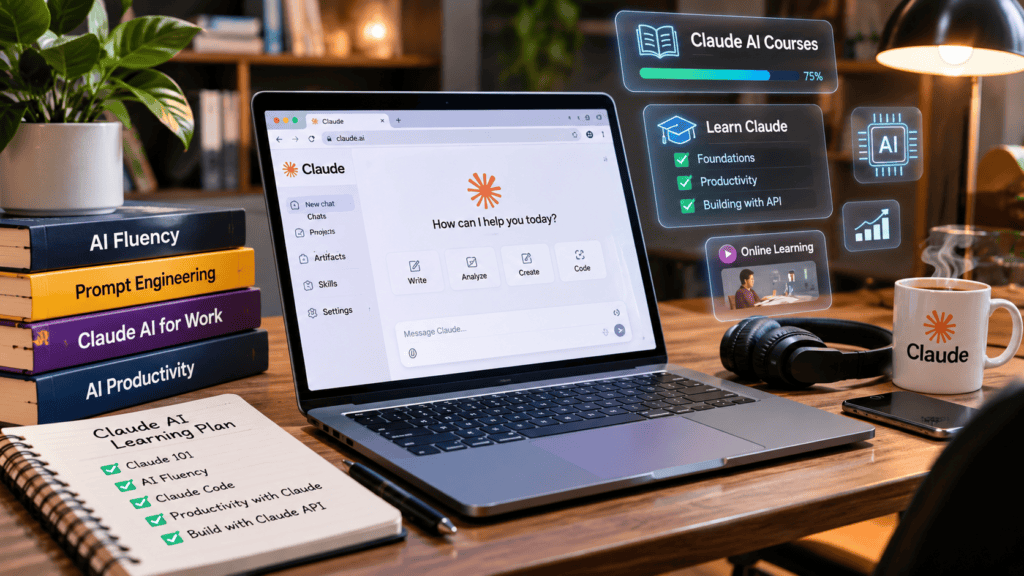
In this guide, we break down 11 free Claude AI courses, what each curriculum teaches, who it’s for, and how to choose the best learning path for your goals.
What is Claude Academy?
Claude Academy is Anthropic’s official educational hub designed for individuals looking to understand, leverage, and build with Claude. The platform offers a curated suite of free Claude AI courses, tutorials, and hands-on resources that span the entire Anthropic ecosystem.
Rather than focusing exclusively on basic chat prompting, the curriculum covers a comprehensive spectrum of skills:
- Everyday Productivity: Optimizing workflows for professional writing, analysis, and daily business tasks.
- Prompt Engineering: Structuring advanced prompts to maximize model capability and output consistency.
- AI Literacy & Governance: Mastering responsible AI collaboration, safety, and ethical usage.
- Workflow Automation: Streamlining complex, multi-step operational processes.
- Developer Tooling: Software development using Claude Code and building custom applications via the Claude API.
- Ecosystem Integration: Connecting Claude to external data sources and tools using the Model Context Protocol (MCP).
- Business & Creative Ops: Scaling commercial strategies and creative production using generative AI.
By segmenting its curriculum by skill level and technical depth, Claude Academy provides actionable pathways for both non-technical professionals and experienced software engineers.
Is Claude Academy Free?
Yes. Anthropic’s official FAQ confirms that Claude Academy is entirely free to access. You can browse the curriculum without signing in. However, creating a free Claude account unlocks additional benefits, allowing you to save your learning progress and earn official course completion badges. You do not need a paid Claude subscription to access the Academy itself. You can explore the official platform directly.
11 Free Claude AI Courses Worth Exploring
Curated directly from Anthropic’s official catalog, these Claude AI courses span all skill levels—ranging from everyday productivity and advanced prompting to software engineering, API development, and Model Context Protocol (MCP) integrations.
Claude 101
- Best for: Beginners
- Duration: 2.5 hours
- Lessons: 13
- Perks: Completion badge
Claude 101 serves as the ideal starting point for anyone with little or no prior experience using generative AI. The curriculum introduces Claude’s core capabilities and teaches you how to structure natural language prompts to communicate effectively with the AI assistant.
What You Will Learn:
- Initiating and structuring your first conversations with Claude.
- Writing high-leverage prompts and iteratively refining responses.
- Organizing context and reference files using Projects.
- Generating code, writing, and structured documents in real-time using Artifacts.
- Leveraging Claude Skills.
- Integrating external tools and exploring built-in research features.
- Navigating different collaboration modes, including Chat, Cowork, and Code.
Who Should Take This Course?
Students, job seekers, entrepreneurs, content creators, and corporate professionals looking to build foundational AI literacy and become confident everyday Claude users.
AI Fluency: Framework and Foundations
- Best for: AI literacy
- Duration: 4 hours
- Lessons: 14
- Perks: Completion badge
Mastering generative AI requires more than just knowing what prompts to write. AI Fluency: Framework and Foundations teaches you how to strategically delegate tasks, provide precise operational context, and critically evaluate model outputs.
The curriculum centers around Anthropic’s proprietary 4D Framework:
- Delegation: Deciding which tasks to assign to AI versus those requiring human oversight.
- Description: Communicating intent, constraints, and instructions with absolute clarity.
- Discernment: Evaluating AI-generated responses, cross-referencing facts, and spotting subtle hallucinations.
- Diligence: Maintaining human accountability for how AI is deployed and how its outputs are applied.
Beyond the 4D framework, the course dives deep into responsible AI collaboration, core prompting methodologies, and an honest assessment of generative AI limitations.
Who Should Take This Course?
Professionals, business owners, educators, students, and anyone looking to move beyond surface-level usage to develop genuine, high-level AI literacy.
AI Capabilities and Limitations
- Best for: Understanding AI mechanics and avoiding hallucinations
- Duration: 3.5 hours
- Lessons: 13
- Perks: Completion badge
One of the most common pitfalls in generative AI adoption is assuming that model outputs are infallible. AI Capabilities and Limitations bridges the gap between surface-level interaction and technical reality, giving learners a clear framework for how large language models actually operate and why they occasionally produce misleading information.
What You Will Learn:
- The core mechanics of generative AI and next-token prediction.
- Understanding AI knowledge limits and information cutoffs.
- Navigating context windows and model working memory constraints.
- Evaluating instruction-following capabilities.
- Identifying common AI errors, edge cases, and hallucinations.
- Methodologies for auditing and analyzing unexpected model responses.
This foundational knowledge is critical for anyone deploying Claude in high-stakes environments such as professional research, business strategy, complex writing, and data analysis.
Who Should Take This Course?
Beginners, researchers, knowledge workers, analysts, and professionals looking to ground their workflow in responsible, eyes-open AI utilization.
Introduction to Claude Cowork
- Best for: Workflow productivity
- Duration: 2.5 hours
- Lessons: 14
- Perks: Completion badge
Introduction to Claude Cowork teaches knowledge workers how to move past simple chatbot interactions and delegate complex, multi-step tasks to Claude. Among the available Claude AI courses, this module focuses specifically on how the Cowork environment interfaces directly with local files, folders, and connected applications to execute heavier assignments.
What You Will Learn:
- Setting up and configuring the Claude Cowork environment.
- Creating and managing dedicated operational workspaces.
- Providing precise context, instructions, and reference material.
- Delegating multi-step execution chains to the AI.
- Integrating plugins and custom Skills.
- Collaborating on live documents and managing deep research tasks.
- Reviewing and auditing AI-generated deliverables.
- Establishing secure and safe working practices for file handling.
For example, a professional can leverage Cowork to ingest messy project files, synthesize distributed research, and automatically format structured reports.
Who Should Take This Course?
Administrative professionals, researchers, entrepreneurs, business operators, and knowledge workers looking to scale their everyday productivity through advanced Claude AI courses.
Prerequisite Note
While the course materials are entirely free, Anthropic currently requires a paid Claude plan to access the hands-on interactive Cowork lessons.
Claude Code 101
- Best for: Aspiring developers and AI-assisted programming
- Duration: 1.5 hours
- Lessons: 12
- Perks: Completion badge
Claude Code 101 introduces learners to Claude Code, Anthropic’s powerful agentic coding interface. As one of the most technically forward-looking Claude AI courses, it is designed to help developers seamlessly integrate AI into every stage of creating, editing, debugging, and maintaining software projects directly from the command line.
What You Will Learn:
- Understanding the architecture and capabilities of AI coding agents.
- Installing, configuring, and authenticating Claude Code.
- Writing precise, high-context coding instructions.
- Leveraging Plan Mode to architect solutions before writing code.
- Navigating the core Explore, Plan, Code, and Commit developer workflow.
- Managing context windows efficiently during large-scale code updates.
- Establishing persistent repository rules using
CLAUDE.mdinstruction files. - Working with subagents and Model Context Protocol (MCP) servers.
Who Should Take This Course?
Aspiring software developers, experienced engineers, and technical builders looking to supercharge their local development workflows using advanced Claude AI courses.
Prerequisite Note
While the course materials are free, completing the practical, hands-on labs requires an eligible paid Claude plan or an Anthropic API key. Basic familiarity with a code editor and command-line interface is also strongly recommended.
Claude Code in Action
- Best for: Advanced AI-assisted development workflows
- Duration: 1 hour
- Lessons: 9
- Perks: Completion badge
For developers who have already mastered the fundamentals, Claude Code in Action takes your technical capabilities further. Among the advanced Claude AI courses available on the platform, this module focuses specifically on running prolonged coding sessions, managing multi-step AI agents, and automating repetitive development tasks.
What You Will Learn:
- Steering and maintaining context during long-running coding sessions.
- Advanced configuration options for Claude Code.
- Writing comprehensive, production-grade
CLAUDE.mdrepository instructions. - Building and distributing reusable custom Skills.
- Managing granular permission modes and custom hooks.
- Automating recurring development workflows and CI/CD pipelines.
- Integrating Claude directly into GitHub workflows.
- Rigorously testing and verifying AI-generated code.
The core objective is helping engineers maintain strict architectural control over AI-assisted development while enabling Claude to autonomously handle heavier execution burdens.
Who Should Take This Course?
Working software engineers and developers who already use Claude Code and want to transition from individual prompts to fully automated development workflows using expert Claude AI courses.
Claude Platform 101
- Best for: Application development and API integration
- Duration: 1.5 hours
- Lessons: 13
- Perks: Completion badge
Claude Platform 101 introduces developers to building production-grade software applications powered by Anthropic’s developer platform. Moving far beyond the standard web chat interface, this module is one of the essential technical Claude AI courses designed to show you how to programmatically integrate Claude into custom software stacks.
What You Will Learn:
- Making and managing programmatic API requests.
- Strategic model selection based on cost, speed, and capability.
- Architecting multi-step autonomous agent loops.
- Implementing function calling and model tool use.
- Utilizing extended thinking capabilities for complex reasoning tasks.
- Leveraging custom Skills and Model Context Protocol (MCP) servers.
- Managing context windows efficiently within application architecture.
- Designing and deploying managed AI agents.
Who Should Take This Course?
Software engineers, AI builders, and technical entrepreneurs looking to build and scale software applications using expert Claude AI courses.
Prerequisite Note
General programming experience and access to the Anthropic Claude Console are recommended. Please note that active API usage may require adding billing credits to your developer account.
Building with the Claude API
- Best for: Comprehensive AI application development
- Duration: 9 hours
- Lessons: 67
- Perks: Completion badge
As one of the most exhaustive and valuable Claude AI courses for engineers, Building with the Claude API provides a deep, production-grade dive into integrating Anthropic’s models directly into software applications. Spanning nearly 60 lessons, this masterclass equips developers with the practical patterns needed to build robust, scalable AI products.
What You Will Learn:
- API authentication, configuration, and environment setup.
- Advanced programmatic prompt engineering techniques.
- Managing state and context in multi-turn conversational systems.
- Implementing advanced tool use and function calling.
- Building Retrieval-Augmented Generation (RAG) pipelines for custom data.
- Integrating the Model Context Protocol (MCP) into applications.
- Rigorous prompt evaluation and testing frameworks.
- Architecting autonomous AI agents and complex execution workflows.
- Core application development patterns for production software.
For example, a developer can use these methodologies to build an intelligent customer support agent that queries internal databases, or an automated document analysis engine that processes complex legal files.
Who Should Take This Course?
Software engineers, AI developers, technical founders, and programmers with Python experience who want to build and deploy commercial, Claude-powered products using expert Claude AI courses.
Prerequisite Note
This course requires Python proficiency and an active Anthropic API key. Because the API is usage-based, practical code execution and testing labs may incur minor usage costs even though the course curriculum itself is free.
Introduction to Model Context Protocol (MCP)
- Best for: Connecting AI applications to external data and tools
- Duration: 1 hour
- Lessons: 10
- Perks: Completion badge
Introduction to Model Context Protocol (MCP) introduces developers to Anthropic’s open standard for connecting AI models securely to external data sources and developer tools. Among technical Claude AI courses, this module is essential for anyone looking to break past isolated prompt interfaces and build deeply integrated AI ecosystems.
What You Will Learn:
- Understanding the core architecture of the Model Context Protocol (MCP).
- The interplay between MCP clients and servers.
- Building functional MCP servers using Python.
- Defining custom tools, resources, and access parameters.
- Creating and packaging reusable prompts.
- Connecting AI applications seamlessly to external services and databases.
- Testing, securing, and debugging MCP implementations.
Who Should Take This Course?
Software developers, technical builders, and AI automation enthusiasts equipped with basic Python and API knowledge who want to leverage open standards through specialized Claude AI courses.
AI Fluency for Small Businesses
- Best for: Entrepreneurs and commercial productivity
- Duration: 3.5 hours
- Lessons: 8
- Perks: Completion badge
AI Fluency for Small Businesses is specifically tailored for entrepreneurs, founders, and business professionals looking to leverage AI to scale daily operations without needing a technical background. Among business-focused Claude AI courses, this module bridges the gap between theoretical AI knowledge and tangible commercial execution.
What You Will Learn:
- Applying generative AI to everyday business activities and administrative operations.
- Conducting fast, comprehensive market and competitor research using AI.
- Analyzing customer feedback and synthesizing qualitative data.
- Streamlining and optimizing operational workflows.
- Critically evaluating AI-generated insights for accuracy and bias.
- Protecting proprietary business data and managing security risks.
- Developing a practical, internal AI usage policy for teams.
- Identifying high-leverage opportunities for responsible business automation.
Who Should Take This Course?
Small-business owners, independent consultants, freelancers, startup founders, and administrative professionals looking to drive efficiency using industry-specific Claude AI courses.
AI Fluency for Builders
- Best for: Technical entrepreneurs and product creators
- Duration: 3 hours
- Lessons: 9
- Perks: Completion badge
Rounding out our list of top Claude AI courses, AI Fluency for Builders is designed specifically for individuals who build products, manage software life cycles, or engineer technical solutions. The curriculum focuses heavily on leveraging AI strategically across every stage of turning raw ideas into functional, production-ready software.
What You Will Learn:
- Applying the 4D AI Fluency framework to technical product development.
- Identifying high-leverage tasks suited for AI delegation.
- Breaking down complex customer problems into manageable engineering tasks.
- Writing precise, context-rich AI instructions for code and architecture.
- Rigorously evaluating AI-generated work, logic, and edge cases.
- Reviewing and auditing AI-generated UI/UX and system designs.
- Maintaining human accountability and engineering oversight over final product decisions.
The core message of the course is mastering how technical builders can maximize velocity with AI without ever compromising on quality, code correctness, or architectural integrity.
Who Should Take This Course?
Developers, product managers, technical startup founders, engineering teams, and aspiring AI builders looking to integrate advanced Claude AI courses into their product development stack.
Comparison of the 11 Free Claude AI Courses
Use this quick matrix to identify the ideal Claude AI course based on your current skill level, role, and time commitment.
| Course Title | Best Suited For | Duration |
| Claude 101 | Beginners & Everyday Users | 2.5 hours |
| AI Fluency: Framework and Foundations | Everyone & General AI Literacy | 4.0 hours |
| AI Capabilities and Limitations | Researchers & Knowledge Workers | 3.5 hours |
| Introduction to Claude Cowork | Administrative Professionals & Operators | 2.5 hours |
| Claude Code 101 | Aspiring Developers & Programmers | 1.5 hours |
| Claude Code in Action | Experienced Claude Code Users | 1.0 hour |
| Claude Platform 101 | Developers & Platform Builders | 1.5 hours |
| Building with the Claude API | Software Engineers & Technical Founders | 9.0 hours |
| Introduction to Model Context Protocol (MCP) | Technical Builders & Integrators | 1.0 hour |
| AI Fluency for Small Businesses | Entrepreneurs & Small Business Owners | 3.5 hours |
| AI Fluency for Builders | Product Managers & Technical Creators | 3.0 hours |
Note: Course titles, estimated durations, and curriculum details verified against the official Claude Academy catalog.
Do Claude AI Courses Offer Certificates?
Anthropic’s Claude Academy does not issue traditional formal certifications for its free curriculum; instead, it awards official completion badges.
After completing the required lessons and passing the associated course quizzes, eligible learners earn a digital badge. According to Anthropic’s official guidelines, these badges can be downloaded as PDFs, added directly to LinkedIn profiles, and verified via public links.
Important Distinction: Badges vs. Professional Certifications
It is essential to distinguish between a standard course completion badge and a formal professional credential:
- Course Completion Badges: These confirm that you have completed the learning modules and quizzes for a specific Claude AI course. They are free, accessible to anyone with a Claude account, and excellent for demonstrating ongoing learning on your CV or LinkedIn.
- Formal Certifications: Anthropic maintains a separate, paid, proctored certification program that is strictly restricted to eligible organizations within its partner network.
Best Practice for Your Resume
You can proudly list your Claude Academy completion badges as evidence of up-to-date AI literacy and technical skill development. However, avoid labeling them as formal “professional certifications” unless you have cleared Anthropic’s official partner certification exams.
How to Choose the Right Claude AI Course
With a diverse catalog available, selecting the ideal learning track depends entirely on your current skill level, daily workflow, and professional objectives.
Use this quick-reference framework to match your goals to the most appropriate Claude AI courses:
| Your Learning Goal | Recommended Claude AI Course |
| Learn Claude from scratch | Claude 101 |
| Become AI-fluent (Core frameworks) | AI Fluency: Framework and Foundations |
| Understand AI limitations & hallucinations | AI Capabilities and Limitations |
| Automate everyday work & file workflows | Introduction to Claude Cowork |
| Learn AI-assisted programming | Claude Code 101 (or Claude Code in Action for advanced users) |
| Build AI applications (Platform level) | Claude Platform 101 |
| Develop with APIs (Deep dive) | Building with the Claude API |
| Connect AI to external tools & data | Introduction to Model Context Protocol (MCP) |
| Apply AI to business operations | AI Fluency for Small Businesses |
| Build AI-powered products (Technical founders) | AI Fluency for Builders |
Recommended Learning Paths
Rather than attempting to take all 11 courses simultaneously, follow a structured learning path that aligns directly with your current experience level and professional objectives.
For Beginners and General Professionals
- Step 1: Claude 101 (Build everyday conversational and prompt foundations)
- Step 2: AI Fluency: Framework and Foundations (Master Anthropic’s 4D framework for effective delegation)
- Step 3: AI Capabilities and Limitations (Understand token limits, context windows, and how to avoid hallucinations)
- Step 4: Introduction to Claude Cowork (Scale file-handling and document workflows)
For Entrepreneurs and Small-Business Owners
- Step 1: Claude 101 (Establish core AI literacy and prompt habits)
- Step 2: AI Fluency: Framework and Foundations (Learn strategic task delegation)
- Step 3: AI Fluency for Small Businesses (Apply AI to commercial research, operations, and workflow optimization)
- Step 4: Introduction to Claude Cowork (Automate administrative and analytical tasks)
For Aspiring Developers and Technical Builders
- Step 1: Claude 101 (Familiarize yourself with the core Claude ecosystem)
- Step 2: AI Fluency for Builders (Learn to integrate AI safely into product development cycles)
- Step 3: Claude Code 101 (Master agentic coding from your command line)
- Step 4: Claude Platform 101 (Transition from chat interfaces to programmatic API integration)
- Step 5: Building with the Claude API (Deep-dive into multi-turn applications, tool use, and RAG pipelines)
- Step 6: Introduction to Model Context Protocol (MCP) (Connect custom apps to external tools and data sources)
Note: These are suggested learning sequences rather than mandatory prerequisites. You are free to mix and match individual Claude AI courses according to your existing knowledge and goals.
Are Claude Academy Courses Worth Taking?
Yes. Anthropic’s official curriculum is exceptionally worthwhile, particularly for anyone looking to move beyond surface-level prompting and gain structured, authoritative instruction directly from the creators of Claude.
The primary advantages include official oversight, a curriculum that spans everyday productivity to advanced agentic development, and zero tuition costs. However, to maximize your time, keep the following considerations in mind:
- Fast-Evolving Ecosystem: Because Claude and its toolsets (such as Claude Code and MCP) evolve rapidly, core concepts remain valuable, but specific UI workflows may occasionally require adaptation.
- Technical Prerequisites: Developer-focused tracks require working Python knowledge, command-line familiarity, and active developer console accounts.
- Paid Tier Requirements: While the course materials are entirely free, completing hands-on labs for advanced modules (like Claude Cowork) or executing high-volume API calls may require a paid Claude subscription or API credits.
- Badges vs. Certifications: Course completion badges are excellent for LinkedIn and CVs, but they are not formal professional certifications.
- Real-World Execution: Watching the lessons is only the first step. True proficiency comes from applying these frameworks directly to live work projects, business workflows, or codebases.
If you are new to the ecosystem, start with Claude 101 to establish your conversational and prompt foundations. Once you understand the core capabilities, branch out into specialized Claude AI courses that align directly with your professional, entrepreneurial, or technical objectives.
Are Claude AI courses free?
Yes. Anthropic’s Claude Academy provides a robust catalog of free online courses covering everything from basic prompt engineering and AI fluency to software development, API integrations, and the Model Context Protocol (MCP). You do not need a paid Claude subscription to access the Academy platform or its core course materials.
Do I need a Claude Pro subscription to take the courses?
No. You can access, browse, and complete coursework using a free Claude account. However, note that certain hands-on practical exercises—particularly advanced modules involving Claude Cowork or Claude Code—may require an eligible paid Claude plan or an active developer API key.
Can beginners learn Claude AI without coding?
Yes. Several beginner-friendly options—such as Claude 101, AI Fluency: Framework and Foundations, and AI Capabilities and Limitations—require zero programming experience. These courses focus entirely on using Claude for everyday writing, research, analysis, and professional productivity.
Do Claude Academy courses provide certificates?
Eligible courses award digital completion badges after you complete the required lessons and pass the course quizzes. These badges can be downloaded as PDFs, added to LinkedIn, and shared via public verification links.
However, they are completion badges rather than formal professional certifications from Anthropic’s separate partner certification program.
How long does it take to complete a Claude AI course?
Completion times vary by module. Short introductory and technical courses take between 1 and 2.5 hours, while comprehensive developer masterclasses (such as Building with the Claude API) can span up to 9 hours. Anthropic’s listed durations are intended as flexible estimates rather than strict timelines.
Can I use Claude AI skills to improve my career?
Yes. Mastering how to use Claude for automated workflows, research, data synthesis, and software engineering is a high-leverage way to boost your marketability and efficiency.
However, completing a course is only the starting point; building a portfolio of practical projects and real-world implementations remains essential for career growth.
Where can I find the official Claude AI courses?
You can explore the official curriculum and start learning directly on Anthropic’s educational platform at academy.claude.com.
In Conclusion
Claude is becoming an increasingly critical tool across the modern AI ecosystem, and mastering its application is a high-leverage way to build valuable digital skills. The advantage of Anthropic’s official curriculum is that you do not have to navigate the ecosystem blindly.
Through Claude Academy, structured, authoritative learning resources are available for everyone—from absolute beginners and entrepreneurs to advanced software engineers.
Your Action Plan:
- New to the platform? Start with Claude 101 to build your prompt engineering and workflow fundamentals.
- Already experienced? Dive straight into specialized modules like Claude Cowork, Claude Code, or API development to scale your productivity.
- Build real-world utility: Don’t just stop at completing lessons. Apply these frameworks directly to live projects, automate your daily workflows, and build a demonstrable portfolio that supports your career or business growth. Visit Claude Academy, choose a course that matches your immediate goals, and begin learning today!