Certificates, Certifications, and Digital Badges Explained
Digital badges are verified, shareable digital icons that represent specific skills or achievements and include embedded metadata for instant online verification. Certificates confirm you completed a course or program. Certifications are third-party, industry-recognized credentials that validate your competency against a professional standard—often via an exam and with renewal requirements.
If you’re deciding which credential to pursue—or which to trust on a CV—this guide explains how digital badges differ from traditional credentials, shows how employers evaluate each, and helps you choose the right option for your goals without wasting time or money.
Who This Guide Is For
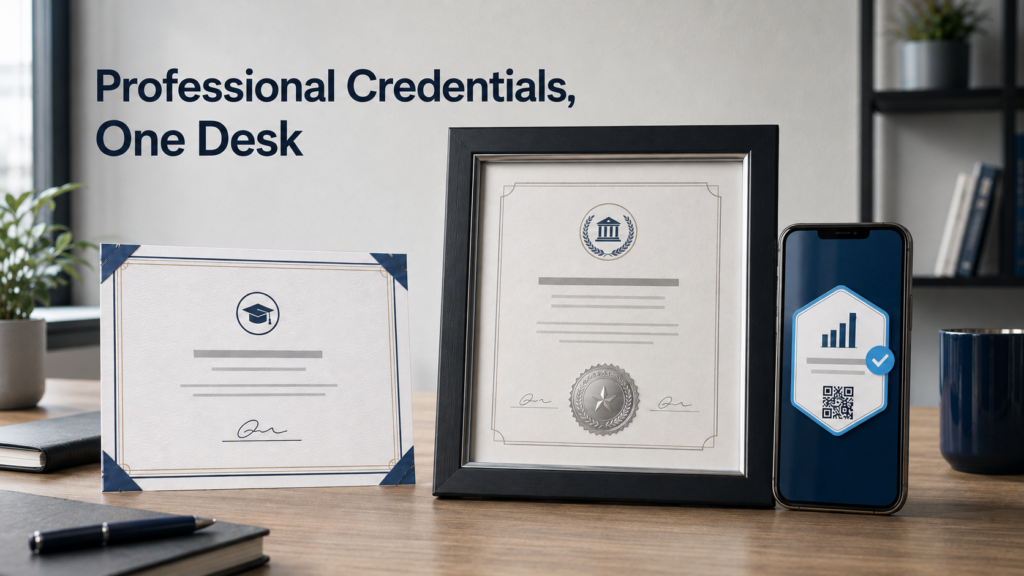
- Students and graduates building a skills portfolio with digital badges alongside their degrees.
- Job seekers and career changers are comparing short courses, digital badges, and professional certifications.
- Professionals evaluating upskilling options, micro-credentials, and verifiable digital badges.
- Employers and hiring managers are learning how to interpret digital badges, certificates, and certifications in recruitment.
What Is a Digital Badge?
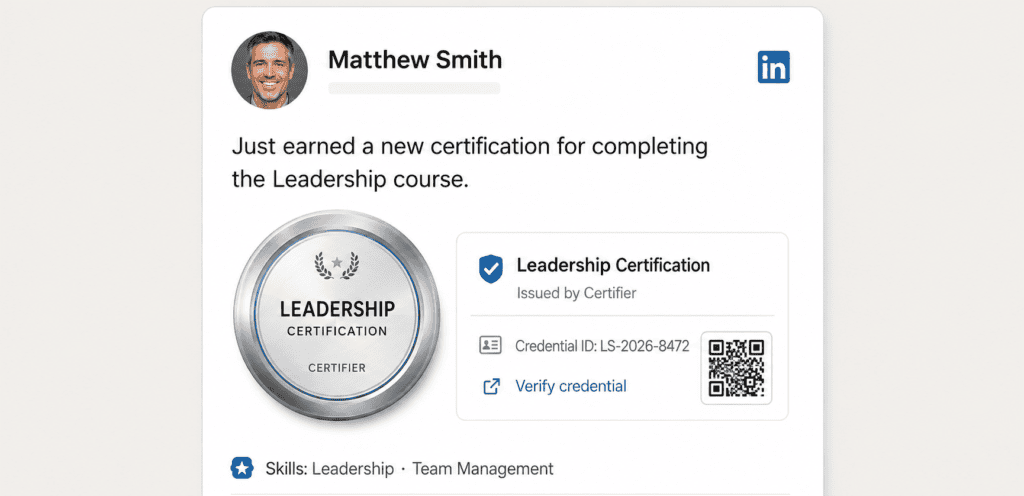
A digital badge is a verified electronic credential that represents specific skills, achievements, or competencies. Designed for easy sharing across digital platforms—such as LinkedIn, personal portfolios, and email signatures—a digital badge contains embedded metadata that allows employers to instantly verify its authenticity.
When clicked, a digital badge provides transparent proof of your abilities by displaying:
- Skill or Competency Earned: The exact proficiency or knowledge set validated.
- Assessment Criteria: How the skill was evaluated (e.g., project, practical exam, or quiz).
- Issuer Details: Who issued the digital badge and the date of issuance.
- Evidence & Standards: Direct links to completed work or criteria met (where supported).
Modern digital badges typically follow the Open Badges standard (maintained by 1EdTech/IMS Global), making them interoperable, portable, and machine-readable across learning systems. Advanced standards like Open Badges 3.0 build on W3C Verifiable Credentials to provide even stronger security and cryptographic proof against fraud.
Why Digital Badges Matter Digital badges convert abstract resume claims (e.g., “Proficient in Python”) into interactive, verifiable proof that hiring managers can click to validate in real time.
What Is a Certificate?
A certificate (or professional certificate) is an educational credential awarded upon completing a defined course, workshop, or curriculum. It signals that you received formal instruction in a specific subject and met the provider’s stated learning outcomes.
Unlike interactive digital badges, which store detailed skill metadata, a certificate primarily serves as proof of course completion.
Key Features of a Certificate:
- Issuing Body: Awarded by universities, colleges, corporate training providers, or online learning platforms.
- Proof Provided: Confirms course attendance, participation, and completion of required modules.
- Format & Verification: Typically delivered as a printable PDF or paper document. While some digital certificates include a basic verification link, they lack the granular, machine-readable metadata native to digital badges.
- Expiration: Generally permanent and does not expire, unless tied to a rapidly evolving technology or specific institutional policy.
Where Certificates Fit
Certificates are ideal for demonstrating structured learning and commitment to professional development—especially when earned from reputable institutions. However, unlike industry certifications or verified digital badges, a certificate proves you completed a course, not necessarily that you passed a rigorous, independent standard of competency.
What Is a Certification?
A certification is a formal, third-party attestation that proves you meet a defined professional or industry standard. Unlike a basic course certificate, a certification is typically awarded by an independent body after you pass a rigorous exam and, in many cases, fulfill specific prerequisite work experience.
Many modern certifying authorities now issue digital badges alongside paper credentials, allowing credential holders to easily display their certified status online with embedded verification data.
Key Characteristics of a Certification:
- Primary Purpose: Validates job-ready competency against an established industry standard, rather than just tracking course completion.
- Issuing Authority: Awarded by independent certifying organizations and industry leaders (e.g., CompTIA, PMI, AWS, Microsoft, Cisco, HRCI).
- Requirements: Requires passing standardized proctored exams; often mandates proven work experience or background prerequisites.
- Renewal & Expiration: Usually time-limited (e.g., valid for 2–3 years) and requires continuing education units (CEUs) or recertification exams to maintain.
- Third-Party Accreditation: Premier certification programs are often accredited by governing bodies like ANSI or NCCA, ensuring strict quality control and institutional trust.
The Value of Certifications
Certifications serve as gold-standard hiring signals for employers—especially in technical, regulated, or highly standardized fields. When paired with shareable digital badges, professionals can instantly prove their certified expertise to recruiters and hiring managers online.
Accreditation vs. Certification vs. Certificate (Don’t Mix These Up)
These three terms are frequently conflated, but they serve entirely distinct roles in education and hiring. Understanding the difference helps you evaluate which credentials—and their accompanying digital badges—carry real weight in the job market.
- Accreditation: Validates the institution or program. It is a formal quality review by an accrediting agency confirming that a school, university, or training provider meets rigorous educational standards.
- Certification: Validates you as a professional. Issued by an independent industry body, it proves your real-world competency against a published standard—usually verified by a proctored exam. Modern certifications are almost always accompanied by digital badges for instant online validation.
- Certificate: Validates course completion. It confirms that you attended instruction and completed a specific curriculum, but it does not necessarily test independent, job-ready mastery against an industry standard.
The Bottom Line
Accreditation validates the provider, certification validates your competence, and a certificate shows you finished the training. When represented as digital badges, both certificates and certifications become far easier for employers to verify on your CV or LinkedIn profile.
Digital Badges vs. Certificates vs. Certifications: A Direct Comparison
Understanding how digital badges, certificates, and certifications stack up across requirements, credibility, and career value helps you determine which credential aligns best with your professional goals.
| Dimension | Digital Badges | Certificates | Certifications |
| What It Proves | Specific skill, micro-achievement, or granular competency. | Completion of a structured course or educational program. | Mastery of skills measured against an industry/professional standard. |
| How It’s Earned | Complete a module, pass an assessment, or demonstrate a skill. | Finish required coursework and training modules. | Pass a proctored exam (often with prerequisite experience and ongoing CEUs). |
| Issuing Bodies | Universities, employers, online platforms, and professional bodies. | Educational institutions, training providers, and platforms. | Independent professional associations, certifying bodies, and industry leaders. |
| Verification Method | Clickable link with embedded metadata and evidence links (Open Badges). | Typically a PDF or paper document; online verification varies. | Registry lookup or verification ID; often requires strict identity checks. |
| Granularity | Fine-grained (single skill, micro-credential, or project milestone). | Broad (full course or multi-week curriculum). | Role- or domain-level professional competency. |
| Expiration & Renewal | Varies by issuer; many digital badges remain perpetual. | Usually perpetual (does not expire). | Time-limited (typically valid for 2–3 years) with recertification requirements. |
| Employer Perception | Rapidly growing trust due to verifiable metadata and transparency. | Trusted for formal learning; weight depends on the provider’s brand. | Gold standard; frequently used as an initial hiring filter for technical roles. |
| Best Use Case | Showcasing specific skills, stacking micro-credentials, and portfolio building. | Documenting continuing professional development (CPD) and structured study. | Proving job-ready competency, satisfying job requirements, and salary negotiation. |
When to Choose a Digital Badge
Opting for a digital badge makes strategic sense when speed, skill-specific proof, and online visibility take priority over traditional multi-year degree credentials.
Key Scenarios to Earn a Digital Badge:
- Showcase Niche or Emerging Skills Quickly: Earn a digital badge for specialized technical capabilities or introductory frameworks (e.g., Prompt Engineering Basics, AWS Cloud Practitioner Intro) without committing to long academic programs.
- Build Stackable Micro-Credentials: Accumulate skill-specific digital badges over time to create a modular, visual portfolio that recruiters can scan instantly on your CV or profile.
- Enable One-Click Online Verification: Easily attach a digital badge to your LinkedIn profile, personal website, or email signature so hiring managers can click to verify your skills in real time.
- Highlight Short-Form Achievements: Demonstrate active engagement in specialized workshops, hackathons, or short corporate courses where issuing a full certificate would be overkill.
Limitations of Digital Badges to Keep in Mind
While digital badges offer unmatched portability and speed, they come with a few trade-offs:
- Varying Issuer Rigor: The credibility of a digital badge depends heavily on the issuing organization. A badge from a globally recognized brand (e.g., AWS, Microsoft) carries significantly more weight than one from an unverified provider.
- Employer Perception Gaps: Traditional industries still prioritize accredited college degrees and formal professional certifications over micro-credentials and standalone digital badges.
- Standardization Differences: Not every digital badge issuer uses the Open Badges standard. Always verify that your digital badge includes verifiable metadata and accessible evidence links to ensure machine readability across hiring platforms.
When to Choose a Certificate
A certificate is your best option when you want to document formal, structured study without sitting for high-stakes professional certification exams.
Key Scenarios to Choose a Certificate:
- Document Structured Learning: Provide tangible proof of completing multi-week academic courses or programs from a university, college, or reputable educational platform.
- Support Career Transitions: Demonstrate a clear commitment to pivoting industries by completing a comprehensive foundation curriculum (e.g., a Data Analytics Professional Certificate).
- Fulfill CPD and Internal Requirements: Satisfy Continuing Professional Development (CPD) or corporate compliance training where tracking course completion matters more than third-party competency testing.
Limitations of Certificates to Keep in Mind
While certificates show dedication to learning, they differ from independent certifications and interactive digital badges in key ways:
- Attainment vs. Performance: A certificate proves you were taught the material and met the learning requirements, but it does not independently test whether you have job-ready, practical competency under exam conditions.
- Heavy Issuer Bias: The hiring weight of a certificate rests almost entirely on the institution’s brand reputation and the curriculum’s real-world relevance.
- Marketing Ambiguity: Many online platforms market “certificate programs” as if they are industry certifications. Unlike verified digital badges or official certifications, standard certificates rarely include embedded metadata or third-party exam proctoring.
When to Choose a Certification
A certification is your best option when you need to prove high-level, job-ready mastery to recruiters and hiring managers—especially in technical, safety-critical, or regulated industries.
Key Scenarios to Choose a Certification:
- Prove Job-Ready Competency: Demonstrate that your skill set meets strict, independent standards through proctored exams rather than simple course completion.
- Satisfy Explicit Job Requirements: Qualify for roles that list mandatory credentials (e.g., AWS Solutions Architect, PMP, CISSP, CCNA).
- Unlock Higher Earning Potential: Position yourself for promotions, higher salary bands, and career mobility, as certified professionals frequently command higher compensation.
- Signal Long-Term Dedication: Demonstrate a commitment to staying current in your field by fulfilling ongoing recertification and continuing education units (CEUs).
Limitations of Certifications to Keep in Mind
While certifications offer the highest degree of trust, they require a significant upfront and ongoing investment:
- High Financial and Time Commitment: Certifications demand substantial study time and carry costs for exam fees, prep materials, and retakes.
- Maintenance and Renewal Demands: Unlike standard certificates or perpetual digital badges, certifications expire (typically every 2–3 years) and require ongoing maintenance fees or continuing education units to stay active.
- Varying Industry Recognition: The weight of a certification depends entirely on its market reputation. Always verify whether the credential is independently accredited (e.g., via NCCA or ANSI) and whether the provider issues verifiable digital badges so employers can easily confirm your active certified status.
How Employers Actually Evaluate These Credentials
While adoption of skills-based hiring continues to accelerate, hiring managers weigh each credential type differently based on risk, job level, and verification speed:
- Certifications act as hard candidate filters. Recruiters often treat industry-standard certifications (e.g., AWS, PMP, CISSP, CompTIA) as mandatory prerequisites. In regulated or technical fields, holding an active certification instantly moves a candidate past ATS screeners.
- Certificates support your professional narrative. Course completion certificates from recognized universities or major learning platforms signal curiosity, initiative, and structured self-improvement, helping back up resume claims during behavioral interviews.
- Digital badges provide dynamic, clickable proof. A digital badge offers instant, low-friction validation. Instead of relying on self-reported resume bullets, recruiters can click a digital badge to view exact skills, rubrics, and project artifacts.
What Matters Most to Recruiters
When evaluating any credential, employers focus on three core variables:
- Issuer Reputation: Brand authority matters. A digital badge or certification backed by an industry leader (e.g., Google, Microsoft, PMI) carries vastly more weight than one from an unknown entity.
- Verification Speed: Recruiters spend seconds scanning applications. Digital badges built on Open Badges standards allow instantly clickable verification, reducing hiring friction.
- Assessment Rigor: Employers distinguish between attendance-based credentials and performance-based achievements. Proctored exams, real-world portfolio projects, and rigorous assessments signal actual competence over passive completion.
How Employers Actually Evaluate These Credentials
While adoption of skills-based hiring continues to accelerate, hiring managers weigh each credential type differently based on risk, job level, and verification speed:
- Certifications act as hard candidate filters. Recruiters often treat industry-standard certifications (e.g., AWS, PMP, CISSP, CompTIA) as mandatory prerequisites. In regulated or technical fields, holding an active certification instantly moves a candidate past ATS screeners.
- Certificates support your professional narrative. Course completion certificates from recognized universities or major learning platforms signal curiosity, initiative, and structured self-improvement, helping back up resume claims during behavioral interviews.
- Digital badges provide dynamic, clickable proof. A digital badge offers instant, low-friction validation. Instead of relying on self-reported resume bullets, recruiters can click a digital badge to view exact skills, rubrics, and project artifacts.
What Matters Most to Recruiters
When evaluating any credential, employers focus on three core variables:
- Issuer Reputation: Brand authority matters. A digital badge or certification backed by an industry leader (e.g., Google, Microsoft, PMI) carries vastly more weight than one from an unknown entity.
- Verification Speed: Recruiters spend seconds scanning applications. Digital badges built on Open Badges standards allow instantly clickable verification, reducing hiring friction.
- Assessment Rigor: Employers distinguish between attendance-based credentials and performance-based achievements. Proctored exams, real-world portfolio projects, and rigorous assessments signal actual competence over passive completion.
Practical Steps: Choosing the Right Credential for Your Goals
Selecting the right credential depends on your career stage, budget, and target industry. Follow this action plan to select, evaluate, and display credentials effectively:
Clarify Your Core Objective
- Targeting an immediate job transition? Prioritize industry-recognized certifications that show up as requirements in target job descriptions.
- Exploring new fields or upskilling? Begin with structured certificates or earned digital badges to build baseline knowledge without a major financial commitment.
- Building a skill-first portfolio? Collect and stack micro digital badges that highlight specific technical abilities and real-world project completions.
Evaluate Issuer Authority and Technical Standards
- For Certifications: Confirm the certifying body carries strong industry standing and, ideally, accredited oversight (such as NCCA or ANSI).
- For Digital Badges: Verify the issuer uses Open Badges standards (like Open Badges 3.0) to ensure embedded metadata and direct project evidence links remain machine-readable for employers.
- For Certificates: Assess the reputation of the issuing university, corporate training provider, or online learning platform.
Reverse-Engineer Job Market Demand
- Review 10–15 current job descriptions in your target field.
- Note mandatory vs. preferred credentials. If a specific certification is listed consistently under “Requirements,” prioritize it first.
- Identify recurring skill keywords and select digital badges or certificate modules that map directly to those gaps.
Factor in Cost, Time Commitment, and Expiration
- Certifications: Require higher upfront exam fees, rigorous prep time, and ongoing maintenance fees or continuing education units (CEUs).
- Certificates: Range from short, low-cost online courses to multi-month executive programs.
- Digital Badges: Offer the fastest, most affordable way to validate individual skills and build a modular portfolio.
Display Credentials Strategic Placement
- Certifications: List under a dedicated “Certifications” section on your CV, including the issuing authority, date, and license/credential ID.
- Certificates: Feature under “Education” or “Professional Development” with the course title, institution, and completion date.
- Digital Badges: Feature interactive digital badges in your LinkedIn profile’s “Licenses & Certifications” section, embed them in your digital portfolio, and add clickable verification links to your email signature.
For Employers: How to Use These Credentials in Hiring
As skills-based hiring replaces rigid degree requirements, credentials provide hiring managers with clear, objective indicators of ability. Incorporating certifications, certificates, and digital badges into your recruitment workflow streamlines candidate screening while opening pipelines to non-traditional talent.
Treat certifications as high-signal competency baselines. Leverage accredited, industry-standard certifications as hard filters during initial ATS screening to instantly confirm candidate readiness in technical or regulated roles.
Leverage digital badges to evaluate specialized skill sets. Use digital badges to evaluate candidates from non-traditional or self-taught backgrounds. A digital badge offers verifiable insight into targeted skills, micro-credentials, and specific tool proficiencies that traditional CVs often omit.
Verify credentials directly via metadata links. Eliminate reliance on self-reported resume claims. Inspect embedded metadata in digital badges or check issuer registries to verify issue dates, skill rubrics, and issuing authority authenticity in seconds.
Combine credentials with practical work samples. Treat credentials as proof of knowledge, but pair them with brief, role-specific technical assessments or portfolio reviews to evaluate practical execution before extending an offer.
Is a digital badge the same as a digital certificate?
No. A digital badge is a fine-grained, metadata-enriched credential that verifies specific micro-skills or accomplishments. A digital certificate is a document-style award confirming completion of an entire curriculum or program. Many modern providers issue both: digital badges for incremental milestones and certificates for full course completion.
Do digital badges really help with getting a job?
Yes, particularly in skills-based hiring environments. Digital badges add measurable value when they are issued by reputable organizations, backed by clear assessment criteria, and mapped to high-demand industry skills.
While a digital badge rarely replaces a degree or professional certification, it provides clickable, transparent proof of your abilities on platforms like LinkedIn.
Can a certificate become a certification?
Not automatically. A certificate merely confirms you completed coursework. A certification requires passing an independent assessment against a formal industry standard, typically governed by a professional body. Completing a certificate program may prepare you for a certification exam, but the certificate itself is not a certification.
How do I verify a digital badge or certification?
Digital Badges: Click the digital badge link or image to view embedded Open Badges metadata, including issuer identity, earning criteria, and portfolio evidence.
Certifications: Query the issuing body’s official public registry or verification portal using the candidate’s name or credential ID.
Certificates: Access the training provider’s unique URL verification page or contact their registrar directly.
Which credential should I get first?
Let target job listings guide your decision. If open roles in your field explicitly mandate a proctored credential (e.g., AWS, PMP), prioritize that certification first. If you are exploring a new field, building a skill portfolio, or upskilling on a budget, begin by earning short-form certificates and verifiable digital badges.
In Conclusion
Navigating modern career credentials comes down to matching the right validation format with your specific goal:
- Digital Badges: Verifiable, shareable proof of specific skills and micro-credentials.
- Certificates: Documented evidence that you completed a structured course or academic program.
- Certifications: Rigorous, third-party validation of job-ready competency against a recognized industry standard (typically requiring proctored exams and ongoing renewal).
Your Next Strategic Step
Identify one target role you want, scan 5 to 10 real job postings, and list the credentials and tool proficiencies that appear most frequently. From there, select a single high-value industry certification—or choose a reputable certificate and digital badge learning path—that directly bridges your biggest skill gap.