H-1B Visa Sponsorship vs Green Card: A Complete Comparison
For professionals navigating the U.S. labor market, understanding the strategic differences between temporary and permanent status is vital. This guide provides a high-leverage comparison between H-1B visa sponsorship and the employment-based Green Card to help you map your long-term career trajectory.
H-1B visa sponsorship is a temporary, non-immigrant work authorization where a U.S. employer petitions for a foreign professional in a “specialty occupation.” Because it is tethered to a specific employer and role, it serves as a talent gateway but carries inherent operational constraints.
In contrast, an employment-based Green Card grants lawful permanent residency. While an H-1B visa is typically limited to a six-year duration and is employer-dependent, a Green Card provides indefinite work authorization and mobility across employers.
Strategic Comparison Framework
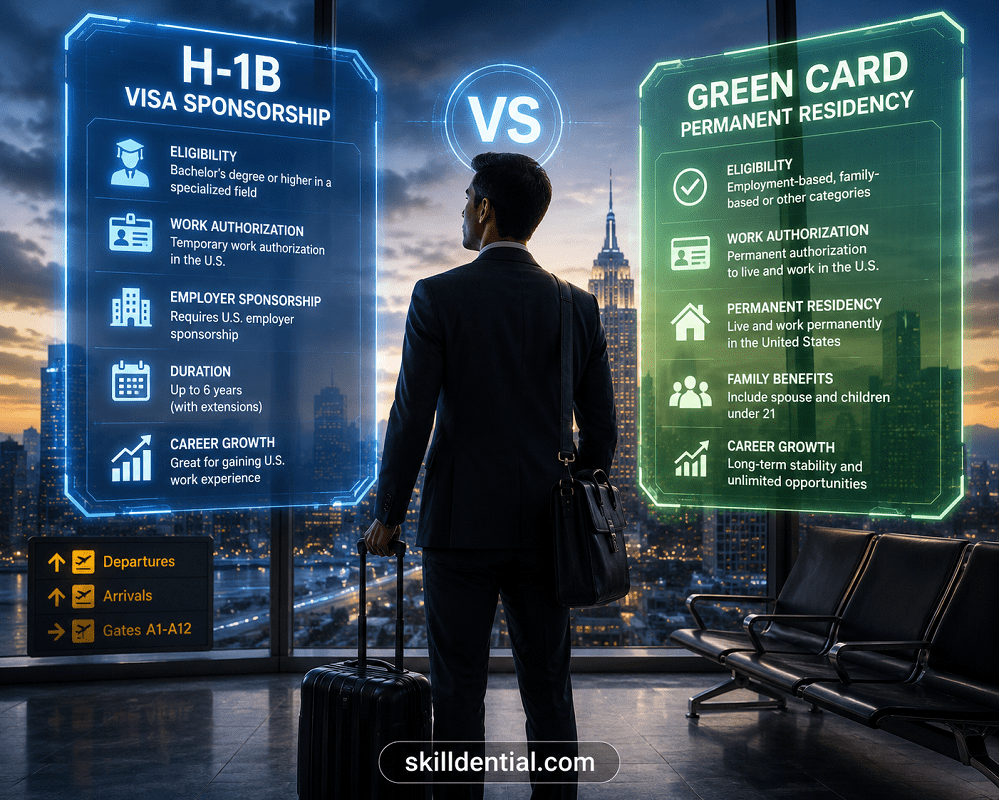
Understanding the transition path is essential for those balancing immediate employment needs with long-term professional sovereignty.
| Feature | H-1B Visa Sponsorship | Employment-Based Green Card |
| Status Type | Nonimmigrant (Temporary) | Immigrant (Permanent) |
| Duration | Fixed (Typically 6 years) | Indefinite |
| Employer Dependency | High (Employer-Sponsored) | Low (Self, Employer, or Family) |
| Eligibility | Bachelor’s Degree Minimum | Category-Specific (EB-1, EB-2, EB-3) |
By evaluating these paths through a career-growth lens, you can decide whether to prioritize H-1B visa sponsorship for immediate entry into a role or align your profile for the permanent stability of a Green Card.
What is H-1B Visa Sponsorship and How Does It Work?
H-1B visa sponsorship is the mechanism by which a U.S. employer petitions the government to hire a foreign professional in a “specialty occupation”—a role that typically requires a bachelor’s degree or higher in a specific field. Because the H-1B is a nonimmigrant visa, the employment is temporary and strictly tethered to the sponsoring employer.
The employer is legally obligated to ensure the role qualifies as a specialty occupation and must attest to paying the higher of the actual wage (paid to similarly situated employees) or the prevailing wage (determined by the Department of Labor) for that occupation in the area of intended employment.
The Operational Process
The H-1B process is highly regulated and follows a specific sequence. As of 2026, the selection process incorporates a wage-level weighted system to prioritize higher-wage positions.
- LCA Certification: The employer must first obtain a certified Labor Condition Application (LCA) from the Department of Labor. This confirms their commitment to fair wages and workplace standards.
- Electronic Registration: Employers submit prospective beneficiary information through the USCIS online system during the designated registration window (typically in March).
- Lottery Selection: USCIS conducts a selection process. To prioritize higher-skilled/higher-compensated roles, registrations are weighted by the Department of Labor’s prevailing wage level (Level I = 1 entry; Level IV = 4 entries).
- Petition Submission: If selected, the employer has a specific window (usually 90 days) to submit a formal Form I-129 petition to USCIS.
- Adjudication: USCIS reviews the petition to ensure all requirements are met. Standard processing currently takes 8–10.5 months, though petitioners can opt for Premium Processing to receive a decision within 15 business days for an additional fee.
- Visa Issuance/Change of Status: Once approved, beneficiaries already in the U.S. may change their status, while those abroad must typically apply for an H-1B visa stamp at a U.S. embassy or consulate before entry.
Note on Caps: The annual limit remains 85,000 total visas: 65,000 for the general cap and 20,000 reserved for individuals with a U.S. master’s degree or higher.
What is an Employment-Based Green Card and How Does It Work?
An employment-based Green Card grants you lawful permanent residency in the United States, providing the freedom to live and work indefinitely without the employer-specific restrictions tied to H-1B visa sponsorship. Unlike the temporary nature of H-1B, this status is intended for long-term residency and is a direct pathway to potential U.S. citizenship.
While the requirements vary by preference category (EB-1, EB-2, or EB-3), the process is designed to prove that the hiring of a foreign national is necessary and does not adversely affect the U.S. labor market.
The Employment-Based Green Card Process
The timeline for this process is highly dependent on your country of birth and the specific category, as visa availability is subject to numerical limits managed by the State Department’s monthly Visa Bulletin.
- PERM Labor Certification (Most EB-2/EB-3 cases):
- Market Testing: The employer must conduct a rigorous recruitment process to demonstrate that no qualified, willing, or able U.S. workers are available for the position.
- DOL Submission: Once recruitment is complete, the employer files Form ETA-9089 with the Department of Labor.
- Note: EB-1 applicants and those eligible for a National Interest Waiver (NIW) in the EB-2 category skip this step.
- Form I-140 Immigrant Petition:
- Once the PERM is certified, the employer files Form I-140 with USCIS to classify you under a specific employment-based preference category.
- This step establishes your Priority Date, which effectively acts as your place in line for a Green Card.
- Form I-485 Adjustment of Status:
- When your Priority Date is current (per the Final Action Dates in the Visa Bulletin), you may file Form I-485 to adjust your status to that of a lawful permanent resident.
- As of June 2026, processing times for this final stage are currently estimated between 9 and 42.5 months, depending on your specific case strength and USCIS office workload.
Quick Comparison: H-1B vs. Green Card
| Feature | H-1B Visa Sponsorship | Employment-Based Green Card |
| Duration | Temporary (Max 6 years) | Indefinite |
| Employer Mobility | Restricted (Tethered) | High (Freedom to change) |
| PERM Requirement | No | Required (For most cases) |
| Pathway to Citizenship | No (Must transition to GC) | Yes |
What Are the Key Differences Between H-1B and Green Card?
The transition from H-1B visa sponsorship to a permanent Green Card represents the most critical strategic pivot in a U.S. professional career. While both pathways provide work authorization, they differ fundamentally in terms of legal permanence, employer flexibility, and long-term security.
Purpose and Duration
| Feature | H-1B Visa Sponsorship | Green Card |
| Status Type | Temporary nonimmigrant | Permanent resident |
| Duration | Up to 6 years total | Indefinite |
| Extension | Requires employer sponsorship | No extension needed |
Employment Rights and Flexibility
- Job Mobility: H-1B visa sponsorship is strictly tied to the specific employer who filed the petition. Any change in employer requires the new company to file a new petition. A Green Card grants you the freedom to work for any employer, change roles, or even start a business without impacting your immigration status.
- Unemployment: Losing a job on an H-1B creates a 60-day grace period to find new sponsorship or change status; otherwise, you must leave the U.S. Green Card holders have no such employment requirement.
- Career Flexibility: With a Green Card, you have no restrictions on promotions or lateral moves. H-1B holders often face hurdles during promotions, as significant changes to the job description may necessitate filing an amended petition.
Path to Citizenship and Family Benefits
- Citizenship Path: H-1B visa sponsorship provides no direct path to citizenship. It is a dual-intent visa that allows you to pursue permanent residency while in the U.S. A Green Card is the prerequisite for naturalization, making you eligible for U.S. citizenship after five years of continuous residency.
- Family Sponsorship: Dependents of H-1B holders receive H-4 status. Crucially, H-4 spouses cannot work unless they independently qualify for an Employment Authorization Document (EAD), typically requiring the H-1B holder to have an approved I-140. Green Card holders can sponsor certain family members for permanent residency, facilitating long-term family unity.
- Travel Freedom: H-1B holders must maintain a valid visa stamp in their passport to re-enter the U.S. after international travel. Green Card holders travel freely and re-enter using their Permanent Resident Card, provided they do not abandon their U.S. residency.
Strategic Takeaway
For many, H-1B visa sponsorship is the entry vehicle into the U.S. market, while the Green Card is the goal for long-term career autonomy. If your objective is professional sovereignty, your roadmap should focus on transitioning from your initial H-1B visa sponsorship to a permanent category (EB-1, EB-2, or EB-3) as early as your credentials allow.
How Do Eligibility Requirements Compare?
Understanding the distinct eligibility frameworks for H-1B visa sponsorship versus an employment-based Green Card is the first step in long-term career strategy. While the H-1B focuses on the immediate, temporary requirements of a specific “specialty occupation,” the employment-based Green Card evaluates your professional profile against broader, hierarchical categories of merit and necessity.
H-1B Visa Sponsorship Eligibility
The H-1B is a nonimmigrant classification designed for temporary roles. Eligibility is contingent on the intersection of your credentials and the specific job offer.
- Specialty Occupation Requirement: The role must demand the theoretical and practical application of highly specialized knowledge, typically requiring at least a bachelor’s degree.
- Educational Foundation: You must hold a U.S. bachelor’s degree or its foreign equivalent in a directly related field.
- The “3-for-1” Rule: In the absence of a degree, USCIS may accept 12 years of progressive professional experience as the equivalent of a 4-year degree, though this route is subject to intense scrutiny.
- Employer Commitment: A U.S. employer must file a Labor Condition Application (LCA) with the Department of Labor, attesting to fair wage practices.
- Cap-Subject vs. Cap-Exempt: Most private-sector roles are subject to the annual 85,000 lottery (65,000 standard + 20,000 for U.S. master’s graduates). Exempt roles (universities, research non-profits) are not subject to this cap.
Employment-Based Green Card Eligibility (EB Categories)
Unlike the temporary H-1B, Green Card categories are ranked by preference, which dictates priority for visa availability.
| Category | Primary Target | Key Requirement |
| EB-1 | Extraordinary ability; outstanding researchers/professors; multinational managers. | Exceptional merit; no labor certification required. |
| EB-2 | Professionals with advanced degrees (Master’s+) or exceptional ability. | PERM labor certification required (unless National Interest Waiver applies). |
| EB-3 | Skilled workers (2+ years experience), professionals (Bachelor’s), or “other workers.” | PERM labor certification mandatory. |
- The “Priority Date” Factor: Your eligibility is only half the battle. Because visa numbers are limited annually, your Priority Date (established when your PERM or I-140 is filed) determines when you can apply for the final stage (I-485).
- Backlog Realities: As of June 2026, applicants from high-demand countries (e.g., India, China) face significant backlogs, meaning that even if you meet the eligibility criteria, you may wait years for your priority date to become “current” before you can receive your Green Card.
Strategic Summary: Which Path Fits You?
- Choose H-1B Visa Sponsorship if: You are seeking immediate entry into the U.S. market, have secured a job offer in a specialty occupation, and need a reliable, though temporary, work authorization.
- Choose Employment-Based Green Card if: You have established a career trajectory and are looking for permanent sovereignty. If your profile fits EB-1 or EB-2 (especially with an NIW), you may be able to bypass the employer-tethered bottlenecks of the H-1B.
How Do Application Processes Differ?
The application processes for H-1B visa sponsorship and employment-based Green Cards are fundamentally different in scope, intensity, and strategic objective. While the H-1B is an annual, lottery-based race to secure temporary work authorization, the employment-based Green Card (EB-2/EB-3) is a long-term, rigorous verification of labor market necessity.
Comparative Application Timelines
| Stage | H-1B Visa Sponsorship | Employment-Based Green Card (EB-2/EB-3) |
| Primary Goal | Temporary Work Authorization | Permanent Residency |
| Market Testing | None (LCA Wage Attestation) | Required (PERM Recruitment) |
| Key Variable | Annual Lottery (Luck) | Visa Bulletin Priority Date (Backlog) |
| Processing Time | ~12–15 months (Inc. Prep) | 2–5+ years (Country dependent) |
Process Breakdown
H-1B Visa Sponsorship: The “Lottery” Model
The H-1B process is designed for speed and flexibility, but it is constrained by annual caps.
- The “Bottleneck”: The annual lottery is the most significant hurdle. Even with a perfect petition, selection is not guaranteed.
- Focus: Speed to entry. The emphasis is on proving the role qualifies as a “specialty occupation” and ensuring the employer meets prevailing wage requirements.
- Premium Processing: Available for the I-129 petition, allowing for a decision within 15 business days if the lottery selection is successful.
Employment-Based Green Card: The “Market-Proof” Model
This process is a strategic demonstration that the hiring of a foreign national will not displace a qualified U.S. worker.
- The PERM Requirement: Before filing with USCIS, the employer must conduct a mandatory recruitment campaign. This requires advertising the position and documenting that no qualified, willing, or able U.S. workers were available—a process that can take 12–18 months.
- The Priority Date: Your place in the “line” is determined by your Priority Date (usually the date the PERM or I-140 is filed). For applicants from countries like India or China, this creates a multi-year backlog that is independent of your case’s merits.
- Adjustment of Status: The final stage (I-485) can only occur once your Priority Date is “current” per the monthly Visa Bulletin.
Strategic Considerations
- Bridging the Gap: Many professionals utilize H-1B visa sponsorship to start working in the U.S. while simultaneously initiating the Green Card process.
- Extension Benefits: Filing a PERM or I-140 petition before the end of your fifth year of H-1B status is a critical lever. It allows you to extend your H-1B beyond the standard six-year maximum, effectively providing a “bridge” until your Green Card priority date becomes current.
Are you preparing a roadmap for your own transition, or are you evaluating these timelines for a broader career strategy guide?
How Do Processing Times Compare in 2026?
As of mid-2026, the contrast between the H-1B and the employment-based Green Card remains stark, primarily due to the difference between temporary work authorization and permanent immigration pathways. While premium processing provides predictable timelines for both, the overall Green Card journey is heavily influenced by the Department of State’s Visa Bulletin backlogs.
Comparative Processing Metrics (2026)
| Process Stage | H-1B Visa Sponsorship | Green Card (EB-2/EB-3) |
| Standard Processing | 4 – 19.5 months | 2.5 – 35 months (I-140/I-485 combined) |
| Premium Processing | 15 business days ($2,965) | 15 or 45 business days ($2,965) |
| Market/Line Wait | Annual cap-based lottery | 0 – 10+ years (Country-specific backlog) |
| I-485 Adjustment | N/A | 9 – 35 months |
Key Strategic Realities
- The H-1B Advantage: The H-1B remains the fastest mechanism for immediate work authorization. While the annual cap-based lottery introduces uncertainty, once selected, premium processing guarantees an adjudicative action (approval, denial, or Request for Evidence) within 15 business days.
- The Green Card “Pipeline”: The employment-based Green Card is not a single process but a phased pipeline.
- PERM Certification: This DOL-led stage is the most significant time sink, often taking 12–24 months for recruitment and analyst review.
- I-140 Adjudication: You can accelerate this specific step to 15 or 45 business days using premium processing, which is highly recommended to secure your Priority Date and unlock H-1B extension eligibility.
- The Visa Bulletin: This is the variable that defies “processing times.” Even with an approved I-140, you cannot file your I-485 or receive your Green Card until your Priority Date is “current.” For nationals from India and China, this wait can span a decade or more.
Strategy Recommendation
For the high-level professional, the “bottleneck” is rarely the USCIS processing time itself—it is the PERM requirement and the Visa Bulletin.
Expert Insight: Leverage H-1B visa sponsorship as your immediate career vehicle, but initiate the PERM/I-140 process as early as possible. Filing the I-140 before the end of your fifth year of H-1B status is the primary leverage point, as it grants you the ability to extend your H-1B indefinitely while you wait for your Priority Date to become current.
How Do Costs Compare for Employer and Employee?
As of June 2026, the cost landscape has shifted significantly. Most notably, the $100,000 Presidential Proclamation fee for new H-1B petitions—which had been a major point of fiscal uncertainty—was invalidated by a federal court on June 8, 2026. While the administration has signaled an intent to appeal, the fee is not currently enforceable.
H-1B Visa Sponsorship Cost Profile
The H-1B remains a lower-barrier entry point, primarily because it lacks the labor market testing (recruitment) required for Green Cards.
| Fee Type | Employer (1–25 employees) | Employer (26+ employees) |
| Registration Fee | $215 | $215 |
| I-129 Base Fee | $460 | $780 |
| ACWIA Training Fee | $750 | $1,500 |
| Fraud Prevention Fee | $500 | $500 |
| Asylum Program Fee | $300 | $600 |
| Total (Base) | $2,225 | $3,595 |
- Employee/Variable Costs: The DS-160 visa application fee is $185. Optional Premium Processing (Form I-907) is $2,965 for both employer sizes. Attorney fees typically range from $3,000 to $5,500.
Employment-Based Green Card Cost Profile
The Green Card process is substantially more expensive, not due to government filing fees alone, but because of mandatory recruitment and advertising costs for the PERM Labor Certification.
| Fee Type | Responsibility | Estimated Cost |
| PERM Advertising | Employer | $2,000 – $5,000 |
| I-140 Petition | Employer | $715 |
| I-485 Adjustment | Employee | $1,440 |
| Asylum Program Fee (I-140) | Employer | $300 – $600 |
| Premium Processing (I-907) | Employer/Employee | $2,965 |
- Strategic Note: Because the PERM process requires the employer to prove they cannot find a qualified U.S. worker, the hidden costs often include third-party advertising services and legal consultation time, which can exceed $5,000+ in total overhead.
Key Financial Takeaways for 2026
- Proclamation Status: The $100,000 fee is currently vacated. However, because the administration is appealing, you should maintain a fiscal buffer or legal contingency plan if you are currently filing for new, cap-subject H-1B petitions.
- Employer vs. Employee Responsibility: By law, mandatory employer fees (such as ACWIA and Fraud fees) cannot be passed to the employee. However, costs such as Premium Processing or the I-485 filing fee are often negotiated as part of an employment package or relocation agreement.
- Scaling Leverage: For Skilldential-aligned career planning, treat H-1B costs as “operational expenses” for immediate market entry, and Green Card costs as “capital investment” in long-term residency.
Benefits and Limitations: H-1B vs. Employment-Based Green Card
Selecting between H-1B visa sponsorship and an employment-based Green Card requires a strategic assessment of your current career stage and long-term residency objectives.
H-1B Visa Sponsorship
The H-1B is the standard nonimmigrant vehicle for immediate U.S. market entry. Its primary value is speed, while its core limitation is the structural dependency on a single employer.
- Benefits:
- Speed to Authorization: Significantly faster to obtain than a Green Card (typically <1 year total process).
- Dual Intent: You may legally pursue permanent residency while holding an H-1B, facilitating a seamless transition between statuses.
- Lower Upfront Cost: Avoids the expensive, months-long mandatory recruitment (PERM) required for most Green Card paths.
- Limitations:
- Employer Tether: Status is strictly tied to the sponsoring employer. Job mobility is restricted; changing employers requires a new, cap-subject petition in most cases.
- Duration Cap: Maximum of 6 years (unless you have a pending/approved PERM or I-140).
- Lottery Uncertainty: The annual cap-based lottery creates significant unpredictability for both the employer and the employee.
Employment-Based Green Card
The Green Card represents professional sovereignty. While the process is slow and costly, it removes the “tether” of employer sponsorship.
- Benefits:
- Permanent Mobility: Grants indefinite right to live and work in the U.S. with total freedom to change employers, roles, or start a business.
- Direct Path to Citizenship: Eligibility for U.S. naturalization after 5 years of continuous residency.
- Family Security: Greater stability for dependents and the ability to sponsor additional family members for permanent residency.
- Limitations:
- High Complexity & Cost: Requires mandatory market testing (PERM) where the employer must prove no qualified U.S. worker is available—a process that often takes 12–24 months.
- Visa Bulletin Backlogs: For professionals born in high-demand countries (e.g., India, China), Priority Date backlogs can result in waits spanning a decade or more, regardless of the merit of the case.
- Maintenance Requirements: Permanent Resident status must be actively maintained; extended absences from the U.S. can lead to abandonment of status.
Strategic Summary
| Feature | H-1B Visa Sponsorship | Employment-Based Green Card |
| Status | Temporary (Nonimmigrant) | Permanent (Immigrant) |
| Job Mobility | Tied to Employer | Full Autonomy |
| Primary Hurdle | Annual Lottery | Visa Bulletin/PERM Recruitment |
| Typical Goal | Market Entry | Professional Sovereignty |
For most high-level professionals, the optimal strategy is to utilize H-1B visa sponsorship as an initial bridge for market access while simultaneously initiating the Green Card process—specifically aiming to file the I-140 petition before the end of the 5th year of H-1B status to unlock indefinite extension eligibility.
Which Option Best Fits Your Career Goals?
To determine the best fit for your career trajectory, assess your goals against your current professional standing. Use this framework to align your immediate entry strategy with your long-term sovereignty.
Strategic Decision Matrix
| Goal | Primary Path | Rationale |
| Rapid Market Entry | H-1B Visa | Fastest mechanism for legal employment in specialty occupations. |
| Professional Sovereignty | Green Card | Removes employer tether, enabling full career mobility. |
| Long-Term Stability | Green Card | Eliminates duration caps and status-loss risk. |
| Citizenship Ambitions | Green Card | Mandatory prerequisite for U.S. naturalization. |
Choosing the H-1B Visa
Select H-1B visa sponsorship if your immediate priority is establishing a footprint in the U.S. labor market. It is the optimal “bridge” for early-to-mid career professionals who require employer backing to settle in the U.S. and begin the multi-year process toward permanent residency.
- Best For: Individuals with a secured job offer in a specialty occupation who need to move quickly and can accept the constraints of employer dependency during the initial 3–6 year period.
- Strategic Move: Initiate the Green Card process (PERM/I-140) before your 5th year of H-1B status to unlock potential extensions beyond the 6-year maximum.
Choosing the Green Card
Select the employment-based Green Card path if your professional profile has matured to the point where you value long-term autonomy over immediate speed.
- Best For: Individuals seeking to transition away from employer-specific restrictions, entrepreneurs planning future ventures, or those who qualify for accelerated categories (EB-1).
- Strategic Move: If you qualify for EB-1 (Extraordinary Ability) or EB-2 National Interest Waiver (NIW), pursue these immediately. They allow you to bypass the PERM labor certification process, significantly shortening your timeline and removing the need for initial employer sponsorship.
Implementation Summary
- Map Your Profile: Identify if you fit EB-1/EB-2 NIW (Self-petition/No PERM) or EB-2/EB-3 (Employer-sponsored/PERM).
- Evaluate Timing: If you are from a high-backlog country (India/China), factor in a 5–10+ year horizon for the Green Card and prioritize securing a “current” priority date as your first objective.
- Leverage Dual Intent: Utilize your H-1B status as a safe harbor. It provides the legal “dual intent” environment necessary to stay in the U.S. while your Green Card application advances through the lengthy USCIS pipeline.
Which professional milestone are you currently aiming for: rapid entry into a new role, or transitioning toward permanent career sovereignty?
Common Misconceptions and Mistakes to Avoid
Navigating the U.S. immigration system requires precision. As of June 2026, the regulatory landscape is shifting, particularly regarding fees and USCIS discretion. Avoid these common pitfalls to ensure your professional stability.
Common Misconceptions
- “H-1B Status Hinders Green Card Processing”: * Fact: The H-1B is a “dual intent” visa. You have a statutory right to pursue permanent residency while holding H-1B status. However, a May 2026 USCIS policy memorandum now requires officers to treat the final adjustment of status as a matter of discretionary grace rather than an automatic entitlement. Even with a “clean” record, officers are now directed to weigh the totality of circumstances.
- “Green Cards Are Permanent Without Maintenance”:
- Fact: Permanent residency is not absolute. You must maintain physical residency in the U.S. and avoid prolonged absences. Failure to do so can result in a finding of abandonment of status. You must also renew your physical green card every 10 years.
- “The $100,000 H-1B Fee is Settled Law”:
- Fact: The fee was ruled unlawful by a federal court on June 8, 2026. While currently stayed by an administrative order pending appeal, the legal status remains volatile. Do not assume the fee is permanently gone or that it will not be reinstated. Consult counsel before assuming your specific petition is exempt.
Critical Mistakes to Avoid
- Assuming Employer Sponsorship: Never assume a company will automatically sponsor your Green Card. This is a business decision, not a legal requirement. Verify sponsorship policies during the interview stage.
- Starting the Green Card Process Too Late: If you rely on an employer for a Green Card, initiate the process at least two years before your H-1B expires. The PERM labor certification process alone can take 6–12 months, followed by the I-140 and I-485 stages.
- Ignoring Country-Specific Backlogs: If you were born in India or China, be aware of the multi-year (often 10+ year) wait for visa numbers to become “current” in the EB-2 and EB-3 categories. Your professional strategy must account for this timeline.
- Errors in Filing: USCIS is increasingly strict. Using outdated form editions, failing to provide complete recruitment documentation for PERM, or having inconsistencies in your employment history across different filings are common triggers for denials or Requests for Evidence (RFEs).
- Out-of-Order Filing: The employment-based Green Card follows a rigid sequence: PERM Labor Certification → I-140 Immigrant Petition → I-485 Adjustment of Status. Attempting to skip or combine these steps leads to automatic rejection.
Strategic Reminder
For high-level professionals, the primary objective is to file your I-140 petition before the end of your 5th year of H-1B status. This provides the legal basis to extend your H-1B indefinitely, protecting you from the 6-year cap while you wait for your Green Card priority date to become current.
The video above provides a detailed breakdown of common H-1B application errors, including issues with job descriptions and wage requirements, which are essential to understand when filing in the current fiscal year.
Practical Next Steps: A Strategic Roadmap
To bridge the gap between temporary work authorization and permanent residency, you must move from passive waiting to active pipeline management. Your strategy depends on your current location and residency status.
If You’re Not Yet in the U.S.
Your goal is to minimize reliance on the cap-subject lottery, which is statistically the biggest bottleneck for international talent.
- Target Cap-Exempt Employers: Prioritize universities, non-profit research organizations, and government research agencies. These entities are not subject to the 85,000 annual cap.
- Leverage Alternative Visas: Explore the O-1 (Extraordinary Ability) or L-1 (Intracompany Transfer). These visas have no annual lottery, providing a more stable path to entry.
- Build Digital Presence: Secure remote contracts with U.S.-based entities. This builds your “U.S. nexus,” making you a more attractive candidate for future H-1B sponsorship once you have established a professional reputation with a firm.
If You’re Already on H-1B
The “Year 3” rule is your most important benchmark. Initiate the conversation about permanent residency immediately.
- The Year 3 Pivot: Based on Skilldential data, initiating your PERM labor certification before the end of your 3rd year is the highest-leverage move. It allows enough buffer for potential PERM audits or recruitment delays before your 5th-year deadline.
- Master the Visa Bulletin: Monitor the U.S. Department of State Visa Bulletin monthly. Understand your Priority Date and exactly how many months/years you are from being “current.”
- Assess EB-1 Eligibility: If your profile has grown, conduct a gap analysis for EB-1 (Extraordinary Ability). Skipping the PERM process entirely is the fastest way to achieve professional sovereignty.
If You’re an Employer/HR Professional
Your role is to transition from reactive compliance to proactive talent retention.
- Audit Your Policy: Clearly define when your company initiates Green Card sponsorship (e.g., “after 12 months of employment”). Transparency here is a massive competitive advantage in hiring.
- Contingency Planning: Given the volatility of fees (such as the recent $100,000 fee litigation), build a fiscal reserve specifically for unexpected immigration policy shifts.
- Data-Driven Transitions: Use the 68% statistic—that most seekers struggle with timing—as a retention tool. By clearly mapping out an employee’s immigration roadmap, you significantly increase loyalty and reduce turnover.
Implementation Checklist: The Skilldential Framework
| Timeline | Action Item | High-Leverage Outcome |
| Year 1 | Align profile for EB-1/EB-2 NIW | Potential to skip PERM recruitment. |
| Year 3 | Initiate PERM/Labor Certification | Avoids H-1B expiration panic. |
| Year 5 | File Form I-140 | Secures indefinite H-1B extensions. |
| Ongoing | Monitor Visa Bulletin | Predicts your final transition date. |
By treating your immigration status as a project with hard deadlines rather than an administrative task, you move from being a beneficiary of employer policy to an architect of your own career.
Are you currently in the preparation phase for your first H-1B petition, or are you actively managing a transition toward an employment-based Green Card?
H-1B Visa Sponsorship vs. Green Card FAQs
Navigating the U.S. immigration system requires a strategic understanding of the differences between temporary work authorization and permanent residency. This guide compares H-1B visa sponsorship and employment-based Green Cards to help you map your long-term career trajectory.
What is the main difference between an H-1B and Green Card?
H-1B Visa: A temporary, nonimmigrant work authorization for “specialty occupations.” It is strictly tethered to the sponsoring employer and limited to a 6-year duration (unless an extension is triggered by a pending/approved Green Card petition).
Green Card: A status of lawful permanent residency. It grants indefinite work authorization, allows you to change employers or roles without filing new petitions, and serves as the direct pathway to U.S. citizenship.
Can I switch from H-1B to Green Card?
Yes. H-1B is a “dual-intent” visa, meaning you are permitted to pursue permanent residency while holding temporary status. The standard transition involves moving from the H-1B to an employment-based Green Card (EB-1, EB-2, or EB-3) via the filing of Form I-140 and, eventually, Form I-485.
How long does H-1B visa sponsorship take in 2026?
Process: Requires Labor Condition Application (LCA) certification, lottery selection (March), and Form I-129 adjudication.
Timeline: Approximately 12–15 months from the start of the process to work authorization.
Adjudication: Standard processing for Form I-129 currently takes 8–10.5 months. Premium processing is available for an additional $2,965, guaranteeing a decision within 15 business days.
How long does an employment-based Green Card take in 2026?
Process: Includes PERM Labor Certification (recruitment), Form I-140 (immigrant petition), and Form I-485 (adjustment of status).
Timeline: Total processing ranges from 2 to 5+ years.
Variable Factors: * PERM Certification: 6–12+ months (requires mandatory labor market testing).
I-485 Processing: 9–42.5 months depending on the USCIS office.
Visa Bulletin: Country-specific backlogs for India and China can extend the wait for a “current” priority date to 10+ years.
Who pays H-1B vs. Green Card fees?
H-1B Base Fees: Paid by Employer ($2,225 – $3,595)
PERM/I-140 Fees: Paid by Employer ($2,300 – $5,300)
I-485/Adjustment Fees: Paid by Employee ($2,155 – $7,270)
- Legal Note on Fees: Employers are legally required to pay certain fees (e.g., ACWIA, Fraud Prevention) for H-1B petitions; these cannot be passed to the employee. Green Card costs, particularly for PERM recruitment, are traditionally covered by the employer, while adjustment of status fees (I-485) are typically the employee’s responsibility.
Disclaimer: Immigration policies and fees are subject to frequent changes, including ongoing litigation regarding the $100,000 H-1B fee. Always consult with a qualified immigration attorney for your specific case.
In Conclusion
Navigating the U.S. immigration landscape requires balancing immediate employment needs with long-term professional sovereignty. Below is the high-level summary of the trade-offs between H-1B visa sponsorship and the employment-based Green Card.
| Metric | H-1B Visa Sponsorship | Employment-Based Green Card |
| Duration | Temporary (6 years max) | Permanent (Indefinite) |
| Processing | ~12–15 months | 2–5+ years |
| Employer Cost | $2,010+ (plus legal fees) | $2,300–$5,300 (plus legal fees) |
| Flexibility | Tied to employer | Complete job mobility |
Execution Strategy
- For Immediate Needs: If your goal is to work in the U.S. within 12–15 months, focus on securing H-1B visa sponsorship. It remains the most efficient vehicle for initial market entry.
- For Long-Term Sovereignty: If your goal is permanent residence and career autonomy, do not wait. Initiate your Green Card process during years 2–3 of your H-1B status. This lead time is critical to account for PERM recruitment and Department of State visa backlogs, preventing status gaps or expiration panic as you approach the 6-year limit.
By aligning your immigration timeline with your career milestones, you transition from being tethered to a single employer to building an independent, scalable professional future.