9 Ways to Understand UK Student Loan Deductions on a Payslip
A UK student loan deduction is an amount automatically taken from an eligible employee’s salary through the Pay As You Earn (PAYE) system to repay a qualifying student loan. This UK student loan deduction depends on your specific repayment plan, your earnings, and current repayment thresholds, rather than the total amount you originally borrowed.
While employers are responsible for calculating and withholding the UK student loan deduction from your wages, the Student Loans Company (SLC) administers your loan account, and repayment rules—including thresholds—can change annually.
Receiving your first payslip can be exciting, but it can also be confusing—especially when you notice a line item labelled “Student Loan.” Many UK employees are unsure why this UK student loan deduction appears, how the amount is calculated, or whether the figure is accurate. Questions such as “Why has my UK student loan deduction increased?” or “How do I know if I’m on the right repayment plan?” are among the most common payroll-related searches.
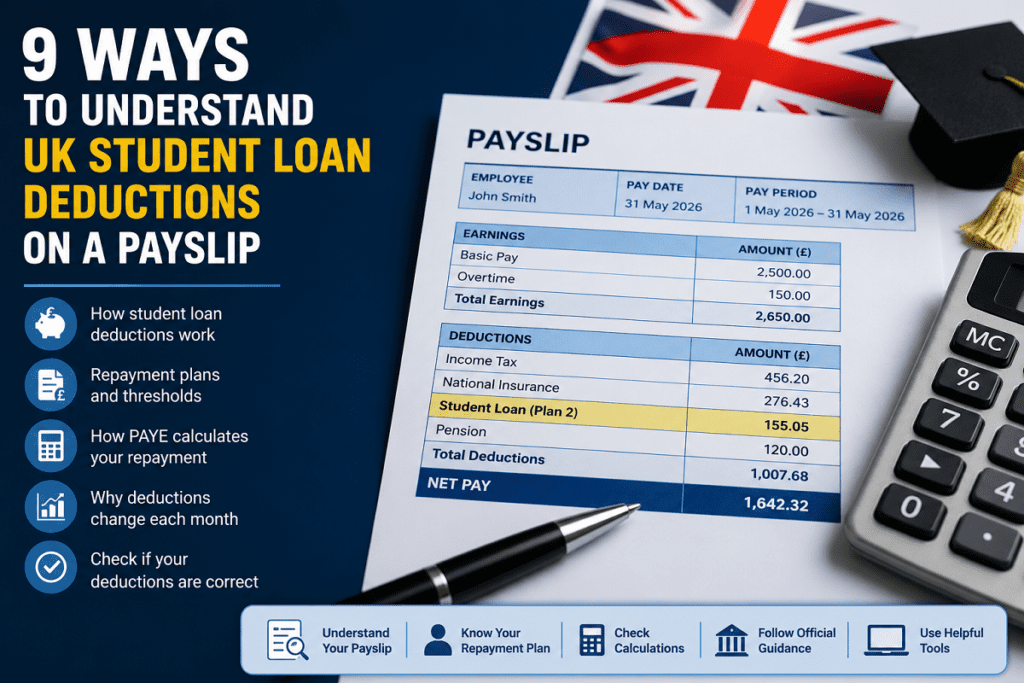
Understanding these deductions is essential because they directly impact your take-home pay and ensure you are meeting your repayment obligations correctly. Whether you are a recent graduate starting your first role, an experienced professional, or an international worker adjusting to the UK’s payroll system, this guide provides the clarity you need.
You will learn:
- Why does a UK student loan deduction appear on your payslip?
- How the PAYE system calculates these repayments.
- How do different repayment plans influence your specific UK student loan deduction?
- Why your UK student loan deduction may fluctuate between pay periods.
- How to verify if your employer is calculating the correct UK student loan deduction.
- Helpful resources, including tools like Flowmetriq.co.uk, that simplify interpreting your payslip alongside official UK guidance.
Rather than simply listing facts, this guide provides practical explanations and examples to help you interpret every UK student loan deduction on your payslip with confidence.
What Is a UK Student Loan Deduction?
A UK student loan deduction is an automatic payroll contribution collected through the Pay As You Earn (PAYE) system once your earnings exceed the specific repayment threshold for your loan plan.
Unlike Income Tax or National Insurance, your UK student loan deduction is directly linked to your loan type and your actual earnings in a given pay period, rather than a flat percentage of your total salary or the total amount you originally borrowed.
Key Points
- Employer-Led Automation: Employers are responsible for calculating and withholding the UK student loan deduction directly from your wages.
- Income-Contingent: The deduction only occurs when your gross earnings for a specific pay period exceed the threshold set for your particular loan plan. If your income falls below this threshold, no deduction is made.
- HMRC & SLC Workflow: Your employer calculates the amount and pays it to HM Revenue & Customs (HMRC) as part of your standard PAYE payments. HMRC then reports this data to the Student Loans Company (SLC).
- Variable Percentages: The rate of your UK student loan deduction depends on your loan plan: generally 9% for undergraduate plans and 6% for postgraduate loans.
- Payroll-Driven: Many employees mistakenly believe they choose their monthly repayment amount. In reality, modern payroll software calculates the UK student loan deduction automatically based on HMRC guidance and the specific plan information provided to your employer.
Because these deductions are calculated per pay period, they can fluctuate if you receive bonuses, overtime, or variable commission, as any earnings above the threshold are subject to the deduction at that time.
Why Does a UK Student Loan Deduction Appear on Your Payslip?
Your employer is instructed to collect these repayments because your earnings have surpassed the repayment threshold for your specific student loan plan. This instruction is communicated to your employer via the Pay As You Earn (PAYE) system, typically following a formal notification process from HM Revenue & Customs (HMRC).
Several factors determine when and why a UK student loan deduction appears on your payslip:
- Your Repayment Plan: Different loans (Plans 1, 2, 4, 5, or Postgraduate) have distinct repayment thresholds. Your UK student loan deduction will only trigger once your earnings for the pay period exceed the threshold associated with your plan.
- Taxable Earnings per Period: Deductions are calculated on a “per-pay-period” basis. If you receive a bonus, overtime pay, or commission in a specific month, your gross earnings may cross the threshold, triggering a UK student loan deduction for that period, even if your base salary usually falls below it.
- HMRC Start Notices (SL1/PGL1): When you start a new job, your employer may receive a start notice from HMRC (form SL1 for student loans or PGL1 for postgraduate loans) instructing them to begin or continue deductions.
- The “No-Averaging” Rule: Unlike some annual tax calculations, student loan repayments are not averaged across the year. Each pay period is assessed independently. This is why a UK student loan deduction might appear in a high-earning month and disappear in a lower-earning one.
- Job Transitions: When you change employers, your P45 or the “Starter Checklist” you complete will signal to your new employer that you are a loan holder, ensuring the UK student loan deduction continues without interruption.
- Loan Status: If you have fully repaid your loan, HMRC will eventually issue a “Stop Notice” (SL2) to your employer, though there is often a short administrative lag—typically up to 42 days—before the deduction ceases on your payslip.
If you are ever unsure why a UK student loan deduction has suddenly appeared or changed, first check your gross pay for that period against your plan’s threshold. Remember, since these deductions are calculated by your payroll software based on HMRC guidance, they are generally highly accurate reflections of your current earnings and plan status.
Decision Checklist: Is Your UK Student Loan Deduction Expected?
Use this quick checklist before assuming there is an error on your payslip. If you answer “No” to any of the fundamental questions or “Yes” to the final ones, it may be time to review your payroll records and log in to your student loan repayment account.
| Question | Yes | No |
| Do you have an outstanding UK student loan? | □ | □ |
| Are your gross earnings for this pay period above your plan’s repayment threshold? | □ | □ |
| Are you on the correct repayment plan (Plan 1, 2, 4, 5, or Postgraduate)? | □ | □ |
| Have you confirmed your current plan threshold against the latest HMRC guidance? | □ | □ |
| Have you recently changed jobs (triggering a potential update to your payroll)? | □ | □ |
| Have you recently received a salary increase, bonus, or overtime? | □ | □ |
| Have you fully repaid your loan (or are you nearing completion)? | □ | □ |
What to Do If Your Answers Don’t Align
If you find discrepancies—such as a UK student loan deduction appearing when your income is below the threshold, or continuing after you believe the balance should be zero—take these steps:
- Check Your Payslip Details: Ensure the deduction is correctly labelled and cross-reference the amount with your specific plan’s threshold.
- Verify Your Loan Status: Log in to your Student Loans Company (SLC) online account to check your current balance and ensure your contact details are up to date.
- Consult HMRC Guidance: If you have multiple loans or have recently transitioned between plans, refer to the official HMRC/GOV.UK repayment pages to ensure your employer has the correct “Start Notice” (SL1/PGL1) information.
- Employer Communication: If you are certain your UK student loan deduction is incorrect (for example, if you have fully repaid your loan and have a “Stop Notice”), contact your payroll department immediately to ensure they have the
Why Understanding Your Payslip Matters
A UK student loan deduction does not exist in isolation. It is one of several variables in your payroll that fluctuates based on your gross earnings. Because these deductions are calculated alongside other mandatory and voluntary contributions, viewing them in isolation can lead to confusion about your total take-home pay.
Your UK student loan deduction interacts with other payroll components in the following ways:
- PAYE Income Tax & National Insurance: These are calculated on your gross pay before many other deductions, but your student loan repayment is also a “post-tax” deduction (it does not reduce your taxable income for Income Tax purposes). Because they are all triggered by your gross salary, they often rise and fall together during high-earning months.
- Salary Sacrifice Arrangements: This is a key strategic lever. Because salary sacrifice reduces your “gross” salary, it effectively lowers your total earnings for the UK student loan deduction calculation. By opting for salary sacrifice (such as for pension contributions or “Cycle to Work” schemes), you are technically reducing your earnings above the repayment threshold, which can decrease your monthly UK student loan deduction and keep more cash in your pocket today—though it may extend the total time it takes to clear your loan balance.
- Workplace Pension Contributions: If your pension is set up as a “net pay” or “relief at source” arrangement, it may not reduce your student loan repayment amount in the same way salary sacrifice does. Understanding how your specific pension is structured is essential to knowing whether it helps “shield” your income from the UK student loan deduction calculation.
- Postgraduate Loan Repayments: If you hold both an undergraduate and a postgraduate loan, you may see multiple deductions. These are treated as separate calculations, each with its own threshold and repayment percentage, and both will appear on your payslip.
How to Build a Clearer Picture
Understanding how these figures fit together provides a clearer picture of your actual take-home pay. If you are unsure how these complex deductions interact, online payslip interpretation tools—such as Flowmetriq.co.uk—can help explain these payroll lines in an accessible, easy-to-understand format.
While these third-party tools are highly useful for interpreting your current payslip, they should be used as a supplement. Always verify your repayment rules, thresholds, and official status by checking the latest guidance from HMRC and the Student Loans Company (SLC). Relying on these official sources ensures you aren’t overpaying or falling behind due to an administrative error.
Understanding UK Student Loan Deductions: 9 Essential Factors
Rather than guessing why a deduction appears, gaining clarity on your payslip requires a foundational understanding of how UK payroll systems interact with student loan obligations. The following nine factors define how a UK student loan deduction is calculated, why amounts fluctuate, and how you can verify the accuracy of your take-home pay.
Know Your Student Loan Repayment Plan
Your repayment plan is the primary driver of your UK student loan deduction, as it dictates both the income threshold at which your repayments begin and how they are calculated. If you are uncertain which plan applies to you, it is impossible to verify if your payslip deduction is accurate.
The UK system currently utilizes several distinct repayment plans:
- Plan 1: Generally for students who started courses before 1 September 2012 (UK-wide).
- Plan 2: For English and Welsh undergraduate students who started courses between 1 September 2012 and 31 July 2023.
- Plan 4: Specifically for Scottish undergraduate and postgraduate students.
- Plan 5: For English undergraduate students who started courses on or after 1 August 2023 (repayments began April 2026).
- Postgraduate Loan (PGL): Operates under a separate framework for Master’s and Doctoral students.
Why the Plan Matters
Your plan depends on where you studied, when you started your course, and the funding body you applied to. Because each plan has a different repayment threshold, two employees earning the same salary can have significantly different UK student loan deductions.
| Repayment Plan | 2026/27 Annual Threshold |
| Plan 1 | £26,900 |
| Plan 2 | £29,385 |
| Plan 4 | £33,795 |
| Plan 5 | £25,000 |
| Postgraduate | £21,000 |
Pro-Tip: If you do not inform your employer of your correct plan, HMRC guidance defaults to Plan 1. If you are actually on a plan with a higher threshold (like Plan 2 or 4), you will be overpaying—making it essential to verify your status through your Student Loans Company (SLC) online accountand ensure your payroll department has the correct information on file.
Understand Your Repayment Threshold
A common misconception is that your UK student loan deduction is a percentage of your total gross salary. In reality, it is calculated exclusively on your earnings above a specific threshold for your plan. This is an “income-contingent” system: if you don’t cross that threshold in a given pay period, you don’t pay.
How the Math Works
Your employer’s payroll software uses your taxable earnings for the pay period to calculate the deduction. The calculation follows this principle:
$$\text{Monthly Deduction} = (\text{Monthly Gross Earnings} – \text{Monthly Threshold}) \times \text{Repayment Rate}$$
- The Threshold: This is the portion of your income protected from repayments.
- The Repayment Rate: Typically 9% for undergraduate loans (Plans 1, 2, 4, and 5) and 6% for Postgraduate loans.
Why This Leads to Variable Deductions
Because this calculation happens every time you are paid, your UK student loan deduction can behave in ways that feel unpredictable:
- Bonuses and Overtime: A one-off commission or overtime payment can push your total monthly earnings above your threshold, triggering a deduction even if your base salary usually falls below it.
- “No-Deduction” Months: If you have a period of unpaid leave, a shorter work month, or a mid-month payroll shift that results in lower gross pay, you might see your deduction disappear entirely for that cycle.
- Salary Sensitivity: Small, incremental salary increases can result in a disproportionate jump in your student loan repayment because the entirety of that increase is now subject to the 9% or 6% deduction.
Current 2026/27 Monthly Thresholds
To verify your payslip, compare your gross monthly pay against the thresholds below:
| Plan | Monthly Threshold | Repayment Rate |
| Plan 1 | £2,241 | 9% |
| Plan 2 | £2,448 | 9% |
| Plan 4 | £2,816 | 9% |
| Plan 5 | £2,083 | 9% |
| Postgraduate | £1,750 | 6% |
Pro-Tip: Remember that thresholds are reviewed annually (usually in April). If you are performing a manual check, ensure you are using the figures for the current tax year, as outdated thresholds will lead to incorrect assumptions about your UK student loan deduction accuracy.
How PAYE Calculates Your UK Student Loan Deduction
It is a common misconception that your employer manually decides or adjusts your UK student loan deduction. In reality, the entire process is automated through your company’s payroll software, which operates under strict HMRC regulations via the Pay As You Earn (PAYE) system.
The Automated Calculation Workflow
Your payroll software follows a rigid, step-by-step logic during every pay run:
- Earnings Capture: It identifies your total gross taxable earnings for the specific pay period (including base salary, bonuses, overtime, and commission).
- Plan Identification: It applies the specific parameters—threshold and percentage—associated with your assigned plan (e.g., Plan 2 or Postgraduate).
- Threshold Application: It subtracts the period-specific threshold from your gross pay.
- Rate Calculation: It applies the relevant repayment percentage (9% for undergraduate plans; 6% for postgraduate plans) to the remaining balance.
- Rounding: Per HMRC rules, the final deduction amount is rounded down to the nearest whole pound.
- Reporting: The deduction is recorded and transmitted to HMRC as part of your regular payroll submission, ensuring your Student Loans Company (SLC) balance is updated annually.
Why Errors Can Still Occur
While the automation minimizes human error, discrepancies can still arise, usually due to “data lag” or incorrect setup:
- Incorrect Plan Assignment: This is the most common error. If your employer has you on Plan 1 but you are actually on Plan 2, you may be repaying earlier than necessary because the Plan 1 threshold is lower.
- HMRC Instruction Delays: There is often a delay between you starting a new job and HMRC issuing a “Start Notice” (SL1/PGL1) to your employer. If your employer lacks this notice, they cannot initiate the UK student loan deduction, which may lead to you accruing a “catch-up” balance later.
- Administrative Lag: If you change your employment status (e.g., switching from a contractor to a permanent employee), your payroll settings may not automatically update unless you provide a new Starter Checklist or updated P45 details.
- Stop Notice Lag: Once you fully repay your loan, HMRC must issue a “Stop Notice” (SL2/PGL2). There is typically an administrative buffer of up to 42 days for this notification to process; deductions may continue during this window.
Pro-Tip: If you suspect an error, do not ask your employer to “guess” your plan. Instead, log into your Student Loans Company account to confirm your status, then provide that documentation to your payroll department. Employers are legally required to follow the official HMRC Start Notice, so providing clear, documented proof of your plan is the fastest way to trigger a payroll correction.
Distinguishing Gross, Taxable, and Net Pay
Many employees mistakenly believe their student loan repayment is a direct percentage of their “Gross Pay.” In reality, the figure used for calculating your UK student loan deduction can differ based on your specific payroll structure—most notably when salary sacrifice is involved.
Key Payroll Definitions
| Term | Meaning | Role in Student Loan Deduction |
| Gross Pay | Total earnings before any tax, NI, or pension deductions. | The starting point, but often not the final figure used. |
| Taxable/NICable Pay | The amount after specific deductions (like salary sacrifice) is removed. | The primary figure used for your student loan calculation. |
| Net Pay | The final amount deposited into your bank account. | Irrelevant to the calculation; it is the result of all deductions. |
Why the Distinction Matters: The Salary Sacrifice Effect
This is a critical area for high-leverage financial management. If you participate in a salary sacrifice arrangement (commonly for pension contributions or “Cycle to Work” schemes), your employer technically reduces your gross contractual salary.
- The Mechanism: Because your “taxable/NICable pay” is reduced by the amount you sacrifice, your UK student loan deduction is calculated on this lower figure.
- The Financial Impact: Salary sacrifice effectively “shields” a portion of your income from the 9% or 6% student loan repayment. While this increases your take-home pay today, it means you are paying off your loan more slowly, which could lead to more interest accruing over the lifetime of the loan.
Pro-Tip: If your employer uses a “Net Pay” pension arrangement rather than “Salary Sacrifice,” your pension contribution will not reduce your student loan deduction. To maximize your financial strategy, check your payslip or ask HR whether your pension is a “Salary Sacrifice” (which reduces your loan repayment) or “Net Pay/Relief at Source” (which does not).
Why Your UK Student Loan Deduction Changes Each Month
It is common for employees to view a fluctuating UK student loan deduction as a sign of a payroll error. However, because student loan repayments are calculated on a “per-pay-period” basis rather than as an annual average, your deduction is designed to respond dynamically to your exact earnings in any given month.
Why Deductions Fluctuate
Since your UK student loan deduction is triggered only by earnings that exceed your plan’s threshold, any variation in your gross taxable pay will directly affect the amount withheld:
- Bonuses and Commission: These are treated as taxable earnings. A one-off performance bonus can push your total monthly income well above your threshold, leading to a significantly higher UK student loan deduction for that specific pay cycle.
- Overtime: Extra hours increase your gross pay. If those hours move your earnings into the “repayment zone,” your deduction will increase proportionally.
- Salary Increases: A mid-year pay rise will often result in a permanent increase in your monthly UK student loan deduction, as a larger portion of your base salary now sits above the repayment threshold.
- Reduced Hours or Unpaid Leave: Conversely, if you work fewer hours, take unpaid leave, or start a new role mid-month, your earnings may fall below your plan’s threshold. In these periods, your UK student loan deduction may decrease or disappear entirely.
- Sick Pay and Maternity Pay: Even during periods of leave, your eligibility for a UK student loan deduction depends solely on whether your income—including Statutory Sick Pay (SSP) or Statutory Maternity Pay (SMP)—exceeds your plan’s threshold. If these payments are lower than your usual salary, your repayments may naturally drop or cease.
Why This Is Not a “Mistake”
The payroll system is doing exactly what it was programmed to do: calculating your repayment based on the income you received in that specific pay period.
Pro-Tip: If you find that your annual income is below your plan’s total annual threshold, but you have had UK student loan deductions taken due to one-off bonuses or overtime, you are entitled to request a refund from the Student Loans Company (SLC) after the end of the tax year. The system is intentionally “over-sensitive” to catch repayments as they occur; the refund process acts as the safety net for your annual total.
Verifying Your UK Student Loan Deduction
Before assuming there is a payroll error, use this systematic approach to audit your payslip. Because student loan repayments are automated, inconsistencies are usually the result of a specific change in your earnings or administrative data, rather than a system glitch.
The Audit Checklist
If your UK student loan deduction feels incorrect, work through these questions:
- Is my plan on file correct? If your employer has you on the wrong plan (e.g., Plan 1 instead of Plan 2), the threshold used will be incorrect. Confirm your plan via your Student Loans Company (SLC) online account.
- Was my gross pay unusually high this period? Remember that bonuses, commission, and overtime increase your taxable earnings for that specific pay cycle, which can trigger a deduction even if your annual salary is lower.
- Did I recently change jobs? If you have moved roles, there may be a lag in the “Start Notice” (SL1/PGL1) reaching your new payroll department.
- Have I recently paid off my loan? If you have completed repayment, there is a mandatory administrative buffer (typically up to 42 days) before your employer receives the “Stop Notice” (SL2/PGL2) from HMRC.
- Did my earnings dip below the threshold? If your gross pay for this period is below the monthly threshold for your plan, you should see zero deductions.
Factors Influencing Deductions: Quick Reference
| Factor | Can It Change Your Deduction? | Impact Note |
| Salary Increase | ✔ Yes | Permanently raises the amount subject to the 9% or 6% deduction. |
| Overtime/Bonus | ✔ Yes | Triggers a higher UK student loan deduction for that specific month. |
| New Job | ✔ Yes | May reset or delay deductions depending on payroll notice updates. |
| Wrong Plan Assigned | ✔ Yes | Leads to over/under-payment; requires manual payroll correction. |
| Earnings < Threshold | ✔ Yes | Deductions stop immediately for that period. |
| Salary Sacrifice | ✔ Yes | Reduces the taxable income base, effectively lowering your deduction. |
Pro-Tip: If your investigation confirms an error—such as deductions continuing months after your loan was cleared—do not ask your employer to guess the fix. Collect your recent payslips and P60s, and contact the Student Loans Company (SLC) directly. They can confirm your balance and, if necessary, issue a formal correction to HMRC, which will then trigger the required adjustments for your payroll department.
What to Do If You Think You’ve Been Overcharged
It is natural to be concerned if a UK student loan deduction appears larger than expected, but before requesting a payroll correction, you must distinguish between an administrative error and a standard calculation based on your current income.
The “Audit First” Approach
Do not jump straight to your payroll department. Often, what appears to be an overcharge is simply the payroll system accurately responding to a bonus, overtime, or a change in your repayment threshold. Follow this sequence to protect your financial interests:
- Re-verify Your Plan: Log into your Student Loans Company (SLC) online account to confirm your exact plan. If your employer has you on Plan 1 but you are actually on Plan 2, you may be repaying at a lower threshold than required.
- Check Your Gross Taxable Pay: Compare your payslip’s “Taxable Pay” figure against your plan’s threshold. If you received a bonus or overtime that pushed your earnings over the threshold for that specific month, the deduction is likely correct and intentional.
- Review the “Stop Notice” Window: If you believe you have fully repaid your loan, note that employers have a 42-day administrative buffer to act on a “Stop Notice” (SL2/PGL2) from HMRC. Deductions continuing for 1–2 months after your final payment are often expected.
- Audit Your Annual Totals: If you suspect you have paid more than you owe across the full tax year, you cannot get a refund mid-year. You must wait until the end of the tax year (April 6th) to allow HMRC to finalize your earnings data with the SLC.
When to Escalate
Only contact your employer’s payroll department if you have confirmed that:
- The Plan is Wrong: You have proof (e.g., an active plan type letter from your SLC account) that your employer is using the wrong plan.
- Deductions are Unwarranted: You have never received a student loan, yet deductions are appearing (which may require an immediate stop notice).
How to Reclaim Overpayments
If you have genuinely overpaid, the Student Loans Company (SLC) manages the refund process. You do not need a third party or “claims company” to do this for you—never pay a fee for this service.
- Wrong Plan or Early Repayment: Contact the SLC directly with your Customer Reference Number (CRN) and recent payslips to process a manual refund.
- Paid in Full: If you continue to be charged after your balance hits zero, the SLC will generally identify the overpayment automatically and contact you. Ensure your bank details in your online account are current to receive these refunds without delay.
Pro-Tip: If you are nearing the end of your loan term, change your payments to Direct Debit in your final year. This allows the SLC to take precise control of the remaining balance, preventing the “overpayment lag” common with standard payroll deductions.
Use Educational Tools as a Supplement to Official Guidance
Online payslip interpretation tools can be excellent for translating complex payroll lines into plain English, helping you gain a “big picture” view of your income. However, it is vital to remember that these tools are educational resources and should not replace official government documentation.
How to Use Tools Like Flowmetriq.co.uk
Resources like Flowmetriq.co.uk can help you visualize how your UK student loan deduction interacts with other payroll elements, such as:
- PAYE Income Tax & National Insurance: Seeing how your tax code affects your take-home pay, alongside your loan repayment.
- Pension Contributions: Understanding the difference between how “Net Pay” and “Salary Sacrifice” schemes impact your taxable earnings.
- Gross vs. Net Pay: Getting a clearer breakdown of why the money leaving your paycheck differs from your base salary.
These platforms are useful for learning the “language” of your payslip. They help bridge the gap between abstract HMRC rules and your actual monthly salary, especially if you are new to the UK payroll system.
When to Rely on Official Sources
While tools can provide helpful context, never use them as your sole source for legal or financial compliance. Always verify critical figures, repayment thresholds, and administrative status through official channels:
- GOV.UK (Student Finance): Use this for the most current repayment thresholds, interest rates, and policy changes for your specific loan plan.
- Your SLC Online Account: This is your primary “source of truth.” Always log in here to check your remaining balance, verify your repayment plan, and ensure your contact details are accurate.
- HMRC Guidance: For employers and employees, HMRC provides the definitive rules on “Start” (SL1/PGL1) and “Stop” (SL2/PGL2) notices, which are the legal instructions governing your payroll.
Pro-Tip: If a third-party tool shows a calculation that differs significantly from your actual payslip, do not assume the tool is wrong—or that your employer is right. Use the tool’s breakdown to identify where the discrepancy lies (e.g., “Is it including my pension?”), and then cross-reference those specific variables against the currentGOV.UK student loan guidance. If you still have concerns, use the official information to form your questions when speaking to your payroll department.
Understand Your Entire Payslip—Not Just the Student Loan Deduction
Looking only at the UK student loan deduction provides an incomplete picture of your financial health. To truly understand your take-home pay, you must view your payslip as an integrated system where each line item interacts with the others.
The Anatomy of Your Payslip
Your payslip is a logical sequence of deductions that reveal how your gross earnings are transformed into your final net income:
- Gross Pay: Your starting point, including all taxable income (base salary, overtime, bonuses, and commission).
- Salary Sacrifice (Optional): If you participate in schemes like a pension salary sacrifice or “Cycle to Work,” this is deducted first. Crucially, this reduces your “taxable/NICable pay,” which in turn lowers your student loan repayment amount.
- Income Tax (PAYE): Calculated based on your tax code. Remember that your UK student loan deduction does not reduce your taxable income for Income Tax purposes; you pay tax on your full gross salary (minus any salary sacrifice).
- National Insurance (NI): Calculated on your gross pay (or post-salary-sacrifice pay). Like your student loan, this is a “social contribution” triggered by earnings thresholds.
- Student Loan & Postgraduate Loan Deductions: These appear as separate lines. They are not taxes, but “post-tax” deductions, meaning they are calculated after your gross pay is determined, but independent of the actual tax and NI amounts deducted.
- Net Pay: The final, definitive figure that reaches your bank account.
Why the Interaction Matters
When you understand how these deductions fit together, you can make better financial decisions:
- The “Net Pay” Illusion: If your net pay drops, don’t just look for a change in your UK student loan deduction. Check if your tax code has changed, if your pension contributions have increased, or if a change in your NI category has occurred.
- Strategic Optimization: By understanding that salary sacrifice reduces the earnings subject to a UK student loan deduction, you can better weigh the trade-off between increasing your take-home pay versus paying down your student loan debt faster.
- Identifying Discrepancies: If your gross pay remains constant but your net pay shifts, the breakdown of these individual lines will pinpoint exactly which deduction—be it tax, NI, or student loan—is responsible for the change.
Pro-Tip: Your payslip is a record of your financial life. Keep your monthly payslips and your annual P60 in a secure folder (digital or physical). If you ever need to dispute a deduction or reconcile your loan balance with the Student Loans Company (SLC), having a clear, historical record of these deductions—and seeing how they fluctuated alongside your earnings—will be your most powerful evidence.
UK Student Loan Deduction Common Misconceptions
Understanding the mechanics of your payroll is the best defense against financial confusion. Many employees hold beliefs about the UK student loan deduction that simply aren’t supported by how the PAYE system functions.
- “Student loan deductions are chosen by my employer.”
- No. Your employer has no discretion in this matter. They are legally required to follow HMRC payroll instructions and use approved payroll software to calculate the UK student loan deduction automatically.
- “Everyone repays the same amount.”
- No. Repayments are highly individualized. Your specific UK student loan deduction depends on your assigned repayment plan (which dictates your threshold), your exact earnings for that pay period, and whether you are also repaying a Postgraduate Loan.
- “Once deductions start, they stay the same.”
- No. Because the system is income-contingent and assessed per pay period, your UK student loan deduction is fluid. It will rise, fall, or pause entirely if your earnings fluctuate due to bonuses, overtime, pay rises, or changes in working hours.
- “Paying more one month means I’ve been overcharged.”
- Not necessarily. A higher-than-usual deduction is often the correct result of a bonus, commission, or overtime payment. Since these increase your taxable earnings, the automated system correctly applies your plan’s percentage to that additional income.
Key Takeaways
- Automation is Standard: Your UK student loan deduction is calculated automatically through the PAYE system. It is a “post-tax” deduction, meaning it is taken after your gross pay is determined, but is independent of your Income Tax or National Insurance liabilities.
- The Plan is Everything: Your repayment plan (Plan 1, 2, 4, 5, or Postgraduate) is the single most important variable. Ensure your employer has the correct plan on file to avoid incorrect thresholds.
- Thresholds are the Trigger: Repayments are not a flat tax; they only trigger when your earnings in a specific pay period exceed the threshold for your plan.
- Fluctuation is Expected: Variability in your take-home pay is normal. If your monthly income changes, your UK student loan deduction will shift to reflect that.
- Verify, Don’t Guess: While third-party tools like Flowmetriq.co.uk are excellent for visualizing how these deductions fit into your overall payslip, they should be used as educational aids. Always rely on your Student Loans Company (SLC) online account and official GOV.UK guidance is your ultimate source of truth for repayment status and legal obligations.
UK Student Loan Deductions FAQs
These FAQs provide concise, actionable answers to common concerns regarding your payslip and payroll deductions.
Why is my UK student loan deduction appearing on my payslip?
Your employer is legally instructed to collect these repayments via the Pay As You Earn (PAYE) system once your earnings in a pay period exceed the threshold for your specific loan plan. This process is fully automated; your employer acts on formal notifications from HMRC.
Does everyone repay the same amount?
No. Repayments are highly individualized. The amount deducted depends entirely on your specific repayment plan (which sets your threshold) and your gross taxable earnings for that exact pay period. Two people earning the same base salary may see different deductions if they are on different plans (e.g., Plan 2 vs. Postgraduate).
Why did my UK student loan deduction increase this month?
Because repayments are calculated per pay period, any increase in your taxable earnings—such as overtime, performance bonuses, commissions, or a recent pay rise—will push more of your income above the repayment threshold. This triggers a higher deduction for that specific month.
Can I ask my employer to stop my UK student loan deduction?
No. Employers are required by law to follow HMRC “Start Notices” (SL1/PGL1). They cannot manually override or pause these deductions at an employee’s request. If you believe deductions should stop (e.g., your loan is fully repaid), you must coordinate with the Student Loans Company (SLC), which will then issue an official “Stop Notice” (SL2/PGL2) to your employer.
What should I do if I suspect my deduction is incorrect?
Do not assume a payroll error immediately. First, audit your figures: confirm your current repayment plan via your SLC online account, check if your earnings for the period exceeded your plan’s threshold, and verify if you received any variable pay (like bonuses). If you confirm an error, contact your payroll department with documentation from the SLC.
Do student loan repayments affect my credit score?
No. Student loan repayments made through the SLC do not appear on your credit report and have no direct impact on your credit score. However, lenders may still ask about your student loan when assessing your “affordability” for large financial commitments, such as a mortgage.
If I have two jobs, are my earnings combined?
No. For employees paid through PAYE, each employer calculates the UK student loan deduction independently based solely on the earnings from that specific job. This means you might not hit the repayment threshold in either job individually, even if your total combined income would have triggered a deduction.
Can I use Flowmetriq.co.uk to understand my payslip?
Yes. Third-party tools like Flowmetriq.co.uk are excellent educational resources for interpreting complex payslip lines and understanding how different deductions interact. However, always treat these as supplementary; rely on GOV.UK and your SLC account for official repayment thresholds and legal guidance, as these are subject to annual updates.
In Conclusion
Understanding your payslip shouldn’t be a source of stress. By moving from a passive observer to an active auditor of your payroll, you gain control over your financial health.
The core takeaway is simple: A UK student loan deduction is a predictable, rule-based process. It is not a random tax, but a dynamic, income-contingent repayment triggered by your earnings hitting specific thresholds.
Essential Principles for Your Financial Confidence
- Automation is the Standard: Your UK student loan deduction is calculated automatically through the PAYE system. Because it is calculated “per pay period,” it is highly sensitive to fluctuations in your gross income—meaning bonuses, overtime, and salary shifts will cause the deduction to move in real-time.
- The Power of Your Repayment Plan: Your plan is the “master switch.” Whether you are on Plan 1, 2, 4, 5, or a Postgraduate loan, your specific threshold dictates when you start paying. Always ensure this is correctly recorded with your employer.
- Systems Interplay: Your UK student loan deduction does not live in a vacuum. It interacts with your pension contributions (especially if you use salary sacrifice), tax code, and National Insurance. Viewing your payslip as a whole system—rather than focusing on one line item—is the best way to interpret your net pay.
- Verify, Don’t Guess: If a figure looks unusual, don’t panic. Audit it against your plan’s threshold and your gross pay for that period. Use educational tools like Flowmetriq.co.uk to help you map out the “why,” but always rely on your official Student Loans Company (SLC) account and HMRC/GOV.UK guidance is your final authority.
Taking Immediate Action
By taking a few minutes to understand your payroll setup today, you achieve three things:
- Early Error Detection: You can spot administrative lags (like the 42-day “Stop Notice” window or incorrect plan assignments) before they impact your long-term balance.
- Effective Budgeting: You understand exactly why your take-home pay varies, allowing you to plan for high-earning and low-earning months with precision.
- Financial Clarity: You move from confusion to competence, ensuring that every pound deducted is accounted for and contributing correctly toward your future.
Final Pro-Tip: Keep a digital folder of your monthly payslips and your annual P60. In an era of digital automation, having your own historical data is the ultimate safety net for any payroll or loan balance verification you may need in the future.
Are you interested in exploring how other payroll factors—such as specific pension salary sacrifice strategies—can further optimize your take-home pay while managing your student loan balance?