15 Best Open Source LLM Models for Building AI Applications
Open source LLM (Large Language Model) models are AI language models whose pretrained weights—and in many cases, source code, training recipes, or documentation—are publicly available for developers to self-host, fine-tune, and integrate into custom AI applications. Unlike proprietary models, they offer greater flexibility, stronger data privacy, reduced long-term operating costs, and full control over deployment across cloud, on-premises, or edge environments.
However, not all open source LLMs are created equal. They differ significantly in licensing, model size, hardware requirements, reasoning ability, multilingual support, context window, and performance across tasks such as coding, content generation, retrieval-augmented generation (RAG), AI agents, chatbots, and document analysis.

In this guide, we compare 15 of the best open source LLM models for building AI applications, highlighting their key features, strengths, limitations, and ideal use cases. Whether you’re developing an AI assistant, coding copilot, enterprise chatbot, or production-ready machine learning solution, this comparison will help you identify the model that best fits your technical requirements and deployment goals.
What are open source LLM models?
The term open source LLM models is frequently used as a blanket label, but in production, distinguishing between true open-source AI and open-weights releases is critical for architecture and compliance planning.
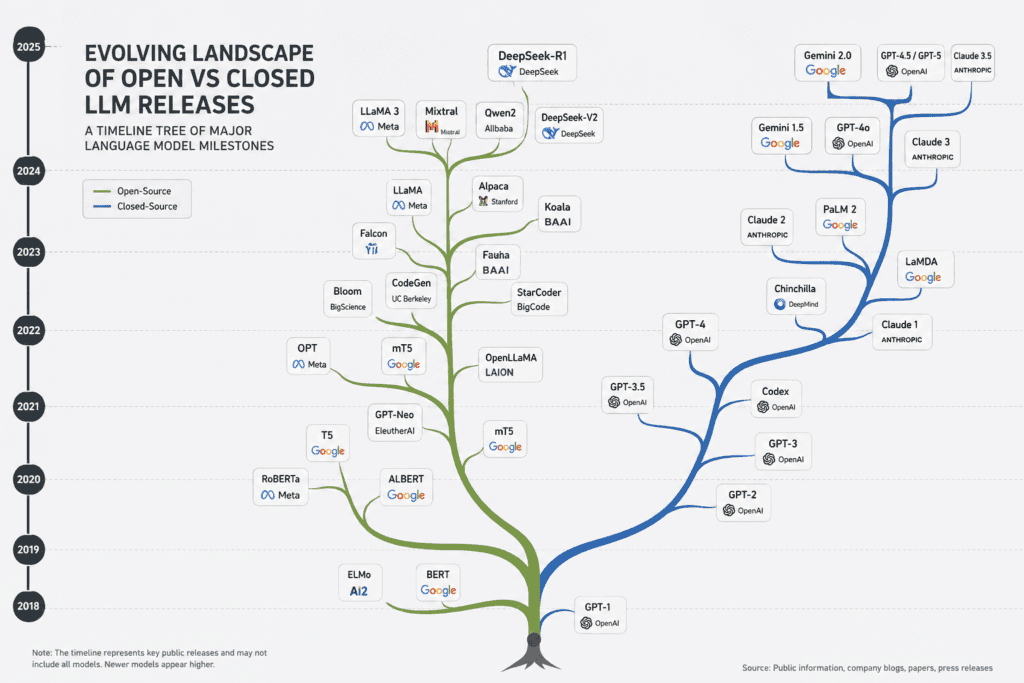
Defining “Open Source” vs. “Open Weight”
To evaluate deployment feasibility, engineers categorize open source LLM models across three main release tiers:
| Release Tier | Artifacts Disclosed | Enterprise Implications | Example Licenses |
| Fully Open Source (OSI-compliant) | Weights, inference code, training code, dataset mixtures, pre-processing scripts | Full auditability, reproducible pre-training, zero commercial restrictions | Apache 2.0, MIT |
| Open Weights (Commercial Use) | Model weights, inference code | Custom fine-tuning and hosting allowed; dataset details often withheld | Custom permissive (e.g., Qwen) |
| Open Weights (Restricted / Hybrid) | Model weights only | Subject to monthly active user (MAU) limits or restrictions on training rival models | Custom restricted (e.g., Llama Community) |
Strategic Advantages of Open Source LLM Models
Adopting open source LLM models over closed-source APIs fundamentally alters your control over the infrastructure:
- Data Governance & Sovereignty: Running models on self-hosted instances (AWS EC2, vLLM on-prem, or private clouds) ensures zero data leakage to third-party providers.
- Domain Adaptation: Open access to model layers enables low-rank adaptation (LoRA) and direct preference optimization (DPO) using proprietary enterprise datasets.
- Cost Predictability at Scale: High-volume token processing transitions from variable API billing to fixed GPU compute costs.
Operational Infrastructure & Serving Stack
Running open source LLM models shifts technical friction to serving efficiency and hardware allocation.
                           Production Serving Pipeline
                                        │
             ┌──────────────────────────┴──────────────────────────┐
             ▼                                                     ▼
     Weight Quantization                                  Serving Engine
  • FP16 → INT8 / INT4 (AWQ / GPTQ)                    • vLLM (PagedAttention)
  • Reduces VRAM footprint ~50-75%                     • TensorRT-LLM / SGLang
Critical Production Considerations
- VRAM Footprint & KV Cache: Compute requirements are governed not just by parameter count, but by KV cache allocation during long-context inference.
- Quantization Loss: Quantizing models to 4-bit (AWQ) significantly lowers hardware barriers, but requires benchmarking to ensure accuracy holds for complex reasoning tasks.
Strategic Value of Open Source LLM Models
Adopting open source LLM models is primarily an architectural trade-off: trading out-of-the-box simplicity for total infrastructure control, cost predictability, and domain-level customization.
While proprietary APIs (like GPT-4o or Claude 3.5) offer turnkey performance, open source LLM models excel in applications requiring strict data isolation, specialized task fine-tuning, or high token throughput.
┌─────────────────────────────────────────────────────────────────────────┐
│                    OPEN SOURCE VS. PROPRIETARY TRADE-OFFS               │
├───────────────────────────────────┬─────────────────────────────────────┤
│ Open Source LLM Models            │ Proprietary APIs                    │
├───────────────────────────────────┼─────────────────────────────────────┤
│ • Zero data leakage to 3rd parties│ • Data sent to external vendor APIs │
│ • Fixed, predictable GPU compute  │ • Variable per-token API pricing    │
│ • Full layer-level fine-tuning    │ • Limited to system prompt/few-shot │
│ • High setup & hardware ops       │ • Zero infrastructure management    │
└───────────────────────────────────┴─────────────────────────────────────┘
Key Advantages for Production AI Applications
Data Sovereignty & Compliance
For HIPAA, GDPR, or SOC2 compliance, sending sensitive prompt data to external LLM providers creates security vectors. Deploying open source LLM models inside a private virtual cloud (VPC) or on-premises infrastructure keeps data within your security perimeter.
Predictable Cost Scaling
API costs scale linearly with token volume. For high-throughput production apps (e.g., automated document processing or real-time code completion), open source LLM models served via optimized engines like vLLM, SGLang, or TensorRT-LLM convert variable API expenditures into predictable GPU hardware costs.
Hyper-Customization (LoRA & DPO)
Closed models rely on prompt engineering or basic RAG. With open source LLM models, teams can perform Parameter-Efficient Fine-Tuning (PEFT) using LoRA (Low-Rank Adaptation) or DPO (Direct Preference Optimization). This instills specialized domain knowledge, enforces structured outputs (JSON schemas), and aligns system behavior directly on proprietary data.
Vendor Lock-in Mitigation
Relying on a single proprietary vendor leaves product roadmaps vulnerable to API deprecations, sudden price shifts, or service outages. Open-weight ecosystems allow applications to swap model backends seamlessly as superior architectures emerge.
When Proprietary Still Wins: Operational Reality
Selecting open source LLM models is not an automatic victory. Production deployments require evaluating critical trade-offs:
- Hardware Footprint: Serving dense models or Mixture-of-Experts (MoE) architectures (e.g., DeepSeek-V3 or Llama-3 series) requires substantial VRAM allocations and multi-GPU nodes.
- Engineering Overhead: Maintaining inference pipelines, managing KV-cache memory, handling continuous batching, and setting up monitoring requires dedicated MLOps engineering.
- Out-of-the-Box General Reasoning: Enterprise closed models often retain an edge on multi-modal, extreme edge-case reasoning without specialized fine-tuning.
For developers weighing the technical differences between leading open-weight options like DeepSeek R1 and Llama 3.1, evaluating architecture against your infrastructure budget is essential for long-term production success.
The video above breaks down the architectural, cost, and task-specific trade-offs between two major open-source model ecosystems to help you choose the right base weights for your application.
Which Open Source LLM Models Should You Evaluate First?
Rather than choosing a model solely because it tops the latest benchmark, start with one that aligns with your application, deployment requirements, and available hardware.
The 15 open-source LLMs below are among the most widely adopted and actively developed models, covering a broad range of use cases, including conversational AI, advanced reasoning, code generation, retrieval-augmented generation (RAG), long-context processing, multilingual applications, and AI agents. This comparison highlights each model’s strengths, trade-offs, and ideal use cases to help you make an informed decision.
DeepSeek-R1 (Model Spotlight)
DeepSeek-R1 stands as one of the most significant shifts in open-weight models. It popularized native Chain-of-Thought (CoT) reasoning within an accessible Mixture-of-Experts (MoE) footprint, rivaling closed reasoning systems on logic-heavy workloads.
                DeepSeek-R1 Architecture Footprint

   [ Input Prompt ] ──► [ Active Routing ]
                               │
               ┌───────────────┴───────────────┐
               ▼                               ▼
       Active Parameters             Inactive Parameters
         (37B compute)                (634B off-loaded)
               │                               │
               └───────────────┬───────────────┘
                               ▼
            [ 671B Total MoE Model Weights ]
                               │
                               ▼
        [ Output: Chain-of-Thought + Final Answer ]Code language: CSS (css)
Technical Breakdown
| Metric / Specification | Detail | Practical Impact |
| Total Parameters | 671B Mixture-of-Experts | Requires massive storage/RAM footprint to hold full weights. |
| Active Parameters | 37B per forward pass | Delivers compute speed comparable to a smaller dense model. |
| Context Window | 128K tokens | Accommodates dense technical docs and large codebases. |
| Licensing | MIT License | Full commercial flexibility with zero user-cap restrictions. |
| Training Pipeline | Cold-start SFT + RL (GRPO) | Learns self-correction, reflection, and multi-step validation. |
Infrastructure Requirements & Deployment
Deploying open-source LLM models at the scale of full DeepSeek-R1 (671B) requires specialized server topologies. For resource-constrained teams, distilled dense variants (1.5B–70B) offer portable alternatives.
- Full-Weight Production (671B):
- Hardware Stack: Multi-node cluster (e.g., 8× H100 / H200 or 8× MI300X GPUs).
- Serving Infrastructure: High-throughput orchestration via vLLM (PagedAttention), SGLang, or TensorRT-LLM using FP8 or INT4 quantization.
- Distilled Local Alternatives:
- Variants: 1.5B, 7B, 8B, 14B, 32B, and 70B models (distilled into Qwen and Llama architectures).
- Hardware Stack: Single consumer/prosumer GPU (e.g., RTX 4090 for 14B/32B quantized or Mac Studio for 70B Q4).
Strengths & Trade-Offs
Pros
- Reasoning Precision: Benchmark-grade performance across complex mathematics, competitive coding, and multi-step logic workflows.
- Commercial Freedom: Permissive MIT licensing makes it safe for enterprise application integration.
- Reasoning Transparency: Exposes explicit CoT thinking tokens, enabling developers to inspect the model’s logic before it delivers the final response.
Cons
- Infrastructure Friction: Serving the native 671B MoE architecture requires significant VRAM allocation and multi-GPU networking bandwidth.
- Latency Overhead: Generating long chain-of-thought tokens increases time-to-first-token (TTFT) and total generation time compared to standard chat completion models.
- Strict Task Alignment: Highly opinionated reasoning outputs can add unnecessary latency for simple classification or short text summarization tasks.
DeepSeek V3.2 (Model Spotlight)
DeepSeek V3.2 serves as the primary general-purpose flagship model in the DeepSeek open-weight ecosystem. While DeepSeek-R1 focuses strictly on explicit step-by-step reasoning tokens, V3.2 blends reasoning, code execution, function calling, and high-throughput agent workflows into a versatile production system.
The primary architectural update in V3.2 is DeepSeek Sparse Attention (DSA). By introducing a lightweight indexer mechanism over attention calculation, V3.2 cuts long-context computational overhead while retaining precision across its 128K context length.
                 DeepSeek V3.2 Architecture Profile

  Total MoE Parameters  : 671 Billion
  Active Parameters     : 37 Billion per token (8 routed + 1 shared expert)
  Attention Mechanism   : Multi-Head Latent Attention (MLA) + DeepSeek Sparse Attention (DSA)
  Training Framework    : Multi-Token Prediction (MTP) with FP8 Precision
  Primary License       : MIT License
Code language: JavaScript (javascript)
Key Technical Specifications
| Parameter / Feature | Specification | Engineering Impact |
| Total Architecture | 671B MoE (256 routed experts + 1 shared expert) | Provides frontier-class capacity without dense compute latency. |
| Per-Token Compute | 37B active parameters | Operates at the inference speed of medium-sized dense models. |
| Attention Optimization | DeepSeek Sparse Attention (DSA) | Reduces sequence memory scaling from $O(L^2)$ down toward $O(Lk)$ for long context. |
| Agent Readiness | Integrated RL with Agentic Synthesis Pipelines | Built-in proficiency for function calling, API routing, and multi-turn tools. |
| Commercial License | MIT License | Zero deployment royalties or restricted user caps. |
Serving & Production Infrastructure Requirements
Deploying open source LLM models at the level of DeepSeek V3.2 demands server-class hardware configurations to hold the 671B parameter distribution in memory.
Server Hardware Stack
- FP8 Quantized Deployment: Requires an 8× NVIDIA H100/H200 or 8× AMD MI300X node to maintain latency SLAs and fit the Multi-head Latent Attention (MLA) KV cache.
- INT4 / Offload Serving: Can be split across multi-node clusters via CPU offloading or distributed network serving engines (e.g., vLLM or SGLang).
Software Serving Optimization
[ Incoming Request ] ──► [ vLLM / SGLang Engine ]
                               │
            ┌──────────────────┴──────────────────┐
            ▼                                     ▼
   DSA Indexing Pass                     PagedAttention KV Cache
(Filters relevant tokens)               (Compressed latent states)
            │                                     │
            └──────────────────┬──────────────────┘
                               ▼
              37B Active Expert Computations (FP8)
                               │
                               ▼
                 [ Direct Output Response ]Code language: CSS (css)
Strengths & Technical Trade-offs
Pros
- Multi-Task Balance: Unlike specialized CoT models that output unnecessary reasoning chains for simple tasks, V3.2 switches between fast conversational responses and deeper reasoning.
- Slashing Long-Context Overhead: DSA coupled with Multi-Head Latent Attention (MLA) dramatically decreases KV cache footprint on long documents and full code repositories.
- Open Ecosystem Integration: Ships with standard LlamaTokenizerFast components and Hugging Face artifacts for standard MLOps pipelines.
Cons
- Heavy Initial Footprint: Full self-hosting demands multi-GPU Enterprise clusters, putting native 671B serving out of range for single workstation hardware.
- Complex Orchestration: Leveraging DSA and MLA speedups requires modern serving engines optimized for custom attention kernels (e.g., vLLM, TensorRT-LLM).
GLM-5.1 (Model Spotlight)
GLM-5.1 (developed by Z.ai) is one of the premier open source LLM models purpose-built for agentic engineering, repository-level coding, and sustained, long-horizon task execution.
Unlike general-purpose chat models that rapidly exhaust their strategy during multi-turn debugging, GLM-5.1 is trained specifically for endurance—enabling autonomous agents to execute plan-test-fix optimization loops over extended sessions.
                GLM-5.1 Long-Horizon Agent Architecture

  [ Developer Prompt / Issue ]
               │
               ▼
   ┌──────────────────────────────────────────┐
   │ Autonomous Execution Loop (Up to 8 Hrs)  │
   │ • Repo Parsing & Plan Strategy           │
   │ • Tool Call Orchestration (MCP / Terminal)│
   │ • Automated Experimentation & Debugging  │
   └──────────────────────────────────────────┘
               │
               ▼
  [ Production Ready PR / Code Base Refactor ]
Technical Breakdown
| Metric / Specification | Detail | Practical Impact |
| Total Architecture | 754B Mixture-of-Experts | Holds extensive parameter depth across 256 experts. |
| Active Compute | 40B parameters per token | Delivers real-time inference speeds using top-8 routing + 1 shared expert. |
| Context Window | 200K / 203K tokens | Analyzes full software repositories, architectural blueprints, and deep logs. |
| Licensing | MIT License | Permissive commercial redistribution, fine-tuning, and on-prem deployment. |
| Agent Performance | 58.4% SWE-Bench Pro | Outperforms proprietary models on complex, multi-file software engineering tasks. |
Production Infrastructure & Deployment Setup
Serving open source LLM models like GLM-5.1 at scale requires high-density memory nodes due to the 754B parameter footprint.
Server Hardware Options
- Recommended Production Target (FP8 Precision): 1× NVIDIA HGX B200 cluster (8× B200 GPUs) or 8× NVIDIA H100 (80GB) nodes using quantized checkpoints (
zai-org/GLM-5.1-FP8). VRAM requirements land around ~640GB–860GB. - Third-Party API Alternatives: Managed endpoints (e.g., DeepInfra, Z.ai API) are widely used for early prototyping before standing up self-hosted clusters.
Serving Engine Compatibility
- Native integration via vLLM (v0.19.0+) and SGLang (v0.5.10+) supporting Model Context Protocol (MCP) integrations, structured JSON output, and streamable function calling.
Strengths & Trade-Offs
Pros
- Long-Horizon Endurance: Maintains productivity across sustained agent loops (up to hundreds of iterations), resolving complex dependency graphs without getting stuck in execution deadlocks.
- Permissive MIT License: Unlike restrictive enterprise open-weight licenses with user limits, GLM-5.1 allows unrestricted commercial deployment and domain-specific fine-tuning.
- Tool-Use Native: Optimized out of the box for shell interaction, automated testing frameworks, and custom Model Context Protocol (MCP) tools.
Cons
- High Infrastructure Entry Barrier: Self-hosting full weights demands substantial hardware investment compared to medium-sized dense coding models.
- Text-Only Processing: Lacks native vision or audio multimodal capabilities; image/diagram workflows require routing to an auxiliary vision model.
Primary Use Cases & Verdict
- Best For: Enterprise code assistants, autonomous software engineering agents, automated unit testing/refactoring suites, and secure on-premise codebases.
- Verdict: The premier open-weight backbone for engineering teams building autonomous agentic coding tools that require absolute data isolation.
Qwen 3.5-27B (Model Spotlight)
Qwen 3.5-27B (developed by Alibaba Cloud) represents the “sweet spot” dense entry in open-weight models. Operating with 27 billion parameters, it avoids the cluster setup requirements of massive 600B+ Mixture-of-Experts architectures while delivering performance competitive with larger frontier models.
Architecturally, Qwen 3.5-27B combines a hybrid linear attention mechanism (Gated Delta Networks paired with Gated Attention). This design keeps memory growth manageable, enabling a native 262K-token context window that can scale up to 1M tokens when required for large document analysis.
                Qwen 3.5-27B Hardware Footprint Options

  [ Single RTX 4090 / 5090 (24GB - 32GB VRAM) ] ──► Quantized (INT4 / AWQ) Deployment
  [ Single NVIDIA A100 (40GB / 80GB VRAM) ]    ──► Native FP16 / High-Throughput Serving
  [ Dual Consumer GPUs (2x 24GB VRAM) ]       ──► FP8 Production API Endpoint
Technical Breakdown
| Metric / Specification | Detail | Practical Impact |
| Model Type | 27B Dense (Non-MoE) | Every token triggers all 27B parameters, maximizing reasoning density per forward pass. |
| Architecture Hybrid | Gated DeltaNet + Gated Attention | Reduces VRAM consumption and inference latency across massive context lengths. |
| Context Window | 262,144 native tokens (1M extensible) | Processes long-form reports, complete repos, or books in a single inference call. |
| Multimodal Support | Native Vision + Language | Directly parses images, diagrams, and video frame sequences without external vision adapters. |
| Licensing | Apache 2.0 | Full commercial usage rights with zero revenue-sharing or user-cap constraints. |
Serving & Production Infrastructure Requirements
Qwen 3.5-27B offers flexible deployment options, making it accessible for startups and mid-sized product teams:
Server Hardware Stack
- FP16 / Unquantized Serving: Requires a single 80GB GPU (such as an NVIDIA A100 or H100) or dual 48GB workstation GPUs to accommodate high-concurrency KV-cache allocations.
- Quantized Production (INT4 / Q4_K_M): Consumes ~16GB–18GB of VRAM. Fits on single consumer-tier GPUs like the RTX 4090 or RTX 5090 for local developer deployments.
Inference Engine Integration
- Directly supported in vLLM, SGLang, and Ollama. Its Byte-Level BPE tokenizer supports over 200 languages out of the box, offering strong token efficiency for international applications.
Strengths & Trade-Offs
Pros
- Practical Infrastructure Requirements: Can be hosted on a single-GPU server, keeping operational overhead low compared to multi-node MoE options.
- Apache 2.0 License: Highly permissive license structure for enterprise integration and custom fine-tuning.
- Multimodal Capability: Built-in vision capabilities eliminate the need to run separate OCR or image recognition models.
Cons
- Ceiling on Complex Reasoning: While capable, it lacks the deep parameter reserve of 600B+ models for highly intricate multi-file software refactoring or advanced mathematical proofs.
- Higher Compute per Active Token: Being a dense model, it computes all 27B parameters on every token, whereas a 37B-active MoE might achieve faster generation speeds under similar compute allocations.
Qwen 3.5-122B-A10B (Model Spotlight)
Qwen 3.5-122B-A10B represents the sparse Mixture-of-Experts (MoE) workhorse within Alibaba’s open-weights lineup. Designed explicitly to bridge the gap between mid-sized dense models (like Qwen 3.5-27B) and massive 600B+ clusters, it delivers near-frontier reasoning and native multimodal capabilities while routing only 10 billion active parameters per forward pass.
Architecturally, it pairs 256 total experts with a 3:1 hybrid layer design (Gated DeltaNet linear attention interleaved with standard Gated Attention). This architecture drastically cuts inference latency and memory scaling, allowing teams to execute long-context visual agent workflows without multi-node hardware setups.
                 Qwen 3.5-122B-A10B Sparse Routing

  [ Multimodal Input: Text / Image / Video ]
                     │
                     ▼
          [ 48-Layer Transformer ]
   (3:1 Ratio: Gated DeltaNet to Attention)
                     │
                     ▼
     ┌───────────────────────────────┐
     │ MoE Layer (256 Total Experts) │
     │ • 8 Routed Experts Activated  │
     │ • 1 Shared Expert Activated   │
     └───────────────┬───────────────┘
                     │ (10B Active Parameters)
                     ▼
  [ Output Response / Tool Call Execution ]Code language: CSS (css)
Technical Breakdown
| Metric / Specification | Detail | Practical Impact |
| Total Parameter Count | 122B total weights | Requires sufficient RAM/VRAM footprint to load all weights in memory. |
| Active Parameters | 10B per token pass | Delivers generation throughput and compute costs similar to a compact dense model. |
| Context Length | 262,144 tokens (1M+ via YaRN) | Handles massive long-horizon code bases, extensive legal documents, and multi-frame video. |
| Modality Support | Native Text, Image, and Video | Early-fusion multimodal architecture processes raw visual tokens alongside text. |
| Licensing | Apache 2.0 | Full, unrestricted commercial deployment rights with zero user-threshold limits. |
Production Infrastructure & Hardware Scaling
Although the active compute matches a 10B model, all 122B parameters must sit in GPU memory to route inference across experts dynamically.
Hardware Configurations by Precision
  [ Single GPU (80GB VRAM) ]       ──► 4-bit Quantization (MXFP4 / AWQ) ~80GB
  [ Dual GPUs (2x 80GB VRAM) ]     ──► 8-bit Quantization (FP8 / INT8) ~140GB
[ 4x Enterprise GPUs (320GB) ] ──► Native Unquantized FP16 Serving ~250GB- Serving Engines: Native out-of-the-box support via vLLM (v0.19+) and SGLang using PagedAttention and FP8 MoE kernels.
- Multimodal Pipelines: Native video and image tokenizers mean developers do not need external vision adapters (like CLIP) in front of the LLM pipeline.
Strengths & Technical Trade-offs
Pros
- High Capability-to-Compute Ratio: Achieves competitive scores on reasoning benchmarks (MMLU-Pro: 86.1%) while running only 10B active parameters.
- Native Video & Visual Reasoning: Handles video file inputs natively for multi-modal analysis, visual document parsing, and visual agent workflows.
- Extensive Multilingual Coverage: Supports over 200 languages out of the box with strong token density.
Cons
- VRAM Memory Floor: Unlike dense models where parameter count equals compute weight, sparse MoEs require holding the entire 122B weight matrix in memory, keeping VRAM requirements high.
- Quantization Sensitivity: Highly sparse MoE routing layers require careful calibration during 4-bit AWQ or GPTQ quantization to avoid degrading long-chain reasoning.
Qwen 3 235B (Model Spotlight)
Qwen3-235B-A22B is Alibaba Cloud’s open-weights flagship Mixture-of-Experts (MoE) foundation model. Released under a permissive Apache 2.0 license, it competes directly with proprietary frontier models across complex math, code generation, and multi-step reasoning tasks.
Its standout architectural feature is Hybrid Dual-Mode Reasoning: the ability to switch dynamically within a single model between weight deployment between an extended CoT Thinking Mode (for deep math/logic debugging) and an instant-response Non-Thinking Mode (for high-throughput conversational dialogue and quick tool dispatch).
                     Qwen3-235B Dual-Mode Orchestration

                         [ Input Request / Prompt ]
                                     │
                 ┌───────────────────┴───────────────────┐
                 ▼                                       ▼
        [ Thinking Mode ]                       [ Non-Thinking Mode ]
  • Emits Explicit CoT Reasoning          • Directly Generates Response
  • Optimized for Math, Code, Logic       • Lower Latency, High Throughput
                 │                                       │
                 └───────────────────┬───────────────────┘
                                     ▼
                     ┌────────────────────────────────┐
                     │  235B MoE Router (128 Experts) │
                     │  Activates 22B Compute Weights │
                     └───────────────┬────────────────┘
                                     ▼
                        [ Structured Output / Action ]Code language: CSS (css)
Key Technical Breakdown
| Specification | Detail | Practical Impact |
| Total Architecture | 235B MoE (128 total experts) | Delivers frontier-class model depth without dense parameter compute penalties. |
| Active Compute | 22B active parameters per token | Runs forward passes at the inference speed of a small-to-medium dense model. |
| Context Length | 32K native (131K via YaRN) | Accommodates multi-step agent plans, large technical manuals, and multi-file code bases. |
| Language & Tooling | 119+ Languages, Native MCP Support | Built out of the box for global agentic tool integration (Model Context Protocol). |
| Licensing | Apache 2.0 | Safe for unrestricted commercial monetization, hosting, and private enterprise fine-tuning. |
Infrastructure & Deployment Requirements
Because Qwen3-235B contains 235B total weights, all parameters must be loaded into memory even though only 22B are active during inference.
Hardware Configurations
- FP8 Enterprise Serving: Requires an 8× H100/H200 (80GB) or 8× MI300X (192GB) server node to hold ~240GB–300GB of VRAM alongside the active KV cache.
- 4-bit Quantized Serving (AWQ/GGUF): Can be loaded across 4× RTX 4090 / 5090 (24GB/32GB) or 2× A100 (80GB) setups consuming roughly ~130GB–150GB of VRAM.
Software Integration
Supported natively in production engines including vLLM (v0.8.5+) and SGLang (v0.4.6+), with dedicated reasoning parsers (--reasoning-parser qwen3) that allow developers to programmatically isolate the thinking process from the final answer.
Strengths & Technical Trade-offs
Pros
- Flexible Thinking Toggles: Avoids wasting compute and latency on simple tasks; developers can force “Non-Thinking” via system prompts or API flags to save user turnaround time.
- Apache 2.0 Freedom: Unlike open-weight alternatives with user thresholds, Qwen3-235B imposes zero commercial usage restrictions.
- Native Tool-Calling & MCP: Built specifically to serve as an agent controller with standardized Model Context Protocol integrations.
Cons
- High Memory Floor: Holding 235B parameters in VRAM requires multi-GPU infrastructure, creating high entry costs for bootstrapped teams.
- Native Context Limits: Native 32K context is shorter than some competitor models offering 128K–1M natively without YaRN scaling.
Qwen 3 8B (Model Spotlight)
Qwen 3 8B is Alibaba Cloud’s lightweight, dense open-weights model designed specifically for edge deployment, local workstation execution, and rapid product prototyping.
Despite its compact 8.2B parameter footprint, it retains the core flagship features of the Qwen 3 line—including native dual-mode thinking/non-thinking toggles, 100+ language support, and function-calling capabilities.
                 Qwen 3 8B Edge & Workstation Footprint

  [ Q4_K_M Quantized (5.2 GB) ] ──► Fits on 8GB VRAM GPUs (RTX 3060/4060) or Apple Silicon
  [ Q8_0 Quantized (~10.6 GB) ] ──► Near-lossless output on 12GB+ Consumer Cards
  [ FP16 Unquantized (~16 GB) ]  ──► Full Precision Production Endpoint
Technical Breakdown
| Metric / Specification | Detail | Practical Impact |
| Model Type | 8.2B Dense Decoder-Only | Runs all parameters per forward pass without MoE routing complexity. |
| Native Context | 32,768 tokens (131,072 via YaRN) | Analyzes moderate documents and conversation logs locally. |
| Reasoning System | Dual-Mode (/think and /no_think) | Allows developers to switch between CoT logic and fast direct generation. |
| Licensing | Apache 2.0 | Unrestricted commercial usage, redistribution, and local fine-tuning. |
| Tokenizer / Vocab | BBPE (151,669 vocab size) | Maintains token efficiency across global and multilingual text prompts. |
Hardware Requirements & Local Deployment
Qwen 3 8B requires minimal compute resources, making it suitable for local-first software setups and budget setups.
- Standard Local Setup (Ollama / llama.cpp):
- Quantization:
Q4_K_M(~5.2 GB footprint). - Minimum Hardware: NVIDIA RTX 3060 / 4060 (8GB VRAM), AMD RX 7600, or Apple M-Series Mac (8GB+ Unified Memory).
- Throughput: ~100+ tokens/sec on an RTX 4090; ~30–50 tokens/sec on mid-range workstation GPUs.
- Quantization:
- Production Edge Serving:
- Serves hundreds of concurrent requests when loaded in FP16 or INT8 on a single mid-range GPU (such as an NVIDIA RTX 4070 Ti or A10G).
Strengths & Trade-Offs
Pros
- Low VRAM Floor: Runs easily on consumer laptops, desktop GPUs, and edge gateways without requiring expensive server rentals.
- Apache 2.0 Permissive Terms: Safe for embedding directly inside commercial software products, desktop applications, or mobile apps.
- CoT on Consumer Hardware: Brings native chain-of-thought reasoning capabilities to single-GPU workstations.
Cons
- Reasoning Ceiling: Cannot match 30B+ dense or 200B+ MoE models on high-complexity, multi-file code refactoring or multi-step logic.
- Context Scaling Degradation: Extending context past 32K tokens via YaRN increases KV-cache memory usage and reduces generation throughput on low-VRAM GPUs.
Llama 4 Scout (Model Spotlight)
Llama 4 Scout is Meta’s flagship efficiency-oriented open source LLM model. Moving away from purely dense architectures, Llama 4 Scout introduces a native Mixture-of-Experts (MoE) footprint combined with early-fusion native multimodality.
Its standout feature is an industry-leading 10 million token context window, allowing engineering teams to load massive codebases, entire legal archives, or multi-hour video sequences into a single prompt.
                  Llama 4 Scout MoE Architecture

   [ Input: 10M Token Text / Vision Context ]
                        │
                        ▼
    ┌───────────────────────────────────────┐
    │  Native Early-Fusion Multimodal Core  │
    └───────────────────┬───────────────────┘
                        │
                        ▼
    ┌───────────────────────────────────────┐
    │ 16-Expert MoE Layer (109B Total)      │
    │ Router Activates 17B Compute Weights  │
    └───────────────────┬───────────────────┘
                        │
                        ▼
        [ Ultra Long-Context Output Generation ]Code language: CSS (css)
Key Technical Breakdown
| Specification | Detail | Practical Impact |
| Total Architecture | 109B MoE (16 experts) | Provides vast capacity for ultra-long context comprehension. |
| Active Compute | 17B active parameters per token | Delivers real-time generation speed comparable to standard medium-dense models. |
| Context Length | 10,000,000 native tokens | Eliminates complex RAG chunking strategies for large document sets. |
| Multimodality | Early-Fusion (Text + Image) | Integrates visual tokens directly into model layers rather than using external adapters. |
| Licensing | Llama 4 Community License | Free for commercial use up to 700M monthly active users (MAU); restricts training competing models. |
Production Infrastructure & Deployment Setup
While Llama 4 Scout contains 109B total parameters, its MoE routing allows it to execute on compact server setups.
Server Hardware Stack
- Single-Node Quantized Deployment (INT4 / AWQ): Fits entirely onto a single NVIDIA H100 (80GB) or A100 (80GB) GPU node.
- High-Concurrency FP8 Production: Runs smoothly across 2× 80GB GPUs, ensuring ample headroom for long-context KV cache memory.
Serving Frameworks
- Full day-one ecosystem integration via vLLM (PagedAttention), Ollama (
ollama run llama4:scout), and managed serverless endpoints like Cloudflare Workers AI.
Strengths & Technical Trade-Offs
Pros
- Massive Native Context: The 10M token window makes it an ideal backbone for analyzing entire code repositories or complex multi-document sets.
- Single GPU Efficiency: Quantized 17B active MoE execution brings high-performance long-context evaluation to single enterprise-grade GPUs.
- Native Vision Support: Early-fusion architecture allows for precise visual document, chart, and UI diagram processing.
Cons
- License Restrictions: The Llama Community License retains user-cap thresholds and prohibits using model outputs to train competing base LLMs.
- VRAM Overhead on 10M Context: While model weights fit on a single 80GB card, fully utilizing multi-million token KV caches requires substantial additional memory.
Llama 4 Maverick (Model Spotlight)
Llama 4 Maverick is Meta’s flagship high-capacity open source LLM model designed for production-grade agent workflows, software development, and deep multimodal reasoning.
Architecturally, Llama 4 Maverick expands Meta’s sparse Mixture-of-Experts (MoE) footprint to 400 billion total parameters spread across 128 experts. By routing tokens dynamically through its top expert, it executes forward passes using only 17 billion active compute parameters per token.
This sparse execution profile yields generation speeds comparable to a mid-sized dense model while keeping the reasoning depth of an enterprise-class foundation system.
                 Llama 4 Maverick MoE Routing & Input

    [ Input: 1M Context + Text / Vision Tokens ]
                         │
                         ▼
     ┌───────────────────────────────────────┐
     │  Early-Fusion Native Multimodal Core  │
     └───────────────────┬───────────────────┘
                         │
                         ▼
     ┌───────────────────────────────────────┐
     │  128-Expert MoE Layer (400B Total)    │
     │  Sparse Router Activates 17B Compute  │
     └───────────────────┬───────────────────┘
                         │
                         ▼
   [ Output: Multilingual / Code / Tool Executions ]Code language: CSS (css)
Key Technical Breakdown
| Metric / Specification | Detail | Practical Impact |
| Total Architecture | 400B Sparse MoE (128 Experts) | Delivers frontier-level model capacity across code, math, and general logic. |
| Active Compute | 17B parameters per token pass | Keeps generation latency low (~50–60 tokens/sec on optimized serving stacks). |
| Context Window | 1,048,576 tokens (1M native) | Holds whole software codebases, technical documentation sets, and long history buffers. |
| Multimodality | Early-Fusion (Text + Vision) | Jointly pre-trained on visual and textual tokens for native image and document understanding. |
| Licensing | Llama 4 Community License | Free commercial use up to 700M MAU; restricts training rival base models. |
Serving & Production Infrastructure Requirements
While Llama 4 Maverick’s 17B active compute footprint keeps token generation fast, its 400B parameter total weight distribution creates a substantial GPU memory floor. All 400B weights must remain loaded in VRAM to route incoming tokens across experts dynamically.
Hardware Stack Configurations
Plaintext
  [ Single Node: 8x H100 (80GB) / H200 (141GB) ] ──► FP8 Production Serving (~400 GB VRAM required)
  [ Compact Node: 2x H200 or 4x RTX 6000 Ada ]  ──► INT4 / AWQ Quantized Deployment (~200 GB VRAM required)
  [ Distributed Multi-Node Cloud Cluster ]      ──► Full Precision BF16 / High-Concurrency Enterprise API
- FP8 Quantized Precision: Consumes ~400GB of VRAM. Ships ready for a single 8× H100 or 8× H200 HGX server node.
- 4-Bit Precision (AWQ/GPTQ): Consumes ~200GB of VRAM. Runs across 2× Gaudi 3, 2× H200, or 4× 48GB workstation GPUs using Tensor Parallelism.
Software Orchestration & Integration
- Day-zero support in vLLM and SGLang via custom GroupedGEMM kernels for FP8 MoE routing.
- Ships with native Grouped Query Attention (GQA) and interleaved RoPE (iRoPE) positional scaling for stable long-context retrieval.
Strengths & Trade-Offs
Pros
- Frontier Performance at 17B Active Speed: Achieves strong benchmarks (89.0 MMLU, 95.0 GSM8K) while running inference compute comparable to a lightweight 17B model.
- Native Early-Fusion Multimodality: Processes complex technical diagrams, UI mockups, and visual documentation alongside text without needing external vision adapters.
- High Output Throughput: Low active parameter count provides faster time-to-first-token (TTFT) and token streaming speeds compared to dense 400B+ models.
Cons
- High VRAM Floor for Self-Hosting: Requires enterprise multi-GPU server setups to keep all 400B parameters in memory.
- Llama Community License Restrictions: Requires legal review for enterprise software products serving over 700 million active users or platforms attempting to use outputs to distill competing foundational models.
Mistral Small 4 (Model Spotlight)
Mistral Small 4 (Mistral AI) is an open-weights Mixture-of-Experts (MoE) system designed to unify multiple specialized product lines—general instruction (Instruct), deep step-by-step logic (Magistral), visual document understanding (Pixtral), and software engineering (Devstral)—into a single unified deployment.
By incorporating a native request-level reasoning_effort toggle, developers can dynamically select between high-throughput direct responses (reasoning_effort="none") and deep chain-of-thought logic (reasoning_effort="high") within the same inference endpoint.
                Mistral Small 4 Architecture Profile

  Total MoE Parameters  : 119 Billion
  Active Parameters     : ~6.5 Billion per token (128 total experts, 4 active)
  Context Length        : 256,000 tokens (Native)
  Inference Speed       : 95% compute reduction vs. dense 119B models
  Primary License       : Apache 2.0Code language: CSS (css)
Technical Breakdown
| Metric / Specification | Detail | Practical Impact |
| Total Architecture | 119B MoE (128 Total Experts) | Provides massive parametric knowledge across code, math, and vision tasks. |
| Active Compute | ~6.5B active per token pass | Executes forward passes with the latency and compute profile of a compact 6B model. |
| Context Window | 256,000 tokens | Ingests entire codebases, technical manuals, or dense financial books in one prompt. |
| Multimodality | Native Text + Image (RGB) | Parses UI screenshots, charts, and architectural diagrams directly without external visual encoders. |
| Licensing | Apache 2.0 | Permissive commercial usage rights with zero revenue-sharing or user-threshold restrictions. |
Production Infrastructure & Deployment Options
While its 6.5B active parameter compute footprint makes token processing exceptionally fast, holding the 119B parameter weight matrix in memory requires high VRAM capacity.
Hardware Footprint Options
- High-Concurrency FP8 Production: Runs across 4× NVIDIA H100 (80GB) or 2× H200 (141GB) nodes.
- 4-Bit NVFP4 / AWQ Quantized Deployment: Fits on 2× 80GB GPUs or 4× 24GB/32GB GPUs (consuming ~65GB–80GB VRAM) for budget server environments.
Software & Serving Pipeline
- Native support in vLLM, SGLang, and NVIDIA NIM containers.
- Includes trained speculative decoding heads (Eagle head) out of the box to boost end-to-end token generation throughput.
Strengths & Trade-Offs
Pros
- Eliminates Model Bloat: Replaces separate routing logic for chat, vision, and coding models with one unified backend deployment.
- Configurable Reasoning Effort: Enables on-the-fly toggling between fast zero-shot responses and deep reasoning chains without changing models or endpoints.
- Apache 2.0 Licensing: Fully open-source release with unrestricted commercial customization, fine-tuning, and redistribution rights.
Cons
- Heavy Initial VRAM Memory Floor: Holding 119B total weights requires multi-GPU server hardware, preventing casual local execution on single workstation GPUs.
- Quantization Complexity: Sparse 128-expert routing requires calibrated FP4 or FP8 quantization matrices to maintain precision across long-context reasoning.
Gemma 4 31B (Model Spotlight)
Gemma 4 31B (developed by Google DeepMind) is the flagship dense open-weights model in the Gemma 4 collection. Built directly from research powering Google’s Gemini 3 generation, Gemma 4 31B is optimized to maximize output quality, structural tool calls, and multimodal reasoning within a single-node GPU footprint.
Architecturally, Gemma 4 31B utilizes a hybrid attention mechanism—interleaving local sliding-window attention with full global attention layers that feature unified Key-Value (KV) projections and Proportional RoPE (p-RoPE). This design enables a 256K-token context window while preserving KV-cache memory during long-document evaluation.
                     Gemma 4 31B Single-GPU Footprint

  [ Q4_K_M Quantized (~18 GB VRAM) ] ──► Fits on RTX 4090 / 5090 (24GB) or Mac Studio
  [ FP8 Quantized (~32 GB VRAM) ]    ──► Runs on RTX 6000 Ada / Single A100 (40GB)
  [ BF16 Unquantized (~62 GB VRAM) ] ──► Full Precision on Single 80GB GPU (A100/H100)
Key Technical Breakdown
| Metric / Specification | Detail | Practical Impact |
| Total Architecture | 30.7B Dense Decoder-Only | Evaluates all 30.7B parameters per token, maximizing reasoning density per forward pass. |
| Context Length | 256,000 tokens | Analyzes extensive software repositories, legal contracts, and long history buffers. |
| Multimodal Inputs | Native Text + Vision (RGB Image & Video) | Directly processes UI elements, charts, document scans, and multi-frame video. |
| Reasoning System | Configurable Thinking / CoT Modes | Toggles between direct responses and step-by-step reasoning chains. |
| Licensing | Apache 2.0 License | Unrestricted commercial usage, hosting, fine-tuning, and software integration. |
Hardware Requirements & Production Deployment
Gemma 4 31B is structured specifically to serve as a high-performance workhorse for teams with single-GPU or prosumer local setups.
Single-GPU Workstation Configurations
- 24GB Consumer VRAM (RTX 4090 / RTX 5090): Runs
Q4_K_MorAWQ 4-bitquantized builds (~18GB weight footprint), leaving ~6GB of VRAM headroom for the 256K KV-cache. - Single 80GB Enterprise GPU (A100 / H100): Holds the full unquantized BF16 model (~62GB) on a single card, avoiding multi-GPU Tensor Parallelism configuration overhead.
Serving Framework Support
- Native, day-one integration across vLLM, Ollama (
ollama run gemma4:31b), SGLang, and NVIDIA NIM containers. - Native function calling and structured outputs (JSON schema enforcement) are built into its instruction-tuning alignment.
Strengths & Trade-Offs
Pros
- High Quality-per-VRAM Ratio: Delivers frontier-level instruction following, coding, and reasoning while fitting on single-GPU server setups.
- Permissive Apache 2.0 Licensing: Offers complete freedom for enterprise commercialization with no monthly active user caps.
- Native Multimodal Parsing: Built-in vision encoder supports UI element detection, bounding-box outputs, and visual document OCR.
Cons
- Dense Inference Latency: Compute scales with all 30.7B parameters on every token, resulting in lower token-per-second output speeds compared to 10B-active sparse MoE architectures.
- VRAM Overhead at Full Context: Utilizing the full 256K context window requires substantial KV-cache allocation, requiring memory-efficient attention backends like PagedAttention.
Gemma 3 27B (Model Spotlight)
Gemma 3 27B (developed by Google DeepMind) remains one of the most reliable and widely deployed mid-sized open-weight models. While its successor (Gemma 4 31B) expands parameter density, Gemma 3 27B provides a proven, highly optimized baseline for engineering teams seeking a mature, multimodal instruction-tuned foundation.
Built as a dense decoder-only architecture, it incorporates native vision-language capabilities. Images are processed directly through its visual encoder at an $896 \times 896$ native resolution (encoded into 256 tokens per image), allowing applications to handle UI screenshots, charts, and document scans without needing separate vision wrappers.
                  Gemma 3 27B Workstation Deployment

  [ Single RTX 3090 / 4090 / 5090 (24GB VRAM) ] ──► 4-Bit / 8-Bit QAT (~16GB–20GB footprint)
  [ Single Workstation GPU (48GB VRAM) ]        ──► Full Precision FP16 / High-Throughput API
Key Technical Breakdown
| Metric / Specification | Detail | Practical Impact |
| Model Type | 27.2B Dense Decoder-Only | Dense architecture provides consistent reasoning and instruction following. |
| Context Window | 128,000 tokens | Evaluates long conversation histories, technical documentation, and code bases. |
| Modality Support | Native Vision + Text Input $\rightarrow$ Text Output | Processes visual data, PDF page renders, and structural diagrams natively. |
| Multilingual Coverage | 140+ Languages supported | Provides token efficiency for non-English and global applications. |
| Licensing | Gemma Terms of Use | Permissive commercial license; requires compliance with Google’s Responsible Use guidelines. |
Production Infrastructure & Deployment Setup
Gemma 3 27B is well-regarded for its predictable hardware footprint and broad integration across serving stacks.
Server & Workstation Hardware Options
- Single Consumer GPU (24GB VRAM): Running Quantization-Aware Training (QAT) 4-bit or 8-bit checkpoints consumes ~16GB–20GB of VRAM, leaving ample room for KV-cache allocation on standard cards like an RTX 3090, 4090, or 5090.
- Full Precision Serving (BF16): Requires ~46GB–54GB VRAM. Fits comfortably on a single 80GB enterprise GPU (NVIDIA A100 / H100) or dual 32GB GPUs.
Ecosystem Compatibility
- Broad day-one support across vLLM, Ollama (
ollama run gemma3:27b), SGLang, Llama.cpp, and NVIDIA NIM microservices. - Native function calling, structured JSON output enforcement, and standard System Prompt support out of the box.
Strengths & Technical Trade-Offs
Pros
- Stable Single-GPU Baseline: Offers a proven track record for teams deploying to single 24GB or 48GB GPU setups without managing complex MoE routing kernels.
- Integrated Vision Capabilities: Eliminates the latency and architectural complexity of combining separate text and vision models.
- High Multilingual Coverage: Delivers strong performance across international datasets spanning over 140 languages.
Cons
- Dense Compute Overhead: Because it is a dense 27B model, every token pass executes all parameters, yielding lower output generation throughput than sparse MoE models with 10B or fewer active parameters per token.
- Lacks Active “Thinking Toggles”: Unlike newer dual-mode architectures (such as Gemma 4 or Qwen 3), Gemma 3 27B relies on standard system prompting rather than built-in reasoning mode switches.
DeepSeek Coder V2 (Model Spotlight)
DeepSeek Coder V2 is an open-weight Mixture-of-Experts (MoE) foundation model purpose-built for code generation, Repository-level refactoring, and complex mathematical reasoning. Built upon the DeepSeek-V2 MoE architecture and pre-trained on an additional 6 trillion code and math tokens, it expands programming language coverage to 338 languages while offering a native 128K context window.
It is released in two primary scale tiers: the flagship 236B model (routing 21B active parameters per token) and the edge-friendly 16B Lite variant (routing 2.4B active parameters).
                 DeepSeek Coder V2 Architecture Variants

  [ Flagship 236B MoE ] ──► 21B Active Compute per Token  ──► Enterprise IDE Backend / Server Cluster
  [ Lite 16B MoE ]     ──► 2.4B Active Compute per Token ──► Runs Locally on 24GB GPUs (RTX 4090 / 5090)
Key Technical Breakdown
| Metric / Specification | Detail | Practical Impact |
| Model Size Options | 236B (21B active) & 16B (2.4B active) | Choice between server-cluster scale or workstation local serving. |
| Language Support | 338 Programming Languages | Deep syntax coverage across legacy (COBOL, Fortran) and modern stacks. |
| Context Window | 128,000 tokens | Ingests entire multi-file codebases, log outputs, and dependency trees. |
| Attention Architecture | Multi-Head Latent Attention (MLA) | Cuts KV-cache VRAM consumption up to 93% on long context sequences. |
| Licensing | MIT License | Permissive commercial use, self-hosting, fine-tuning, and IDE integration. |
Hardware Footprint & Deployment Options
Depending on the targeted deployment environment, developers can choose between the lightweight or full parameter distributions:
Local Workstation (16B Lite Model)
- VRAM Footprint: Consumes ~10GB–15GB VRAM in
Q4_K_MorFP8quantization. - Compatible Hardware: Single consumer GPU (e.g., NVIDIA RTX 4070/4090, RTX 5090) or Apple Silicon Mac (16GB+ RAM).
- Best For: On-device IDE code completion extensions (VS Code / JetBrains plugins).
Enterprise Cloud Cluster (236B Flagship Model)
- VRAM Footprint: Requires ~140GB–240GB VRAM depending on quantization (FP8 vs 4-bit AWQ).
- Compatible Hardware: Dual NVIDIA A100 (80GB), H100 (80GB), or Gaudi 3 nodes running vLLM with MLA optimizations.
Strengths & Technical Trade-Offs
Pros
- Unmatched Language Coverage: Supports 338 programming languages, making it suitable for polyglot systems and legacy codebase migration.
- Permissive MIT Licensing: Fully open for commercial deployment, on-premise air-gapped hosting, and custom domain fine-tuning.
- Ultra-Efficient MLA KV Cache: Multi-Head Latent Attention significantly reduces VRAM footprint during long-sequence code generation.
Cons
- Specialized Domain Focus: Optimizations are heavily weighted toward programming syntax, math, and technical logic, making it less suitable as a conversational/general-knowledge assistant.
- Memory Floor for 236B Base: While active parameter compute is only 21B, all 236B parameters must be loaded into memory for the flagship variant.
Kimi K2.7 Code (Model Spotlight)
Kimi K2.7 Code (developed by Moonshot AI) is a specialized open-weight Mixture-of-Experts (MoE) system engineered specifically for long-horizon software engineering, repository-level tool calling, and multi-file debugging.
Rather than focusing merely on code-completion snippets, K2.7 Code operates natively in an Always-On Thinking Mode. It preserves reasoning context across multi-turn developer sessions, reducing reasoning-token consumption by ~30% compared to prior base models while boosting end-to-end task execution rates.
                Kimi K2.7 Code Architecture Profile

  Total MoE Parameters  : ~1 Trillion (384 Experts)
  Active Parameters     : 32 Billion per token
  Context Length        : 262,144 tokens (256K Native)
  Attention Mechanism   : Multi-Head Latent Attention (MLA)
  Input Modalities      : Text, Images, Video (Native MoonViT Vision Core)
  Primary License       : Modified MIT (Open Weights)Code language: CSS (css)
Technical Breakdown
| Metric / Specification | Detail | Practical Impact |
| Total Architecture | ~1 Trillion MoE (384 Experts) | Provides extensive parametric depth across codebases and system architectures. |
| Active Compute | 32B active per token pass | Operates with the generation throughput of a mid-sized dense 32B model. |
| Context Window | 256,000 tokens (262,144) | Ingests full code repositories, architectural logs, and dependency trees. |
| Native Visual Inputs | Text, Images, and Video (MoonViT) | Directly parses UI screenshots, recorded bug video reproductions, and wireframes. |
| Licensing | Modified MIT License | Open-weights access for self-hosting, API integration, and custom fine-tuning. |
Production Infrastructure & Deployment Options
Holding a 1-trillion-parameter weight matrix in memory requires high VRAM allocations, though Multi-Head Latent Attention (MLA) keeps memory consumption manageable during long context processing.
Hardware Footprint Options
- Enterprise High-Concurrency Serving (FP8 / INT8): Deployable across multi-GPU server clusters (e.g., 8× H100 / H200 nodes) running vLLM or SGLang.
- Native INT4 Quantized Deployment: Ships with native INT4 quantization support, reducing hardware barriers and enabling self-hosting on mid-tier server nodes or high-VRAM workstation clusters.
Strengths & Trade-Offs
Pros
- Long-Horizon Software Engineering: Specifically optimized for multi-step agent plans, repository navigation, and tool execution rather than simple isolated prompts.
- Multimodal UI Debugging: Native MoonViT vision encoder allows coding agents to inspect UI screenshots and video recordings to fix front-end visual bugs.
- Optimized Reasoning Efficiency: Reduces reasoning-token overhead by ~30%, saving compute budget and reducing time-to-completion on complex tasks.
Cons
- Mandatory Thinking Overhead: Always-on thinking mode cannot be toggled off, adding unnecessary latency for trivial single-line code completion.
- VRAM Floor: Requires substantial multi-GPU memory footprint to store all 1 trillion parameters in active memory.
MiniMax M3 (Model Spotlight)
MiniMax M3 (developed by MiniMax AI) is an open-weight foundation model engineered explicitly for long-horizon agent execution, multi-modal software co-working, and million-token context analysis. Built on a 428-billion-parameter Mixture-of-Experts (MoE) framework with 22B–23B active parameters per token, it was trained as a native multimodal model from step zero rather than adding vision encoders as post-hoc adapters.
Its key innovation is MiniMax Sparse Attention (MSA), a high-performance attention operator that cuts per-token compute down to roughly $1/20\text{th}$ the cost of dense attention at extreme context lengths. This yields up to a $9\times$ prefill and $15\times$ decode speedup over traditional attention architectures, enabling 1M-token context inference without requiring multi-cluster infrastructure.
                 MiniMax M3 Sparse Attention Architecture

    [ Input: 1M Token Context (Text / Images / Video) ]
                            │
                            ▼
     ┌──────────────────────────────────────────────┐
     │  MiniMax Sparse Attention (MSA) Block        │
     │  (KV-Block Selection Pre-filtering)          │
     └──────────────────────┬───────────────────────┘
                            │
                            ▼
     ┌──────────────────────────────────────────────┐
     │  428B MoE Backbone (128 Experts)             │
     │  Routes 22B–23B Active Compute Parameters    │
     └──────────────────────┬───────────────────────┘
                            │
                            ▼
     [ Output: Coding PR / Multi-Step Agent Action ]Code language: CSS (css)
Key Technical Breakdown
| Metric / Specification | Detail | Practical Impact |
| Total Architecture | 428B MoE (128 total experts) | Delivers frontier-level model capacity across multi-file refactoring and research. |
| Active Compute | 22B–23B active per token pass | Operates with the low latency and compute cost of a compact 22B model. |
| Context Window | 1,000,000 native tokens | Analyzes multi-hour video streams, massive codebases, and deep document archives. |
| Reasoning Modes | Configurable thinking parameter (enabled, adaptive, disabled) | Dynamically toggles extended reasoning chains on or off to balance latency and depth. |
| Licensing | MiniMax Community License | Open weights access for self-hosting, fine-tuning, and enterprise serving. |
Hardware Requirements & Production Deployment
While its 22B active parameter footprint keeps generation fast, holding all 428B parameters in VRAM requires enterprise-grade hardware nodes.
- Production Hardware Configurations
- FP8 / MXFP8 Precision: Runs across 4× to 8× NVIDIA H100 (80GB), H200 (141GB), or NVIDIA Blackwell nodes.
- 4-Bit Quantized Deployment (KTransformers / Unsloth): Fits within 2× 80GB GPUs (~180GB VRAM footprint) using custom MSA kernels for local cluster testing.
- Serving Framework Support
- Day-one deployment integration across vLLM, SGLang, KTransformers, and NVIDIA TensorRT-LLM engines.
Strengths & Technical Trade-Offs
Pros
- Ultra-Fast Long-Context Inference: MSA enables low-cost $1\text{M}$ token context processing with fast time-to-first-token (TTFT) performance.
- Native Multimodal Pre-Training: Processes raw video frames, complex architectural charts, and technical documentation within one unified semantic space.
- Long-Horizon Agentic Endurance: High scores on agentic benchmarks (SWE-Bench, Apex-Agents, BrowseComp) for autonomous multi-step execution.
Cons
- Heavy VRAM Entry Threshold: Requires multi-GPU server infrastructure to store all 428B weights in memory.
- Custom Sparse Attention Kernels: Maximizing inference performance requires serving frameworks explicitly compiled with MSA kernel support (e.g., vLLM or SGLang).
Master Comparison Table (All 15 Open Source LLM Models)
| # | Model Name | Architecture Type | Context Window | Licensing | Best-Fit Production Use Case |
| 1 | DeepSeek-R1 | 671B MoE (37B active) | 128K | MIT License | Complex math, logic, and multi-step reasoning. |
| 2 | DeepSeek V3.2 | 671B MoE (37B active) | 128K | MIT License | General-purpose enterprise chat, RAG, and agents. |
| 3 | GLM-5.1 | 754B MoE (40B active) | 200K | MIT License | Sustained 8-hour agentic coding and automation. |
| 4 | Qwen 3.5-27B | 27B Dense | 262K | Apache 2.0 | Balanced single-GPU backend for startups. |
| 5 | Qwen 3.5-122B-A10B | 122B MoE (10B active) | 262K | Apache 2.0 | Multimodal document parsing & global text. |
| 6 | Qwen 3 235B | 235B MoE (22B active) | 32K (131K via YaRN) | Apache 2.0 | High-capability dual-mode reasoning assistant. |
| 7 | Qwen 3 8B | 8.2B Dense | 32K | Apache 2.0 | Edge deployment, local Macs, and fast prototypes. |
| 8 | Llama 4 Scout | 109B MoE (17B active) | 10M | Llama Community | Massive multi-million token document & code RAG. |
| 9 | Llama 4 Maverick | 400B MoE (17B active) | 1M | Llama Community | Frontier multimodal reasoning & enterprise APIs. |
| 10 | Mistral Small 4 | 119B MoE (6.5B active) | 256K | Apache 2.0 | Unified single-model deployment (chat, code, vision). |
| 11 | Gemma 4 31B | 30.7B Dense | 256K | Apache 2.0 | High quality-per-VRAM ratio on single 24GB GPUs. |
| 12 | Gemma 3 27B | 27.2B Dense | 128K | Gemma Terms | Mature, highly stable workstation & server baseline. |
| 13 | DeepSeek Coder V2 | 236B MoE / 16B Lite | 128K | MIT License | IDE extensions, code completion (338 languages). |
| 14 | Kimi K2.7 Code | ~1T MoE (32B active) | 256K | Modified MIT | Autonomous repo engineering & visual UI debugging. |
| 15 | MiniMax M3 | 428B MoE (22B active) | 1M | Community License | Million-token sparse attention & agentic co-working. |
Strategic Framework: Choosing the Right Open Source LLM Model
Selecting an open source LLM model for production requires balancing raw benchmark capability against hardware infrastructure overhead, inference latency targets, and compliance terms. A model that scores near the top of leaderboards can easily fail in production if it creates high cloud expenses, violates enterprise licensing terms, or introduces latency that hurts the user experience.
Follow this three-step execution framework: evaluate by workload alignment, verify commercial licensing, and map to your hardware capacity.
                  Model Selection Process Flow

   ┌─────────────────────────────────────────────────────────┐
   │ 1. WORKLOAD FIRST                                       │
   │    Match model topology to task (CoT, MoE, Dense)       │
   └────────────────────────────┬────────────────────────────┘
                                │
                                ▼
   ┌─────────────────────────────────────────────────────────┐
   │ 2. LICENSE CHECK                                        │
   │    Audit terms (MIT/Apache vs. Custom/Community)       │
   └────────────────────────────┬────────────────────────────┘
                                │
                                ▼
   ┌─────────────────────────────────────────────────────────┐
   │ 3. HARDWARE & LATENCY FIT                               │
   │    Calculate VRAM floor, KV cache, and TTFT SLAs        │
   └─────────────────────────────────────────────────────────┘
Production Decision Matrix
Use this matrix to quickly map your primary application requirements to the ideal starting base model:
| Core Production Need | Recommended Base Model | Key Architectural Advantage |
| Deep Reasoning & Math | DeepSeek-R1 | Explicit Chain-of-Thought reasoning with permissive MIT licensing. |
| Coding Assistants & Agents | GLM-5.1 or DeepSeek Coder V2 | Optimized for long-horizon multi-turn software refactoring. |
| Long-Context RAG & Repos | Llama 4 Scout or MiniMax M3 | 1M to 10M token context handling via Sparse Attention. |
| Balanced Single-GPU App | Qwen 3.5-27B or Gemma 4 31B | High quality-per-VRAM ratio running on single 24GB/48GB GPUs. |
| Edge / Local Workstations | Qwen 3 8B | Compact footprint fitting easily on consumer laptop GPUs. |
| Multimodal Enterprise Apps | Mistral Small 4 or Llama 4 Maverick | Unified text, visual chart, and video parsing natively. |
| Unrestricted Commercial Use | Apache 2.0 / MIT Models | Zero user caps, royalties, or competitor distillation bans. |
| Frontier Open Benchmarking | DeepSeek V3.2 or MiniMax M3 | Top-tier leaderboard performance across general reasoning. |
Self-Hosting Build vs. Buy Evaluation
Before committing engineering resources to self-hosting an open source LLM model, assess whether private infrastructure aligns with your unit economics and team capacity.
When to Self-Host (Build)
- Strict Data Privacy & Sovereignty: Your application processes HIPAA, SOC2, or GDPR-governed data that cannot cross third-party API perimeters.
- Predictable Token Volume: At high token scales, fixed GPU server costs (e.g., dedicated H100 or H200 nodes) become far cheaper than linear per-token API billing.
- Layer-Level Fine-Tuning: Your product relies on Low-Rank Adaptation (LoRA) or Direct Preference Optimization (DPO) on private enterprise datasets.
- Custom Guardrails & Latency Rules: You need low-level control over KV-cache management, custom batching strategies, and serving parameters via engines like vLLM or SGLang.
When to Use Managed Services or Closed APIs (Buy)
- Zero Infrastructure Overhead: Your engineering team lacks dedicated MLOps engineers to manage node scaling, quantization calibration, and GPU monitoring.
- Low or Variable Traffic: Early-stage prototyping where paying per token is more economical than paying for idle GPU server capacity.
- Restrictive Capital Outlay: Your hardware budget cannot support the multi-GPU memory floor required to load state-of-the-art Mixture-of-Experts architectures.
Next Steps for Developers
Deploying an open source LLM model provides complete infrastructure ownership, lower long-term operating costs, and freedom from vendor lock-in. To move from evaluation to production:
Optimize Serving Engine: Pair your base weights with modern inference backends like vLLM, SGLang, or TensorRT-LLM using PagedAttention to maximize concurrency and memory efficiency.
Benchmark on Target Hardware: Prototype using quantized checkpoints (FP8 or 4-bit AWQ) on your actual serving setup to measure real-world time-to-first-token (TTFT) and generation throughput.
Audit Model Licenses Early: Ensure your preferred model’s license (whether MIT, Apache 2.0, or a custom Community License) permits your targeted commercial scale and user volume.

Production Pitfalls: What Buyers & Builders Must Watch For
Adopting an open source LLM model is an infrastructure commitment, not a simple API swap. The most common mistake engineering teams make is treating “open source” as a single homogenous category.
To avoid costly architectural rework or compliance risks, evaluate these six operational checkpoints before pushing any model to production:
                       Production Readiness Checklist

  [ 1. License & Version ] ──► Audit exact LICENSE file & MAU/commercial terms
  [ 2. Context Behavior  ] ──► Test retrieval accuracy across entire token window
  [ 3. Quantization Loss ] ──► Benchmark INT4/FP8 drop against FP16 baselines
  [ 4. Latency / TTFT    ] ──► Measure Time-To-First-Token under realistic concurrency
  [ 5. MLOps & Failover  ] ──► Define fallback routes, telemetry, and rollback plans
  [ 6. Continuous Eval   ] ──► Re-run evaluation suite on every model patch/weights release
Code language: JavaScript (javascript)
Audit the Exact Model Version and License Terms
- Open-Weights $\neq$ True Open-Source: Models under permissive licenses (Apache 2.0, MIT) allow unrestricted commercial deployment and redistribution. Custom or community licenses (e.g., Llama Community Terms, modified MIT, or gated licenses) often enforce monthly active user (MAU) thresholds or prohibit using model outputs to distill competing foundational models.
- Verify Artifact Release Files: Check the exact
LICENSEfile within the model repository (e.g., Hugging Face checkpoint directory) rather than relying on marketing headlines.
Match Context Window Claims to Real-World Behavior
- Beware the “Needle in a Haystack” Gap: A claimed 128K, 256K, or 1M context length does not guarantee 100% retrieval fidelity across the entire prompt span. Models often experience accuracy degradation (the “middle-loss” phenomenon) when processing dense information placed deep within long contexts.
- Calculate KV-Cache Footprint: Long-context prompts scale memory usage exponentially. Ensure your serving engine (e.g., vLLM or SGLang) uses PagedAttention or Multi-Head Latent Attention (MLA) to prevent out-of-memory (OOM) crashes under high request concurrency.
Profile Latency and Throughput on Actual Target Hardware
- Time-To-First-Token (TTFT) vs. Generation Speed: High-parameter or Mixture-of-Experts (MoE) architectures can deliver high token-per-second streaming speeds once generation begins, but they may exhibit slow TTFT during the initial prefill stage on long prompts.
- Concurrency Load Testing: Benchmarking a model with single-user prompts locally does not reflect production load. Run stress tests with simultaneous active requests to evaluate batching efficiency and hardware queue depth.
Quantization Impact: Compare Full Precision against INT4/FP8
- Accuracy Trade-Offs: Quantizing a model down to FP8, INT8, or 4-bit AWQ/GGUF dramatically cuts VRAM requirements, but it can degrade performance on complex multi-step reasoning, mathematical proofs, or structured JSON output generation.
- Non-Linear Unpacking Latency Overhead: Some 2-bit or 3-bit quantization schemes incur GPU instruction unpacking overhead, which can actually increase token generation latency despite fitting within smaller VRAM footprints. Always benchmark 4-bit AWQ or FP8 against full BF16 baseline weights on your specific domain dataset.
Establish Privacy, Observability, and Fallback Routing
- Telemetry & Guardrails: Deploy open-source inference gateways (such as OpenRouter, LiteLLM, or custom vLLM wrappers) to track token consumption, request latency, system prompts, and output guardrails.
- Fallback Strategies: Always build a multi-model failover system. If a self-hosted primary cluster hits capacity limits or suffers hardware degradation, automatically route lower-priority traffic to secondary local instances or back-up managed endpoints.
Implement Continuous Integration & Re-Testing Protocols
- Weights Update Drift: Open-source maintainers frequently publish updated fine-tunes, minor patch releases, or modified tokenizer files.
- Automate Your Eval Pipeline: Run a fixed task-specific test harness (measuring code accuracy, RAG context retrieval, or tool-calling success rates) every time you update base weights, serving engines, or system prompts.
Are open source LLM models free to use?
Often yes, but “free” refers to the absence of software license fees, not total operational cost. While downloading and modifying open-weight files costs nothing, running an open source LLM model in production incurs real infrastructure expenses:
Compute Hardware: Cloud GPU server instances (e.g., NVIDIA H100, A100, or workstation hardware) or local silicon.
KV-Cache Memory & Storage: VRAM and high-speed NVMe storage to host model parameters and context states.
MLOps Overhead: Engineering hours spent on deployment, quantization calibration, inference orchestration, and monitoring.
What is the difference between open source and open weight?
The distinction lies in transparency and commercial governance:
True Open Source (OSI-Compliant): Releases model weights alongside full pre-training code, dataset mixtures, processing scripts, and permissive licenses (such as Apache 2.0 or MIT). It grants complete freedom for modification, hosting, and commercial redistribution.
Open Weights: Discloses model weights and inference code, allowing fine-tuning and self-hosting. However, the license file may restrict commercial use (e.g., monthly active user limits), prohibit outputs from being used to train competing models, or withhold training data details. Always review the specific LICENSE file before integrating weights into a product.
Which open source LLM model is best for coding?
The optimal coding model depends on your specific operational workflow:
For Long-Horizon Agent Engineering: GLM-5.1 leads in multi-turn software refactoring, repo navigation, and sustained automated testing loops.
For Multi-Language IDE Completion: DeepSeek Coder V2 provides syntax coverage across 338 programming languages with multi-head latent attention (MLA) KV-cache optimizations.
For Visual UI Debugging & Repo Navigation: Kimi K2.7 Code combines a 256K context window with native vision capabilities to process front-end bug screenshots and videos alongside source code.
Which model is best for self-hosting on a budget?
For engineering teams operating within single-GPU hardware limits, Qwen 3.5-27B and Gemma 4 31B offer the most practical middle ground.
VRAM Efficiency: Quantized 4-bit/8-bit builds fit comfortably on a single 24GB consumer card (e.g., RTX 4090 / 5090) or a single 48GB workstation GPU.
Production Punch: They avoid the complex multi-node cluster configurations required by 600B+ Mixture-of-Experts (MoE) architectures while delivering near-frontier instruction following and long-context performance.
Can open source LLMs power enterprise production apps?
Yes. Organizations across healthcare, finance, software, and defense run open source LLM models in production to power RAG systems, customer assistants, code tools, and autonomous agents. Success in production requires validating four pillars before launch:
Data Sovereignty: Verifying that private data stays isolated within your virtual private cloud (VPC) or air-gapped on-premise hardware.
License Safety: Ensuring license terms explicitly permit your commercial scale and user volume.
Serving Latency: Benchmarking time-to-first-token (TTFT) and throughput on serving engines like vLLM, SGLang, or TensorRT-LLM.
Model Observability: Implementing guardrails, telemetry logging, and continuous evaluation suites.
In Conclusion
Selecting the optimal open source LLM model isn’t about identifying a single “best” overall model; it requires matching your specific technical workload against hardware limits, latency constraints, and commercial licensing.
                 Recommended Deployment Roadmap

  [ Phase 1: Prototype ]  ──► Start with a mid-sized Apache 2.0 / MIT Model
                             (e.g., Qwen 3.5-27B or Gemma 4 31B)
                                         │
                                         ▼
  [ Phase 2: Benchmark ]  ──► Validate latency, TTFT, & output quality
                             on actual hardware using FP8 / 4-bit AWQ
                                         │
                                         ▼
  [ Phase 3: Scale ]      ──► Upgrade to MoE flagship clusters (DeepSeek V3.2 /
                             GLM-5.1) ONLY if performance gains justify costs
Code language: JavaScript (javascript)
Strategic Takeaways
- Workload First: Align model selection to your product’s core job-to-be-done. Choose DeepSeek-R1 / V3.2 for deep step-by-step reasoning, GLM-5.1 or DeepSeek Coder V2 for software agents, and Llama 4 Scout or MiniMax M3 for long-context RAG.
- Start Mid-Size: Begin prototyping with permissively licensed mid-size models like Qwen 3.5-27B or Gemma 4 31B. They run efficiently on single GPUs while keeping compliance straightforward under Apache 2.0.
- Verify Licenses Early: Always distinguish between true OSI open-source and open-weights releases. Inspect the exact
LICENSEfile for user-threshold caps (e.g., Llama Community terms) or training restrictions before deploying commercially. - Validate on Real Hardware: Never rely on static benchmark scores alone. Measure real-world time-to-first-token (TTFT) and throughput using serving engines like vLLM or SGLang on your actual serving nodes.