11 Ways to Improve Your RN Resume and Get More Job Offers
In the current high-stakes nursing market, improving your RN resume is the most critical lever for securing premium job offers. Recruiters and Applicant Tracking Systems (ATS) prioritize candidates who bridge the gap between technical clinical competency and measurable patient-care impact.
By systematically improving your RN resume to emphasize your active licenses, specialty-specific clinical experience, and data-backed performance metrics, you transform a generic document into a high-leverage career asset. This guide breaks down the essential technical adjustments required to optimize your profile, ensuring you consistently meet clinical, safety, and teamwork requirements to maximize your interview conversion rate.
Recommended Structural Framework: The High-Leverage RN Resume
To achieve maximum visibility with both ATS algorithms and human recruiters, use the following modular structure. This layout prioritizes data density and scannability, ensuring your most critical “hire-ability” signals are positioned at the top of the hierarchy.
Header (The Identification Layer)
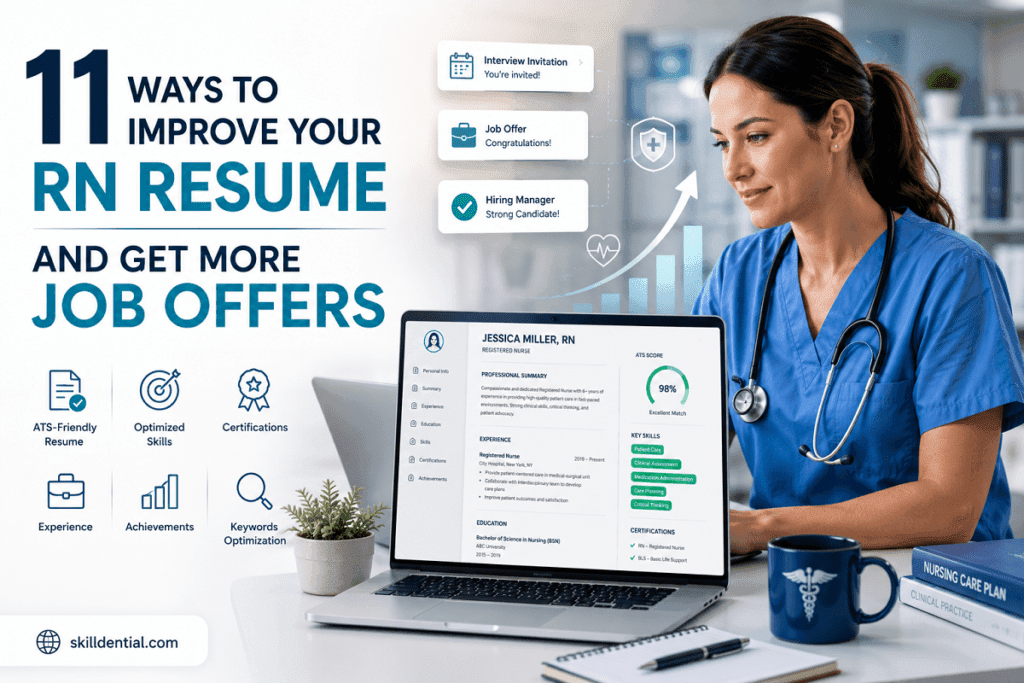
- Elements: Full name, phone number, professional email, LinkedIn profile, and active nursing license number (including state/compact status).
- Strategy: Place this clearly at the top. Including your license type (e.g., BSN, RN) immediately establishes clinical standing.
Professional Summary (The Value Proposition)
- Elements: 3–4 punchy lines summarizing your total years of experience, primary clinical specialty, and a “hero” metric (e.g., “Reduced patient readmission by 15% through protocol optimization”).
- Strategy: Tailor this section for every job description. This is your primary opportunity to insert target keywords from the listing.
Core Competencies & Technical Skills
- Elements: A categorized list of hard skills (e.g., EMR/EHR proficiency like Epic or Cerner, BLS/ACLS/PALS, specialty-specific procedures).
- Strategy: Use a two-column grid to maximize white space while listing 8–10 high-value keywords that match the job posting.
Professional Clinical Experience (The Evidence Layer)
- Format: Reverse-chronological order.
- Strategy: Structure entries by Action + Context + Quantifiable Result.
- Bad: “Provided care to patients on a med-surg floor.”
- Good: “Managed a 1:5 nurse-to-patient ratio in a 30-bed unit; increased patient satisfaction scores by 12% over 6 months.”
Licenses, Certifications, & Education
- Elements: Academic degrees, specialty certifications (e.g., CCRN, CEN), and active state licenses.
- Strategy: List the expiration dates or “Current” status clearly. Recruiters must verify eligibility instantly to pass you to the next stage.
Technical Formatting Standards for Optimization
| Feature | Requirement |
| File Format | PDF (unless specified otherwise) to ensure layout consistency in ATS. |
| Font | Sans-serif (e.g., Arial, Calibri, Roboto) at 10–12pt for body text. |
| Headers | Bold, 14–16pt size for distinct visual hierarchy. |
| Page Length | 1 page for <5 years of experience; 2 pages max for senior clinical roles. |
| Design | Single-column layout. Avoid complex graphics, tables, or text boxes that break ATS parsing. |
Pro Tip: When improving your RN resume, save your file using a descriptive, professional naming convention:
FirstName_LastName_RN_Specialty.pdf. This makes your document easily searchable within a recruiter’s candidate database.
Strategic Placement for Credential Visibility
To ensure your credentials act as an immediate “green light” for recruiters and ATS, they must be positioned where they are impossible to miss. Follow this high-leverage format to maximize their impact when improving your RN resume.
The “Licenses & Certifications” Block
Place this section immediately after your Professional Summary and before your Clinical Experience. This positioning ensures that your eligibility is confirmed before the recruiter dives into your specific work history.
Required Data Fields
To ensure compliance and credibility, include the following for every entry:
- Credential Name: (e.g., Registered Nurse, Critical Care Registered Nurse – CCRN)
- Issuing Body: (e.g., State Board of Nursing, American Heart Association)
- License/Cert Number: (Optional but recommended for state licenses)
- Status/Expiration: (e.g., Active, Expiring: MM/YYYY)
Optimized Example Template
Licenses & Certifications
- Registered Nurse (RN) | State Board of Nursing | License #12345678 | Active (Exp: 08/2027)
- Compact State Status | Multi-state privilege
- Advanced Cardiovascular Life Support (ACLS) | American Heart Association | Active (Exp: 02/2028)
- Critical Care Registered Nurse (CCRN) | AACN | Certification #ABC12345 | Active (Exp: 11/2026)
- Basic Life Support (BLS) | American Heart Association | Active (Exp: 02/2028)
Tactical Rules for Maximum Impact
- Prioritize by Relevance: If you are applying for an ICU position, place your CCRN or ACLS at the very top of the list. Move generic certifications (e.g., BLS) below specialized ones.
- The “Pending” Protocol: If you are a new graduate awaiting licensure, be precise to avoid ATS rejection. Use: “Registered Nurse (NCLEX-RN Passed, License Pending, Issue Expected: MM/YYYY).”
- Use Industry-Standard Acronyms: Recruiters search by specific acronyms. Use ACLS rather than “Advanced Cardiovascular Life Support” to ensure your profile appears in keyword-filtered searches.
- Avoid Clutter: Only include certifications that are active and relevant to the target role. Remove outdated, expired, or entry-level certifications (e.g., outdated First Aid or unrelated clerical certifications) as you gain more senior experience.
By isolating these credentials, you eliminate the cognitive load for the hiring manager, allowing them to verify your core qualifications in seconds while improving your RN resume score in ATS parsing.
Technical Standards for ATS-Compatible RN Resumes
Applicant Tracking Systems (ATS) are essentially data parsers. When improving your RN resume, your objective is to ensure the software accurately maps your career data into the employer’s database without misinterpreting headers or failing to read bullet points.
Architectural Rules for Parsing
- Layout: Use a single-column format. Multi-column layouts often cause ATS to read text horizontally across the page, mangling the chronological order of your employment.
- Headers: Stick to standard industry nomenclature. Use:
Professional SummaryCore CompetenciesClinical ExperienceEducationLicenses & Certifications
- Avoid Non-Parseable Elements:
- No Graphics: Logos, icons, charts, or images are invisible to most parsers.
- No Text Boxes: These are often treated as independent objects and frequently skipped by the ingestion engine.
- No Tables: While aesthetically pleasing, tables often misalign data. Use clean, left-aligned bullet points instead.
Keyword Integration Strategy (The “Skilldential” Method)
ATS algorithms rank resumes based on the density and relevance of keywords found in the job description. Do not simply list buzzwords; anchor them in your experience:
- Identify: Extract the “must-have” clinical skills, EMR platforms, and certifications from the posting (e.g., Epic, Ventilator Management, BLS, Patient Advocacy).
- Embed: Weave these into your bullet points.
- Example: “Utilized Epic to document care planning and monitor vitals for 5 acute-care patients per shift.”
- Avoid Keyword Stuffing: Never use white text or hidden keywords; modern ATS can detect this, and human recruiters will immediately disqualify your resume for lack of transparency.
Formatting & File Integrity
- File Format: Always use PDF unless the job portal specifically requests
.docx. PDF preserves your layout across all OS versions. - Fonts: Use system-standard, web-safe fonts like Arial, Calibri, or Helvetica. These are pre-loaded into every parser, ensuring no character substitution errors.
- Bullet Points: Use standard circles or squares. Avoid custom characters or symbols, which can be interpreted as corrupted text by older ATS versions.
Technical Checklist Before Submission
| Checkpoint | Action |
| Parsing Test | Copy-paste your resume into a plain text editor (e.g., Notepad). If the text is out of order or unreadable, the ATS will also fail to parse it. |
| Consistency | Ensure the spelling of medical terminology matches the job description exactly (e.g., “med-surg” vs “medical-surgical”). |
| Metrics | Use numerals (e.g., “15%,” “1:4”) rather than written numbers (“fifteen percent”) for faster data extraction by automated systems. |
Strategy Note: By stripping away the visual “noise” of modern design templates and focusing on machine-readable structure, you optimize the chances of your resume reaching a human recruiter. This foundational work is essential for improving your RN resume performance in competitive hiring environments.
Transforming Duty-Lists into Impact-Statements
To distinguish yourself as an elite candidate, you must pivot from a “task-based” description—what you did—to a “result-based” description—the clinical value you delivered. This is the cornerstone of improving your RN resume to compete for high-level roles.
The “Impact Formula” for Nursing Experience
Every bullet point in your clinical experience section should follow this architecture to ensure it satisfies both automated ATS keyword scanning and the analytical needs of a hiring manager:
[Action Verb] + [Clinical Context/Complexity] + [Quantifiable Outcome/Measure]
- Action Verb: Use powerful terms (e.g., Managed, Orchestrated, Optimized, Reduced, Spearheaded).
- Clinical Context: Define the scale (e.g., 1:3 ICU ratio, 40-bed step-down unit, high-acuity trauma setting).
- Quantifiable Outcome: Use hard numbers to validate your performance (e.g., 15% improvement in HCAHPS scores, 0 incidents of medication errors, reduced documentation time by 20%).
Before vs. After: High-Leverage Transformation
| Traditional Duty (Weak) | Impact-Driven Statement (Strong) |
| Administered medications to patients. | Administered complex medication regimens for 5+ high-acuity patients per shift, achieving a 100% medication safety record over 12 months. |
| Assisted with patient discharges. | Streamlined patient discharge protocols for a 30-bed unit, reducing wait times by 20% and improving interdisciplinary communication. |
| Precepted new nursing students. | Mentored 5+ nursing students annually, standardizing clinical onboarding procedures and accelerating unit integration time by 2 weeks. |
| Monitored patient vitals. | Identified early-stage clinical deterioration in patients through rigorous vital sign monitoring, directly resulting in 3 critical intervention saves in Q1. |
Strategies for High-Leverage Differentiation
- Contextualize Your Environment: Always specify the setting. A “Med-Surg” role in a 500-bed Level 1 Trauma center carries more weight than one in a small community clinic. State the bed count and acuity levels to anchor your experience.
- Highlight Quality Improvement (QI): Recruiters look for nurses who improve systems, not just follow them. Mention any participation in committee work, evidence-based practice (EBP) projects, or safety initiatives.
- Translate Rotations for New Grads: If you are a new graduate, treat your clinical rotations like professional roles. Define the patient population, the primary diagnosis codes handled, and the specific equipment utilized.
- Focus on Interdisciplinary Synergy: Nursing is a collaborative function. Highlight how your work improved outcomes for the entire care team (e.g., Reduced communication gaps with physician teams by implementing a new SBAR reporting template).
Expert Insight: When improving your RN resume, remember that your clinical experience is your primary proof of competency. Use specific medical terminology and unit-specific protocols to demonstrate that you can step into the role and perform on day one.
What skills should you include on an RN resume?
When improving your RN resume, your “Skills” section serves two functions: providing a quick-scan snapshot for recruiters and providing a dense keyword bank for ATS. Do not list generic soft skills; focus on high-leverage technical and professional competencies that demonstrate immediate clinical readiness.
High-Leverage Skills Matrix
Organize your skills into three logical categories to help the reader navigate your technical versatility. Use the following framework as your baseline:
Clinical & Procedural Skills
Focus on the hard skills that define your scope of practice and specialty competency.
- Examples: Advanced Cardiac Life Support (ACLS), Pediatric Advanced Life Support (PALS), IV Therapy & Phlebotomy, Wound Care & VAC Management, Telemetry Monitoring, Ventilator Management, Sterile Field Maintenance, Medication Administration (PO/IV/IM/SubQ), Foley/NG Tube Insertion.
Technical & EHR Proficiency
Focus on the specific platforms you have mastered. Recruiters filter heavily for these to avoid onboarding costs.
- Examples: EHR Systems (Epic, Cerner, Meditech, PointClickCare), Bedside Monitoring Systems (Philips, GE Healthcare), Medication Dispensing Systems (Pyxis, Omnicell), Telehealth Platforms.
Professional & Operational Competencies
Focus on the operational “levers” that improve team efficiency and patient safety.
- Examples: Patient Care Planning & Triage, Interdisciplinary Coordination, SBAR Reporting, Precepting & Mentorship, Crisis Intervention, Quality Improvement (QI) Protocols, Regulatory Compliance (HIPAA, Joint Commission), Patient Advocacy.
Implementation Strategy
| Technique | Execution |
| Categorization | Group by the headings above for maximum scannability. |
| Specificity | Avoid vague terms like “Communication.” Use “Interdisciplinary Coordination” or “Family Education/Counseling” instead. |
| Tailoring | Match your list to the job description’s top 5 requirements. If the job description lists “Epic” and “Wound Care” as top priorities, ensure those are in your top 10 items. |
Pro Tip: When improving your RN resume, avoid adding a “proficient in” scale (e.g., 5/5 stars). It is subjective and adds no value to an ATS. Simply list the skill; if it is on your resume, the recruiter assumes you are competent to practice it safely.
How can you tailor your RN resume to a specific job description?
Tailoring is not about rewriting your history; it is about surfacing the specific data points that prove you are the solution to the employer’s current problems. When improving your RN resume, view the job description as a roadmap of the recruiter’s pain points.
Step 1: The Keyword Extraction (The Analysis Phase)
Before editing, identify the “High-Leverage Signals” in the job description. Create a list of:
- Hard Skills: Specific EMRs (e.g., Epic), procedures (e.g., hemodialysis), and equipment.
- Patient Population: Acuity levels (e.g., high-acuity), age groups (e.g., neonate vs. geriatric), and diagnoses.
- Operational Priorities: Metrics like “reduced wait times,” “safety compliance,” or “interdisciplinary coordination.”
Step 2: Strategic Content Mapping
Map your experience to the job’s priorities. If a job emphasizes “patient safety and fall prevention,” ensure your experience section explicitly highlights a scenario where you led a safety initiative or improved a patient safety metric.
Step 3: The “Top-Heavy” Optimization
Recruiters and ATS scan the top 1/3 of your document first.
- Rewrite your Professional Summary: Replace generic phrases with a headline that mirrors the job title.
- Example: If the role is “ICU RN,” your summary should lead with “Critical Care RN with 5+ years of experience in high-acuity level 1 trauma units.”
- Prioritize Bullet Points: Move the bullet points that most closely match the job’s requirements to the top of your “Clinical Experience” section for each role.
Step 4: Linguistic Mirroring
Use the employer’s terminology to describe your tasks. If the posting uses “care coordination” instead of “case management,” adopt their terminology. This creates a psychological alignment between your experience and their operational model.
Tailoring Checklist for Every Application
| Target Area | Tailoring Action |
| Header | Ensure contact info is current and professional. |
| Professional Summary | Insert at least 2 primary keywords from the job description. |
| Clinical Experience | Reorder bullets to prioritize the top 3 requirements of the role. |
| Core Competencies | Swap out 2–3 skills to match the specific unit’s needs (e.g., swapping “Triage” for “Post-Operative Care”). |
Strategy Note: The goal of tailoring is to make it impossible for a recruiter to look at your resume and not immediately see a perfect clinical match. By mirroring their language, you signal that you are an industry peer who understands the operational demands of their specific facility.
How can new graduate nurses improve their resumes with limited experience?
As a new graduate, your clinical experience is your most valuable asset. When improving your RN resume, you must shift the perspective from “student” to “entry-level professional.” Your goal is to prove clinical competency and safety readiness despite a lack of independent work history.
Elevate Clinical Rotations to “Professional Experience”
Do not relegate your clinical rotations to a small, secondary list. Treat them as jobs. If you have completed a senior practicum or capstone, it deserves the same layout as a formal position.
- Structure: [Facility Name] | [Unit/Specialty] | [Total Clinical Hours]
- Content: Focus on the “Action-Context-Outcome” model previously discussed. Instead of saying “Observed wound care,” say “Performed complex wound care under supervision, adhering to sterile protocols for 5+ patients daily.”
Leverage High-Value Competencies
Even without professional employment, you have demonstrated specific skills. Categorize these to make your resume instantly readable by ATS.
- Simulation & Lab: Highlight specific proficiencies (e.g., “Proficient in high-fidelity simulation for code blue scenarios,” “Competent in sterile technique and IV insertion”).
- Interdisciplinary Work: Emphasize any experience presenting at report, participating in SBAR handoffs, or collaborating with staff nurses. This signals that you understand the operational flow of a hospital.
Incorporate Non-Clinical “Hire-ability” Signals
If you have limited clinical experience, bridge the gap with evidence of character and soft skills that nursing managers value.
- Healthcare-Related Roles: Include roles like CNA, PCT, or hospital volunteer work. These roles prove you have already been “vetted” by the clinical environment.
- Student Leadership: Did you hold a position in a Nursing Student Association? Did you tutor underclassmen? These roles demonstrate leadership, responsibility, and communication—all essential for an RN.
The “Ready-to-Practice” Professional Summary
Avoid the dated “Objective” statement. Replace it with a professional summary that explicitly states your qualifications and intent.
Example: “Dedicated Nursing Graduate with 600+ hours of clinical experience in high-acuity Med-Surg and ICU settings. Proven competency in Epic EHR, sterile technique, and patient safety protocols. Eager to leverage strong clinical foundational skills and a commitment to patient-centered care to contribute to the [Specific Unit] team at [Hospital Name].”
High-Leverage Checklist for New Grads
| Component | Strategy for Success |
| Licensure | Clearly state “NCLEX-RN Passed” or “License Pending (Exam Date: MM/DD/YYYY).” |
| Clinical Detail | Quantify your load (e.g., “Managed 1:4 patient ratio during senior practicum”). |
| Tech Skills | Include any EHR systems used during clinicals—this is a massive advantage for recruiters. |
| Professionalism | Ensure zero grammar errors; use an active, confident, professional tone. |
By meticulously structuring your clinical rotations and showcasing your readiness through standardized professional language, you are effectively improving your RN resume to match the standards of experienced hires.
Strategic Positioning for Advanced Nursing Roles
Advancement as an experienced or travel nurse requires a transition from “clinician” to “clinical leader.” When improving your RN resume for senior-level opportunities, your narrative must prove that you not only handle high-acuity patient loads but also elevate the performance of the entire unit.
The “Leadership & Professional Involvement” Section
For senior roles, move beyond daily tasks. Dedicate a specific, highly visible section to your influence on hospital systems.
- Precepting & Mentorship: Quantify the number of new hires or nursing students you have trained. Mention how your mentorship reduced their onboarding time or increased their competence in specific unit protocols.
- Unit-Based Councils: List participation in committees (e.g., Falls Prevention, Patient Experience, EBP/Research).
- Quality Improvement (QI): Highlight specific initiatives where you identified a bottleneck or safety risk and implemented a solution that resulted in measurable data changes (e.g., “Led a transition to a new bedside report process that improved patient satisfaction scores by 10%”).
High-Leverage Travel Nurse Formatting
Travel nurses face a unique challenge: a fragmented work history that can look like instability to an inexperienced recruiter. Frame your travel career as a demonstration of clinical versatility and rapid adaptability.
- Standardized Entry: Group assignments by facility if there are many, or list them as:
- Role: [Specialty] RN (Travel)
- Facility: [Name], [City/State] | [Bed Size / Level]
- Impact: “Successfully integrated into a high-acuity [Unit Type] within 48 hours of onboarding; maintained a 1:4 patient ratio across 3 different hospital systems.”
Targeting Senior & Specialist Roles
If you are aiming for Charge RN, Resource Nurse, or Clinical Lead positions, your resume must demonstrate “system-level thinking.”
- Showcase Versatility: Highlight your ability to “float” between units (e.g., Step-down to ICU) and manage complex, high-acuity conditions. This proves you are a reliable asset during high-census periods.
- Quantify Advanced Tech: Explicitly list advanced equipment and specialty platforms. A specialist role usually requires deep proficiency in specific monitoring or life-support hardware.
- Continuing Education: List certifications (e.g., CCRN, TCRN, CEN) at the top, along with any advanced workshops or courses that directly relate to the seniority of the target role.
Advanced Positioning Checklist
| Positioning Lever | Objective |
| Charge/Lead Roles | Emphasize delegation, conflict resolution, and flow management. |
| Specialist Roles | Emphasize deep technical expertise, evidence-based protocols, and mentorship. |
| Travel Versatility | Emphasize rapid onboarding, EHR agility, and adaptability to different acuity models. |
Strategy Note: When improving your RN resume for advancement, remember that a leadership role is ultimately about risk management and team output. Ensure every bullet point supports the narrative that you are a nurse who makes the entire team more effective, not just yourself.
How can RNs avoid common resume mistakes that reduce job offers?
To maximize your interview conversion rate, you must remove the “cognitive noise” that causes recruiters to pause or discard your application. When improving your RN resume, your objective is to clear the path for the recruiter to say “yes” in under 10 seconds.
Critical Errors to Excise Immediately
| Common Mistake | The “Skilldential” Correction |
| Generic Objectives | Replace with a high-impact Professional Summary that mirrors the job title and core requirements. |
| Non-Relevant Experience | Remove or drastically reduce non-healthcare work. If you must keep it, use only 1–2 bullets to show transferable soft skills (e.g., Leadership, Time Management). |
| Dense Paragraphs | ATS systems and recruiters struggle with blocks of text. Use Action-Oriented Bullet Points exclusively. |
| “Hidden” Credentials | Never bury your license or certifications in the footer. Place them in a dedicated, high-visibility block. |
| Typos/Inconsistency | Errors in medical terminology or medication names are “hard stops” that imply a lack of clinical safety awareness. |
Structural Best Practices for Clarity
To ensure your resume remains professional and high-signal, follow these formatting non-negotiables:
- Remove Personal Metadata: Never include age, marital status, religious affiliation, or photos. These are irrelevant to your clinical capability and can create unconscious bias or compliance issues.
- Rationalize Dates: Ensure your employment dates are accurate and formatted consistently (e.g.,
MM/YYYY). Gaps are normal; just ensure they are honest and prepared to be explained in an interview. - Unit-Specific Detail: If you are applying for a specialized unit, ensure that experience is front-and-center. If you spent 3 years in Med-Surg but are applying to the ICU, prioritize the ICU-related skills (e.g., telemetry, titrating drips) even if they occurred earlier in your career.
The “Attention to Detail” Audit
Before submitting any application, perform this final technical audit:
- The “5-Second Scan”: Ask a peer to look at your resume for 5 seconds. Can they immediately identify your current specialty, your license status, and your years of experience? If not, your hierarchy needs adjustment.
- Terminology Audit: Check the spelling of every medication, clinical procedure, and EMR system against official guidelines. A misspelling of “Levothyroxine” or “Cerner” is a red flag for a recruiter assessing your clinical safety.
- ATS Compatibility Check: Ensure no text boxes, charts, or images are hiding your contact information or headers. If you cannot highlight the text with your cursor, the ATS cannot read it.
Strategy Note: The most successful candidates treat their resume as a clinical document. Precision in your resume signals precision in your patient care. By eliminating these common errors, you differentiate yourself as a candidate who values accuracy, safety, and professional excellence—the exact traits nurse managers prioritize.
How can resume builders and ATS checkers help nurses improve their resumes?
Resume builders and ATS (Applicant Tracking System) checkers are force multipliers for improving your RN resume. While they provide the architectural foundation, your clinical expertise remains the critical input. When used correctly, these tools transition your document from a generic template to a high-leverage professional asset.
The Role of Resume Builders
Resume builders provide the “shell” necessary for success. Their primary value lies in enforcing structural discipline that prevents common formatting errors.
- Standardization: They force your data into a clean, single-column, parseable format, which is the most critical requirement for ATS compatibility.
- Structural Hierarchy: They ensure sections like
Licenses & CertificationsandClinical Experienceare prioritized, mimicking the professional standard that recruiters expect to see. - Layout Consistency: By enforcing specific font sizes and margin constraints, they eliminate the visual clutter that distracts recruiters during a 10-second scan.
The Role of ATS Checkers
ATS checkers act as your quality control. They simulate the “ingestion” process that your resume will undergo when submitted to a hospital’s portal.
- Keyword Gap Analysis: These tools compare your resume’s content against the target job description. They identify missing “High-Leverage Signals”—such as specific EMRs, clinical procedures, or specialty protocols—that the ATS algorithm expects to find.
- Parsing Reliability: They identify elements that will “break” the parser, such as columns, tables, or non-standard characters, allowing you to fix these before submission.
Integration: The “Human-in-the-Loop” Strategy
Tools are not a substitute for your clinical narrative. Use them as a diagnostic layer, then apply your expertise to finalize the content:
- Use the Builder for Structure: Start by choosing a clean, professional template. Avoid “creative” designs; prioritize readability and ATS-friendliness.
- Use the Checker for Optimization: Run your draft through an ATS checker to ensure your keyword density matches the job description. Aim for at least 80% alignment.
- Refine for Authenticity (Manual Override): This is where you finalize the document.
- Quantify Results: ATS checkers don’t know the impact of “reducing falls by 15%.” You must manually edit your bullet points to ensure they include these metrics.
- Clinical Nuance: Ensure the terminology remains accurate. If a checker suggests a keyword that doesn’t fit your clinical background, do not include it. Accuracy is non-negotiable in nursing.
Tactical Workflow for Success
| Phase | Responsibility | Goal |
| Structure | Resume Builder | Ensure perfect ATS parsing/layout. |
| Optimization | ATS Checker | Maximize keyword density and alignment. |
| Finalization | You (The Expert) | Inject metrics, clinical depth, and professional voice. |
Strategy Note: The most effective strategy for improving your RN resume is to treat these tools as a validation layer, not a content creator. Your resume’s strength lies in the depth of your clinical accomplishments, which no tool can write for you.
When using these tools, ensure you are testing against a specific job description rather than a generic profile; this maximizes the relevance of the keyword suggestions.
When should you update and customize your RN resume?
To remain competitive, you must treat your resume as a “living” career asset rather than a static document. By adopting a proactive maintenance schedule, you ensure that your most high-leverage data is always ready for immediate deployment.
The “Dynamic Update” Framework
The “Major Milestone” Trigger (Ad-Hoc)
Update your resume immediately following any of these events:
- Certifications: Earning a new credential (e.g., CCRN, CEN, PALS) is a major clinical upgrade.
- Role Changes: Adding a new title or significant shift in responsibilities.
- Skill Acquisition: Mastering a new EMR system, complex medical device, or specialized clinical protocol.
- Metrics: Documenting a measurable win, such as leading a unit safety project or achieving a specific performance goal.
The Scheduled Maintenance Trigger (6–12 Months)
Review your document biannually. This prevents the “memory decay” that makes it difficult to recall details about specific clinical achievements, patient ratios, or EBP initiatives later.
The Customization Workflow for Active Applications
When applying for a specific position, your goal is to align your resume with the specific technical and operational requirements of that job description.
| Component | Customization Action |
| Professional Summary | Mirror the target job title and 2–3 core technical priorities. |
| Skills Section | Reorder or add specific tools/protocols listed as “requirements” in the posting. |
| Experience Bullets | Elevate accomplishments that address the unit’s specific acuity level and patient population. |
| Licenses | Confirm the status/expiration date is current and prominently displayed. |
Strategy Note: The primary purpose of customizing your resume is to optimize your relevance score for both the hiring manager and the ATS. When you proactively refresh your core document, you create a high-leverage “master version” that minimizes the time required to tailor it for any specific application.
RN resume strategy matrix for different nursing profiles
This matrix synthesizes high-leverage focus areas for different nursing profiles. By aligning your resume’s architecture with these priorities, you ensure your “hire-ability” signals are optimized for your specific career stage and target role.
| Nursing Profile | Top Resume Focus Areas | Key Sections to Prioritize | Risk if Ignored |
| New Graduate RN | Clinical rotations aligned to target unit; readiness to learn | Education, Licenses, Clinical Experience, Skills | Treated as generic applicant with no clear specialty interest |
| Experienced Staff RN | Measurable impact, quality/safety projects, precepting | Professional Experience, Licenses, Skills, Leadership & Committees | Overlooked for senior or better-paying roles |
| Travel Nurse | Adaptability, range of settings, contract history, rapid onboarding | Assignments (with facilities & dates), Licenses, Skills | Seen as unstable or unfocused rather than versatile |
| LPN to RN Transition | Progressive responsibility, bridge from LPN to RN scope | Licenses, Education (RN program), Experience (RN duties) | Recruiters may question readiness for full RN responsibilities |
| International Nurse | License equivalence, language skills, international experience | Licenses & Exams, Education equivalency, Clinical Experience | Applications stalled at screening due to uncertainty |
| Leadership/Charge | Team coordination, mentorship, unit outcomes, committee work | Professional Experience, Leadership & Committees, Certifications | Missed opportunities for formal leadership titles |
Strategic Implementation
To ensure this strategy translates to tangible career growth, focus on the following deployment principles:
- Evidence-Based Positioning: Regardless of your profile, your resume must function as a proof-of-competence document. For experienced and leadership profiles, shift the weight from tasks performed to outcomes achieved.
- The “Hire-ability” Hierarchy: ATS parsing is optimized for standard section headings. Keep your structure clean and conventional; let the quality of your quantified achievements differentiate you, not the layout design.
- Contextual Calibration: Your resume must demonstrate an understanding of the specific unit’s acuity and operational demands. Use the matrix above to curate which clinical wins you highlight for a specific application.
By utilizing this matrix, you transition from simply “listing experience” to strategically positioning your profile for the specific nursing market you are targeting. This is the core of improving your RN resume for sustainable, long-term career growth.
Which of these profiles currently best describes your professional standing, and which section of your resume do you feel requires the most immediate refinement to better align with your next career move?
RN Resume FAQs
To effectively navigate the nursing job market, treat your resume as a technical document. Below are the definitive answers to common questions, framed to help you optimize your professional impact.
What is an RN resume?
An RN resume is a clinical proof-of-competency document. It is a structured summary of your education, licensure, specialty certifications, clinical experience, and technical skills. Recruiters and ATS (Applicant Tracking Systems) analyze this document to verify your eligibility and clinical fit against the precise requirements of a specific unit.
How long should an RN resume be?
New Graduates: 1 page.
Experienced/Specialist RNs: 1–2 pages maximum.
Strategy: Prioritize data density and high-value achievements over page length. If you have 10+ years of experience, you may use a second page, but ensure it focuses on relevant clinical achievements rather than outdated historical duties.
Do I need a summary or objective?
Avoid the “Objective” statement; it is outdated and focus-draining. Replace it with a Professional Summary that functions as your value proposition.
Example: “Critical Care RN with 6+ years of Level 1 Trauma experience. Expert in ventilator management, hemodynamic monitoring, and interdisciplinary care coordination. Proven track record of reducing patient readmission rates by 12%.”
Should I include all past jobs?
No. Focus on the last 10–15 years of relevant clinical experience.
Healthcare Roles: Provide detailed, metric-driven bullet points.
Non-Healthcare Roles: Use a “Transferable Skills” entry only if you lack clinical experience or need to showcase critical soft skills like leadership or conflict resolution. Keep these entries to 1–2 lines.
How often should I update my resume?
Ad-Hoc: Update immediately upon earning a new certification, completing a significant training program, or taking on new responsibilities.
Scheduled: Conduct a comprehensive review every 6–12 months.
Strategic Note: Keeping a “Master Resume” with all your metrics, projects, and certifications makes tailoring your document for specific job applications significantly faster and more accurate.
Expert Advice: When improving your RN resume, view every section as a real estate investment on your page. Only include information that increases your “hire-ability” score for the specific position you are targeting.
In Conclusion
Improving your RN resume is a systematic process of aligning your clinical evidence with employer requirements. By prioritizing a clean, ATS-compliant structure, ensuring high-visibility placement of your licenses, and anchoring your experience in quantifiable results, you transform a standard document into a high-leverage career asset.
Whether you are a new graduate or an advanced clinician, the formula for success remains consistent: targeted relevance. By mirroring the specific language and operational priorities found in your target job description, you move from “applicant” to “qualified candidate” in the eyes of both the algorithm and the recruiter.
Your Execution Roadmap
To transition from strategy to action, execute this final sequence for your next application:
- Target Selection: Identify one specific job posting that aligns with your career trajectory.
- Gap Analysis: Perform a line-by-line comparison between that job description and your current resume.
- Targeted Refinement: Adjust your summary, competencies, and clinical bullets to mirror the employer’s requested skills, patient populations, and facility settings.
- Technical Audit: Run your customized file through an ATS checker to ensure perfect parsing and keyword alignment.
By following this disciplined approach, you ensure your resume is not just sent, but read, parsed, and prioritized.