Marc Benioff vs Elon Musk: Different Paths to Tech Influence
The architecture of modern technology leadership is defined by two opposed execution models. Marc Benioff represents the pinnacle of cloud-era enterprise scale, leveraging distribution, data consolidation, and systemic acquisition frameworks to build a dominant software footprint.
Conversely, Elon Musk operates as a first-principles engineer-operator, scaling vertically integrated, capital-intensive ventures that internalize the physical and digital supply chains.
Contrasting Playbooks: Marc Benioff vs. Elon Musk
The operational mechanics of these two approaches dictate how value is captured:
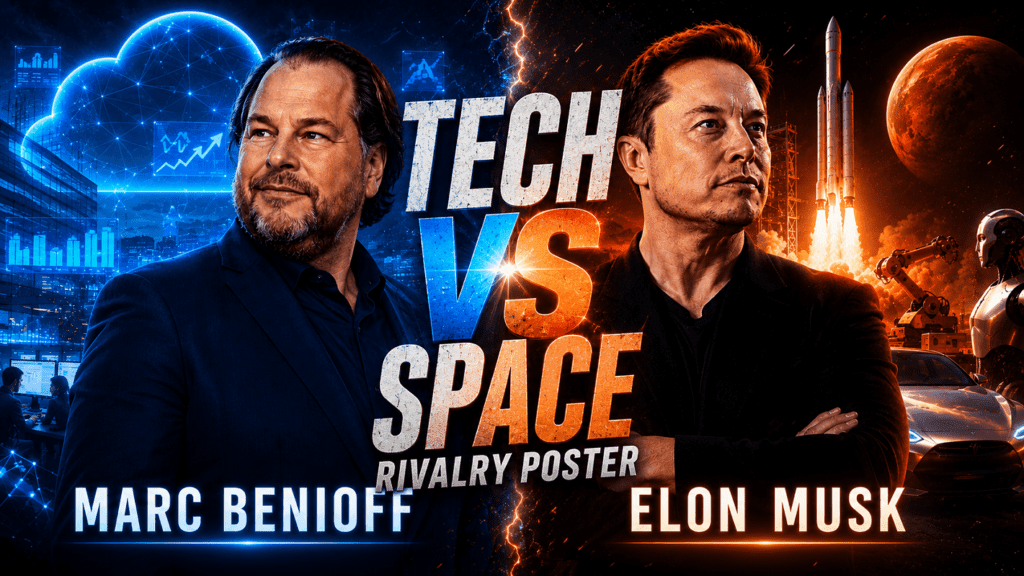
- The Marc Benioff Framework: This strategy compounds market leverage by building and acquiring a multi-tenant SaaS ecosystem. By integrating platform standardization across CRM, core data layers, and enterprise AI, Marc Benioff optimizes for go-to-market (GTM) velocity, compounding annual recurring revenue (ARR) through enterprise network effects and aggressive M&A.
- The Elon Musk Framework: This strategy compounds operational velocity by driving cost collapse through in-house design, localized manufacturing, and compressed test-iterate hardware loops. It bypasses traditional vendor ecosystems entirely to optimize the underlying engineering physics.
Strategic Implication for Leaders
For enterprise executives, tech founders, and venture strategists, choosing between these execution models is binary. The optimal path depends directly on your capital structure, proprietary deal access, and whether your primary competitive advantage relies on distribution networks or pure engineering breakthrough loops.
The Structural Mechanics of Marc Benioff’s Enterprise Playbook
Marc Benioff’s durable tech influence is not a byproduct of media presence; it is an engineered outcome of software architecture, data distribution economics, and aggressive capital allocation. By transforming a single-point software application into a foundational enterprise operating system, the playbook creates asymmetric switching costs and compounded network effects.
The playbook executes across three distinct vectors:
Architectural Foundation: The SaaS Paradigm & Data Gravity
Benioff’s initial disruption was shifting enterprise software from capital-expenditure (CapEx), on-premise deployments to operational-expenditure (OpEx), multi-tenant SaaS. This structural shift unlocked distinct economic and technical levers:
- Predictable Capital Influx: High-margin Subscription Economics generate highly predictable, recurring cash flows (ARR). This capital engine continuously funds R&D and aggressive market expansion without diluting equity at scale.
- Aggregated Data Gravity: By hosting customer data on a unified, multi-tenant cloud infrastructure, Salesforce creates massive data gravity. As an enterprise accumulates historical customer interactions, pipelines, and telemetry within the system, the operational friction and financial cost of migrating that data to a competitor becomes prohibitive.
The M&A Engine: Strategic Layering & Unified Data Models
A core pillar of the playbook is using the core CRM engine as a distribution launchpad for acquired technologies. Benioff systematically acquires market leaders in adjacent verticals to expand Salesforce’s total addressable market (TAM) and deepens account penetration.
| Phase | Strategic Acquisition | Tactical Objective |
| Marketing Cloud | ExactTarget | Captures top-of-funnel customer touchpoints and marketing automation data. |
| Commerce Cloud | Demandware | Integrates transactional B2B/B2C storefront data directly into the core customer profile. |
| Integration Layer | MuleSoft | Normalizes and ingests legacy, siloed on-premise data to fuel Salesforce systems. |
| Analytics Layer | Tableau | Provides enterprise-wide business intelligence directly on top of the consolidated data. |
Technical Consolidation
Rather than leaving these acquisitions as disparate silos, the current iteration of the playbook focuses on unifying these apps onto a common data model (Data Cloud). This creates a single source of truth for enterprise data, making the platform the definitive control point of the organization’s tech stack.
The Ecosystem Flywheel: AppExchange & Partner Lock-In
Durable influence requires outsourcing innovation to a decentralized network of partners. Benioff achieved this by building the AppExchange, creating a powerful platform ecosystem:
[Salesforce Core Data Layer]
       ▲            │
       │ API        │ Distribution
       │ Access     ▼
[Third-Party Developers & ISVs] ──► Custom Enterprise Workflows
Code language: CSS (css)- Independent Software Vendors (ISVs): Third-party developers build specialized software directly on top of Salesforce’s architecture via APIs.
- The Lock-In Effect: When an enterprise integrates multiple AppExchange apps into its daily workflows, they are no longer just buying a CRM from Marc Benioff; they are operating a customized internal network. Replacing Salesforce would mean breaking dozens of integrated business applications, cementing its status as an unkillable enterprise operating system.
The Modern Frontier: AI Layering over Unified Data
The terminal phase of Benioff’s current playbook is the monetization of enterprise AI. Large Language Models (LLMs) and autonomous agents are structurally dependent on clean, contextual, and secure data.
Because the playbook successfully executed on data consolidation over the last two decades, Salesforce does not need to build the best foundation AI models from scratch. Instead, it layers AI automation agents directly onto the customer’s existing, highly specific Data Cloud. This ensures that enterprise AI strategies must run through Salesforce infrastructure, securing Benioff’s tech influence for the next computing cycle.
The Structural Mechanics of Elon Musk’s First-Principles Model
Elon Musk’s model drives technology adoption not by establishing industry software standards or software ecosystems, but by rewriting the unit economics of physical hardware. By dismantling traditional multi-tier supplier networks and applying first-principles engineering, this approach forces industry-wide inflection points through sheer cost collapse and performance breakthroughs.
The model executes across three distinct operational vectors:
First-Principles Engineering: Overcoming the Tyranny of the Supplier Margin
The foundation of Musk’s approach is breaking a complex physical asset down into its fundamental material costs (e.g., the cost of carbon fiber, aluminum, lithium, copper, and iron) rather than accepting vendor quotes.
- De-risking the Cost Curve: In traditional aerospace and automotive manufacturing, Tier 1 and Tier 2 suppliers capture margin at every handoff, inflating the final cost of goods sold (COGS). Musk’s model rejects this “catalog engineering.” If the market price for an actuator or a valve is $\$10,000$, but the raw material inputs cost $\$100$, the mandate is to engineer and manufacture the component in-house.
- Overcoming Physics Constraints vs. Process Constraints: Traditional OEMs (Original Equipment Manufacturers) optimize for process compliance and vendor management. Musk’s model optimizes strictly for the laws of physics, systematically deleting parts, processes, and requirements that do not directly contribute to structural efficiency or mass reduction.
Vertical Integration: Compressing the Hardware Iteration Loop
Traditional manufacturing relies heavily on outsourcing components to an international web of suppliers. While this minimizes upfront capital expenditures (CapEx), it introduces catastrophic latency into product development loops. Vertical integration sacrifices short-term capital efficiency to capture total operational velocity.
Traditional OEM Model (High Latency):
[Design Change] ──► [RFPs to Tier 1 Suppliers] ──► [Supplier Tooling Changes] ──► [Months of Lead Time] ──► [Testing]

Musk Vertical Model (Low Latency):
[Design Change] ──► [In-House CAD Update] ──► [In-House Manufacturing Floor] ──► [Weeks of Lead Time] ──► [Test to Failure]
Code language: CSS (css)
Comparative Iteration Metrics
- SpaceX Framework: By building roughly 90% of rocket parts, engines, avionics, and structures in-house, SpaceX decouples its development timeline from external supply chains. Software engineers sit next to manufacturing engineers, allowing a “build fast, test to failure, analyze, iterate” loop to execute in weeks rather than fiscal quarters. This hyper-velocity is what made reusable launch architectures commercially viable while competitors were stuck in multi-year design reviews.
- Tesla Framework: Instead of relying on legacy automotive suppliers for electronic control units (ECUs), battery packs, and power electronics, Tesla internalizes the entire compute and battery stack. When a global semiconductor shortage occurs or an engineering optimization is found, Tesla writes custom code to utilize alternative, in-house firmware and silicon, avoiding assembly line shutdowns that cripple traditional OEMs.
Forcing Market Adoption Through Visible Step-Changes
Because this model does not rely on creating ecosystem lock-in through APIs or developer networks (like the SaaS playbook), it influences the market by altering the competitive landscape.
- Collapsing the Economic Threshold: Technology adoption is often bottlenecked by cost. By driving down the cost per kilogram to orbit via SpaceX Starship or the cost per kilowatt-hour via Tesla’s continuous battery cell iterations, the model makes previously non-viable technologies economically inevitable.
- The Forced Paradigm Shift: Legacy competitors are forced to adapt or face obsolescence. The automotive industry did not shift toward electric vehicles due to regulatory compliance alone; they shifted because Tesla proved that high-performance, high-margin EVs could scale globally. Similarly, global aerospace defense contractors have had to abandon expendable rocket designs to compete with SpaceX’s launch cadence and pricing.
The Core Operational Trade-Offs
While highly potent, the execution of Musk’s model requires a high-risk corporate profile:
- Extreme Capital Intensity: Building gigafactories and launch facilities requires billions in upfront, high-risk capital allocation before achieving positive unit economics.
- Operational Fragility: Internalizing the supply chain means assuming 100% of the operational risk. A single bottleneck on your factory floor can completely halt the enterprise production loop.
The Structural Framework of the Marc Benioff Engine
In practice, Marc Benioff’s multi-tenant cloud and M&A engine operates as a highly orchestrated capital-and-code loop. It is designed to capture, clean, and monetize enterprise customer data. Rather than building every application from scratch, the framework utilizes programmatic mergers and acquisitions to constantly expand Salesforce’s market footprint, immediately forcing those acquired assets onto a shared core infrastructure.
[Acquired Apps & Data Sources] (Informatica, MuleSoft, ExactTarget, Demandware)
                    │
                    ▼ Ingestion & Normalization
        [Data Cloud / Data 360 Layer] (Unified Apache Iceberg / Parquet Lakehouse)
                    │
                    ▼ Metadata Standardization
      [Core Salesforce Metadata Layer] (Unified Object Definitions, Sharing Rules)
                    │
                    ▼ Autonomous Execution
 [Agentforce / AI Application Layer] (Atlas Reasoning Engine & Slack Interface)
Code language: JavaScript (javascript)
The engine executes in production via a four-stage loop:
High-Margin Multi-Tenancy: The Scalability Baseline
The engine relies on a unified multi-tenant kernel. Thousands of enterprises share the same underlying compute infrastructure and core codebase, isolated securely via structural metadata.
- Dynamic Virtualization: When custom applications or workflows are constructed within the system, the platform does not compile unique database tables or siloed code. Instead, it logs runtime metadata definitions. The multi-tenant runtime engine reads this metadata to dynamically materialize tenant-specific environments on demand.
- Hyper-Scale Upgrades: Because there is only one codebase to manage, infrastructure updates, security patches, and structural optimizations deploy simultaneously across the global footprint without fracturing the ecosystem.
Programmatic M&A: Closing Data Gaps and Expanding Surface Area
When Marc Benioff identifies a critical enterprise capability or an emerging workflow silo outside the ecosystem, Salesforce deploys its balance sheet to acquire the market leader. The criteria for these acquisitions are highly precise, targeting explicit structural gaps in the enterprise stack.
| Asset | Transaction Focus | Tactical Role in the Engine |
| MuleSoft | Data Ingestion | Exposes and pipes legacy on-premise silos into the cloud engine via managed APIs. |
| Tableau | BI & Visualization | Delivers native semantic querying and visualization directly over ingested assets. |
| Slack | Engagement Layer | Serves as the operational, conversational front end for human and agent interaction. |
| Informatica | Data Management | Ingests enterprise master data management (MDM), mass integration, and governance pipelines. |
| Qualified & Momentum | Top-of-Funnel AI | Captures and automates real-time website demand and early-stage pipeline qualification. |
The Normalization Layer: Breaking Data Silos
An acquisition is a liability if left isolated. The true power of the engine lies in forcing external applications onto a single, standardized data and identity layer.
- Data Cloud (Data 360): Ingested data from acquired stacks is harmonized into an open, high-scale lakehouse architecture utilizing open standards (e.g., Apache Iceberg and Parquet).
- Zero Copy Architecture: Instead of forcing continuous, brittle ETL (Extract, Transform, Load) pipelines, the data engine utilizes bidirectional federation with external warehouses (e.g., Snowflake, BigQuery, Databricks). This allows the system to read and compute data in real-time without costly data duplication or added security risk.
- The Common Metadata Framework: All data is mapped to a Single Source of Truth (SSOT) semantic data model. Once normalized, an object from an acquired platform inherits Salesforce’s standard access controls, sharing rules, and workflow capabilities.
The Activation Phase: Monetizing the Customer Data Plane
The endgame of Marc Benioff’s architecture is to shift the platform from a passive system of record to an active execution layer. This is realized through the deployment of autonomous enterprise AI via Agentforce.
- The Atlas Reasoning Engine: Rather than connecting third-party Large Language Models (LLMs) directly to raw, unstructured data lakes, Agentforce routes natural language prompts through the core metadata schema. The AI agent understands the specific context of an account, opportunity, or service case because it reads from the unified data plane.
- Decentralized Multi-Tenant AI: The platform isolates tenant reasoning engines securely via unique workspace identifiers embedded into storage keys. This allows teams to deploy custom, low-latency AI agents (leveraging retrieval-augmented generation) that safely interact with core enterprise records without risk of cross-tenant data leaks.
The Strategic Bottom Line
By controlling the customer data plane across departments (Sales, Service, Marketing, Commerce), Marc Benioff’s engine creates an unassailable ecosystem. For enterprise buyers, switching away from Salesforce doesn’t just mean changing a point-solution app; it means dismantling their entire enterprise data architecture and workflow automation stack.
The Structural Dichotomy: Physical Capital vs. Digital Network Control
While both models seek absolute dominance over their respective markets, their structural architectures are inverted. Marc Benioff’s strategy relies on a capital-efficient digital ecosystem that scales through external partnerships and software developer networks. Elon Musk’s strategy relies on a capital-intensive physical stack that scales through asset internalization and manufacturing physics.
The structural divergences separate into three core operational pillars:
Capital Allocation & Asset Density
The financial frameworks governing these two models prioritize completely different asset profiles.
| Structural Vector | The Marc Benioff Ecosystem Model | The Elon Musk Vertical Model |
| Asset Profile | Asset-Light / Software Centric: Maximizes operating leverage by renting cloud infrastructure and shifting custom code deployment onto customers and partners. | Asset-Heavy / Factory Centric: Maximizes physical control via massive capital expenditure (CapEx) in factories, foundries, and automated assembly. |
| Marginal Cost of Scale | Near-zero. Deploying a new seat on a multi-tenant node requires minimal computing overhead. | Linear and bound by materials. Scaling vehicle or rocket production requires scaling raw material inputs and physical floor space. |
| Risk Profile | Lower execution risk; market down-cycles are insulated by highly predictable, multi-year recurring SaaS contracts (ARR). | Extreme operational risk; cash-flow crunches on production lines can lead to systemic enterprise failure (e.g., Tesla’s “production hell”). |
The Locus of Control: Production Stack vs. Data Plane
The definition of a “control point” differs fundamentally between these two playbooks.
Musk’s Production Stack Control
Musk seeks technical sovereignty by owning the physical supply chain. Instead of purchasing generic components off the shelf, his company internalizes everything from the metallurgical composition of rocket hulls to custom silicon design for autonomous vehicle computing.
- The Engineering Objective: Eliminate supplier markups, prevent external component delays, and maintain absolute control over the speed of hardware optimization loops. If a part needs adjustment, the engineering change order updates the CAD file and the in-house manufacturing tooling simultaneously.
Benioff’s Data Plane Control
Marc Benioff does not seek to own the underlying infrastructure hardware or individual specialized business apps. Instead, his model establishes Salesforce as the definitive system of record and customer data plane for the enterprise.
- The Software Objective: Centralize metadata, identity management, and business logic layers. Once an enterprise standardizes its workflows on this unified data plane, Salesforce becomes the operational foundation. It dictates how external apps connect, process, and automate data across departments.
Partner Networks: The AppExchange vs. In-House Monolith
The implementation of third-party networks showcases the most stark structural difference in how these models scale market influence.
Benioff Ecosystem Architecture (Decentralized Leverage):
[Salesforce Core / Data Cloud]
      ├──► AppExchange (Thousands of Independent Software Vendors)
      ├──► Global Systems Integrators (Accenture, Deloitte scaling delivery)
      └──► MuleSoft Partner API Network (Extending platform reach)

Musk Vertical Architecture (Monolithic Loop):
[Raw Material Inputs] ──► [In-House Engineering] ──► [In-House Manufacturing] ──► [Direct-to-Consumer / End Product]
Code language: CSS (css)
The Benioff Ecosystem Flywheel
The software strategy scales exponentially by encouraging third-party dependencies. Through the AppExchange, thousands of Independent Software Vendors (ISVs) build point solutions directly on top of Salesforce’s core architecture. Concurrently, Global Systems Integrators (GSIs) build highly profitable consulting practices dedicated to implementing and scaling Salesforce software inside Fortune 500 companies.
This creates immense distribution leverage: external partners assume the engineering and sales costs of extending the software’s capabilities into niche industries, while Salesforce collects high-margin platform toll fees.
The Musk Monolithic Loop
Musk’s model views external partner reliance as a vulnerability and a source of unnecessary friction. The vertical architecture systematically eliminates middlemen, distributors, and franchised dealer networks.
Tesla handles its own vehicle sales and services directly to consumers, and SpaceX operates its own global satellite constellation (Starlink) down to the consumer ground terminals. Rather than orchestrating an ecosystem of external contributors, the model relies on tightly coupled internal engineering teams executing rapid, synchronous feedback loops to outpace the market.
Strategic Synthesis
- Marc Benioff wins by owning distribution, workflow, and data gravity. He creates an open yet sticky digital marketplace where the ecosystem does the heavy lifting of scaling product utility.
- Elon Musk wins by owning materials, engineering, physics, and manufacturing speed. He creates closed, high-performance execution engines that force industry adoption by completely collapsing the unit economics of physical technology.
Decision Framework: Ecosystem vs. Internalization
Choosing between a Marc Benioff platform strategy and an Elon Musk vertical integration model is not an aesthetic choice; it is a structural decision dictated by your product’s relationship with raw materials, capital constraints, and network distribution.
Deploy this specific, high-leverage evaluation framework to determine the optimal execution path for your enterprise.
The Core Bottleneck Test: Distribution vs. Physics
Look directly at the fundamental constraint limiting your company’s growth.
Is the primary gating factor to market dominance:
                  │
                  ├──► CUSTOMER AGGREGATION & DATA ISOLATION?
                  │    └───► Execute the Benioff Playbook
                  │
                  └──► RAW UNIT ECONOMICS & PRODUCTION VELOCITY?
                       └───► Execute the Musk Playbook
- Deploy the Benioff Model if: Your primary barrier is market fragmentation and workflow friction. If value is created by getting disparate departments or third-party tools to speak to a single, unified database layer, you must build an ecosystem. Your goal is to establish data gravity and extract high-margin rents by sitting in the middle of all customer interactions.
- Deploy the Musk Model if: Your primary barrier is a physical or economic constraint dictated by the laws of physics or material costs. If the market is bottlenecked because battery cells are too expensive, launch costs are too high, or computing infrastructure requires immense power, you must internalize the stack. You cannot outsource the core engineering loop if the industry standard components are fundamentally inefficient.
Structural Capital & Governance Alignment
The choice of execution model dictates your corporate finance strategy and board architecture.
The Benioff Capital Profile (High Operating Leverage)
- Financial Mechanics: Highly predictable, compounding ARR with near-zero marginal costs of delivery per software seat. Balance sheets are leveraged programmatic-style: using high stock valuations and predictable cash flows to fuel M&A, buying out point solutions and immediately routing them into your core multi-tenant engine.
- Operational Footprint: You shift the burden of building niche, hyper-specific industry vertical features onto a decentralized network of Independent Software Vendors (ISVs) and global systems integrators, optimizing for a high Return on Invested Capital (ROIC).
The Musk Capital Profile (High Capital Intensity)
- Financial Mechanics: Mass CapEx deployment into physical infrastructure (foundries, automated assembly lines, orbital data networks) before achieving positive unit economics.
- Operational Governance: Requires structural insulation from public-market quarterly earnings pressure. To run hyper-velocity “test-to-failure” engineering loops, the founder must maintain definitive voting control (e.g., Musk’s super-voting Class B structures at SpaceX). If a board can fire you for exploding prototypes or experiencing temporary “production hell,” this model will collapse under short-term fiduciary panic.
The Core Competency Matrix
Evaluate your team’s native capabilities against the operational demands of each framework:
| Vector | Benioff Execution Imperatives | Musk Execution Imperatives |
| Product Strategy | Metadata architecture, semantic data modeling, API normalization, and ecosystem governance. | First-principles engineering, material sciences, localized supply-chain design, and vertical software-hardware integration. |
| Go-To-Market (GTM) | Enterprise relationship management, value-selling frameworks, and managing massive third-party partner channels. | Direct-to-consumer delivery, defining structural paradigms through step-change performance leaps, and forcing market capitulation via pure cost collapse. |
| Modern AI Integration | The Integration Layer Approach: Allocating massive capital to inference tokens (e.g., routing complex enterprise workflows through frontier reasoning engines like Anthropic) to build autonomous agentic platforms like Agentforce. | The Proprietary Stack Approach: Ingesting foundational AI directly into internal compute clusters and physical hardware payloads (e.g., autonomous vehicles, robotics, or space-bound computing nodes) to bypass external software layers. |
Strategic Synthesis
- Choose Marc Benioff if: You want to own the digital interface and customer data plane. Your execution weapon is the integration framework, your defense is high switching costs, and your scale is realized through a network of thousands of external partners.
- Choose Elon Musk if: You want to own the physical assets and manufacturing loops. Your execution weapon is the first-principles deletion of parts and processes, your defense is structural cost dominance, and your scale is realized through absolute internal sovereignty.
Executive Decision Matrix: Benioff vs. Musk
| Dimension | Benioff‑Style (Multi‑Tenant + M&A Engine) | Musk‑Style (Vertical Integration + First Principles) |
| Primary Leverage | Platform distribution, semantic data gravity, and decentralized partner ecosystems structured around enterprise workflows. | First-principles engineering breakthroughs, physics-driven optimization, and structural cost collapse via total in-house manufacturing control. |
| Capital Profile | Asset-Light/OpEx Centric: Moderate infrastructure CapEx; heavy capital allocation toward strategic M&A and enterprise GTM pipelines; funded by predictable, compounding ARR. | Asset-Heavy/CapEx Centric: Immense upfront capital requirements for factories, foundries, and heavy hardware R&D; extended, highly volatile pre-revenue horizons. |
| Speed of Iteration | Hyper-Velocity at Application Layer: Near-instantaneous metadata and code deployment across global multi-tenant nodes; slow, complex organizational integration post-M&A. | Hyper-Velocity at Engineering Layer: Compressed “build-test-fail-iterate” loops executed in weeks by eliminating external supplier lead times; bound linearly by physical manufacturing constraints. |
| Customer Lock-In | Systemic Workflow Dependency: Asymmetric switching costs driven by deep data gravity, custom API integrations, and specialized third-party software dependencies (AppExchange). | Performance & Economic Monopoly: Irreplaceable unit-economic advantage; switching costs dictated by unique hardware integration, proprietary compute layers, and structural utility lack of alternatives. |
| Talent Profile | Enterprise GTM strategists, solution/integration architects, corporate development (M&A) specialists, platform PMs, and partner ecosystem operators. | Deep-domain hardware/software engineers, metallurgists, factory automation designers, supply chain architects, and specialized test-operations crews. |
| Risk Profile | Post-acquisition technical debt, integration/synergy failure, enterprise platform fatigue, and regulatory/antitrust hurdles are facing large-scale data aggregation and M&A. | Catastrophic execution risk, hardware/safety incidents, systemic CapEx overruns, and binary technology failures during un-insulated production cycles. |
| Best Suited For | B2B SaaS, decentralized data platforms, complex workflow automation systems, and digital marketplace hubs crossing global business verticals. | Space infrastructure, electric mobility, autonomous robotics, deep-tech manufacturing, defense hardware, and capital-intensive clean energy grids. |
What do Skilldential career audits reveal about working in these environments?
Skilldential career audits reveal that professional friction and burnout during these transitions are rarely caused by a lack of raw technical capability. Instead, failure points emerge from a structural misalignment between a candidate’s native skill profile and the operational mechanics of the target organization’s execution model.
When mapping talent movement into these polarized corporate environments, the audits highlight two distinct sets of systemic friction points and the corresponding high-leverage skill systems required to unlock upward mobility.
Entering Benioff-Style Platforms: The Integration Trap
Mid-to-senior professionals migrating into multi-tenant, M&A-driven ecosystems frequently misjudge the nature of the work. They enter expecting pure product engineering but are instead absorbed by the demands of enterprise scale.
Core Discoveries
- The Underestimation of Technical Debt: Candidates routinely underestimate the governance required to manage cross-cloud dependencies, unified metadata schemas, and complex API integration layers (e.g., MuleSoft ecosystems).
- The Revenue-Architecture Gap: Velocity in this framework is tied to distribution. Engineers and product managers stall when they fail to realize that software architecture must directly align with enterprise go-to-market (GTM) pipelines and strategic partner networks.
High-Leverage Upskilling Framework
To achieve promotion readiness (yielding a 25–35% increase in mobility based on audit metrics), platform talent must transition from pure feature-building to systemic ecosystem design:
- Enterprise Sales & GTM Alignment: Translating technical features into repeatable, high-scale enterprise value propositions.
- Partner Solution Architecture: Designing software platforms specifically to allow third-party Independent Software Vendors (ISVs) and Global Systems Integrators (GSIs) to build applications on top of your core metadata layer.
- Post-Acquisition Integration Playbooks: Developing standard operating procedures to ingest fragmented, external software assets and normalize them onto a central customer data plane without breaking backward compatibility.
Entering Musk-Style Monoliths: The Operational Shock
Conversely, professionals entering first-principles, vertically integrated organizations face an entirely different operational crisis.
Core Discoveries
- The Velocity Load: Talent transitioning from traditional corporate structures is often destabilized by the sheer intensity of compressed, in-house hardware and software iteration loops. The “build fast, test to failure” mandate removes the insulation typically provided by multi-tier vendor networks.
- The Accountability Crunch: When your organization internalizes 90% of its supply chain and components, you own 100% of the operational risk. Engineers frequently burn out because they lack the structured methodologies required to manage concurrent design changes, localized manufacturing bottlenecks, and strict physical testing windows simultaneously.
High-Leverage Upskilling Framework
Deep-tech and hard-tech candidates stabilize and progress predictably only when they augment their domain expertise with operational velocity skills:
- Design for Manufacturability (DFM): Moving past theoretical engineering to optimize designs specifically for rapid assembly, material minimization, and the elimination of redundant parts.
- Reliability Engineering & Root-Cause Analysis: Implementing immediate, data-driven diagnostic frameworks to analyze physical failures during hyper-compressed test cycles.
- Automated Test-Loop Architecture: Designing automated, continuous feedback loops that feed production-floor telemetry directly back to the design team in real-time, completely bypassing corporate latency.
The Strategic Takeaway
The ultimate indicator of career sustainability is structural alignment. Skilldential career audits demonstrate that lasting tech influence is achieved by matching your personal capability development to the macro-economic engine of your employer:
[Candidate Core Competency] ──► Explicitly Aligned To ──► [Corporate Execution Model]
       │                                                                │
       ├──► Platform, M&A, & GTM Sync ──────────────────────────────────┼──► Benioff Playbook
       │                                                                │
       └──► First-Principles, DFM, & Iteration Loops ───────────────────└──► Musk Playbook
Code language: CSS (css)
By decoupling your career development from arbitrary job titles and anchoring it to these specific structural skill maps, you insulate yourself against systemic burnout and position your career directly inside the organization’s core control point.
Is Marc Benioff a first-principles operator like Elon Musk?
No. Marc Benioff is primarily a platform and distribution strategist who scales enterprise footprints via multi-tenant SaaS architecture, systematic M&A, and compounding go-to-market (GTM) loops.
Conversely, Musk’s operating style focuses on physical first-principles engineering and vertical integration, systematically deleting components and processes to minimize unit costs.
While both apply rigorous reasoning to their business frameworks, Benioff optimizes the digital data layer and ecosystem distribution, whereas Musk optimizes materials, production physics, and engineering cycle velocity.
Which model is better for a SaaS startup: Benioff’s or Musk’s?
For the vast majority of software startups, a Benioff-style approach is structurally appropriate. Software success depends heavily on API integrations, data gravity, and building a standardized platform ecosystem around user workflows.
Attempting a Musk-style vertical integration in SaaS (e.g., building proprietary server hardware, writing custom low-level database languages from scratch, or shunning third-party developer toolchains) creates unnecessary capital intensity and catastrophic latency.
The Musk model is strictly optimized for deep-tech, hardware, or asset-heavy domains where controlling the absolute production stack is the only way to achieve a step-change performance breakthrough.
Does vertical integration always beat partnerships and M&A?
No. Vertical integration minimizes reliance on external suppliers and accelerates technical learning loops, but it demands immense upfront capital expenditure (CapEx) and introduces massive operational fragility.
If a single in-house component fails, the entire production chain stalls. Partnerships and programmatic M&A, as executed in the Benioff model, allow an enterprise to scale its surface area and total addressable market (TAM) with vastly superior capital efficiency.
However, the trade-off shifts from manufacturing risk to integration risk—requiring heavy governance to manage technical debt, unified metadata architectures, and cross-cloud ecosystem fragmentation.
Can an enterprise company combine Benioff-style and Musk-style strategies?
Yes, but only through explicit organizational compartmentalization. A company can vertically integrate its core, high-leverage competitive advantage while running a platform-and-partner model for its non-core capabilities.
For example, a tech company might apply first-principles engineering to design its own specialized compute silicon (Musk-style) but rely entirely on global systems integrators, open APIs, and an app marketplace to distribute and scale its enterprise workflow software (Benioff-style).
Merging these strategies fails when a company misaligns its KPIs—such as forcing an asset-heavy hardware manufacturing timeline onto an agile software deployment cycle, resulting in systemic operational gridlock.
What skills are critical to succeed in a Benioff-style company?
To achieve upward mobility and drive impact within a Benioff-style enterprise stack, professionals must master competencies tailored to platform distribution and ecosystem complexity:
Semantic Data Architecture: Designing unified metadata models and zero-copy data clouds to seamlessly orchestrate information across siloed applications.
Ecosystem and Partner Management: Building robust API networks and partner frameworks that incentivize third-party developers (ISVs) to scale utility on top of your platform.
Post-Merger Technical Integration: Standardizing and normalizing newly acquired software assets onto a central system of record without degrading enterprise stability.
GTM Systems Realignment: Mapping product and engineering development cycles directly to enterprise sales pipelines and client adoption frameworks.
These capabilities contrast directly with the material sciences, design for manufacturability (DFM), and automated test-loop engineering required to survive inside a Musk-style monolith.
In Conclusion
The structural divergence between the two archetypes of modern technology leadership is absolute:
- The Marc Benioff Framework: Establishes dominance by engineering a multi-tenant software ecosystem. By compounding distribution leverage through programmatic M&A, platform integrations, and a unified semantic data layer, this model centralizes enterprise workflows to build a moat out of sheer data gravity.
- The Elon Musk Framework: Establishes dominance by rewriting the underlying unit economics of physical assets. By enforcing first-principles engineering and vertical integration, this model compresses technical iteration loops, eliminates supplier latency, and forces market adoption through massive cost collapse and hardware breakthroughs.
For software-as-a-service (SaaS) and marketplace platforms, the Marc Benioff architecture remains the definitive model for capturing recurring revenue and workflow lock-in. For deep-tech, robotics, and hardware-centric industries, the Musk model provides the necessary technical sovereignty to overcome complex manufacturing and physical constraints.
Attempting to blend these execution styles by default creates severe operational drag, misaligned key performance indicators (KPIs), and capital inefficiency. At an individual level, as documented by Skilldential career audits, a failure to recognize the underlying mechanics of your employer’s corporate model leads directly to structural skill gaps, stalled upward mobility, and professional burnout.
Actionable Strategy: The 18-Month Alignment Blueprint
To maximize organizational or career leverage, you must eliminate strategic ambiguity by executing a forced alignment loop:
Execute a Structural Audit
Evaluate your current enterprise venture or career trajectory against the core metrics of the decision matrix. Explicitly declare your operational anchor: are you scaling via digital platform and ecosystem leverage, or are you scaling via vertically integrated engineering and manufacturing velocity?
Streamline Your Resource Allocation
Once your operational anchor is locked in, ruthlessly eliminate misaligned processes over the next 12 to 18 months:
- If you are on the Benioff path: Direct your capital and hiring efforts toward mastering metadata architecture, zero-copy data integration, and enterprise partner distribution networks. Stop over-engineering proprietary, low-level technical stacks that could be outsourced to the ecosystem.
- If you are on the Musk path: Direct your resources toward first-principles component reduction, design for manufacturability (DFM), and automated internal testing loops. Purge dependencies on multi-tier external suppliers that introduce margin drain and operational latency into your development cycle.