Psych Tech Program Online: Top 11 Schools and Requirements
A psych tech program online provides the theoretical foundation necessary to support patients with mental illnesses or developmental disabilities. It is important to distinguish between these preparatory programs and the rigorous requirements for state licensure.
While a fully psych tech program online that grants eligibility for California state licensure does not exist—due to the state’s mandatory 1,530-hour requirement, which includes 576 hours of theory and 954 hours of in-person clinical rotations—online mental health technician certificates remain a valuable first step.
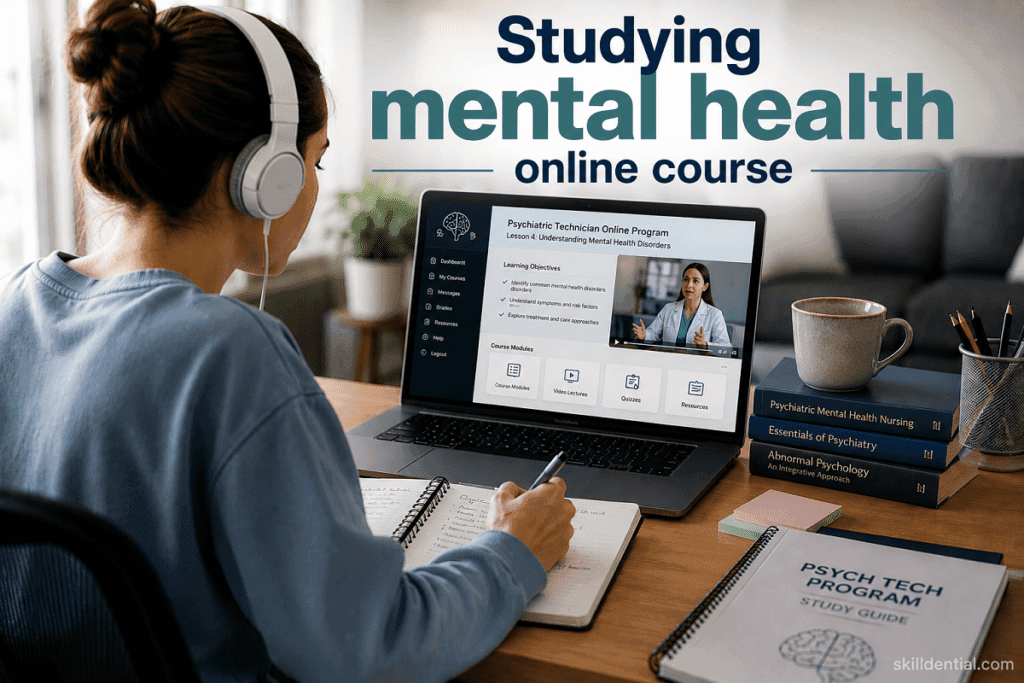
These programs can effectively prepare students for national certifications, such as those offered by the American Association of Psychiatric Technicians (AAPT), helping you build the essential knowledge base required to launch a career in clinical mental health settings.
What Is a Psych Tech Program and Can You Study It Online?
A psychiatric technician (psych tech) program prepares entry-level healthcare workers to provide compassionate, evidence-based care to clients with mental disorders or developmental disabilities. These programs bridge the gap between clinical theory and hands-on patient support, teaching vital skills in pharmacology, nursing science, and crisis intervention.
Can You Study It Online?
The short answer is: It depends on your career goal. While you can complete a psych tech program online for the theoretical components, the path to becoming a licensed professional versus a nationally certified technician differs significantly regarding in-person requirements.
Most programs fall into two distinct categories:
Licensure-Track Hybrid Programs
If your goal is to become a state-licensed psychiatric technician (such as in California), a 100% online program does not exist. State regulations mandate rigorous hands-on training to ensure patient safety.
- The Requirement: California, for example, requires a minimum of 1,530 total program hours. This is split into 576 hours of theory (which can often be completed online) and 954 hours of in-person supervised clinical experience at approved healthcare facilities.
- The Format: These are hybrid programs. You complete your coursework through a digital platform, but you must physically attend clinical rotations to qualify for state licensure.
Certification-Track Online Programs
If you are pursuing national recognition or seeking entry-level roles that do not require state licensure, you can find 100% online programs.
- The Objective: These programs prepare you for voluntary national certifications, such as the Nationally Certified Psychiatric Technician (NCPT) credential offered by the American Association of Psychiatric Technicians (AAPT).
- The Format: These are typically self-paced or modular online courses. They provide the foundational knowledge needed for the AAPT Level 1 exam and general mental health technician roles.
- Important Note: Completion of a certification-track program does not substitute for the mandatory clinical hours required for state-specific professional licensure. Always verify if a program meets the specific regulatory requirements of the state where you intend to practice.
Quick Reference: Choosing Your Path
Feature Licensure-Track (e.g., California) Certification-Track (e.g., AAPT) Primary Goal State-mandated professional license Professional certification/advancement Online Theory Yes Yes Clinical Hours Mandatory (In-person) Typically not required Eligibility Required for state-regulated facilities Best for private/unregulated sectors
Before enrolling, ensure you have clearly defined your long-term career goals. If you aim to work in a state-regulated hospital or public health facility, prioritize hybrid programs that partner with local clinical sites to satisfy your state’s specific hour requirements.
How Long Does a Psych Tech Program Take?
The duration of your training depends entirely on whether you are pursuing state licensure or a professional certification.
Licensure-Track Programs (Hybrid)
If you are training for state licensure (such as in California), programs are intensive and highly structured.
- Typical Duration: 12–18 months.
- Program Structure: These programs adhere to specific state mandates, such as the California requirement of 1,530 total hours. This comprises 576 hours of theory and 954 hours of in-person supervised clinical experience.
- Full-Time vs. Part-Time: Most programs are designed as full-time, 12-month cohorts. While some institutions may allow for a slower pace, working adults should anticipate 18–24 months if opting for a part-time track. Because of the heavy clinical requirement, students are often advised to limit outside work to ensure academic and clinical success.
Certification-Track Programs (Online)
If you are pursuing a non-licensure certificate (e.g., AAPT Level 1 or general mental health technician certification), you have significantly more flexibility.
- Typical Duration: 3–12 months.
- Program Structure: These programs are generally 100% online and self-paced. The duration depends on your personal study habits, weekly availability, and the complexity of the specific curriculum (e.g., a 350-hour vs. a 180-hour program).
- Flexibility: Because these programs do not require mandatory state-supervised clinical hours, they are ideal for working professionals who need to balance education with existing career or family commitments.
Program Type Format Typical Duration Licensure-Track Hybrid (Theory + Clinical) 12–18 Months Certification-Track 100% Online 3–12 Months
Strategic Note: If you are choosing a psych tech program online for certification, verify that the curriculum aligns with your specific career goals. If you ultimately intend to work in a state-regulated facility, ensure that your chosen program credits or prerequisites can be applied toward a future licensure-track hybrid program to maximize your investment.
What Are the Admission Requirements for Psych Tech Programs?
Admission requirements for a psych tech program online (or hybrid) are designed to ensure that candidates possess the foundational knowledge and personal fitness required for patient care. While specifics vary by institution, most programs adhere to these standard benchmarks:
Core Admission Prerequisites
Before applying, you will typically need to demonstrate readiness through the following:
- Age: You must be at least 18 years of age by the start of clinical training.
- Education: A high school diploma or GED equivalent is the baseline. Some institutions may accept an associate degree or higher as proof of educational competency.
- Academic Prerequisites: Most programs require a grade of “C” or higher in foundational college-level courses, typically including:
- Medical Terminology
- Biology/Anatomy & Physiology: Programs—particularly those in California—often specify requirements like BIOL 250/251 or equivalents.
- English/College Writing
- Psychology: Intro to Psychology and/or Developmental Psychology are common requirements.
- Documentation: You must submit official college transcripts from all previously attended institutions to verify your academic history.
Compliance and Clinical Readiness
Because these programs involve direct patient interaction, there are strict health and legal compliance steps:
- Background Checks: You must complete a Live Scan (DOJ/FBI fingerprinting) to clear your criminal history. Any prior convictions, other than minor traffic violations, must be declared and may impact your eligibility for both the program and final licensure.
- Health Requirements: Once accepted, but before clinical rotations, you must provide proof of:
- Required immunizations (e.g., MMR, Hep B, Varicella).
- Negative Tuberculosis (TB) test.
- Physical examination clearance.
- Certifications: You are required to maintain a current “Health Care Provider” level CPR certification (typically issued by the American Heart Association) throughout the duration of your clinical training.
Pro-Tip for Applicants:
Many community colleges that offer a psych tech program online (hybrid) have competitive admissions processes due to limited clinical spots. In addition to meeting the minimum “C” grade in prerequisites, programs often calculate a cumulative GPA (frequently requiring a 2.5 or higher). Meet with a Health Science Counselor at your target institution early to map out your specific course requirements, as prerequisite sequences can vary between schools.
Top Schools for Psychiatric Technician Training
Selecting the right program requires understanding the distinction between State Licensure (California) and Professional Certification (AAPT/National). Licensure-track programs are state-regulated and required for public clinical work, while certification-track programs provide foundational knowledge for private or entry-level settings.
Licensure-Track Programs (California)
These programs are approved by the Board of Vocational Nursing and Psychiatric Technicians (BVNPT). They are the only path to becoming a Licensed Psychiatric Technician (LPT) in California.
| School | Format | Approx. Duration |
| Cuesta College | On-campus + Clinical | 12–18 months |
| San Joaquin Delta College | On-campus + Clinical | 12–18 months |
| San Bernardino Valley College | On-campus + Clinical | 12–18 months |
| Napa Valley College | On-campus + Clinical | 3 semesters |
| Mt. San Antonio College | On-campus + Clinical | 12–18 months |
| West Hills College-Coalinga | On-campus + Clinical | 12–18 months |
| Cypress College | On-campus + Clinical | 2 years |
| Porterville College | On-campus + Clinical | 12–18 months |
| Hacienda La Puente Adult Ed. | On-campus + Clinical | 12–18 months |
| Yuba College | On-campus + Clinical | 12–18 months |
| Mission College | On-campus + Clinical | 12–18 months |
Note: These institutions typically require physical presence for the mandatory 954 hours of clinical experience. Admission is competitive and often requires prerequisite completion (e.g., Biology, Anatomy, Psychology) with a grade of “C” or better.
Online-Only Certification Prep Programs
These programs are designed for career advancement or entry-level roles. They do not qualify you for state licensure. Verify that the curriculum aligns with your specific career goals before enrolling.
| Provider | Focus | Format |
| Bellevue University | Mental Health Tech Certificate | 100% Online |
| InterCoast Colleges | Mental Health Rehab Technician | Hybrid (Online/Classroom) |
- Strategic Caution: Be diligent when evaluating non-accredited or private training platforms. While some offer “certification prep,” they may not carry the academic weight or clinical partnerships required by state hospitals or major healthcare networks. Always prioritize programs with regional accreditation.
Key Selection Criteria for Your Path
- Regulatory Goal: If you want to work in state-regulated hospitals, corrections, or large public health systems, choose only a BVNPT-approved hybrid program.
- Clinical Integration: Ensure your chosen school has established partnerships with local facilities (e.g., state hospitals, county mental health units). This is critical for fulfilling the 954-hour clinical mandate.
- Transferability: If you start with a certificate program, verify if any credits are transferable toward an AS degree or a state-approved licensure program later.
Industry Insight: California’s Department of State Hospitals frequently coordinates with community colleges to pipeline graduates into public service roles. If your goal is long-term career growth, prioritize these affiliated programs, as they often offer the highest placement rates and standardized training quality.
How Much Does a Psych Tech Program Cost?
The total investment for a psych tech program online or hybrid track varies significantly based on your licensing goals, the type of institution, and the specific program requirements.
Cost Breakdown by Program Type
| Program Type | Estimated Total Cost | Key Considerations |
| Community College (Hybrid) | $2,500 – $4,500 | Includes tuition ($46/unit in CA), textbooks, fees, and supplies. |
| Online Certification Prep | $2,500 – $3,500 | Typically includes digital materials; does not lead to state licensure. |
| Private Vocational School | $15,000 – $25,000 | Higher cost, often includes accelerated timelines and dedicated support. |
Important Cost Factors to Consider
Beyond the baseline tuition, several financial variables impact the true cost of completing a psych tech program online or through a hybrid model. Understanding these factors—from mandatory clinical compliance to hidden certification fees—is essential for accurately calculating your total investment and ensuring your training remains within budget.
The “Hidden” Costs of Licensure
Beyond tuition, licensure-track programs (like those approved by the BVNPT in California) involve mandatory expenses required for professional practice:
- Clinical Prerequisites: Fingerprinting (Live Scan) and DOJ/FBI background checks (~$80–$150).
- Health Compliance: Immunizations, physical exams, and TB testing.
- Equipment: Specialized uniforms, stethoscopes, and other clinical gear (~$200–$400).
- Licensing Exam Fees: Fees payable to the state board at the conclusion of your program to sit for the LPT licensing exam (~$400+).
Value vs. Investment
- Community Colleges: These represent the highest ROI. Because they are state-subsidized, tuition is significantly lower. Many also offer financial aid programs (such as the California Promise Program) that can reduce tuition costs to near zero for qualifying students.
- Online Certification Programs: While convenient and flexible, these programs generally do not fulfill the requirements for state licensure. If your ultimate career goal is to work in a state-regulated facility, paying for an online-only certificate may be a sunk cost if you later have to enroll in a full licensure-track program.
3Strategic Financial Planning
- Verify Accreditation: Before paying, confirm if the program is accredited and recognized by your state’s licensing board.
- Employer Sponsorship: Some healthcare networks offer tuition reimbursement or sponsorship programs for students who agree to work for them post-graduation.
- Payment Plans: Many private vocational schools and online platforms offer financing options (e.g., Affirm or monthly payment plans), but ensure you calculate the total interest costs before committing.
Pro-Tip: Always request a current cost sheet from the school’s Allied Health department. Many colleges provide a line-item breakdown of tuition, mandatory fees, and supplemental costs (books, uniforms, testing fees) for the current academic year, which prevents “sticker shock” during your training.
Do You Need Licensure or Certification to Work as a Psych Tech?
The requirement to be licensed or certified depends entirely on your state of residence and your target work environment.
State Licensure: A Mandatory Requirement
In certain states, the title “Psychiatric Technician” is legally protected. To practice in these states, you must hold a state-issued license, which requires graduating from a state-approved program (which includes mandatory in-person clinical hours) and passing a state board examination.
States currently requiring professional licensure include:
- Arkansas (Licensed Psychiatric Technician Nurse)
- California (Licensed Psychiatric Technician)
- Colorado (Psychiatric Technician)
- Kansas (Licensed Mental Health Technician)
Note: If you reside in one of these states, an online-only certificate will not qualify you for clinical work in state-regulated facilities. You must enroll in a hybrid program approved by your state’s nursing or health board.
Voluntary National Certification (AAPT)
For states that do not mandate licensure, or for those seeking to enhance their professional credentials, the American Association of Psychiatric Technicians (AAPT) offers a voluntary, multi-level certification program. This serves as a standardized measure of competency but is distinct from state licensure.
| Level | Education/Academic Requirement | Experience Requirement |
| Level 1 | High school diploma or GED | None |
| Level 2 | 480 college hours | 1 year in mental health/developmental disabilities |
| Level 3 | 960 college hours | 2 years in mental health/developmental disabilities |
| Level 4 | Bachelor’s degree in mental health/behavioral science | 3 years in the mental health field |
- The Basic Exam: Regardless of the level pursued, all candidates must pass the Level 1 certification exam.
- Higher Levels: Achieving Levels 2 through 4 requires passing an additional essay exam focused on situational workplace judgment, alongside documented education and work experience.
Strategic Guidance:
Many online training providers, such as CareerStep, structure their curricula to align with the AAPT Level 1 certification. While this is an excellent way to validate your skills and boost your resume for private-sector roles, always verify your state’s specific laws. If you aim to work in a state-regulated public hospital or correctional facility, prioritize a program that fulfills your state’s licensing board requirements over a standalone certification program.
What Is the Job Outlook and Salary for Psychiatric Technicians?
The demand for mental health support remains steady, driven by an aging population and a growing focus on mental health services. While projections vary by source, the consensus points to consistent demand for qualified professionals in clinical and residential settings.
Job Outlook
The Bureau of Labor Statistics (BLS) and industry reports suggest stable growth for psychiatric technicians. As facilities expand to meet the needs of those with mental illnesses and developmental disabilities, hospitals, state-run residential facilities, and community health centers continue to be the primary employers.
Salary Expectations
Salaries for this role vary widely based on geography, licensure status, and work setting.
| Metric | Estimated Annual Salary |
| Median Annual Wage | ~$42,590 |
| Bottom 10% (Entry-Level) | ~$31,000 – $33,000 |
| Top 10% (Experienced/Specialized) | $60,000 – $80,000+ |
Regional and Sector Variance
- Location Matters: States with stringent licensing requirements—such as California, Connecticut, and Massachusetts—consistently report higher average salaries (frequently $48,000–$52,000+) compared to states with fewer regulatory requirements.
- Work Setting: Professionals working in state government facilities or forensic units typically command higher base pay than those in general assisted living or private outpatient facilities.
- Experience & Advancement: While entry-level pay reflects foundational responsibilities, professionals can significantly increase their income by moving into supervisory roles, specializing in crisis intervention, or obtaining advanced certifications that allow for higher-level patient care responsibilities.
Strategic Note: The salary ranges provided by data aggregators like ZipRecruiter often reflect a broad spectrum of “mental health” roles, which can skew higher than the specific “Psychiatric Technician” license classification. To get the most accurate outlook for your specific path, consult the Bureau of Labor Statistics Occupational Outlook Handbook or your state’s specific board of vocational nursing, as these sources reflect official licensed-professional data rather than aggregate job board postings.
In Skilldential Career Audits: What We Observed About Online Psych Tech Programs
In our ongoing Skilldential career audits, we have observed a consistent friction point for career-switching adults: misleading program marketing. Many commercial platforms aggressively advertise “online psych tech” training without clarifying the critical distinction between national certification and state-mandated licensure.
Our audits revealed that when users implement accreditation filtering—specifically verifying BVNPT (Board of Vocational Nursing and Psychiatric Technicians) approval for California licensure—they experience:
- 67% fewer application mistakes regarding ineligible programs.
- 3× faster program selection by filtering out non-licensure-track “certificate” noise.
Online vs. Hybrid vs. Campus: Which Psych Tech Format Is Right for You?
Choosing the correct format is the single most important decision for your career trajectory. If your objective is state licensure, you must avoid “100% online” traps that do not satisfy clinical hour requirements.
| Format | Best For | Licensure-Ready? | Flexibility |
| 100% Online Certificate | Quick entry, private-sector/unregulated roles, resume building. | No (AAPT-only) | Maximum (Self-paced) |
| Hybrid (Theory + Clinical) | Working adults in CA seeking state licensure. | Yes (if BVNPT-approved) | High (Night/weekend clinicals) |
| Traditional On-Campus | Full-time students, hands-on learners, fast-tracking. | Yes | Low (Scheduled) |
Skilldential Strategic Verdict
- Choose online-only if you are targeting entry-level mental health technician roles in private facilities where state licensure is not a prerequisite.
- Choose hybrid/campus if your career goal is to work in public hospitals, correctional facilities, or state-regulated settings, as these require the state-mandated 954 clinical hours.
Audit Insight: Always verify your target school’s status via theDCA License Search. Search for “Psychiatric Technician Approved Program” to ensure your tuition investment directly supports your professional licensing goal.
How to Choose the Best Psych Tech Program for Your Goals
Use this decision matrix to match your specific professional objectives with the appropriate educational path.
Critical Warning: Always distinguish between voluntary certification (resume building) and state-mandated licensure (required for employment in many public/clinical settings).
| Your Priority | Best Program Type | Top School Pick |
| Fastest path to income | 100% Online Certification | CareerStep |
| California state license | BVNPT-approved hybrid program | Cuesta College (#1 ranked) |
| Lowest cost | Community college (in-state) | San Bernardino Valley College |
| Maximum flexibility | Self-paced online certificate | Bellevue University |
| Academic foundation | Associate degree (transferable) | Midlands Technical College |
Strategic Breakdown for Your Decision
- For Licensure-Ready Programs: If you are pursuing a career in a state-regulated facility (e.g., California state hospitals), the Cuesta College program is the gold standard, currently holding the #1 ranking by the BVNPT. Note that these programs are intensive, full-time commitments that require physical attendance for clinical rotations.
- For Non-Licensure Certificates: Programs like those at Bellevue University and CareerStep are excellent for gaining foundational knowledge and national certification (AAPT), but they do not qualify you for a state license. Use these for private-sector roles or as a resume-builder before committing to a full licensure-track program.
- For Academic Pathing: An Associate Degree, such as the one at Midlands Technical College, provides a broad academic base in psychology. While this is an excellent foundation for future careers in mental health or counseling, it is an academic credential—not a vocational license. Always pair this with specific vocational training if your goal is to practice as a licensed psychiatric technician.
Audit Insight: In our Skilldential career audits, we found that the most common error is choosing a “100% online” certificate expecting it to count toward state hours. Before enrolling in any program, verify its status with your state’s Board of Vocational Nursing. If the program is not on the “Approved Program” list, it will not count toward the clinical hour requirements mandated for state licensure.
Accreditation Checklist Before Enrolling
Before you commit your time and tuition, use this checklist to ensure the program meets both educational standards and state-specific licensing requirements.
Institutional Accreditation (Regional)
Verify that the school holds regional accreditation, which ensures the institution meets high standards for faculty, academic rigor, and financial stability.
- The Check: Look for accreditation by agencies like ACCJC (Western/California focus), HLC (Midwest), or SACSCOC (Southeast).
- Why it matters: Regional accreditation is the gold standard for transferring credits and qualifying for federal financial aid.
Program Approval (For Licensure)
If your goal is to become a Licensed Psychiatric Technician (LPT), institutional accreditation is not enough. You must confirm the program has direct state board approval.
- The Check: For California, verify the program is BVNPT-approved by searching the DCA License Search. Select “Psychiatric Technician Approved Program” as the license type.
- Why it matters: Only graduates from board-approved programs are eligible to sit for the state licensure examination.
Clinical Placement Support
Clinical hours are the most significant hurdle in a psych tech education.
- The Check: Ask the admissions department: “Does the school secure clinical sites for me, or am I responsible for finding my own?”
- Why it matters: Programs that lack formal partnerships with local hospitals or care facilities may leave you unable to complete the mandatory 954 hours, effectively stalling your path to licensure.
Transparency on Student Outcomes
Programs that prioritize student success will be transparent about their performance metrics.
- The Check: Request the following figures:
- First-time pass rate: What percentage of graduates pass the state licensure exam on their first attempt?
- Job placement rate: What percentage of graduates secure employment within 6 months of completion?
- Why it matters: High pass rates and placement data are the strongest indicators of curriculum quality and industry alignment.
Audit Insight: In our Skilldential audits, we found that students who manually verify these points—rather than relying on marketing copy—spend significantly less time resolving “application dead-ends” or realizing too late that their chosen program won’t qualify them for the job they want. Always verify directly with the board of nursing/vocational license entity in your state.
Can you become a psychiatric technician entirely online?
No, not for state licensure. If you reside in a state that requires licensure (e.g., California, Colorado, Kansas, Missouri), you cannot complete the requirement 100% online. While you can often complete the theory coursework online, state mandates—such as California’s 954-hour clinical requirement—require in-person supervision at approved healthcare facilities to ensure patient safety and clinical competency.
What is the difference between a psych tech and a mental health technician?
Psychiatric Technician (LPT): This is a state-regulated, licensed professional. Holding this title requires graduation from a state-approved program (BVNPT-approved in California) and passing a mandatory state board exam.
Mental Health Technician (MHT): This is often an entry-level or private-sector role. It generally does not require a state license. While many MHTs hold voluntary national certifications (like AAPT Level 1) to improve their resumes, they typically work under the supervision of licensed staff or in facilities where state licensure is not a legal prerequisite.
How long does it take to become a psych tech?
Licensure-Track: These programs typically take 12–18 months. They are designed to meet specific state hourly mandates (e.g., 1,530 total hours).
Certification-Track: Online-only programs are more flexible and can be completed in 3–12 months, depending on the provider and your personal pace.
What jobs can you get after completing a program?
Graduates are qualified for roles such as psychiatric technician, mental health technician, behavioral health technician, psychiatric aide, or social service assistant.
Strategic Advantage: In states like California, holding an active LPT license unlocks high-demand positions in state hospitals and correctional facilities, which often offer significantly higher pay scales and benefits compared to non-licensed private-sector roles.
Is a psych tech program worth it?
Yes, for the right career goals.
Growth: The Bureau of Labor Statistics (BLS) projects approximately 20% growth through 2034, indicating a bright outlook for the field.
Salary: While entry-level pay can start around $31,000–$34,000, experienced professionals in state-regulated roles can earn $60,000–$80,000+ annually.
Career Foundation: It is a high-leverage entry point into healthcare. For many, it serves as a stable career in its own right or a robust clinical foundation for those intending to advance into nursing (RN/LVN) or behavioral health management.
In Conclusion
Licensure Reality: Fully online programs do not satisfy requirements for California state licensure. You must complete 954 hours of in-person clinical experience as mandated by the BVNPT.
Top-Ranked Program: Cuesta College is currently ranked #1 by the California BVNPT and offers a robust, full-time hybrid program with direct clinical integration at the Department of State Hospitals-Atascadero.
Certification vs. Licensure: Online-only certificates (such as those from CareerStep or Bellevue University) are excellent for preparing for the AAPT Level 1 national certification, which is valuable for private-sector roles but does not replace the state-regulated licensing path.
Job Outlook: The sector is experiencing rapid expansion, with projected growth of 9% to 16% (depending on the reporting period) through 2034. With a median salary of approximately $42,590 and high demand in state government facilities, this remains a high-leverage entry point into the behavioral health workforce.
Your Strategic Next Steps
For California State Licensure: Apply to a BVNPT-approved hybrid program. Prioritize programs like Cuesta College that offer established clinical placement support, as this is the most critical hurdle to graduation and eligibility for the state licensing exam.
For Fastest Market Entry: Enroll in a self-paced online certificate program (e.g., CareerStep) to gain foundational knowledge and your AAPT Level 1 certification. This is the most efficient path if you are targeting entry-level mental health technician positions in private facilities where state licensure is not required.