Top 11 Hugging Face Competitors AI Developers Should Know
Hugging Face competitors are platforms and infrastructure providers that offer alternative solutions for discovering, hosting, fine-tuning, and deploying machine learning models. Depending on their focus, these platforms specialize in open-source model repositories, low-latency cloud inference, managed serverless hosting, enterprise security, or local execution. Finding the right alternative ultimately depends on your production workflow, latency requirements, budget, and target cloud environment.
Hugging Face has established itself as a cornerstone of the modern AI ecosystem. Its extensive repository of open weights, datasets, open-source libraries (such as transformers), and community tools makes it a go-to platform for researchers, startups, and developers alike.
However, Hugging Face is not always the best fit for every architecture:
- Production Scale & Latency: High-throughput production environments often require specialized inference engines or dedicated hardware optimization.
- Cost Efficiency: Managed hosting costs can scale rapidly compared to serverless pay-per-token API providers or raw compute orchestrators.
- Enterprise & Compliance: Custom VPC deployments, strict data privacy, and SLA guarantees may mandate direct cloud provider integration (AWS, Google Cloud, Azure).
- Local & Edge Execution: On-device development frequently demands lightweight local runners rather than cloud-hosted hubs.
Evaluating top Hugging Face competitors enables developers to select platforms tailored to their specific operational constraints. This guide compares the 11 best alternatives across technical capabilities, deployment models, pricing structures, and trade-offs.
What You Will Learn
- Core Offerings: The foundational ecosystem capabilities Hugging Face provides and where gaps emerge.
- Strategic Drivers: The technical and economic reasons developers switch to alternative platforms.
- Competitor Breakdown: A side-by-side evaluation comparing top Hugging Face competitors on inference speed, ease of deployment, and developer UX.
- Use-Case Selection Framework: Practical guidance to align specific platforms with your engineering stack, scale, and budget.
What Is Hugging Face?
Hugging Face is the central platform and open-source ecosystem for machine learning, enabling developers to discover, fine-tune, host, and deploy AI models and datasets. Often described as the “GitHub of Machine Learning,” it provides both the central registry for open-weight models and the Python tooling necessary to run them.
While originally recognized for Natural Language Processing (NLP) and its flagship transformers library, Hugging Face has expanded into a unified, multi-modal hub supporting:
- Large Language Models (LLMs) & Small Language Models (SLMs)
- Computer Vision, Video, & Audio/Speech AI
- Diffusion & Generative Image Models (
diffusers) - Reinforcement Learning & Agentic Frameworks (
TRL,smolagents) - Multimodal AI & AI Datasets with streaming data loaders
Key Capabilities & Infrastructure
Beyond serving as an open model repository, Hugging Face offers a fully managed deployment and hosting stack:
- Hugging Face Hub: Git-LFS and Xet-backed repository hosting for versioning models, datasets, and interactive applications.
- Spaces: Lightweight application hosting for interactive web demos (built using Gradio, Streamlit, or Docker) with optional GPU/ZeroGPU scaling.
- Inference APIs & Providers: Serverless API access routing requests across partner infrastructure for rapid prototyping.
- Dedicated Inference Endpoints: Fully managed, autoscaling container deployments on dedicated cloud GPUs (Nvidia T4, A10G, A100, H100) for production workloads requiring strict SLAs and security.
Why Look for Alternatives?
Despite its status as the default hub for open AI, developers increasingly evaluate specialized Hugging Face competitors when their workloads demand lower per-token costs, enterprise single-tenant security, ultra-low-latency inference engines (like vLLM or TensorRT-LLM), or native cloud integrations.
Why Do Developers Look for Hugging Face Competitors?
While Hugging Face serves as the default ecosystem for open-weight model exploration, production environments present distinct technical, operational, and financial constraints. AI engineering teams frequently evaluate Hugging Face competitors to optimize for token throughput, lower infrastructure costs, meet strict compliance standards, or support local execution.
Key Drivers for Seeking Alternatives
                 ┌──────────────────────────────────────────────┐
                 │        Why Switch from Hugging Face?         │
                 └──────────────────────┬───────────────────────┘
                                        │
     ┌──────────────────┬───────────────┴───────────────┬──────────────────┐
     ▼                  ▼                               ▼                  ▼
┌─────────┐      ┌──────────────┐              ┌────────────────┐   ┌─────────────┐
│ Cost &  │      │ Enterprise   │              │ Production     │   │ Local & Edge│
│ Latency │      │ Security     │              │ Infrastructure │   │ Execution   │
└─────────┘      └──────────────┘              └────────────────┘   └─────────────┘
Code language: JavaScript (javascript)
Lower Inference Costs & Sub-Second Latency
Running always-on dedicated endpoints on Hugging Face (e.g., $0.50/hr for an AWS T4 GPU instance) adds up quickly for variable or high-volume traffic. Alternative serverless platforms (such as Together AI, Groq, or DeepSeek) specialize in ultra-fast LLM inference, using customized hardware (LPUs) or optimized engines (vLLM, SGLang, TensorRT-LLM) to deliver higher token throughput at significantly lower cost per million tokens.
Native Cloud & Enterprise Integration
For organizations with strict governance, compliance, or existing cloud commitments, spinning up third-party platforms creates architectural friction. Competitors integrated natively into major cloud ecosystems—such as Amazon SageMaker, Google Cloud Vertex AI, or Microsoft Azure AI Studio—offer unified billing, identity management (IAM/SSO), private VPC endpoints, and immutable audit logging.
Purpose-Built Production Infrastructure
Hugging Face excels at model discovery and early-stage prototyping. However, scaling production AI services often requires dedicated MLOps pipelines, custom orchestration, and containerized microservices. Infrastructure platforms like BentoML, Modal, and Northflank allow developers to package Hugging Face models into custom Python REST/gRPC APIs with granular autoscaling, background queues, and BYOC (Bring Your Own Cloud) capabilities.
Local AI Execution & Zero-Data-Leakage Workloads
Data privacy regulations, air-gapped environments, and offline application requirements drive developers away from cloud-hosted APIs entirely. Platforms like Ollama and LM Studio simplify running quantized open-weight models (such as Llama 3 or Qwen 2.5) directly on local hardware (Mac Apple Silicon, Nvidia GPUs) without sending data to external servers.
Specialized AI Ecosystems
Different phases of the machine learning lifecycle demand specialized tooling. Developers often turn to niche Hugging Face competitors for specific requirements:
- Dataset & Competition Hubs: Kaggle (backed by Google) for structured datasets and benchmark challenges.
- Model Fine-Tuning Platforms: Unsloth, Predibase, or Anyscale for ultra-fast, memory-efficient LoRA/QLoRA training.
- Proprietary Frontier APIs: OpenAI, Anthropic, and Cohere; when managed, state-of-the-art reasoning APIs are required over self-hosted open-weight models.
How We Selected the Competitors
To provide a rigorous, high-signal evaluation of Hugging Face competitors, we benchmarked each platform using a structured 9-point framework. Evaluating platforms against these consistent technical and operational pillars ensures developers, MLOps teams, and founders can select tools aligned with their production realities rather than marketing claims.
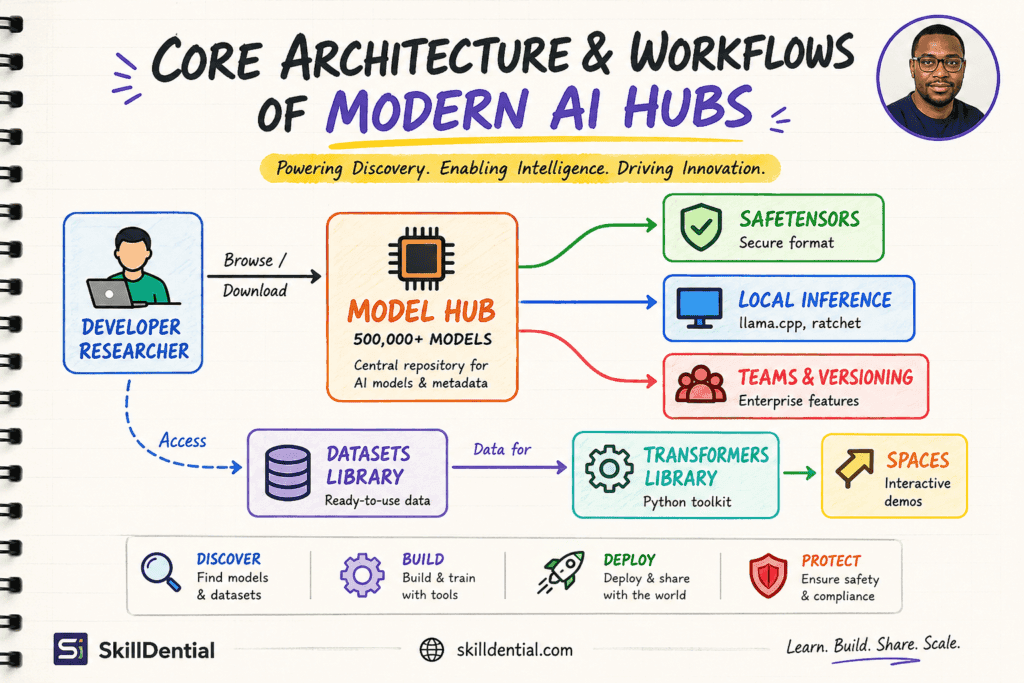
To provide a rigorous, high-signal evaluation of Hugging Face competitors, we benchmarked each platform using a structured 9-point framework. Evaluating platforms against these consistent technical and operational pillars ensures developers, MLOps teams, and founders can select tools aligned with their production realities rather than marketing claims.
Evaluation Framework
| Criteria | Core Benchmark | Why It Matters |
| Model Availability | Catalogue depth across open-weight LLMs, SLMs, vision, audio, and multimodal architectures. | Determines whether a platform can serve as a primary model registry or if you will be constrained by limited model choices. |
| Open-Source Support | Native integration with Open Weights, custom fine-tuning hooks (LoRA/QLoRA), and open-source libraries. | Critical for avoiding vendor lock-in and maintaining full control over model architectures, weights, and license compliance. |
| API Availability & Performance | Serverless REST/gRPC endpoints, streaming response support, and SDK quality across Python and TypeScript. | Dictates how fast and seamlessly engineers can integrate model capabilities into frontend apps, backends, and agentic pipelines. |
| Deployment Flexibility | Support for serverless cloud, dedicated containers, bring-your-own-cloud (BYOC), edge, and local hardware. | Ensures infrastructure can scale seamlessly from local prototyping directly into enterprise VPCs or low-latency production clusters. |
| Ease of Use & DX | Developer experience, CLI quality, UI intuitive workflows, and low-code orchestration capabilities. | Directly impacts team velocity, onboarding time, and overall developer friction during early implementation phases. |
| Documentation & Tooling | Quality of quickstarts, API references, architecture blueprints, and maintained client libraries. | High-quality developer documentation reduces time-to-production and minimizes debugging overhead during custom integrations. |
| Community & Ecosystem | Active contributor base, open benchmarks, fine-tuning scripts, and peer support forums. | Strong ecosystems ensure rapid bug resolution, continuous community contributions, and long-term framework maintenance. |
| Pricing & Cost Efficiency | Transparency of free tiers, token-based pricing, hourly GPU instance billing, and enterprise discounts. | Helps teams accurately forecast operational expense (OpEx) scaling when transitioning from low-traffic MVPs to high-throughput production. |
| Enterprise Readiness | Single sign-on (SSO), Role-Based Access Control (RBAC), SOC 2 compliance, HIPAA alignment, and SLAs. | Mandatory criteria for enterprise security teams evaluating platforms for sensitive corporate or customer data workloads. |
Methodology Note: Every platform included in this guide was evaluated based on real-world engineering constraints: latency benchmarks, billing transparency, deployment ease, and developer workflow fit.
What Makes a Good Hugging Face Alternative?
Not every platform competes with Hugging Face in the same way. The open-source AI ecosystem has fractured into specialized domain layers: some providers focus strictly on low-latency inference, others build developer-first serverless GPU compute, while others engineer local, zero-data-leakage execution engines.
A strong alternative should excel in one or more of these core technical archetypes:
                  ┌─────────────────────────────────────────┐
                  │    Alternative Core Architecture Focus  │
                  └────────────────────┬────────────────────┘
                                       │
     ┌──────────────────┬──────────────┴──────────────┬──────────────────┐
     ▼                  ▼                             ▼                  ▼
┌─────────┐      ┌──────────────┐              ┌──────────────┐   ┌─────────────┐
│ Ultra-  │      │ Managed GPU  │              │ Post-        │   │ Local / Edge│
│ Fast    │      │ Serverless   │              │ Training &   │   │ Model       │
│ Inference│      │ Compute      │              │ Fine-Tuning  │   │ Execution   │
└─────────┘      └──────────────┘              └──────────────┘   └─────────────┘
 (Groq, Together) (Modal, Baseten)              (Unsloth, Predibase) (Ollama, LM Studio)
Core Pillars of a High-Performance Alternative
Low-Latency, High-Throughput Inference
While Hugging Face provides managed inference containers, production applications often require specialized serving engines. Alternatives built around engines like vLLM, SGLang, or custom silicon (such as Groq’s LPUs) achieve significantly higher token throughput and lower Time-to-First-Token (TTFT) via advanced techniques like PagedAttention and continuous batching.
Native Post-Training & Fine-Tuning Workflows
Fine-tuning models on Hugging Face typically requires writing custom PyTorch loops or managing raw compute instances. Leading alternatives streamline post-training by offering integrated parameter-efficient fine-tuning (LoRA/QLoRA), Direct Preference Optimization (DPO), and automated quantization.
Flexible, Consumption-Based Pricing
Dedicated Hugging Face Inference Endpoints charge flat hourly rates per GPU (e.g., ~$0.50/hr for a T4 up to $4.00+/hr for an A100/H100), regardless of whether traffic is flowing. Strong competitors offer true serverless pay-per-million-token billing or per-second GPU pricing with sub-second scale-to-zero capabilities.
Frictionless Developer Experience & Local Execution
For rapid prototyping, edge deployment, or strict data privacy constraints, running cloud endpoints creates unnecessary overhead. Native local runners simplify model pulling, quantization, and local API serving without complex dependency management.
Enterprise Security & Infrastructure Governance
Enterprise deployments demand zero data retention policies, single-tenant isolation, Role-Based Access Control (RBAC), and compliance alignment (SOC 2 Type II, HIPAA, ISO 27001). Top cloud alternatives integrate directly into existing AWS, Azure, or GCP Virtual Private Clouds (VPCs).
Evaluating Trade-Offs Before Choosing
Key Takeaway: No single platform is universally superior. The optimal choice depends on your primary engineering constraint:
| Primary Engineering Goal | Ideal Platform Strategy | Primary Trade-off |
| Maximum Model Variety & Community | Hugging Face | Higher hosting costs; higher latency on default endpoints. |
| Sub-Second Real-Time Voice/Chat | Groq / Fireworks AI | Narrower model catalog compared to HF Hub. |
| Custom Infrastructure & Python Code | Modal / Baseten | Requires MLOps setup and custom API wrapper engineering. |
| Zero Data Leakage & Offline Use | Ollama / LM Studio | Limited by client hardware VRAM/RAM constraints. |
Quick Comparison Table
The following comparison matrix evaluates the top Hugging Face competitors across core platform strengths, primary use cases, open-source model availability, and managed inference capabilities:
| Platform | Primary Strength | Best For | Open Source | Managed Inference |
| Kaggle | Datasets & Community Competitions | ML learning, data exploration, and benchmarking | Yes | Limited |
| GitHub Models | Developer Workflows & IDE Native Prototyping | Prototyping inside GitHub/VS Code environments (Sunsetting July 2026) | Mixed | Yes |
| Replicate | Serverless AI Model APIs | Rapid full-stack application development | Yes | Yes |
| Ollama | Local Model Execution Engine | Data privacy, air-gapped systems, and local offline dev | Yes | No |
| OpenRouter | Unified Multi-Model API Aggregation | Multi-model routing, fallback logic, and cost optimization | Mixed | Yes |
| ModelScope | Enterprise Model & Dataset Hub (Alibaba) | APAC enterprise deployment and Qwen ecosystem hosting | Yes | Yes |
| NVIDIA NGC | Enterprise GPU-Optimized Software Hub | High-performance compute, TensorRT, and edge deployments | Mixed | Yes |
| Vertex AI Model Garden | Google Cloud Enterprise Ecosystem | End-to-end enterprise ML pipelines and Gemini integrations | Mixed | Yes |
| Azure AI Foundry | Microsoft Enterprise Governance & Guardrails | Large-scale enterprise agentic AI and Azure cloud security | Mixed | Yes |
| Amazon Bedrock | AWS Serverless Enterprise AI Infrastructure | Production enterprise applications with zero-data-retention SLAs | Mixed | Yes |
| Together AI | High-Throughput Open-Weight Inference | Ultra-low-latency production LLM serving and fine-tuning | Yes | Yes |
Key Observations
- Local & Privacy-Focused: If zero data leakage or offline execution is your priority, Ollama stands out as the cleanest local alternative.
- Serverless Developer Speed: For developers packaging ML features without managing cloud infrastructure, Replicate, Together AI, and OpenRouter offer pay-per-token/pay-per-second simplicity.
- Hyperscale Cloud & Enterprise Governance: When corporate compliance, SOC 2 alignment, and single-tenant VPC deployments are mandatory, Amazon Bedrock, Azure AI Foundry, and Vertex AI serve as direct cloud alternatives to Hugging Face Enterprise Endpoints.
Top 11 Hugging Face Competitors
While Hugging Face remains the central hub for open-weight models, no single platform can address every engineering requirement. Whether your focus is cutting inference costs, securing single-tenant enterprise compliance, serving low-latency applications, or executing LLMs locally on edge hardware, the AI infrastructure ecosystem offers robust, specialized alternatives.
The following 11 platforms represent the leading Hugging Face competitors across managed cloud hubs, ultra-fast inference engines, local execution frameworks, and enterprise MLOps platforms.
Kaggle
Kaggle (a subsidiary of Google) is the world’s largest machine learning community, combining public datasets, cloud-hosted Jupyter Notebooks, interactive learning courses, and competitive AI challenges. While it does not feature a dedicated serverless deployment endpoint like Hugging Face, it has evolved beyond a pure competition hub into an open platform that hosts over 48,000 pre-trained open models (including Google’s Gemma and open weights) alongside Kaggle Benchmarks for LLM evaluation.
Platform Type
Cloud-based AI community, model repository, and notebook environment.
AI Features
- Kaggle Models & Datasets: Over 48,000 open-weight models and 700,000+ public datasets.
- Kaggle Benchmarks & SDK: Native tools for running reproducible evaluations, multi-agent scenarios, and “LLM-as-a-judge” testing.
- Managed Compute Notebooks: Free GPU (Nvidia T4/P100) and TPU access for up to 30 hours per week.
- Global Competitions & Hackathons: Benchmark tasks co-hosted by organizations like Google DeepMind, OpenAI, and Meta.
Key Specifications
| Feature | Details |
| Open-Source Support | Yes (supports open-weight models, datasets, and code) |
| Model Hosting | Yes (Model repository for open-weight sharing) |
| Dataset Repository | Industry-leading (700K+ public datasets) |
| API Support | Moderate (Kaggle API for datasets/notebooks; Benchmarks SDK for LLM prompts) |
| Training Environment | Yes (Cloud Jupyter notebooks with GPU/TPU acceleration) |
| Production Deployment | Limited (No managed inference endpoints or low-latency REST APIs) |
Compatibility
- Languages & Frameworks: Python, R, PyTorch, TensorFlow, JAX, Scikit-learn, Keras
- Environment: Web Browser, Kaggle API, Kaggle Benchmarks SDK
Best For
- Students, researchers, and data scientists learning ML fundamentals or benchmarking new architectures.
- Developers looking for free GPU/TPU compute to fine-tune open weights or analyze large datasets.
Pros
- Massive Free Resources: Free access to GPUs/TPUs, notebooks, and public datasets without requiring credit card registration.
- Rich Community & Benchmarking: Unmatched peer write-ups, crowdsourced evaluations, and real-world problem sets.
- Standardized Evaluation: Kaggle Benchmarks simplifies comparing LLM outputs across multiple models.
Cons
- No Production Endpoint Serving: Cannot replace Hugging Face Inference Endpoints for low-latency web production APIs.
- Session Execution Limits: Notebook sessions time out after 12 hours (non-GPU) or 9 hours (GPU), making it unsuitable for persistent multi-day workloads without checkpointing.
Estimated Price Range
Free for core compute quotas (up to 30 hours/week GPU/TPU time). Optional Google Cloud integration available for advanced, persistent cloud workloads.
Privacy & Security
Public by default. Private datasets and notebooks can be created, but Kaggle is not designed for regulated corporate data holding HIPAA or strict SOC 2 guarantees.
Direct Alternatives
- Hugging Face Hub (for broader model hosting and inference endpoints)
- Google Colab (for standalone cloud notebook experimentation)
- ModelScope (for an open-source model registry with native compute links)
Verdict
Choose Kaggle if your primary goal is model experimentation, benchmark evaluation, and exploratory data science. Switch to a specialized Hugging Face competitor (such as Together AI, Baseten, or Replicate) when you need to deploy models behind persistent, auto-scaling production APIs.
GitHub Models
Important Lifecycle Update: GitHub officially announced the retirement of GitHub Models, fully shutting down the playground, model catalog, and inference APIs on July 30, 2026. Existing workflows must migrate to primary platform alternatives like Azure AI Foundry or OpenRouter.
GitHub Models was built directly into the GitHub developer ecosystem to allow engineers to discover, test, and compare open and proprietary models (such as Llama 3, Phi-3, and GPT-4o) directly inside VS Code and GitHub repositories. Serving as an inline playground and API testbed, it allowed developers to evaluate model performance, tweak prompts, and integrate inference into GitHub Actions pipelines without managing external API keys.
Platform Type
Developer-centric AI playground, model catalog, and prototyping API suite.
AI Features
- Integrated Model Playground: Web interface and VS Code extension to interactively test and compare model outputs side-by-side.
- Zero-Setup API Keys: Instant access to serverless REST endpoints authenticated via standard GitHub personal access tokens (PATs).
- GitHub Actions Integration: Native execution of inference calls inside CI/CD automation pipelines for automated code reviews and issue triage.
- Seamless Migration Path: Direct export of working prompts and configurations straight to Microsoft Azure AI Foundry for production scaling.
Key Specifications
| Feature | Details |
| Open-Source Support | Mixed (Hosted open-weight models alongside proprietary LLMs) |
| Model Hosting | No (Served via underlying Azure AI infrastructure) |
| Dataset Repository | No (Relies on standard GitHub code repositories) |
| API Support | Yes (REST endpoints fully compatible with OpenAI SDKs) |
| Training Environment | No (Inference and prompt evaluation only) |
| Production Deployment | Limited (Designed primarily for prototyping and early-stage testing) |
Compatibility
- Environments: GitHub, VS Code, GitHub Actions, Codespaces
- SDKs & APIs: Python, TypeScript/JavaScript, cURL, OpenAI-compatible REST endpoints
Best For
- Software engineers looking to rapidly prototype AI features using existing GitHub credentials.
- Teams evaluating multiple LLM providers before committing to a dedicated production cloud infrastructure.
Pros
- Zero Infrastructure Friction: No separate cloud billing or provider setup required for initial experimentation.
- Developer Workflow Alignment: Live side-by-side model benchmarking within developer tools.
- Standardized SDK Integration: Built using OpenAI-compatible response formats, making code portable to other providers.
Cons
- Product Retirement: Fully sunsetting on July 30, 2026, meaning it cannot serve as a long-term production solution.
- Rate Limits: Free tier usage tiers are strictly constrained to prevent production abuse.
Estimated Price Range
Free for prototyping with strict daily/minute rate limits. (Production workloads are directed to Azure AI Foundry pay-as-you-go pricing).
Privacy & Security
Protected under standard GitHub and Enterprise agreement privacy boundaries. Prompts and code inputs are not used to train underlying foundational models.
Direct Alternatives
- Azure AI Foundry (The official Microsoft migration path for enterprise production)
- OpenRouter (For unified multi-model routing and playground access)
- Replicate (For fast serverless API deployment across open models)
Verdict
While GitHub Models provided an exceptionally frictionless entry point for developers experimenting with LLMs inside their repositories, its July 2026 deprecation means teams should look to primary Hugging Face competitors like OpenRouter, Replicate, or Azure AI Foundry for ongoing development and long-term production deployment.
Replicate
Replicate is a cloud AI platform that allows developers to run, fine-tune, and deploy open-source machine learning models through serverless cloud APIs. Instead of provisioning raw GPU instances, managing Docker containers, or writing custom Flask wrappers, developers can trigger predictions using simple HTTP endpoints, official client SDKs (Python, Node.js, Go, Swift), or command-line interfaces.
Replicate relies heavily on Cog, its open-source, Docker-based containerization framework designed to bundle model weights, CUDA dependencies, and Python environments into standard RESTful microservices.
Platform Type
Serverless AI model API provider, model hub, and containerized deployment infrastructure.
AI Features
- Extensive Public Model Library: Direct, instant access to over 50,000 public models covering LLMs (e.g., Llama 3, DeepSeek R1), image generation (FLUX, SDXL), video generation (Wan, Veo 3), and audio.
- Cog Container Packaging: Open-source tool that automates building CUDA-compatible Docker containers with built-in OpenAPI schema generation and input validation.
- Automatic Scaling to Zero: Public models scale down automatically when idle, eliminating idle compute expenses.
- Webhooks & Streaming: Real-time output streaming for text/audio and async webhook callbacks for heavy image or video generation tasks.
- Custom Model Hosting: Push custom PyTorch/TensorFlow models directly using
cog push.
Key Specifications
| Feature | Details |
| Open-Source Support | Excellent (Hosts open-weight models; maintains open-source tools like Cog and pget) |
| Hosted APIs | Yes (Fully managed REST endpoints with client SDKs) |
| Custom Model Deployment | Yes (Built and pushed using Cog containers) |
| GPU Infrastructure | Managed (Includes Nvidia T4, L40S, A100 80GB, and H100 GPUs) |
| Billing Granularity | Billed per GPU-second on custom/private runs or per-token/per-output on public models |
Compatibility
- Languages & Frameworks: Python, Node.js/TypeScript, Go, Swift, cURL
- Packaging & Containerization: Cog, Docker, OCI-compliant runtime registries
Best For
- Full-stack engineers, SaaS developers, and AI startups who want to add state-of-the-art generative features without managing infrastructure.
- Teams that need rapid prototyping with immediate scale-to-zero capabilities for bursty traffic.
Pros
- Unmatched Developer Velocity: Going from an open-source model to an active production REST API takes minutes.
- Scale-to-Zero Efficiency: Public models cost nothing while idle, making it ideal for variable traffic.
- Containerized Portability: Models packaged with Cog can be run locally or exported to any Docker runtime, preventing vendor lock-in.
Cons
- Cold Starts on Private Deployments: Custom or private models spinning up from zero can incur noticeable cold-boot delays.
- Sustained Scale Expenses: Per-second runtime billing (e.g., ~$5.49/hr effective for an H100) becomes more expensive than dedicated bare-metal or reserved instances at high, continuous volume.
Estimated Price Range
Pay-as-you-go based on active execution runtime or output volume:
- Public Hardware Rates: Billed per active second (e.g., Nvidia T4 at ~$0.81/hr, A100 80GB at ~$5.04/hr, H100 at ~$5.49/hr).
- Output / Token Pricing: Public models offer fixed per-generation billing (e.g., FLUX schnell at ~$0.003/image, Claude 3.7 Sonnet / DeepSeek R1 token rates).
Privacy & Security
Public models process data through shared serverless queues. For sensitive data, private deployments isolate model inputs, and enterprise agreements offer zero-data-retention options.
Direct Alternatives
- Together AI (For lower per-token pricing on open LLMs)
- Baseten (For enterprise-grade model serving with dedicated warm endpoints)
- Modal (For Python-native serverless compute workflows)
Verdict
Replicate is one of the most accessible Hugging Face competitors for teams prioritizing developer speed. It bridges the gap between open-source model exploration and instant API integration without forcing engineers to build complex MLOps pipelines.
OpenRouter
OpenRouter is a unified AI model router and API gateway that provides a single, standardized interface to over 400 models across more than 70 infrastructure providers. Rather than hosting model weights directly like the Hugging Face Hub, OpenRouter aggregates access to both open-weight models (such as Llama, Qwen, and DeepSeek) and proprietary LLMs (such as OpenAI, Anthropic, and Google) through an OpenAI-compatible API.
It abstracts away multi-vendor billing, API fragmentation, rate-limit management, and provider outages by offering dynamic fallback chains, latency-based routing, and centralized cost controls.
                                  ┌───────────────────────────┐
                                  │   OpenRouter API Gateway  │
                                  └─────────────┬─────────────┘
                                                │
                 ┌──────────────────────────────┼──────────────────────────────┐
                 ▼                              ▼                              ▼
     ┌───────────────────────┐      ┌───────────────────────┐      ┌───────────────────────┐
     │ Provider Failover     │      │ Auto-Router & Pareto  │      │ Unified Single Bill   │
     │ Auto-retry on 5xx/429 │      │ Task-aware routing    │      │ Zero setup per-vendor │
     └───────────────────────┘      └───────────────────────┘      └───────────────────────┘
Platform Type
Cloud API gateway, LLM router, and multi-provider aggregation layer.
AI Features
- Unified Single API Base URL: Access text, image generation, vision, audio transcription, embeddings, and reasoning models via one OpenAI, Anthropic, or REST schema.
- Automated Provider & Model Fallbacks: Configure ordered arrays of models or providers; if the primary endpoint experiences a rate limit or outage, OpenRouter instantly reroutes the request downstream with zero client downtime.
- Task-Aware Auto-Routers: Native plugins like
Auto Router,Pareto Code Router, andFusiondynamically classify prompts and route them to the optimal cost/performance model or multi-model deliberation panel. - Bring Your Own Key (BYOK): Connect your own direct AWS Bedrock, Google Vertex AI, or direct provider credentials to retain custom enterprise discounts while utilizing OpenRouter’s routing logic.
- Prompt Caching & Sticky Routing: Routes consecutive requests to the same underlying provider instance to maximize prompt cache hits and lower input token costs by up to 90%.
Key Specifications
| Feature | Details |
| Open-Source Model Support | Yes (Hosts hundreds of open-weight models served via specialized inference providers) |
| Model Hosting | No (API routing and aggregation layer only; relies on partner hardware infrastructure) |
| Dataset / Storage Hub | No (Focused exclusively on runtime inference calls) |
| API Compatibility | Excellent (Native drop-in replacement for OpenAI SDKs, Anthropic Messages, and Vercel AI) |
| Enterprise Controls | Yes (Provisioning API keys with granular daily/monthly spend limits per team or user) |
| Zero Data Retention (ZDR) | Supported (Filter requests specifically to providers enforcing ZDR policies) |
Compatibility
- Languages & Frameworks: Python, JavaScript/TypeScript, cURL, LangChain, LlamaIndex, Vercel AI SDK
- Developer Tools: Cursor, Cline, VS Code, OpenWebUI, Claude Code
Best For
- Engineering teams building multi-model production SaaS applications that require 99.99% uptime and automatic provider failover.
- Developers pointing coding assistants or agents at a single credit balance without maintaining 10+ separate API keys.
Pros
- Eliminates Vendor Lock-In: Swapping from an open-source model to a proprietary model requires changing only a single string parameter in your API payload.
- Higher Availability: Prevents application 500 errors by automatically routing around provider rate limits and regional outages.
- Transparent Pricing & Analytics: Live rankings, latency telemetry, and cost breakdown per developer or provisioning key.
Cons
- Third-Party Hop Overhead: Introducing an API router layer can add minor routing latency (typically tens of milliseconds) compared to direct VPC connections.
- No Direct Weights / Fine-Tuning Execution: Cannot be used to store raw Safetensors, manage Git LFS datasets, or train models from scratch.
Estimated Price Range
- Core Router Fee: Passes through underlying provider token prices with a standard ~5.5% platform fee on pay-as-you-go credit top-ups.
- Free Models Router (
openrouter/free): Free access to a rotating pool of open-weight models with rate limits.
Privacy & Security
Offers strict Zero Data Retention (ZDR) routing flags to force prompts through enterprise-compliant providers. ISO 27001, SOC 2, and HIPAA-ready options available.
Direct Alternatives
- LiteLLM (For a self-hosted, open-source proxy alternative)
- Together AI (For direct primary open-weight inference without routing middleware)
- Azure AI Foundry (For enterprise-only Microsoft and OpenAI unified routing)
Verdict
Choose OpenRouter if you want a single API to access the entire model landscape—combining the open-source breadth of Hugging Face with the proprietary power of top AI labs—backed by enterprise failover logic that ensures your production app stays online.
ModelScope
ModelScope is an open-source, Model-as-a-Service (MaaS) ecosystem developed by Alibaba Cloud. Functioning as Asia’s largest open model registry, it is the primary home for the Qwen foundation model series, multimodal vision engines, and thousands of open-weight models.
It features an interactive “Studio” app hosting (akin to Hugging Face Spaces), 7,000+ free API endpoints, dataset repositories, and deep hardware integration with Alibaba Cloud Model Studio for instant model fine-tuning and deployment.
Platform Type
Cloud AI model registry, dataset repository, and managed MaaS platform.
AI Features
- Primary Qwen & Multimodal Hub: Official release source for state-of-the-art open models including the Qwen LLM series, Wan Video generation, and Qwen-Image foundation models.
- ModelScope Studios: Hosted application containers (supporting Gradio, Streamlit, and Docker) powered by free cloud CPU/GPU allocation.
- Unified
modelscopeCLI & Client SDK: Native CLI (ms download,ms upload) and Python SDK built for direct model weight streaming and git-like version control. - Model Context Protocol (MCP) Server Support: Built-in repository and deployment tooling for managing agentic MCP servers.
- Model Studio Integration: Seamless one-click path to convert hosted weights into production-grade managed APIs with enterprise SLAs.
Key Specifications
| Feature | Details |
| Open-Source Support | Native (Hosts thousands of Apache 2.0 and open-weight checkpoints) |
| Model Hosting | Yes (Free public model hosting, weights distribution, and private repos) |
| Dataset Repository | Excellent (Thousands of specialized datasets, including global & Asian languages) |
| API Support | Yes (Free community API quotas plus Alibaba Cloud Model Studio production REST/OpenAI endpoints) |
| Training Environment | Yes (Free cloud LoRA fine-tuning resources and notebook environments) |
| Production Deployment | Excellent (Direct integration with Alibaba Cloud PAI-EAS for high-throughput scaling) |
Compatibility
- Languages & Frameworks: Python, PyTorch, TensorFlow, SGLang, vLLM, Diffusers
- Client SDKs & Tools:
modelscopePython library,msCLI, ModelScope Studio SDK
Best For
- Developers and teams building with state-of-the-art open weights like Qwen, requiring instant access to the newest checkpoints.
- Engineers looking for free, zero-credit-card cloud GPU hosting, free API calling quotas, and LoRA fine-tuning.
Pros
- Generous Community Resources: Offers daily free API calls and free cloud compute for hosting Studios and fine-tuning models.
- First-Class Multimodal Support: Unrivaled variety of vision-language, audio-speech, and image/video synthesis models.
- Production Scale Path: One-click transition from open-source experimentation to managed enterprise APIs.
Cons
- Regional Infrastructure Focus: While an English portal exists, primary latency nodes and some community documentation cater heavily to the APAC and China regions.
- Ecosystem Specialization: Strongest optimization around Alibaba and Chinese open-source ecosystems (Qwen, DeepSeek, GLM, MiniMax) relative to Western proprietary APIs.
Estimated Price Range
- Community Model Hub & SDK: 100% Free (includes free daily API calls, Studio hosting, and GPU compute allocations).
- Alibaba Cloud Model Studio (Production): Pay-as-you-go per million tokens (e.g., Qwen-Plus at ~$0.40/1M input tokens).
Privacy & Security
Offers private repositories and encrypted user access. Enterprise cloud deployments run within isolated Virtual Private Clouds (VPC) adhering to regional data governance laws.
Direct Alternatives
- Hugging Face Hub (The primary global competitor for open model repos and Spaces)
- Kaggle (For dataset exploration and notebook community)
- NVIDIA NGC (For optimized enterprise container runtimes)
Verdict
As a direct Hugging Face competitor, ModelScope stands out as the ultimate open alternative—offering free GPU hosting, free API quotas, and immediate access to top-performing open models like Qwen.
NVIDIA NGC
NVIDIA NGC (NVIDIA GPU Cloud) is an enterprise-grade AI software hub designed to accelerate the end-to-end development and deployment of GPU-accelerated applications.
Rather than serving as a community-driven repository for general open-weight experimentation like Hugging Face, NGC provides production-ready, security-vetted infrastructure components—including GPU-optimized Docker containers, pre-trained AI models, Helm charts, and specialized SDKs (such as NeMo, Riva, and TensorRT). Central to NGC’s modern deployment stack is NVIDIA NIM (NVIDIA Inference Microservices), which packages foundational open models (like Llama, DeepSeek, and Qwen) into production-ready, microservice containers optimized for low-latency execution across hybrid and multi-cloud environments.
Platform Type
Enterprise AI software catalog, container registry, and inference microservice platform.
AI Features
- NVIDIA NIM Microservices: Pre-built, containerized inference engines with built-in CUDA, TensorRT, and vLLM optimizations accessible via OpenAI-compatible APIs.
- GPU-Optimized Container Registry: Security-scanned, battle-tested Docker containers for PyTorch, TensorFlow, RAPIDS, and Triton Inference Server.
- Enterprise AI Frameworks: Complete developer stacks including NeMo (for guardrails, agentic workflows, and LLM customization) and NeMo Retriever (for enterprise RAG pipelines).
- Kubernetes Infrastructure Support: Production-ready Helm charts and operators (GPU Operator, NIM Operator) for automated deployment on bare-metal or cloud clusters.
Key Specifications
| Feature | Details |
| Open-Source Model Support | Mixed (Hosts open-weight models optimized as NIM containers alongside proprietary weights) |
| Model Hosting & Distribution | Yes (Registry for validated model checkpoints, GGUFs, and containerized NIM microservices) |
| Dataset Repository | Limited (Focuses on sample pipeline resources, Jupyter benchmarks, and enterprise SDK data scripts) |
| API Support | Excellent (OpenAI-compatible REST and gRPC endpoints exposed through NIM containers) |
| Training Environment | Supported (Containers provided for distributed multi-GPU/multi-node training on NVIDIA hardware) |
| Production Deployment | Industry-leading (Native support for Kubernetes, hybrid clouds, and air-gapped enterprise data centers) |
Compatibility
- Hardware: NVIDIA Tensor Core GPUs (Data center, workstation, and edge hardware)
- Runtimes & Cloud: Docker, Kubernetes, Bare-Metal, AWS, GCP, Microsoft Azure, Hybrid VPCs
Best For
- Enterprise MLOps teams and DevOps engineers scaling production AI on dedicated NVIDIA hardware infrastructure.
- Organizations that require strict security scanning, enterprise SLAs, and deterministic, sub-second inference performance.
Pros
- Unmatched Performance Optimization: Built-in TensorRT acceleration maximizes token throughput and reduces latency on NVIDIA silicon.
- Enterprise Security & Compliance: Scanned for vulnerabilities, offers zero-data-retention, and includes long-term enterprise support branches (LTSB).
- Seamless Kubernetes Integration: NIM operators streamline microservice autoscaling and deployment across enterprise clusters.
Cons
- Hardware Vendor Lock-in: Designed exclusively to run on NVIDIA GPU hardware.
- Higher Technical Complexity: Requires MLOps and Kubernetes expertise compared to zero-config serverless API platforms like Replicate or OpenRouter.
Estimated Price Range
- NGC Public Catalog: Free to download public containers, open-weight models, and developer tools.
- NVIDIA AI Enterprise (Production Licensing): Annual subscription pricing (approx. $4,500 per GPU/year or $1.00/GPU-hour) for enterprise deployment, dedicated support, and production NIM access.
Privacy & Security
Designed for enterprise-grade isolation. NIM containers run fully within your private cloud, on-premises data centers, or air-gapped environments, ensuring zero external data leakage.
Direct Alternatives
- Vertex AI Model Garden (For Google Cloud-native enterprise deployment)
- Amazon Bedrock (For AWS-managed serverless enterprise infrastructure)
- Baseten (For managed production container orchestration across open models)
Verdict
NVIDIA NGC is the premier Hugging Face competitor for enterprise organizations running self-hosted or cloud-based production workloads on NVIDIA hardware. While Hugging Face is ideal for early discovery, NGC provides the containerized, security-hardened foundation required to run low-latency AI microservices at scale.
Vertex AI Model Garden
Vertex AI Model Garden (integrated within Google Cloud’s AI platform) serves as an enterprise-grade model repository and deployment catalog. Rather than functioning solely as an open community hub, it brings together Google’s proprietary foundation models (such as Gemini 3, Imagen, Veo, and Chirp), third-party enterprise models (such as Anthropic Claude), and over 200 open-weight models (including Gemma, Llama, and DeepSeek) into a single managed infrastructure plane. Developers can evaluate, fine-tune, and deploy models directly onto managed Vertex endpoints or Google Kubernetes Engine (GKE) clusters with enterprise MLOps automation.
                             ┌─────────────────────────────────────────┐
                             │        Vertex AI Model Garden           │
                             └────────────────────┬────────────────────┘
                                                  │
                 ┌────────────────────────────────┼────────────────────────────────┐
                 ▼                                ▼                                ▼
    ┌─────────────────────────┐      ┌─────────────────────────┐      ┌─────────────────────────┐
    │ Google First-Party      │      │ Top Third-Party         │      │ Curated Open Models     │
    │ Gemini 3, Veo, Imagen   │      │ Anthropic Claude        │      │ Gemma, Llama 3, DeepSeek│
    └─────────────────────────┘      └─────────────────────────┘      └─────────────────────────┘
Platform Type
Enterprise cloud AI platform, managed model hub, and MLOps deployment ecosystem.
AI Features
- Curated Foundation Catalog: One-click access to Google first-party models (Gemini, Imagen 3, Veo 2, Chirp), partner LLMs (Anthropic Claude), and open-source models.
- Native Hugging Face Integration: Directly import and deploy over 250,000 public checkpoints from the Hugging Face Hub using Google Cloud-managed prediction containers.
- Enterprise Fine-Tuning & Distillation: Built-in pipelines for Parameter-Efficient Fine-Tuning (PEFT/LoRA), Distillation, and Reinforcement Learning from Human Feedback (RLHF).
- Integrated Agent & Prompt Studio: Experiment with model prompts, configure tool calls, and transition directly into agent building.
- Built-In Model Armor & Security Scanning: Automated malware detection, checkpoint verification, and runtime prompt injection protection.
Key Specifications
| Feature | Details |
| Open-Source Support | Excellent (Hosts open-weight models and integrates directly with Hugging Face Hub) |
| Model Hosting | Yes (Fully managed Vertex Endpoints or custom Google Kubernetes Engine clusters) |
| Dataset & Feature Hub | Excellent (Integrates with BigQuery, Vertex AI Feature Store, and Cloud Storage) |
| API Support | Excellent (REST, gRPC, and Python/Go/Java/Node SDKs) |
| Training Environment | Yes (Vertex AI Training pipelines, Colab Enterprise notebooks, and TPU/GPU hardware) |
| Production Deployment | Industry-leading (Autoscaling, multi-region failover, private VPC endpoints, and SLAs) |
Compatibility
- Languages & Frameworks: Python, Java, Node.js, Go, PyTorch, TensorFlow, JAX
- Cloud Infrastructure: Google Cloud Platform (GCP), GKE, BigQuery, Vertex AI Pipelines
Best For
- Enterprise development teams and GCP customers requiring managed infrastructure, unified billing, and compliance guardrails.
- MLOps engineers looking to transition models from Hugging Face directly into scalable, enterprise-backed production endpoints.
Pros
- Seamless Hugging Face Import: Bridges open-source discovery on Hugging Face with production-grade GCP deployment.
- Enterprise Governance & Security: Granular IAM controls, VPC Service Controls, SOC 2 / HIPAA compliance, and Model Armor security.
- Hardware Acceleration Choice: High availability of NVIDIA GPUs (H100/A100/L4) alongside Google Cloud TPUs (v5p/v6e) for cost-effective inference and training.
Cons
- GCP Cloud Lock-In: Core deployment tools and pipelines require an active Google Cloud Platform organization account.
- Infrastructure Complexity: Setting up custom VPCs, IAM policies, and deployment containers involves a steeper learning curve compared to lightweight serverless platforms like Replicate.
Estimated Price Range
- Model Garden Access: Free to browse and evaluate.
- First-Party Managed APIs: Pay-as-you-go per million tokens (e.g., Gemini 2.5 Flash / Pro rates).
- Open Model Hosting: Standard GCP compute charges for deployed node instances (GPU/vCPU/Memory per hour).
Privacy & Security
Enterprise-grade data protection. Customer data and model inputs are isolated within private tenant boundaries and are never used to train foundational Google or third-party models.
Direct Alternatives
- Amazon Bedrock (For AWS-native enterprise model hosting)
- Azure AI Foundry (For Microsoft cloud ecosystem integration)
- Hugging Face Enterprise Endpoints (For direct deployment through Hugging Face on custom cloud VPCs)
Verdict
Vertex AI Model Garden is the premier Hugging Face competitor for enterprise organizations built on Google Cloud. It combines the massive open-model selection of Hugging Face with the security, scale, and MLOps tooling of GCP.
Azure AI Foundry (Microsoft Foundry)
Azure AI Foundry (recently rebranded as Microsoft Foundry) is Microsoft’s central enterprise platform for discovering, evaluating, building, and scaling generative AI models and autonomous agentic workflows. Serving as Microsoft’s comprehensive response to the Hugging Face Hub, it brings together a model catalog of over 11,000 models—including proprietary OpenAI models (GPT-4o, GPT-5 series), Anthropic Claude, DeepSeek, and open-weight models from Hugging Face and Meta—into a single managed development control plane.
                            ┌─────────────────────────────────────────┐
                            │    Microsoft Foundry (Azure AI)         │
                            └────────────────────┬────────────────────┘
                                                 │
                ┌────────────────────────────────┼────────────────────────────────┐
                ▼                                ▼                                ▼
   ┌──────────────────────────┐     ┌──────────────────────────┐     ┌──────────────────────────┐
   │ Enterprise Model Hub     │     │ Agent Factory & Runtime  │     │ Responsible AI & Safety  │
   │ 11K+ Open & Private Repos│     │ Multi-Agent Orchestration│     │ Content Safety & Guardrails
   └──────────────────────────┘     └──────────────────────────┘     └──────────────────────────┘
Code language: PHP (php)
Platform Type
Enterprise cloud AI development platform, managed model catalog, and autonomous agent orchestration engine.
AI Features
- Expanded Model Catalog: Managed serverless access to 11,000+ models, spanning OpenAI, Meta Llama, DeepSeek, Mistral, xAI Grok, and the Hugging Face model registry.
- Foundry Agent Service & Agent-to-Agent (A2A): Pre-built infrastructure for constructing, evaluating, and deploying multi-agent workflows with built-in long-term memory and cross-agent communication protocols.
- Azure AI Model Inference API: A single, standardized OpenAI-compatible API schema to swap models dynamically with zero code rewrites.
- Prompt Flow & Continuous Evaluation: Visual orchestrator to design prompt chains, run automated benchmarking against custom ground-truth datasets, and measure response quality before release.
- Content Understanding & Safety: Built-in guardrails for hallucination monitoring, PII detection, automated content filtering, and prompt injection defense.
Key Specifications
| Feature | Details |
| Open-Source Support | Excellent (Direct integration with Hugging Face Hub and native support for open-weight models) |
| Model Hosting | Yes (Models as a Service / Serverless APIs and Provisioned Throughput units) |
| Dataset & Vector Search | Native (Integrates directly with Azure AI Search, Fabric OneLake, and Cosmos DB) |
| API Support | Industry-standard (Unified OpenAI-compatible REST APIs and azure-ai-projects SDKs) |
| Training & Fine-Tuning | Supported (Serverless fine-tuning for open models and frontier fine-tuning pipelines) |
| Production Deployment | Enterprise-grade (Private Endpoints, Entra ID SSO, RBAC, and SLA-backed cloud scaling) |
Compatibility
- Frameworks & Languages: Python, C#/.NET, TypeScript/JavaScript, Java, LangChain, AutoGen
- Development Environments: VS Code (via Microsoft Foundry extension), Visual Studio, GitHub Actions, Azure Portal
Best For
- Enterprise organizations standardized on the Microsoft and Azure ecosystem needing compliance-backed generative AI deployments.
- Developers building autonomous, multi-agent systems requiring built-in memory, retrieval (RAG), and unified governance.
Pros
- Unrivaled Frontier Model Availability: Hosts exclusive access to Azure OpenAI models alongside top open-source alternatives under a single unified billing engine.
- Native Developer Experience: Deep visual integration with VS Code and GitHub allows testing and debugging agents directly within standard IDE workflows.
- Enterprise Security & Governance: Enforces Microsoft Entra ID (Azure AD), Customer-Managed Keys (CMK), private VNet connectivity, and Purview audit logging.
Cons
- Enterprise Complexity: The portal and IAM permissions can feel heavy and overly complex for independent developers or small startups looking for a simple API key.
- Azure Lock-In: While APIs use standardized response formats, maximum value is realized when deployed within Azure virtual networks and connected to Microsoft enterprise services.
Estimated Price Range
- Serverless API (MaaS): Pay-as-you-go based on input/output token usage per model.
- Provisioned Throughput Units (PTU): Fixed hourly reservation billing for ultra-high-throughput, low-latency enterprise requirements.
Privacy & Security
Ensures strict Zero Data Retention (ZDR) options, customer data isolation, and compliance with SOC 2 Type II, HIPAA, ISO 27001, and the EU AI Act. User data and model inputs are never used to train foundational base models.
Direct Alternatives
- Amazon Bedrock (For AWS-based enterprise model governance)
- Vertex AI Model Garden (For Google Cloud Platform enterprise deployments)
- OpenRouter (For lightweight multi-model API routing without cloud lock-in)
Verdict
Microsoft Foundry (Azure AI Foundry) is the ultimate enterprise Hugging Face competitor for corporate teams. It pairs the open model choice of Hugging Face with the proprietary power of OpenAI, Anthropic, and DeepSeek—all wrapped in the security, compliance, and multi-agent infrastructure required for scale.
Amazon Bedrock
Amazon Bedrock is AWS’s fully managed serverless foundation model platform. It allows enterprise organizations to evaluate, customize, and deploy AI models from top providers—including Anthropic (Claude), OpenAI (GPT-5.6), Meta (Llama 4), Mistral, Stability AI, and Amazon’s native Nova model family—without managing GPU compute or underlying infrastructure.
Bedrock acts as AWS’s core enterprise counterweight to the Hugging Face Hub by wrapping foundation models in AWS IAM security, PrivateLink network isolation, and serverless MLOps controls.
                               ┌──────────────────────────────────────────┐
                               │              Amazon Bedrock              │
                               └────────────────────┬─────────────────────┘
                                                    │
                 ┌──────────────────────────────────┼──────────────────────────────────┐
                 ▼                                  ▼                                  ▼
    ┌───────────────────────────┐      ┌───────────────────────────┐      ┌───────────────────────────┐
    │ Managed Foundation Models │      │ AgentCore & Orchestration │      │ Guardrails & Knowledge    │
    │ Anthropic, OpenAI, Meta,  │      │ Autonomous Agent Tools &  │      │ PII Masking, Hallucination│
    │ Amazon Nova, DeepSeek     │      │ Multi-Agent Frameworks    │      │ Checks, Vector RAG (S3)   │
    └───────────────────────────┘      └───────────────────────────┘      └───────────────────────────┘
Platform Type
Managed serverless cloud AI platform, enterprise foundation model hub, and agentic orchestration framework.
AI Features
- Multi-Vendor Foundation Model Hub: Access over 100 models spanning Anthropic Claude, OpenAI GPT-5.6, Meta Llama 4, DeepSeek R1, Cohere, and Amazon Nova.
- Bedrock AgentCore & Managed Agents: Built-in agentic framework featuring deterministic policy execution, CEDAR-based authorization, multi-agent collaboration, and observability tools.
- Bedrock Guardrails: Enterprise safety layer providing contextual grounding checks (hallucination reduction), topic blocking, custom word filters, and automated PII redaction.
- Knowledge Bases (Serverless RAG): Native retrieval-augmented generation connecting S3 document repositories directly to models with automated chunking, embedding, and vector storage.
- Intelligent Prompt Routing & Model Distillation: Automatically routes simple tasks to low-cost models (cutting costs by up to 30%) and distills frontier models into faster, cheaper specialized variants.
Key Specifications
| Feature | Details |
| Open-Source Model Support | Excellent (Hosts open-weight models like Meta Llama, DeepSeek, and Mistral alongside custom imported weights) |
| Model Hosting | Fully Managed (Serverless pay-per-token or Provisioned Throughput) |
| Dataset & Storage Integration | Native (Deep integration with Amazon S3, S3 Vectors, OpenSearch, and AWS Glue) |
| API Support | Excellent (Unified Bedrock Converse API, OpenAI-compatible SDKs, Boto3, and REST) |
| Training & Customization | Supported (Supervised Fine-Tuning, Reinforcement Fine-Tuning, and Custom Model Import) |
| Production Deployment | Enterprise-grade (AWS PrivateLink, IAM, KMS encryption, CloudTrail logging, SOC/HIPAA alignment) |
Compatibility
- Languages & SDKs: Python (Boto3), JavaScript/TypeScript, Java, .NET, Go
- AWS Cloud Services: AWS Lambda, Amazon S3, Amazon Bedrock AgentCore, AWS Step Functions, Amazon ECS/EKS
Best For
- Enterprise organizations heavily invested in the AWS ecosystem requiring zero-infrastructure model management.
- Developers building production agentic pipelines and enterprise RAG applications backed by strict compliance and security controls.
Pros
- Zero Infrastructure Setup: Start making inference calls in minutes using existing AWS credentials and unified billing.
- Comprehensive Safety & Governance: Bedrock Guardrails enforce consistent safety policies across every model in your stack.
- Prompt Caching & Batch Discounts: Up to 90% cost reduction on cached prompts and 50% flat discounts on asynchronous batch workloads.
Cons
- AWS Ecosystem Dependency: Maximum performance, identity control, and network isolation require operating within AWS environments.
- Cost Controls at High Scale: High-volume continuous streaming can become expensive without utilizing Provisioned Throughput or Prompt Routing.
Estimated Price Range
- Serverless On-Demand: Pay-as-you-go per million input/output tokens (varies by model tier).
- Batch Inference: 50% discount off standard on-demand pricing.
- Prompt Caching: 90% discount on cached input tokens.
Privacy & Security
Industry-leading enterprise privacy. Customer data is never used to train provider foundation models. All traffic remains within private VPC boundaries via AWS PrivateLink with KMS encryption at rest and in transit.
Direct Alternatives
- Azure AI Foundry (For Microsoft cloud ecosystem integration)
- Vertex AI Model Garden (For Google Cloud Platform enterprise workflows)
- Together AI (For direct open-weight serverless execution outside hyper-scaler environments)
Verdict
Amazon Bedrock is the ultimate enterprise Hugging Face competitor for teams running on AWS. It provides the multi-model choice of an open hub with the operational maturity, safety guardrails, and compliance required for Fortune 500 production workloads.
Together AI
Together AI is an AI-native cloud platform focused on high-throughput serverless inference, fine-tuning, and dedicated cluster hosting for open-weight models. Positioned as a direct execution-focused Hugging Face competitor, it bridges the gap between open model hubs and enterprise production.
Rather than requiring developers to configure custom Kubernetes clusters or manage PyTorch Docker containers, Together AI provides ultra-low latency, serverless REST APIs—fully compatible with OpenAI SDKs—across a massive catalog of open-weight LLMs, vision engines, and code models.
                             ┌─────────────────────────────────────────┐
                             │             Together AI Hub             │
                             └────────────────────┬────────────────────┘
                                                  │
                ┌─────────────────────────────────┼─────────────────────────────────┐
                ▼                                 ▼                                 ▼
   ┌───────────────────────────┐     ┌───────────────────────────┐     ┌───────────────────────────┐
   │ Serverless Multi-Modal    │     │ Low-Cost Fine-Tuning Engine│     │ Dedicated & BYOC Clusters │
   │ Pay-per-token API endpoints│     │ LoRA / Full Fine-Tuning   │     │ Reserved H100/H200/B200   │
   └───────────────────────────┘     └───────────────────────────┘     └───────────────────────────┘
Platform Type
Cloud AI developer platform, serverless inference engine, and dedicated GPU infrastructure provider.
AI Features
- Broad Serverless Model Catalog: High-speed serverless inference for leading open models, including Meta Llama, DeepSeek, Qwen, GLM, Gemma, and MiniMax.
- Managed LoRA & Full Fine-Tuning: Automated fine-tuning pipeline supporting supervised fine-tuning (SFT) and Direct Preference Optimization (DPO).
- Dedicated Endpoints & Provisioned Throughput: Single-tenant GPU deployments (NVIDIA H100, H200, B200) ensuring guaranteed SLA-backed token throughput.
- Batch API: Asynchronous processing offering a 50% flat discount for non-real-time batch workloads like synthetic data generation or document parsing.
- Multi-Modal Capabilities: Beyond text, serverless APIs support image generation (FLUX), video generation (Seedance, HappyHorse), and audio processing.
Key Specifications
| Feature | Details |
| Open-Source Support | Native (Dedicated to hosting and fine-tuning open-weight models) |
| Model Hosting | Yes (Serverless multi-tenant APIs or single-tenant dedicated instances) |
| Dataset Repository | Moderate (Focuses on training data ingestion for fine-tuning rather than public datasets) |
| API Compatibility | Drop-in (OpenAI-compatible REST endpoints, native Python/JS SDKs, LangChain, Vercel AI) |
| Fine-Tuning Engine | Yes (LoRA, DPO, and full-parameter fine-tuning with automatic job cost estimation) |
| Production Scaling | Excellent (Supports 400+ trillion monthly tokens with sub-second time-to-first-token) |
Compatibility
- Frameworks & Languages: Python, JavaScript/TypeScript, cURL, PyTorch, vLLM, FlashAttention-3
- Orchestration Tools: LangChain, LlamaIndex, Vercel AI SDK, Continue.dev, Cursor
Best For
- AI startups and SaaS engineering teams looking to run open-weight models at production scale without managing raw GPUs.
- Developers looking to fine-tune open foundation models on custom domain datasets and immediately deploy them to serverless or dedicated endpoints.
Pros
- Extremely Competitive Pricing: Per-token serverless rates significantly undercut proprietary APIs while delivering equal or superior output speed.
- One-Stop API Infrastructure: Unifies text, vision, code, audio, and video models under a single credit billing engine.
- Seamless Custom Model Lifecycle: Train custom LoRA adapters and host them on shared inference infrastructure with minimal cost overhead.
Cons
- No Public Dataset Hub: Unlike Hugging Face, it does not host community datasets or open code repositories.
- Shared Serverless Latency Variance: Heavy global traffic during peak hours can introduce tail latency spikes on popular shared endpoints.
Estimated Price Range
- Serverless Pay-As-You-Go: Token pricing based on model size (e.g., Llama 3.3 70B at ~$1.04/1M tokens, DeepSeek V4 Pro at ~$1.74/1M input tokens).
- Dedicated Hardware Instances: Billed per GPU-hour (e.g., $5.40/hr for an NVIDIA H100, $9.00/hr for an HGX B200).
- Batch API: 50% discount on serverless token rates.
Privacy & Security
Provides enterprise isolation controls. Endpoints comply with SOC 2 Type II, GDPR, and HIPAA standards. Data sent through serverless endpoints is not retained for foundational model training.
Direct Alternatives
- Fireworks AI (For fast serverless open-model inference)
- Replicate (For simple containerized model deployment and public API variety)
- Ollama (For local hardware execution without cloud token costs)
Verdict
Together AI is one of the strongest Hugging Face competitors for production engineering teams. While Hugging Face remains the primary discovery hub for downloading open weights, Together AI provides the high-performance, cost-effective serverless execution layer that turns those open weights into reliable production APIs.
Comparison Matrix: Top Hugging Face Competitors
The following matrix provides a side-by-side evaluation of Hugging Face competitors across core deployment capabilities, open-source model availability, managed serverless endpoints, enterprise security features, and local execution support:
| Platform | Primary Focus & Best For | Open Source Support | Managed Serverless Inference | Enterprise Security & Compliance | Local / Edge Execution |
| Hugging Face | Central open-source model hub, datasets, and community experimentation | ✅ | ✅ | ✅ | Limited |
| Kaggle | Data science learning, ML benchmark competitions, and public datasets | ✅ | Limited | ❌ | ❌ |
| GitHub Models | Prototyping inside GitHub/VS Code environments (Sunsetting July 2026) | Mixed | ✅ | ✅ | ❌ |
| Replicate | Serverless AI model APIs and rapid full-stack app deployment | ✅ | ✅ | Limited | ❌ |
| Ollama | Local model execution engine, offline dev, and zero data leakage | ✅ | ❌ | ❌ | ✅ |
| OpenRouter | Unified multi-model API aggregation, dynamic routing, and failover | Mixed | ✅ | Limited | ❌ |
| ModelScope | Enterprise model registry, dataset hub, and APAC AI deployment | ✅ | ✅ | Limited | ❌ |
| NVIDIA NGC | Enterprise GPU-optimized software hub and containerized microservices | Mixed | ✅ | ✅ | Limited |
| Vertex AI Model Garden | Google Cloud enterprise ecosystem, first-party models, and GCP MLOps | Mixed | ✅ | ✅ | ❌ |
| Azure AI Foundry | Microsoft enterprise governance, agentic workflows, and Azure cloud security | Mixed | ✅ | ✅ | ❌ |
| Amazon Bedrock | AWS serverless enterprise AI infrastructure and guardrails | Mixed | ✅ | ✅ | ❌ |
| Together AI | High-throughput open-weight model inference, fine-tuning, and dedicated clusters | ✅ | ✅ | Limited | ❌ |
Core Selection Framework
                          ┌───────────────────────────────────────────┐
                          │    Which Platform Fits Your Workload?     │
                          └─────────────────────┬─────────────────────┘
                                                │
         ┌───────────────────────┬──────────────┴──────────────┬───────────────────────┐
         ▼                       ▼                             ▼                       ▼
┌──────────────────┐    ┌──────────────────┐          ┌──────────────────┐    ┌──────────────────┐
│  Local & Edge    │    │ Full-Stack SaaS  │          │ Enterprise Cloud │    │ Open-Weight Scale│
│ Zero-Data-Leak   │    │ Rapid Prototyping│          │ Governance & VPC │    │ Low-Cost Token API│
└────────┬─────────┘    └────────┬─────────┘          └────────┬─────────┘    └────────┬─────────┘
         │                       │                             │                       │
         ▼                       ▼                             ▼                       ▼
    ┌──────────┐            ┌──────────┐               ┌───────────────┐        ┌─────────────┐
    │  Ollama  │            │ Replicate│               │ AWS Bedrock / │        │ Together AI │
    │LM Studio │            │OpenRouter│               │Azure Foundry  │        │Fireworks AI │
    └──────────┘            └──────────┘               └───────────────┘        └─────────────┘
- For Privacy & Local Dev: Choose Ollama if you need $0 per-token inference costs, air-gapped system isolation, or local hardware execution without external network calls.
- For Rapid App Prototyping: Choose Replicate or OpenRouter to spin up serverless endpoints across hundreds of open models using a single unified API payload.
- For High-Volume Production LLMs: Choose Together AI to achieve maximum token throughput and lower cost-per-million-tokens on open weights like Llama 3 and DeepSeek.
- For Enterprise Compliance & Hyperscale Infrastructure: Choose Amazon Bedrock, Azure AI Foundry, or Vertex AI when your workloads require single-tenant VPC boundaries, SOC 2/HIPAA alignment, and unified enterprise cloud billing.
Which Platform Should You Choose?
Selecting the best Hugging Face competitor depends on where you sit in the AI development lifecycle. Use this decision guide to match your operational constraints—such as privacy, infrastructure lock-in, budget, or inference speed—with the right alternative:
| Your Persona & Core Need | Recommended Platform | Strategic Fit |
| AI Beginner or ML Student | Kaggle | Zero setup cost, free GPU/TPU hours, structured learning competitions, and crowdsourced benchmark code. |
| Open-Source Enthusiast | Hugging Face or ModelScope | Massive community registries for discovering open-weight models, datasets, and lightweight web apps. |
| Full-Stack / API Developer | Replicate | Serverless pay-per-token/pay-per-second REST APIs, instant scale-to-zero capabilities, and zero GPU management. |
| Privacy-First / Local Developer | Ollama | 100% offline local execution on macOS/Windows/Linux, zero per-token cost, and local agentic CLI workflows. |
| Enterprise Cloud Developer (Microsoft) | Azure AI Foundry | Enterprise security, agentic orchestration, native Azure integration, and unified access to OpenAI and open models. |
| Enterprise Cloud Developer (Google Cloud) | Vertex AI Model Garden | Google Cloud MLOps pipelines, TPU/GPU hosting, BigQuery data links, and native Hugging Face model imports. |
| Enterprise Cloud Developer (AWS) | Amazon Bedrock | Serverless foundation model hosting, AWS PrivateLink data isolation, and Bedrock Guardrails for enterprise safety. |
| NVIDIA Hardware Engineer | NVIDIA NGC | Security-scanned GPU containers, TensorRT optimization, and Kubernetes-native NVIDIA NIM microservices. |
| Multi-Model Developer / Agent Builder | OpenRouter | Single OpenAI-compatible API to route prompts across 400+ models with dynamic failovers and cost controls. |
| Open-Weight Production Engineer | Together AI | Ultra-fast, low-latency serverless inference and fine-tuning for open models like Llama 3 and DeepSeek. |
Key Takeaways for Platform Selection
- Start Local First: For rapid local testing, prototyping, and privacy-sensitive code editing, start with Ollama. It eliminates cloud token billing and keeps model weights on your local hardware.
- Move to Serverless for MVPs: When launching web features, move to Replicate or OpenRouter. They abstract away MLOps complexity, letting you call models through HTTP endpoints.
- Graduate to Dedicated or Hyperscale Infrastructure for Production: As traffic scales, move heavy production LLM workloads to Together AI for lower cost-per-million-tokens, or deploy directly inside Amazon Bedrock, Azure AI Foundry, or Vertex AI for enterprise VPC governance and compliance.
The video above provides a practical overview of how Replicate simplifies open-source model deployment and API integration for developers.
Platform Buying Guide & Decision Matrix
To finalize your platform selection, balance your technical requirements against operational realities. Selecting the right alternative isn’t just about picking features—it’s about aligning with your team’s existing infrastructure, budget constraints, and latency tolerance.
┌─────────────────────────────────────────────────────────────────────────────┐
│                       When Should You Use What?                             │
├──────────────────────────────────────┬──────────────────────────────────────┤
│ Choose Hugging Face If...            │ Consider Alternatives If...          │
├──────────────────────────────────────┼──────────────────────────────────────┤
│ • You need access to the largest     │ • You require enterprise-grade VPC   │
│   open-source community & 500k+      │   governance, SSO, and compliance    │
│   models/datasets.                   │   (AWS, Azure, GCP).   │
│ • You want integrated Spaces, Hub    │ • You need local offline execution   │
│   storage, and fine-tuning tools     │   for strict data privacy (Ollama).  │
│   in one platform.│ • You require sub-second low-latency │
│ • You actively contribute back to    │   serverless token APIs (Together AI,│
│   the open-source ecosystem.│ Groq, Fireworks).│
│ • You rely on community-shared       │ • You want a unified gateway across  │
│   Gradio/Streamlit demos.│ multiple providers (OpenRouter). │
└──────────────────────────────────────┴──────────────────────────────────────┘Code language: JavaScript (javascript)
Critical Evaluation Factors Before Buying
Before committing to a platform, evaluate these eight core criteria against your team’s production requirements:
- Deployment Architecture: Determine whether your application requires serverless pay-per-token APIs, persistent warm container instances, local on-device runtimes, or air-gapped private VPC deployments.
- Pricing Structure & Predictability: Analyze the billing model—whether pay-per-token, per-GPU-second, or hourly instance reservations—to avoid unexpected scaling costs as throughput increases.
- Data Privacy & Retention: Verify whether inputs and prompts are subject to zero-data-retention (ZDR) policies, stored in public/shared queues, or retained for model fine-tuning.
- Compliance & Governance Obligations: Confirm platform alignment with mandatory security certifications, including SOC 2 Type II, HIPAA, ISO 27001, and the EU AI Act.
- Ecosystem & Cloud Compatibility: Ensure native interoperability with your existing cloud provider (AWS, GCP, Azure), identity management (SSO/Entra ID), and CI/CD pipelines.
- Long-Term Support & Infrastructure Uptime: Review provider Service Level Agreements (SLAs), historical status logs, and long-term hardware availability guarantees.
- Developer Velocity & Documentation: Test SDK quality, API compatibility (e.g., drop-in OpenAI schema replacements), CLI tooling, and quickstart documentation depth.
- Community & Model Ecosystem Support: Evaluate how quickly the platform adopts newly released state-of-the-art open weights (such as Llama, DeepSeek, and Qwen).
Is there a completely free alternative to Hugging Face?
Kaggle and Ollama serve as the two strongest free alternatives. Kaggle offers free weekly GPU/TPU notebook compute and access to public datasets. Ollama is 100% free and open-source, allowing you to run models locally on your own hardware without cloud token costs or subscription fees.
Which platform is best for running open-source LLMs in production?
For serverless, low-cost API inference on open weights like Llama 3 or DeepSeek, Together AI and Replicate lead in performance and cost-efficiency. If you require enterprise compliance and single-tenant VPC boundaries, Amazon Bedrock, Azure AI Foundry, or Vertex AI Model Garden are the strongest options.
How do Hugging Face Inference Endpoints compare to serverless API providers?
Hugging Face Inference Endpoints charge flat hourly rates for dedicated GPU compute instances (e.g., $0.50+/hr for an AWS T4 up to $4.00+/hr for an A100) regardless of traffic volume. Serverless alternatives like Together AI or Replicate bill per-token or per-execution-second, offering scale-to-zero capabilities that lower costs for variable traffic.
What is the best alternative if I want to avoid cloud vendor lock-in?
OpenRouter and Together AI offer unified, OpenAI-compatible REST APIs that allow you to swap models or providers with a single string change in your code. For local hardware, Ollama allows you to switch between open-weight models without any external API dependencies.
Is Hugging Face the best AI model platform?
Hugging Face is the premier open-source AI ecosystem and model repository, hosting over one million models, datasets, and collaborative tools. However, the “best” platform depends entirely on your engineering constraints.
Teams prioritizing sub-second serverless token latency, dedicated enterprise cloud governance, or local air-gapped execution often find specialized Hugging Face competitors (like Together AI, Amazon Bedrock, or Ollama) better suited for their production workloads.
Which Hugging Face competitor is best for beginners?
Kaggle is the ideal starting point for beginners, ML students, and researchers. Backed by Google, Kaggle provides a zero-setup environment combining free weekly GPU/TPU compute, structured learning courses, public datasets, and real-world benchmark competitions—allowing developers to learn and experiment without incurring cloud infrastructure costs.
Which platform is best for running AI models locally?
Ollama is the leading choice for local execution and zero-data-leakage workloads. Functioning like “Docker for AI,” it enables developers to run, manage, and query quantized open-weight models (such as Llama 3, Qwen 2.5, and DeepSeek) directly on macOS, Windows, or Linux hardware via a native command-line interface or OpenAI-compatible local APIs—completely offline and free of token fees.
Which Hugging Face alternative is best for enterprises?
For production enterprise environments, the top alternatives are hyper-scaler model platforms: Azure AI Foundry (Microsoft), Amazon Bedrock (AWS), Vertex AI Model Garden (Google Cloud), and NVIDIA NGC.
These platforms provide enterprise-grade capabilities that general open hubs lack, including Virtual Private Cloud (VPC) isolation, single sign-on (SSO), automated PII guardrails, SOC 2/HIPAA compliance, and unified cloud billing. The optimal choice usually aligns with your organization’s primary cloud infrastructure.
In Conclusion
Hugging Face remains a foundational pillar of the machine learning ecosystem, but the proliferation of specialized alternatives means it is no longer the sole default for every stage of the AI stack.
Key Strategic Takeaways
- Specialization Over Generalization: No single platform dominates every phase of the ML lifecycle. Runtimes like Ollama lead in local privacy, engines like Together AI maximize token throughput for open weights, and serverless hubs like Replicate streamline API delivery.
- Ecosystem Alignment Reduces Overhead: Leveraging platforms native to your core cloud provider—such as Amazon Bedrock, Azure AI Foundry, or Vertex AI Model Garden—significantly simplifies enterprise governance, single sign-on (SSO), and infrastructure compliance.
- Architecture Drives Cost: Open-source model access, token-based pricing, and containerized deployment vary substantially. Benchmarking inference performance and latency against total cost of ownership (TCO) is essential before locking in production pipelines.
For developers seeking the broadest selection of open-source models, datasets, and community experimentation, Hugging Face remains an unmatched choice. However, when production demands strictly dictate sub-second latency, zero-data-retention security, local execution, or hyperscale cloud governance, exploring specialized Hugging Face competitors provides the clearest path to an optimized AI architecture.