Top 15 AI Interview Questions and Answers for Beginners
Preparing for your first artificial intelligence interview can feel overwhelming, especially with the rapid growth of AI careers and the wide range of topics employers expect candidates to understand. Whether you’re applying for an internship, an entry-level AI position, or a junior machine learning role, reviewing the right AI Interview Questions and Answers can help you build confidence and improve your interview performance.
AI Interview Questions and Answers for beginners typically cover fundamental concepts such as artificial intelligence, machine learning, deep learning, data handling, algorithms, ethics, and real-world AI applications. Recruiters use these questions to evaluate your understanding of core principles, your problem-solving ability, and how well you can explain technical concepts in simple, practical terms. Success often depends not only on knowing the correct answer but also on communicating your reasoning clearly and relating theory to real-world scenarios.

This guide is designed for students, fresh graduates, self-taught learners, bootcamp graduates, career changers, and junior developers preparing for their first AI-related interview. You’ll discover the top 15 AI Interview Questions and Answers for beginners, learn why interviewers ask each question, explore sample answers, identify common mistakes to avoid, and find free resources to strengthen your preparation before interview day.
To make your preparation easier, this article also includes a concept revision checklist, behavioral interview tips, recommended learning resources, frequently asked questions, and practical advice to help you approach AI interviews with confidence. While interview questions vary by role, company, and experience level, mastering these beginner-friendly AI Interview Questions and Answers will give you a strong foundation for many entry-level AI opportunities.
What Are the Top AI Interview Questions for Beginners?
The top AI Interview Questions and Answers for beginners focus on testing your understanding of fundamental AI concepts rather than on advanced technical expertise. Interviewers typically want to know whether you can explain key ideas clearly, apply them to real-world scenarios, and demonstrate logical problem-solving skills. Even if you have limited professional experience, a solid grasp of the basics can leave a strong impression.
Common beginner AI Interview Questions and Answers cover topics such as the difference between artificial intelligence and machine learning, supervised versus unsupervised learning, overfitting and underfitting, model evaluation metrics, data preprocessing, and popular AI applications like chatbots, recommendation systems, computer vision, and natural language processing. Employers may also ask about your personal projects, familiarity with Python and popular AI libraries, and behavioral questions that assess your willingness to learn, collaborate, and adapt.
In this guide, you’ll find 15 carefully selected AI Interview Questions and Answers that frequently appear in entry-level interviews. Each question includes a beginner-friendly explanation, a sample answer, and an overview of why interviewers ask it, helping you understand not only the correct response but also what employers are looking for during the interview process.
Question 1: What is artificial intelligence?
- Direct Answer: Artificial intelligence (AI) is the field of computer science focused on building systems capable of performing tasks that traditionally require human intelligence—such as learning, reasoning, visual perception, and decision-making. Rather than relying solely on hardcoded rules, modern AI uses data to identify patterns, make predictions, and adapt over time.
- Why Interviewers Ask This: Interviewers want to confirm you understand AI as a broad discipline rather than just a buzzword or a single algorithm. A strong answer shows you can connect foundational concepts to real-world capabilities.
Recommended Answer Framework
When delivering your response, follow this 3-part structure:
- Core Definition: State the primary goal of AI in one direct sentence (performing tasks requiring human intelligence).
- Real-World Examples: Ground the definition with 2–3 concrete applications (e.g., recommendation algorithms, spam detection, chatbots, or computer vision).
- Adaptive Mechanism: Conclude with a brief note on how systems improve or adapt through data exposure.
Question 2: What is the difference between AI and machine learning?
- Direct Answer: Artificial Intelligence (AI) is the overarching field of computer science dedicated to creating smart systems capable of mimicking human intelligence. Machine Learning (ML) is a specific subset of AI that uses statistical algorithms to learn patterns directly from data, allowing systems to make predictions or decisions without being explicitly programmed.
- Why Interviewers Ask This: Employers want to ensure you can distinguish high-level domain concepts from specific technical approaches. They want to verify that you treat ML as one implementation method within the broader AI umbrella, rather than using the terms interchangeably.
Recommended Answer Framework
When answering in an interview, structure your response using these three points:
- High-Level Definition (AI): Define AI in one sentence as the goal of creating intelligent machines.
- Specific Method (ML): Define ML in one sentence as the data-driven mechanism used to achieve that goal.
- Hierarchy & Context: Conclude by noting that while all ML is AI, not all AI is ML—traditional AI also includes non-learning methods such as expert systems, symbolic logic, and heuristic search algorithms.
| Domain | Scope | Primary Driver | Example Use Case |
| Artificial Intelligence (AI) | Overarching goal to replicate human cognition | Logic, rules, search, or data-driven models | Deep Blue chess engine (rule/search-based) |
| Machine Learning (ML) | Specific subset focused on learning from data | Data patterns & statistical algorithms | Spam detection filtering your email |
Question 3: What are common types of machine learning?
- Direct Answer: The three most common types of machine learning are supervised learning, unsupervised learning, and reinforcement learning. Understanding these paradigms is a core component when preparing AI interview questions and answers, as each type relies on a distinct approach to processing data and making decisions.
- Why Interviewers Ask This: Interviewers ask this to test whether you understand foundational machine learning frameworks and can pair real-world problems with the appropriate training approach. Demonstrating this conceptual mapping shows you possess practical reasoning for entry-level roles.
Recommended Answer Framework
When structuring your response for AI interview questions and answers on this topic, break it down clearly across the three primary paradigms:
- Supervised Learning: Models are trained on labeled data to predict specific targets. Used primarily for classification (e.g., spam detection) and regression (e.g., house price forecasting).
- Unsupervised Learning: Models process unlabeled data to uncover hidden structures or groupings on their own. Commonly used for clustering (e.g., customer segmentation) and dimensionality reduction.
- Reinforcement Learning: Agents learn optimal strategies by taking actions within an environment to maximize cumulative rewards through trial and error (e.g., game-playing AI or autonomous robotics).
| Learning Type | Input Data Type | Core Objective | Key Real-World Examples |
| Supervised | Labeled (Inputs + Targets) | Predict known outputs for new inputs | Fraud detection, price prediction |
| Unsupervised | Unlabeled (Raw Inputs) | Find underlying patterns or structures | Customer segmentation, anomaly detection |
| Reinforcement | Environment state & rewards | Maximize rewards over time | Autonomous driving, game AI (AlphaGo) |
Question 4: What is a dataset and why does data quality matter?
- Direct Answer: A dataset is a structured collection of data—organized as samples (rows) and attributes or features (columns)—used to train, validate, and test models. Data quality is critical because an AI model can only learn from the patterns present in its input data. If the data is noisy, incomplete, or biased, the resulting model will yield inaccurate, unstable, or unfair predictions.
- Why Interviewers Ask This: Beginners often over-focus on model algorithms while underestimating data engineering. When asking AI interview questions and answers around this topic, recruiters want to confirm that you understand the “garbage in, garbage out” principle and recognize that model performance depends heavily on clean, representative data.
Recommended Answer Framework
When structuring your response for AI interview questions and answers on dataset quality, use these three key points:
- Define the Structure: State clearly what a dataset is (examples and features) and its role in model training.
- Explain the Impact: Highlight why poor data quality harms model performance—leading to inaccurate predictions, severe bias, or poor generalization.
- Mention Essential Data Hygiene Practices: Conclude with actionable data cleaning steps, such as handling missing values, scaling features, removing duplicates, and auditing for dataset bias.
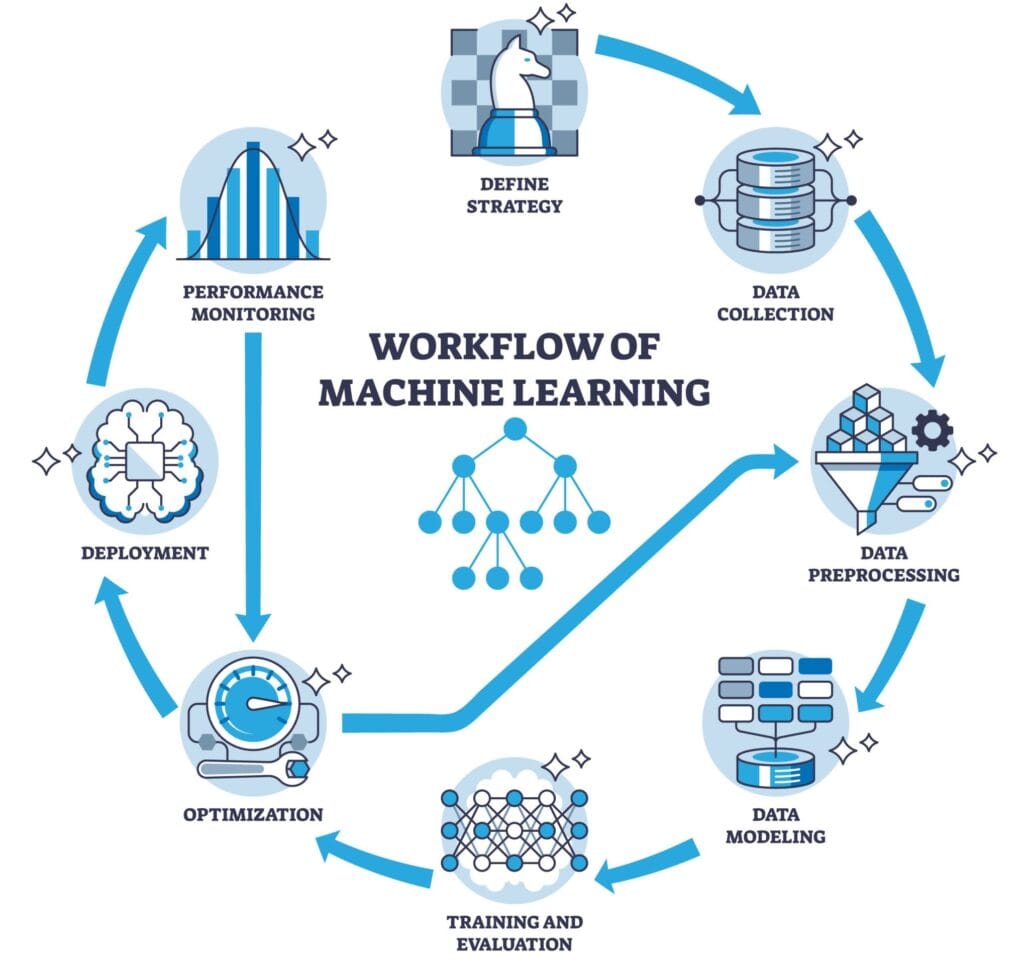
As shown in the machine learning workflow above, Data Preprocessing feeds directly into Data Modeling and training. Skipping proper data hygiene compromises the entire downstream pipeline.
| Quality Flaw | Consequences on AI Models | Mitigation Technique |
| Missing Values / Noise | Reduces training stability and introduces errors | Imputation (mean/median/KNN) or filtering |
| Biased Sampling | Skews predictions unfairly against underrepresented groups | Re-balancing, stratified sampling, or fairness audits |
| Unscaled Features | Causes gradient-based algorithms to converge slowly | Min-Max Scaling or Standardization ($Z$-score) |
Question 5: What is overfitting in machine learning?
- Direct Answer: Overfitting occurs when a machine learning model learns the training data too closely—memorizing its specific noise, outliers, and random fluctuations rather than underlying patterns. As a result, the model achieves high accuracy on training data but fails to generalize, leading to poor performance on new, unseen test data.
- Why Interviewers Ask This: Overfitting is one of the most fundamental concepts tested in beginner AI interview questions and answers. Recruiters ask this to verify that you prioritize model generalization over simply maximizing training accuracy, and that you know how to build robust, production-ready systems.
Recommended Answer Framework
When delivering your response for AI interview questions and answers on overfitting, structure your explanation around these three points:
- Clear Definition: Define overfitting as memorization of training noise rather than true pattern learning.
- Practical Indicators: Explain how it manifests in metrics—specifically a large gap between high training accuracy and low test/validation accuracy.
- Remediation Techniques: List 3–4 practical methods to prevent it:
- Using cross-validation ($k$-fold).
- Gathering more training data or applying data augmentation.
- Applying regularization techniques (e.g., L1/L2 penalties or Dropout in neural networks).
- Simplifying model complexity (e.g., pruning decision trees).
| Metric Zone | Overfitted Model | Well-Fitted Model | Underfitted Model |
| Training Performance | Extremely High (~99%) | High (~90-95%) | Low (~60%) |
| Test Performance | Low (~65%) | High (~88-93%) | Low (~58%) |
| Core Issue | Memorized noise & details | Learned core patterns | Too simple to capture patterns |
Question 6: What is supervised learning?
- Direct Answer: Supervised learning is a core subfield of machine learning where algorithms are trained on labeled datasets—meaning each training sample includes both input features and the correct target output. The model’s objective is to learn an underlying mapping function ($y = f(x)$) that accurately predicts outputs for new, unseen input data.
- Why Interviewers Ask This: Supervised learning powers the vast majority of commercial AI deployments today. In AI interview questions and answers candidate reviews, hiring managers use this prompt to verify that you understand how labeled data guides model optimization and that you can identify real-world business applications.
Recommended Answer Framework
When structuring your response during an entry-level interview, address these three key components:
- Core Concept: Define supervised learning in one sentence, explicitly highlighting the role of labeled inputs and ground-truth targets.
- Learning Mechanism: Explain that during training, the model compares its predictions against true labels, calculates the error (loss), and adjusts its internal parameters to minimize that error.
- Application Pairings: Give two concrete task examples—one for classification (discrete labels, e.g., spam detection) and one for regression (continuous values, e.g., house price forecasting).
| Task Type | Target Output | Real-World Application | Common Algorithms |
| Classification | Discrete categories/labels | Email spam detection (Spam vs. Not Spam) | Logistic Regression, Decision Trees, SVM |
| Regression | Continuous numerical values | Predicting house prices or annual revenue | Linear Regression, Random Forest Regressor |
Question 7: What is unsupervised learning?
- Direct Answer: Unsupervised learning is a category of machine learning that trains models on unlabeled data. Because there are no ground-truth target outputs provided, the model’s goal is to discover hidden patterns, underlying structures, clusters, or lower-dimensional representations directly from raw inputs.
- Why Interviewers Ask This: Interviewers include this in AI interview questions and technical screenings to confirm that you know how models handle real-world scenarios where labeling data is too expensive, time-consuming, or impractical. It checks whether you understand data exploration tasks like customer segmentation and anomaly detection.
Recommended Answer Framework
When structuring your response during an interview, cover these three key points:
- Core Concept: Define unsupervised learning clearly, emphasizing the complete absence of human-annotated labels or target outputs.
- Primary Methods: Mention its two main branches:
- Clustering: Grouping similar data points together based on shared characteristics.
- Dimensionality Reduction: Reducing the number of input variables while preserving core information.
- Real-World Application: Provide a practical business example, such as grouping e-commerce customers into behavioral segments or detecting fraudulent bank transactions as rare outliers.
| Task Type | Core Mechanics | Real-World Application | Key Algorithms |
| Clustering | Partitioning data into groups based on similarity | E-commerce customer segmentation | $K$-Means, Hierarchical Clustering, DBSCAN |
| Dimensionality Reduction | Compressing features while retaining variance | Visualizing high-dimensional data, preprocessing | Principal Component Analysis (PCA), t-SNE |
| Anomaly Detection | Identifying rare data points that deviate from the norm | Fraud detection, manufacturing flaw detection | Isolation Forest, One-Class SVM |
Question 8: What is a neural network?
- Direct Answer: A neural network is a machine learning model loosely inspired by the structure and function of biological neural pathways in the human brain. It is composed of interconnected layers of simple processing nodes (“neurons”) that pass signals to one another, transforming raw input data into predictions using learnable weights, biases, and activation functions.
- Why Interviewers Ask This: Neural networks form the foundation of modern deep learning and Large Language Models (LLMs). When evaluating AI interview questions and answers, hiring managers use this prompt to check whether you grasp architectural fundamentals without relying on dense mathematical jargon.
Recommended Answer Framework
When presenting your response in an entry-level interview, break down the concept using these three clear components:
- Structural Layers: Explain that a network consists of three distinct zones:
- Input Layer: Receives raw features (e.g., pixel values or text embeddings).
- Hidden Layer(s): Extracts feature representations and non-linear patterns through mathematical transformations.
- Output Layer: Generates the final prediction (e.g., classification probability or continuous target value).
- Neuron Mechanics: Describe how individual nodes multiply inputs by adjustable weights, add a bias, and run the result through an activation function (like ReLU or Sigmoid) to introduce non-linearity.
- Learning Process: Conclude by noting that training involves passing data forward (forward propagation), calculating prediction error against ground truth, and updating weights backward via algorithms like backpropagation and gradient descent to minimize that error over time.
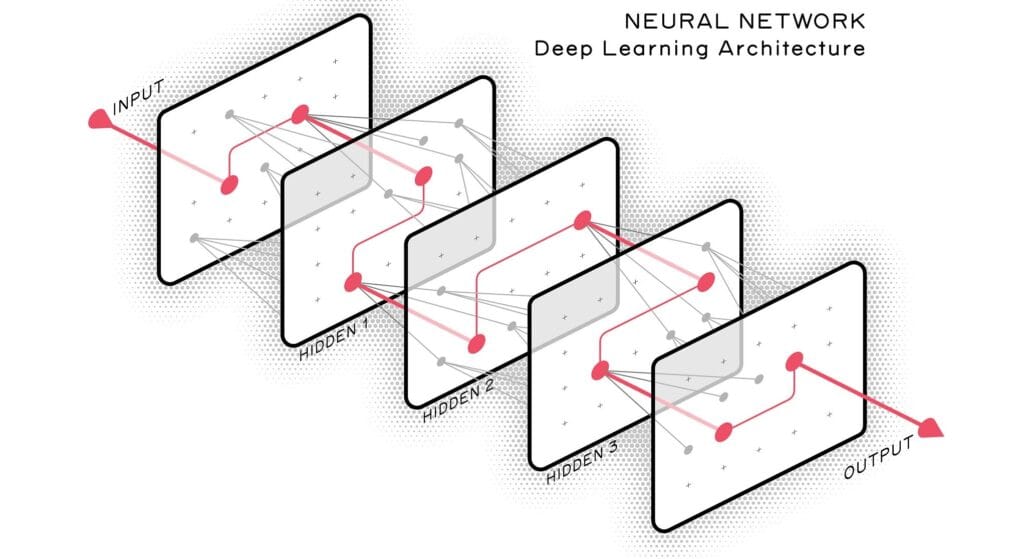
As shown in the architecture diagram above, signals flow systematically from the Input layer through multiple intermediate Hidden layers—where feature extraction occurs—before reaching the final Output node.
| Layer Type | Core Function | Example Data (Image Task) |
| Input Layer | Accepts raw, unprocessed features into the system | $28 \times 28$ image pixel grid ($784$ features) |
| Hidden Layer(s) | Performs transformations to extract increasingly complex patterns | Detects edges, shapes, and structural contours |
| Output Layer | Converts internal representations into final predictions | Predicts class probabilities (e.g., $95\%$ probability of “Cat”) |
Question 9: What is deep learning?
- Direct Answer: Deep learning is a specialized subset of machine learning that utilizes artificial neural networks with many hidden layers (“deep” architectures) to automatically extract representations and learn complex patterns from massive volumes of data. It powers breakthrough capabilities in computer vision, speech processing, and natural language understanding (NLU).
- Why Interviewers Ask This: Deep learning underpins modern frontier AI models. When evaluating candidate responses to AI interview questions and answers, recruiters want to see if you understand why deep learning excels with unstructured data and recognize its reliance on massive datasets and specialized computational resources (GPUs/TPUs).
Recommended Answer Framework
When structuring your response for AI interview questions and answers on deep learning, include these three elements:
- Core Distinction: Define deep learning in one sentence, highlighting its ability to perform automatic feature extraction directly from raw inputs without human feature engineering.
- Key Application Domains: Mention at least two major areas where deep learning dominates—such as Computer Vision (image/video classification) and Natural Language Processing (chatbots, translation, and text generation).
- Trade-offs & Constraints: Conclude by explicitly noting the trade-offs: deep learning models require significantly larger datasets and higher computational resources (hardware costs and power consumption) compared to traditional machine learning algorithms.
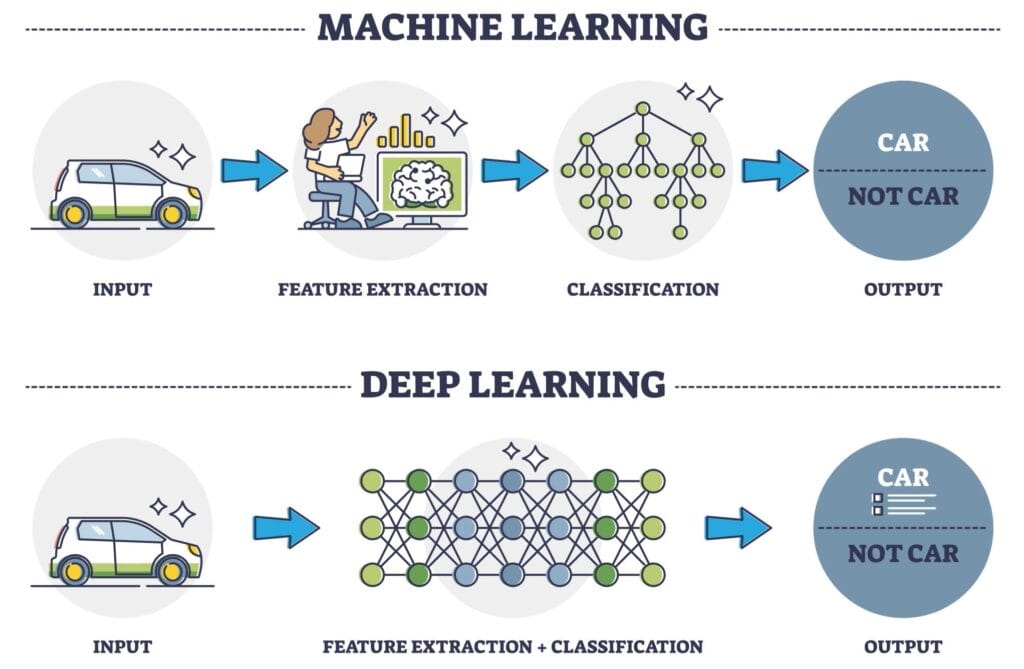
As illustrated in the comparison above, traditional machine learning relies on manual, human-guided feature extraction before classification, whereas deep learning merges feature extraction and classification into a unified, multi-layered end-to-end process.
| Feature Dimension | Traditional Machine Learning | Deep Learning |
| Data Requirement | Functions well on small-to-medium tabular datasets | Demands massive volumes of structured or unstructured data |
| Feature Extraction | Requires manual domain engineering | Automatically learns features across stacked hidden layers |
| Hardware Dependency | Runs efficiently on standard CPUs | Requires specialized accelerators (GPUs, TPUs) |
| Optimal Use Cases | Structured tabular data, financial risk modeling | Computer vision, audio recognition, LLMs/GenAI |
Question 10: What are classification and regression?
- Direct Answer: Classification and regression are the two primary problem types in supervised learning. Classification trains a model to predict discrete categorical labels (e.g., “Spam” vs. “Not Spam”), whereas regression trains a model to predict continuous numerical values (e.g., estimating a home’s market value).
- Why Interviewers Ask This: Hiring managers routinely include this in AI interview questions and technical screenings to test whether you can translate high-level business problems into the correct machine learning task and choose appropriate algorithms and metrics accordingly.
Recommended Answer Framework
When presenting your response during an interview, structure your answer around these three core points:
- Define Classification: Explain that classification outputs categorical labels. Give two distinct examples, such as binary classification (email spam detection or disease diagnosis) and multi-class classification (document sorting).
- Define Regression: Explain that regression outputs continuous numerical values along a continuous scale. Give real-world examples, such as predicting house prices, sales forecasting, or estimating transit times.
- Common Ground: Conclude by highlighting that both tasks rely on labeled training data ($X$ inputs mapped to known $Y$ targets) to learn prediction mappings.
| Feature | Classification Task | Regression Task |
| Output Type | Discrete classes/categories | Continuous numerical values |
| Example Questions | “Will this customer churn? (Yes/No)” | “How many days until this customer churns?” |
| Evaluation Metrics | Accuracy, Precision, Recall, F1-Score, ROC-AUC | Mean Absolute Error (MAE), Mean Squared Error (MSE), $R^2$ |
| Common Algorithms | Logistic Regression, Decision Trees, Random Forest | Linear Regression, Ridge/Lasso, Decision Tree Regressor |
Question 11: What is a confusion matrix?
- Direct Answer: A confusion matrix is a specific layout table that summarizes the performance of a classification model by comparing its predicted outputs against actual ground-truth labels. It breaks down predictions into four core outcomes: True Positives (TP), True Negatives (TN), False Positives (FP), and False Negatives (FN).
- Why Interviewers Ask This: Interviewers ask this in AI interview questions and answers candidate reviews to assess whether you understand model evaluation beyond surface-level overall accuracy—especially when dealing with imbalanced datasets where accuracy can be misleading.
Recommended Answer Framework
When presenting your response in an entry-level technical interview, structure your points as follows:
- Grid Breakdown: Define the matrix as a 2×2 grid (for binary tasks) comparing predicted vs. actual outcomes.
- Metric Foundation: Explain that this matrix serves as the foundation for calculating critical evaluation metrics like Precision, Recall, F1-Score, and Specificity.
- High-Stakes Real-World Context: Illustrate why error types matter using a medical diagnosis example:
- False Positive (Type I Error): Diagnosing a healthy patient as sick (causes unnecessary anxiety and testing).
- False Negative (Type II Error): Diagnosing a sick patient as healthy (potentially life-threatening failure to treat).
| Predicted: Positive | Predicted: Negative | |
| Actual: Positive | True Positive (TP) (Sick patient correctly identified) | False Negative (FN) (Sick patient missed — Type II Error) |
| Actual: Negative | False Positive (FP) (Healthy patient flagged — Type I Error) | True Negative (TN) (Healthy patient correctly cleared) |
| Derived Metric | Formula | What It Measures |
| Precision | $\frac{\text{TP}}{\text{TP} + \text{FP}}$ | Out of all predicted positives, how many were actually positive? |
| Recall (Sensitivity) | $\frac{\text{TP}}{\text{TP} + \text{FN}}$ | Out of all actual positives, how many did the model capture? |
| F1-Score | $2 \times \frac{\text{Precision} \times \text{Recall}}{\text{Precision} + \text{Recall}}$ | Harmonic mean balancing precision and recall trade-offs. |
Question 12: What is bias and variance in ML models?
- Direct Answer: Bias refers to error introduced when a model makes overly simplistic assumptions, causing it to miss underlying patterns (underfitting). Variance refers to error introduced when a model is overly sensitive to small fluctuations and noise in the training data (overfitting), leading to unstable performance on new datasets.
- Why Interviewers Ask This: Understanding the bias-variance tradeoff is a foundational technical milestone. When reviewing AI interview questions and answers, candidates and recruiters use this topic to gauge your ability to diagnose model performance issues and tune parameters for optimal generalization.
Recommended Answer Framework
When explaining bias and variance during an interview, structure your answer around these three core concepts:
- High Bias (Underfitting): Explain that high bias occurs when an overly simple algorithm fails to capture the complexity of the data (e.g., fitting a straight line to a complex curve), resulting in high error on both training and test data.
- High Variance (Overfitting): Explain that high variance occurs when a complex algorithm fits the training data too closely (e.g., a deep decision tree memorizing noise), yielding near-zero training error but high test error.
- The Optimal Tradeoff: Conclude by stating that machine learning engineering aims to find the sweet spot that minimizes total error by balancing model simplicity and complexity.
| Feature | High Bias (Underfitting) | Optimal Balance | High Variance (Overfitting) |
| Model Complexity | Too simple (e.g., linear model on non-linear data) | Well-tuned complexity | Too complex (e.g., deep unpruned tree) |
| Training Error | High | Low | Extremely Low / Zero |
| Test Error | High | Low | High |
| Primary Cause | Oversimplified assumptions | Captures true underlying signal | Learns random noise & training outliers |
Question 13: What is natural language processing (NLP)?
- Direct Answer: Natural Language Processing (NLP) is a subfield of artificial intelligence, linguistics, and computer science focused on enabling computers to understand, interpret, manipulate, and generate human language in both text and speech forms.
- Why Interviewers Ask This: NLP powers mainstream consumer AI systems—including Large Language Models (LLMs), automated translation engines, and voice assistants. When evaluating AI interview questions and answers, candidates and hiring teams ask this to check your familiarity with language processing fundamentals and their commercial applications.
Recommended Answer Framework
Structure your response using this 3-part framework:
- Core Scope: Define NLP as the bridge between unstructured human communication and computational understanding.
- Key Capabilities & Tasks: Highlight 3–4 standard operational tasks:
- Sentiment Analysis: Categorizing tone or mood (e.g., positive vs. negative product reviews).
- Machine Translation: Translating text across languages (e.g., Google Translate).
- Text Classification & Summarization: Grouping documents or condensing long reports.
- Question Answering & Information Extraction: Retrieving answers from knowledge bases.
- Technological Context: Conclude by pointing out that while traditional NLP relied on rule-based parsing and statistical linguistics (e.g., TF-IDF), modern NLP is driven by deep learning neural architectures like Transformers (e.g., BERT, GPT).
| Processing Era | Primary Methodology | Key Strengths / Limitations | Example Tools |
| Traditional NLP | Rule-based heuristics, bag-of-words, TF-IDF | Fast, lightweight; lacks semantic context | NLTK, early spam filters |
| Modern Deep NLP | Transformer architectures, self-attention mechanisms | Understands complex context & semantics; resource-intensive | Spacy, Hugging Face, GPT-4, BERT |
Question 14: What is computer vision?
- Direct Answer: Computer vision is an interdisciplinary field of artificial intelligence that enables computers and automated systems to derive meaningful information from visual inputs—such as digital images, video streams, and sensor feeds—and take actions or make recommendations based on that data.
- Why Interviewers Ask This: Computer vision powers major commercial AI implementations, including autonomous driving, medical imaging, robotics, and security monitoring. In entry-level AI interview questions and answers technical rounds, recruiters use this question to check whether you can define core visual tasks and explain how machines process pixel data into structured decisions.
Recommended Answer Framework
When presenting your response in an entry-level interview, break it down across these three structural steps:
- Core Scope: Define computer vision as the machine equivalent of human visual perception—converting numerical pixel matrices into semantic understanding.
- Key Functional Tasks: Highlight the primary tasks within the domain:
- Image Classification: Assigning a label to an entire image (e.g., “Contains a vehicle”).
- Object Detection: Locating and drawing bounding boxes around multiple objects within an image.
- Semantic/Instance Segmentation: Partitioning an image into pixel-level masks to identify exact boundaries.
- Everyday Consumer Applications: Ground your answer with ubiquitous examples, such as face unlock on smartphones, automated photo tagging, document scanning/OCR, or optical inspection in manufacturing.
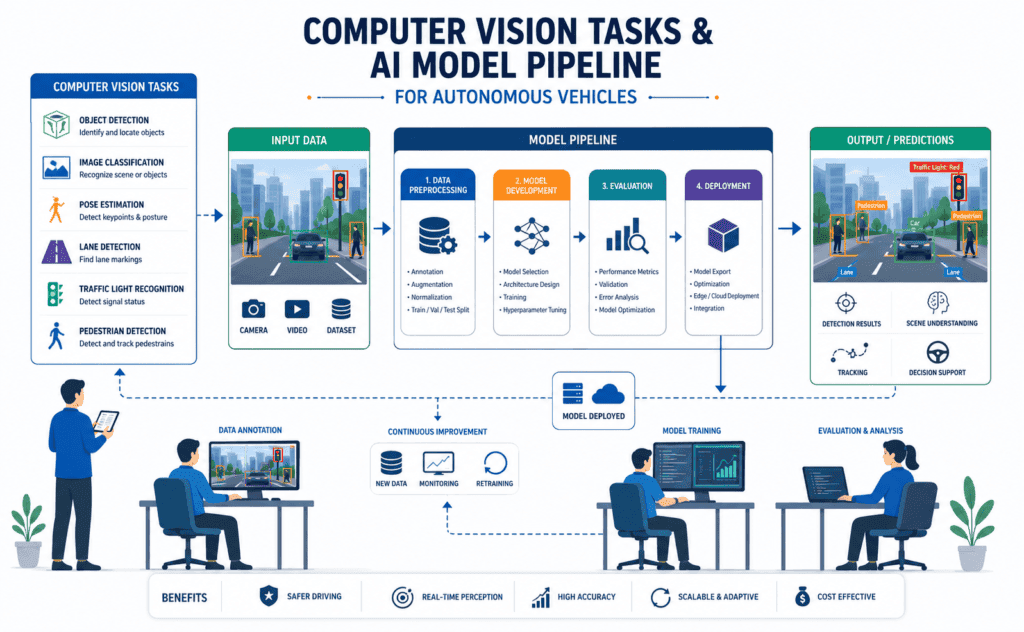
As shown in the model pipeline illustration above, computer vision systems convert raw visual inputs through specialized neural network pipelines (such as CNNs or Vision Transformers) to execute tasks like Object Detection and Pose Estimation in real time.
| Computer Vision Task | Operational Mechanics | Practical Enterprise Example |
| Image Classification | Predicts overall image category | Diagnostic triage (e.g., flagging normal vs. abnormal X-rays) |
| Object Detection | Identifies object locations via bounding boxes | Autonomous driving (detecting pedestrians, signs, and vehicles) |
| Optical Character Recognition (OCR) | Converts pixel text into machine-readable strings | Automated document scanning and invoice processing |
Question 15: How would you explain an AI project you worked on?
- Direct Answer: When explaining a personal, academic, or bootcamp AI project, structure your answer using a concise, impact-driven narrative: clearly define the Problem, detail your Solution (data, tools, and model choices), quantify the Impact or results, and conclude with a self-aware Reflection on limitations or lessons learned.
- Why Interviewers Ask This: Technical recruiters include this in AI interview questions and answers evaluation rounds to test your practical hands-on experience, your end-to-end technical reasoning, and your ability to articulate complex technical decisions to both technical and non-technical stakeholders.
Recommended Answer Framework
Structure your response using the Problem–Solution–Impact–Reflection (PSIR) framework:
- Problem: State the business or technical problem you aimed to solve in 1–2 sentences.
- Solution: Briefly walk through your workflow—the dataset used, data preprocessing steps, key libraries (e.g.,
scikit-learn,PyTorch,Pandas), baseline model selection, and final architecture choice. - Impact: Quantify your results using specific metrics (e.g., “Achieved an 88% F1-score” or “Reduced false positives by 15% compared to baseline”).
- Reflection: Share what you learned, edge cases you encountered, or how you would improve the model if given more data or compute time.
  [1. Problem]       [2. Solution]       [3. Impact]        [4. Reflection]
  Business Context   Dataset & Modeling   Metrics & Value    Lessons & Next Steps
 standard problem -> pipeline choices  -> concrete results -> honest self-critique
Code language: CSS (css)| PSIR Stage | Focus Area | Example Candidate Script |
| 1. Problem | Context & Goal | “I built a churn prediction system to help subscription businesses identify at-risk users early.” |
| 2. Solution | Pipeline & Tech Stack | “I cleaned 50k user activity logs using Pandas, handled class imbalance via SMOTE, and trained a Random Forest classifier in Python.” |
| 3. Impact | Quantitative Results | “The model achieved a 0.84 ROC-AUC score, outperforming a baseline Logistic Regression model by 12%.” |
| 4. Reflection | Growth & Future Enhancements | “If I had more time, I would collect more temporal features and experiment with XGBoost to improve minority class recall.” |
AI Interview Preparation Decision Matrix
Use this decision matrix to determine the most effective preparation strategy based on your current technical background and available lead time.
| Situation | Primary Prep Method | Time Focus | Best For | Key Trade-off |
| No Prior AI Background | Structured beginner course + targeted question practice | 2–4 weeks | Students and career switchers building baseline concepts | Slower initial start, but builds a stronger foundation; may not cover advanced edge cases |
| Some ML / DS Coursework | Targeted revision of core concepts + mock interviews | 1–2 weeks | CS/DS students refreshing foundational knowledge | Highly efficient, but assumes you already understand basic math and programming principles |
| Bootcamp or Self-Taught | Portfolio polishing + project storytelling practice | 3–7 days | Bootcamp graduates and self-taught developers | Delivers a strong practical narrative, but theoretical knowledge may have minor gaps |
| Already in Data / IT Role | Role-specific question sets + target company research | 3–7 days | IT, software, and data professionals transitioning into AI | Highly focused on the immediate job opening; offers less generic domain coverage |
| Last-Minute Prep ($\le$ 72 Hours) | Top 15–30 questions review + deep-dive into one personal project | 1–3 days | Candidates with an imminent interview scheduled | Delivers a fast short-term confidence boost; offers limited depth in broad fundamentals |
Key Takeaway: Match your preparation strategy to your biggest liability. Candidates with strong theoretical backgrounds should focus on project storytelling, while self-taught candidates should prioritize core concept definitions and metrics.
Buying Guide: AI Interview Prep Tools and Platforms
Selecting the right resources is a critical step when mastering AI interview questions and answers. Below is a strategic guide to help candidates evaluate preparation tools, platforms, and practice environments based on budget, features, and privacy.

Free Resources vs. Paid Platforms
| Resource Tier | Best Suited For | Strategic Value | Primary Drawback |
| Free Resources (Open-source guides, documentation, YouTube) | Students, early-career candidates, and self-taught developers | Ideal for building foundational conceptual clarity without financial risk | Lacks structured feedback, live practice environments, and graded feedback |
| Paid Platforms (Interactive prep sites, live coaching) | Candidates entering high-stakes recruitment cycles | Delivers structured skill paths, real-time mock interviews, and actionable scoring | Requires subscription investment; quality varies across platforms |
Rule of Thumb: Start with free curated lists of AI interview questions and answers to master core theory. Invest in paid mock platforms or coaching only when you need to refine live technical articulation or speed.
Feature Evaluation Matrix
When selecting a tool or subscription platform to practice AI interview questions and answers, evaluate candidates against these non-negotiable and value-add features:
  [Must-Have Core]                     [Nice-to-Have Additions]
  • Essential Concept Coverage         • Role-Specific Skill Tracks
  • Solved Question Banks              • Integrated Python Environments
  • Mock Practice Environments         • Automated AI Performance Scoring
  • Project Portfolio Guidance         • Dynamic Progress Dashboards
Code language: CSS (css)
Must-Have Features
- Core Concept Coverage: Comprehensive material covering beginner-to-intermediate AI, ML, and data fundamentals.
- Curated Question Banks: High-signal questions complete with model answers, trade-off breakdowns, and structural tips.
- Practice Environments: Options for live peer-to-peer, recorded, or AI-driven mock interviews.
- Portfolio & Project Guidance: Frameworks for translating personal or academic projects into compelling interview narratives.
Nice-to-Have Features
- Role-Specific Specializations: Custom tracks tailored to specific titles (e.g., Entry-Level AI Engineer, Data Science Intern, or Prompt Engineer).
- In-Browser Coding Workspaces: Integrated Python sandboxes for testing data manipulation libraries (
Pandas,NumPy,Scikit-Learn). - Automated Feedback Engines: Instant scoring on speaking pace, clarity, confidence, and keyword coverage.
Data Privacy and Governance
Modern AI interview prep tools often record audio, video, or text responses to analyze performance. Before uploading data or practicing on an interactive platform, audit these security factors:
- Storage & Retention: Confirm how long your audio, video recordings, and transcripts are retained on server infrastructure.
- Data Sharing Policies: Verify that your practice session data and mock interview scores are never shared with potential employers without explicit consent.
- Deletion Controls: Ensure the platform grants you full authority to permanently delete account data, media files, and transcript logs at any time.
Ecosystem Compatibility & Long-Term Relevance
The AI job landscape evolves rapidly. Ensure your selected prep stack maintains long-term relevance:
- Modern Stack Alignment: Verify that tools cover modern Python libraries (
PyTorch,Hugging Face,Scikit-Learn) alongside traditional ML concepts. - Emerging Paradigm Coverage: Ensure question banks are routinely updated to cover modern architectures like Retrieval-Augmented Generation (RAG), Large Language Models (LLMs), and AI ethics alongside classic statistics.
Common AI Interview Mistakes Beginners Make
Navigating beginner-level AI interviews requires balancing theoretical knowledge, practical execution, and soft skills. Recognizing these common pitfalls—highlighted across leading career and technical hiring platforms—is the fastest way to refine your strategy.
Rote Memorization Over Conceptual Understanding
- The Mistake: Memorizing textbook definitions line-by-line without understanding the underlying mechanics.
- The Risk: When an interviewer rephrases a question or introduces a slight variation (e.g., asking “When would you prefer precision over recall?” instead of “Define precision and recall”), candidates who relied on rote learning struggle to adapt.
- The Fix: Practice explaining concepts using analogies or simple 2–3 sentence summaries. If you cannot explain a concept to a non-technical peer, revisit the fundamentals.
Treating AI as an Isolated Tech Stack (Ignoring the Job Description)
- The Mistake: Giving generic, one-size-fits-all answers rather than tailoring responses to the employer’s specific domain and product needs.
- The Risk: An answer focused purely on deep computer vision architectures will fall flat if the role primarily targets tabular data modeling for financial fraud detection.
- The Fix: Map your target role’s job description directly to your prep. Identify whether the team prioritizes traditional ML, NLP, GenAI, or data engineering, and tailor your example selection accordingly.
Overusing Buzzwords Without Substance
- The Mistake: Dropping high-level industry terms—such as “Transformer architectures,” “Generative AI,” or “Deep Learning”—without being able to explain how they function under the hood.
- The Risk: Technical interviewers frequently use buzzwords as a prompt to probe deeper. Failing to explain basic mechanics damages credibility quickly.
- The Fix: Only mention architectures or tools in your interview answers if you can comfortably discuss their inputs, outputs, key hyperparameters, and limitations.
Over-Focusing on Algorithms While Neglecting Pipeline Realities
- The Mistake: Spending 90% of prep time studying complex model architectures while skipping data hygiene, evaluation metrics, and model deployment.
- The Risk: Real-world enterprise AI spends far more time on data cleaning, handling class imbalance, and metric selection than on model selection.
- The Fix: Ensure every technical answer covers the full lifecycle: Data Preprocessing $\rightarrow$ Baseline Model $\rightarrow$ Metric Selection $\rightarrow$ Error Analysis.
Neglecting Behavioral & Soft Skill Questions
- The Mistake: Treating the interview solely as an exam and ignoring questions about teamwork, learning agility, feedback, or project setbacks.
- The Risk: Engineering teams hire collaborators, not isolated algorithms. Poor communication or resistance to feedback is a frequent cause of candidate rejection.
- The Fix: Prepare 2–3 structured behavioral stories using the STAR method (Situation, Task, Action, Result) that highlight how you debugged a broken pipeline, learned a new framework under pressure, or responded to technical feedback.
Weak or Disorganized Project Storytelling
- The Mistake: Rambling through personal, academic, or bootcamp projects without a clear structure.
- The Risk: Interviewers lose track of your individual contributions, tools used, and business context.
- The Fix: Use the Problem–Solution–Impact–Reflection framework for every project on your resume:
  [Problem]                 [Solution]                 [Impact]               [Reflection]
  What was the goal?  --->  Data, tools, & model  ---> Metrics & outcomes ---> What would you improve?
Code language: CSS (css)| Common Pitfall | Typical Candidate Behavior | High-Signal Alternative Strategy |
| Rote Memorization | Reciting textbook definitions verbatim | Explaining concepts via trade-offs and real-world scenarios |
| Buzzword Reliance | Throwing out terms like “LLM” or “Neural Nets” | Grounding terms in inputs, outputs, and edge cases |
| Algorithm-Only Focus | Discussing model code while ignoring data flaws | Emphasizing data cleaning, validation sets, and metrics |
| Unstructured Projects | Giving long-winded, disorganized project summaries | Structuring narratives via Problem–Solution–Impact–Reflection |
Essential AI Concepts Revision Checklist
Focusing your study on a targeted set of core fundamentals yields far better results than trying to memorize advanced research papers. Use this checklist as a high-impact revision audit before entering your interview:
  [1. Core Foundations]   --->   [2. Data & Validation]   --->   [3. Evaluation & Metrics]
  AI / ML / DL Hierarchy          Splits & Cleaning               Precision, Recall, F1, MSE
Fundamental Frameworks & Definitions
- AI vs. ML vs. DL: Differentiate high-level AI concepts, data-driven machine learning algorithms, and multi-layered deep learning architectures.
- Learning Paradigms: Explain Supervised, Unsupervised, and Reinforcement Learning with clear real-world examples (e.g., email spam filtering, customer segmentation, automated navigation).
- Generative vs. Traditional AI: Contrast discriminative models (predicting labels) with generative models (creating novel text, images, or code).
High-Level Algorithm Mechanics
- Linear & Logistic Regression: Explain how continuous targets vs. discrete classification boundaries are modeled.
- Decision Trees & Ensembles: Describe basic tree-splitting decisions and why ensemble methods (Random Forests, Gradient Boosting) reduce variance.
- Clustering ($K$-Means): Explain how unlabeled data points are grouped into clusters around centroids based on distance metrics.
- Neural Network Basics: Articulate the roles of input, hidden, and output layers, activation functions (e.g., ReLU, Sigmoid), and gradient descent optimization.
Model Generalization & Performance Issues
- Overfitting & Underfitting: Identify symptoms of high training accuracy paired with poor test performance vs. low accuracy across all splits.
- Bias-Variance Tradeoff: Explain how model simplicity (high bias) vs. model complexity (high variance) dictates total prediction error.
- Regularization: List basic techniques (L1/L2 penalties, Dropout, Early Stopping) used to prevent models from memorizing training noise.
Data Hygiene, Processing & Splitting
- Data Preprocessing: Walk through handling missing values (imputation), removing duplicates, scaling numerical features (Min-Max vs. Standardization), and encoding categorical variables.
- Dataset Partitioning: Explain the distinct roles of Training, Validation, and Test sets to avoid data leakage during hyperparameter tuning.
- Feature Engineering: Describe creating new features from raw inputs to help algorithms extract patterns more effectively.
Evaluation Metrics & Error Interpretation
- Classification Metrics: Define Accuracy, Precision, Recall, and F1-Score, highlighting when to prioritize specific metrics (e.g., high recall in medical diagnosis).
- Confusion Matrix: Map True Positives (TP), True Negatives (TN), False Positives (FP), and False Negatives (FN) to real-world outcomes.
- Regression Metrics: Explain Mean Squared Error (MSE) and Mean Absolute Error (MAE) in simple terms.
Primary Domain Applications
- Natural Language Processing (NLP): Define core tasks like sentiment analysis, text classification, machine translation, and Large Language Models (LLMs).
- Computer Vision: Explain image classification, object detection (bounding boxes), and image segmentation.
- Modern AI Architectures: Explain high-level concepts like Retrieval-Augmented Generation (RAG) and how grounded data prevents hallucinations.
Preparation Strategy: At the entry-level, you do not need complex mathematical derivations or proofs on the whiteboard. Focus on delivering direct, plain-language definitions paired with a concrete business or engineering scenario.
Tips for Answering Behavioral AI Interview Questions

Behavioral questions evaluate how you think, communicate, and solve problems within a team—not just your technical or coding speed. In entry-level AI roles, recruiters use these questions to gauge your learning agility, adaptability, and problem-solving mindset when dealing with non-deterministic models and messy real-world data.
Structure Answers Using the STAR Method
To keep your answers concise, logical, and impact-driven, structure your responses using the STAR framework:
  [Situation]             [Task]                [Action]                [Result]
  Set the context    ---> Define your goal ---> Specific steps taken ---> Quantified outcomes
Code language: CSS (css)- Situation: Briefly set the background in 1–2 sentences (academic project, internship, or hackathon).
- Task: State the explicit challenge or objective you needed to solve.
- Action: Focus on your specific contributions—the tools you researched, algorithms you experimented with, or how you collaborated.
- Result: Share the outcome using concrete metrics or clear qualitative takeaways (e.g., “Improved accuracy by 8%” or “Successfully met the project deadline”).
2. Highlight Learning Agility & Resourcefulness
The AI field evolves rapidly, and hiring managers do not expect entry-level candidates to know every library or architecture. Demonstrate that when you encounter an unfamiliar concept:
- You independently consult documentation, research papers, or open-source repositories.
- You build small proof-of-concept tests to evaluate tools.
- You know when to seek targeted guidance from senior engineers or peers without getting stalled.
3. Demonstrate Technical Humility & Self-Awareness
AI projects frequently fail due to bad data, overfitting, or compute constraints. Instead of presenting a “flawless” project narrative:
- Discuss real limitations you encountered (e.g., small sample sizes, compute limits, or noisy labels).
- Explain how you diagnosed the root cause and implemented a workaround.
- Conclude with what you would do differently if you had access to more data or higher-tier compute resources.
4. Emphasize Responsible AI & Ethical Awareness
Deploying AI models carries inherent risks around dataset bias, privacy violations, and hallucinated outputs. Stand out by actively weaving ethical considerations into your answers:
- Fairness: Auditing training data for demographic representation.
- Privacy: Handling sensitive user information securely (e.g., anonymization).
- Transparency: Preferring interpretable models (or tools like SHAP/LIME) when high explainability is required.
Common Behavioral AI Questions & Winning Approaches
| Question Type | What Recruiters Are Testing | Strategic Approach |
| “Tell me about a time an AI model failed or performed poorly.” | Debugging methodology and resilience | Focus on root-cause analysis (e.g., detecting overfitting or class imbalance) rather than blaming the tool. |
| “How do you stay updated with new AI tools and frameworks?” | Continuous learning and genuine interest | Mention specific high-signal resources you follow (e.g., technical blogs, paper summaries, GitHub repos). |
| “How did you explain a complex technical concept to a non-technical peer?” | Communication and cross-functional teamwork | Explain how you used simple visual analogies or business metrics instead of technical jargon. |
Recommended Free Resources for AI Interview Preparation
Building a strong foundation for your interview doesn’t require expensive courses or subscriptions. A wealth of high-quality, open-access resources exists across developer communities, academic institutions, and open-source platforms.
Use this curated roadmap to systematically build your skills at zero cost:
  [1. Concept Explainers]  --->  [2. Question Banks]  --->  [3. Open-Source Code]  --->  [4. Mock Practice]
  W3Schools / Fast.ai           GeeksforGeeks / Kaggle         GitHub Repositories            AI Sandbox Tools
Educational Platforms & Interactive Tutorials
- GeeksforGeeks & DataCamp Blogs: Excellent starting points for quick, structured breakdowns of core algorithms, evaluation metrics, and cheat sheets.
- Fast.ai (
Practical Deep Learning for Coders): A top-tier, free hands-on course that teaches top-down deep learning using PyTorch, perfect for understanding real-world application pipelines. - W3Schools & Scikit-Learn Documentation: Clean, interactive tutorials for revising fundamental Python syntax, data manipulation (
Pandas/NumPy), and basic machine learning implementations.
University Courseware & MOOCs
- Stanford CS229 (Machine Learning) & CS224N (NLP): Lecture notes, slide decks, and recorded video sessions available freely on YouTube or course portals. They map directly to standard industry interview questions.
- MIT OpenCourseWare (Intro to Deep Learning): Exceptional foundational video lectures covering neural networks, computer vision, and modern transformer architectures.
Open-Source Repositories & Real-World Code
- GitHub (
awesome-ai-interview-questions): Open-source, community-maintained repositories detailing hundreds of real interview questions categorized by topic and difficulty. - Kaggle Notebooks: Explore winning community notebooks to see how practitioners perform exploratory data analysis (EDA), data cleaning, feature engineering, and cross-validation on messy real-world datasets.
Free Tiers of AI Mock Interview & Practice Tools
- AI-Powered Mock Practice: Tools offering limited free tiers for practicing spoken responses, getting instant feedback on pacing, and identifying missing keywords.
- Community Peer Mocks: Developer forums and Discord servers (e.g., Kaggle, Hugging Face, or local AI meetup groups) where candidates conduct mutual, recorded peer mock interviews.
Resource Allocation Strategy
| Preparation Phase | Focus Area | Recommended Free Resource | Outcome Goal |
| Phase 1: Theory Revision | Conceptual definitions & math basics | GeeksforGeeks, Fast.ai, MIT OCW | Master plain-language explanations of core ML/DL concepts |
| Phase 2: Code & Pipeline | Data cleaning, modeling, & metrics | Kaggle Notebooks, Scikit-Learn Docs | Understand end-to-end Python ML workflows |
| Phase 3: Question Practice | Curated Q&A banks & edge cases | GitHub Awesome Lists, Career Blogs | Build rapid recall for top 30 beginner questions |
| Phase 4: Verbal Delivery | Mock interviews & storytelling | Free AI tools, peer practice groups | Deliver structured STAR/PSIR answers clearly under pressure |
Are AI interview questions the same for every role?
No. While entry-level AI engineers, data scientists, and machine learning analysts share foundational overlap in statistics and core algorithms, the specific focus varies significantly by domain:
AI/ML Engineers: Focus heavily on system design, clean coding (Python), API integration, model deployment pipelines, and operational efficiency.
Data Scientists: Focus on feature engineering, statistical modeling, hypothesis testing, metrics selection, and business data interpretation.
Data Analysts: Focus on exploratory data analysis (EDA), SQL queries, basic classification/regression tasks, and dashboarding.
How many AI interview questions should I practice as a beginner?
Focus on 20 to 40 core conceptual questions rather than attempting to memorize hundreds of questions word-for-word. Understanding the underlying trade-offs (e.g., Precision vs. Recall, Overfitting vs. Underfitting, or Prompting vs. Fine-Tuning) enables you to comfortably adapt your answers to any variation an interviewer presents.
Do I need real work experience for an entry-level AI interview?
No. Recruiters for beginner roles evaluate problem-solving methodology, foundational knowledge, and technical clarity over years of enterprise experience. Well-explained bootcamp assignments, open-source contributions, academic research, or personal projects are acceptable substitutes—provided you can walk through the data pipeline, model choices, metrics, and limitations using a structured framework (such as Problem–Solution–Impact–Reflection).
How important are soft skills in AI interviews?
Soft skills are just as critical as technical skills. Engineering teams evaluate candidates on how clearly they can communicate complex technical ideas, collaborate with cross-functional team members, receive feedback during code reviews, and think through ethical considerations (such as data privacy, fairness, and bias).
Should beginners worry about advanced topics like reinforcement learning or agentic workflows?
For general entry-level roles, advanced topics like Reinforcement Learning (RL), complex Agentic architectures, or custom distributed training are helpful to understand at a high conceptual level, but they are rarely required in depth. Prioritize mastering core supervised and unsupervised paradigms, data preprocessing, and evaluation metrics first.
How is Generative AI impacting entry-level interview questions?
In addition to traditional ML concepts, recruiters increasingly expect beginners to understand basic modern AI terms—such as Large Language Models (LLMs), Prompt Engineering, Retrieval-Augmented Generation (RAG), and AI Hallucinations. Demonstrating a basic awareness of how these tools work in real-world applications provides a strong competitive edge.
In Conclusion
Mastering beginner AI interview questions and answers comes down to core conceptual clarity, disciplined communication frameworks, and practical execution. Hiring teams for entry-level roles do not expect advanced theoretical derivations; instead, they assess your foundational knowledge, problem-solving reasoning, and ability to translate data pipelines into business value.
 [Phase 1: Revise Fundamentals]  --->  [Phase 2: Practice Core Questions]  --->  [Phase 3: Polish Project Stories]
 Master definitions, metrics,           Target 20-40 representative          Structure 1-2 narratives via
 & model trade-offs                    questions with clear trade-offs       Problem-Solution-Impact-Reflection
Code language: CSS (css)
Actionable Action Plan
- Consolidate Core Concepts: Revisit the high-impact checklist—focusing on the AI/ML/DL hierarchy, supervised vs. unsupervised paradigms, overfitting mitigations, and performance metrics (Precision, Recall, F1, MSE).
- Rehearse Top Question Sets: Practice articulating 20–40 foundational questions out loud. Practice delivering direct 2–3 sentence answers paired with clear trade-off explanations.
- Structure Your Project Narratives: Prepare at least one personal, course, or bootcamp project using the Problem–Solution–Impact–Reflection (PSIR) format. Be ready to candidly discuss edge cases, data cleaning steps, and what you would improve with more compute or data.
- Tailor to the Job Description: Audit your target company’s domain stack (NLP, Computer Vision, Tabular ML, or GenAI/RAG) and adjust your prep emphasis accordingly.