AI Engineer Career Roadmap: Beginner-to-Production Guide
An actionable AI engineer career roadmap outlines the exact skills, tools, and real-world projects required to transition from foundational programming to a production-ready engineering role.
This guide provides a structured, end-to-end path covering Python fundamentals, core machine learning, large language models (LLMs), retrieval-augmented generation (RAG), autonomous AI agents, cloud deployment, MLOps, and portfolio development.
Who This AI Engineer Career Roadmap Is For
This AI engineer career roadmap is built for:
- Beginners: Individuals exploring AI engineering as a high-leverage career path.
- Students & Self-Taught Learners: Motivated builders looking for a clear, structured learning pathway.
- Software Engineers: Developers transitioning into modern AI, LLM, and agentic systems development.
- Data Scientists & ML Practitioners: Analytics professionals moving from experimental models to production-grade software engineering.
- Career Changers: Professionals focused on building portfolio-ready, end-to-end AI applications.
If you have basic programming awareness or are willing to master Python from first principles, following this AI engineer career roadmap will help you acquire job-ready competencies within 6 to 12 months.
What Does an AI Engineer Do?
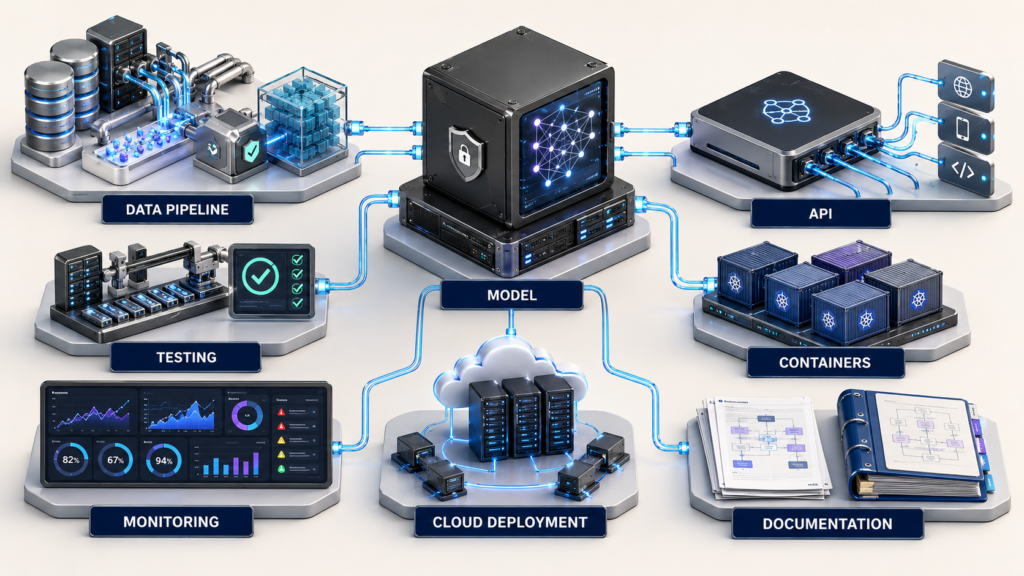
An AI engineer career roadmap provides clarity on the exact operational responsibilities required to succeed in modern production environments. Unlike research scientists who focus on mathematical theory or training foundational models from scratch, AI engineers specialize in integrating, optimizing, and deploying AI models—especially Large Language Models (LLMs)—into real-world systems.
Core Responsibilities
An actionable AI engineer career roadmap focuses on mastering these core responsibilities:
- Designing Agentic Systems & RAG Pipelines: Building context-aware workflows, Retrieval-Augmented Generation (RAG) architectures, and multi-agent systems to solve specific business problems.
- Integrating Top-Tier LLM APIs: Seamlessly connecting software applications with API endpoints (OpenAI, Anthropic, Google Gemini, Hugging Face) and local models (Ollama, vLLM).
- Optimizing Model Inference: Balancing system performance by tuning latency, compute cost, rate limits, and response reliability.
- Implementing Evaluation & Observability: Deploying evaluation frameworks (e.g., Ragas, TruLens) along with logging and tracing tools (e.g., LangSmith, Phoenix) to track system performance.
- Cross-Functional Collaboration: Partnering with product management, UX design, backend infrastructure, and security teams to ship production-ready features.
Industry Demand & Compensation
Following a structured AI engineer career roadmap leads to one of the most lucrative and high-demand tech specializations. Compensation ranges reflect this market demand:
| Experience Level | US Base Salary Range | Typical Total Compensation |
| Entry-Level (0–2 yrs) | $100,000 – $135,000 | $120,000 – $160,000 |
| Mid-Level (2–5 yrs) | $140,000 – $185,000 | $180,000 – $260,000 |
| Senior Level (5+ yrs) | $180,000 – $250,000+ | $280,000 – $400,000+ |
(Note: Total compensation figures include base pay, annual performance bonuses, and equity grants common in tech markets like San Francisco, New York, and Seattle.)
How Long Does It Take to Become an AI Engineer?

How long it takes to execute an AI engineer career roadmap depends directly on your starting technical baseline and weekly time commitment.
Realistic Timelines by Background
| Starting Background | Estimated Timeline | Core Focus Areas |
| Complete Beginner (No programming) | 8–12 months | Master Python, basic data structures, Git, and REST APIs before advancing to LLM orchestrations. |
| Technical / Analytics (SQL, Data Analysts) | 5–8 months | Transition from analytical queries to production Python, object-oriented design, and RAG architectures. |
| Software Engineer (Backend/Full-Stack) | 3–6 months | Bypass core software engineering patterns; focus entirely on LLMs, vector search, RAG pipelines, and MLOps. |
Time Commitment & Pace Strategy
- Part-Time Execution (10–15 hours/week): Most working professionals complete a production-ready AI engineer career roadmap in 5 to 8 months.
- Full-Time Intensive (30–40 hours/week): Dedicated builders or boot-camp learners can compress the roadmap into 3 to 4 months.
- The Implementation Rule: Compressing your learning timeline relies on project-based execution—building, deploying, and evaluating real apps from day one rather than passively consuming video tutorials.
For a detailed walkthrough on structuring a 6-month timeline to production readiness, check out the 6-Month Roadmap to Become an AI Engineer guide. The video above breaks down a realistic month-by-month framework from foundations to deploying agentic AI systems.
Phase 1: Python and Developer Foundations (2–3 Months)
Phase 1 of this AI engineer career roadmap focuses on building production-grade software engineering habits before touching complex LLM frameworks or model architectures. AI engineering is fundamentally software engineering with a probabilistic component—without clean code, modular design, and robust version control, AI systems quickly fail in production.
Core Technical Competencies
| Competency Area | Essential Skills & Concepts | Target Tooling |
| Python Engineering | Object-Oriented Programming (OOP), asynchronous execution (asyncio), decorators, type hinting, unit testing | Python 3.11+, Poetry/UV, Pytest |
| Data Processing | Vectorized computation, memory-efficient array handling, tabular transformations | NumPy, Pandas, Polars |
| Developer Workflow | Shell scripting, version control, feature branching, interactive debugging | Bash/Zsh, Git, GitHub |
| Applied Mathematics | Matrix operations, dot products, vector spaces, probability distributions, gradient descent mechanics | Linear Algebra, Statistics, Calculus |
Practical Portfolio Projects
To validate Phase 1 of your AI engineer career roadmap, execute three concrete build projects:
- Automated Data Pipeline: Build a Python script that ingests, validates, and transforms raw CSV/JSON datasets using Pandas with explicit error handling, structured logging, and automated execution.
- Production CLI Tool: Build an interactive Command Line Interface (such as an automated system utility or custom API consumer) using
argparseorClick, adhering to standard modular file layouts. - Open-Source Contribution: Fork an open-source Python repository on GitHub, implement a bug fix or modular utility, write unit tests with
Pytest, and submit a pull request adhering to production Git workflows.
High-Signal Resources
- Python & Software Design: Python for Everybody (syntax fundamentals); Fluent Python by Luciano Ramalho (advanced OOP, async, and idiomatic patterns).
- Mathematical Intuition: 3Blue1Brown (Essence of Linear Algebra) and Khan Academy for applied probability and calculus refreshers.
- Developer Workflows: Official Git Documentation and Real Python guides for virtual environments, package distribution, and production debugging.
Phase 2: Machine Learning and Deep Learning Core (3–4 Months)
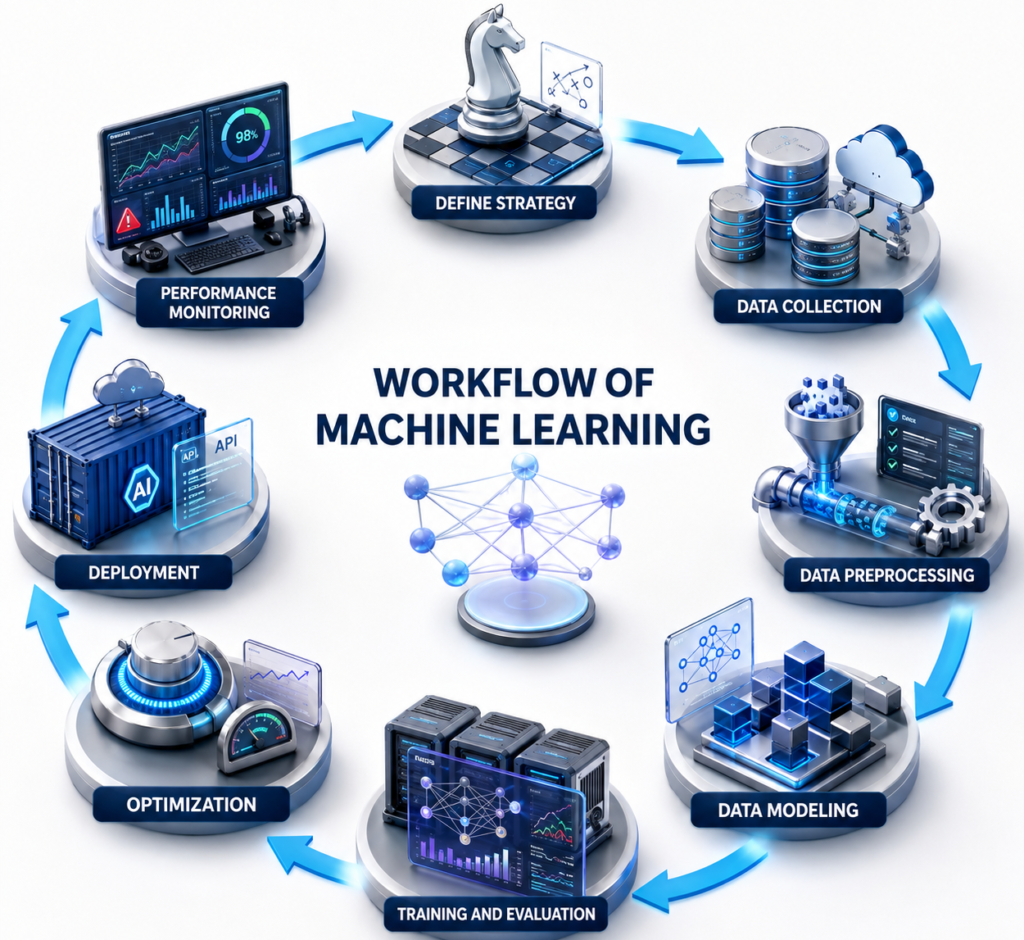
Phase 2 of this AI engineer career roadmap shifts focus toward core machine learning principles and deep learning architectures. Understanding how models learn, generalize, and optimize loss functions is essential for debugging non-deterministic AI systems and fine-tuning modern models.
Core Technical Competencies
| Domain | Essential Concepts | Target Tooling |
| Supervised Learning | Linear/Logistic Regression, Decision Trees, Gradient Boosting, Precision/Recall, ROC-AUC | Scikit-Learn, XGBoost, LightGBM |
| Unsupervised Learning | K-Means clustering, Principal Component Analysis (PCA), dimensionality reduction | Scikit-Learn |
| Deep Learning | Backpropagation, stochastic gradient descent (SGD), activation functions (ReLU, Softmax), loss functions | PyTorch, TensorBoard |
| Neural Network Architecture | Multi-Layer Perceptrons (MLP), Convolutional Networks (CNN), Attention mechanisms, Transformers | PyTorch, Hugging Face Transformers |
Practical Portfolio Projects
To demonstrate mastery in this stage of your AI engineer career roadmap, complete these three targeted builds:
- End-to-End Classification Pipeline: Build a spam detection or fraud prevention engine using Scikit-Learn or XGBoost, complete with feature scaling, cross-validation, and an exported model file (
pickle/ONNX). - PyTorch Image Classifier: Train a custom deep neural network or fine-tune a pre-trained model (ResNet or Vision Transformer) on datasets like CIFAR-10, logging loss curves and evaluation metrics via TensorBoard.
- Kaggle Competition & Reproducible Notebook: Participate in a structured tabular or vision Kaggle challenge. Document data preprocessing, hyperparameter optimization, and validation strategies in a clean, reproducible Jupyter notebook.
High-Signal Resources
- Theoretical Foundation: Andrew Ng’s Machine Learning Specialization (Coursera) for core ML intuition.
- Practical Deep Learning: Practical Deep Learning for Coders by fast.ai for a top-down, code-first approach to neural networks.
- Framework Mastery: Official PyTorch tutorials and DeepLearning.AI’s Deep Learning Specialization.
Phase 3: LLMs, Prompt Engineering, and APIs (2–3 Months)
Phase 3 of this AI engineer career roadmap pivots into modern generative AI architecture. Here, you shift from training models from scratch to leveraging frontier Large Language Models (LLMs) via APIs, managing context windows, engineering structured prompts, and orchestrating Retrieval-Augmented Generation (RAG) and agentic workflows.
Core Technical Competencies
| Domain | Essential Concepts | Target Tooling |
| LLM Fundamentals & APIs | Context management, tokenization mechanics, function calling / tool use, system instruction design | OpenAI API, Anthropic SDK, Google Gemini API, Ollama (Local) |
| Prompt & Structural Control | Few-shot prompting, Chain-of-Thought (CoT), Pydantic structured output validation, JSON mode enforcement | Instructor, Pydantic, Guidance |
| Vector Search & RAG Foundations | Text embeddings, chunking strategies (semantic, recursive), vector indexing, cosine similarity vs. dot product | Pinecone, Qdrant, ChromaDB, FAISS |
| Orchestration & Agents | Directed state graphs, document indexing pipelines, multi-tool agentic loops, state persistence | LangGraph, LlamaIndex, CrewAI |
Practical Portfolio Projects
To validate Phase 3 of your AI engineer career roadmap, build these three real-world applications:
- Production Knowledge-Base RAG Pipeline: Build an enterprise document Q&A engine that ingests unstructured PDFs, converts content into vector embeddings, stores them in Pinecone or Qdrant, and performs hybrid search (sparse + dense) with re-ranking before synthesizing answers via an LLM.
- Structured Data Extraction Agent: Build a tool-using AI agent using LangGraph or CrewAI that accepts messy unstructured text (like receipts or resume PDFs), executes function calls, and returns clean, validated JSON schemas using Pydantic.
- FastAPI Microservice for LLM Inferencing: Wrap your RAG pipeline or agentic workflow inside an asynchronous FastAPI backend complete with stream handling (
Server-Sent Events), token usage tracking, and automated error handling.
High-Signal Resources
- Documentation & Official SDKs: OpenAI and Anthropic official developer guides for function calling and prompt optimization strategies.
- Framework Tutorials: DeepLearning.AI’s courses on LangGraph, LlamaIndex, and Building Systems with the ChatGPT API.
- Open Source Frameworks: LangChain/LangGraph documentation for cyclic agent architectures and LlamaIndex guides for enterprise data parsing.
Phase 4: Production RAG Systems (2–3 Months)
Phase 4 of this AI engineer career roadmap shifts from prototype builds to production-grade Retrieval-Augmented Generation (RAG). While basic naive RAG relies on simple vector similarity, production RAG requires multi-stage retrieval, document-structure-aware chunking, hybrid search, and rigorous automated evaluation loops.
Core Technical Competencies
| Domain | Essential Concepts | Target Tooling |
| Advanced Chunking Strategy | Document-structure chunking, contextual chunk injection (Anthropic pattern), late chunking | Unstructured, LlamaIndex Parsers, LangChain |
| Hybrid Retrieval & Reranking | Dense vector search + Sparse keyword search (BM25), Reciprocal Rank Fusion (RRF), Cross-Encoder reranking | Pinecone, Qdrant, BM25, Cohere Rerank, BGE-Reranker |
| Query Optimization | Query rewriting, sub-query decomposition, hypothetical document embeddings (HyDE) | LangGraph, LlamaIndex, Instructor |
| Automated Evaluation & Evals | Reference-free LLM-as-a-Judge, Groundedness, Faithfulness, Context Precision & Recall | RAGAS, TruLens, DeepEval, Phoenix |
Practical Portfolio Projects
To validate Phase 4 of your AI engineer career roadmap, construct these two advanced engineering projects:
- Enterprise Hybrid RAG System with Reranking: Build a production Q&A pipeline over complex, unstructured PDFs (such as financial reports or internal documentation). Combine dense vector search with sparse BM25 keyword matching via Reciprocal Rank Fusion (RRF) and pass the candidates through a Cross-Encoder reranker to maximize precision.
- RAG Evaluation Harness & CI/CD Pipeline: Implement an automated evals test suite using RAGAS or TruLens. Programmatically score your RAG app against a benchmark dataset across faithfulness, context precision, and answer relevance, blocking automated deployments if faithfulness drops below set baseline thresholds.
High-Signal Resources
- Framework Documentation: LlamaIndex Production RAG guides and LangChain Advanced Retrieval Strategies.
- Evaluation Frameworks: Official documentation for RAGAS and TruLens for setting up reference-free evaluation pipelines.
- Research & Architecture: Anthropic’s research guides on Contextual Retrieval and Microsoft’s GraphRAG whitepapers.
Phase 5: AI Agents and Advanced Workflows (2–3 Months)
Phase 5 of this AI engineer career roadmap addresses the transition from passive text generation to dynamic execution environments. While traditional RAG systems passively query knowledge bases, autonomous AI agents combine tool execution, persistent state management, multi-step planning loops, and multi-agent delegation.
Core Technical Competencies
| Domain | Essential Concepts | Target Tooling |
| Agentic Loop Architectures | ReAct (Reasoning + Acting), Plan-and-Solve, State Machine graphs, Reflection & Self-Correction loops | LangGraph, OpenAI Agents SDK, CrewAI |
| Tool Orchestration Protocol | Model Context Protocol (MCP), schema-enforced tool calling, Pydantic tool definitions | FastMCP, Anthropic SDK, Pydantic |
| Memory Structures | Working memory (in-context), Episodic/Semantic vector memory, Procedural memory execution rules | Redis, Qdrant, Mem0, LangGraph Checkpointers |
| Multi-Agent Coordination | Supervisor routing patterns, Hierarchical delegation, Parallel specialized agents, Shared State schemas | LangGraph, CrewAI, AutoGen / AG2 |
| Guardrails & Execution Control | Human-in-the-Loop (HITL) approval gates, Deterministic state pauses, Tool execution sandboxing | Guardrails AI, NeMo Guardrails, LangChain |
Practical Portfolio Projects
To validate Phase 5 of your AI engineer career roadmap, execute these two production-grade agent builds:
- Autonomous Research & Fact-Checking Multi-Agent System: Build a supervisor-directed graph using LangGraph. A primary supervisor agent receives research tasks, routes execution to a specialized web-scraping agent (via Tavily or Playwright APIs), transfers state to a drafting agent, and routes to a critique/reflection agent to evaluate outputs before finalizing.
- Enterprise Support Agent with Tool Calling & HITL: Construct an automated order support agent capable of checking order databases, calculating refunds, and writing back to an API. Implement Pydantic schema validation for tool calls and configure a Human-in-the-Loop interrupt gate requiring human approval before executing sensitive financial actions (like issuing refunds over a specific threshold).
High-Signal Resources
- Framework Documentation: Official LangGraph Guides (State Management, Checkpointing, and Time Travel Debugging) and Model Context Protocol (MCP) documentation.
- Multi-Agent Architecture: CrewAI Production Orchestration guidelines and OpenAI Agents SDK handoff specs.
- Research Papers: ReAct: Synergizing Reasoning and Acting in Language Models (Yao et al.) and Reflexion: Language Agents with Verbal Reinforcement Learning (Shinn et al.).
Phase 6: MLOps and Production Deployment (2–3 Months)
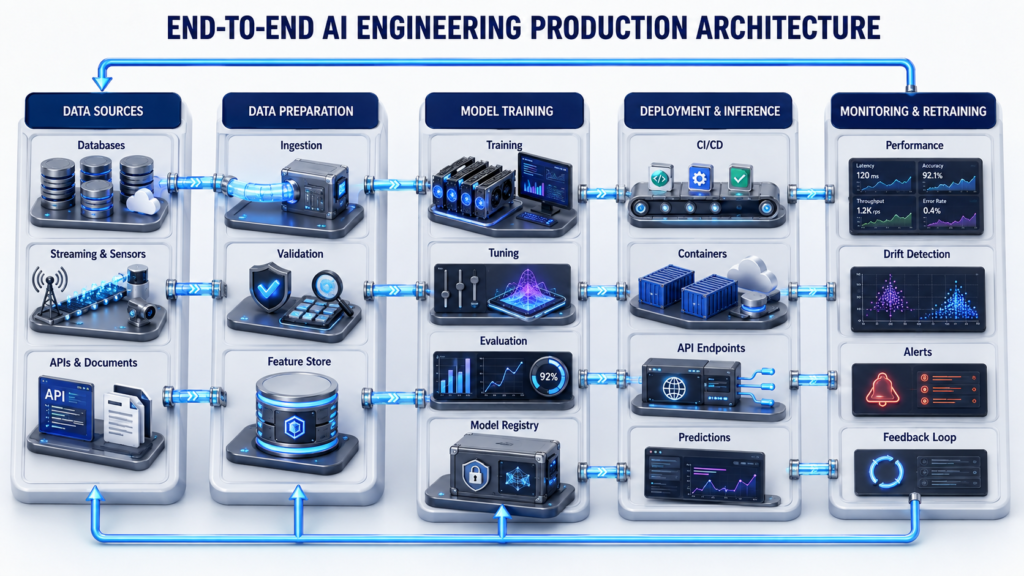
Phase 6 of this AI engineer career roadmap focuses on MLOps (Machine Learning Operations), LLMOps, and production deployment. Building a prototype in a local environment is vastly different from serving non-deterministic AI models at scale. This stage equips you with the infrastructure, automation, and observability tooling necessary to ship reliable, cost-efficient, and secure AI systems.
Core Technical Competencies
| Domain | Essential Concepts | Target Tooling |
| Model Serving & API Design | Asynchronous API endpoints, streaming responses (SSE), batch inferencing, request throttling | FastAPI, Uvicorn, vLLM, Modal, AWS Lambda |
| Containerization & Orchestration | Multi-stage Docker builds, dependency isolation, production environment variables, autoscaling | Docker, Docker Compose, Kubernetes, Helm |
| Experiment Tracking & Registry | Model artifact versioning, prompt tracking, data lineage, experiment logging | MLflow, Weights & Biases (W&B Weave), DVC |
| CI/CD for AI Systems | Automated unit/integration testing, model evaluation gates, staging-to-production promotion | GitHub Actions, GitOps, Argo Workflows |
| Observability & Guardrails | Data and prediction drift detection, token-cost tracking, latency monitoring, real-time fallback routing | Arize Phoenix, Prometheus, Grafana, OpenTelemetry |
Practical Portfolio Projects
To demonstrate production-grade execution in this stage of your AI engineer career roadmap, build these two infrastructure-focused projects:
- Containerized FastAPI Inference Engine with Automated CI/CD: Containerize an asynchronous LLM or custom ML inference API using multi-stage Docker builds. Configure a GitHub Actions pipeline that runs automated linting, unit tests, and prompt evaluation suites on every push before deploying to a container registry or cloud app platform (e.g., AWS App Runner, GCP Cloud Run, or Render).
- Production Observability & Drift Monitoring Dashboard: Deploy an end-to-end telemetry pipeline using OpenTelemetry and Arize Phoenix or Grafana. Log real-time model metrics—including P95/P99 latency, token consumption costs, input/output drift, and guardrail violations—and build an automated alerting system that triggers fallbacks when error rates exceed defined Service Level Objectives (SLOs).
High-Signal Resources
- Containerization & API Infrastructure: Official Docker, FastAPI, and Kubernetes developer documentation.
- MLOps & LLMOps Frameworks: Coursera MLOps Specialization by DeepLearning.AI and official documentation for MLflow, DVC, and Weights & Biases.
- Cloud Platform Engineering: AWS SageMaker, Google Vertex AI, or Azure ML production deployment guides.
Phase 7: Portfolio and Job Readiness (1–2 Months)
Phase 7 of this AI engineer career roadmap focuses on translating your technical capabilities into a compelling, market-ready signal. Modern hiring managers in 2026 filter for candidates who demonstrate production engineering discipline—clean code architecture, trade-off analysis, automated evaluations, and deployed systems.
Core Technical Competencies & Hiring Criteria
| Evaluation Area | What Production Teams Look For | High-Signal Deliverables |
| Engineering Rigor | Modular Python, type hinting (Pydantic), unit testing (Pytest), clean Git commit history. | Open-source repos with standard directory layouts and passing CI/CD badges. |
| Production Architecture | Asynchronous APIs (FastAPI), containerization (Docker), observability (OpenTelemetry/Phoenix). | Deployed, publicly accessible microservices hosted on AWS, GCP, or Render. |
| System Evaluation | Moving beyond “vibes-based” testing; measuring accuracy, latency, and cost with formal benchmarks. | RAGAS or TruLens evaluation logs embedded directly into repo documentation. |
| Trade-Off Communication | Ability to defend choices between RAG vs. fine-tuning, vector indexes, or model sizing. | System architecture diagrams and technical write-ups detailing failure modes. |
The 3-Project Production Portfolio Strategy
To optimize your AI engineer career roadmap execution, build 3 deep, production-grade systems:
┌─────────────────────────────────────────────────────────────────────────────┐
│                       PORTFOLIO REPOSITORY LAYOUT                           │
├─────────────────────────────────────────────────────────────────────────────┤
│ ├── .github/workflows/    ──> Automated Linting, Pytest & Eval Pipelines     │
│ ├── src/                                                                    │
│ │   ├── core/             ──> Pydantic Schemas & State Graphs               │
│ │   ├── services/         ──> Vector DB Retrieval & Tool Orchestration      │
│ │   └── api/              ──> Asynchronous FastAPI Endpoint Routing         │
│ ├── tests/                ──> Integration Tests & RAGAS Benchmarks          │
│ ├── Dockerfile            ──> Multi-stage Production Container Build        │
│ └── README.md             ──> System Architecture Diagram & Demo Link       │
└─────────────────────────────────────────────────────────────────────────────┘
Code language: PHP (php)- Enterprise Hybrid RAG System: Features multi-format ingestion, sparse (BM25) + dense vector retrieval, cross-encoder reranking, and an automated evaluation dashboard tracking faithfulness and context recall.
- Autonomous Multi-Agent System with Guardrails: A supervisor-directed agentic graph (using LangGraph) with schema-validated tool execution, Human-in-the-Loop approval gates, and Model Context Protocol (MCP) tool integration.
- MLOps & Inference Service Pipeline: A fine-tuned open model (e.g., Llama/Qwen via Unsloth/vLLM) served as an asynchronous FastAPI endpoint, deployed with Docker, GitHub Actions CI/CD, and real-time telemetry tracking latency, token usage, and drift.
GitHub Profile & README Architecture
To maximize impact when recruiters review your AI engineer career roadmap execution, every pinned repository must follow a standardized structure:
- The 1-Paragraph Problem Statement: Clearly state the real-world business case and target metric (e.g., “Reduces document retrieval latency by 40% while maintaining 90%+ answer faithfulness”).
- System Architecture Diagram: Include a clear ASCII or visual sequence flow mapping data ingestion, embedding models, vector stores, LLM endpoints, and output validation.
- Live Demo & Benchmark Metrics: Link to a live deployment (Hosted on Hugging Face Spaces, Render, or Vercel) alongside explicit evaluation tables (latency, token costs, evaluation scores).
- Quickstart Commands: Provide exact, single-line commands to run the application locally via Docker (
docker-compose up).
Technical Interview Preparation
The final stage of the AI engineer career roadmap involves mastering three distinct interview formats:
- System Design (GenAI & MLOps): Practice architecting scalable AI applications under latency, budget, and context constraints (e.g., “Design an enterprise AI customer service system processing 10,000 queries/minute”). Focus on retrieval mechanisms, fallback loops, caching (Redis/semantic cache), and rate limiting.
- LLM & Core ML Fundamentals: Be prepared to explain trade-offs from first principles—such as Self-Attention mechanisms ($Q, K, V$ matrices), Tokenization mechanics (BPE), Prompting vs. RAG vs. Fine-tuning, and Quantization strategies (GGUF, AWQ, FP8).
- Live Coding & Code Review: Expect hands-on exercises involving parsing raw API responses, implementing custom vector search operations, building a LangGraph state loop, or writing a PyTorch training loop from scratch.
Summary: 6–12 Month Visual Timeline
| Month | Phase Focus | Key Deliverable / Milestone |
| Months 1–2 | Python & Dev Foundations | Modular CLI utility, raw data pipeline, unit tests, Git workflows. |
| Months 3–4 | ML & Deep Learning Core | Custom PyTorch model classifier, Scikit-Learn pipeline, Kaggle submission. |
| Months 5–6 | LLMs, Prompting & APIs | Production-grade structured output agent using Pydantic and LLM APIs. |
| Months 7–8 | Production RAG Systems | Hybrid search RAG engine with Cross-Encoder reranking & RAGAS evals. |
| Months 9–10 | Autonomous AI Agents | Multi-agent state graph with Human-in-the-Loop execution guards. |
| Month 11 | MLOps & Cloud Deployment | Containerized FastAPI inference microservice with automated GitHub Actions CI/CD. |
| Month 12 | Portfolio & Interview Prep | 3 pinned GitHub repos with architecture diagrams, live demos, and technical system design practice. |
Essential AI Engineer Skills Checklist
An Essential AI Engineer Skills Checklist outlines the operational competencies required by hiring teams in 2026. The field has evolved from experimental modeling toward distributed software engineering with probabilistic components—meaning skills like asynchronous execution, protocol standardization, evaluation metrics, and guardrail enforcement carry equal weight alongside classical ML foundations.
Technical Competencies & Tooling
| Competency Area | Baseline Essentials | Advanced Production Skills | Target Tooling & Ecosystem |
| Programming & Systems | Python (OOP, data structures), basic JS/TS for web UIs | Asynchronous execution (asyncio), concurrency, low-latency streaming | Python 3.11+, TypeScript, Pytest, httpx, UV/Poetry |
| Generative AI & LLMs | Prompt design, API integrations, structured JSON outputs | Multi-provider abstraction routing, Model Context Protocol (MCP), caching | OpenAI API, Anthropic Claude SDK, LiteLLM, FastMCP |
| RAG & Vector Search | Simple dense embeddings, basic vector similarity search | Hybrid search (sparse + dense), reranking, contextual chunking, evaluation | Pinecone, Qdrant, ChromaDB, Cohere Rerank, BM25 |
| Agent Architectures | Simple tool-calling loops, basic conversational memory | State graph orchestration, Human-in-the-Loop (HITL) gates, multi-agent systems | LangGraph, CrewAI, AutoGen / AG2, Pydantic AI |
| Deployment & APIs | RESTful routing, Flask or basic web microservices | Asynchronous streaming endpoints (SSE), multi-stage containers, cloud scaling | FastAPI, Docker, Kubernetes, AWS SageMaker, GCP Cloud Run |
| MLOps & Observability | Basic manual logging, model weight saving (pickle/h5) | Telemetry, LLM-as-a-Judge evals, drift tracking, CI/CD automated gates | Arize Phoenix, RAGAS, MLflow, GitHub Actions, OpenTelemetry |
Non-Technical & Strategic Execution Skills
- Trade-off & Cost Analysis: Selecting the correct tool for the job—knowing when to use a fast, inexpensive model vs. a heavy reasoning model, or choosing between RAG vs. Fine-Tuning.
- Structured Problem Decomposition: Breaking down complex business problems into modular pipelines, agentic state graphs, or deterministic software loops.
- System Reliability & Guardrails: Designing defensive error handling for non-deterministic model failures, API rate limits, and output format parsing.
- AI Safety & Governance: Implementing PII masking, prompt injection defenses, audit logging, and adhering to compliance standards (e.g., EU AI Act).
Common Mistakes to Avoid
Executing an AI engineer career roadmap requires navigating common pitfalls that separate junior builders from production-grade engineers. Avoiding these critical mistakes will save months of wasted effort and position your portfolio ahead of standard tutorial-driven applicants.
Critical Pitfalls & Mitigation Strategies
| Common Mistake | Root Impact | How to Correct It |
| 1. Skipping Software Engineering Foundations | Jumping straight into high-level LLM orchestrators without solid Python OOP, async patterns, or data structures creates brittle codebases that fail in production. | Complete Phases 1 & 2 of your AI engineer career roadmap thoroughly. Master asynchronous execution (asyncio), design patterns, and unit testing before importing agent frameworks. |
| 2. Building Generic Tutorial Clones | Copying standard YouTube or bootcamp projects (e.g., a basic PDF chat app using default LangChain scripts) signals low technical depth to hiring managers. | Solve real problems. Ingest unique or unformatted data sources, implement custom hybrid retrieval engines, add Pydantic schema validation, and publish live, accessible demos. |
| 3. Stopping at Jupyter Notebooks (No MLOps) | A model or agent trapped in a notebook .ipynb file is not a software product. Engineering teams hire for serving, latency, containerization, and API stability. | Wrap every system inside an asynchronous FastAPI backend, package it with Docker, and configure an automated GitHub Actions CI/CD pipeline for cloud deployment. |
| 4. Relying on “Vibes-Based” Testing (No Evals) | Manually testing LLM outputs with 5 sample prompts fails to capture regressions, hallucinations, or edge-case breakages when prompts change. | Implement formal automated evaluation frameworks (RAGAS, TruLens, or DeepEval). Establish automated evaluation pipelines that track faithfulness, precision, and recall metrics. |
| 5. Neglecting Systems Communication & Soft Skills | AI engineers do not operate in a vacuum—they translate complex, probabilistic model behaviors into business metrics for product managers, security teams, and executive leaders. | Practice writing clear technical documentation, system architecture breakdown write-ups, and trade-off analysis essays explaining cost vs. latency vs. model accuracy. |
An AI engineer career roadmap is ultimately a blueprint for software engineering discipline applied to non-deterministic systems. Focus on building real-world software, measuring system accuracy programmatically, and deploying production services.
AI Engineer Career Paths and Specialisations
Once you execute the core AI engineer career roadmap, you can specialize based on your background, technical interests, and career goals. Specialization allows you to command higher compensation and target specific production problems.
Core Specialization Breakdown
| Specialization Path | Primary Focus & Core Objective | Key Tooling & Stack | Target Compensation (US Base / TC) |
| LLM Application Engineer | Building customer-facing AI products, multi-agent systems, advanced RAG, and prompt orchestration. | LangGraph, LlamaIndex, Qdrant, OpenAI/Anthropic APIs, Pydantic, FastAPI. | $140K – $220K+ |
| MLOps Engineer | Deployment automation, CI/CD pipelines, model monitoring, fallback routing, and cost/latency scaling. | Docker, Kubernetes, MLflow, Weights & Biases, Arize Phoenix, GitHub Actions. | $150K – $240K+ |
| AI Infrastructure Engineer | Building compute clusters, optimizing model serving/inference, distributed training, and hardware acceleration. | vLLM, TensorRT-LLM, Ray, Triton Inference Server, CUDA, AWS/GCP. | $180K – $300K+ |
| Applied AI Researcher | Bridging theoretical research and product engineering; fine-tuning models, RLHF/DPO, and custom domain architectures. | PyTorch, Hugging Face Transformers, Unsloth, DeepSpeed, Axolotl. | $170K – $280K+ |
| AI Product Manager | Defining AI product strategy, evaluating model trade-offs (cost vs. latency vs. accuracy), and leading cross-functional teams. | Product Analytics, RAGAS/Evals frameworks, Jira, System Architecture, Figma. | $135K – $220K+ |
Selecting Your Path
- If you come from Software Engineering or Web Development: Focus on LLM Application Engineer or MLOps Engineer to capitalize on your existing backend, API, and cloud deployment background.
- If you come from Systems, DevOps, or Cloud Infrastructure: Target AI Infrastructure Engineer to manage GPU clusters, low-latency inference runtimes, and distributed serving.
- If you come from Data Science, Math, or Academic Research: Transition into Applied AI Researcher or LLM Engineer to focus on model fine-tuning, domain adaptation, and evaluation frameworks.
- If you come from Product, UX, or Business Strategy: Choose AI Product Manager to translate business goals into technical requirements and manage the probabilistic nature of GenAI applications.
Do I need a degree to become an AI engineer?
No, a formal computer science or software engineering degree is not strictly required. While a relevant degree can provide a solid foundation, hiring teams in 2026 prioritize demonstrated software engineering capability, portfolio projects, and production deployments over credentials.
Candidates transitioning from backend development, data analysis, or self-taught paths successfully break into the role by demonstrating hands-on proficiency with tools like Python, vector databases, LangGraph, and MLOps frameworks.
What’s the difference between an AI engineer and a data scientist?
Data Scientists focus on statistical modeling, exploratory data analysis, hypothesis testing, and deriving strategic business insights from data.
AI Engineers focus on software engineering and application development—integrating pre-trained LLMs, building Retrieval-Augmented Generation (RAG) pipelines, creating autonomous agents, and serving low-latency models in production systems.
Should I learn PyTorch or TensorFlow?
Start with PyTorch. PyTorch is the industry standard for modern generative AI, transformer architectures, Hugging Face models, and AI research. While TensorFlow remains active in legacy enterprise production environments, PyTorch offers better ecosystem integration for LLMs, agentic frameworks, and fine-tuning tools.
How important is mathematics for AI engineering?
You need a practical understanding of linear algebra (vectors, matrices, dot products), probability/statistics, and basic calculus (gradients, optimization) to understand embeddings, loss functions, and evaluation metrics.
However, you do not need a PhD or advanced theoretical math for the majority of AI engineering roles. The day-to-day focus is primarily on software architecture, API design, and system orchestration.
What’s the best way to stay updated in AI?
Official Technical Blogs: Follow developer blogs from Anthropic, OpenAI, Google DeepMind, Meta AI, and Hugging Face.
Open-Source Repositories: Monitor release notes and architectural changes in core frameworks like LangGraph, LlamaIndex, vLLM, and Qdrant.
Engineering Newsletters & Communities: Subscribe to curated, high-signal technical newsletters (e.g., Import AI, The Batch by DeepLearning.AI, Latent Space) and participate in MLOps/AI Discord communities.
First-Principles Focus: Avoid chasing every fleeting wrapper tool—focus on fundamental architecture patterns like vector search, agent loops, state management, and evaluation frameworks.
In Conclusion
The journey to becoming a production-grade AI engineer requires a disciplined execution strategy—moving systematically from foundational programming patterns through modern LLM orchestrations, agentic workflows, and cloud-native MLOps.
Following this AI engineer career roadmap provides the exact structured framework needed to acquire high-leverage skills, build portfolio-worthy software systems, and land high-paying tech roles.
Final Action Plan
To execute this AI engineer career roadmap effectively:
- Commit to Phase 1 Today: Set up a clean local Python 3.11+ environment, master fundamental Git and GitHub workflows, and construct a modular data processing pipeline.
- Build for Depth Over Breadth: Avoid cloning simple tutorial wrappers. Ensure every major project incorporates structured data validation (
Pydantic), asynchronous APIs (FastAPI), vector search indexing, and containerized deployment (Docker). - Measure and Observe: Move beyond manual output testing. Implement reference-free evaluation metrics (
RAGAS/TruLens) and end-to-end telemetry (Arize Phoenix/OpenTelemetry) to demonstrate true production awareness. - Publish Your Progress: Document your system architecture diagrams, publish live working demos, and open-source clean, well-tested code repositories on GitHub.
By executing each stage of this AI engineer career roadmap step-by-step, you will bridge the gap between experimental prototyping and enterprise production—positioning yourself for top-tier opportunities in the rapidly expanding AI ecosystem.