How to Learn Machine Learning: A Beginner’s Guide
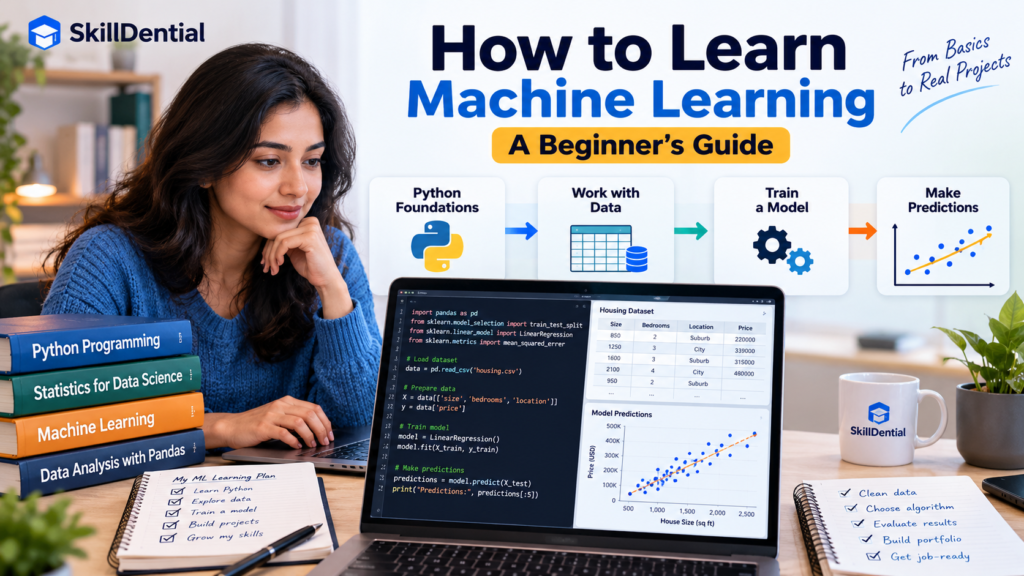
Learning machine learning starts with understanding how computers use data to identify patterns and make predictions. You do not need to master advanced mathematics or become an expert programmer before beginning. If you are exploring how to learn machine learning effectively, the key is to start with Python and basic statistics, learn how core algorithms operate, practice preparing datasets, and build simple models.
With consistent practice, you can transform these foundational concepts into practical, job-relevant portfolio projects. Machine learning is a critical branch of artificial intelligence, powering real-world applications like fraud detection, personal recommendations, demand forecasting, image recognition, and natural language processing.
However, mastering it requires more than passively watching tutorials or memorizing algorithms. True proficiency demands learning how to frame business problems, clean and prepare data, rigorously evaluate model output, and communicate actionable insights.
Whether you are an aspiring data analyst, data scientist, machine learning engineer, software developer, student, or business professional looking to future-proof your career, this step-by-step guide provides a structured, practical roadmap on how to learn machine learning from scratch and apply it to real-world challenges.
What Is Machine Learning?
Machine learning (ML) is a subfield of artificial intelligence focused on building systems that learn patterns from data and use those patterns to make predictions, classifications, or decisions without requiring every rule to be explicitly hard-coded.
Consider an online retailer that wants to predict which products a customer is most likely to purchase. Instead of writing manual rules for every customer segment, a data team trains a machine learning model on historical transaction data. The model identifies statistical relationships and applies them to estimate outcomes for new, unseen cases.
However, a model’s prediction is never infallible. Its reliability depends on several critical factors:
- Data Quality: Clean, accurate, and unbiased input data.
- Representativeness: Whether the training examples reflect real-world scenarios.
- Algorithm Selection: Choosing the right model architecture for the specific problem type.
- Rigorous Evaluation: Testing performance on unseen data to prevent overfitting.
Next Section Suggestion: Prerequisites & Reality Check
To keep the momentum going for your Skilldential guide, here is the next logical section addressing the biggest barrier to entry for beginners:
Do You Need Advanced Math to Learn Machine Learning?
One of the most common misconceptions holding beginners back from figuring out how to learn machine learning is the belief that they need a Ph.D. in mathematics or theoretical statistics before writing their first line of code.
The reality is nuanced:
- You do not need advanced math on day one. Modern libraries (like Scikit-Learn, TensorFlow, and PyTorch) abstract away complex calculus and linear algebra, allowing you to build functional models early.
- Applied math matters later. As you progress from building basic models to tuning performance, debugging underperformance, and deploying production systems, a working knowledge of linear algebra, multivariable calculus, and probability becomes essential.
The 80/20 Approach for Beginners:
- Programming Fundamentals: Master basic Python (control flow, data structures, functions).
- Core Data Libraries: Learn
pandasfor data manipulation andmatplotlib/seabornfor visualization. - Foundational Statistics: Understand mean, median, variance, standard deviation, and basic probability.
- Incremental Depth: Learn the mathematical theory behind algorithms as you use them, rather than studying math in a vacuum.
The Main Types of Machine Learning
Understanding the major learning paradigms is essential for structuring your study plan and selecting the right tools. Machine learning is broadly categorized into three core approaches:
| Learning Type | What It Does | Real-World Example |
| Supervised Learning | Learns from historical examples containing known target outcomes. | Predicting house prices based on square footage and location. |
| Unsupervised Learning | Identifies hidden structures and patterns in data without pre-supplied target labels. | Segmenting customers into clusters based on purchasing behavior. |
| Reinforcement Learning | Learns optimal actions through a system of trials, rewards, and penalties within an environment. | Training an AI agent to navigate a simulated environment or play a game. |
Deep Dive: Supervised Learning Subtypes
Because it forms the foundation of most commercial applications, supervised learning splits into two primary problem types:
- Regression: Predicts a continuous numerical value (e.g., forecasting monthly sales, predicting delivery times).
- Classification: Predicts a discrete category or class label (e.g., detecting whether an email is spam or a transaction is fraudulent).
Knowing these distinctions is critical because your problem type directly dictates your data requirements, the algorithm architectures you select, and the evaluation metrics you use to measure performance.
How to Learn Machine Learning Step by Step
The most efficient way to learn machine learning is to master the fundamentals in sequence and apply them immediately to small, clearly defined projects. You don’t need to learn every algorithm before building your first working model.
Step 1: Learn the Basics of Python
Python is the undisputed industry-standard first programming language for machine learning. Its dominance stems from an extensive, mature ecosystem of libraries dedicated to data manipulation, numerical computing, visualization, and model development.
Focus your initial learning on these core programming concepts:
- Variables and Data Types: Integers, floats, strings, and booleans.
- Data Structures: Lists, dictionaries, tuples, and sets.
- Control Flow: Conditional statements (
if/else) and loops (for/while). - Modular Code: Writing and using functions and reusable scripts.
- File Operations: Reading from and writing to files (e.g., CSVs, text files).
- Package Management: Importing and utilizing external libraries.
- Debugging: Basic error handling and troubleshooting syntax or runtime issues.
The Proficiency Benchmark
You do not need to become an advanced software engineer or master complex design patterns at this stage. Your goal is simply to write small scripts, manipulate data structures fluently, and understand the logic behind your code.
Recommended Resource
The official Python documentation offers a comprehensive beginner tutorial for individuals with basic programming familiarity. If you are entirely new to coding, supplement it with a structured introductory programming course.
Practical Challenge
Write a Python script that takes a list of numerical values, calculates their average, identifies the maximum value, and counts how many entries exceed a user-defined threshold.
Step 2: Build Your Mathematical and Statistical Foundations
You do not need a degree in mathematics to start building machine learning models. However, grasping core mathematical and statistical principles is what separates practitioners who blindly copy code from those who can actually debug models, tune performance, and make sound architectural decisions.
Focus your study on these four essential pillars:
- Linear Algebra: Vectors, matrices, and matrix multiplication (the fundamental language of data representation and model weights).
- Calculus: Derivatives, partial derivatives, and gradients (essential for understanding optimization algorithms like gradient descent).
- Statistics: Mean, median, variance, standard deviation, and distributions (crucial for data analysis, feature engineering, and evaluating results).
- Probability: Conditional probability and likelihood (foundational for classification tasks and probabilistic modeling).
The 80/20 Strategy
Do not pause your learning journey for months to study mathematics in a vacuum. Industry standards—such as Google’s Machine Learning Crash Course—advocate for studying mathematical concepts as you encounter them while building and experimenting with code.
Recommended Approach: Learn core programming first, then tackle mathematical concepts iteratively when you run into them during algorithm implementation.
Practical Challenge
Calculate the mean and median of a small dataset containing an outlier. Write a brief explanation analyzing how the unusually large value disproportionately skews the mean while leaving the median largely unaffected.
Step 3: Master Data Preparation and Cleaning
In machine learning, data preparation is not a secondary administrative chore—it is the core engine of model performance. The industry axiom “garbage in, garbage out” dictates that even the most advanced algorithm will fail if trained on dirty, biased, or poorly structured data.
Focus your data engineering workflow on these essential competencies:
- Data Ingestion: Loading datasets from formats like CSVs, Excel spreadsheets, and SQL databases.
- Exploratory Data Analysis (EDA): Inspecting rows, columns, data types, and summary statistics.
- Data Hygiene: Identifying and resolving missing values, duplicate entries, and anomalous outliers.
- Feature Transformation: Converting categorical variables into numerical formats and scaling features for model compatibility.
- Dataset Splitting: Separating your input feature matrix ($X$) from your target label ($y$).
The Essential Python Toolkit
- pandas: The industry-standard library for working with labeled, tabular data via DataFrames.
- NumPy: The foundational library powering high-performance numerical operations on multi-dimensional arrays.
Real-World Application
Consider a real estate dataset containing property size, bedroom count, location, and sale price. Before training any algorithm, you must clean missing records, standardize location strings into numerical categories, and verify that the sample size is statistically sufficient.
The Professional Standard
Never assume an online dataset is reliable simply because it is publicly available. Always audit data provenance—understand how the data was collected, what the columns represent, and whether potential biases make it suitable for your specific use case.
Step 4: Master Core Machine Learning Concepts
As you advance in how to learn machine learning, the next critical milestone—once you are comfortable handling data—is understanding how algorithms actually learn, evaluate performance, and make predictions.
Master these core concepts in sequence:
- Features: The input variables ($X$) that a model uses to evaluate patterns and make decisions.
- Target: The specific outcome label ($y$) that a supervised model is trained to predict.
- Training: The algorithmic process of fitting model parameters to historical data.
- Testing: Evaluating model performance on independent data withheld strictly from the training phase.
- Generalization: How effectively a trained model applies its rules to new, unseen real-world examples.
- Overfitting: When a model memorizes the noise and granular quirks of its training set rather than learning true underlying patterns, leading to poor real-world performance.
- Underfitting: When a model architecture is too simple or constrained to capture the actual signals in the data.
- Evaluation Metrics: Quantitative benchmarks (such as accuracy, precision, recall, or root mean squared error) used to judge objective model quality.
Why This Matters
Grasping these theoretical guardrails prevents a classic beginner trap: deploying a model that boasts 99% accuracy on its training set but fails catastrophically in production. Industry standards, such as Google’s machine learning curricula, emphasize generalization and overfitting as foundational pillars of effective practice.
Step 5: Train Your First Machine Learning Model
A crucial milestone when figuring out how to learn machine learning is transitioning from theoretical study to hands-on execution. You do not need to build a complex neural network or deep learning architecture for your first project. Instead, begin with a simple, interpretable model that solves a clear problem using industry-standard libraries like scikit-learn.
scikit-learn is the premier library for beginners and practitioners alike, offering consistent APIs for data preprocessing, model selection, training, and evaluation.
The following example demonstrates how to train a baseline classification model using a built-in dataset (the Iris flower dataset), eliminating the friction of finding and cleaning external files on day one:
Python
from sklearn.datasets import load_iris
from sklearn.model_selection import train_test_split
from sklearn.linear_model import LogisticRegression
from sklearn.metrics import accuracy_score

# Load a classic benchmark dataset
iris = load_iris()
X, y = iris.data, iris.target

# Split the data: reserve 20% for unseen testing
X_train, X_test, y_train, y_test = train_test_split(
    X, y, test_size=0.2, random_state=42, stratify=y
)

# Initialize and train a baseline logistic regression model
model = LogisticRegression(max_iter=1000)
model.fit(X_train, y_train)

# Evaluate performance on held-out test data
predictions = model.predict(X_test)
print("Accuracy:", accuracy_score(y_test, predictions))Code language: PHP (php)
What This Exercise Teaches You
- Data Separation: Why we split data into training and testing sets to prevent data leakage and evaluate real-world generalizability.
- Model Fitting: What happens under the hood when the
.fit()method optimizes parameters based on input features ($X$) and target labels ($y$). - Evaluation Limitations: What an accuracy score tells you—and what it obscures (e.g., class imbalance or misclassification patterns).
Step 6: Learn to Evaluate Models Properly
As you advance in how to learn machine learning, you will quickly realize that training a model is only half the battle. Determining whether its predictions are genuinely useful, robust, and reliable—rather than just memorized—is where professional competence is proven.
Never rely on a single metric. Different problem types demand different evaluation frameworks:
| Metric | Common Use | Important Limitation |
| Accuracy | Classification | Can be dangerously misleading when classes are heavily imbalanced. |
| Precision | Classification | Does not measure how many actual positive cases were missed (false negatives). |
| Recall | Classification | Does not measure how many predicted positive cases were false alarms (false positives). |
| F1-Score | Classification | Elegantly balances precision and recall, but does not capture domain-specific business costs. |
| Mean Absolute Error (MAE) | Regression | Treats all deviations equally; does not penalize unusually large errors disproportionately. |
Real-World Application: The Class Imbalance Trap
Consider a model built to identify fraudulent transactions. If only 0.1% of all transactions are fraudulent, a lazy baseline model that predicts “legitimate” for every single case achieves 99.9% accuracy while catching zero fraud. In this scenario, evaluating through precision, recall, and the real-world cost of false alarms is non-negotiable.
Critical Pitfalls to Master
- Cross-Validation: Moving beyond a single train-test split to ensure your performance metrics are consistent and robust across multiple data subsets.
- Data Leakage: A critical failure mode where information from outside the training dataset (or from the future) inadvertently leaks into model training, producing artificially inflated performance scores that collapse in production.
Industry Standard
Utilize
scikit-learnpipelines to chain preprocessing steps directly to your model training. This structural habit explicitly prevents data leakage during cross-validation and feature scaling.
Step 7: Build Practical Machine Learning Projects
A critical turning point in how to learn machine learning is transitioning from passive tutorials to active portfolio building. Real-world projects bridge the gap between theoretical knowledge and practical execution, giving you concrete artifacts to demonstrate competence to peers, clients, or employers.
Choose projects that you can explain from start to finish—from problem framing to production limitations. Focus on building these three foundational projects:
Project 1: House Price Prediction
- Level: Beginner
- Core Objective: Use property features (e.g., square footage, room count, location) to predict a continuous numerical sale price.
- Skills Practiced: Exploratory data analysis, data cleaning, regression modeling, error measurement (MAE/RMSE), and articulating model limitations.
Project 2: Spam Classification
- Level: Beginner to Intermediate
- Core Objective: Train a natural language or tabular model to classify text messages or emails as spam versus legitimate.
- Skills Practiced: Text tokenization or feature extraction, handling class imbalance, optimizing precision and recall, and analyzing the trade-offs of false positives.
Project 3: Customer Segmentation
- Level: Beginner to Intermediate
- Core Objective: Explore multi-dimensional customer data and apply unsupervised clustering algorithms to identify distinct demographic or behavioral groups.
- Skills Practiced: Unsupervised learning (e.g., K-Means), feature scaling, cluster interpretation, and recognizing why unsupervised outputs require domain validation.
The Professional Documentation Standard
A portfolio project is valuable only if it demonstrates your reasoning and problem-solving framework, not just your ability to execute a Jupyter notebook. For every project you build, document the following:
- The Problem Statement: What real-world challenge are you solving, and why does it matter?
- Data Provenance & Limitations: Where did the data originate, and what hidden biases or missing values exist?
- Data Hygiene & Preparation: The exact cleaning, transformation, and train-test splitting steps taken.
- Baseline Selection: Your initial model choice and the strategic rationale behind selecting it.
- Rigorous Evaluation: Which metrics you used, why you chose them, and what the final results actually reveal.
- Iterative Improvements: A transparent critique of what you would refine given better data, more compute, or advanced architectures.
Step 8: Build a Portfolio That Demonstrates Real-World Competence
Reaching the final stage of how to learn machine learning means packaging your practical projects into a professional portfolio. A collection of clean GitHub repositories is the industry standard for sharing code, architecture, and version history.
A professional portfolio item should never look like a raw, unorganized Jupyter notebook. Every project must feature a comprehensive README.md that outlines:
- The Business Problem: What challenge you solved and why it matters.
- Data Provenance: Where the dataset came from and its inherent limitations.
- Methodology: Your data cleaning, feature engineering, and model selection process.
- Evaluation Results: Objective metrics beyond simple accuracy, complete with failure analysis.
- Reproducibility: Clear instructions on how to set up the environment and run the code.
The Professional Mindset: Reasoning Over Raw Scores
Avoid the amateur trap of presenting a model’s 98% accuracy score as proof of absolute mastery. Hiring managers and experienced practitioners care less about the final number and more about how you approached the task, what assumptions you made, and whether you can articulate why a model succeeded or failed.
Tailor Your Portfolio to Your Target Role
- For Aspiring Machine Learning Engineers: Extend your notebooks into production-ready software engineering. Focus on version control (Git), unit testing, API deployment (e.g., FastAPI), containerization (Docker), and model monitoring.
- For Aspiring Data Scientists & Analysts: Focus heavily on data hygiene, exploratory data analysis, statistical reasoning, visual storytelling, and translating technical outputs into actionable business recommendations.
Free Resources to Learn Machine Learning
You can master the end-to-end workflow without investing in expensive courses or degrees. High-quality documentation and free interactive curricula provide everything required to move from absolute beginner to industry practitioner.
When evaluating resources, compare them by their teaching structure, technical prerequisites, code execution environment, and emphasis on practical projects.
| Resource | Best For | Practical Approach | Key Prerequisites |
| Google Machine Learning Crash Course | Structured learning with interactive exercises | Browser-based Colab exercises using real datasets | Introductory Python, NumPy/pandas, and high school algebra |
| scikit-learn Documentation | Master operational ML workflows & API standards | Code-first examples covering preprocessing, cross-validation, and pipelines | Working knowledge of Python data structures and matrices |
| Official Python Tutorial | Establishing foundational programming mechanics | Writing functions, loops, and basic file manipulation scripts | General computer literacy |
| pandas Getting-Started Guide | Practical data handling and hygiene | Filtering, merging, and cleaning tabular data frames | Basic Python syntax |
Detailed Resource Overview
- Google Machine Learning Crash Course: Includes self-paced modules, video lectures, and interactive coding exercises. It covers core theory—including dataset splits, generalization, regularization, and neural networks—alongside practical implementation using TensorFlow and Keras APIs.
- scikit-learn API Reference & Guides: Provides production-grade examples for algorithm selection, preprocessing transformations, and model evaluation metrics. Studying these docs teaches industry standards for chaining estimators and avoiding data leakage.
Key Takeaway for Beginners
Understanding how to learn machine learning efficiently comes down to execution velocity. You do not need to finish every module or read every documentation page before writing code.
Select one primary structured resource (such as Google’s Crash Course), refer to documentation when you encounter code errors, and immediately transition to building small, end-to-end portfolio projects as soon as you understand model fitting and evaluation.
How Long Does It Take to Learn Machine Learning?
The time required to master machine learning depends heavily on your prior programming experience, your background in mathematics, your weekly study schedule, and your target proficiency level. Rather than aiming for an arbitrary deadline, use a progressive learning schedule to track your capability.
| Stage | Suggested Focus | Practical Milestone | Estimated Timeline (Indicative) |
| 1 | Python fundamentals | Write, debug, and execute simple scripts. | 2 to 4 weeks |
| 2 | Statistics and data handling | Clean, transform, and explore a real dataset. | 3 to 5 weeks |
| 3 | Core ML concepts | Train, tune, and evaluate a baseline model. | 3 to 4 weeks |
| 4 | Applied projects | Build, document, and publish an end-to-end project. | 4 to 6 weeks |
| 5 | Specialization | Develop domain-specific architectures for a target role. | 6+ weeks |
Variables That Impact Your Timeline
- Starting Point: If you already have working experience with Python, SQL, or data analysis, you can compress Stages 1 and 2 significantly. If you are starting entirely from zero, expect to spend extra time reinforcing basic programming loops, data structures, and foundational math.
- Consistency over Intensity: Studying 1 to 2 hours daily yields much stronger retention and skill compounding than cramming 10 hours over a single weekend.
The Ultimate Benchmark
Your readiness isn’t determined by a completion certificate. You have successfully learned machine learning when you can frame a real-world problem, engineer the data, train a suitable model, evaluate its performance rigorously, and clearly articulate its operational limitations—all without blindly copying tutorial code.
Machine Learning Skills for Different Career Paths
When figuring out how to learn machine learning, you do not need to follow the same path as every other beginner. Tailor your focus to the specific career direction you want to pursue:
| Career Direction | Skills to Prioritize | Core Focus |
| Data Analyst | SQL, data cleaning, descriptive statistics, data visualization, and introductory predictive modeling | Turning raw data into clear insights and business intelligence. |
| Data Scientist | Advanced statistics, Python, experimentation, feature engineering, rigorous model evaluation, and executive communication | Discovering patterns, testing hypotheses, and building predictive models. |
| Machine Learning Engineer | Python, advanced software engineering, system architecture, unit testing, model deployment, and production monitoring | Scaling, deploying, and maintaining machine learning models in production systems. |
| AI-Focused Software Developer | Core programming, API integration, pipeline orchestration, application testing, and software development | Integrating pre-trained models and AI services into user-facing applications. |
| Business or Operations Professional | Data literacy, forecasting fundamentals, performance evaluation, and identifying high-ROI business use cases | Leveraging AI and ML insights to optimize operational workflows and strategy. |
Why Alignment Matters
While these paths overlap, they are not interchangeable. Simply learning how to train a basic model provides a strong foundation, but qualifying for a professional role requires mastering the specific technical stack and workflow associated with that job family.
For instance, an operations professional might focus on demand forecasting and ROI evaluation, whereas a software developer will prioritize API integration and inference latency. Both benefit from understanding machine learning, but their execution goals differ entirely.
Common Mistakes to Avoid When Learning Machine Learning
Even with a structured roadmap, several common pitfalls can slow your progress, create skill gaps, or leave you unable to apply your knowledge independently.
Avoid these critical mistakes as you master how to learn machine learning:
- Starting with Advanced Deep Learning Too Early: Neural networks are powerful, but jumping straight into complex architectures before mastering data structures, basic algorithms, and generalization guarantees confusion. Build your foundation from the ground up.
- Watching Tutorials Without Coding: Passive video consumption creates an illusion of competence. If you cannot write, debug, and execute the code independently from a blank screen, you haven’t truly learned the concept.
- Ignoring Data Quality: No algorithm can salvage dirty data. Neglecting missing values, inconsistent formats, biased samples, or poorly defined targets guarantees failure under the rule of “garbage in, garbage out.”
- Evaluating Models on Training Data Alone: Measuring success solely on the data a model was trained on is a recipe for overfitting. Always reserve unseen test sets and use rigorous cross-validation.
- Relying Solely on Accuracy: Treating accuracy as the ultimate metric on imbalanced datasets will give you a false sense of security. Always align your evaluation metrics with the actual business problem and the cost of false positives versus false negatives.
- Copying Portfolio Projects Blindly: Cloning a GitHub repository and running a notebook isn’t a portfolio piece. Hiring managers want to see your design choices, feature engineering decisions, and failure analysis.
- Treating AI-Generated Code as Infallible: While AI tools are fantastic coding companions, blind trust leads to subtle bugs and logical errors. Always inspect, test, and verify every line of code you implement.
- Trying to Learn Everything at Once: Attempting to study computer vision, natural language processing, reinforcement learning, and MLOps simultaneously leads to burnout. Pick one core path, master the fundamentals, and expand outward incrementally.
Can I learn machine learning without a computer science degree?
Yes. A computer science degree is not a prerequisite for building practical machine learning competence. You can master the necessary programming, data handling, and modeling skills through self-directed study, structured courses, and portfolio projects. However, certain enterprise roles or specialized research positions may still list formal degrees as a baseline requirement.
Can I learn machine learning without knowing Python?
You can study high-level conceptual frameworks without code, but Python is practically mandatory if you intend to build, train, and deploy models using modern industry tools like scikit-learn, pandas, and PyTorch. Plan to learn basic programming fundamentals early in your journey.
Is advanced mathematics compulsory on day one?
No. You do not need a background in advanced calculus or theoretical linear algebra to start building models. Basic arithmetic, statistics, algebra, and probability provide a sufficient early foundation. You can study heavier mathematical concepts iteratively as you encounter them during algorithm implementation.
Is machine learning the same thing as artificial intelligence?
No. Artificial intelligence (AI) is the broad, overarching field encompassing any system designed to mimic human intelligence. Machine learning (ML) is a specific subfield of AI focused on algorithms that learn patterns directly from data rather than relying entirely on hard-coded rules.
Do I need an expensive workstation or GPU to start?
Not at all. Introductory projects, data cleaning exercises, and baseline models run comfortably on any standard laptop. Furthermore, platforms like Google Colab provide free cloud-based compute environments for running Python scripts. You only need specialized hardware or cloud clusters when scaling up to massive datasets or deep neural networks.
What should I study after mastering the basics?
Your next steps depend entirely on your professional goals. You might dive deeper into advanced feature engineering, ensemble methods, cross-validation, or model deployment (MLOps). If you want to work with unstructured data, you can transition into deep learning, natural language processing (NLP), or computer vision.
Does learning machine learning guarantee a job?
No course or certificate can guarantee employment. While learning the technical stack builds essential capabilities, your hiring prospects depend on the quality of your portfolio projects, your problem-solving ability, and your capacity to demonstrate real-world competence to employers.
In Conclusion
Learning machine learning is a process of building connected skills rather than memorizing a disconnected list of algorithms. Start with Python, strengthen your mathematical and statistical foundations, master data preparation, and deeply understand how models are trained and rigorously evaluated.
Then, immediately apply what you learn to small, practical projects. Document your architectural choices, explain your results transparently, and be honest about the operational limitations of your models. As your experience grows, choose a specialization that aligns directly with your career goals.
Your Immediate Next Step
Start with a beginner Python exercise or dive into the introductory modules of Google’s Machine Learning Crash Course. Set aside consistent daily or weekly time to practice, and aim to build your first simple model rather than waiting until you feel you know everything.