21 AI Tools for Animal Science & Animal Physiology Students
Animal Science is the study of domesticated and companion animals, focusing on their physiology, nutrition, genetics, health, and management in agriculture and society. For Animal Science students and animal physiology students, the field is rapidly evolving; AI tools now support faster literature reviews, precise livestock monitoring, advanced data analysis, and immersive simulation-based learning.
When used alongside sound scientific judgment and ethical practices, these tools act as powerful force multipliers, not replacements for essential discipline-specific expertise. Artificial intelligence is now deeply embedded in the academic and professional lifecycle, from precision poultry farming to AI-assisted veterinary diagnostics.
For Animal Science students, this technology is fundamentally shifting how they study nutrition, growth, reproduction, health, and welfare in both real-world farms and clinical laboratories. Staying competitive in 2026 and beyond requires more than just biological knowledge—it demands the ability to integrate AI into your research and practice.
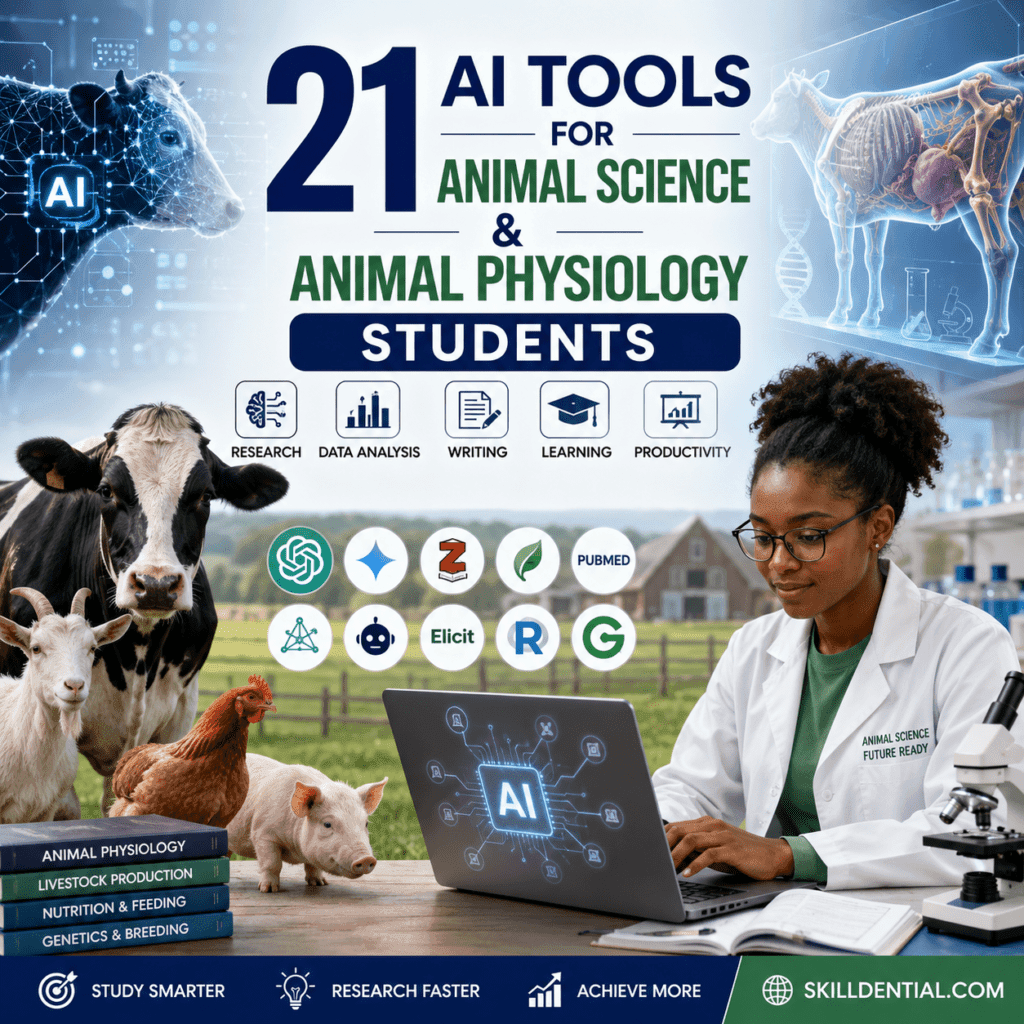
This guide is designed for undergraduate and postgraduate Animal Science students, researchers, lecturers, veterinarians, and livestock professionals who are ready to bridge the gap between core domain knowledge and high-leverage data skills. Throughout this article, you will learn which AI tools offer the highest utility, how they map directly to typical coursework and research tasks, and what technical trade-offs you must consider before adopting them.
The article is organized for maximum efficiency:
- The Landscape: A quick overview of how AI is transforming the field.
- The Toolkit: A curated list of AI tools categorized by use case—learning, research & writing, data analysis & modeling, and livestock/physiology applications.
- Decision Support: A strategic decision matrix, buying guide, and expert FAQs to help you choose the right tools for your specific goals.
- Maintenance: Guidance on staying updated as these technologies evolve.
What is Animal Science, and how is AI changing it?
Animal science is a multi-disciplinary field applying biological, physiological, genetic, and nutritional principles to the management of domesticated, companion, and laboratory animals. As of 2026, the industry is transitioning from isolated “smart” tools to integrated digital ecosystems, where AI functions not just as a task-specific assistant, but as a core component of agricultural and clinical infrastructure.
How AI is Transforming the Field
The integration of AI is shifting the role of the animal scientist from manual observation to data-driven synthesis.
- From Discrete Tools to Integrated Ecosystems: Previously, AI applications were limited to specific tasks like milk yield prediction. Today, systems act as “hubs” (e.g., DairyBrain), pulling data from multiple sources—genetics, environment, and real-time sensor feeds—to create a computational phenotype for each animal. This allows for proactive, whole-system management rather than reactive troubleshooting.
- Precision Livestock Farming (PLF) & Computer Vision: Using deep learning and computer vision, AI can now monitor intricate behaviors—such as gait analysis for lameness, social interactions, or subtle signs of stress—non-invasively. This enables earlier disease detection than human observation alone could achieve.
- Generative AI in Research & Academia: Beyond field applications, generative AI is a standard academic tool. For Animal Science students, it is used to structure complex data, simulate physiological responses, generate study aids, and draft research proposals, while forcing a higher reliance on “human-in-the-loop” validation to avoid technical inaccuracies.
- Predictive Decision Support: AI is moving agriculture from descriptive (what happened?) to predictive (what will happen?) and prescriptive (what should we do?). This includes modeling disease outbreaks, optimizing feed rations based on real-time climate and growth data, and automating health interventions.
Key Applications by Domain
| Application Area | AI Capability | Impact on Practice |
| Livestock Management | Predictive Modeling | Real-time optimization of feed, health, and environmental controls. |
| Veterinary Diagnostics | Image/Data Analysis | Accelerated interpretation of radiographs, ultrasounds, and medical records. |
| Research & Genetics | Bioinformatic Tools | Rapid genomic analysis, sequence alignment, and pathway visualization. |
| Education & Learning | Generative Models | Customized tutoring, practice simulations, and structural support for complex writing. |
The Strategic Shift for Students
For Animal Science students today, the professional bar has been raised. The modern animal scientist must be a “bilingual” professional—fluent in both the physiological needs of the animal and the data science required to manage digital systems.
Core Takeaway: AI is not replacing the need for animal science expertise; it is increasing the leverage of that expertise. The goal for any student or professional is to use AI to handle the “data deluge,” freeing up cognitive bandwidth to focus on complex decision-making, animal welfare ethics, and high-level strategy.
How should Animal Physiology students think about AI tools?
For Animal Physiology students, the transition to an AI-augmented environment requires a shift from passive consumption to active, critical stewardship of digital tools. Because physiology deals with complex, interconnected systems—where a change in one pathway often triggers compensatory mechanisms elsewhere—blind reliance on AI can lead to significant conceptual errors.
The “Skeptic-Collaborator” Mindset
To master AI while maintaining academic rigor, Animal Physiology students should adopt the following framework:
- View AI as a Process Accelerator, Not a Source of Truth: AI is an exceptional tool for synthesizing information, summarizing dense literature, and clarifying mechanistic pathways (e.g., the HPA axis or digestive feedback loops). However, AI models do not possess biological intuition. Always treat the output as a draft that requires verification against peer-reviewed literature or established textbooks.
- Prioritize Higher-Order Thinking: The greatest value of AI lies in its ability to support tasks at the top of Bloom’s Taxonomy—creating, evaluating, and analyzing. Use AI to simulate physiological “what-if” scenarios, refine experimental designs, or critique your own research hypotheses, rather than using it to complete low-level descriptive assignments.
- Maintain “Biological Grounding”: AI is only as good as the prompt provided and the underlying data. As a student, your primary competitive advantage is your domain-specific expertise. If an AI suggests a physiological outcome that contradicts fundamental biological principles (e.g., violating thermodynamic constraints in metabolic modeling), your role is to identify and correct that flaw.
Strategic Implementation for Physiology Tasks
| Task Type | Recommended AI Approach | Human Responsibility |
| Concept Clarification | Use Generative AI to break down complex pathways (e.g., endocrinology). | Cross-reference with primary sources to ensure technical accuracy. |
| Experimental Simulation | Use AI to model hypothetical outcomes or optimize sample sizes. | Critically evaluate the logic and ethical implications of the simulation. |
| Data Analysis | Use AI-assisted coding (e.g., Python/R copilots) for data cleaning/scripting. | Interpret the biological meaning of the statistical results. |
| Research Ethics | Use AI to check formatting or summarize trends. | Zero-tolerance: Never upload sensitive, private, or proprietary farm/lab data to public AI models. |
Operational Boundaries
The most successful students will be those who establish clear “operational boundaries” early in their academic careers. AI is a tool of efficiency, but it carries a risk of “skill atrophy” if over-relied upon. Use it to bridge the gap between complex raw data and meaningful biological insight, but ensure you are the one steering the intellectual direction of every project.
The Golden Rule: If you cannot explain the “why” behind the AI-generated insight using your own knowledge of anatomy, biochemistry, or physiology, you should not be using that insight as the basis for your research or coursework.
Framework: 4 core workflows where AI helps Animal Science students
This framework categorizes the 21 tools into the four core workflows identified. Each tool is selected for its high utility in the context of academic rigor and industry application for Animal Science students.
The High-Leverage AI Stack for Animal Science
| Workflow | Recommended AI Tools | Primary Value for Students |
| Learn & Revise | Khanmigo, PhET, Quizlet AI, RemNote | Converts dense biological theory into interactive, personalized study sessions. |
| Research & Write | Perplexity, Consensus, SciSpace, NotebookLM, Jenni AI | Accelerates literature synthesis, automates citation, and grounds writing in peer-reviewed data. |
| Analyze & Model | Julius AI, Wolfram Alpha, ChatGPT (Advanced Data Analysis) | Automates statistical scripting (R/Python) and visualization of physiological datasets. |
| Apply in Systems | WiseYield, SatAI, Plantix, Labster | Provides virtual exposure to precision agriculture and digital diagnostic environments. |
Detailed Tool Mapping
Learn & Revise Concepts
- Khanmigo: Uses Socratic tutoring to explain complex physiological mechanisms (e.g., metabolic pathways) without just answering.
- PhET Interactive Simulations: Essential for “virtual experimentation”—manipulating variables in biological systems (e.g., pH or temperature changes) to observe physiological outcomes.
- Quizlet AI & RemNote: Perfect for high-volume memorization of anatomy, taxonomy, and terminology using spaced-repetition algorithms.
Research, Read & Write
- Perplexity AI: The “research search engine” for rapid, cited answers to foundational questions about animal health or production.
- Consensus: Connects queries directly to peer-reviewed evidence, ideal for vetting claims in essays or lab reports.
- SciSpace: The “PDF reader for researchers.” Upload a dense physiology paper and ask it to break down confusing methodology or statistical results.
- NotebookLM: Upload your specific course notes, lab manuals, or datasets; it creates an “AI study guide” grounded exclusively in your own high-quality materials.
- Jenni AI: Assists in academic drafting, ensuring your writing maintains the formal structure required for thesis and manuscript submissions.
Analyze & Model Data
- Julius AI: The premier tool for students to upload a raw CSV of animal growth data or field observations and generate professional-grade statistical charts using plain English prompts.
- Wolfram Alpha: A computational engine that handles advanced math, chemical balancing for feed formulations, and complex physics equations within physiological models.
- ChatGPT (Advanced Data Analysis): Best for cleaning messy datasets or generating Python/R code snippets to perform specific statistical tests on animal trials.
Apply AI in Livestock Systems
- WiseYield: A practical entry point into precision farming that uses AI to forecast yields and optimize resources.
- SatAI & Plantix: Tools that demonstrate how remote sensing and computer vision are currently identifying stress, disease, and nutrient deficiencies in agricultural environments.
- Labster: Immersive, AI-managed virtual labs that simulate complex equipment usage, offering safe, repeatable practice for students with limited access to physical high-tech lab facilities.
Strategic Guidance for Your “Stack”
To build a high-leverage stack, do not adopt all 21 tools at once. Focus on interoperability:
- Start with the Research/Write layer: These provide the highest immediate ROI for your grades.
- Integrate the Analysis layer: Once comfortable with the literature, use Julius AI to handle the heavy lifting of data visualization.
- Apply to the Domain: Use the “Systems” tools to observe how your academic knowledge is being deployed in the real world (e.g., precision poultry/dairy).
Expert Note: When using these tools, always verify “AI hallucinations” against a trusted primary source. Your value as an Animal Science student is your ability to interpret these outputs through the lens of biology and ethics—if the AI output looks biologically impossible, it likely is.
AI tools for learning difficult Animal Science and Physiology concepts
This section evaluates three foundational categories of AI tools designed to help Animal Science students and Animal Physiology students master complex theoretical content. These tools act as cognitive scaffolding, allowing you to synthesize vast amounts of lecture and textbook material into structured knowledge.
General-Purpose LLM Tutors (e.g., Perplexity, ChatGPT, Claude)
These chat-based models serve as the most flexible, “horizontal” support system. They are invaluable for brainstorming research ideas, explaining intricate physiological feedback loops, or simulating oral exam scenarios.
- Best For: Clarifying foundational concepts, preparing for viva voce (oral exams), and generating custom question banks from your lecture notes.
- Strategic Verdict: An essential core tool. However, they are not domain-specialized; they act as a “junior research assistant.” You must provide clear context and cross-reference all physiological claims against peer-reviewed journals (e.g., Journal of Animal Science).
- Student Workflow Tip: When studying nutrition or endocrinology, use the prompt: “Act as an expert in ruminant physiology. Explain the role of [hormone] in [metabolic pathway] using a step-by-step approach. Then, create three challenging multiple-choice questions to test my understanding.”
AI-Enhanced Flashcard & Spaced Repetition (e.g., Anki, RemNote)
Mastery of Animal Science requires the retention of massive amounts of terminology, breed characteristics, and complex anatomical classifications. AI-powered spaced repetition accelerates the transformation of your dense class notes into high-recall data.
- Best For: Memorizing essential physiological pathways, nutritional requirements, and clinical pathology indicators.
- Strategic Verdict: High-impact for foundational coursework. By automating the creation of flashcards, these tools reduce the “administrative burden” of studying, allowing you to spend more time on active recall and conceptual application.
- Student Workflow Tip: Use AI add-ons to convert your handwritten lecture summaries into “cloze deletion” flashcards. This ensures you are testing yourself on the mechanisms of a process, not just the names of the parts.
AI Video Summarizers & Transcript Assistants
For postgraduate seminars, international webinars, or dense conference recordings, these tools extract searchable text and summaries from audio/video. They turn hours of lectures into actionable, searchable notes.
- Best For: Reviewing complex seminar content, identifying specific expert insights on livestock production, and navigating recordings where specific physiological mechanisms were discussed.
- Strategic Verdict: Highly recommended for students managing a high volume of guest lectures or conference-based learning. They bridge the gap between “listening to” and “interrogating” academic content.
- Student Workflow Tip: Upload a recording of a lecture on precision poultry farming. Use the AI to generate a summary of the main variables mentioned in the speaker’s model. This transforms a passive viewing experience into an active analytical exercise.
Summary Checklist for Students
| Tool Category | Primary Utility | “Human-in-the-Loop” Requirement |
| LLM Tutors | Concept synthesis & tutoring | Verify all biological “facts” against textbooks. |
| Spaced Repetition | Long-term memory retention | Audit cards for conceptual accuracy. |
| Video Assistants | Efficient lecture review | Ensure transcript captures technical terminology correctly. |
Important Privacy Note: For all three categories, never upload sensitive research data, proprietary farm information, or unpublished experimental datasets to public AI models unless you are using an institutionally approved, secure interface. Stick to published papers, lecture slides, and open-source materials.
Decision asset: Quick starting stack for Animal Science students (learning-focused)
To maximize the impact of your “Learning and Revision” workflow, ensure your students understand that these tools function best as a triangulated system—using the LLM for synthesis, the flashcard tool for long-term retention, and the video summarizer for dense media intake.
Below is the optimized Decision Matrix for your guide.
Decision Matrix: The Animal Science Learning Stack
| Use Case | Recommended Tool Type | Level (UG / PG) | Budget Priority | Key Trade-off |
| Clarifying Concepts | General-purpose LLM (e.g., Perplexity/Claude) | UG & PG | Essential | Can hallucinate; requires verification against textbooks. |
| Memorizing Physiology | AI-enhanced Flashcards (e.g., Anki/RemNote) | UG | Essential | Requires daily consistency; content must be audited for accuracy. |
| Reviewing Lectures | Video Summarizer (e.g., Otter.ai/NotebookLM) | UG & PG | Nice-to-have | Dependent on audio quality and institutional IP policies. |
| Experimental Design | Specialized LLM (e.g., ChatGPT w/ Advanced Data) | PG | Essential | Brainstorming is high-value, but experimental rigor is non-negotiable. |
Strategic Recommendations for Implementation
- Prioritize the “Stack,” not the “Shiny Object”: Encourage students to master one LLM and one spaced-repetition system before adding specialized research tools. This prevents “tool fatigue” and ensures they actually learn the material.
- The “Grounding” Rule: For any tool used in the Research & Writing or Analysis categories (coming next), mandate the use of tools that offer verifiable citations (e.g., Consensus, Perplexity Pro, or SciSpace). In Animal Science, a “hallucinated” statistic or physiological pathway can be disastrous for research credibility.
- Institutional Ethics: Always reiterate that students must not upload proprietary farm data or sensitive experimental results into public AI models. For sensitive datasets, they should use locally hosted LLMs or institutionally approved, enterprise-grade AI environments.
Suggested “Pro-Tip” for Students
“Treat AI as a high-speed junior intern—it is excellent at synthesis, summarizing, and pattern matching, but it lacks the ‘biological intuition’ required for final decision-making. Your role as a student is to perform the ‘final audit’ on every piece of information the AI provides.”
AI tools for literature review, writing, and referencing
This section builds on the foundation to provide an AI-enhanced research workflow specifically tailored for Animal Science students and Animal Physiology students.
Note: Pricing and features are subject to change. As of June 2026, many platforms have moved to a credit-based model to manage high compute demands.
Semantic Scholar (Discovery & Exploration)
A free, AI-powered scholarly search engine. It is arguably the most efficient tool for scoping broad topics in animal genetics or nutrition without getting lost in “noise.”
- AI Features: Semantic search, automated “TLDR” summaries for papers, and interactive citation graphs.
- Best For: Early-stage literature reviews. Use the “Citation Graphs” to identify foundational papers in physiology that you might otherwise miss.
- Verdict: A permanent fixture in any student’s bookmark bar. It is a “horizontal” tool—essential for everyone from undergraduates starting a class project to PhD candidates scoping a thesis.
Elicit (Evidence Synthesis)
An AI-powered research assistant that automates the most labor-intensive parts of a literature review: screening and data extraction.
- AI Features: Systematic review workflows, automated data extraction into tables (e.g., comparing sample sizes, methodology, or outcomes across 50+ papers), and AI-generated research reports.
- Best For: M.Sc. and Ph.D. students. Elicit is a “vertical” power tool—it is built to handle the heavy lifting of evidence synthesis.
- Verdict: High-leverage. If your work involves comparing outcomes across multiple animal trials or clinical studies, Elicit will save you dozens of hours of manual spreadsheet work.
Zotero (Reference Management)
The gold standard for open-source reference management. While not AI-native, its ecosystem of community-developed plugins allows it to integrate AI-driven summarization and organizational logic.
- AI Features: Via plugins, you can automate tag suggestions, extract key findings into notes, and link your library to AI readers.
- Best For: Organizing your bibliography across multiple years of study.
- Verdict: A “must-have.” Do not rely on AI to manage your citations; use Zotero to anchor your research. Treat AI as a helpful layer on top of your master library.
SciSpace (Reading & Annotating)
An AI research assistant that functions as an “augmented PDF reader.” It is highly effective at breaking down dense methodology or complex physiological data tables.
- AI Features: “Ask your PDF” functionality, inline explanations for complex formulas, and section-by-section summaries.
- Best For: Deep reading. Use this when you are struggling to interpret the statistics or experimental design in a journal article.
- Verdict: Excellent for “active reading.” It forces you to engage with the text rather than skimming it. Use the free tier to test the workflow, then scale with credits if you are managing a high volume of primary literature.
Research Workflow Strategy for Students
| Tool | Role in Research | High-Leverage Prompt / Action |
| Semantic Scholar | The Scout | “Show me the most influential papers on [physiological pathway] from the last 5 years.” |
| Elicit | The Analyst | “Extract the sample sizes and primary outcomes of these 20 papers into a table.” |
| Zotero | The Librarian | Always use the browser connector to capture metadata and PDFs simultaneously. |
| SciSpace | The Tutor | “Explain the statistical method used in the results section of this paper.” |
Privacy & Ethical Warning
Data Integrity: Never upload unpublished experimental data or proprietary farm information to Elicit or SciSpace. These tools often store documents to power their AI models. For unpublished thesis work, use local, offline, or institution-provided secure AI environments.
AI tools for data analysis, modeling, and statistics
For Animal Science students and Animal Physiology students, data analysis is where the transition from “student” to “researcher” occurs. The following tools represent the modern standard for processing experimental, field, and sensor data.
Note: As of June 2026, AI-integrated data tools have shifted toward “Agentic” workflows—where AI doesn’t just write code, but helps manage the entire data analysis pipeline.
R/Python with AI Coding Assistants (e.g., GitHub Copilot, Zerve)
The professional standard. Whether using RStudio (for biostatistics) or VS Code (for data science), AI coding assistants act as pair programmers, helping you debug complex statistical models (like mixed-effects models or ANOVA).
- AI Features: Context-aware code completion, instant documentation lookup, and refactoring suggestions.
- Best For: Thesis-level research, large-scale data wrangling, and reproducible science.
- Strategic Verdict: Essential for those pursuing a research career. Use GitHub Copilot for script-heavy work, or explore Zerve if you want an AI-native notebook environment that maintains context across your entire project.
Visual ML Platforms (e.g., Orange, KNIME)
“Low-code” platforms that allow you to build sophisticated predictive models (e.g., weight gain prediction, disease detection) by dragging and dropping “widgets” rather than writing scripts.
- AI Features: AutoML (automatic model selection), feature importance visualization, and drag-and-drop neural network construction.
- Best For: M.Sc. projects, rapid prototyping, and students who need to perform advanced analytics without deep programming experience.
- Strategic Verdict: An excellent “bridge” tool. Orange is often preferred for classroom learning and pedagogical visualizations, while KNIME is more robust for heavy-duty data integration and enterprise-scale pipelines.
AI-Enhanced Spreadsheets (e.g., Microsoft Copilot, GPT for Work)
For many students, the spreadsheet is the primary data “home.” New integrations like Microsoft Copilot (Excel) and GPT for Work (Google Sheets) allow you to perform complex analysis through natural language.
- AI Features: Natural language formula generation, automated trend spotting, and one-click data cleaning.
- Best For: Exploratory data analysis, lab reports, and smaller datasets where the overhead of a full coding environment isn’t required.
- Strategic Verdict: A “must-have” productivity boost. These tools are no longer just for simple math; they can handle pattern detection and complex formula syntax, significantly lowering the “barrier to entry” for statistics.
Decision Matrix: Data Analysis Tools
| Tool Category | Primary Use Case | Level (UG / PG) | “Human-in-the-Loop” Requirement |
| Coding Assistants | Complex statistics / Modeling | PG | High: Validate stats outputs vs. theory. |
| Visual ML (KNIME) | Workflow-based analysis | UG & PG | Medium: Ensure data cleaning is robust. |
| AI Spreadsheets | Exploration & Summarization | UG | Low: Use for quick insights, not final peer-review models. |
Pro-Tip: The “Reproducibility” Rule
“AI-generated code is often functional but not always reproducible. For your thesis or research, always ensure you can explain each line of code provided by an assistant. If the AI suggests a statistical test (e.g., a specific variation of an ANOVA), verify it matches the experimental design and data distribution of your study.”
AI tools for livestock management and precision animal agriculture
This section transitions from theoretical academic tools to the applied, high-tech environments that define modern Precision Livestock Farming (PLF). For Animal Science students, these tools represent the “industry-ready” frontier—where sensors, robotics, and machine learning converge to manage animal health and productivity in real-time.
Precision Poultry Farming Platforms
Integrated systems utilizing Internet of Things (IoT) sensors, acoustic monitoring, and computer vision (CV) to monitor flock dynamics.
- AI Role: CV algorithms detect abnormal distribution or activity (e.g., huddling, lethargy), while environmental sensors (ammonia, temp, humidity) trigger predictive alerts for welfare concerns.
- Best For: Understanding “flock-level” management. These systems allow students to see how data-driven environments replace reactive, manual barn checks.
- Strategic Verdict: Essential for students focusing on agricultural technology or poultry production. Look for case studies on platforms like Fancom (eYeNamic) or similar integrated barn-control suites.
AI-Enabled Dairy Monitoring
Systems that track individual cow metrics—rumination, activity (for estrus), and milk yield—to optimize reproduction and feeding.
- AI Role: Time-series modeling and predictive analytics convert raw sensor data into actionable alerts, such as “ideal breeding window” or “early-stage mastitis risk.”
- Best For: Understanding “individual-level” precision management. It provides a blueprint for how AI helps maintain productivity while simultaneously improving animal welfare.
- Strategic Verdict: The “gold standard” for PLF. Study these systems to understand the trade-offs between capital-intensive automation and traditional, labor-heavy herd management.
Veterinary Digital Health & Imaging
Platforms that integrate diagnostic AI into the clinical workflow. These are increasingly vital for both companion animal practice and high-value livestock diagnostics.
- AI Role: Image interpretation (e.g., SignalPET for radiology, Zoetis VETSCAN Imagyst for digital cytology) and clinical decision support (e.g., Sofie AI for differential diagnoses).
- Best For: Students interested in the clinical or veterinary-tech side of Animal Science.
- Strategic Verdict: High-leverage. These tools demonstrate the future of the “diagnostic loop”—from image acquisition to structured, AI-assisted reporting—that minimizes human error and speeds up treatment.
Decision Matrix: Applied Industry Stack
| Application Area | AI/Tech Focus | Level | Industry Priority |
| Poultry Systems | Computer Vision / Audio | UG | High (Welfare & Efficiency) |
| Dairy Systems | Time-series / Wearables | UG/PG | Critical (Production & Repro) |
| Vet Diagnostics | Imaging / Decision Support | PG | High (Clinical Accuracy) |
Strategic Guidance for “Real-World” AI
As a student, you likely won’t have direct access to a commercial dairy barn or a large-scale poultry operation. To bridge this gap:
- Seek Out “Digital Twins” or Case Studies: Look for datasets on public repositories that mimic sensor data from these systems.
- Focus on Data Integration: The value in these systems isn’t just the AI—it’s how the AI talks to the farm management software. Understand the API/integration layer to see how data moves from a sensor to a farmer’s dashboard.
- Ethical Oversight: Always evaluate these systems through the lens of data ownership. Who owns the data from a cow’s activity collar—the farmer, the software vendor, or the breeding company? This is a critical discussion topic for any student entering the modern livestock industry.
Comparison table: Core AI tool categories for Animal Science students
This comparison table organizes the essential AI-powered categories for Animal Science students into a high-leverage “stack.” It is designed to help you prioritize tools based on their specific utility in your academic and professional workflow.
AI Tool Stack for Animal Science & Animal Physiology Students
| Category | Example Tools / Platforms | Primary Workflow | Level Focus | Value vs. Effort |
| General LLM Tutor | Perplexity, ChatGPT, Claude | Learning & Concept Clarification | UG & PG | Very High: Must be paired with critical evaluation. |
| Literature Discovery | Semantic Scholar | Scoping & Topic Research | UG & PG | High: Essential for mapping research trends. |
| Evidence Synthesis | Elicit | Systematic Review | PG | High: Massive time-saver for thesis/review work. |
| Reference Management | Zotero (+ AI plugins) | Writing & Citations | UG & PG | Essential: The backbone of academic integrity. |
| AI Reading Assistant | SciSpace, ExplainPaper | Comprehension & Analysis | UG & PG | High: Transforms dense papers into active learning. |
| Coding Assistants | GitHub Copilot, R/Python LLMs | Data Analysis & Modeling | Mainly PG | Very High: Critical for reproducible science. |
| Visual ML Platforms | Orange, KNIME | Predictive Modeling | UG/PG | High: Low-code path to advanced analytics. |
| AI Spreadsheets | Copilot / GPT for Sheets | Light Data Analysis | UG | Medium: Excellent “gateway” tool. |
| Precision Livestock | Dairy/Poultry AI Platforms | Industry Applications | UG & PG | High: Vital for understanding modern PLF. |
| Vet Digital Health | Imaging/Triage AI | Diagnostics & Health | PG / Vet | High: Conceptual foundation for future clinical work. |
Strategic Summary for Students
- The “Foundational” Layer (UG): Focus on mastering General LLM Tutors for conceptual synthesis, Zotero for organization, and AI Spreadsheets for foundational data tasks.
- The “Professional” Layer (PG/Research): Integrate Elicit for evidence synthesis, Coding Assistants for statistical reproducibility, and Visual ML for predictive modeling.
- The “Industry” Layer: Engage with Precision Livestock and Digital Health case studies to understand how theoretical knowledge is deployed in real-world agricultural and clinical systems.
Pro-Tips for Long-Term Success
- Avoid Tool Fatigue: Do not try to implement all these tools at once. Start with your biggest “pain point” (e.g., if the literature review is slowing you down, focus on Elicit and Semantic Scholar first).
- Maintain “Domain-First” Thinking: AI is a force multiplier, not a replacement for biological expertise. Always ground AI outputs in the physiological or nutritional principles you learn in the classroom.
- Data Integrity: Be cautious with proprietary farm/lab data. Unless your institution provides a secure, private AI instance, keep sensitive datasets offline or within authorized institutional environments.
Buying and adoption guide for Animal Science & Animal Physiology students
This “Buying and Adoption Guide” serves as a strategic roadmap for Animal Science and Animal Physiology students to integrate AI into their workflows responsibly, ethically, and efficiently.
Targeted Adoption Tiers
| Profile | Essential Stack | Optional / High-Leverage Add-ons |
| Undergraduate Students | LLM Tutor (e.g., Claude/ChatGPT), Zotero, AI Spaced Repetition (e.g., RemNote/Anki) | Spreadsheet AI add-ons, AI Video Summarizers |
| Postgraduate & Researchers | Semantic Scholar, Elicit, AI Reading Assistant (e.g., SciSpace), Coding Assistants (GitHub Copilot for R/Python) | Visual ML platforms (KNIME/Orange), Enterprise-grade AI environments |
| Lecturers & Professionals | LLM for content design, Literature discovery tools, and applied industry case studies | Precision Livestock / Vet Diagnostic AI platforms |
Strategic Considerations for Implementation
Budgeting for AI
- The “Free” Advantage: Most foundational research tools (Semantic Scholar, Zotero, KNIME) are open-access or free. Prioritize these to build a robust, cost-effective infrastructure.
- Targeted Investment: Paid subscriptions are only defensible when they significantly accelerate high-value tasks—typically one “Pro” LLM for synthesis, and perhaps a specialized coding or summarization tool if your research relies heavily on dense data or recorded seminars.
- Institutional Access: Always check for university-provided licenses for tools like Microsoft Copilot, specialized veterinary diagnostic suites, or enterprise-grade cloud computing environments.
Essential vs. Nice-to-Have Features
- Essential: Look for citation transparency (direct links to original peer-reviewed papers), data ownership transparency, and platform interoperability (e.g., tools that export to Zotero/BibTeX).
- Nice-to-Have: Multi-modal capabilities (chart/image understanding) and integrated “workspace” tools are convenient but should not replace the rigor of primary source verification.
Privacy, Ethics, and Academic Integrity
- Sensitive Data: Never input identifiable farm records, client veterinary data, or unpublished experimental datasets into public LLMs. These models often use input to train future iterations.
- Disclosure: Academic publishers (e.g., USAMV Cluj-Napoca and others as of 2026) now mandate explicit AI disclosure statements. When using AI for thesis or manuscript preparation, use the following template: “During the preparation of this research, the authors used [NAME OF TOOL] for [PURPOSE]. All outputs generated were critically evaluated and revised by the authors, who assume full responsibility for the accuracy and integrity of the work.”
- Human-in-the-Loop: AI must remain an advisory assistant. In veterinary and agricultural decision-making, the final clinical or management decision must always be grounded in biological expertise, not algorithmic output.
Building Your Ecosystem
- Interoperability is Key: Choose tools that “talk” to each other. A strong stack flows data seamlessly: Semantic Scholar (Discovery) $\rightarrow$ Zotero (Reference Management) $\rightarrow$ Elicit/SciSpace (Analysis) $\rightarrow$ LLM (Drafting).
- Prioritize Long-Term Skills: Favor open-source platforms like R, Python, Orange, and KNIME. These teach you reproducible data science workflows—a skill set that remains valuable even as the specific AI tools change or evolve.
Expert Tip for the Next 30 Days:
Do not overhaul your entire workflow at once. Start with one: if literature review is your bottleneck, spend 30 days mastering Elicit and Semantic Scholar. Once that process is optimized, add the next layer. This prevents “tool sprawl” and ensures you stay focused on your core goal: high-leverage learning and research in Animal Science.
Can Animal Science students rely solely on AI for literature reviews?
No. AI tools like Semantic Scholar and Elicit can drastically accelerate discovery and data extraction, but they do not replace field-specific databases (e.g., CAB Abstracts, PubMed). Use AI to scope trends and summarize content, but always perform a manual “deep dive” into peer-reviewed literature to ensure your research is comprehensive and unbiased.
Are general-purpose LLMs reliable for detailed Animal Physiology explanations?
Use with caution. While LLMs are excellent for brainstorming and explaining concepts, they can “hallucinate” or oversimplify complex physiological feedback loops. Always treat LLM explanations as drafts; verify every technical claim against established textbooks or primary academic sources.
Do AI coding assistants replace the need for formal statistical training?
Absolutely not. AI tools (e.g., GitHub Copilot) can handle syntax and boilerplate code, but they cannot interpret your experimental data or design. A solid grasp of experimental design, data distribution, and statistical theory is mandatory to ensure your analysis is scientifically valid.
Are AI livestock monitoring systems accessible to smallholder farmers?
Currently, no. Most high-end precision livestock farming (PLF) platforms are optimized for commercial, large-scale operations due to significant infrastructure and hardware costs. However, literature is trending toward scalable, low-cost “digital twin” solutions that may eventually bridge this gap.
How do I maintain academic integrity when using AI in my thesis or assignments?
Transparency is key. In 2026, most institutions follow a “disclosure-based” model. If you use AI, include an AI Declaration Statement detailing which tools were used and for what purpose (e.g., brainstorming, proofreading, or data formatting). Submitting AI-generated content as your own work without disclosure is generally considered academic misconduct.
How can I avoid plagiarism when using AI?
Write first, edit with AI. Use AI to structure your arguments, improve clarity, or check grammar—but never let the AI generate the body of your text. Always write your own drafts, ensure every cited idea is mapped to a source, and adhere strictly to your university’s specific AI usage policy.
Which free tools provide the highest value for students on a budget?
A “core stack” of free tools—Semantic Scholar (for discovery), Zotero (for citations), KNIME (for low-code predictive modeling), and a standard LLM (e.g., the free tiers of Claude or ChatGPT)—covers 90% of a student’s research needs.
Do AI tools handle non-English scientific literature effectively?
Variable. While many AI tools have improved multilingual capabilities, they are still heavily biased toward English-language datasets. For regional or specialized agricultural literature, you must supplement your AI search with local, language-specific databases to ensure you aren’t missing critical, context-specific research.
Can AI help in the design of animal experiments?
Yes, for conceptualization. AI is excellent at brainstorming variables and suggesting power analyses. However, all experimental designs involving animals must undergo formal review and approval by your Institutional Animal Care and Use Committee (IACUC) or equivalent ethics board. AI advice does not override ethical compliance.
How often should I review my AI “toolkit”?
At least once per academic year. The AI landscape is shifting rapidly. Every fall, review your toolset to see if free versions have changed, if new, more efficient tools have emerged, and—crucially—if your institution has updated its policy on AI-assisted research.
In Conclusion
The integration of Artificial Intelligence into Animal Science and Animal Physiology is no longer a futuristic concept; it is the current standard for research, education, and precision livestock production. As this guide has outlined, the transition from manual, reactive processes to data-driven, predictive systems is fundamentally changing the professional requirements for the next generation of animal scientists.
The Path to High-Leverage Mastery
To thrive in this evolving landscape, you must resist the urge to collect “random apps.” Instead, adopt a modular, high-leverage stack—a curated, integrated set of tools that scale with your career:
- For Learning: Master a General LLM tutor for conceptual synthesis and AI-enhanced spaced repetition for long-term physiological mastery.
- For Research: Anchor your workflow in Zotero for citation integrity, using Semantic Scholar and Elicit to turn literature discovery into an automated, systematic process.
- For Data & Modeling: Develop fluency in R or Python supported by coding assistants. These are not merely analysis tools; they are the foundation for the reproducible, high-impact research required in today’s industry.
- For Industry Awareness: Use case studies and virtual platforms to understand Precision Livestock Farming (PLF). While your access to these commercial systems may initially be limited, understanding their logic—how they ingest data, model outcomes, and provide decision support—is essential for any student aiming for an industry-leading career.
Your Professional “Human-in-the-Loop” Mandate
AI is a force multiplier, not a replacement for biological expertise. Your unique value as an Animal Science student lies in your ability to synthesize data through the lens of physiological principles, ethical standards, and scientific intuition.
- Audit, Don’t Outsource: Always treat AI output as a “junior intern’s” first draft. Validate technical claims against primary literature and interrogate results for biological plausibility.
- Prioritize Ethics: Maintain rigorous standards of academic integrity. Disclose your use of AI, protect sensitive research or farm data, and ensure your final decision-making process is transparent and evidence-based.
- Stay Adaptable: The AI landscape will continue to shift. Set an annual “recalibration” date to evaluate new tools, review institutional policies, and update your stack.
By building a disciplined, tool-agnostic strategy today, you are not just learning to use current software—you are developing the AI-literacy and critical thinking skills necessary to lead in an increasingly data-intensive future. You are now equipped to bridge the gap between core domain knowledge and the high-leverage data science that will define the next decade of animal health, welfare, and production.