Environmental Science Graduate Career Paths: Complete Guide
Environmental Science Graduate Career Paths are diverse and technically demanding, spanning consulting, government regulation, and private sector sustainability. Understanding these trajectories is critical for aligning your academic background with current market compensation and skill requirements.
Primary Career Roles
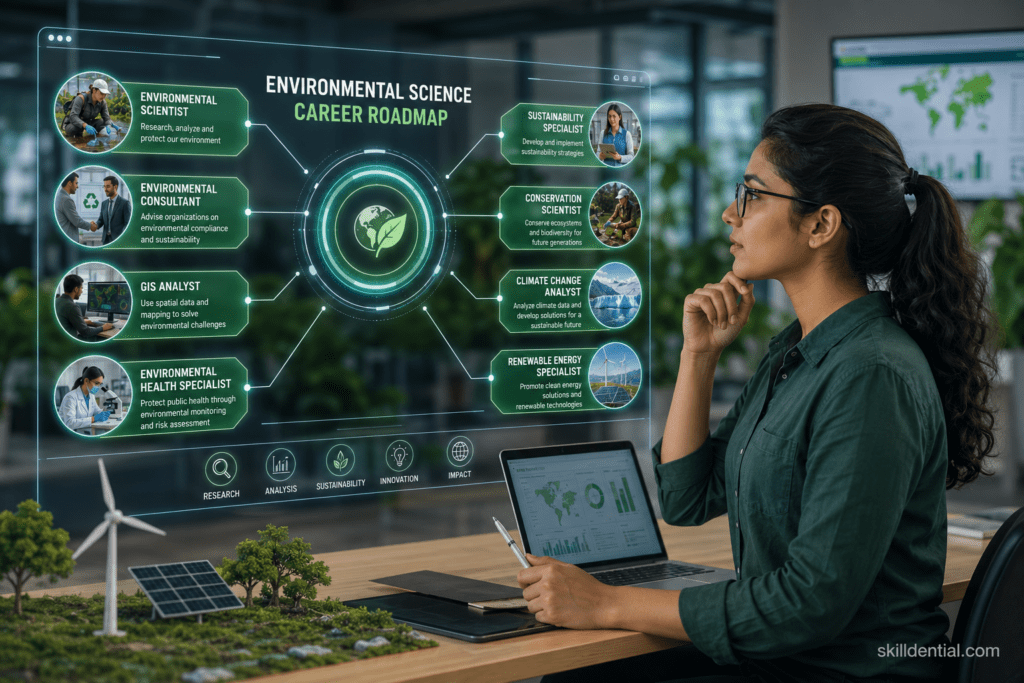
Success in Environmental Science Graduate Career Paths often hinges on your ability to specialize. Key roles include:
- Environmental Scientist: Conducts research and investigations to protect the environment or human health.
- Environmental Engineer: Focuses on designing systems for waste disposal, pollution control, and public health infrastructure.
- Conservation Scientist: Manages land quality in forests, parks, and rangelands.
- GIS Specialist: Applies geospatial data analysis to map environmental hazards and resource trends.
- ESG Reporter: Translates environmental impact data into business strategy and regulatory disclosures.
- Environmental Health & Safety (EHS) Officer: Ensures workplace compliance with environmental regulations and safety standards.
Compensation Benchmarks
Market data for 2024 underscores the value of technical specialization.
| Role | Median Annual Salary (2024) |
| Environmental Engineer | $104,170 |
| Environmental Scientist | $80,060 |
For environmental scientists, salary potential scales significantly with experience. While the median is $80,060, the top 10% of practitioners earn over $134,830, typically reflecting roles in specialized consulting, federal government agencies, or executive-level project management.
Strategic Skill Acquisition
To optimize your trajectory within Environmental Science Graduate Career Paths, prioritize high-leverage technical certifications:
- Geospatial Mastery: Obtaining a GIS certification is non-negotiable for data-heavy roles. Proficiency in platforms like ArcGIS combined with spatial data modeling creates a high barrier to entry that elevates your market value.
- Professional Credentials: The Registered Environmental Professional (REP) certification is a gold-standard indicator of project management competence for those with graduate-level experience.
- Computational Literacy: Fluency in Python or R is increasingly required to automate data analysis, handle large environmental datasets, and conduct predictive modeling. Integrating these coding skills with traditional environmental knowledge positions you as a hybrid professional capable of delivering actionable insights rather than just descriptive reports.
What jobs are available after studying Environmental Science?
The field of environmental science offers a wide array of career paths that bridge scientific research, technical implementation, regulatory compliance, and strategic consulting. Because the degree is interdisciplinary, graduates can pivot into diverse sectors based on their specialization in biology, chemistry, data analysis, or policy.
Core Career Pathways
Depending on your interests and technical skill set, career roles generally fall into these primary categories:
- Scientific Research & Fieldwork: Professionals in these roles conduct site investigations, collect samples (soil, water, air), and analyze data to understand ecosystems and environmental impacts.
- Titles: Environmental Scientist, Wildlife/Marine Biologist, Environmental Chemist, Ecologist, Environmental Technician.
- Engineering & Technical Solutions: These roles focus on designing systems to prevent pollution, manage waste, and ensure sustainable infrastructure development.
- Titles: Environmental Engineer, Geoscientist, Hazardous Materials Manager, Water Quality Specialist.
- Compliance, Policy & Regulation: Experts in this area interpret environmental laws to ensure organizations operate within legal and ethical guardrails.
- Titles: Environmental Compliance Advisor, Environmental Policy Analyst, EHS Officer (Environmental Health & Safety), Environmental Consultant.
- Data Analysis & Geospatial Intelligence: Utilizing technology to visualize patterns, predict environmental shifts, and support land-use planning.
- Titles: GIS Specialist/Analyst, Climate Change Analyst, Remote Sensing Specialist.
- Sustainability & ESG Strategy: Helping corporations and NGOs align business operations with environmental targets and regulatory disclosures.
- Titles: Sustainability Consultant, ESG (Environmental, Social, and Governance) Reporter, Sustainability Manager.
Major Employment Sectors
Graduates typically find opportunities in the following environments:
| Sector | Nature of Work |
| Government Agencies | Enforcing regulations, land management, and public policy (e.g., EPA, National Park Service). |
| Environmental Consulting | Providing expert advice to private clients on risk assessment, site remediation, and impact reports. |
| Renewable Energy | Analyzing ecological impacts and promoting sustainable site planning for green energy projects. |
| NGOs & Non-Profits | Advocacy, conservation research, and public education on environmental issues. |
| Corporate/Private Sector | Managing internal sustainability initiatives, ESG compliance, and workplace safety standards. |
Strategic Tips for Employability
- Technical Stack: Employers increasingly value proficiency in GIS (Geographic Information Systems), Python/R for data modeling, and project management tools.
- Professional Certification: Consider certifications such as the Registered Environmental Professional (REP) or OSHA safety credentials to differentiate yourself in the job market.
- Specialization: Because the field is broad, focusing your electives or post-graduate projects on a specific domain (e.g., Toxicology, Hydrogeology, or Urban Planning) can significantly increase your starting salary and placement prospects.
Which career path pays the most for Environmental Science graduates?
When assessing compensation across Environmental Science Graduate Career Paths, environmental engineering consistently ranks at the top due to the technical integration of infrastructure design and regulatory compliance.
Salary Comparison by Role and Experience Level
The table below illustrates the compensation trajectory for professionals pursuing Environmental Science Graduate Career Paths.
Note: USD figures represent annual salaries in the US market; EHS figures in Naira are estimates for the Nigerian market.
| Role | Entry-Level | Mid-Level | Senior | Expert |
| Environmental Engineer | $73,500 | $91,191 | $127,500 | $133,000+ |
| Environmental Scientist | $52,654 | $103,223 | $126,235 | $134,000+ |
| ESG Reporter | $55,000 | $75,000 | $90,000 | $110,000+ |
| GIS Specialist | $50,000 | $65,000 | $78,000 | $90,000 |
| Conservation Scientist | $47,000 | $63,750 | $75,000 | $85,000 |
| EHS Officer (NGN) | ₦1.8M–3.6M | ₦4.8M–7.2M | ₦7.2M–10.8M | ₦12M+ |
Key Factors Driving Salary Growth
To maximize earning potential within Environmental Science Graduate Career Paths, consider the following high-leverage factors:
- Technical Specialization: Roles requiring licensure (e.g., Professional Engineer) or specialized computational skills (e.g., Python/R for environmental modeling) command a significant salary premium over generalist roles.
- Industry Selection: The highest-paying sectors typically include federal government agencies, specialized engineering services, and top-tier management consulting firms.
- Cross-Disciplinary Skills: Professionals who combine environmental science with ESG strategy or data analytics—such as those moving into ESG Reporting—can tap into corporate budgets, which often provide higher variable compensation (bonuses/equity) compared to traditional research roles.
- Geographic Arbitrage: In the US, salaries fluctuate significantly based on local cost of living and regional regulatory intensity (e.g., states with stricter environmental compliance requirements often see higher demand for specialized scientists).
Would you like to explore the specific technical certifications that would best position you for the upper-tier salary brackets in these career paths?
What skills are employers looking for in Environmental Science graduates?
Employers hiring for Environmental Science Graduate Career Paths now prioritize a hybrid skill set: the ability to manage complex data ecosystems, navigate shifting regulatory landscapes, and translate technical findings for non-technical stakeholders.
Core Competencies in Demand
To stand out in the current job market, you must demonstrate proficiency in these four pillars:
- Technical & Digital Literacy: Beyond field methods, employers seek graduates who can automate data processing. This includes proficiency in Python or R for statistical analysis, GIS (ArcGIS/QGIS) for spatial intelligence, and familiarity with Environmental Modeling software (e.g., HEC-RAS).
- Analytical & Regulatory Fluency: You must be able to bridge the gap between scientific data and legal requirements. Understanding Environmental Impact Assessment (EIA) procedures, carbon accounting, and specific local/international compliance frameworks (e.g., EPA standards) is critical.
- Communication & Systems Thinking: The ability to distill complex environmental issues into actionable strategy is a high-leverage skill. This includes professional report writing, grant writing, and stakeholder engagement to build buy-in for sustainable initiatives.
- Applied Project Management: Competence in budgeting, scheduling, and risk mitigation ensures you can transition from an academic environment to a professional project delivery role.
Strategic Certifications
Certifications serve as a tangible signal of your readiness for specific roles within Environmental Science Graduate Career Paths:
| Certification | Focus Area | Best For |
| GISP | Geospatial Intelligence | GIS Specialists & Resource Planners |
| REM (Registered Environmental Manager) | Project Management | Senior Scientists & Compliance Managers |
| CESCO | Regulatory Compliance | EHS Officers & Compliance Advisors |
| LEED Green Associate | Sustainable Infrastructure | ESG Reporters & Sustainability Consultants |
| OSHA 40-Hour HAZWOPER | Site Safety & Risk | Field Scientists & Remediation Specialists |
Decision Matrix: Matching Strengths to Roles
Use this matrix to align your specific skill clusters with the most viable Environmental Science Graduate Career Paths:
| If You Excel In… | Best Career Match | Why It Fits |
| Data Analysis + Modeling | Environmental Scientist | Leverages research, statistical rigor, and policy advising. |
| Engineering + Problem-Solving | Environmental Engineer | Focuses on technical infrastructure and pollution control. |
| Map Visualization + Geography | GIS Specialist | Utilizes spatial data for renewable energy & planning. |
| People + Public Awareness | Environmental Compliance Advisor | Relies on communication, policy, and stakeholder engagement. |
| Business + Reporting | ESG Reporter | Aligns sustainability metrics with corporate/financial strategy. |
| Fieldwork + Nature | Conservation Scientist | Focuses on habitat management and natural resources. |
| Safety + Regulations | EHS Officer | Prioritizes site inspections, audits, and hazard analysis. |
Would you like a roadmap on how to acquire these specific certifications while still in school or during your first year of employment?
Which industries hire Environmental Science graduates?
Environmental Science Graduate Career Paths are increasingly essential across both public and private sectors, driven by global climate mandates, regulatory complexity, and the transition to sustainable energy.
Key Industries and Hiring Sectors
Opportunities for graduates are distributed across several high-leverage sectors. Each offers unique pathways for career advancement based on your technical specialization.
| Industry | Primary Role of Environmental Scientists |
| Environmental Consulting | Conducting environmental impact assessments (EIA), site remediation, and regulatory compliance advisory for private and public clients. |
| Government & Public Sector | Enforcing environmental laws, managing natural resources, public health monitoring, and urban land-use planning (e.g., EPA, state environmental departments). |
| Renewable Energy | Supporting project planning, ecological impact evaluations, and environmental permitting for solar, wind, and bioenergy infrastructure. |
| Corporate/ESG Teams | Overseeing carbon accounting, sustainability reporting, waste reduction strategies, and ensuring adherence to ESG (Environmental, Social, and Governance) frameworks. |
| Natural Resources & Conservation | Managing forest, park, and water quality programs; wildlife population monitoring; and habitat restoration. |
| Oil, Gas & Manufacturing | Managing site-specific environmental compliance, waste handling, and risk mitigation in high-impact industrial operations. |
Growth Trends and Market Outlook (2026–2034)
The job market for professionals in Environmental Science Graduate Career Paths is characterized by steady expansion, with an average growth projection of approximately 4% to 8% depending on the specific sub-field. Key drivers include:
- Climate Adaptation & Resilience: Rapidly increasing demand for professionals who can model climate hazards (e.g., flood, drought, heat) and integrate nature-based solutions into infrastructure.
- Green Finance & ESG Reporting: Growing institutional pressure requires companies to provide transparent environmental disclosures, creating a surge in roles for graduates who can bridge the gap between technical data and business strategy.
- Regulatory Complexity: As global environmental standards tighten, firms across all sectors—including manufacturing and utilities—require experts to manage compliance, thereby insulating these roles from broader economic volatility.
- Data-Driven Decision Making: A clear premium is placed on professionals who combine environmental science with Geographic Information Systems (GIS) and computational modeling (Python/R) to solve complex land-use and pollution management challenges.
Strategic Advice for Career Entry
To capitalize on these industrial opportunities:
- Leverage Internships: Consulting firms frequently utilize internships as their primary pipeline for full-time hiring.
- Focus on “Hybrid” Skill Sets: Employers prioritize candidates who can perform technical field analysis while simultaneously interpreting findings for policy or business stakeholders.
- Target High-Growth Niches: Specializing in carbon management, water resource optimization, or environmental data intelligence provides a stronger value proposition in today’s competitive job market.
Would you like a breakdown of how to tailor your resume for a specific industry, such as consulting versus government?
How can graduates improve their employability after Environmental Science?
To bridge the technical gap identified in Environmental Science Graduate Career Paths, you must move beyond foundational theory and cultivate a specialized, high-leverage skill stack. Employers in 2026 are no longer hiring generalist scientists; they are hiring “technical translators” who can collect, process, and automate environmental data.
Master High-Leverage Technical Stacks
The most effective way to improve your employability is to integrate data science with environmental domain expertise.
- Geospatial Intelligence (GIS): It is not enough to simply know the interface; you must master spatial analysis. Target certifications like the ESRI Technical Certification or build a portfolio using QGIS (open-source) to demonstrate your ability to model land-use patterns, pollution plumes, and climate hazards.
- Computational Literacy (Python/R): Shift from manual data entry to automation. Proficiency in Python (for data scraping, processing, and machine learning) and R (for complex statistical analysis and ecological modeling) allows you to handle the large, messy datasets that define modern environmental roles.
- Industry-Specific Software: Gain exposure to sector-standard tools. For water resources, learn HEC-RAS; for site assessments, familiarize yourself with AutoCAD; and for sustainability reporting, understand GHG Protocol carbon accounting frameworks.
Strategic Credentialing
Professional certifications act as a “proof of competence” that accelerates your hiring timeline by bypassing screening filters.
- Regulatory Competency: Obtain the 40-Hour HAZWOPER (Hazardous Waste Operations and Emergency Response) certification. It is an industry standard for field-based environmental consultants and technicians.
- Professional Designations: Aim for credentials such as the Registered Environmental Professional (REP) or Certified Environmental and Safety Compliance Officer (CESCO). These demonstrate a mastery of project-level regulatory navigation.
- Sustainability Focus: For roles in Environmental Science Graduate Career Paths focused on corporate strategy, obtain the LEED Green Associate credential or certifications in ESG reporting to align with the growing demand for climate-risk disclosure.
Build a “Verified Experience” Portfolio
Don’t just list your degree; demonstrate your impact through a portfolio that highlights technical application.
- Quantifiable Projects: In your resume and interviews, use the “Skill-Action-Result” framework. Instead of saying “I performed fieldwork,” say: “Utilized QGIS to map local watershed health, resulting in a 15% improvement in site sampling accuracy for a remediation project.”
- Targeted Volunteering: If you lack professional experience, use citizen science platforms (like Zooniverse) or volunteer with local conservation non-profits specifically to gain experience in field sampling, GPS data collection, or community stakeholder engagement.
- Informational Interviews: Connect with professionals already working in your target Environmental Science Graduate Career Paths. Ask specifically about the “hidden” technical requirements of their role; this intelligence allows you to focus your learning on the skills that actually drive hiring decisions in that specific company.
Optimize for the “Hybrid” Market
The most resilient Environmental Science Graduate Career Paths are those that bridge the gap between technical rigor and business necessity. Whether you are aiming for government compliance or corporate sustainability, framing yourself as a professional who can deliver actionable insights—not just descriptive reports—will significantly increase your callback rates.
Would you like a roadmap on how to structure a technical portfolio that effectively showcases these GIS and programming skills to recruiters?
What is the difference between an environmental scientist and an environmental engineer?
Environmental Scientists conduct research, analyze data, and provide policy advice to protect the environment and human health. Environmental Engineers design technical solutions, such as pollution control systems and waste treatment facilities, to address these issues.
Is GIS certification worth it for Environmental Science graduates?
Yes. GIS skills are highly marketable for analysis and visualization in renewable energy, conservation, and urban planning. Most modern environmental projects rely on GIS for critical spatial analysis.
What certification is best for entry-level Environmental Science graduates?
Start with the Associate Environmental Professional (AEP) or Certified Environmental and Safety Compliance Officer (CESCO). These provide foundational validation and serve as essential stepping stones toward the Registered Environmental Professional (REP) credential.
Can Environmental Science graduates work in renewable energy?
Yes. Graduates are vital to renewable energy projects, contributing to emissions-reduction efforts, carbon management, and geospatial planning. Opportunities also exist in biofuels and large-scale environmental restoration.
How long does it take to become a Registered Environmental Professional?
The REP is a senior-level, culmination credential that requires a Master’s or Doctoral degree, plus several years of relevant professional experience. It is not an entry-level designation; you should prioritize the AEP or REM as you build your career.
In Conclusion
Environmental Science Graduate Career Paths are no longer defined solely by scientific literacy; they are defined by your ability to bridge technical complexity with actionable business or regulatory outcomes.
Success in this field hinges on a clear, three-part strategy:
- Technical Arbitrage: Differentiate yourself by mastering high-leverage tools—specifically GIS, Python, or R—that automate analysis and solve real-world problems.
- Verified Credentialing: Use entry-level credentials (e.g., AEP, CESCO) to bypass screening filters early, while maintaining a clear trajectory toward culmination designations like the REP.
- Sector Alignment: Align your specialization with high-growth industries like renewable energy, ESG strategy, and climate-resilient infrastructure where technical talent is currently undervalued and in high demand.
Execute your transition: Stop applying as a generalist. Audit your current technical gaps today, secure your foundational certifications within 30 days, and pivot your narrative toward the specific ROI you provide to employers. Your career trajectory is a product of deliberate skill stacking.