Tesla Robotaxi Deployment Tracker: 15 Impacts on AI Careers
The Tesla Robotaxi Deployment Tracker serves as the primary bellwether for the next decade of automation-led career migration. As the transition from supervised driver assistance to fully unsupervised fleet operations accelerates, the Tesla Robotaxi Deployment Tracker serves as a real-time index of labor demand. Professionals tracking this movement gain a competitive advantage by aligning skill acquisition with the specific technical and regulatory milestones that trigger massive hiring waves in AI infrastructure, sensor fusion, and autonomous fleet management.
Strategic Impact: The Infrastructure-Talent Feedback Loop
The Tesla Robotaxi Deployment Tracker provides more than logistical data; it maps the critical path for technical professionals. By monitoring these deployments, experts can anticipate high-leverage career shifts where traditional software engineering roles converge with robotics and real-world AI operations.
- Engineering Requirements: The deployment cycle dictates a pivot from legacy cloud-based SaaS roles to edge computing, latency-sensitive network architecture, and specialized simulation environments.
- Regulatory & Operational Oversight: As the Tesla Robotaxi Deployment Tracker confirms new operational domains, market demand is shifting toward roles that bridge the gap between algorithmic performance and municipal regulatory compliance.
- The Scalability Multiplier: Each expansion phase identified by the Tesla Robotaxi Deployment Tracker signals an inflection point where localized technical support roles must scale into systemic, data-driven oversight positions.
Analytical Framework: 15 Points of Career Disruption
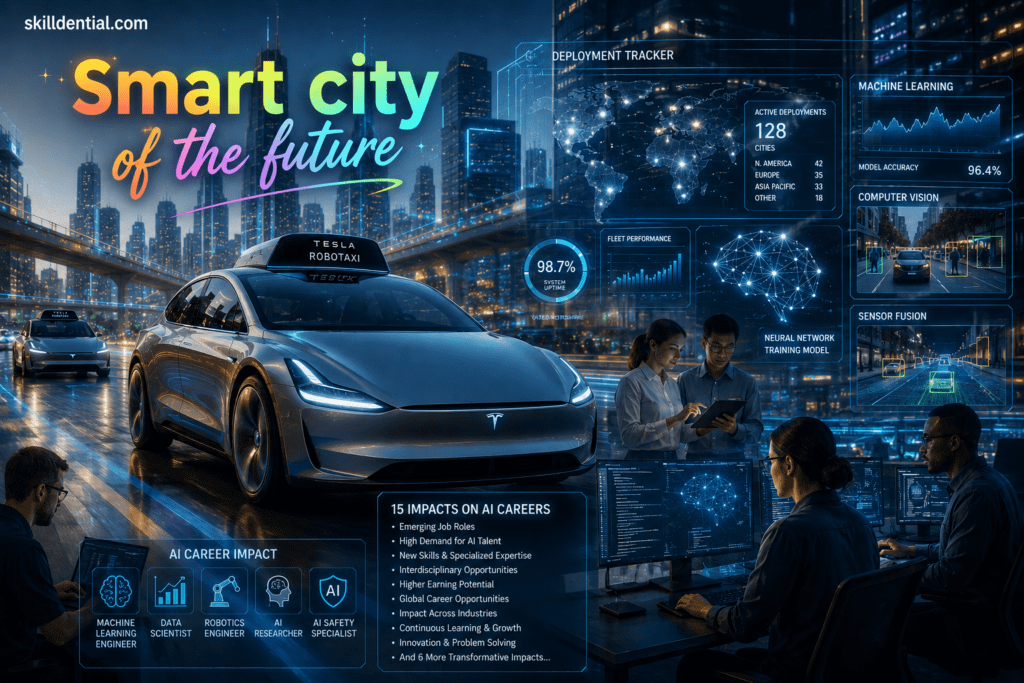
To maintain the high-leverage standards of Skilldential, these 15 impacts categorize how the Tesla Robotaxi Deployment Tracker dictates market value:
| Domain | Impact Category | Career Shift Opportunity |
| Technical Stack | Simulation Engineering | Moving from standard CI/CD to high-fidelity digital twin creation. |
| AI/ML | Data Engine Ops | Transitioning from general ML models to edge-case-heavy synthetic data generation. |
| Operations | Fleet Orchestration | Moving from legacy logistics to AI-optimized autonomous traffic control. |
| Hardware | Sensor/Compute Integration | Transitioning from general systems engineering to specialized AI4/AI6 silicon optimization. |
| Regulation | Compliance Tech | Bridging technical capabilities with localized legislative data requirements. |
What is the Tesla Robotaxi Deployment Tracker?
The Tesla Robotaxi Deployment Tracker serves as a vital analytical instrument for professionals monitoring the transition from supervised driver-assistance to fully unsupervised fleet operation. As of June 2026, the tracker reveals a significant delta between announced ambitions and current operational scale.
Current Market Status (June 2026)
While public messaging highlights rapid expansion, the Tesla Robotaxi Deployment Tracker exposes a high-friction reality:
- Geographical Footprint: Service is active in Austin, Dallas, and Houston, with active regulatory and testing pipelines in Phoenix, Miami, Orlando, Tampa, and Las Vegas.
- Fleet Scale vs. Map Coverage: While service maps for Austin now cover the entire metropolitan area, the active driverless fleet remains concentrated (estimated at ~42–59 vehicles statewide in Texas). This creates a “coverage vs. capacity” gap, where wide geographic availability masks low vehicle density and longer wait times compared to incumbent competitors.
- Cybercab Integration: Purpose-built Cybercab production commenced at Giga Texas in Q2 2026. However, management has signaled that initial manufacturing volume is “agonizingly slow,” with material scaling—and the subsequent impact on fleet economics—targeted for late 2026 into 2027.
Career Impact Vectors
For AI and robotics professionals, the Tesla Robotaxi Deployment Tracker acts as a leading indicator for specific skill demand:
| Domain | Infrastructure/Talent Shift |
| Edge Autonomy | Demand is pivoting from general FSD software to high-reliability edge-case resolution for unsupervised operations. |
| Fleet Ops | Scaling from human-supervised “demonstration” mode to automated, high-density fleet orchestration. |
| Compliance Tech | Increasing necessity for roles that bridge technical FSD milestones with state-level DMV self-certification and autonomous network permitting. |
Monitoring these shifts allows you to align your career trajectory with the specific inflection points—such as state-level regulatory approvals or Cybercab production ramps—that necessitate large-scale hiring in autonomous systems engineering and infrastructure management.
The video above provides a deep dive into the manufacturing and strategic framework surrounding the Cybercab rollout, offering context on how the production timeline impacts the broader autonomous mobility roadmap.
How is Tesla’s Robotaxi rollout progressing in 2026?
As of June 2026, the Tesla Robotaxi Deployment Tracker indicates a significant gap between ambitious public roadmaps and current operational reality. While Tesla has successfully expanded its service area to the entirety of the Austin Metropolitan Area, the fleet scale remains constrained, posing challenges for widespread commercial adoption.
Current Operational Status (June 2026)
- Geographic Footprint: The service is active in three Texas markets: Austin, Dallas, and Houston. While the Austin service area now covers the entire metro region, performance in other cities remains in early, restricted phases.
- Fleet Constraints: Public filings and independent trackers estimate the active Robotaxi fleet size to be between 42 and 59 vehicles across all markets. This is substantially lower than investor expectations and current industry standards set by competitors like Waymo.
- Operational Friction: Users report inconsistent availability, with peak wait times often exceeding 30 minutes. The service currently relies on a mix of supervised and unsupervised Model Y vehicles.
Infrastructure & Scaling
- Cybercab Production: Production of the purpose-built, steering-less Cybercab platform commenced at Giga Texas in April 2026. Despite this, the units have not yet entered public ride-hailing service, and management has characterized the initial manufacturing ramp as slow.
- Regulatory Pipeline: Tesla is actively pursuing aggressive expansion, including a recent filing to operate up to 5,000 vehicles in Clark County, Nevada. These regulatory efforts are designed to create the infrastructure necessary to absorb future manufacturing volume.
Career Implications
For technical professionals, the current data confirms that the demand for autonomy-related talent is entering a high-friction “scaling phase” rather than a mass-market deployment phase. The primary career opportunities are shifting toward:
- Operational Efficiency: Roles focused on fleet orchestration and solving high-latency/edge-case issues that currently limit vehicle availability.
- Compliance Engineering: Bridging the gap between raw FSD algorithmic capability and the localized DMV self-certification/permitting requirements needed to move from testing to public operation.
- Manufacturing Infrastructure: Engineering roles dedicated to high-volume autonomous platform production at Giga Texas.
The video above provides an overview of the production-spec units spotted at Gigafactory Texas and summarizes the current challenges and progress in the Cybercab rollout.
How do Robotaxis create new AI and data roles?
The transition of Robotaxi fleets from controlled pilots to scalable infrastructure mandates a massive expansion of the “data-to-behavior” loop. For companies like Tesla, the physical fleet serves as a high-velocity sensor array that requires a sophisticated industrial-grade data architecture to function.
This architecture creates a specific set of high-leverage roles tasked with managing the lifecycle of autonomous intelligence.
The Autonomous Data Lifecycle & Role Evolution
The creation of new roles is driven by the necessity to move petabytes of raw, unstructured data (video, LiDAR, telemetry) into production-grade driving models. Each stage of this pipeline requires specialized talent:
- Data Ingestion & Orchestration: As the fleet scales, engineers must design systems that can ingest, validate, and store raw logs across disparate geographical locations. This requires Data Infrastructure Engineers who can manage high-throughput, low-latency pipelines.
- Intelligent Curation & Labeling: Not all miles driven provide equal value. Teams now prioritize “high-value” data (e.g., edge cases, near-misses, complex intersections). Machine Learning Data Engineers build automated systems to index, search, and curate this data, often using generative AI to create synthetic scenarios that fill gaps in the real-world dataset.
- Model Training & Validation: With the shift toward end-to-end neural networks (such as those powering FSD), there is a surge in demand for ML Infrastructure Engineers who can optimize distributed training across massive GPU clusters, ensuring consistency and reproducibility in model checkpoints.
- Closed-Loop Simulation: To achieve safety milestones, code cannot be pushed directly to vehicles. Simulation Engineers build high-fidelity “digital twins” of urban environments, allowing the team to test new model iterations against billions of virtual miles before deployment.
Strategic Career Impacts
The rise of Robotaxi-scale deployments fundamentally shifts the AI labor market in three ways:
- From Generic ML to Physical AI: Roles are pivoting away from abstract LLM/NLP tasks toward “Physical AI”—where models must interact with the laws of physics, hardware latency, and real-time safety constraints.
- The Rise of MLOps/DataOps for Edge: Standard MLOps practices are being adapted for edge computing. Professionals who can manage model deployment across thousands of remote nodes while monitoring for performance drift are becoming industry cornerstones.
- Compliance-Linked Engineering: Regulatory requirements for “safety-critical systems” mean that engineering output must be auditable and explainable. This creates a niche for engineers who can bridge the gap between high-performance model design and strict regulatory transparency.
For the professional, the “Robotaxi-driven” job market is moving toward roles that sit at the intersection of systems engineering, cloud-scale data management, and computer vision. The value isn’t just in training models—it is in building the automated factories that train them.
What are the 15 key Robotaxi impacts on AI careers?
The transition to a fleet-scale autonomous network is fundamentally an exercise in industrial-scale data engineering. As the Tesla Robotaxi Deployment Tracker signals growth, the following 15 impacts define the shifting landscape for AI and technical professionals.
The 15 Impacts on AI Careers
The Tesla Robotaxi deployment is more than a transportation innovation. It represents a major advancement in real-world AI adoption. As autonomous vehicle technology scales, demand for specialized AI talent is expected to grow across multiple disciplines. Here are 15 key ways Tesla Robotaxi deployment could shape the future of AI careers.
Surge in Autonomous Driving Engineers
The shift toward high-fidelity urban autonomy represents a fundamental move away from the structured, predictable environment of highway driving. For autonomous driving engineers, this transition demands a move from simple lane-keeping logic to complex, interaction-based behavioral modeling.
The Urban Complexity Shift
Unlike highways, where the focus is on maintaining speed and lane position with relatively long reaction times, urban environments are defined by:
- Dynamic Agents: Pedestrians, cyclists, and delivery vehicles move with high degrees of intent and unpredictability.
- Multipath Complexity: Urban infrastructure (buildings, metal signs, glass) creates reflections and “noise” that challenge standard radar and camera perception stacks.
- Regulatory & Semantic Complexity: Interpreting traffic lights, temporary construction signage, and “soft” rules (like right-of-way in an uncontrolled intersection) requires more than just spatial awareness; it requires semantic understanding of the scene.
Technical Implications for Engineering Roles
To function in dense settings, the perception and planning stacks must evolve from “obstacle avoidance” to “cooperative navigation”:
- Prediction as a First-Class Citizen: Urban planning is no longer about where objects are, but where they might go in the next 3–5 seconds. This necessitates Query-Based Prediction Models that account for intent.
- Hierarchical Planning: Engineers must implement decoupled architectures where a high-level behavioral planner sets the strategy, while a low-level, kinematically feasible path planner executes the trajectory using nonlinear optimization.
- Real-Time Latency Budgets: In urban environments, a 100ms delay in inference can be the difference between a safe merge and a collision. Engineers must master model quantization, GPU optimization, and edge-computing efficiency to keep the perception-to-actuation loop within millisecond constraints.
- Simulation Fidelity: Because real-world urban data is expensive and dangerous to acquire, the “Digital Twin” has become the primary site of development. Engineers must build environments that can simulate not just the road, but the interactions—people walking into streets, cars double-parking, and weather anomalies.
Critical Skill-Gap
The most valuable engineers today are those who can bridge the gap between high-level deep learning (perception/prediction) and low-level control theory (trajectory execution). You are looking to move from being an “algorithm builder” to a “system orchestrator” who understands how a slight change in a computer vision detection confidence interval ripples through the entire safety and planning stack.
The video above details the specific challenges of urban environments, such as sensor noise and the necessity of high-resolution radar for critical safety, which is essential for understanding the technical hurdles of urban autonomy.
Expansion of Computer Vision (CV) & Sensor Fusion
This specialized field represents one of the most difficult engineering challenges in modern AI. Moving to a “vision-only” or “vision-centric” architecture—where LiDAR is excluded in favor of high-fidelity camera data—shifts the burden from hardware-based measurement to software-based inference.
The Engineering Pivot: From “Measurement” to “Inference”
In a multi-sensor system, LiDAR provides a direct “ground truth” for depth and distance, essentially giving the vehicle a physical map of its surroundings. In a vision-only system, the vehicle must “hallucinate” this 3D depth using only 2D pixel data.
- Spatial Awareness via Deep Learning: Instead of relying on a laser to measure the distance to a car, perception models must use geometric priors, motion parallax, and object recognition to infer depth. This requires massive neural networks trained on petabytes of driving data to correlate 2D visual cues with actual physical distances.
- The “Data Engine” Requirement: Without LiDAR to act as a fallback, the vision system must be perfect. This creates a massive demand for engineers who can manage the automated labeling pipeline. You aren’t just building a model; you are building the factory that generates the data to teach the model how to “see” depth.
- Computational Efficiency (Foveated Vision): Fusing data from eight or more high-resolution cameras in real-time is computationally expensive. Engineers must implement “foveated” processing—allocating high-resolution compute only to the parts of the image (like the horizon) where high-precision detection is required, and downsampling the rest to save energy.
Strategic Value for AI Careers
For an engineer, this shift represents a move from Systems Integration (plugging in sensors and merging their data) to Core Architectural AI (designing the models that interpret reality).
| Focus Area | Challenge | Career Opportunity |
| Depth Inference | Inferring 3D from 2D. | Expert in Transformer-based vision architectures. |
| Edge-Case Resilience | Handling glare/low light/occlusion. | Specialist in synthetic data generation and digital twins. |
| Model Quantization | Running complex inference on car hardware. | Edge AI optimization (CUDA/TensorRT/C++). |
The “Hidden” Complexity
The primary barrier to vision-only autonomy is not the cameras; it is uncertainty. In a LiDAR-equipped system, if the vision system fails to identify a box in the road, the LiDAR still detects an “obstacle” and stops the car. In a vision-only system, the perception model must be robust enough to recognize the “shape” of an obstacle even if it has never seen that specific object before. This is why the industry is seeing a massive surge in demand for Foundational Vision Research—moving beyond “object detection” toward “general scene understanding.”
The video above explores the fundamental technical debate between vision-only architectures and multi-sensor systems, providing insight into the engineering hurdles of depth estimation and redundancy that define this career path.
Increased Demand for Machine Learning Engineers (MLEs)
In the context of Robotaxi fleets, the Machine Learning Engineer (MLE) role has evolved from a researcher who “trains a model” into a systems engineer who maintains a high-velocity industrial pipeline.
Because Robotaxi environments are non-static—weather changes, road construction occurs, and edge cases appear daily—models suffer from “silent degradation” (data drift) where they continue to function but lose accuracy. The MLE is the architect responsible for ensuring this does not result in safety failures.
The “Data-to-Deployment” Pipeline
In this domain, the pipeline must be fully automated to support continuous improvement. The MLE’s responsibilities focus on the reliability and observability of these four stages:
- Automated Ingestion & Curation: The fleet acts as a continuous sensor array. MLEs build automated pipelines that sift through petabytes of raw data to identify “high-value” samples (e.g., a near-miss at a complex intersection) and discard redundant information.
- Continuous Training (CT): The pipeline is triggered automatically by performance degradation detected in production or by a scheduled refresh. The MLE manages the infrastructure to ensure that retraining on new data does not cause “catastrophic forgetting”—where the model improves on new scenarios but regresses on previously mastered skills.
- Validation & “Model Blessing”: Before any updated model reaches the fleet, it must pass automated “gatekeeping.” This involves running the model through high-fidelity digital twin simulations to verify it doesn’t violate safety constraints or introduce new bias.
- Deployment & Monitoring: Updates are rolled out using Canary or A/B deployment strategies. The MLE monitors production metrics—such as intervention rates or prediction confidence scores—to ensure the new model performs as expected.
Key Shift: From Research to Reliability
The value of an MLE in this space is defined by their ability to treat model training as a production service.
| Capability | Legacy MLE/Data Scientist | Modern Robotaxi MLE |
| Primary Output | High-performing static model. | Stable, reproducible training pipeline. |
| Performance Metric | Model accuracy (e.g., F1-score). | Fleet safety, intervention rate, & compute cost. |
| Debugging Focus | Identifying algorithmic flaws. | Identifying data drift & pipeline bottlenecks. |
| Tooling | Jupyter Notebooks, local training. | Kubernetes, distributed GPU orchestration, CI/CD. |
Strategic Professional Development
To excel in this role, you must move beyond building models and become an expert in systemic reliability.
- Master the Infrastructure: Proficiency in distributed training (PyTorch/TensorFlow on clusters), container orchestration (Kubernetes), and workflow orchestration (Airflow/Prefect) is no longer optional.
- Embrace Observability: Learn to instrument your models with telemetry that triggers retraining before the fleet encounters a dangerous failure.
- Understand the “Data Engine”: Focus on the data lifecycle. The most successful engineers in this space are those who build the tools to automate the creation of labeled datasets from raw fleet logs, rather than those who manually tune hyperparameters.
The “data-to-deployment” cycle is the heartbeat of a Robotaxi company. By mastering the automation of this loop, you position yourself at the most critical control point of autonomous infrastructure.
Growth of AI Safety Engineering
The Tesla Robotaxi Deployment Tracker serves as a vital barometer for this shift. As Tesla moves toward unsupervised operation, the industry focus is rapidly migrating from “performance optimization” to “formal safety assurance.” This creates a new career pillar: AI Safety Engineering.
The Strategic Shift: From Ethics to Engineering
Historically, AI safety was framed as an abstract ethical debate. For autonomous systems, that era is over. The Tesla Robotaxi Deployment Tracker now tracks the metrics—such as Miles Per Incident (MPI) and intervention frequency—that regulators use to determine the threshold for driverless approval. This has forced safety engineering into a rigorous, deterministic discipline.
Core Technical Pillars for AI Safety Careers
To succeed in this role, you must translate fuzzy real-world safety requirements into hard, verifiable mathematical proofs.
1Formal Verification
Instead of relying solely on “testing” (which is inherently incomplete), AI Safety Engineers use Formal Methods to prove that a model will always adhere to safety constraints.
- Model Checking & Theorem Proving: Using mathematical logic to verify that the AI’s decision-making logic cannot reach an “unsafe” state, regardless of the input.
- Reachability Analysis: Calculating the set of all possible outputs the AI can produce for a given set of inputs to ensure they stay within a “Safe Polytope”—a bounded zone of safe vehicle behaviors.
2Statistical Verification
The Tesla Robotaxi Deployment Tracker helps identify the “long tail” of edge cases—the statistically rare, high-stakes incidents. AI Safety Engineers use this data to perform:
- Probabilistic Safety Cases: Calculating the likelihood of failure based on sensor confidence levels and environmental variables (e.g., fog backscatter index, glare saturation).
- Assurance Gates: Implementing “software locks” that force the vehicle into a fail-safe state (e.g., controlled stop) if the AI’s perception confidence drops below a deterministic threshold.
Explainable Safety Audits
Regulators now demand “tamper-evident” audit trails. When a vehicle behaves unexpectedly, safety engineers must provide a deterministic log explaining why the decision was made. This requires deep technical expertise in:
- Traceable Decision Logs: Recording the state of the neural network at the exact moment of an intervention.
- Failure Mode Analysis (HARA): Systematically mapping environmental triggers (like heavy rain or non-standard pedestrian crossings) to specific perception errors.
Career Leverage: The “Safety-Case” Expert
The professional who masters these techniques acts as the bridge between stochastic AI models (which are unpredictable) and deterministic safety requirements (which are mandatory for public road operation).
| Role | Skill Focus | Strategic Value |
| Safety Case Engineer | Hazard Analysis, Assurance Frameworks | Provides the “safety argument” to regulators to unlock deployment. |
| Formal Methods Specialist | Model Checking, SMT Solvers | Guarantees code correctness for safety-critical logic. |
| Fleet Reliability SRE | Incident Triage, Root-Cause Analysis | Ensures the fleet stays within its “Safe Operational Domain.” |
For an audience focused on high-leverage growth, the safety engineering path is one of the most resilient. As the Tesla Robotaxi Deployment Tracker reflects an increasingly dense autonomous landscape, the demand for professionals who can “mathematically guarantee” the safety of these fleets will continue to outpace the supply of traditional AI engineers.
Are you interested in the specific mathematical frameworks (like SMT solving or control barrier functions) used to build these “Safety Gates”?
New Robotics Software Engineer Roles
The Tesla Robotaxi Deployment Tracker highlights an increasing reliance on Robotics Software Engineers who act as the essential integration layer. As autonomous fleets transition from pilot testing to large-scale operations, the “integration gap” between high-level AI perception and low-level mechanical control has become the primary bottleneck for reliability and scalability.
The Role: Integration as the “System Glue”
In this architecture, high-level AI models (perception, prediction, routing) provide the “intent,” but the hardware actuators (steering, braking, acceleration) require precise, real-time “execution.” The Robotics Software Engineer bridges these two domains.
Key Engineering Responsibilities:
- Latency Management: Ensuring that the AI’s “decision” (often calculated in milliseconds) reaches the vehicle’s embedded controllers without jitter or dropped frames, which is critical at urban speeds.
- Hardware Abstraction Layers (HAL): Designing standard interfaces that allow high-level AI perception models to interact with diverse hardware generations (e.g., transitioning from AI4 to AI6 silicon) without needing a total software rewrite.
- Deterministic Fallbacks: Developing “safety-critical” low-level code that can take over if the high-level AI perception system fails, ensuring the vehicle can perform a controlled stop even in the absence of valid high-level input.
- Simulation-to-Real Synchronization: Translating virtual simulation logic (created in “digital twins”) into physical vehicle movement, ensuring that the performance gains seen in training translate 1:1 to the real-world deployment monitored by the Tesla Robotaxi Deployment Tracker.
The Strategic Value of This Role
For technical professionals, this is a “high-leverage” career path because it requires mastery of both the Stochastic (AI/ML models) and the Deterministic (Control Theory/Embedded Systems).
| Responsibility | Skill Requirement | Strategic Value |
| Real-Time Integration | C++, ROS2, Middleware (DDS/gRPC) | Ensures system-wide safety and performance. |
| Edge-Case Triage | Hardware-in-the-loop (HIL) Testing | Bridges the gap between lab-testing and road-safety. |
| Feedback Loops | Telemetry/Log Analysis | Directly informs the retraining of perception models. |
As the Tesla Robotaxi Deployment Tracker continues to indicate expansion into new, complex metropolitan environments, the companies that succeed will be those that minimize the friction between “thought” (AI) and “action” (Control). Engineers capable of facilitating this flow are becoming the highest-valued assets in the autonomy sector.
The video above provides a clear, data-backed assessment of the current state of Tesla’s autonomous infrastructure and the complexities involved in scaling fleet deployments.
Scale-up of Data Annotation & Labeling Specialists
The Tesla Robotaxi Deployment Tracker serves as a vital indicator of when and where the next wave of data demand will hit. As Robotaxi fleets expand from controlled pilot environments into new cities, the volume of raw, high-resolution sensor data grows exponentially. This creates an urgent, scalable need for data curation that manual labor alone cannot satisfy.
Consequently, the role of the Data Annotation Specialist is undergoing a radical transition. The value is shifting away from simple “box-drawing” toward the design and maintenance of automated labeling ontologies and synthetic data pipelines.
The Evolution: From “Worker” to “Architect”
The current bottleneck in scaling autonomy is not the lack of raw video; it is the scarcity of “high-value” data—the rare edge cases that cause model performance to dip.
- Automated Labeling Ontologies: Specialists now define the rules for AI models to label themselves. Instead of manually drawing boxes, these professionals design complex taxonomies that teach the AI how to classify objects, behaviors, and relationships (e.g., “Yielding behavior” vs. “Aggressive cut-in”).
- Synthetic Data Pipelines: As companies look to fill “data gaps” (e.g., extreme weather or rare accident scenarios), specialists design the scenarios in high-fidelity simulation environments. They oversee the generation of synthetic datasets that provide the AI with millions of training examples that would be impossible or unsafe to capture on the road.
Strategic Career Leverage
For an expert professional, the Data Annotation sector is no longer an entry-level dead end. It has become the “Data Engine” control room.
| Role | Responsibility | Strategic Value |
| Ontology Architect | Designing the “language” of perception. | Ensures the AI “understands” the world correctly. |
| Synthetic Pipeline Lead | Designing simulation-based training. | Solves the “long tail” of rare edge cases. |
| Data QA/Reliability | Validating automated labeling output. | Prevents “data poisoning” in the training pipeline. |
The “Build Once, Scale Forever” Philosophy
For Skilldential readers, this is a prime example of the “build once, scale forever” framework. A specialist who manually labels 1,000 images has a linear impact. An Ontology Architect who designs the system to automatically label 1,000,000 images has a multiplicative impact on the fleet’s deployment velocity.
As the Tesla Robotaxi Deployment Tracker shows growth into new markets like Florida or Nevada, the need for specialists who can quickly “stand up” an automated labeling pipeline for that region—accounting for local driving customs and infrastructure—will be the defining factor in how fast Tesla can launch its service.
Rising Need for Simulation Engineers
The Simulation Engineer is the architect of the “virtual proving ground.” As the Tesla Robotaxi Deployment Tracker signals expansion, the ability to test autonomous systems in high-fidelity, risk-free environments becomes the primary multiplier for deployment velocity.
The Role: Building the “Digital Twin”
Simulation engineers do not just run tests; they construct, calibrate, and maintain the virtual mirrors of the physical world—known as digital twins. These environments enable the “infinite testing” of AI behavior against millions of virtual miles, covering scenarios that would be too dangerous or too rare to encounter on public roads.
Key Engineering Responsibilities
- Environment Synthesis: Creating photorealistic, physically accurate 3D replicas of cities, highways, and intersections. This includes modeling road geometry, traffic signals, and complex human behaviors (e.g., erratic pedestrians, aggressive merging).
- Physics-Based Sensor Modeling: Simulating the raw data output of cameras, radar, and other sensors. Engineers must ensure the virtual sensor data matches the noise, glare, and resolution characteristics of real-world hardware, such as the AI4/AI6 sensor suites.
- Scenario Generation & Edge-Case Injection: Systematically creating “what-if” scenarios. If the Tesla Robotaxi Deployment Tracker identifies an expansion into a region with high rainfall, simulation engineers must build and stress-test the model’s performance in virtual rain scenarios before the real vehicles arrive.
- Closed-Loop Pipeline Integration: Designing the “Software-in-the-Loop” (SIL) and “Hardware-in-the-Loop” (HIL) pipelines where the actual autonomy software stack (the “virtual driver”) interacts with the simulation in real time.
Strategic Value for AI Careers
The simulation engineer is a productivity multiplier. By enabling rapid iteration, they determine how quickly the team can move from a “prototype” to a “production-ready” model.
| Responsibility | Skill Requirement | Strategic Value |
| Physics/Graphics | Game engines (Unreal/Unity), 3D Math | Creates high-fidelity “Digital Twins.” |
| Scenario Automation | Python, C++, Scenario definition languages | Enables “Infinite Testing” scalability. |
| Data Synchronization | ROS2, Distributed Computing | Ensures simulation results match real-world telemetry. |
The “Build Once, Scale Forever” Edge
For a Skilldential-aligned career, the simulation domain offers immense leverage. Unlike a manual test driver, a Simulation Engineer builds a platform that can run thousands of tests simultaneously, 24/7, across multiple city configurations.
As the Tesla Robotaxi Deployment Tracker records new site activations, the need for simulation experts who can rapidly generate “local” virtual environments—customized to the specific traffic laws and infrastructure of new cities—will remain a primary driver of hiring in the autonomy sector.
Strong Demand for Edge AI & Embedded Engineers
The Tesla Robotaxi Deployment Tracker reveals a critical industry inflection point: as neural networks grow in complexity, the bottleneck is shifting from “algorithm design” to “silicon-level execution.”
For Edge AI and Embedded Engineers, the challenge is no longer just shipping code; it is maintaining safety-critical performance within the fixed energy and compute constraints of vehicle hardware like AI4 and AI6.
The Engineering Pivot: Optimization as a Core Requirement
In high-scale deployments, you cannot simply throw more GPU power at a problem. The car is a power-constrained environment. Engineers must treat every clock cycle and byte of memory as a finite resource.
Key Engineering Domains for High-Leverage Impact
- Model Quantization: Transitioning neural networks from high-precision floating-point (FP32) to lower-precision integers (INT8/INT4). This reduces memory footprint and increases inference speed by orders of magnitude, often with negligible accuracy loss, which is essential for real-time responsiveness.
- Hardware-Software Co-Design: Tailoring model architectures to the specific instruction sets of AI4/AI6 silicon. This involves deep expertise in kernel optimization, custom CUDA programming, or utilizing vendor-specific accelerators to maximize throughput.
- Latency Determinism: Ensuring that the perception-to-actuation loop executes in a predictable time frame. Embedded engineers must master Real-Time Operating Systems (RTOS) and interrupt handling to guarantee that safety-critical path planning is never delayed by background data processing.
- Memory Management & Sparsity: Implementing “pruning”—removing redundant neurons—and optimizing memory access patterns to prevent the system from bottlenecking on bus bandwidth, a common failure mode in complex vision pipelines.
Strategic Professional Development
To capitalize on this, move away from generalist software engineering and toward roles that sit at the intersection of Deep Learning and Systems Architecture.
| Engineering Focus | Technical Requirement | Strategic Value |
| Edge Optimization | CUDA, TensorRT, Model Quantization | Enables “Impossible” models to run in real-time. |
| System Reliability | RTOS, C++, Memory Safety | Guarantees safety in mission-critical hardware. |
| Hardware Integration | Driver Development, Interconnects | Optimizes the link between sensors and silicon. |
The “Build Once, Scale Forever” Edge
For a career in autonomy, mastering Edge AI is the ultimate leverage. When you optimize a model to run 2x faster or use 30% less power, that improvement scales across every single vehicle in the fleet. As the Tesla Robotaxi Deployment Tracker tracks the deployment of thousands of Cybercabs, your optimization work—once deployed—continues to deliver value across the entire distributed network without further human intervention.
Expansion of AI Infrastructure & MLOps
The scale of autonomous vehicle (AV) operations requires moving beyond traditional software maintenance into industrial-scale AI operations. As the Tesla Robotaxi Deployment Tracker signals expansion, the “AI Factory”—the infrastructure that turns petabytes of raw sensor data into actionable driving models—becomes the primary competitive moat.
The Role of AI Infrastructure & MLOps
In an AV context, MLOps is not just about deploying models; it is about managing a high-concurrency, high-throughput data-to-behavior lifecycle. Infrastructure engineers here are responsible for the physical and logical architecture that keeps thousands of GPUs running at near 100% utilization.
Managing Distributed GPU Clusters
Unlike standard cloud workloads, large-scale model training for AVs (e.g., end-to-end transformers for FSD) requires massive parallelization across thousands of GPUs.
- The “Straggler” Problem: In distributed training, every GPU must synchronize its gradients after each batch. If one node is slow due to network congestion or hardware failure, the entire multi-million dollar cluster sits idle. AI Infrastructure engineers design non-blocking, leaf-spine network fabrics and implement RDMA (Remote Direct Memory Access) to allow GPUs to communicate directly, bypassing CPU bottlenecks.
- Orchestration: Using tools like Kubernetes, engineers orchestrate these clusters to dynamically allocate resources for different training jobs, ensuring that high-priority “edge case” retraining happens immediately, while routine testing jobs run in the background.
Large-Scale Data Orchestration
The fleet is a continuous sensor array generating petabytes of raw, unstructured data. MLOps teams must build the pipeline to handle this volume:
- The Data Stall Bottleneck: The primary cause of low GPU utilization is not compute; it is I/O. If the storage system cannot feed data to the GPUs fast enough, the hardware idles. Engineers optimize this by implementing tiered storage, geo-distributed caching, and high-throughput data pipelines that ensure “warm” training data is always ready for the GPUs.
- Automated Data Quality: You cannot train safe models on “dirty” data. Engineers implement automated validation layers that scan ingested sensor logs for sensor noise, calibration errors, or missing metadata before they ever reach the training cluster.
The Strategic Value of This Career Path
The professionals who master this domain bridge the gap between abstract AI research and real-world deployment. They move from “building models” to “building the machines that build models.”
| Responsibility | Skill Requirement | Strategic Value |
| Cluster Orchestration | Kubernetes, Ray, Slurm, GPU Scheduling | Maximizes hardware ROI and training velocity. |
| Network/IO Optimization | RDMA, RoCEv2, Distributed Storage | Eliminates “Data Stalls” and “Stragglers.” |
| Pipeline Automation | Airflow, MLflow, CI/CD for ML | Ensures reproducible, high-speed model iteration. |
| Observability | Prometheus, Grafana, Distributed Tracing | Proactively identifies model/data drift before safety failures. |
The “Build Once, Scale Forever” Edge
For a career in autonomy, mastering AI Infrastructure is arguably the highest-leverage path available. When you optimize a distributed training pipeline to run 20% faster, that efficiency gain compounds every single day across every training run in the organization. As the Tesla Robotaxi Deployment Tracker drives the need for more frequent, more localized model updates, the companies that win will be those that have turned “continuous model delivery” into an automated commodity.
Growth in Fleet Data Operations
In the context of the Tesla Robotaxi Deployment Tracker, the emergence of Fleet Data Operations is the critical enabler for scaling. As the fleet expands, the volume of sensor data transitions from “manageable” to “petabyte-scale,” turning data engineering into a core autonomous driving capability rather than a support function.
The Evolution: Data Engineering for Autonomy
The primary challenge for fleet data operations is not storage, but curation. Most miles driven by a robotaxi are “low-value” (e.g., cruising on a clear highway). The goal of these operations is to identify and extract the “high-value” data—the rare interactions, edge cases, and safety-critical anomalies—that actually improve the driving model.
Core Competencies for Fleet Data Engineers
- Automated Data Lifecycle (DataOps): Engineering automated pipelines that ingest, validate, and move raw sensor logs from the vehicle to cold storage, and ultimately to high-performance “hot” storage for ML teams. This involves rigorous manifest validation, deduplication, and lifecycle management (e.g., archiving or deleting redundant data).
- High-Value Corner Case Indexing: Implementing advanced indexing systems that allow ML practitioners to query petabytes of data for specific semantic scenarios—such as “pedestrian crossing in heavy rain” or “unprotected left turn with occluded traffic”—in seconds.
- Marginality Quantification: Building frameworks that quantify the “novelty” or “risk” of a scenario. Data engineers develop these tools to automatically flag data that contains new interaction patterns, which are then prioritized for labeling and training.
- Synthetic Data Integration: Bridging real-world data operations with simulation. When real-world data for a specific corner case is unavailable, fleet data operations must be able to generate synthetic equivalents, maintaining a unified data format and schema across both domains.
Strategic Leverage in Autonomous Scaling
For a professional, mastering Fleet Data Operations means becoming the architect of the “Data Flywheel.” Every efficiency gain in how you ingest, curate, and index data compounds across the entire fleet.
| Responsibility | Skill Requirement | Strategic Value |
| Data Orchestration | Spark, EMR, Distributed Storage (S3/HDFS) | Eliminates pipeline bottlenecks at petabyte scale. |
| Queryability | Data indexing, Parquet/Arrow formats | Reduces “time-to-insight” for ML engineers. |
| Data Quality | Automated ETL/Validation pipelines | Prevents “data poisoning” in model training. |
| Scenario Discovery | Semantic data querying, Metadata management | Directly accelerates the model’s “learning” velocity. |
The “Build Once, Scale Forever” Edge
For a career in autonomy, Fleet Data Operations is where the “industrialization” of AI happens. Unlike roles that focus on single-model accuracy, you are building the infrastructure that feeds the entire development ecosystem. As the Tesla Robotaxi Deployment Tracker signals expansion, the companies that succeed will be those with the most efficient “data-to-training” pipelines.
The video above demonstrates the technical challenge of querying billions of data points in real time, illustrating the infrastructure required to manage the massive datasets typical of modern autonomous fleets.
New Opportunities in Regulatory & Policy Analytics
As the Tesla Robotaxi Deployment Tracker signals expansion, the gap between “technical performance” and “legal permission” has become a critical bottleneck. Regulatory bodies—such as the NHTSA and state-level DMVs—require exhaustive, tamper-evident proof that autonomous systems operate within their “Safe Operational Domain.”
This necessity has created a high-value niche for professionals who function as the “compliance interface” for AI. These experts do not merely handle paperwork; they build the data translation layer between raw machine telemetry and regulatory safety requirements.
The Engineering-to-Compliance Translation Layer
In this role, you are tasked with transforming massive, unstructured sensor and log data into structured, “auditable” evidence. This requires a synthesis of technical literacy and policy fluency.
- Log-to-Compliance Mapping: When an autonomous system performs a maneuver, engineers generate a “log entry.” Regulatory analysts must map these technical logs—such as sensor confidence scores or path-planning triggers—to specific regulatory safety criteria, such as “adherence to traffic signals” or “object detection latency standards.”
- Safety Assurance Arguments: Regulatory bodies increasingly require “Safety Cases”—structured documents that argue a system is safe based on evidence. You are responsible for extracting the correct evidence (e.g., simulation success rates in specific weather conditions, validation of redundant system hand-offs) from petabytes of data to build these arguments.
- Quantitative Safety Metrics: You are building the “safety dashboard” that regulators use to approve expanded operations. This involves defining the KPIs—like frequency of critical disengagements, sensor health status, or system-level uptime—and ensuring these metrics are calculated with 100% integrity.
Strategic Value for AI Careers
This career path offers high leverage for professionals who want to avoid the “commodity” AI roles. You are positioning yourself as a “Safety-Critical Systems Expert.”
| Responsibility | Skill Requirement | Strategic Value |
| Audit Log Design | Data Engineering, Compliance standards | Creates “tamper-evident” evidence of safety. |
| Safety Case Building | Quantitative Analysis, Policy Fluency | Translates model performance into legal “Permission to Operate.” |
| KPI/Metric Definition | Statistical Modeling, Domain Expertise | Sets the “bar” for what counts as a safe Robotaxi. |
The “Build Once, Scale Forever” Edge
For a career in autonomy, mastering Regulatory & Policy Analytics is about controlling the velocity of deployment. When you design a streamlined, automated compliance pipeline that takes raw fleet logs and instantly generates a DMV-ready safety report, you are directly accelerating the company’s expansion.
As the Tesla Robotaxi Deployment Tracker signals entry into new regions, the ability to rapidly “stand up” a compliance framework tailored to local regulations—without adding massive headcount—is a superpower that companies will pay a premium for.
Increase in SRE-style Fleet Reliability Roles
The Tesla Robotaxi Deployment Tracker serves as a vital record of fleet expansion, but as the scale increases, the operational complexity grows non-linearly. The rise of Fleet SRE (Site Reliability Engineering) roles marks the shift from “experimental autonomy” to “industrial-scale infrastructure operations.”
The Role: Fleet SRE as the “24/7 Safety Architect”
Fleet SREs do not drive cars; they operate the Distributed Safety System that keeps the fleet running. They view the entire autonomous fleet as a massive, geographically distributed data center on wheels.
Key Engineering Responsibilities:
- Incident Triage & Observability: Fleet SREs build the “cockpit” for fleet monitoring. This includes high-resolution telemetry pipelines that allow the team to detect a vehicle anomaly in Dallas while sitting in an operations center in Austin. They must differentiate between “nuisance alerts” and “safety-critical events” in real-time.
- Remote-Operator Support (Tele-assistance): When an autonomous system reaches a high-uncertainty state (e.g., a blocked road or ambiguous construction zone), the system asks for help. SREs build the low-latency, secure communication links that allow human remote operators to provide high-level guidance (not direct driving) to the vehicle.
- Automated Rollback & Self-Healing: The SRE defines the “Safe State” logic. If a fleet-wide software update causes an unexpected spike in interventions, the SRE’s automated guardrails trigger an immediate, fleet-wide rollback to the last known “stable” model version, minimizing exposure.
- Infrastructure Resilience: Ensuring that communication infrastructure—cellular backhaul, V2X (Vehicle-to-Everything) connectivity, and edge-server responsiveness—is as reliable as the vehicle’s onboard AI.
Strategic Value for AI Careers
For the technical professional, this role represents a fusion of distributed systems engineering and real-time safety operations.
| Responsibility | Skill Requirement | Strategic Value |
| Fleet Monitoring | DataDog, Prometheus, OpenTelemetry | Provides the visibility needed to scale safety. |
| Remote-Ops Stack | Low-latency streaming, WebRTC, Security | Enables vehicles to navigate “unsolvable” edge cases. |
| Incident Automation | Python, CI/CD, Error Budgeting | Turns “manual toil” into automated system safety. |
| Safety Guardrails | Formal Methods, Logic Verification | Guarantees the system operates within defined safety limits. |
The “Build Once, Scale Forever” Edge
For a Skilldential-aligned career, the Fleet SRE path is the ultimate “leverage” position. You are not fixing a single vehicle; you are building the processes and tools that manage thousands of vehicles at once. As the Tesla Robotaxi Deployment Tracker shows expansion into new regions, your ability to automate incident resolution and remote support directly dictates how many vehicles the company can safely manage with a fixed-size operations team.
This is the transition from “human-in-the-loop” to “system-in-the-loop,” where the human is no longer a driver, but a policy-setter for an automated fleet-reliability engine.
Growth of Human Factors & HMI AI
As the Tesla Robotaxi Deployment Tracker signals expansion, the “Human Factors & HMI AI” domain has shifted from a peripheral UI concern to a mission-critical safety feature. In the absence of a human driver, the vehicle itself must replace the non-verbal cues—such as eye contact, hand gestures, and head movements—that currently govern traffic interactions.
The Engineering Challenge: Externalizing Intent
The fundamental hurdle is creating an External Human-Machine Interface (eHMI) that is universally understood. If a Robotaxi intends to yield at a crosswalk, it must communicate that intent clearly to pedestrians who would otherwise rely on seeing a driver wave them through.
Core Domains for HMI AI Development
- Intent Signaling (eHMI): Developing visual and auditory systems that broadcast the vehicle’s next action. This includes light-based signals (e.g., pulsing bars or color-coded indicators) that signal “yielding,” “stopped,” or “approaching.”
- Multimodal Communication: Relying on a single signal is dangerous. AI-driven HMI must synchronize multiple channels—visual signals, auditory tones (for the visually impaired), and even haptic feedback (in mobile app integrations)—to ensure the message is received by all road users.
- Predictive Interaction: The HMI must be “aware” of its environment. For example, if the Robotaxi detects a pedestrian hesitantly approaching a curb, the AI should trigger a signal to confirm the vehicle is yielding before the pedestrian makes the first move.
- In-Cabin Trust & Transparency: The HMI isn’t just external. Passengers need to trust the machine. This involves real-time visualization of the AI’s “mental model”—displaying the objects the car sees (pedestrians, lane lines, traffic lights) so the passenger understands why the vehicle is braking or accelerating.
Strategic Leverage for AI Careers
For the technical professional, this domain is a fusion of Behavioral Psychology and Real-time Embedded Systems.
| Responsibility | Skill Requirement | Strategic Value |
| Interaction Design | Behavioral Science, UX Research | Defines the “social contract” between AI and humans. |
| eHMI Hardware | Embedded C++, LED/Light controller integration | Ensures high-reliability broadcast of intent. |
| Scene Perception | Computer Vision (Object Detection/Intent) | Enables the AI to “see” and “react” to pedestrian cues. |
| Safety Certification | ISO 26262/Safety-Case Analysis | Bridges the gap between “concept” and “public-road approved.” |
The “Build Once, Scale Forever” Edge
This is a prime example of high-leverage work. An HMI engineer who perfects a signaling protocol for a Robotaxi’s “yield” behavior has designed a solution that will govern the behavior of thousands of vehicles in every city they enter.
As the Tesla Robotaxi Deployment Tracker tracks new expansion markets—each with unique local driving cultures and pedestrian behaviors—the ability to rapidly “tune” the HMI signaling via over-the-air updates, rather than physical design changes, is what allows a company to scale its operations globally.
New AI Product Management (AI PM)
In the context of the Tesla Robotaxi Deployment Tracker, the role of the AI Product Manager (AI PM) represents a departure from traditional software-as-a-service (SaaS) metrics. While standard SaaS PMs optimize for acquisition, conversion, and retention, AI PMs in autonomous mobility must optimize for fleet economics and operational physics.
The Shift: From User Engagement to Unit Economics
Autonomous fleet management shifts the focus from “screen time” to “asset efficiency.” An AI PM for Robotaxi services must balance the technical performance of the FSD stack with the brutal financial realities of maintaining a physical, automated fleet.
Fleet-Centric Key Performance Indicators (KPIs)
Unlike SaaS, where “churn” is a digital metric, AI PMs track physical operational efficiency:
- Cost-Per-Mile (CPM): The comprehensive cost of operating one vehicle for one mile (energy, wear-and-tear, insurance, remote-assistance costs). The AI PM’s roadmap is designed to drive this figure down through optimized routing, predictive maintenance, and energy management.
- Utilization Rate: The percentage of time a vehicle is actively transporting a passenger. High utilization is the “holy grail,” requiring the AI PM to balance fleet deployment, demand prediction, and charging infrastructure.
- Intervention Rate (Human-in-the-Loop): How often the AI requires remote-operator intervention. Every intervention is a direct hit to the unit economics, as it necessitates high-cost human overhead.
- Safe Operational Domain (SOD) Coverage: A measure of how much of a city’s geography the fleet can cover while maintaining safety benchmarks.
The Role of the AI PM in Roadmap Strategy
The AI PM defines the roadmap not by “feature releases,” but by “capability milestones” that unlock lower costs and higher availability:
| Roadmap Focus | Traditional SaaS PM | Autonomous AI PM |
| Prioritization | User feature requests (e.g., Dark Mode). | Fleet bottlenecks (e.g., reducing “unprotected left turn” failure rate). |
| Strategy | Growth/Acquisition. | Operational Efficiency (minimizing CPM). |
| Outcome | Feature adoption. | Fleet safety, uptime, and margin per ride. |
| Data Strategy | Understanding user behavior. | Mining high-value “corner cases” to retrain models. |
Strategic Value: “Build Once, Scale Forever”
For a high-leverage career, the AI PM role is unique. You are essentially the “Architect of the Fleet’s Profitability.” When you build a system to automate the scheduling of charging cycles based on real-time grid pricing or predictive maintenance that catches a sensor failure before it happens, that logic scales across the entire fleet.
As the Tesla Robotaxi Deployment Tracker signals expansion, the PMs who will be most valuable are those who can translate the “messy” data of city streets into highly predictable, high-margin operations.
Ecosystem Spillover
The expansion of autonomous fleets—monitored by the Tesla Robotaxi Deployment Tracker—creates a “force multiplier” effect. As these vehicles move from controlled tests to urban infrastructure, they generate an entirely new industrial ecosystem. For technical professionals, this spillover is where the “second wave” of career opportunity lies, extending far beyond the manufacturers themselves.
The Autonomy-Adjacent Ecosystem
The value in this sector has shifted from “building the vehicle” to “servicing the network.” This creates a massive demand for specialized, high-leverage infrastructure that allows these fleets to operate 24/7.
Inductive & Autonomous Charging Infrastructure
Autonomous vehicles cannot rely on human-plugged-in charging. The industry is currently pivoting toward hands-free, automated power delivery:
- Inductive Charging: Startups are developing road-embedded and pad-based wireless charging systems that allow vehicles to “top off” while idling at designated pick-up zones.
- Automated Plug-in Robotics: For faster charging needs, startups are engineering robotic arms that identify the charge port and initiate the connection, removing the need for manual intervention.
- Career Impact: Demand is surging for Power Electronics Engineers and Industrial Robotics Engineers who can design high-efficiency, high-durability charging hardware that functions in harsh, outdoor urban environments.
Specialized Fleet Management & Orchestration Software
A Robotaxi fleet is a massive, distributed computer system. Startups are capitalizing on the need for “off-the-shelf” orchestration software that isn’t built in-house:
- Predictive Maintenance: Platforms that ingest sensor telemetry to predict component failure before it happens, ensuring fleet uptime is maximized.
- Smart Traffic Coordination: Software that manages fleet density and routing to prevent congestion, often integrating directly with “smart city” traffic signals.
- Career Impact: This creates roles for SREs, Data Engineers, and Cloud Infrastructure Architects who can build software to manage thousands of vehicles as a single, cohesive entity.
Safety Analytics & Auditing Tools
As regulators tighten requirements, companies are outsourcing the “compliance burden” to specialized safety analytics firms:
- Third-Party Safety Auditing: Startups providing independent validation of AI safety cases, using simulation to stress-test fleets against regional traffic patterns.
- Event Data Recorders (EDR): Advanced logging and analytics software that provides forensic-level detail on incident triggers, essential for legal and insurance purposes.
- Career Impact: High demand for Safety Engineers, Cybersecurity Analysts, and Regulatory Analytics Experts who can turn raw log data into “defensible” safety reports for insurance companies and DMV regulators.
Strategic Career Leverage
For the Skilldential audience, this ecosystem spillover represents geographic and organizational arbitrage. You don’t have to work at Tesla to profit from the Robotaxi rollout.
| Spillover Sector | Strategic Value | Core Skill Focus |
| Charging Infrastructure | Enabling 24/7 fleet uptime. | Power Electronics, Embedded Systems. |
| Fleet Management SW | Increasing utilization (efficiency). | Distributed Systems, Real-time Data. |
| Safety Analytics | Unlocking regulatory approval. | Statistical Verification, Formal Methods. |
The “Build Once, Scale Forever” Edge
This sector is the ultimate realization of the ecosystem flywheel. As the Tesla Robotaxi Deployment Tracker signals growth in new cities, these “adjacent” startups scale alongside the primary manufacturer. By focusing your career on the enabling infrastructure of the autonomy economy, you insulate yourself from the volatility of any single vehicle brand and position yourself as a foundational expert in the new mobility landscape.
Which of these 15 impacts aligns most closely with your current technical trajectory?
Which skills matter most for Tesla Robotaxi-era careers?
To excel in the era of Robotaxi deployment, you must move beyond generalist AI knowledge and specialize in Physical AI—the intersection of high-level machine learning and low-level hardware constraints. As Tesla’s fleet expands, the hiring market is prioritizing engineers who can bridge the gap between “code” and “kinetic reality.”
The Autonomy Career Skills Matrix
To build a high-leverage career, focus your development on these four technical pillars. Mastery in one pillar combined with operational literacy in the others creates a highly defensible professional profile.
| Pillar | Core Technical Requirements | Strategic Value |
| Edge Autonomy | C++, CUDA, Model Quantization, RTOS | Drives real-time inference on power-constrained silicon (AI4/AI6). |
| Data Factory | Distributed Systems, Kubernetes, Kafka, Spark | Automates the ingestion/labeling of petabyte-scale sensor data. |
| Validation/Safety | Digital Twin Simulation (Unreal/Unity), Formal Methods | Reduces “time-to-deployment” by testing behaviors virtually. |
| Fleet Operations | SRE, Observability, Telemetry, Remote-Ops | Ensures fleet uptime and safety during unsupervised operation. |
Critical Technical Pillars for Robotaxi Careers
To move from theoretical interest to high-leverage participation in the autonomy sector, you must shift your focus from generalist AI development to Physical AI—the engineering of software that interacts reliably with the laws of physics, hardware limitations, and real-time safety constraints. The following pillars define the specialized technical foundation required to move from prototype development to industrial-scale Robotaxi operations.
Performance-Oriented Programming (C++/Rust/CUDA)
While Python is the language of model research, C++ and Rust are the languages of the road.
- Focus: Deep understanding of memory management, multithreading, and low-latency execution.
- Why: Robotaxi inference must run deterministically on embedded hardware. If your code exceeds the latency budget, the vehicle cannot safely navigate dense urban environments.
The “Physical AI” Pipeline
Autonomous driving is not just about training an accurate model; it is about building the infrastructure that trains the model itself.
- Focus: Automated labeling ontologies, synthetic data generation, and “closed-loop” simulation.
- Why: The ability to automatically turn raw fleet sensor logs into labeled training data is the primary differentiator for scaling speed.
Formal Safety & Verification
As fleets move toward unsupervised operation, regulators require rigorous safety proofs, not just “high performance.”
- Focus: Statistical verification, hazard analysis (HARA), and simulation-based safety case development.
- Why: You must be able to translate complex model behaviors into auditable safety logs for DMV/regulatory review.
Systems-Level Observability
Operating a fleet of thousands of autonomous vehicles is fundamentally a distributed systems problem.
- Focus: Telemetry pipelines, incident triage, and automated rollback systems.
- Why: When a vehicle in a remote city encounters an “unsolvable” edge case, your ability to diagnose, triage, and remotely support that vehicle—without human intervention—is what dictates fleet-scale economics.
The “Build Once, Scale Forever” Strategy
To differentiate yourself, do not aim to be a “model trainer.” Instead, aim to be an Infrastructure Architect for the autonomy pipeline. The person who builds the tool that automates model deployment, monitors for drift, and triggers automated rollbacks is infinitely more valuable to a scaling Robotaxi company than the person who manually fine-tunes the hyperparameters of a single neural network.
As the Tesla Robotaxi Deployment Tracker signals growth, the industry is shifting from the “Experimental Phase” (where research-centric skills were prized) to the “Scaling Phase” (where systems-centric, reliability-focused engineering skills are the absolute priority).
Which of these four pillars—Edge Autonomy, Data Factory, Validation/Safety, or Fleet Operations—do you feel is the weakest point in your current professional stack?
How can aspiring AI professionals prepare for Robotaxi-driven roles?
Aspiring professionals must pivot from “model-centric” thinking—focused on accuracy scores in Jupyter notebooks—to “system-centric” engineering, where performance is only valid if it remains stable, safe, and efficient under production constraints.
The Robotaxi Readiness Framework
To bridge the gap between academic interest and industrial utility, structure your preparation around these three high-leverage domains:
Implement Production-Grade Autonomy Pipelines
Don’t just train a vision model; build an end-to-end stack.
- Action: Create a project that ingests raw data, processes it through a perception model, and outputs a control command in a simulated environment (e.g., using ).
- The “Production” Twist: Implement basic monitoring and safety constraints. What happens when your model encounters “noise” (e.g., low light or occlusions)? If you can demonstrate an automated “fail-safe” trigger or a data-drift alarm, you are already ahead of 90% of candidates.
Master the “Infrastructure-as-Skill”
The most sought-after engineers in the Tesla Robotaxi Deployment Tracker ecosystem are those who understand how to deploy and manage models at scale.
- Action: Practice using Kubernetes to manage distributed training jobs, or implement a CI/CD pipeline for ML (using tools like GitHub Actions or MLflow) that automatically runs a suite of tests whenever you update your model weights.
- Key Skill: Learn to manage data using modern formats like Apache Parquet or Arrow to ensure your pipeline doesn’t choke on large datasets.
Deepen Domain-Specific Rigor
Autonomy requires a functional understanding of the physical world.
- Action: Study the basics of Control Theory (PID controllers, MPC) and Sensor Fusion (Kalman Filters).
- The Edge Advantage: If you are targeting roles related to the AI4/AI6 hardware rollout, focus on C++ or CUDA. Demonstrating the ability to optimize a neural network for edge hardware—rather than just running it on a high-powered GPU—is a powerful validator of your readiness for real-world deployment.
Skilldential Pro-Tip: The “Audit Your Gap” Strategy
In our career audits, we find that the most successful candidates aren’t those with the most degrees, but those who can articulate their work in terms of system safety and unit economics.
- Don’t say: “I built a model that detects cars with 98% accuracy.”
- Do say: “I designed a perception pipeline with a deterministic latency of <20ms and implemented an automated fallback mechanism for when confidence levels drop below 0.7.”
By shifting your language from “accuracy” to “reliability,” you signal to hiring managers that you understand the stakes of public-road autonomy.
Decision matrix: Which Robotaxi-related path fits which profile?
This decision matrix serves as a strategic map for navigating the autonomy-driven labor market. To maximize your leverage, prioritize a path that aligns with your current technical foundation while ensuring you develop a “second-pillar” of knowledge in infrastructure or safety to remain adaptable.
Robotaxi Career Decision Matrix
| Path / Role Focus | Best for strengths in… | Core tools & skills | Primary value in Robotaxi era |
| Autonomous Driving / Robotics | Algorithms, math, low-level systems | C++, Python, planning & control, ROS | Designing driving behavior and vehicle control logic. |
| CV / Perception Engineer | Vision, DL research, GPU workloads | PyTorch, 3D vision, sensor fusion | Turning raw sensor data into environment understanding. |
| ML & MLOps Engineer | ML systems, pipelines, DevOps | Python, ML frameworks, CI/CD, cloud | Training, deploying, and maintaining models at scale. |
| AI Safety & Simulation | Risk mindset, testing, tooling | Simulation engines, metrics, safety analysis | Validating safety and stress-testing models before deployment. |
| Data & Infrastructure | Distributed systems, performance | Data pipelines, streaming, Kubernetes | Structuring data and compute for fleet-scale AI. |
| Edge / Embedded AI | Hardware-near code, optimization | C++, accelerators, quantization, RTOS | Running models efficiently on vehicle hardware. |
| Data Annotation & Ops | Detail orientation, process optimization | Labeling tools, QA, Python, SQL | Producing high-quality labeled data and managing operations. |
Strategic Career Mapping
To use this matrix for long-term career growth, apply the following “First Principles” approach:
- The “Hardware-Software” Convergence: If you currently work in pure cloud/web software, the highest-leverage move is to build a foundation in Edge/Embedded AI or Robotics. Understanding how software interacts with physical constraints (like battery, latency, and sensor noise) is the single most valuable differentiator in this sector.
- The “Safety-Scale” Bridge: If you are a strong ML practitioner, specialize in AI Safety & Simulation. As the Tesla Robotaxi Deployment Tracker shows expansion, the bottleneck is no longer “can we build an AI?” but “can we prove this AI is safe to deploy?” The professionals who can build the simulation-based validation frameworks to answer that question will command the highest market premiums.
- The “Data Engine” Multiplier: If you are a Data Engineer, pivot toward Data & Infrastructure for autonomy. You are not just building pipelines; you are building the “data factory” that trains the fleet. Your value is measured by the velocity at which your company can ingest, curate, and deploy model updates.
This matrix helps you identify where your existing skills provide the highest entry leverage. Which of these paths aligns best with your current expertise, and where do you see your primary “skill gap” for moving into the autonomy sector?
What tools and technologies power Robotaxi-scale AI?
Robotaxi-scale AI operates through a high-velocity feedback loop where physical fleet data constantly informs model refinement. This infrastructure is divided into two primary environments: the In-Vehicle Compute (where real-time inference happens) and the Data Center Training (where the “brain” of the autonomous system is built).
In-Vehicle Compute: Real-Time Inference
Robotaxis must make driving decisions in milliseconds. To achieve this, the vehicle relies on specialized AI hardware that optimizes “Physical AI”—the ability to process camera streams and sensor inputs locally without cloud latency.
- Hardware Generations: Tesla uses a vertical integration strategy, designing custom System-on-Chips (SoCs).
- AI4 (Hardware 4): The current platform powering production Robotaxis, designed for massive neural network models.
- AI5 & AI6: Future generations focus on significantly increased TOPS (Tera Operations Per Second), memory bandwidth, and power efficiency, enabling the vehicle to run even more complex end-to-end foundation models directly on the edge.
- Inference Pipeline: The software stack here is heavily optimized using C++ and custom CUDA kernels to minimize latency. Perception (identifying objects), planning (calculating trajectories), and control (steering/braking) must run deterministically, often utilizing redundant compute modules to ensure “fail-operational” safety.
Data Center Training: The “AI Factory”
This is the infrastructure that “builds” the driver. It transforms petabytes of raw, unstructured sensor data collected by the global fleet into refined neural network weights.
- Distributed Training Clusters: Massive clusters of GPUs (like NVIDIA DGX systems or Tesla’s internal clusters) are orchestrated to train foundation models. These systems must manage “strong scaling,” where training jobs are parallelized across thousands of GPUs without bottlenecking on network synchronization.
- The Data Lifecycle (DataOps):
- Ingestion: Moving high-bandwidth raw logs (6GB/s+ per vehicle) from the fleet to the data center.
- Automated Labeling: Since manual labeling cannot keep pace with fleet growth, AI infrastructure engineers build “auto-labeling” pipelines that use pre-trained models to generate ground-truth labels for new, unseen driving scenarios.
- Simulation (Digital Twins): Engineers build high-fidelity virtual environments—using game engines like Unreal or NVIDIA Omniverse—to “re-run” the real-world experiences of the fleet. This allows the AI to learn from its mistakes in a risk-free virtual space before updates are pushed via Over-the-Air (OTA) deployments.
Key Software Architecture Patterns
Regardless of the hardware vendor, the industry has standardized on a few core software patterns that every AI professional in this space should understand:
| Component | Strategic Purpose |
| Orchestration | Kubernetes/Ray for managing training jobs across thousands of nodes. |
| Pipeline Logic | Python-based front-ends for model definition, offloading heavy compute to C++/CUDA. |
| Observability | Real-time monitoring of fleet performance to detect “model drift” or safety degradation. |
| CI/CD for ML | Automated testing, validation, and safety-gating of models before they are “blessed” for deployment. |
For an aspiring professional, the focus should not be on mastering a single vendor’s API, but on understanding distributed system constraints (latency, throughput, synchronization) and data-centric AI development (the ability to build automated pipelines that curate and label massive datasets).
How does Robotaxi deployment prove real-world AI adoption?
Robotaxi deployments serve as the ultimate “stress test” for AI adoption because they force neural networks out of the controlled environment of a laboratory and into the high-stakes, unpredictable reality of public infrastructure.
The Robotaxi Case Study: Lab vs. Infrastructure
The shift from prototype to infrastructure changes the very definition of success for AI systems. In a lab setting, a model’s value is determined by accuracy metrics on a static dataset. In the context of Robotaxis, success is defined by industrial-grade reliability (often measured in millions of miles without intervention).
- Deterministic vs. Stochastic Systems: Traditional AI models are often “black boxes” that produce probabilistic results. Robotaxis require deterministic safety guardrails. Engineers must now build “Safety Cases” that mathematically prove the AI will behave safely, even when it encounters an edge case it has never seen before.
- The “Data Flywheel” Requirement: Real-world adoption demands a continuous feedback loop. A vehicle encounters an “unsolvable” edge case in the field (e.g., a flooded street or malfunctioning traffic light), and that data must be ingested, curated, labeled, and used to retrain the model—which is then pushed back to the fleet via OTA updates. This is the Data Factory, and it is the primary differentiator between experimental AI and scaled infrastructure.
Career Implications: Ownership of Live Systems
For AI professionals, the move to Robotaxi-scale infrastructure means a permanent change in career focus. The demand is shifting away from “model researchers” who build artifacts and toward “System Operators” who own live, safety-critical systems.
| Traditional AI Career | Robotaxi-Era AI Career |
| Artifact: Static ML Model | Artifact: End-to-end Data-to-Behavior Pipeline |
| Success Metric: Accuracy (e.g., F1 Score) | Success Metric: Fleet Reliability (MPI / Intervention Rate) |
| Workflow: Research-to-Training | Workflow: Ingestion-to-Simulation-to-Deployment |
| Skill Focus: Algorithm Design | Skill Focus: Systems Reliability & Observability |
Strategic Takeaway: The “Scale-Up” Inflection Point
The current state of the industry, as highlighted by the Tesla Robotaxi Deployment Tracker, shows that we are currently in the “High-Friction Scaling Phase.”
- The Reality Gap: Public expectations of “instant, nationwide robotaxis” are colliding with the reality of “incremental, city-by-city infrastructure build-outs.”
- The Talent Market: This gap is creating a massive hiring surge for roles that can manage this friction. Companies are not just looking for people who can build “smarter models”; they are paying a premium for engineers who can build the infrastructure that makes those models predictable, auditable, and manageable at scale.
By focusing your career on the systems that maintain and scale live AI, you are positioning yourself for the long-term reality of the AI labor market, where industrial automation will be the primary driver of job creation.
How can you design a learning path for Robotaxi-era AI roles?
The rapid expansion of autonomous fleets—monitored by the Tesla Robotaxi Deployment Tracker—signals a fundamental shift in the AI labor market. The industry is moving past the “experimental” phase of single-model research into the “industrial” phase of fleet-scale operations.
To remain competitive, technical professionals must pivot from model-centric development to Physical AI—the engineering of software that interacts reliably with physical hardware, real-time safety constraints, and petabyte-scale data pipelines.
The New Industrial Requirements
Autonomous fleets are not just software; they are distributed systems where the physical vehicle is an edge node in a massive, continuous learning loop.
- From Accuracy to Reliability: In an experimental setting, a model is evaluated by its accuracy metrics. In an industrial setting, a model is evaluated by its Mean Miles Between Interventions (MMBI). Success now requires building “Safety Cases”—mathematical and empirical proof that a model operates within deterministic bounds.
- Infrastructure as a Moat: The competitive advantage of leading AV companies is no longer just the model itself, but the Data Factory. This is the automated pipeline that ingests raw fleet logs, uses auto-labeling to curate “high-value” corner cases, and retrains the model through simulation-based validation before pushing updates via Over-the-Air (OTA) delivery.
High-Leverage Competency Framework
For a professional to be considered “production-ready” in the current autonomy market, they must demonstrate proficiency across three core technical layers.
Edge Autonomy (The Physical Layer)
- Optimization: Proficiency in C++, CUDA, and model quantization (INT8/INT4). The objective is to run complex neural networks on power-constrained silicon (e.g., AI4/AI6) while maintaining real-time, deterministic latency.
- Systems Control: Functional knowledge of real-time operating systems (RTOS) and sensor fusion techniques, ensuring the system can reliably process raw data from cameras, radar, and LiDAR.
Data Factory Architecture (The Infrastructure Layer)
- Pipeline Orchestration: Expertise in distributed systems (Kubernetes/Ray) to manage massive GPU training clusters. The goal is to eliminate I/O bottlenecks and “straggler” nodes during model training.
- Data Lifecycle: Design of automated ingestion, deduplication, and high-value indexing systems that allow ML teams to query petabytes of driving data for specific scenarios in seconds.
Validation & Safety (The Assurance Layer)
- Simulation-Driven Development: Mastery of “digital twin” environments. The ability to build high-fidelity simulations that stress-test autonomy software against rare, high-stakes edge cases that are too dangerous to encounter on public roads.
- Safety Case Compliance: Competence in formal methods and hazard analysis (HARA/STPA). This translates raw system logs and simulation performance into auditable evidence for regulatory review by agencies like the NHTSA or local DMVs.
The Strategic Shift
The era of the “AI Generalist” is closing. The most valuable professionals in the autonomy sector are those who specialize in the bridging technologies—the people who build the pipelines, the safety frameworks, and the observability tools that allow a stochastic AI model to function as a deterministic, safe, and profitable transportation service.
As fleet deployments scale, the demand for this “systems-level” expertise will continue to outpace supply. For high-leverage careers, the focus must remain on mastering the industrial architecture of autonomy rather than the transient nuances of specific model architectures.
Tesla Robotaxi Deployment Tracker FAQs
The deployment of autonomous fleets is not merely a product milestone; it is an industrial signal of where capital, infrastructure, and top-tier talent are migrating. For professionals navigating the AI labor market, understanding the mechanics of this rollout is critical for career positioning.
What is the Tesla Robotaxi?
The Robotaxi is an autonomous ride-hailing service powered by Tesla’s Full Self-Driving (FSD) software stack. It aims to operate vehicles in an unsupervised state, allowing them to transport passengers without a human driver. Deployment is gated by achieving safety metrics that exceed human performance and securing the necessary regulatory permits in specific geographic markets.
How does the Robotaxi Deployment Tracker impact AI careers?
The Tracker acts as a leading indicator of regional labor demand. As Tesla announces expansion into new metropolitan areas, it creates an immediate requirement for “local” autonomy expertise—including fleet reliability engineers, regional safety analysts, and infrastructure specialists. Monitoring this tracker allows you to identify where hiring velocity will surge, enabling you to position your skill set before the market is saturated.
Which AI roles are most impacted by Robotaxi deployment?
Deployment shifts the hiring focus from “experimental research” to “infrastructure and reliability.” The roles in highest demand include:
Systems/Infrastructure: MLOps, AI Infrastructure, and Data Engineers who build the “data factory” pipelines.
Safety/Validation: AI Safety and Simulation Engineers who build the digital twins and safety cases required for regulatory approval.
Core Autonomy: Perception, Robotics, and Edge AI Engineers who optimize the software to run deterministically on hardware like AI4/AI6.
Are advanced academic degrees (MS/PhD) mandatory?
While research-heavy roles (e.g., foundation model design) often favor PhDs, the scaling phase of Robotaxi deployment is dominated by Systems Engineering.
Employers now prioritize candidates who can demonstrate mastery of production-grade code, distributed systems, and real-time inference optimization. A robust portfolio of end-to-end projects—demonstrating safety-gating, monitoring, and pipeline efficiency—often carries more weight than academic credentials for infrastructure and engineering positions.
Is autonomy-specific experience transferable to other sectors?
The technical pillars underpinning Robotaxis—MLOps, computer vision, distributed data orchestration, and real-time edge processing—are foundational to the broader Physical AI economy. Skills developed here are directly transferable to logistics, industrial robotics, clean energy management, and smart-city infrastructure.
By mastering the industrial architecture of autonomy, you insulate your career against the volatility of any single vehicle manufacturer and position yourself as a foundational expert in the new, hardware-integrated AI landscape.
The Robotaxi-era labor market is transitioning away from the “ML Researcher” as the primary hero, favoring the “Systems Reliability Architect.” If your goal is high-leverage career growth, focus your technical development on the infrastructure that allows AI to function reliably in the physical world. This is where the highest long-term market value resides.
In Conclusion
The expansion of Tesla’s Robotaxi fleet signals a fundamental shift in the AI labor market: the move from experimental research to industrial-scale infrastructure. As these systems move into more cities, the demand for “lab-grade” model development is being eclipsed by the need for “production-grade” systems architecture.
This rollout highlights an urgent need for technical talent across 15+ specialized roles, including autonomy engineering, computer vision, AI safety, simulation, and high-performance infrastructure. The lesson for the modern professional is clear: the future of AI careers lies in owning the lifecycle of live, real-world systems rather than the creation of static, standalone models.
The technical foundation required—spanning Python, deep learning, robotics, cloud architecture, and MLOps—is inherently high-leverage and broadly transferable across sectors like logistics, clean energy, and industrial automation.
Strategic Recommendation: To position yourself for this shift, select one Robotaxi-aligned path (such as perception, ML/MLOps, robotics, or data infrastructure). Execute a 12–18 month roadmap that prioritizes:
- Foundational Rigor: Mastering the core math and systems theory.
- Portfolio Projects: Building two to three autonomy-style projects that mirror real-world constraints.
- Production Pipelines: Implementing at least one end-to-end system that demonstrates your ability to monitor, validate, and maintain AI performance in a production environment.
By proving you can build systems that thrive in the real world, you secure your place at the frontier of the next generation of industrial AI.