7 Ways to Boost Your LinkedIn Profile for AI-Powered Search
In today’s talent marketplace, your professional presence is no longer just a digital resume—it is a dataset. Boosting your LinkedIn profile for AI-powered search is the process of architecting your digital footprint so that recommendation systems, recruiter tools, and AI-driven search engines can accurately index, categorize, and prioritize your expertise.
When you treat your profile as an optimized content asset, you move beyond passive networking. Through strategic skill alignment, evidence-based achievement mapping, and consistent data-driven activity, you signal high-authority relevance to the platforms that gatekeep the world’s most lucrative opportunities. Structured professional data significantly improves matching accuracy, while authority signals—such as verified credentials and network density—act as multipliers for your visibility.
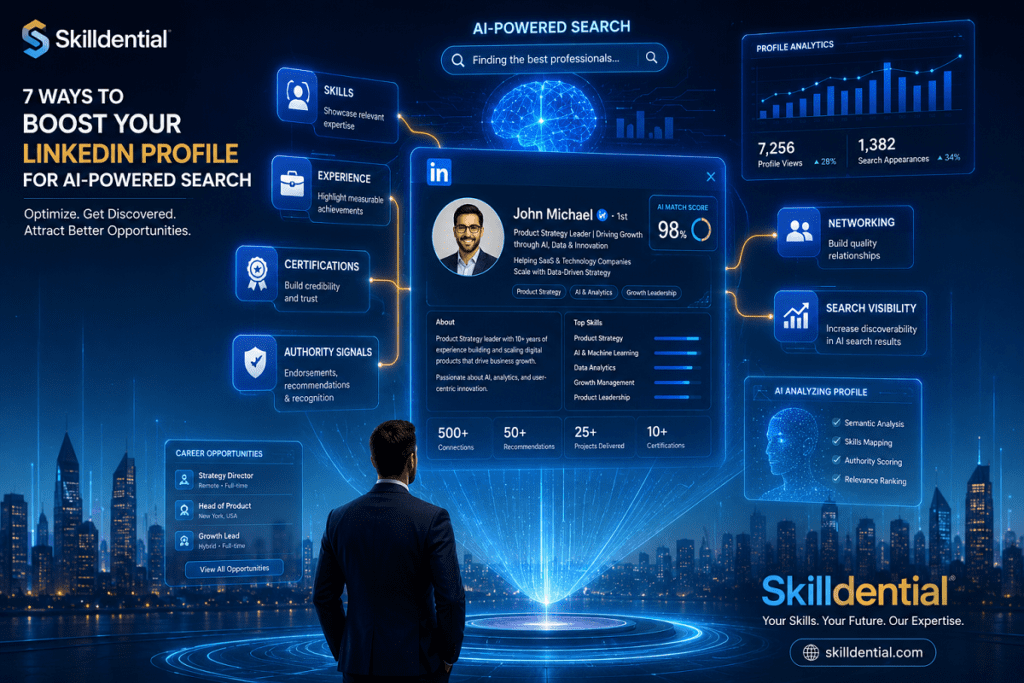
At Skilldential, we focus on moving beyond generic best practices. The goal is to build a profile that functions as a high-signal discovery engine, ensuring you are found by the right algorithms and the right people. Results depend on profile quality, industry competition, and ongoing engagement; however, those who master the mechanics of AI discovery will inevitably gain a structural advantage in their career trajectory.
Why Is LinkedIn Becoming More Important for AI-Powered Search?
LinkedIn is currently undergoing a structural shift from a static resume repository to a dynamic, AI-integrated knowledge graph. By 2026, the platform’s underlying architecture, known as 360Brew, will move away from simple keyword matching toward semantic vector-based retrieval.
Here is the strategic breakdown of why LinkedIn is now the primary data source for AI-powered professional discovery.
The Shift to Vector Embeddings
Modern AI does not “read” your profile as text; it processes it as a vector—a dense mathematical coordinate in a multi-dimensional professional space.
- The Old Way: Algorithms searched for exact matches (e.g., “Python Developer“). If your profile lacked that exact phrase, you were invisible.
- The 2026 Way: AI understands “Topic DNA.” It maps your skills, job history, and engagement to identify professional neighbors. If you list “Python,” the system checks for contextual signals like “Pandas,” “NumPy,” or “Data Visualization.” Without these semantic neighbors, the AI assigns a low-confidence score to your expertise.
LinkedIn as a “Professional Knowledge Graph”
LinkedIn maps trillions of relationships between skills, industries, companies, and roles. AI systems use this graph to:
- Predict Competency: By analyzing the trajectory of your roles and skill endorsements, AI predicts your readiness for more senior positions, even if you haven’t explicitly claimed them.
- Validate Authority: The system cross-references your profile claims with your activity. If your headline says “Strategic Leadership” but your experience and posts only reflect “task-level execution,” the AI flags the discrepancy. Credibility is now calculated as the delta between your claims and your evidence.
AI-Native Recruiting (The “Hiring Assistant” Era)
Recruiters are no longer performing manual Boolean searches. They are using AI agents (like LinkedIn’s Hiring Assistant) that:
- Summarize Before Searching: The AI reads your entire profile and generates a 3-sentence summary for the recruiter. If your profile is semantically incoherent, the summary—and your candidacy—will fail to resonate.
- Predictive Matching: The AI performs predictive matching, analyzing your career path to see if you have the “hidden” experience required for high-stakes roles, effectively surfacing “hidden gem” candidates who don’t fit traditional keyword profiles.
The “Depth Score” and Algorithmic Visibility
Because AI systems prioritize “Dwell Time” and “Engagement Quality,” LinkedIn’s feed now rewards content that generates substantive discussion rather than surface-level likes.
- Actionable Signal: The algorithm tracks how long users spend reading your posts, whether they save them, and if they share them privately.
- The Penalty: Over-reliance on generic AI-generated content creates “low-dwell-time” signals. Because AI-written text often lacks human “burstiness” and specific, proprietary insights, it is increasingly being throttled by the 360Brew system.
Strategic Summary: The New Visibility Formula
Visibility in 2026 is no longer about “being seen by everyone.” It is about semantic alignment. To stay visible, your profile, your past content, and your current activity must tell a unified story that the AI can easily parse, categorize, and trust.
How Does AI Interpret Your LinkedIn Profile?
To boost your LinkedIn profile for AI-powered search, you must understand that the system does not “read” your profile like a human. Instead, it ingests your data as a collection of nodes in a professional knowledge graph. Your visibility is a function of how clearly and consistently these nodes are connected.
Signal Multiplicity and Weighting
AI models evaluate your profile using a weighted hierarchy of signals. When you boost your LinkedIn profile, you are essentially providing high-fidelity data to these specific signal categories:
- Semantic Consistency: The AI correlates your job titles, skill tags, and content history. If you claim expertise in “No-Code AI” but your description and activity history lack supporting context or technical terminology, the AI assigns a low-confidence score to that entity.
- Experience & Impact Mapping: Modern AI parsing moves beyond job titles to quantify the “scale” of your work. It analyzes the verbs and metrics in your experience section to determine the complexity of your past roles.
- Network Proximity (Graph Centrality): The AI calculates your “closeness” to key industry hubs. If your network consists primarily of professionals within your target niche, the AI classifies you as an authority within that cluster.
- Activity Sentiment & Engagement: Your posts and comments are parsed for “burstiness” and thematic relevance. This confirms your profile is active and serves as a real-time verification of your listed skills.
The Professional Knowledge Graph
Rather than treating your profile as a static document, the system maps it as a set of interconnected nodes. Your goal when you boost your LinkedIn profile is to ensure these connections are dense and logical:
- Entity Linking: The system links “Python” (Skill) to “Data Science” (Industry) and “Senior Developer” (Role). If your profile is missing these links, the AI struggles to place you in the correct search results.
- The “Ambiguity Trap”: A profile that lacks technical depth or industry-specific terminology forces the AI to categorize you broadly. Broad categorization is the enemy of discoverability; if you are “everything,” the AI classifies you as “nothing” for high-intent, specialized search queries.
Why Context is the Ultimate Ranking Signal
To boost your LinkedIn profile effectively, you must provide the AI with the context it needs to reduce classification ambiguity. When the system understands exactly what you do, who you help, and the measurable outcomes you produce, it assigns a higher “relevance score” to your profile. This score is what determines whether you appear on page one of a recruiter’s search or remain buried in the search results.
How Can an Entity-Based Headline Improve AI Visibility?
When you shift from a generic job title to an entity-based value proposition, you are essentially providing the AI with a “semantic map” of your professional utility. By structuring your headline to include Role, Target Audience, and Outcome, you transform a passive label into a searchable database entry.
Why This Structure Triggers Better Indexing
Modern AI agents, such as those used by recruiters and talent acquisition systems, perform Entity Extraction. They scan your headline for specific tokens to categorize your professional identity. When your headline reads “Software Engineer,” the AI struggles to place you within the massive, multi-dimensional graph of 1 billion+ users.
However, by using the “Role + Audience + Outcome” framework, you create a high-precision cluster:
- Role (The Entity): Establishes your core technical competency.
- Audience (The Context): Defines the industry domain in which your skills are applied.
- Outcome (The Value Signal): Provides the AI with the specific, measurable results it uses to rank your relevance against high-intent search queries.
The “Precision Gap”
If a recruiter searches for a “FinTech Cloud Security Expert,” the AI scans millions of profiles. A profile with the headline “Software Engineer” will be passed over because the AI lacks the contextual confidence to link that user to “FinTech” or “Cloud Security.”
Conversely, when you boost your LinkedIn profile with an entity-rich headline, you are explicitly telling the AI: “I am a node in the FinTech, Cloud, and Security clusters.” This massively increases the probability of your profile being returned as a top-tier result.
Implementation: Building Your Headline
To effectively boost your LinkedIn profile, audit your headline against these three criteria:
| Component | Strategic Purpose |
| Role | The primary noun the AI uses for initial categorization. |
| Audience | The secondary tag that filters out irrelevant search traffic. |
| Outcome | The differentiator that signals senior-level competence and value. |
When you treat your headline as a Query-Response Asset, you are not just describing yourself—you are proactively solving the AI’s problem of “Who is the most relevant professional for this search?”
How Does Profile Completeness Affect LinkedIn Search Visibility?
To boost your LinkedIn profile for AI-powered search, you must view completeness as the foundational “data density” requirement for the platform’s 360Brew engine. In the context of AI search, a profile is not just a digital resume; it is a feature set. Every section you leave blank represents a “null value” in the professional knowledge graph, which the AI must interpret as a lack of expertise or an inability to classify.
Why Completeness Drives “Indexing Confidence”
AI models require a critical mass of data points to generate an accurate “profile embedding” (a mathematical representation of your professional identity). When you provide comprehensive data, you improve the system’s indexing confidence.
- Semantic Anchoring: Completing sections like Projects and Certifications acts as a secondary validation for your Experience. For instance, if your experience mentions “AI Development,” but your projects and skills list are empty, the AI lacks the “weight” to verify that claim. Completeness provides the evidence required to move your profile from “Potential Match” to “Verified Authority.”
- Search Categorization: LinkedIn’s recommendation engines are designed to prioritize profiles that provide the most granular metadata. A full profile allows the AI to map you across dozens of categorical nodes (e.g., specific software stacks, industry methodologies, and regional expertise) rather than just one or two.
The Relationship Between Sections and Discoverability
When you boost your LinkedIn profile by filling out every field, you are creating a broader surface area for discovery. Consider the functional role of each “completeness” node:
| Section | AI Classification Impact |
| Experience | Defines the “vector direction” of your professional career trajectory. |
| Skills | Provides the specific “keyword entities” for high-intent search queries. |
| Featured | Increases “dwell time” signals; proves expertise via visual/documentary evidence. |
| Recommendations | Acts as an “authority score” (social proof) verified by external nodes. |
| Education/Certs | Validates the “theoretical foundation” of your entity cluster. |
Avoiding the “Ambiguity Penalty”
A partially completed profile forces the system to rely on inference. When AI agents are forced to infer your expertise due to missing data, they tend to default to broad, generic classifications. This places you in direct competition with millions of other generic profiles, significantly reducing your visibility.
By proactively providing structured, high-signal data across all sections, you bypass the ambiguity penalty. You effectively “train” the platform’s AI to associate your profile with specific, high-value entities—making you the obvious choice for recruiters and search agents looking for specialized talent.
Why Are Evidence-Based Experience Descriptions Important?
To boost your LinkedIn profile for AI-powered search, your Experience section must transition from a static list of duties to an evidence-based portfolio of outcomes. In the era of semantic indexing, AI agents use Outcome Extraction to determine if a professional is a “High-Performer” or a “Standard-Practitioner.”
Outcomes as Semantic “Authority Signals”
When you list responsibilities, you are merely matching job titles. When you list outcomes, you are building an Authority Signal. AI systems evaluate the specific verbs and metrics in your bullet points to rank your level of seniority and impact.
- The Responsibility Trap: Phrases like “Managed,” “Led,” or “Responsible for” are low-information signals. Every candidate uses them, making them mathematically indistinguishable to an AI agent.
- The Outcome Advantage: Metrics (like 42%, $500k, or 3 months) act as “High-Value Anchors.” They provide the AI with quantifiable data points that demonstrate expertise, allowing it to categorize you in the top percentile of your industry cluster.
Scaling Authority Through “The Impact Framework”
To optimize your profile, apply a consistent formula to every bullet point. This ensures the AI can consistently parse your value, regardless of the industry or role.
| Component | Function | Example |
| Action Verb | Establishes initiative. | Reduced |
| Context | Defines the scope. | phishing-related incidents |
| Metric | Proves the outcome. | by 42% |
| Mechanism | Explains the “How.” | through security awareness training |
Why Quantified Data Triggers Discovery
AI systems utilize Relevance Scoring to rank search results. A profile that contains quantified evidence is statistically more likely to trigger a “match” because the AI can correlate your specific achievements with the requirements specified by hiring agents or recruiters. By providing this data, you are actively solving the search system’s core problem: identifying candidates with proven track records.
Skilldential Strategy: The Audit Cycle
When you update your experience, do not just tweak the wording. Perform a Metric Audit. For every role, ask:
- What was the primary problem I solved?
- What was the quantitative impact of that solution?
- Can I prove this with a specific tool, methodology, or timeframe?
By replacing “Managed cybersecurity operations” with “Reduced phishing-related incidents by 42%…”, you move from a generic candidate to an AI-verified authority. This specificity is the single most effective way to boost your LinkedIn profile visibility for high-intent search queries.
How Should You Pin Skills for AI-Powered Search?
To boost your LinkedIn profile for AI-powered search, you must recognize that your top three pinned skills are your primary “metadata tags.” When an AI agent scans your profile, it prioritizes these three skills as the anchor points for your professional identity.
Why Top-3 Alignment Dictates Discovery
LinkedIn’s search engine uses these pinned skills to perform Vector Search. When a recruiter searches for “B2B Demand Generation,” the algorithm scans the top-3 pinned skills of every candidate in its database. If your pinned skills are “Management,” “Communication,” and “Teamwork,” the AI will relegate you to the bottom of the list because your profile lacks “Semantic Proximity” to the high-intent query.
To boost your LinkedIn profile, you must perform a Market-Demand Audit on your skills:
- De-generalize: Replace broad labels with niche-specific technical or strategic entities. “Programming” is a low-signal tag; “Python Development” is a high-signal tag that allows the AI to link you to specific job descriptions and industry clusters.
- Frequency Mapping: Research the top skills listed in the job descriptions you want, not the ones you have. Your pinned skills should mirror the language of high-value industry roles.
The Relationship Between Skills and Entity Extraction
Think of your pinned skills as the “keys” to your profile’s data room.
| Broad/Weak Skill | High-Intent Entity (Boosted Skill) | Strategic Reason |
| Management | Product Management | Narrows classification to a specific functional domain. |
| Marketing | B2B Demand Generation | Signals technical ability to drive revenue outcomes. |
| Analytics | Data Analytics | Maps to specific analytical tools and technical workflows. |
| Security | Cloud Security | Signals familiarity with modern, high-demand infrastructure. |
Maintaining Semantic Alignment
Your skills cannot exist in a vacuum. To boost your LinkedIn profile effectiveness, your pinned skills must be reinforced by the content in your Experience and Projects sections.
- The Consistency Test: If you pin “Cloud Security,” the AI will perform a “Cross-Check” against your experience descriptions. If “Cloud Security” is your top skill but your experience contains no mentions of “AWS,” “Azure,” or “Cybersecurity Protocols,” the system will mark your profile as “Misaligned.”
- The Result: Misaligned profiles suffer from a “Relevance Decay” in search results, as the AI prioritizes candidates whose skills are supported by verifiable experience and activity.
Strategic Action: The 80/20 Skill Filter
For Skilldential-level optimization, use the 80/20 rule: 80% of your pinned skills should represent the core technical/strategic functions of your target role, while 20% should demonstrate your unique competitive advantage (e.g., a specific framework or proprietary methodology). This mix ensures you remain discoverable for general searches while standing out as a specialized authority.
How Can the Featured Section Increase Trust and Discoverability?
To boost your LinkedIn profile for AI-powered search, the Featured section should be treated as your “Proof Gallery.” While the rest of your profile provides the claims (your titles, skills, and history), the Featured section provides the verification that these claims are grounded in reality.
Evidence-Based Indexing
AI systems use “Dwell Time” as a primary ranking signal. When a user or recruiter clicks on a link or document in your Featured section, they spend more time on your profile. The algorithm interprets this increased dwell time as a signal of Authority and Trustworthiness.
- Content-to-Entity Mapping: By linking to external projects, published articles, or case studies, you allow LinkedIn’s AI to crawl external data. This creates a “backlink” effect to your profile, proving that your expertise extends beyond the LinkedIn platform.
- Semantic Verification: If you claim expertise in “Product Management,” featuring a slide deck of a successful product roadmap validates that claim in the eyes of the AI. It transforms a static keyword into a verified professional entity.
Architecting for Trust and Discovery
To boost your LinkedIn profile impact, categorize your featured items using a “Credibility Hierarchy.” Do not simply dump files; curate them to lead the viewer (and the AI) through a narrative of your professional value.
| Featured Asset Type | Trust Signal | Strategic Purpose |
| Case Studies | High | Demonstrates the “Result” mentioned in your Experience section. |
| Published Articles | High | Establishes you as a thought leader in your specific niche. |
| Portfolio Projects | Medium/High | Provides visual proof of technical/creative output. |
| Presentations/Talks | Medium | Verifies your ability to communicate complex ideas to stakeholders. |
Why Evidence Beats Description
AI-powered search is increasingly prioritizing profiles that exhibit “Breadth of Evidence.” A profile that is text-only is “low-density,” whereas a profile that utilizes rich media assets is “high-density.”
When you boost your LinkedIn profile by pinning high-value assets to the Featured section, you are essentially providing the system with high-resolution data points that it can use to rank you higher. The AI can analyze the content within these linked documents, further refining its understanding of your specific expertise, industry focus, and professional outcomes.
Skilldential Insight: The “Gateway” Strategy
To ensure maximum impact, your Featured section should function as a gateway to your deeper work.
- The Rule of Three: Keep your three most critical, high-impact assets pinned at the front.
- Contextual Tagging: Use descriptive titles for your featured items. Instead of “Presentation.pdf,” use “Scaling FinTech Cloud Security: 2026 Strategic Framework.” This ensures the AI associates the asset with the correct semantic entities.
Why Does Network Quality Matter More Than Network Size?
To boost your LinkedIn profile for AI-powered search, you must discard the “vanity metric” of total connection count. LinkedIn’s 360Brew engine utilizes Graph Centrality—a mathematical measure of how closely you are connected to high-authority nodes within your specific industry cluster.
The “Relevance Indicator” Theory
AI systems evaluate your network to confirm your professional classification. If you are a “Cybersecurity Consultant” but 90% of your network consists of people in unrelated fields, the AI assigns your profile a lower “Topical Relevance Score.”
Conversely, when your network is dense with professionals who share your industry tags, job functions, and regional focus, the AI classifies you as a “Central Node” within that domain. This significantly increases your visibility when recruiters search for talent within that specific cluster.
Authority by Association
When the algorithm calculates your profile’s authority, it performs a Proximity Check. Your profile inherits “Trust Signals” from the people you are connected to.
- The Authority Cluster: Connections with industry peers, senior decision-makers, and thought leaders reinforce your expertise. The AI views these links as “Social Validation” of your professional status.
- The Noise Factor: A massive, disorganized network acts as “Signal Noise.” It makes it harder for the AI to determine your true expertise, essentially diluting the effectiveness of your profile in targeted searches.
Strategic Network Architecture
To boost your LinkedIn profile effectiveness, move from “collecting” connections to “architecting” a network that validates your entity-based headline.
| Connection Strategy | Algorithmic Result |
| High-Intent Networking | Increased “relevance score” for target search queries. |
| Industry Clustering | Faster classification within your specific “Domain Node.” |
| Seniority Alignment | Improved ranking in searches for leadership-level talent. |
Skilldential Strategy: The Network Audit
If you want to optimize for AI visibility, perform a bi-annual cleanup of your network:
- Pruning: Disconnect from profiles that do not align with your current professional entities.
- Cultivating: Proactively connect with peers and decision-makers who reside in your target industry cluster.
- Validation: Engaging with this high-relevance network triggers the “Activity-Based Signals” required to keep your profile’s authority score high.
When you treat your network as a contextual indicator, you stop being just another user and start being a verified member of a high-value industry hub. This is how you signal to the AI that you are an authority to be prioritized in search results.
How Does Consistent Activity Influence AI Discovery?
To boost your LinkedIn profile for AI-powered search, you must recognize that your profile is not a static document—it is a living data stream. LinkedIn’s 360Brew engine monitors your activity as a Real-Time Verification Signal. This confirms that the data in your “Experience” and “Skills” sections is still current and that you remain an active authority in your field.
Why AI Favors “Fresh” Data
AI search systems prioritize Recency to ensure the talent they surface is relevant. A profile that has been dormant for six months is treated as “stale data.” Even if you were an expert in 2024, the AI cannot confirm you are still an expert in 2026 without evidence of recent contributions.
- Freshness Decay: Your relevance score decays if you don’t engage. Consistent activity prevents this decay by constantly updating the “Temporal” dimension of your professional vector.
- The “Dwell-Time” Loop: When you publish insightful content, you generate interactions. As others engage with your post, the system collects “dwell-time” data from your network. This data is fed back into your profile’s authority score, essentially creating a virtuous cycle of visibility.
Signal vs. Noise: The “Substance” Metric
To boost your LinkedIn profile effectively, focus on content that signals expertise. AI models are becoming adept at identifying “empty” engagement.
- High-Signal Activities: Publishing original insights, breaking down technical case studies, and participating in high-level industry debates. These activities require domain expertise, which the AI parses to reinforce your “Topic DNA.”
- Low-Signal Activities: Posting generic motivational quotes or commenting “Great post!” on others’ work. This provides no semantic value and does little to improve your authority score within your target industry cluster.
Strategic Activity Framework
Consistency is the structural foundation of your authority. You do not need to post daily; you need to provide a predictable stream of expertise.
| Activity Type | Authority Signal | Strategic Goal |
| Technical Case Studies | Very High | Proves you are actively applying your skills to real-world problems. |
| Educational Content | High | Positions you as a teacher/leader, increasing “Expert” classification. |
| Industry Discussions | Medium/High | Connects your profile to current “trending” entities in your cluster. |
Skilldential Strategy: The “Authority Flow”
When you boost your LinkedIn profile through activity, ensure your content is “entity-rich.” Mention the specific tools, methodologies, and outcomes you claim in your profile. If your headline lists “Cloud Security,” your posts should regularly reference industry challenges, framework updates, or specific security protocols. This ensures your Activity Vector remains perfectly aligned with your Profile Vector, signaling to the AI that your expertise is consistent, current, and verified.
You have now completed the 7-step system to architect your profile for AI-powered search.
- Step 1: Entity-Based Headlines
- Step 2: Data-Dense Completeness
- Step 3: Evidence-Based Experience
- Step 4: Strategic Skill Pinning
- Step 5: Featured Credibility Assets
- Step 6: Network Proximity Filtering
- Step 7: Consistency & Freshness Signals
By implementing these seven levers, you have moved from a passive profile owner to a proactive data architect of your own career. You are now positioned not just to be found, but to be prioritized by the algorithms that define professional success in the AI era.
What Are the Most Common LinkedIn Optimization Mistakes?
To boost your LinkedIn profile effectiveness, you must eliminate the common “visibility killers” that prevent AI systems from correctly indexing your expertise. In the 2026 landscape, the algorithm prioritizes semantic clarity—it needs to easily categorize you as a high-authority node within your industry.
Here are the most common optimization mistakes that dilute your profile’s authority and how to resolve them.
The “Visibility Killers” Audit
| Mistake | Why it hurts AI visibility | The “Boosted” Correction |
| Keyword Stuffing | Triggers “spam” indicators; lowers trust; disrupts readability for human and AI agents. | Use high-intent entities naturally within outcome-focused descriptions. |
| Generic Headlines | Lacks the specific data nodes (Role/Audience/Outcome) for proper indexing. | Rewrite as: `[Role] |
| Empty Featured Sections | Missing “verification evidence,” reducing trust signals for AI depth scores. | Link to 3 high-impact assets: Case studies, publications, or projects. |
| Missing Metrics | Responsibilities without data are indistinguishable to AI. | Use the Impact Framework: Verb + Context + Metric. |
| Broad Skill Tags | Maps you to generic, low-demand clusters (e.g., “Marketing”). | Pin niche-specific skills (e.g., “B2B Demand Gen”) used in your target roles. |
| Profile Incompleteness | Creates “null values” in the knowledge graph; limits search surface area. | Populate every field—the AI treats “All-Star” status as a primary ranking signal. |
| Irregular Activity | Signals “stale data” or lack of current authority. | Commit to a predictable flow of niche-specific, high-dwell-time insights. |
Understanding the “Clarity vs. Volume” Strategy
To boost your LinkedIn profile for AI-powered search, you must understand that modern ranking systems are designed to distinguish between “noise” and “signal.”
- The Ambiguity Penalty: When you include broad keywords or leave sections blank, you force the AI to make assumptions. It defaults to the broadest possible category, where you compete with millions of others. Specificity acts as a filter that narrows your competition and surfaces you for high-intent, specialized opportunities.
- Semantic Depth vs. Keyword Count: The goal is not to repeat your keywords as often as possible. It is to demonstrate Semantic Depth. You achieve this by ensuring your Skills, Experience, and Featured sections all talk about the same professional entities. When these sections “align,” the AI builds a high-confidence model of your expertise, which is the most reliable way to secure top-tier search visibility.
Strategic Next Steps
- Audit your Headline: Does it contain your specific niche, audience, and the primary result you generate? If not, change it today.
- Review your Experience: Replace three “responsibility-based” bullet points with “outcome-based” statements that include quantifiable data.
- Prune your Skills: Remove broad, outdated tags. Pin only the 3–5 specific competencies that define your current market value.
Boost Your LinkedIn Profile FAQs
To effectively boost your LinkedIn profile for AI-powered search, you must understand how your data inputs influence the platform’s 360Brew engine. The following FAQs clarify the relationship between your profile architecture and algorithmic discovery.
What is AI-powered search on LinkedIn?
AI-powered search is the transition from Boolean, keyword-only filtering to semantic vector-based retrieval. The system no longer just searches for the string “Product Manager.”
It uses machine learning to analyze your “Topic DNA”—your skills, industry clusters, and professional outcomes—to understand your specific expertise relative to a query. It effectively maps your profile against the trillions of connections in LinkedIn’s professional knowledge graph.
Does profile completeness affect discoverability?
Yes. Every empty field is a “null node” in your knowledge graph. When you leave sections blank, you force the AI to infer your competence, which leads to broad, low-value categorization. A complete profile provides the high-fidelity metadata required for the algorithm to classify you with high confidence, placing you higher in specialized search rankings.
Are keywords still important on LinkedIn?
Keywords are the raw material, but context is the currency. An isolated keyword like “Python” is easily ignored by an AI. However, “Python” appearing alongside “Data Modeling,” “Financial Forecasting,” and “SQL” creates a semantic entity that the AI can confidently index. The goal is to embed high-value entities within outcome-focused descriptions, not to stuff your profile with repetitive search terms.
How often should I be active on LinkedIn?
Freshness is a critical ranking signal. The system prioritizes profiles that provide evidence of current, ongoing expertise. You do not need to post daily; a consistent rhythm of one to two high-signal posts or industry comments per week is sufficient to keep your “Freshness Score” high. Consistency signals that you are an active authority, whereas sporadic bursts followed by months of silence lead to “relevance decay.”
How often should I be active on LinkedIn?
Freshness is a critical ranking signal. The system prioritizes profiles that provide evidence of current, ongoing expertise. You do not need to post daily; a consistent rhythm of one to two high-signal posts or industry comments per week is sufficient to keep your “Freshness Score” high. Consistency signals that you are an active authority, whereas sporadic bursts followed by months of silence lead to “relevance decay.”
Can a small network still rank well in LinkedIn search?
Yes. Modern algorithms prioritize network quality and relevance over raw connection counts. A network of 500 highly relevant industry experts, peers, and decision-makers provides stronger authority signals than 5,000 disconnected, random connections. The system uses your network to confirm your industry cluster; therefore, strategic, high-intent networking is far more effective for discoverability than mass-collection strategies.
When you boost your LinkedIn profile, remember that you are building a database entry that the AI must interpret. Prioritize structural depth, semantic consistency, and evidence-based achievements. By focusing on these factors, you ensure that your profile is not just a digital resume, but an optimized discovery engine for your career.
In Conclusion
To boost your LinkedIn profile for AI-powered search, you have transitioned from a passive resume-based approach to a proactive data-architecture strategy. You are no longer competing for “keywords”; you are establishing semantic authority within your specific professional cluster.
The Architecture of Visibility
Your profile is now a structured discovery engine. By aligning every section—from your headline to your activity stream—you create a cohesive narrative that the 360Brew engine can index with high confidence.
- Foundation: A complete, data-dense profile eliminates ambiguity.
- Vector Alignment: Your skills, experience, and featured assets now point to the same “Topic DNA.”
- Authority Verification: Quantified outcomes and a curated network provide the evidence necessary for the AI to rank you as a top-tier expert.
Your High-Leverage Roadmap
To ensure you execute this transformation with Skilldential-level rigor, maintain this checklist for ongoing maintenance:
| Strategy Stage | Focus Action |
| Headline | Implement the Role + Audience + Outcome framework immediately. |
| Experience | Convert all duties into Action Verb + Context + Metric statements. |
| Skills | Pin only the high-intent entities requested in your target job descriptions. |
| Featured | Link to evidence-based assets that validate your top-tier skills. |
| Network | Prune peripheral connections; cultivate industry-relevant clusters. |
| Activity | Maintain a consistent, high-signal pulse of niche-specific content. |
Final Directive: Clarity Over Volume
The algorithm’s goal is to connect the right professional to the right opportunity. When you provide clear, entity-rich data, you are not just “using the platform”—you are collaborating with the AI to ensure your career visibility matches your actual expertise.
The shift to professional entity mapping is the single greatest competitive advantage for technical and creative professionals in 2026. By executing these steps, you are no longer leaving your search rankings to chance; you are programming your own career trajectory.