Google Project Management Professional Certificate Review
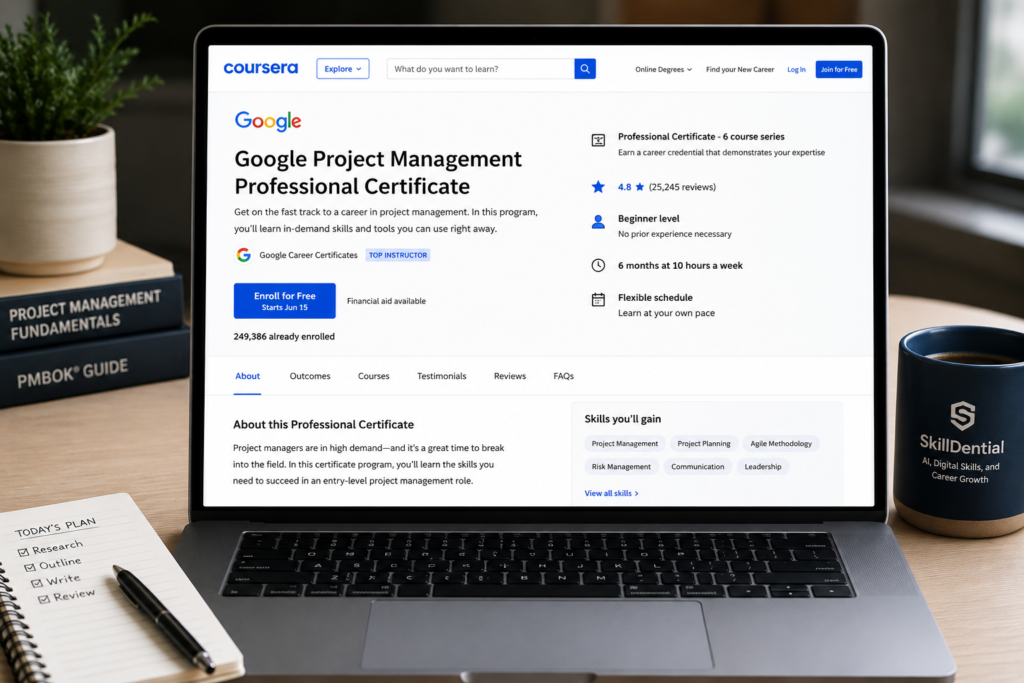
The Google Project Management Professional Certificate provides a structured, accessible entry point for career changers and beginners entering the field. Costing between $147 and $294 and completed over 3 to 6 months, the program covers both traditional waterfall methodologies and modern Agile frameworks.
While the Google Project Management Professional Certificate does not replace the gold-standard PMP for senior positions, it fulfills the contact hour requirement for CAPM eligibility and holds recognition through Google’s employer consortium for junior project manager and project coordinator roles.
Who this review is for
- Beginners with little or no background who want a step-by-step onboarding into project management fundamentals through the Google Project Management Professional Certificate.
- Career changers weighing the cost, time, and ROI of the Google Project Management Professional Certificate against alternatives like the CAPM or PMP.
- Students and working professionals looking for recognized credentials without the commitment of a multi-year degree.
- International learners analyzing the true global employer value and market traction of the Google Project Management Professional Certificate outside the U.S.
By the end of this review, you will have a clear, data-driven framework to decide if the Google Project Management Professional Certificate matches your professional trajectory and financial investment.
What the Google Project Management Professional Certificate Is
The Google Project Management Professional Certificate is a foundational credential hosted on Coursera and developed entirely by Google practitioners. It serves as an accessible entry point into the discipline, combining asynchronous video lectures, interactive quizzes, and practical project deliverables to cover both traditional predictive (waterfall) methodologies and adaptive frameworks like Agile and Scrum.
Key Facts
- Provider: Google Career Certificates via Coursera.
- Curriculum Structure: A 7-course series comprising 6 core operational courses and 1 dedicated job-search and interview preparation capstone.
- Target Audience & Prerequisites: Absolute beginners; zero prior project management experience or college degree required.
- Professional Outcomes: Issuance of a verifiable digital certificate, a direct pathway into the Google Career Certificates Employer Consortium, and over 100 hours of formal project management education applicable toward PMI certifications such as the CAPM.
Market Impact
Google internal data indicates that approximately 75% of U.S. program graduates across its certificate ecosystem report a positive career outcome—such as a new job, promotion, or salary increase—within six months of completion, with the Google Project Management Professional Certificate tracking competitively within those metrics.
Curriculum Breakdown: What You Actually Learn
The Google Project Management Professional Certificate is structured as a 7-part series, combining 6 core instructional blocks with a practical capstone and an AI-focused job-search module. The curriculum bridges traditional project management frameworks with modern iterative methodologies.
- Foundations of Project Management: Establishes core project management roles, responsibilities, and the end-to-end project life cycle. Compares traditional predictive methodologies with adaptive approaches, and examines how organizational structures and culture influence project outcomes.
- Project Initiation: Starting a Successful Project: Covers foundational startup artifacts, including project charters, comprehensive stakeholder analysis, RACI matrices, and initial kick-off strategies.
- Project Planning: Putting It All Together: Focuses on detailed execution planning, teaching work breakdown structures (WBS), Gantt charts, critical path methodology (CPM), risk management registers, budgeting, and communication planning.
- Project Execution: Running the Project: Shifts to active management, covering quality assurance, data-driven status reporting, team dynamics, change control procedures, and structured project closing processes.
- Agile Project Management: Deep dives into Agile values, principles, and the Scrum framework. Breaks down specific Scrum roles, ceremonies (sprint planning, daily stand-ups, reviews, retrospectives), and key artifacts.
- Capstone: Applying Project Management in the Real World: A simulated end-to-end project where you independently generate a complete professional portfolio package—including a project charter, planning documents, risk registers, and status reports.
- Accelerate Your Job Search with AI: A bonus module leveraging modern artificial intelligence tools to optimize resume building, interview preparation, and targeted job-search strategies.
Across the entire program, learners receive over 140 hours of instruction paired with practice-based assessments designed to mirror everyday workplace tasks for junior project managers and coordinators.
Time Commitment and Difficulty
- Recommended Pace: Under 10 hours per week for a target completion window of less than 6 months.
- Typical Timeline: 3 to 6 months for most working professionals, though highly motivated, full-time learners can fast-track completion in 8 to 12 weeks.
- Total Effort: Approximately 120 to 240 cumulative hours, varying based on your chosen study pace and how rigorously you build out your capstone portfolio pieces.
- Difficulty Level: Widely rated as beginner-friendly (averaging 1/5 in independent technical reviews) with zero prior project management experience required to get started.
Learners with existing corporate or office administration experience typically move rapidly through the initial traditional project management courses, while career changers from non-office backgrounds may need extra bandwidth upfront to master project management terminology, documentation standards, and software workflows.
Current Cost (2026) and How to Minimize It
- Pricing Model: Operates on a Coursera monthly subscription model, standardizing at approximately $49/month in the U.S. and Canada, with regional pricing adjustments available in specific international markets.
- Total Cost Projections:
- 3 months: $\approx \$147$
- 6 months: $\approx \$294$
- Most diligent learners finish the Google Project Management Professional Certificate well under the $\$300$ threshold.
- Hidden/Extra Fees: Zero. All reading materials, video lectures, quizzes, and capstone software resources are fully included within the active monthly subscription.
Strategies to Minimize Costs
- Accelerated Completion: Dedicate 10 to 15 hours per week to complete the coursework within a single 1-month billing cycle, reducing your total investment to roughly $\$49$.
- Coursera Financial Aid: Eligible applicants can apply for Coursera’s financial aid program, which can cover up to 100% of the tuition. Note that applications require a statement of purpose and typically take up to 15 days for review and approval.
When evaluated against traditional project management credentials—such as the PMP ($405–$555 exam fee plus extensive prep material) or the CAPM ($225–$300 exam fee)—the Google Project Management Professional Certificate remains a significantly cheaper and faster entry vehicle. However, it does not match the executive seniority or universal industry weight of the Project Management Institute’s core certifications.
Skills You Gain and Hands-On Work
Upon completing the Google Project Management Professional Certificate, learners acquire a practical toolkit designed for entry-level and coordinator-level roles. Specifically, you will be able to:
- Define precise project scope, high-level goals, and measurable success metrics using SMART criteria.
- Draft operational artifacts including project charters, comprehensive stakeholder analyses, and structured communication plans.
- Build detailed work breakdown structures (WBS), execution schedules, and fundamental project budgets.
- Identify, evaluate, and mitigate project risks using professional risk registers and proactive tracking strategies.
- Facilitate and document core Agile and Scrum ceremonies (such as daily stand-ups and retrospectives) while determining when to apply adaptive versus predictive frameworks.
- Generate stakeholder status reports, quality assurance plans, and formal project closing documentation.
- Utilize foundational productivity suites (spreadsheets, document editors, presentation tools) alongside project management software like Asana, while leveraging generative AI for drafting charters, brainstorming risks, and writing professional communications.
The mandatory capstone project forces the integration of these competencies within a simulated real-world scenario, yielding concrete portfolio artifacts that can be directly presented to prospective employers during interviews.
Professional Certificate vs. Professional Certification (PMP/CAPM)
This distinction represents the most critical factor for career planning and is frequently misunderstood by aspiring project managers.
Google Project Management Professional Certificate
- Classification: A professional training certificate issued by Google via Coursera.
- Core Value: Validates that you have completed a structured, comprehensive educational curriculum covering modern project management fundamentals.
- Prerequisites: None. Designed explicitly for absolute beginners and career changers breaking into entry-level positions.
- Industry Standing: While not an independent board-governed professional certification, it satisfies over 100 hours of formal project management education, directly fulfilling the educational prerequisite required to sit for the Project Management Institute’s (PMI) CAPM exam.
PMI Certifications (CAPM / PMP)
- Classification: Formally accredited, globally standardized professional certifications governed strictly by the Project Management Institute (PMI).
- Core Value: Rigorous third-party validation of professional competency, advanced methodology mastery, and adherence to global industry standards.
- Prerequisites:
- CAPM (Certified Associate in Project Management): Requires a secondary degree plus either 23 hours of project management education (which the Google certificate satisfies) or 1,500 hours of project experience.
- PMP (Project Management Professional): Demands extensive professional experience (36 to 60 months leading projects depending on your degree level) alongside 35 hours of formal project management education.
- Industry Standing: Universally recognized as a gold-standard executive and mid-career credential required by major corporate, governmental, and engineering enterprises for senior project leadership roles.
Certified Associate in Project Management (CAPM)
- Classification: A formally accredited, exam-based professional certification issued globally by the Project Management Institute (PMI).
- Prerequisites & Education: Entry-level credential that requires a secondary degree (high school diploma or equivalent) alongside at least 23 hours of formal project management education—a requirement that completion of the Google Project Management Professional Certificate fully satisfies.
- Industry Standing: Recognized globally as a standardized benchmark for foundational project management competency, signaling to employers that you have passed a rigorous proctored exam covering the PMBOK Guide.
Project Management Professional (PMP)
- Classification: A senior-level, globally recognized professional certification issued by the Project Management Institute (PMI).
- Prerequisites & Education: Demands verified, documented project management experience (typically 36 to 60 months of leading projects, depending on whether you hold a four-year degree) alongside 35 hours of formal project management education.
- Industry Standing: Universally regarded as the gold standard for experienced project managers. It commands significant salary premiums, validates advanced leadership competency, and is frequently an absolute prerequisite for senior and enterprise-level management roles.
Summary: How They Compare
| Metric | Google Project Management Certificate | CAPM | PMP |
| Type | Professional Training Certificate | Entry-Level Certification | Senior-Level Certification |
| Issuer | Google (via Coursera) | Project Management Institute (PMI) | Project Management Institute (PMI) |
| Prerequisites | None | High school diploma + 23 hours of PM education | 36–60 months experience + 35 hours PM education |
| Assessment | Quizzes, peer-graded assignments, capstone | Proctored multiple-choice exam | Rigorous proctored multiple-choice exam |
| Primary Value | Practical skill acquisition and portfolio building | Formal validation of foundational PM knowledge | Industry-standard proof of advanced project leadership |
The Google Project Management Professional Certificate functions as an educational on-ramp and practical training pathway, whereas the CAPM and PMP are rigorous, exam-governed industry credentials that validate theoretical mastery and real-world execution experience.
Employer Recognition and Job Outcomes
One of the most important factors to consider before enrolling in the Google Project Management Professional Certificate is how employers view the credential and whether it can improve your job prospects.
This section examines its recognition among employers, the project management roles it may help you pursue, and how the skills and credential can strengthen your resume. It also looks at realistic career outcomes for beginners, while clarifying that completing the certificate does not guarantee employment.
Where the Certificate is Recognized
- Employer Consortium: Google established a Career Certificates Employer Consortium featuring over 150 major U.S. and multinational employers—including Google, Deloitte, Target, Verizon, T-Mobile, and Wells Fargo—that specifically consider certificate graduates for entry-level openings.
- Global Footprint: Similar employer networks span international markets such as Canada, India, Singapore, and Indonesia.
- Academic Credit Recommendations: The program carries an ACE (American Council on Education) recommendation for up to 9 college credits (equivalent to roughly 3 lower-division undergraduate courses), which select partner universities accept toward degree pathways.
Typical Entry-Level Roles
Graduates of the Google Project Management Professional Certificate frequently target early-career titles such as:
- Project Coordinator
- Junior Project Manager
- Project Analyst
- Program Coordinator
- Junior Scrum Master
- Operations Associate
Market Demand and Compensation
Labor market data compiled via Lightcast and the U.S. Bureau of Labor Statistics (BLS) highlights strong baseline prospects for project management professionals:
- Open Roles: Hundreds of thousands of active project management openings persist across the U.S. market in technology, healthcare, construction, and finance.
- Salary Projections: Median entry-level compensation for coordinator and junior PM tracks generally spans $70,000 to $90,000, while overall U.S. median pay for project management specialists sits near $100,750.
Independent industry analysts emphasize that while the Google Project Management Professional Certificate serves as an effective lever for securing interviews—particularly when paired with a robust capstone portfolio and active networking—it operates as a career accelerator rather than an automatic job placement guarantee.
Google Project Management vs CAPM vs PMP vs PRINCE2
The Google Project Management Professional Certificate, CAPM, PMP, and PRINCE2 can all support a career in project management, but they are designed for different experience levels, career goals, and professional needs. This section compares them based on eligibility requirements, cost, difficulty, training and exam structure, industry recognition, and career value.
Understanding these differences can help you decide whether the Google certificate is the right starting point or whether an established project management certification such as CAPM, PMP, or PRINCE2 better matches your experience and career goals.
| Credential Type | Typical Cost | Time | Experience Needed | Best For |
| Google Project Management Professional Certificate | ~$147–$294 total | 3–6 months | None | Beginners and career changers wanting an entry-level PM role |
| CAPM (PMI) | ~$225–$300 exam + prep | 2–4 months | 23 hours of PM education | Recent grads and associate PMs who want a globally recognised PMI credential |
| PMP (PMI) | $405–$555 exam + prep | 3–6+ months | ~36 months PM experience + 35 hours education | Mid-career and senior PMs targeting higher-paying roles |
| PRINCE2 Foundation | ~$500–$750 (exam voucher & digital manual via PeopleCert) | 1–2 months | None | U.K./EU public sector and organisations using structured process-driven frameworks |
For someone with no PM experience, the Google Project Management Professional Certificate serves as the lowest-cost, most structured starting point. The CAPM acts as a logical next step once you have logged your education hours and want a PMI-branded credential, whereas PRINCE2 Foundation suits professionals targeting regions or industries (like the U.K. public sector) heavily anchored in process-driven methodologies.
Pros and Cons of the Google Project Management Professional Certificate
Like any professional learning program, the Google Project Management Professional Certificate has strengths and limitations that can affect its value depending on your experience, budget, and career goals.
Looking at both sides can help you determine whether the program offers the right combination of practical skills, flexibility, affordability, and career relevance for you. Below, we examine the key advantages and potential drawbacks to consider before enrolling.
Advantages
- Beginner-Friendly and Flexible: Zero academic or professional prerequisites required; fully self-paced structure fits easily around existing work or study commitments.
- Strong Brand Signal: The Google Project Management Professional Certificate brand association carries instant recognition and credibility with many hiring managers and recruiters.
- Practical, Hands-On Curriculum: Focuses on building realistic operational artifacts (project charters, schedules, risk registers) culminating in a tangible capstone portfolio.
- Modern Framework Integration: Comprehensive coverage of both traditional waterfall methodologies and adaptive Agile/Scrum practices commonly seen in contemporary job postings.
- Pathway to PMI Credentials: Satisfies over 100 hours of formal project management education, directly fulfilling the education prerequisite for the CAPM examination.
- Employer Consortium Access: Unlocks access to the Google Career Certificates Employer Consortium, providing direct application pathways with over 150 global enterprises.
- Cost-Efficient: Completing the program within a standard timeline keeps total expenses well under $300, making it significantly cheaper than formal university certificates or bootcamps.
Limitations
- Not a PMP Equivalent: The Google Project Management Professional Certificate cannot substitute for the Project Management Professional (PMP) credential in senior, highly technical, or strictly regulated corporate environments.
- Simulated Experience Gap: Because the capstone project is simulated, candidates lacking prior professional work history may still face stiff competition against applicants with direct on-the-job execution experience.
- Introductory Agile Depth: While the program covers Scrum fundamentals, it provides introductory-level exposure that is insufficient for specialized, advanced Scrum Master roles without dedicated, advanced certifications (like CSM or PSM).
- Surface-Level Soft Skills: Complex negotiations, stakeholder politics, and executive-level communication are introduced conceptually but lack the deep, real-world practice required for high-stakes leadership.
- Regional Recognition Variance: While strong in the U.S. and consortium-aligned countries, brand traction and employer weight vary internationally in markets dominated by traditional local accreditations or the global PMP standard.
Who Should Take This Certificate
The Google Project Management Professional Certificate is a high-leverage investment if you fall into one of these categories:
- Complete Beginners: Individuals with little to no formal project management background who require a structured, step-by-step introduction to the discipline.
- Career Changers: Professionals transitioning from unrelated fields who need a credible, affordable credential to break into junior project management or coordinator roles.
- Informal Practitioners: People who already manage projects as part of their current job (e.g., marketing leads, operations staff) and want to formalize their knowledge using standard industry terminology and structured artifacts.
- Aspiring PMI Candidates: Learners planning to sit for the CAPM or future PMP exams who need an affordable, efficient way to satisfy required formal education hours.
Who Should Skip It
- Experienced PMs: Professionals with multiple years of direct project management experience targeting senior positions; the PMP or industry-specific certifications will yield a much higher career return.
- Strict Compliance Seekers: Those looking for credentials explicitly mandated by job listings that strictly require a traditional designation like the PMP.
- Software Specialists: Learners seeking deep, advanced training in specific enterprise tools like Jira or Microsoft Project, which require dedicated, platform-specific technical training.
How to Maximize the Value If You Enroll
To maximize the return on your time and financial investment in the Google Project Management Professional Certificate, execute these tactical implementation steps:
- Treat the Capstone as a Real-World Deliverable: Go beyond the minimum grading requirements. Quantify project outcomes, build realistic constraints, and polish your documents so they look ready to present to an executive stakeholder during an interview.
- Build a Dedicated PM Portfolio: Host your capstone artifacts—including your project charter, work breakdown structure, risk register, and status reports—on a personal professional website, Notion page, or GitHub/GitLab Pages to prove your execution skills.
- Stack Credentials Strategically: Use the completed Google Project Management Professional Certificate as your foundational stepping stone, immediately transitioning to study for the CAPM to add a globally recognized PMI certification to your resume.
- Network Actively While Studying: Join local Project Management Institute (PMI) chapters, participate in virtual Agile meetups, and connect with working project managers on LinkedIn before you even finish the coursework.
- Optimize Resume and LinkedIn Positioning: Explicitly highlight hard competencies—such as Agile, Scrum, risk management, stakeholder analysis, and budgeting—while clearly noting that the program fulfills your formal PMI education hours.
Is the Google Project Management Professional Certificate worth it in 2026?
Yes, for beginners and career changers targeting entry-level project management roles, the Google Project Management Professional Certificate remains one of the most cost-effective and structured options available.
While it does not replace the PMP for senior leadership positions, it provides solid foundational training, a tangible portfolio piece, and a recognized pathway toward fulfilling educational hours for the CAPM.
Can I get a job with only this certificate?
Many graduates successfully land project coordinator or junior project management roles, particularly when they combine the Google Project Management Professional Certificate with proactive networking, a polished capstone portfolio, and complementary credentials like the CAPM.
The certificate significantly improves your resume’s initial screening power, but it does not act as an automatic job guarantee on its own.
How does it compare to a degree or MBA?
The Google Project Management Professional Certificate is not equivalent to a multi-year academic degree or an MBA, but it is exponentially faster and more affordable.
For entry-level and coordinator positions, it provides sufficient practical credentials at a fraction of the cost, allowing you to build real-world skills and pursue advanced formal degrees or certifications later if your career trajectory demands it.
Is the certificate recognized outside the U.S.?
Recognition for the Google Project Management Professional Certificate is strongest in the U.S. and international markets where Google maintains active employer consortiums (such as Canada, India, Singapore, and Indonesia).
In other global regions, the technical skills and frameworks taught remain valuable, though traditional local accreditations or the global PMP standard often carry heavier weight with local employers.
In Conclusion
The Google Project Management Professional Certificate provides a credible, highly structured, and budget-friendly entry point for beginners and career changers breaking into the field. By balancing traditional waterfall methodologies with modern Agile and Scrum frameworks, the curriculum ensures you learn core operational skills while producing a tangible capstone portfolio piece.
While it does not replace the senior-level PMP credential, it fulfills essential educational hours for CAPM eligibility and connects graduates to a vast employer consortium seeking junior project managers and coordinators.
If you are ready to enter the discipline, start the 7-day free trial on Coursera, review the initial syllabus and sample lessons, and evaluate whether the pace and structure align with your professional goals before committing to a full subscription.