How AI Is Transforming Grocery Apps: Benefits and Use Cases
The grocery industry is undergoing a structural transformation driven by artificial intelligence, fundamentally altering both consumer purchasing behaviors and backend operational logistics. By integrating machine learning and predictive analytics, modern grocery apps are shifting from simple transactional interfaces to intelligent, service-oriented platforms.
As online grocery demand accelerates, AI has become the primary mechanism for scaling hyper-personalized recommendations, optimizing supply chain efficiency, and automating customer support—positioning grocery apps as critical nodes in the future of the digital economy.
What is AI in Grocery?
AI in grocery apps refers to the strategic deployment of machine learning, predictive analytics, natural language processing (NLP), and computer vision to optimize the grocery value chain. These technologies ingest granular customer data and real-time operational inputs to drive automated, high-precision decision-making.
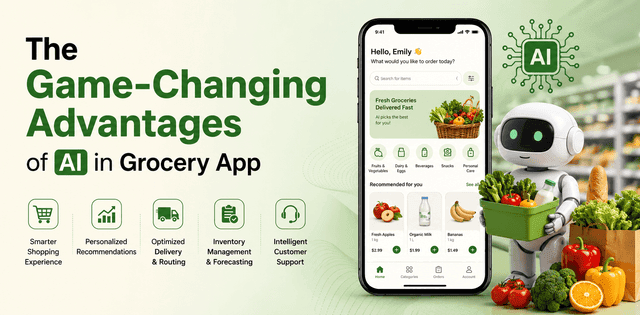
By leveraging AI, retailers move beyond traditional transactional models, achieving superior demand forecasting, dynamic inventory management, and hyper-personalized user experiences that directly correlate to increased retention and operational efficiency.
Top Advantages of AI in Grocery Shopping
The integration of AI into grocery apps creates a shift from reactive service to proactive value delivery. For both operators and consumers, the advantages extend far beyond simple convenience; they represent a fundamental optimization of the entire grocery value chain.
By leveraging data-driven intelligence, retailers can effectively solve the “perishables paradox”—balancing high-velocity inventory needs with shifting consumer preferences—while simultaneously delivering a hyper-personalized interface that drives long-term customer loyalty and operational margins.
Personalized Product Recommendations
AI-driven recommendation engines represent a shift from static catalog browsing to a dynamic, intent-based discovery process. By synthesizing historical purchase data, real-time browsing signals, and contextual factors (such as seasonality or dietary preferences), grocery apps can surface hyper-relevant products at the point of decision.
Unlike traditional rule-based filters, modern AI employs collaborative and content-based filtering to predict future needs, effectively transforming the shopping experience from a manual chore into an anticipatory service.
Strategic Benefits:
- Increased Average Order Value (AOV): AI-driven cross-selling and “frequently bought together” prompts encourage larger basket sizes by identifying logical product adjacencies.
- Enhanced Customer Lifetime Value (CLV): By reducing decision fatigue and consistently surfacing preferred items, retailers build deeper brand affinity and long-term loyalty.
- Operational Efficiency: Data-backed recommendations allow for more effective inventory turnover, moving specific product categories based on algorithmic demand signals.
- Reduced Friction: Intelligent surfacing of recurring items (e.g., staple replenishment) shortens the time-to-checkout, creating a superior, streamlined user experience.
Smarter Inventory Management
Inventory optimization is a perennial challenge in the grocery sector, where the “perishables paradox”—balancing high-velocity turnover with tight margins—can make or break profitability. AI moves beyond static, manual reorder points by synthesizing multidimensional data streams, including historical sales velocity, seasonal shifts, localized demand signals, and external variables like weather or regional events.
By deploying predictive analytics within grocery apps, businesses transition from reactive stock-counting to proactive supply chain orchestration.
Strategic Benefits:
- Precision Demand Forecasting: Machine learning models identify granular demand patterns that legacy systems miss, allowing for optimized stock levels that mitigate the risk of both stockouts and capital-intensive overstocking.
- Shrinkage Reduction: AI-driven anomaly detection and shelf-life monitoring systems identify potential spoilage or inventory discrepancies in real-time, drastically reducing waste and improving gross margins.
- Automated Replenishment: By integrating sales data directly with supplier lead times, AI triggers automated purchase orders at optimal thresholds, ensuring high product availability without human intervention.
- Operational Resilience: The ability to run “what-if” scenario simulations allows managers to stress-test supply chains against potential disruptions, ensuring the app remains a reliable, always-on utility for the consumer.
Frictionless Search and Product Discovery
In the 2026 digital marketplace, the line between “searching” for an item and “discovering” a solution has blurred. AI-powered discovery engines within grocery apps have shifted from reactive, keyword-matching systems to intent-aware agents. By utilizing natural language processing (NLP) and semantic search, these platforms interpret the “why” behind a query—such as “ingredients for a gluten-free pasta dinner under $15″—rather than just scanning for exact product tags.
This evolution reduces the cognitive load on the consumer and minimizes “search abandonment,” turning the digital aisle into a guided, high-conversion environment.
Strategic Benefits:
- Conversational Intent Recognition: Modern apps now support natural language and voice queries, allowing users to interact with their digital storefronts as they would a personal shopper. This conversational interface effectively converts vague needs into specific, actionable shopping lists.
- Visual & Contextual Discovery: Through computer vision, users can upload images of recipes or pantry staples to instantly identify and source products. This removes the “cold start” friction for new shoppers who may not know specific brand names or technical categories.
- Dynamic Relevance Tuning: AI algorithms monitor real-time behavioral signals—such as what a user lingers on, re-types, or clicks—to adjust search rankings on the fly. This ensures that the most relevant, high-margin, or highly rated products are surfaced precisely when they are most likely to result in a purchase.
- Intelligent Substitution: When primary items are out of stock, AI-driven substitution engines analyze product attributes, nutritional profiles, and past preferences to suggest viable alternatives, maintaining cart integrity and reducing checkout friction.
Enhanced Customer Support & Agentic Service
The evolution of customer support in grocery apps has moved beyond simple, rule-based chatbots. In 2026, we are witnessing the rise of “agentic commerce,” where AI no longer just answers questions—it executes tasks autonomously to resolve issues end-to-end. By integrating natural language processing (NLP) and contextual memory, these AI agents provide a seamless, 24/7 service layer that maintains continuity across channels.
Modern systems can now interpret intent, access real-time order status, and process complex requests—such as automated refunds, substitution adjustments, or delivery rescheduling—without human intervention, only escalating to human agents for high-complexity edge cases.
Strategic Benefits:
- Agentic Resolution: Unlike legacy bots, autonomous AI agents interpret business rules to complete transactions—like re-routing a delivery or processing a verified return—reducing the “human-in-the-loop” burden for routine operations.
- Contextual Intelligence: Advanced AI maintains “memory” of a customer’s history across touchpoints. When a user reaches out, the system already understands their recent purchase history, delivery preferences, and previous friction points, eliminating the need for customers to repeat information.
- Scalability & Cost Optimization: AI handles massive surges in support volume during peak demand periods (holidays, sales events) without the linear cost increases associated with staffing human call centers.
- Sentiment Analysis: By analyzing the tone and linguistic patterns of customer interactions in real-time, AI can identify frustrated users and proactively escalate them to a senior human agent, effectively salvaging potentially lost loyalty.
Optimized Delivery Logistics
In the high-stakes world of on-demand grocery apps, delivery is not merely a service—it is the primary battlefield for profitability. Last-mile logistics typically represent over 40% of total fulfillment costs, making it the most significant bottleneck in the grocery value chain. By moving from static, manual dispatching to AI-driven dynamic routing, companies are transforming this cost center into a competitive advantage.
Modern AI engines continuously ingest multidimensional data—live traffic, weather patterns, historical delivery windows, and vehicle capacity—to orchestrate “smarter” rather than just “shorter” routes.
Strategic Benefits:
- Dynamic Route Orchestration: AI systems instantly recalculate paths in response to real-time disruptions (e.g., road closures, sudden weather changes), ensuring on-time performance (SLA) without human intervention.
- Increased Route Density: By effectively clustering nearby orders and balancing load distribution across a hybrid fleet (internal drivers vs. third-party networks), businesses maximize “drops per route,” directly lowering the cost-per-delivery.
- Predictive Dispatching: AI synchronizes the “pick-and-pack” process with the arrival of delivery partners. By predicting precisely when an order will be ready, the system eliminates driver idle time at the warehouse and prevents groceries from sitting out and spoiling.
- First-Attempt Success: Through predictive modeling of customer availability and automated, real-time ETA updates, AI reduces the rate of failed deliveries—a common source of operational waste and customer churn.
Dynamic Pricing and Algorithmic Revenue Optimization
In the 2026 retail landscape, static pricing is increasingly obsolete. AI-driven dynamic pricing in grocery apps marks the transition from broad-brush promotional strategies to high-precision, data-informed commercial orchestration. By synthesizing real-time signals—competitor pricing, localized demand elasticity, stock pressure, and even seasonal or hourly trends—algorithms enable retailers to optimize margins without the latency of manual updates.
However, for the modern operator, the goal is not merely “surge pricing,” but “intelligent optimization.” The most sophisticated platforms utilize hybrid models where machine learning provides recommendations, but business governance frameworks—defined by margin floors and brand-equity guardrails—ensure consistency and fairness.
Strategic Benefits:
- Elasticity-Based Optimization: AI models predict how specific SKUs respond to price changes, allowing retailers to protect margins on inelastic staples while using targeted discounts on highly elastic, discretionary items to drive volume.
- Inventory-Aware Markdowns: Instead of broad clearance events that erode brand value, AI recommends SKU-level price adjustments based on “days-to-spoil” and sell-through velocity, effectively balancing turnover with profitability.
- Personalized Incentivization: Rather than changing the public list price—which risks consumer backlash—leading grocery apps now leverage AI to deliver 1:1 dynamic discounts or loyalty-based offers, providing a competitive edge while maintaining a stable, transparent storefront.
- Operational Governance: Automated pricing engines surface anomalies for human review, ensuring that commercial decisions align with long-term brand goals and regulatory compliance, particularly in sensitive markets.
A Note on Ethical Deployment
As you scale these capabilities, remember that the “grocery-consumer relationship” is built on trust. Transparent communication regarding pricing logic and strict adherence to ethical guardrails—avoiding discriminatory pricing or predatory surges during crises—are essential to maintaining the long-term customer lifetime value (CLV) that is the hallmark of a resilient business.
Fraud Detection and Secure Payments
In the ecosystem of modern grocery apps, security is no longer a peripheral feature—it is a core pillar of brand equity. As transaction volumes and “agentic” shopping (AI-assisted buying) scale, traditional rule-based fraud filters have become obsolete. Today’s platforms require an adaptive, AI-driven security layer capable of distinguishing between high-velocity legitimate traffic and sophisticated, automated attack vectors in real-time.
Modern AI fraud prevention functions invisibly, scanning thousands of data points—from behavioral biometrics like typing cadence and navigation patterns to complex multi-account correlation—to block threats without introducing friction for the genuine customer.
Strategic Benefits:
- Behavioral Intelligence vs. Static Rules: By analyzing user behavior (e.g., mouse movements, swipe patterns, and device fingerprints), AI identifies bots and account takeover (ATO) attempts instantly, even when the login credentials are correct. This creates a “digital fingerprint” that significantly reduces false positives.
- Proactive Threat Neutralization: Instead of waiting for a chargeback or a failed delivery report, AI-driven systems perform real-time risk scoring at every touchpoint—from account creation to checkout—flagging anomalies like “promo farming” or “coupon stacking” before they impact your margins.
- Frictionless Verification: Adaptive authentication ensures that security steps (like MFA or device proofing) are triggered only when a transaction hits a specific risk threshold. This maintains a seamless user journey for 99% of customers while keeping the “backdoor” closed to malicious actors.
- Operational Resilience: AI-powered fraud management acts as a force multiplier for security teams, automating the investigation of low-risk alerts and allowing human analysts to focus exclusively on high-complexity edge cases, thereby reducing operational overhead and improving response times.
Strategic Summary for Founders
To successfully scale, treat your security infrastructure as a “growth engine” rather than a cost center. A robust, AI-secured platform does more than prevent loss—it builds the deep, implicit trust required to encourage larger basket sizes, higher-frequency ordering, and the adoption of new, high-convenience payment features.
Predictive Analytics for Strategic Scaling
In the 2026 digital grocery market, reactive management is a liability. Predictive analytics has evolved from a back-office reporting tool into a high-leverage strategic engine. By synthesizing massive datasets—historical sales velocity, real-time consumer intent signals, seasonal trends, and even external variables like hyper-local weather or socioeconomic shifts—these models allow grocery apps to move from “what happened” to “what will happen.”
For founders and product leads, this capability is the differentiator between steady-state operation and aggressive market growth. It turns raw, fragmented data into a continuous intelligence loop that informs decision-making from the boardroom to the distribution center.
Strategic Benefits:
- Proactive Demand Orchestration: Instead of guessing stock needs, AI models project demand at the SKU-store level with 90%+ confidence. This drastically reduces the “perishables paradox” (balancing stockouts against spoilage), freeing up working capital that was previously tied to inventory inefficiency.
- Customer Lifetime Value (CLV) Forecasting: AI identifies early churn indicators—such as subtle shifts in basket composition or engagement latency—enabling teams to launch retention campaigns before a customer defects, rather than trying to win them back post-churn.
- Campaign ROI Maximization: By predicting how specific segments respond to different incentives (e.g., discounts vs. convenience-based promos), businesses move away from expensive “spray-and-pray” marketing toward targeted, high-conversion acquisition strategies.
- Scenario Simulation & Stress Testing: Leaders can now run “digital twin” simulations to model the impact of supply chain shocks, price fluctuations, or new market entry. This proactive risk management ensures the business remains resilient and agile in an era of permanent disruption.
Strategic Implementation Roadmap: From Data to Decision
To derive actual ROI from these predictive engines, avoid the “black box” trap. Successful implementation follows a disciplined framework:
- Data Governance: Establish a “single source of truth” by cleaning and unifying fragmented data across your app, POS, and supply chain. A simple model with high-quality data outperforms a complex model with “junk” inputs.
- Define Quantifiable Objectives: Move beyond generic goals (e.g., “improve forecasting”) to precision targets (e.g., “reduce inventory carrying costs by 15% over six months”).
- Human-in-the-Loop Orchestration: Ensure that your AI outputs feed directly into existing workflows—like automated reorder triggers—rather than living in siloed dashboards that planners must manually check.
- Continuous MLOps: Deploy systems for monitoring “model drift,” ensuring your predictive logic evolves alongside changing consumer behaviors and competitive dynamics.
The Impact of AI in Online Grocery Shopping
The integration of artificial intelligence into the digital grocery landscape represents more than a technological upgrade—it is a fundamental restructuring of the retail value chain. By transitioning from reactive, transaction-based models to proactive, intent-aware platforms, grocery apps are fundamentally redefining consumer expectations.
Today’s shoppers demand seamless, “mission-based” experiences where the app functions not merely as a catalog, but as an intelligent agent. They expect hyper-personalized discovery, real-time availability, and frictionless service—from conversational support to optimized, predictive delivery.
For operators, AI is the engine that bridges the gap between these elevated consumer expectations and the necessity for scalable, high-margin business operations. By automating the “perishables paradox”—balancing high-velocity inventory needs with shifting demand—AI allows retailers to achieve operational excellence, reduce waste, and build the deep, long-term brand loyalty required to compete in a crowded digital economy.
Executive Summary: The AI-Driven Grocery Shift
| Strategic Pillar | Transformation Impact |
| Consumer Journey | From transactional catalog browsing to proactive, intent-aware agentic commerce. |
| Operational Model | From static supply chain management to predictive, real-time inventory orchestration. |
| Economic Advantage | Margin protection through waste reduction, dynamic pricing, and optimized logistics. |
Why Businesses Must Invest in AI-Powered Grocery Apps
The grocery sector is currently undergoing a structural pivot. As digital adoption accelerates, companies relying on legacy, manual operations face a widening “efficiency gap” compared to AI-native competitors. Investing in AI-powered grocery apps is no longer an optional innovation—it is a strategic requirement for maintaining margins and market relevance.
By partnering with professional Grocery Delivery App development services, businesses can implement advanced AI capabilities that improve operational efficiency, enhance customer experiences, optimize inventory management, and support sustainable long-term growth.
Artificial intelligence serves as the foundational architecture for modern retail, shifting the business model from reactive fulfillment to proactive, data-driven orchestration.
The Strategic Case for Investment
- Operational Margin Protection: By deploying predictive AI, businesses solve the “perishables paradox.” Automated demand forecasting and inventory orchestration minimize food waste and optimize stock levels, directly protecting gross margins that are traditionally razor-thin.
- Customer Lifetime Value (CLV) Optimization: Modern consumers equate “convenience” with personalization. AI-native platforms surface relevant products, automate replenishment, and provide instant, agentic support. This shift from transactional to relationship-based commerce is the primary driver of repeat purchase rates and long-term loyalty.
- Competitive Moat Building: The integration of AI—specifically through dynamic pricing, optimized route planning, and real-time fraud detection—creates a technical barrier to entry. Companies that embed these intelligence layers early gain a “data flywheel” effect, where every transaction further trains their models, making their service progressively faster, cheaper, and more accurate than their peers’.
- Scalable Efficiency: As your user base grows, human-centric management hits a wall of diminishing returns. AI automates the “complexity-heavy” tasks—like warehouse fulfillment, customer service inquiries, and route optimization—allowing the business to scale revenue without a linear increase in overhead or headcount.
In 2026, the market rewards those who treat AI as an integrated business capability rather than a bolt-on feature. Whether through custom development or strategic implementation of specialized platforms, the objective is the same: to transform your grocery app from a simple digital catalog into an intelligent, autonomous logistics engine.
The video above provides a practical breakdown of how real-time data and intelligent systems are being integrated into grocery ecosystems to drive actual business results.
The Future of AI in Grocery Apps: From Search to Autonomous Commerce
As we move through 2026, the grocery industry is transitioning from simple digital transformation to autonomous intelligence. The future of grocery apps lies in the shift from “search-and-scroll” interfaces toward Agentic Commerce—where AI systems don’t just recommend products, but execute the entire procurement process on behalf of the consumer.
The 2026 Paradigm Shift
The next phase of grocery innovation is defined by three converging trends:
- Zero-Click Commerce: Consumers are increasingly delegating their routine “replenishment missions” to AI agents. These agents analyze household consumption patterns, dietary goals, and price sensitivity to autonomously curate baskets and schedule deliveries, effectively removing the cognitive load of manual grocery shopping.
- The Rise of “Retail Intelligence” Ecosystems: Leading retailers are moving beyond isolated tools. By integrating supply chain agents, inventory orchestrators, and customer-360 data, they are creating a single “intelligent ecosystem.” This ensures that a promotional price on an item is instantly reflected in store planograms, inventory reorders, and the personalized “just-for-you” digital coupon a customer sees as they enter the aisle.
- Hyper-Personalized Biology: The “grocerant” trend and personalized nutrition are converging. Future grocery apps will ingest real-time health data—such as preferences for nutrient-dense, high-protein, or gut-health-specific items—to actively curate product discovery, turning the store app into a primary hub for personal wellness.
Strategic Implications for Growth
For founders and tech-forward grocery retailers, the future is clear: Data is the new resource, and AI is the refinery.
The competitive advantage will not go to those with the largest store footprint, but to those who possess the most refined data-fusion capabilities. By standardizing product catalogs, implementing Model Context Protocol (MCP) servers to allow inter-agent communication, and maintaining high-integrity first-party data, businesses can build a “data flywheel” that makes their service increasingly accurate, predictive, and indispensable.
Summary for Leadership
In the coming years, the winners in the grocery space will be those who view AI not as an “add-on” feature, but as the operating system of the business. The transition to autonomous fulfillment and agentic customer journeys is accelerating; those who embed these intelligence layers today will define the standards for reliability, efficiency, and customer loyalty in the decade to come.
How does AI solve the “Perishables Paradox” in grocery delivery?
The perishables paradox refers to the conflicting requirement of maintaining high-velocity turnover (to ensure freshness) while avoiding stockouts. AI solves this by moving from manual reorder points to predictive demand orchestration.
By ingesting real-time variables—local weather, regional events, and micro-demand trends—AI models forecast SKU-level demand at specific warehouse locations. This high-precision forecasting allows for “just-in-time” inventory positioning, which reduces waste by up to 50% while simultaneously increasing shelf availability.
Is it better to build a custom AI solution or integrate off-the-shelf AI tools?
This depends on your business’s “data moat.” If your competitive advantage relies on proprietary logistics or unique customer-behavior patterns, a hybrid approach is best: utilize modular, off-the-shelf AI for commodity services (like standard chatbot support or basic image recognition) and invest in custom-trained models for your core value drivers (like demand forecasting or dynamic pricing). Avoid building from scratch unless you have the specialized engineering talent to maintain MLOps workflows over the long term.
What are the primary data prerequisites for a successful AI rollout?
AI is only as robust as the “source of truth” it is fed. Before deploying AI, you must ensure:
Data Centralization: Your CRM, POS, and warehouse management systems (WMS) must be unified into a clean, integrated data lake.
Governance & Integrity: Automate the cleansing of inconsistent SKU naming conventions and historical gaps.
Real-Time Latency: Ensure your architecture supports the ingestion of real-time signals, as stagnant, historical-only data will lead to “model drift” and poor predictive accuracy.
How does AI-driven dynamic pricing maintain brand trust?
The risk with dynamic pricing is the perception of “price gouging.” To maintain loyalty, successful brands move away from public-facing surge pricing and instead utilize 1:1 algorithmic discounting. By targeting price-sensitive segments with personalized, item-specific incentives based on their unique elasticity profiles, you can optimize margins and drive conversion without alienating your wider customer base with visible, volatile price shifts.
What is the single biggest pitfall businesses face when implementing AI?
The most common failure is treating AI as an “isolated bolt-on” rather than a core operational philosophy. Companies that treat AI as a standalone “feature” often suffer from fragmented initiatives that never reach maturity. Success requires a “top-down” digital transformation where AI is integrated into the business strategy, supported by cross-functional teams, and measured against concrete KPIs like cost-per-delivery, waste reduction, and customer lifetime value (CLV).
In Conclusion
The integration of artificial intelligence into the grocery sector has evolved from a differentiator to a baseline requirement. What began as a series of disparate “smart” features—dynamic pricing, predictive replenishment, and automated support—has matured into a comprehensive AI-driven operating system for the modern grocer.
For industry leaders, the transition is clear: AI is no longer a peripheral technical experiment but the core engine of competitive endurance. By operationalizing data-fusion—integrating logistics, inventory, and consumer intent into a single intelligent loop—businesses can solve the historically intractable “perishables paradox,” protect razor-thin margins, and deliver the hyper-personalized experiences that define loyalty in the digital age.
As the grocery landscape continues to move toward autonomous commerce and agentic service, the firms that will lead in 2026 and beyond are those that view AI as a foundational investment in operational resilience.
Whether you are a founder scaling a startup or a retail executive optimizing a multi-store network, the path forward is the same: prioritize data governance, embrace agentic automation, and focus on delivering proactive value. In this era of perpetual change, those who fail to integrate intelligence into their core operations risk obsolescence; those who do will define the new standard for the digital grocery economy.
The video above provides a high-level expert overview of how real-time data and intelligent systems are being integrated into the grocery ecosystem to drive efficiency and operational scalability.