3 Python Frameworks Compared: Django vs Flask vs FastAPI
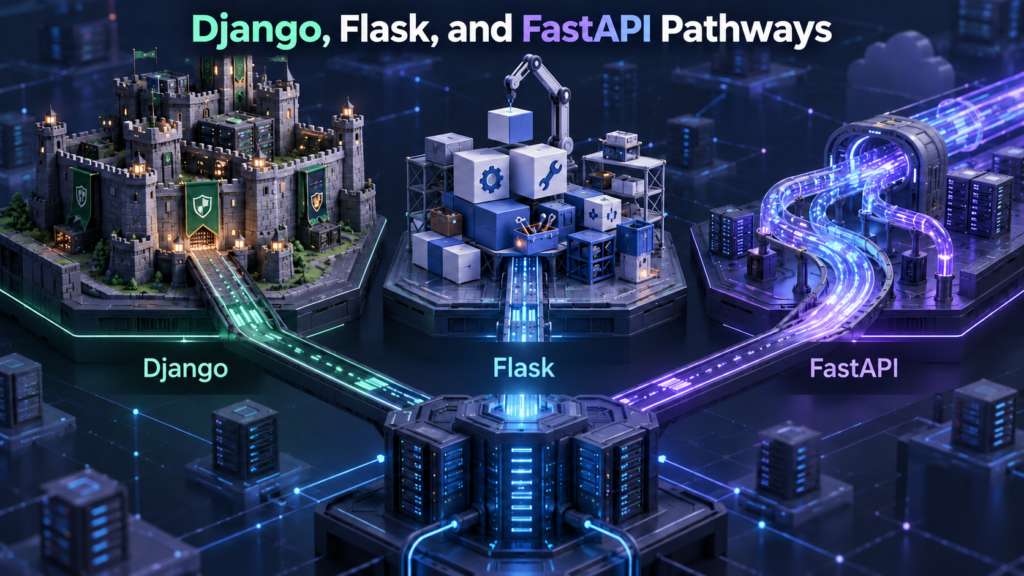
When evaluating modern Python frameworks for full-stack or large-scale enterprise web applications, Django traditionally emerges as the most robust choice, offering a comprehensive, batteries-included ecosystem that handles everything from database ORM and authentication to administrative tooling out of the box.
Conversely, if your development philosophy leans toward minimalism, architectural freedom, and granular control, Flask remains a peerless option among lightweight Python frameworks, providing a flexible micro-foundation where you handpick every extension, database connector, and library to match your exact specifications.
Meanwhile, for developers engineering high-performance, type-safe APIs and asynchronous microservices, FastAPI has rapidly established itself as a premier solution within the ecosystem of Python frameworks due to its exceptional execution speed, native support for Python type hints, and automatic generation of interactive API documentation.
Ultimately, navigating the diverse landscape of Python frameworks depends far less on abstract popularity rankings and far more on carefully evaluating your project’s core functional requirements, your team’s existing skill sets, your underlying data models, your production deployment environment, and your long-term scalability goals.
What are Python frameworks?
Python frameworks are standardized collections of modules, libraries, and architectural conventions designed to accelerate backend development. Rather than writing boilerplate code for repetitive web engineering tasks—such as URL routing, input validation, database abstraction, session management, and authentication—developers rely on these frameworks to provide secure, tested, and scalable foundations.
While numerous options exist within the ecosystem, backend development largely converges on three core frameworks, each built around distinct architectural philosophies:
- Django: A monolithic, “batteries-included” framework optimized for rapid full-stack application development. It ships with an exhaustive built-in suite—including an Object-Relational Mapper (ORM), an admin dashboard, authentication systems, and robust cross-site scripting protections—making it ideal for complex, data-driven applications that require high security out of the box.
- Flask: A minimalist micro-framework designed for maximum modularity and architectural freedom. Flask provides a lightweight core that handles fundamental request routing, leaving structural choices, database connectors, and extension packages entirely up to the developer. This makes it a strong option for microservices, small-to-medium applications, and custom architectures.
- FastAPI: A modern, asynchronous framework engineered specifically for high-performance APIs.Built on Starlette and Pydantic, FastAPI leverages native Python type hints to deliver automated interactive documentation (Swagger/OpenAPI), real-time data validation, and asynchronous processing speeds that rival Node.js and Go.
Evaluating these tools requires moving past generic benchmark scores. Real-world application performance is ultimately dictated by database indexing strategies, query efficiency, asynchronous execution models, infrastructure caching layers, and deployment configurations rather than framework choice alone.
Django vs Flask vs FastAPI
Choosing the right Python framework depends on your application’s architecture, scaling requirements, and whether you are building a server-rendered monolith or an API-driven microservice.
| Feature | Django | Flask | FastAPI |
| Core Approach | Full-stack framework | Lightweight microframework | API-focused framework |
| Best Suited To | Content-heavy sites, SaaS platforms, dashboards, large web applications | Small services, prototypes, custom applications, simple backends | REST APIs, microservices, data services, AI/ML backends |
| Included Features | ORM, authentication, admin, forms, migrations, security tools | Minimal core; most features use extensions | Validation, dependency injection, OpenAPI documentation |
| Learning Curve | Steeper initially, easier as projects grow | Gentle start, but architecture decisions increase later | Moderate, especially when learning type hints and async concepts |
| Flexibility | Structured and opinionated | Very high | High for APIs, more opinionated around schemas |
| API Development | Capable, often with Django REST Framework | Capable through extensions | Built in through OpenAPI, Swagger UI, and ReDoc |
| Async Support | Supports async views and ASGI deployment | Supports async views, but remains WSGI-oriented | Designed for ASGI and async workloads |
| Admin Interface | Built in | Requires an extension or custom implementation | Not built in |
| Database Layer | Built-in Django ORM | Choose an ORM or database library | Typically uses external tools such as SQLAlchemy or SQLModel |
| Automatic API Docs | Not part of core Django | Not part of core Flask | Built in |
| Architectural Control | Moderate | High | High for services and APIs |
| Main Trade-off | More framework to learn and configure | More choices and integration work | Less suitable for traditional server-rendered sites |
Django: The Complete Application Framework
Django is built to handle nearly every layer of infrastructure required for a full-scale web application out of the box. Its official ecosystem ships with core features including authentication, role-based permissions, user sessions, dynamic forms, database migrations, and a powerful object-relational mapper (ORM).
Additionally, Django includes a production-ready administration dashboard that eliminates the need to build custom internal interfaces for managing database models during early development stages.
The framework’s signature “batteries-included” philosophy minimizes the initial decision fatigue teams face when architecting a project. By enforcing rigid conventions and a standardized project layout, Django ensures high codebase consistency, making it easier for multiple developers to collaborate without breaking architectural patterns.
Ideal Use Cases
- SaaS products requiring robust user accounts, multi-tenant structures, and fine-grained permissions.
- Content management systems and digital publishing platforms with complex media and text models.
- E-commerce applications managing product catalogs, shopping carts, and secure user checkouts.
- Internal dashboards and administrative systems that leverage Django’s built-in UI panels.
- Educational and learning management platforms tracking student progress and course hierarchies.
- Applications with deep relational data that benefit from a mature, integrated ORM.
- Teams that prioritize strict conventions and long-term maintainability over custom architectural setups.
Architectural Trade-offs and Considerations
While comprehensive, Django is rarely the fastest or leanest option for exposing a simple, lightweight endpoint. Developers must familiarize themselves with an extensive ecosystem—spanning settings files, URL routing, models, migrations, template engines, middleware, and app-level structures—before the framework feels fluid.
Although modern releases support asynchronous views and an ASGI-compatible request stack, unlocking true asynchronous performance requires evaluating the entire stack, including third-party middleware, database driver compatibility, and external API integrations.
Flask: The Flexible Foundation
Flask is a minimalist WSGI web application framework engineered for simplicity and granular architectural control. Unlike monolithic alternatives, Flask’s core intentionally avoids prescribing solutions for database management, form validation, or user authentication. Instead, developers assemble their ideal stack by integrating community extensions or independent third-party libraries.
This lightweight philosophy provides a minimal starting footprint. Developers can instantiate a basic route, return an immediate response, and progressively layer on components only as application requirements demand.
Ideal Use Cases
- Small-to-medium web applications that do not require the heavy scaffolding of a full-stack framework.
- Rapid prototypes and proof-of-concept products where getting code running quickly is the primary objective.
- Custom backends tailored for specific data processing or integration pipelines.
- Lightweight internal tools and operational scripts with simple web interfaces.
- Simple REST services that require minimal overhead.
- Projects where development teams prefer bringing their own pre-vetted libraries and database connectors.
- Developers looking to master the fundamental HTTP request-response cycle without framework abstractions getting in the way.
Architectural Trade-offs and Considerations
Flask’s greatest strength—its unopinionated flexibility—is also its primary long-term challenge. Because the framework does not mandate a standard approach to directory organization, database architecture, or security management, two Flask codebases can look completely different, occasionally introducing friction as teams scale.
While this freedom empowers experienced developers to craft highly customized systems, it can leave growing teams or beginners overwhelmed by architectural decisions that more rigid frameworks handle automatically.
Furthermore, although Flask supports asynchronous route handlers when installed with async extras, it remains fundamentally a WSGI application. Each request occupies a dedicated worker thread during execution, meaning async syntax does not inherently transform Flask into an asynchronous-first ASGI framework.
FastAPI: The API-First Option
FastAPI is engineered specifically for building production-grade APIs by leveraging standard Python type hints. It uses this type metadata to drive automatic request validation, data serialization, enhanced code editor autocompletion, and interactive API documentation. FastAPI’s documentation system is built natively on OpenAPI and JSON Schema standards, delivering out-of-the-box interactive interfaces through Swagger UI and ReDoc.
Built on top of Starlette and Pydantic within the asynchronous ASGI ecosystem, FastAPI supports both synchronous and asynchronous endpoint functions. This architecture makes it exceptionally well-suited for high-throughput services that handle intensive I/O operations, such as external API calls, database interactions, message queues, and AI model inference pipelines.
Ideal Use Cases
- High-performance REST APIs requiring strict data validation and type safety.
- Microservice architectures communicating via lightweight JSON payloads or asynchronous protocols.
- Machine learning inference endpoints and AI model backends.
- Mobile and single-page application (SPA) backends needing rapid response times and clean contracts.
- Real-time or I/O-heavy services utilizing WebSockets or asynchronous task queues.
- APIs requiring strict schemas and automated documentation generation directly from source code.
Architectural Trade-offs and Considerations
Unlike Django, FastAPI does not provide an all-inclusive application suite out of the box. Essential layers such as user authentication mechanisms, database ORM integration, background task processing, and business logic patterns require intentional package selection and custom design.
Furthermore, FastAPI’s raw performance claims should be evaluated pragmatically. While the framework drastically minimizes routing overhead and supports concurrent non-blocking I/O, overall execution speed is ultimately bound by downstream bottlenecks, such as unoptimized database queries, network latency, or slow external third-party dependencies.
Which framework is easiest to learn?
Flask consistently offers the gentlest initial learning curve among the major Python frameworks because its core API is deliberately small and unopinionated. A beginner can instantiate a route and return a response with minimal setup, making it an excellent vehicle for grasping the fundamental HTTP request-response cycle without wading through heavy boilerplate.
FastAPI is also approachable for developers who already have a firm grasp of standard Python functions, type hints, and basic HTTP concepts. Features like automatic OpenAPI documentation and immediate request validation streamline early development, though learners must eventually master modern concepts such as Pydantic models, dependency injection, and asynchronous execution workflows.
Conversely, Django traditionally presents the steepest initial hurdle because it introduces an extensive ecosystem of concepts, configurations, and mandatory project conventions right out of the gate. However, the trade-off is that those rigid structures and built-in components quickly pay dividends in maintainability and consistency as application complexity scales.
Strategic Learning Paths
- Choose Flask if your primary goal is to master the fundamentals of web routing, manual request handling, and building lightweight application structures from scratch.
- Choose FastAPI if you want to build modern APIs, leverage native type hints, and practice asynchronous backend development.
- Choose Django if your objective is to build complete, full-stack applications complete with user authentication, database management, administrative dashboards, and server-rendered templates.
Ultimately, mastering any one of these Python frameworks does not lock you into a single technology stack. Core engineering competencies—such as understanding HTTP semantics, REST architectural design, database modeling, authentication flows, testing methodologies, and security best practices—transfer seamlessly across all three.
Which Framework Performs Best?
There is no single universal winner when evaluating raw speed, because “performance” encompasses multiple distinct metrics:
- Requests per second (Throughput): The volume of client requests handled concurrently.
- Response latency: The round-trip time required to process and fulfill a request.
- Concurrent connections: The framework’s ability to maintain idle or active socket connections simultaneously.
- Database throughput: How efficiently queries, connection pooling, and ORM mapping are executed under load.
- Memory consumption: The RAM footprint of the runtime process.
- Developer velocity: The time and engineering effort required to build, test, and maintain features.
- Operational complexity: The overhead involved in deploying, scaling, and monitoring the application in production.
Performance Profiles by Framework
- FastAPI: Routinely leads in raw throughput and concurrency for API workloads. Because it is built on ASGI and native asynchronous architecture (Starlette and Pydantic), it excels at handling high-volume I/O-bound requests (such as external API calls, microservice hops, and database streaming). However, async execution does not inherently accelerate CPU-bound computational tasks.
- Flask: Delivers reliable performance for conventional, lightweight applications when deployed correctly. Its minimal core footprint introduces virtually zero framework overhead, though final application performance remains heavily dictated by third-party extensions, database layer efficiency, and custom business logic.
- Django: While burdened with a larger initial runtime overhead due to its comprehensive feature set, Django scales effectively in production. Its native ASGI support allows it to handle concurrent workloads well, provided engineering teams implement proper database indexing, query optimization, caching strategies, and asynchronous background jobs.
Evaluating Performance in Practice
Choosing a framework based solely on synthetic benchmark numbers often leads to architectural missteps. Real-world performance depends heavily on the entire infrastructure stack. To make an accurate, data-driven choice for your system, test a representative endpoint incorporating:
- Representative payloads and real data structures.
- The actual production database and target drivers.
- Active authentication, security middleware, and data validation layers.
- Production-grade deployment configurations (e.g., Gunicorn with Uvicorn workers).
- Realistic concurrent user loads.
- Continuous monitoring for latency percentiles, error rates, memory usage, and database query times.
Which framework is most flexible?
Flask provides the highest degree of architectural freedom among Python frameworks, deliberately refusing to mandate how you structure your code or handle common backend concerns. Developers maintain complete autonomy to handpick their database toolkit, ORM, validation library, authentication flow, and project layout, making it the most malleable option for custom or highly specialized architectures.
FastAPI offers high flexibility specifically tailored to API design, but it imposes a structured approach around data modeling and contracts. Its type-hint-driven architecture enforces consistency using Pydantic schemas, ensuring that your inputs and outputs remain rigorously validated across your services.
Django sits on the opposite end of the spectrum, trading structural flexibility for rigid, opinionated conventions. It provides pre-determined pathways for nearly every major architectural decision—from database migrations and authentication to admin panels and template rendering—ensuring a unified standard across large engineering teams.
While maximum freedom allows experienced developers to custom-build precise software environments, it also introduces decision fatigue and technical debt. For many growing teams, Django’s opinionated constraints ultimately deliver higher velocity than the blank canvas offered by more flexible alternatives.
How to Choose the Right Framework
Selecting the ideal tool among these Python frameworks comes down to matching your product architecture and team requirements to each tool’s core strengths:
- Choose Django when building a complete, full-stack web application that benefits from an integrated, batteries-included ecosystem.
- Choose Flask when developing small, highly custom, experimental applications or when your team prefers handpicking its own technology stack.
- Choose FastAPI when your primary product is an API or microservice requiring typed schemas, automated documentation, high-concurrency async endpoints, or AI and data service integrations.
Decision Checklist
Before committing to a framework, evaluate your project against these core questions:
- Core Product Type: Is your main deliverable a server-rendered website or a decoupled API?
- Administrative Needs: Do you require a built-in admin dashboard out of the box?
- Access Control: Will the application require complex user accounts, groups, and fine-grained permissions?
- Team Philosophy: Does your team prefer rigid conventions for consistency or maximum architectural choice for customization?
- Concurrency & I/O: Will the service handle heavy asynchronous operations or high-volume concurrent I/O?
- Documentation Requirements: Do consumers need an automated, interactive OpenAPI specification?
- Rendering Strategy: Does the project require server-rendered HTML or a client-side architecture?
- Team Competency: Which framework does the team already have production experience with?
- Ecosystem Requirements: What downstream tools (databases, authentication providers, task queues) are you integrating?
- Long-Term Maintenance: Is the framework’s ecosystem robust and sustainable for your product’s projected multi-year lifecycle?
Practical Scenarios
| Project Scenario | Recommended Framework | Rationale |
| Student learning backend basics | Flask | Small core makes the HTTP request-response cycle transparent and easy to observe. |
| Blog or publishing platform | Django | Ships with built-in models, admin panels, authentication, forms, and templates. |
| AI model inference API | FastAPI | Delivers strong validation, native OpenAPI documentation, and async-compatible execution. |
| Startup SaaS application | Django or FastAPI | Django suits integrated product development; FastAPI suits API-first architectures. |
| Small webhook receiver | Flask or FastAPI | Both function well; choose based on validation preferences and async requirements. |
| Mobile application backend | FastAPI or Django | FastAPI is API-first and lightweight; Django is useful if business administration is extensive. |
| Highly customized service | Flask | Empowers the team to select and configure components independently. |
| Data-heavy internal platform | Django | Built-in ORM, authentication, admin, and relational modeling drastically reduce implementation time. |
Common Mistakes to Avoid
Choosing the right Python framework involves more than comparing features and performance. Developers often select a framework based on popularity without considering their project requirements, experience level, scalability needs, or long-term maintenance. Here are the common mistakes to avoid when choosing and using Django, Flask, or FastAPI.
- Choosing from benchmarks alone: A framework benchmark rarely represents your complete production system. Real-world factors—such as database queries, external API calls, data serialization, caching layers, and deployment configurations—typically have a far greater impact on overall performance than core routing overhead.
- Confusing async syntax with async architecture: Adding
async defto an endpoint does not automatically render every downstream operation non-blocking. Utilizing blocking database drivers, synchronous file operations, or legacy third-party SDKs inside an asynchronous loop will stall execution threads and degrade throughput.
- Adding too many extensions: While Flask’s extension ecosystem provides modular freedom, every third-party dependency introduces maintenance debt, version compatibility risks, and security overhead. Always prioritize actively maintained packages with clean release histories.
- Treating generated API documentation as security: FastAPI’s automated Swagger and ReDoc interfaces streamline developer onboarding and testing, but they do not substitute for robust authentication, authorization, rate limiting, strict input constraints, or secret management.
- Ignoring project structure: Small Flask or FastAPI applications can quickly degrade into unmaintainable legacy code if routes, database access, business logic, configuration files, and security rules are crammed into a handful of monolithic files. Establish clear structural boundaries early in development.
- Rebuilding Django features without estimating the cost: A minimalist framework may appear leaner at project inception. However, if a product eventually demands user authentication, role-based permissions, administrative dashboards, complex form handling, and migration tools, building those features from scratch frequently exceeds the cost of starting with Django.
Is Django better than Flask?
Neither framework is universally superior. Django is typically more efficient for building complete, feature-rich applications that align with standard web patterns. Flask is preferable when you require a minimal core foundation and precise control over architectural components.
Is FastAPI better than Django for APIs?
FastAPI is usually the more streamlined choice for dedicated API-first services because native request validation, automated OpenAPI documentation, and asynchronous execution are built directly into its core design. Django remains a powerful alternative when your API functions as part of a larger full-stack application that leverages Django’s built-in ORM, authentication system, and administrative tooling.
Can Flask and Django build APIs?
Yes, both frameworks excel at powering APIs. Django projects commonly integrate the Django REST Framework (DRF) to handle complex API requirements, while Flask projects utilize extensions and independent serialization libraries. FastAPI simply offers these API-specific capabilities out of the box.
Can FastAPI build websites?
FastAPI can serve HTML responses and static files via Starlette’s integrations, but it is fundamentally engineered for APIs. If your primary requirement is a server-rendered website featuring an out-of-the-box administrative panel, Django serves as a much more natural starting point.
Which framework is best for beginners?
Flask generally offers the easiest entry point because it exposes fewer underlying concepts and abstractions. Django is ideal for learners wanting to master structured full-stack architecture, while FastAPI is the best option for those specifically targeting modern API development, data engineering, or AI backends.
Can a project use more than one framework?
Yes, multi-framework architectures are common in enterprise environments, though they introduce additional deployment, testing, and monitoring complexity.
A typical pattern involves utilizing Django for core business logic and user management, coupled with a dedicated FastAPI microservice optimized for high-throughput machine learning inference or specialized data processing. Introduce architectural splits only when the functional boundary delivers clear operational advantages.
In Conclusion
Django, Flask, and FastAPI each offer distinct strengths. The best Python framework depends on your project’s size, purpose, performance requirements, and your development experience.
- Choose Django for complete web applications with integrated data management, authentication, administration, and rigid conventions.
- Choose Flask for a minimal foundation and maximum architectural control.
- Choose FastAPI for modern APIs that benefit from type-based validation, automatic documentation, and asynchronous support.
When evaluating your options, assess the full system rather than relying solely on raw framework speed. Prioritize maintainability, ecosystem maturity, team expertise, security standards, and production deployment requirements.
A practical next step is to build the same small service in your preferred framework. Create a single endpoint, add data validation, connect a database, write tests, and deploy it. The hands-on implementation effort will provide far more reliable evidence for your decision than any generic framework ranking.