How to Fact-Check AI Answers When No Sources Are Provided
When a large language model (LLM) provides a detailed and confident response without citing any sources, it can be tempting to accept the information as accurate—especially when the explanation sounds logical and professionally written. However, confidence, fluency, and accuracy are not the same thing.
AI tools can produce outdated information, misrepresent statistics, confuse events, omit important context, and occasionally generate facts, quotations, or references that do not exist. Accepting such an answer at face value can introduce significant risks, particularly when the information will be used for academic work, professional decisions, technical documentation, health-related research, financial analysis, or published content.
To effectively fact-check AI answers, begin by treating every unsupported response as an unverified draft rather than a reliable source of truth. This does not mean that the entire answer is necessarily wrong. Instead, it means that each important factual statement should earn your trust through independent verification.
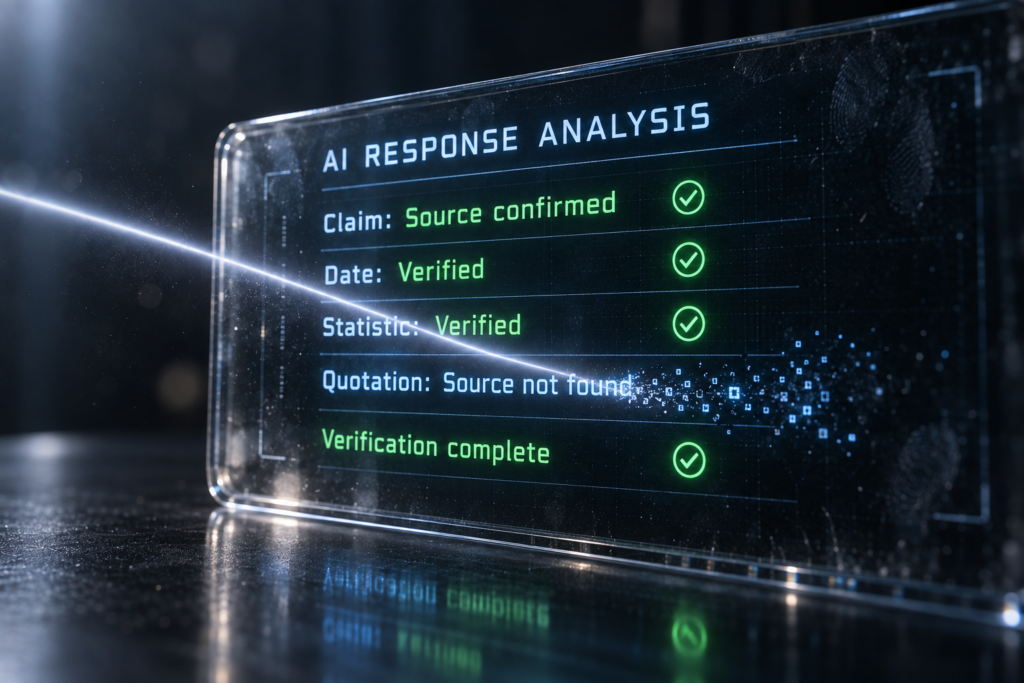
The core verification process involves breaking the response into separate, testable claims, identifying the statements with the greatest potential impact, and cross-referencing them with authoritative primary sources. For example, technical statistics may need to be checked against official documentation or original research, historical dates against trusted archives, and direct quotations against the original speech, interview, publication, or transcript.
This claim-by-claim approach also helps reduce hallucination bias—the tendency to trust incorrect information because it is presented clearly and confidently. By systematically fact-checking AI answers before using, publishing, or acting on them, you can identify unsupported claims, correct misleading details, preserve essential context, and make more informed decisions. The goal is not to reject AI-generated information automatically, but to combine the speed of AI with careful human judgment and dependable evidence.
Why AI Answers Need Verification
AI-generated text is designed to be fluent, detailed, and authoritative, which often masks underlying inaccuracies. Because language models predict tokens based on statistical probability rather than factual retrieval, they frequently produce errors that fall into several distinct categories:
- Hallucinations and Fabrications: Generating completely false facts, data points, or entirely non-existent citations with absolute confidence.
- Contextual Omission: Leaving out critical constraints, edge cases, or counter-arguments that fundamentally change the validity of the output.
- Cross-Contamination: Combining unrelated facts, timelines, or entities into a single, plausible-sounding falsehood.
- Temporal Decay: Relying on outdated training data or superseded standards while presenting the information as current.
The Risk of the Uncited Claim
The absence of citations in an AI response does not inherently prove that the information is false; rather, it indicates an absence of evidence. Without a verifiable trail, the output remains an unverified draft. Accepting these outputs at face value introduces operational risk, particularly in professional, academic, or public-facing contexts.
Institutional standards reinforce this operational caution:
- Academic & Research Protocols: Research guidelines from institutions like Northwestern University mandate cross-referencing AI outputs against credible sources, noting that even responses containing real citations can misinterpret data or misattribute names and dates.
- Risk Frameworks: The National Institute of Standards and Technology (NIST) generative AI risk guidance highlights the necessity of documenting verification workflows when utilizing content derived from unknown or multi-source models.
Target Audience
This verification methodology is engineered for professionals, researchers, students, and content creators who rely on LLMs like ChatGPT, Claude, Gemini, Copilot, and Perplexity for high-stakes workflows where accuracy is non-negotiable.
The Five-Minute Fact-Checking Process
Relying on an AI tool to audit its own output is an ineffective verification strategy. When a response lacks citations, you need a systematic, high-leverage evaluation workflow.
Execute these five steps to rapidly and rigorously fact-check AI answers:
Separate the Answer into Claims
Never evaluate an entire paragraph as a single block. Deconstruct the response into individual, atomic statements that can independently be true, false, outdated, or misleading.
- Example: The statement, “The Nigerian Data Protection Act was passed in 2023, is enforced by the Nigeria Data Protection Commission, and requires every organisation to appoint a data protection officer,” must be split into distinct assertions regarding the enactment year, the regulatory authority, and the universal mandate for a DPO. Each component requires targeted verification.
Mark High-Risk Claims
Prioritize claims where inaccuracies carry real-world consequences, such as financial loss, reputational damage, legal exposure, or poor decision-making. Focus immediate verification on:
- Legal, medical, financial, tax, or safety guidelines.
- Specific statistics, metrics, percentages, dates, and deadlines.
- Software product specifications, versions, and feature availability.
- Direct quotations and attributed opinions.
- Absolute claims utilizing words like “always,” “never,” “all,” or “proven.”
Extract Searchable Keywords
Do not paste dense AI sentences into search engines, as generative phrasing rarely matches primary source documents. Strip each claim down to high-signal search strings:
- Laws or Policies:
[Exact law name] official government website - Statistics:
"[Exact statistic]" original report - Academic Findings:
"[Key research phrase]" Google Scholar - Quotations:
"[Distinctive quote snippet]" [Speaker] - Company / Product Details:
[Company/Product name] official documentation release notes
Find the Best Source Type
Search engine results are discovery tools, not proof. Match each claim type to its highest-authority primary source:
- Laws and Regulations: Official government portals, legislation databases, and regulatory gazettes.
- Software and APIs: Official product documentation and technical release notes.
- Research and Statistics: Original academic papers, university repositories, or primary government datasets.
- Corporate Data: Investor relations pages, regulatory filings, and audited reports.
Compare the Claim with the Evidence
Finding a matching keyword on a web page is not enough. Scrutinize the source material to ensure it directly backs the AI’s specific assertion by asking:
- Does the source explicitly state the same fact for the correct country, population, and time period?
- Has the model exaggerated a nuanced or cautious academic conclusion?
- Has a mere correlation been misconstrued as causation?
- Has a future forecast been presented as an established historical fact?
How to Evaluate a Source
Evaluating a source requires looking far beyond its top-level domain. Relying on a .edu, .gov, or .com suffix is insufficient to guarantee accuracy. Institutional standards—including framework guidance from major university libraries and Harvard’s source-evaluation criteria—mandate assessing five core dimensions:
Authority
Determine who created the information. Evaluate the author’s or organization’s credentials, professional background, editorial independence, and domain-specific reputation. A whitepaper published by an established regulatory body carries more weight than an unverified corporate blog post.
Currency
Confirm when the information was published or last updated. Timeliness is critical for fields where rules, technology, or data shift rapidly. Rigorous currency checks are mandatory for:
- AI platforms, software versions, and developer APIs.
- Pricing structures, enterprise tiers, and subscription plans.
- Legislation, statutory instruments, and compliance mandates.
- Immigration policies, visa requirements, and employment laws.
- Public health directives, medical protocols, and statistical reports.
Accuracy
Examine whether the source provides transparent evidence, underlying methodology, and references or links to primary materials. Scrutinize the text for internal contradictions, unsupported assertions, or factual errors in names, figures, and dates.
Relevance
Verify whether the source directly answers your specific question. A broad overview of data protection principles, for instance, cannot substitute for the explicit textual requirements of a targeted local framework like the Nigeria Data Protection Act.
Purpose and Bias
Identify the primary motivation behind the content: whether it was created to inform, sell, persuade, campaign, entertain, or capture search engine traffic. While commercial vendors or advocacy groups can publish accurate data, their interpretations must be cross-referenced against neutral, independent sources.
How to Verify Common AI Errors
When learning how to fact-check AI answers, knowing where models typically fail saves hours of manual auditing. Different categories of AI error require specific verification protocols to ensure complete accuracy:
Statistics
Never rely on secondary articles or round numbers when auditing metrics. When fact-checking AI answers involving data, locate the original survey, report, or dataset to verify:
- The exact numerical value and how it is framed (percentage, rate, average, or estimate).
- The geographic scope, sample size, and target population measured.
- The explicit time period and metric definitions.
- Check: A statistic can be mathematically correct yet entirely misleading if its denominator or context is omitted.
Dates and Timelines
AI systems frequently hallucinate chronological sequences by merging related events, shifting years, or confusing announcement milestones with active deployment. When verifying timelines, search events, individuals, and organizations independently. For software-related claims, rigorously distinguish between:
- Announcement dates and public beta rollouts.
- General availability (GA) and regional deployment.
- Documentation updates and strict deprecation deadlines.
Quotations
When fact-checking AI answers featuring direct speech, isolate a distinctive phrase within quotation marks. Confirm that:
- The quote is hosted on a credible primary or archival source.
- The speaker, setting, and exact date are verified.
- The wording is complete and has not been stripped of essential context.
- Rule: If an exact quote cannot be found in a primary source, discard it.
Names and Identities
Language models routinely conflate individuals with similar backgrounds or misattribute achievements to the wrong organizations. When validating names and identities, use official biographies, corporate filings, institutional profiles, or university directories to verify spelling, current roles, and locations.
Academic Studies
Research guides from institutions like Northwestern University warn that models frequently generate “Frankenstein citations”—combining a real paper title with the wrong authors, fabricated journals, or conflating non-peer-reviewed preprints with validated studies. To fact-check AI answers in academic contexts, search titles, author names, DOIs, and publication years directly in Google Scholar, Crossref, or institutional repositories.
Laws and Regulations
Summaries and blog posts regarding legal frameworks are frequently out of date. When validating laws and statutory instruments, always review the primary text directly from government portals, official gazettes, or regulatory bodies. Verify jurisdictional boundaries, effective dates, statutory definitions, enforcement authorities, penalties, and subsequent legislative amendments.
Technical Claims
LLMs often output plausible code snippets or architecture guidelines based on deprecated libraries or outdated version syntax. When verifying technical claims, cross-reference official documentation, code repositories, and change logs. Always check the target product version, required OS, cloud environment, and permission structures before deploying AI-generated code to production.
Ask the AI for Sources, But Do Not Stop There
You can prompt an AI tool to expose the evidence behind its output by requesting a structured breakdown. Use a prompt format such as:
“Break your answer into factual claims. For each claim, provide a source title, author or organisation, publication date, direct URL, and the exact passage that supports it. If you are uncertain or cannot verify a source, say so.”
This technique accelerates the audit process by flagging what needs verification. However, an AI-generated citation is merely a lead, not definitive proof. When fact-checking AI answers that include model-generated links, execute this systematic verification sequence:
- Open the link: Never trust a citation based solely on its title or description.
- Confirm existence: Verify that the target URL resolves to an active, legitimate page.
- Match metadata: Cross-check the author, title, publication date, and publishing organization against independent records.
- Locate the passage: Find the exact text referenced within the source document.
- Validate the claim: Determine whether the passage fully supports the specific assertion made by the AI.
- Check currency: Confirm that the information remains timely and appropriate for the context.
Replace weak, secondary, or broken links with primary evidence whenever possible. As institutional research guidelines (such as those from Northwestern University) emphasize, you must always open the source and compare the model’s output directly against it before relying on the information.
Cross-Check Important Claims
For high-impact claims, relying on a single reference point is a vulnerability. When you fact-check AI answers involving critical data, always seek confirmation from at least two independent sources.
True independence requires variety; five different websites republishing the same corporate press release do not constitute five independent confirmations.
The Dual-Source Verification Model
A robust cross-check combines two distinct evidentiary pillars:
- Primary Source: An official regulatory document, primary dataset, peer-reviewed paper, or direct institutional statement.
- Independent Secondary Source: A reputable publication, university analysis, or specialist industry organization providing objective commentary or context.
Trace claims backward to identify their earliest credible origin. When evaluating current news events, cross-reference dates, locations, named actors, and direct statements across multiple reputable outlets. For technical or academic assertions, compare the original research directly against an authoritative review article, institutional standard, or official documentation.
Warning Signs in Unsupported AI Answers
When you fact-check AI answers, certain linguistic and structural patterns act as immediate red flags. An output should be treated as high-risk if it exhibits multiple warning signals:
- Unearned Confidence: Displaying absolute certainty despite providing zero supporting evidence or verification trails.
- Orphaned Statistics: Presenting highly specific numerical figures or percentages without naming a primary report, dataset, or methodology.
- Weasel Words: Relying on vague, non-attributable phrases such as “experts say,””studies show,” or “industry consensus.”
- Ghost Citations: Listing references that lack DOIs, publication years, functional URLs, or identifiable authors.
- Broken Links: Providing hyperlinks that either return error pages (such as 404s) or lead to content completely unrelated to the cited claim.
- Chronological Mismatch: Blending current facts with outdated, superseded protocols or historical data.
- Unverifiable Quotes: Featuring polished, perfectly phrased quotations that do not exist in any primary or archival record.
- Internal Inconsistencies: Exhibiting contradictory dates, spelling variations, names, or figures within the same response.
- Overgeneralization: Extrapolating a sweeping, universal claim from a single, isolated example.
- Absolutist Language: Using rigid terminology like “guaranteed,””always,””never,” or “everyone” while ignoring edge cases.
- Nuance Erasure: Omitting necessary regional differences, legal exceptions, or explicit points of uncertainty.
- Stochastic Variance: Producing a substantially different answer when asked the same prompt a second time.
These signals do not automatically prove that an AI answer is false, but they indicate that the output is unvetted. Recognizing these patterns ensures you catch unverified assumptions before deploying AI-generated text in professional or public workflows.
A Practical Reliability Rating
When you fact-check AI answers, abandoning subjective judgments like “it feels right” is essential. Instead, apply a systematic, evidence-based classification system to evaluate the reliability of specific assertions.
This rating system applies to individual claims rather than the entire AI response, allowing you to isolate mixed outputs where accurate data coexists with hallucinations.
| Rating | Meaning | Appropriate Action |
| Verified | Important claims match strong, current, and relevant primary sources. | Use with confidence, include citations, and preserve the evidentiary trail. |
| Probably accurate | Claims align with credible sources, but the supporting evidence remains indirect or incomplete. | Use cautiously, verify secondary markers, and disclose any limitations. |
| Unverified | Plausible claims lack sufficient evidence or corroborating documentation. | Do not publish or base high-stakes decisions on these assertions. |
| Misleading | Core facts may be technically correct, but context, scope, temporal validity, or certainty is distorted. | Rewrite with rigorous qualifications, necessary context, and proper support. |
| False | Authoritative primary sources directly contradict the AI’s claim. | Discard the claim entirely, do not repeat it, and correct the record. |
A single AI-generated paragraph frequently contains a mixture of verified, unverified, and misleading statements. Granular rating ensures you clean up every layer before deploying content publicly or professionally.
What to Do When Sources Cannot Be Found
When you fact-check AI answers and hit a dead end where corroborating evidence is missing, never present the claim as fact simply because it sounds plausible. Maintaining professional integrity requires decisive remediation when verification fails.
Execute one of these protocols when a claim cannot be substantiated:
- Drop the Claim: Excise the unsupported statement entirely. If a sentence is not essential to your core narrative, removing it is the safest option.
- Reframe as Uncertainty: Explicitly acknowledge the gap in the data rather than hiding behind silence.
- Narrow the Assertion: Scale back a broad, sweeping claim into a specific, defensible subset that is backed by available evidence.
- Consult a Subject Matter Expert: Escalate high-stakes or technical questions to a qualified professional or domain specialist.
- Switch to Deep-Dive Databases: Move beyond standard search engines to specialized academic repositories, regulatory filings, or primary archives.
Communicating Uncertainty Effectively
When partial context exists but definitive proof remains elusive, use transparent, qualifying language. Frame the limitation clearly for your audience using precise statements:
- “I could not verify this claim from an authoritative source.”
- “Available primary sources provide conflicting figures.”
- “This outcome appears plausible, but the underlying evidence is insufficient.”
- “The source document is required before this can be treated as verified.”
For published articles, reports, or professional deliverables, unsupported assertions should be excluded by default. A transparent limitation is always more valuable than a fabricated citation.
Common Mistakes to Avoid
When you fact-check AI answers, falling into common cognitive and procedural traps can undermine your verification workflow. Avoid these eight critical pitfalls:
- Asking the Same AI for Confirmation: Prompting the same model to “double-check” its work will typically result in the model defending its original hallucination or rephrasing the error. A second output is never an independent source.
- Trusting Fluent Writing: Impeccable grammar, dense technical vocabulary, and absolute confidence measure presentation quality and token probability, not factual accuracy.
- Treating Search Ranking as Proof: Search engine algorithms optimize for relevance, SEO, and engagement. The top result is not inherently the most authoritative, objective, or current source.
- Checking Only One Sentence: Reviewing a single headline claim while ignoring the surrounding context often misses nested errors, such as a correct general statement paired with a fabricated statistic or date.
- Counting Copied Sources as Independent Evidence: Finding five different blogs repeating the same unsourced claim or press release equals a single unverified data point, not five independent confirmations.
- Checking Citations But Not Context: A real source can still be misinterpreted, taken out of context, or stripped of vital conditions. Always open the link and read the specific passage.
- Ignoring Regional Differences: Assuming a rule, price, legal framework, software feature, or public service applies universally across all jurisdictions, regions, or account types leads directly to compliance and accuracy failures.
- Copying AI Output Directly Into Final Work: Treat AI text strictly as an unverified draft or research lead. You must verify, rewrite, cite, and take full professional responsibility for the final output.
A Reusable Verification Prompt
Use this prompt template to jump-start your verification workflow when dealing with complex, uncited AI outputs:
Plaintext
Review the answer below as a fact-checking assistant.
1. Extract every factual claim.
2. Classify each claim as time-sensitive, numerical, legal, medical, technical, historical, opinion, or general explanation.
3. Identify which claims require primary-source verification.
4. For each claim, provide search keywords rather than assuming the claim is true.
5. Suggest authoritative source types to consult.
6. Mark each claim as verified, uncertain, misleading, or unsupported only when evidence is available.
7. Do not invent citations. If you cannot verify a source, say so.
8. Separate facts, interpretations, assumptions, and recommendations.

Answer to review:
[Paste the AI answer here]
Code language: PHP (php)
Operational Note
Use the structured output from this prompt to organize your manual audit, not as a substitute for opening, reading, and evaluating the primary sources yourself.
Can AI answers be trusted without sources?
Not automatically. An uncited answer may be accurate, but you have no evidence trail to evaluate it. Trust should depend on the claim’s risk, the quality of independent evidence, and the answer’s currency.
How can I fact-check ChatGPT?
Copy the answer into a document, split it into atomic claims, search key claims independently, and verify them against official websites, academic databases, primary documents, and reputable reporting. Ask ChatGPT for sources only as a starting point, then inspect each source yourself.
Is Google enough for fact-checking?
Google and other search engines are useful for discovering evidence, but they are not evidence by themselves. Open the results, identify the source, assess its authority and date, and compare important claims independently.
Should I use Google Scholar?
Google Scholar is useful for locating academic papers, theses, books, and citations. It does not guarantee that every result is peer-reviewed, current, or relevant. Check the publisher, journal, study method, and original text.
What if the AI gives a real citation that does not support its answer?
Treat the claim as unsupported or misleading until you find evidence that supports it. A real source can be incorrectly cited, taken out of context, or used to support a conclusion it does not establish.
How many sources should I check?
There is no universal number. Match the effort to the risk. A low-stakes explanation may need one authoritative source. A medical, legal, financial, academic, or public-interest claim may require a primary source and independent confirmation.
Can AI detection tools prove that an answer is false?
No. AI-detection tools address how text may have been produced, not whether its claims are true. Fact-checking requires evidence for the claims themselves.
In Conclusion
Fact-checking AI outputs doesn’t require complex tools—it requires a disciplined workflow. Review this core checklist to ensure every uncited response is rigorously audited, verified, and safely deployed before it ever reaches your audience.
- Treat uncited output as unverified: An AI answer lacking sources is not automatically false, but it carries zero evidentiary weight until validated.
- Deconstruct into atomic claims: Break complex paragraphs into individual statements that can be tested independently.
- Prioritize high-risk categories: Focus immediate audit efforts on medical, legal, financial, statistical, chronological, and safety-critical claims.
- Isolate targeted keywords: Strip AI sentences down to distinctive phrases rather than pasting whole paragraphs into search engines.
- Rely on primary sources: Prioritize official government portals, regulatory filings, original datasets, and peer-reviewed studies over secondary summaries.
- Validate the evidence trail: Open links, verify metadata, and ensure the source material directly supports the specific claim being made.
- Cross-check critical data: Confirm high-impact claims across at least two independent, non-circular sources.
- Treat model citations as leads: Never trust an AI-generated link or citation without manually inspecting the underlying document.
- Manage unverified claims: If evidence is missing, remove the claim entirely or frame it transparently as an uncertainty.
Action Item
The next time an LLM delivers a confident, uncited response, spend five minutes extracting its core claims and verifying the highest-risk assertion first. Building this single habit eliminates the risk of deploying unvetted AI misinformation.