15 Free Ways to Promote Your YouTube Videos for More Views
Getting a YouTube video discovered does not always require a paid advertising budget. You can promote your YouTube videos through search optimization, YouTube Shorts, social media, websites, online communities, email, playlists, collaborations, and other free channels. The goal is not simply to share the same video link everywhere, but to place each video where people who are genuinely interested in its topic are most likely to discover and watch it.
In this guide, you’ll learn 15 practical ways to promote your YouTube videos for free, how each method works, and when to use it. You’ll also discover how to combine different promotion strategies to increase your video’s visibility, attract relevant viewers, and build a more consistent audience without relying entirely on paid advertising.
What Does It Mean to Promote a YouTube Video?
To promote your YouTube videos is to engineer deliberate distribution channels that connect your content with a high-intent audience. It requires moving beyond passive publishing and actively building discovery loops.
This distribution happens across two distinct ecosystems:
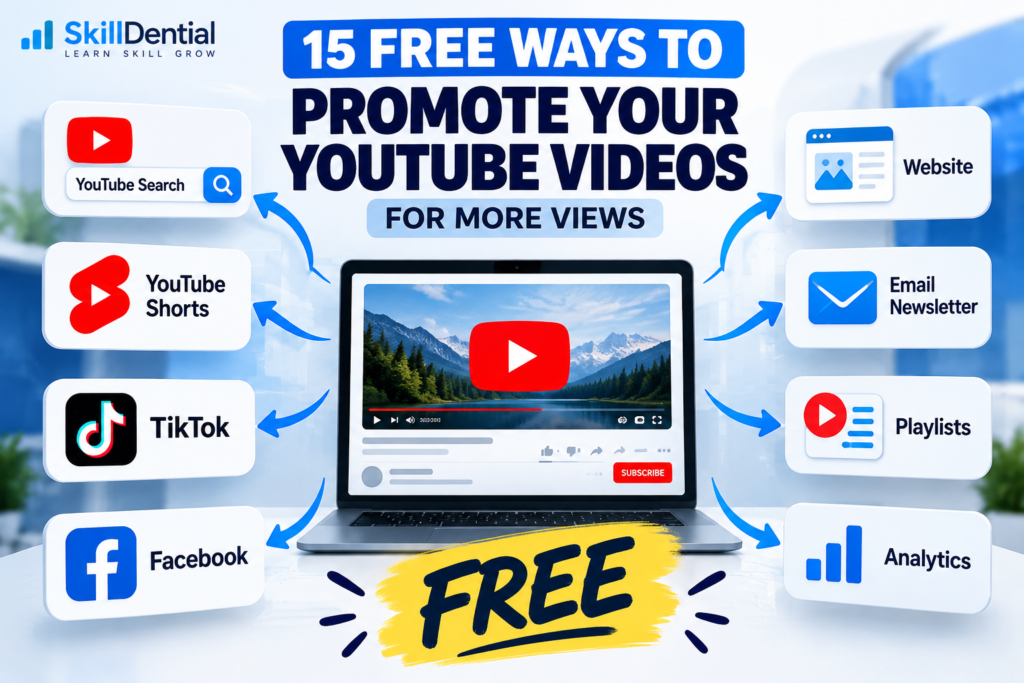
- Internal (Algorithmic Leverage): Optimizing for YouTube’s native search, suggested videos, homepage recommendations, Shorts, and high-retention playlists.
- External (Traffic Funnels): Driving off-platform viewership via targeted communities, email lists, SEO-driven websites, and cross-platform social assets.
YouTube’s discovery engine does not reward raw clicks; it optimizes for viewer satisfaction. The algorithm evaluates relevance (metadata matching the query), behavioral signals (click-through rates), and performance (average view duration and session time).
Therefore, successful promotion isn’t about spamming links to inflate initial views. It is a targeted strategy designed to attract viewers who will actually watch, retain, and signal to the algorithm that your content deserves broader reach.
15 Free Ways to Promote Your YouTube Videos
Discover 15 free ways to promote your YouTube videos and increase views without spending money on ads. From social media promotion and YouTube SEO to online communities, email marketing, collaborations, and content repurposing, these practical strategies can help you reach more viewers, build an audience, and grow your YouTube channel organically.
Optimize Your Video for YouTube Search (SEO)
Search intent matching is the most sustainable engine to promote your YouTube videos. YouTube’s 2026 ranking algorithm does not rely on outdated keyword stuffing; it evaluates semantic relevance (metadata) and performance validation (click-through rate and audience retention).
To engineer your video for discovery, map your metadata directly to the user’s search query. Focus on these high-leverage execution points:
- The Title (The Hook): Front-load your exact target keyword within the first 60 characters to prevent truncation on mobile devices.
- The Description (The Context): Place your primary keyword and a compelling summary within the first 125 characters—the critical text visible above the “Show more” fold.
- The Spoken Word (The Transcript): YouTube automatically transcribes your audio. Speak your target keyword naturally early in the video to reinforce algorithmic relevance.
- The Thumbnail (The CTR Lever): Use high-contrast visuals and minimal, bold text (under 4 words) to drive a target 5-10% Click-Through Rate (CTR) on impressions.
- Chapter Timestamps: Add keyword-rich chapters to videos to capture indexed “key moments” directly in Google Search results.
Before vs. After Optimization:
- Weak Signal: “My YouTube Tips” (Vague, lacks specific search intent).
- High Signal: “How to Promote Your YouTube Videos for Free” (Direct, matches exactly what the user is typing into the search bar).
Strategic Use Case
Best deployed for tutorials, educational frameworks, and highly specific how-to queries where viewers have clear, predefined problems they need solved.
Turn Core Concepts Into YouTube Shorts
Short-form content serves as a low-friction, top-of-funnel discovery engine to promote your YouTube videos. Rather than lazily clipping segments from long-form content, re-architect your highest-value insights into standalone Shorts designed for high retention.
To build an effective Shorts distribution bridge:
- Isolate Single Ideas: Extract one self-contained strategy, tip, or common mistake per Short. Do not try to compress a 15-minute framework into 60 seconds.
- Master the First 3 Seconds: Front-load the value proposition immediately to stop viewers from swiping away in the feed.
- Leverage Native Linking: Use YouTube’s built-in “Related Video” setting in YouTube Studio to attach your full-length long-form video directly to the Short’s UI.
Repurposing Architecture:
- Pillar Video: 15 Free Ways to Promote Your YouTube Videos
- Micro-Asset 1: “The #1 Distribution Mistake Killing Your YouTube Reach”
- Micro-Asset 2: “How to Use TikTok to Drive Traffic Back to YouTube”
- Micro-Asset 3: “1 Free Tool to Optimize Your YouTube Titles”
Algorithmic Signal
YouTube ranks Shorts based on view-vs-swipe ratio and total completion rate. Treat Shorts as a brand-awareness catalyst designed to capture top-of-funnel attention and funnel high-intent viewers directly to your long-form assets.
Strategic Use Case: Best for creators with evergreen long-form content looking to maximize reach without producing entirely new topics from scratch.
Build a TikTok-to-YouTube Conversion Funnel
Using TikTok as a top-of-funnel acquisition channel requires delivering native value—not lazy redirection. The algorithm suppresses content that acts solely as a billboard for external platforms. The governing rule is content first, promotion second.
If you upload a TikTok that simply says, “Watch my full video on YouTube,” the algorithm will kill its reach instantly due to early drop-offs. Instead, engineer an “Open Loop” conversion funnel using this structure:
- The Curiosity Hook (0–3 Seconds): Open with a specific, high-tension statement that stops the scroll. (e.g., “Here are three free ways to get more YouTube views. The third one is the only reason my channel grew this month.”)
- The Value Delivery (The Body): Deliver 80% of the promised value directly on TikTok. Explain the first two tips in detail. The video must be highly useful and retain attention even if the viewer never leaves the app.
- The Strategic Bridge (The Call-to-Action): Use the final 10% of the video to create an information gap. Tell the viewer exactly what the missing piece is and direct them to your YouTube channel to close the loop.
- Native Q&A Extraction: Alternatively, isolate a single hyper-specific question answered in your long-form video, solve it fully on TikTok, and position the YouTube link as the comprehensive masterclass.
Before vs. After Call-to-Action:
- Weak Signal (Billboard): “Go to my YouTube channel to see how I promote videos.”
- High Signal (Open Loop): “I break down the exact settings for this third promotion strategy in the new video on my channel—link in bio.”
Strategic Use Case
Best for creators with an established short-form workflow who can isolate high-leverage frameworks from their long-form content to capture algorithmic reach on TikTok.
Leverage Facebook Communities for Targeted Distribution
Facebook remains a high-leverage distribution channel when approached strategically. To successfully promote your YouTube videos on the platform, avoid the low-ROI tactic of spamming raw links across unrelated feeds. Instead, embed your content within high-intent communities using native formats.
Execute Facebook distribution using these high-signal levers:
- Native Value Extraction (Zero-Click Optimization): The Facebook algorithm suppresses posts containing external links. Counter this by writing a standalone, high-value text post or mini-essay natively on the platform. Place the link to your YouTube video in the first comment as the “deep dive” resource.
- Hyper-Niche Group Syndication: Distribute your content exclusively to highly relevant Facebook groups where your video solves a specific, active community pain point.
- Native Video Bridging: Upload a compelling 60-second teaser or highlight natively to Facebook Video or Reels, using the caption to funnel viewers to the full YouTube asset.
The Distribution Rule
Audience relevance strictly outweighs audience size. A highly targeted group of 500 practitioners will yield significantly higher session watch time—and better algorithmic validation on YouTube—than a generic group of 50,000 members. Unrelated clicks kill your average view duration.
Strategic Use Case: Best for B2B frameworks, educational tutorials, local-interest topics, and niches with established, heavily moderated community groups.
Embed Content in High-Traffic SEO Blog Posts
Leveraging your owned media is one of the most scalable ways to promote your YouTube videos. By embedding relevant videos into high-ranking blog content, you create a compounding distribution engine that benefits both platforms: the video increases your website’s dwell time (boosting Google SEO), while the blog drives high-intent, external traffic directly to your channel.
To execute this cross-platform funnel effectively:
- Contextual Alignment: The embedded video must strictly match the search intent of the article. If the blog post covers “How to Start a YouTube Channel,” embed a specific, technical tutorial on channel setup—do not embed a generic brand video.
- Value-Add Positioning: Do not use the video merely as a text replacement. Frame the embed as a supplementary “deep dive” or a visual demonstration of the written framework to incentivize clicks.
- The Analytics Feedback Loop: Monitor the “External sites or apps” report in YouTube Analytics. Identify which specific blog URLs are driving the highest average view duration, and reverse-engineer that embedding strategy across your site architecture.
The Relevancy Rule
Never embed a video simply to farm impressions. If the video does not genuinely enhance the reader’s experience, the resulting immediate click-offs will generate negative retention signals, explicitly harming your video’s algorithmic reach on YouTube.
Strategic Use Case: Best for founders, businesses, and content creators with established websites or SEO-driven blogs looking to convert existing text-based organic traffic into video subscribers.
Architect High-Retention YouTube Playlists
Using curated playlists is a critical retention mechanism to promote your YouTube videos by shifting the viewer’s behavior from a single click to an extended binge session. YouTube’s algorithm heavily rewards channels that generate high overall session watch time, making playlists a direct algorithmic lever.
To engineer playlists for maximum distribution leverage:
- The Intent-Driven Journey: Do not treat playlists as generic storage folders. Structure them as sequential learning pathways or logical frameworks. A viewer finishing video one should naturally require video two to complete the system.
- Topical Hub Isolation: Group content into hyper-specific pillars. For a digital skills channel, isolate “No-Code AI Workflows” from “SEO Content Strategy.” Mixing intents breaks the binge cycle and causes immediate viewer drop-off.
- The Analytics Feedback Loop: Monitor the “Playlists” metric within your YouTube Analytics Traffic Sources. This data reveals which specific video sequences successfully convert single-click viewers into multi-video consumers.
The Curation Rule
Never dump your entire video library into a single “All Uploads” playlist. Every playlist must serve a distinct, recognizable viewer intent. A tightly curated 5-video playlist driving a 40% completion rate is infinitely more valuable than a 50-video playlist with a 1% completion rate.
Strategic Use Case: Best for established creators and businesses with distinct content pillars looking to compound their existing traffic into exponential session watch time.
Build Algorithmic Viewing Paths with End Screens
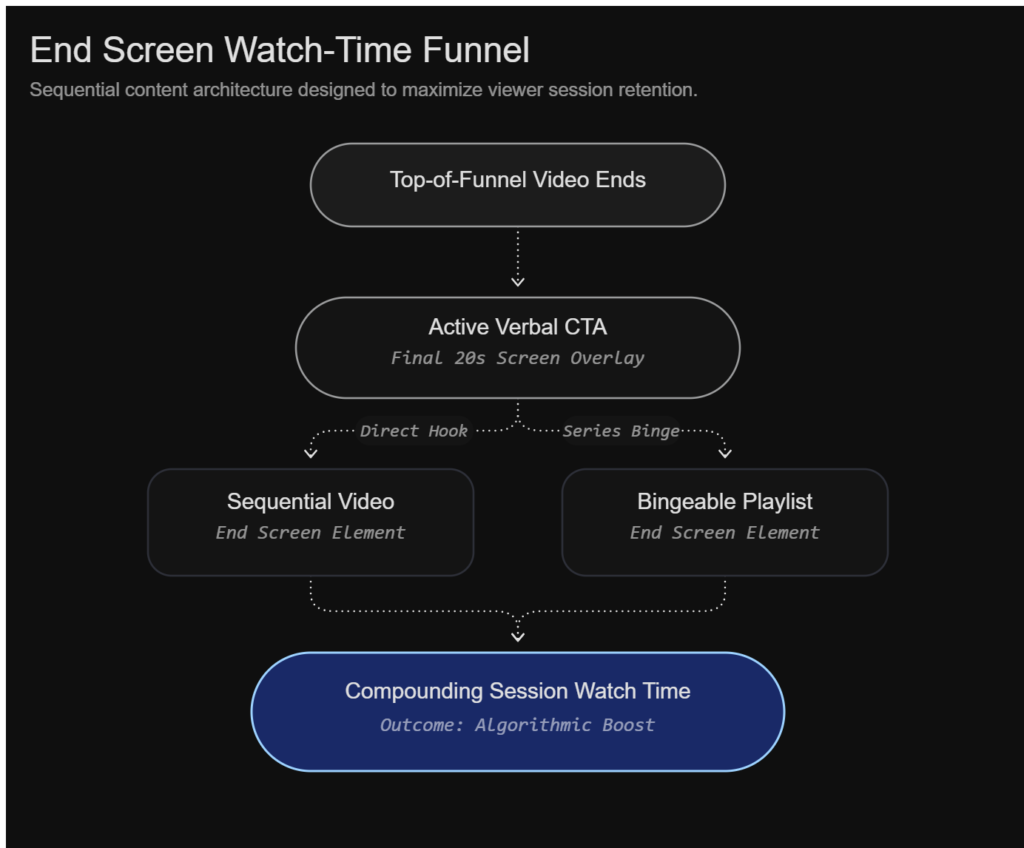
The final 20 seconds of your video are not a goodbye; they are a strategic handoff.YouTube’s discovery system optimizes heavily for total session watch time—rewarding channels that successfully keep viewers on the platform across multiple videos.
To promote your YouTube videos effectively, use end screens to connect individual pieces of content into a compounding viewing path. Treat every video as a node in a system, and every end screen as the conversion mechanism.
To execute a high-converting end screen funnel:
- The Active Hand-Off (Verbal CTA): Silent end screens underperform. Do not rely on visual overlays alone. Point directly to the video element on screen, name it, and tell the viewer exactly what value they will get by clicking it before they leave.
- The Open Loop Sequence: Match the end screen recommendation directly to the viewer’s current intent. If they just watched “How to Find YouTube Keywords,” the end screen must logically bridge to a specific next step, like “How to Optimize Your YouTube Title.”
- Visual Architecture (Negative Space): Plan your end screen before you film. Dedicate the final 5–20 seconds to a clean visual layout—creators who layer end screen elements over important footage create a visual mess that viewers ignore.
- The Paradox of Choice: Limit your end screen to 2–3 elements. Giving viewers the maximum four choices creates decision fatigue and fractures your overall click-through rate.
Here is how a high-retention end screen funnel operates structurally:
The Analytics Feedback Loop
A healthy end screen click-through rate (CTR) sits between 3% and 7%. If your rate is lower, your verbal CTA is weak or your recommended video does not align with the viewer’s immediate next step.
Strategic Use Case: Best for channels with established content pillars looking to convert single-video traffic into multi-video binge sessions, signaling high viewer satisfaction to the algorithm.
Engineer a High-Conversion Title and Thumbnail Strategy
Any effort to promote your YouTube videos will fail if your packaging cannot convert impressions into clicks. Your title and thumbnail operate as a unified, two-part conversion mechanism: the thumbnail creates the visual pattern interrupt, and the title confirms the logical value proposition.
To build a high-leverage packaging strategy, execute these core principles:
- The Complementary Rule: Never duplicate your title text inside your thumbnail. They serve different functions. Use the thumbnail to provoke curiosity or illustrate the result, and use the title to establish clear search intent.
- Visual Architecture (The Mobile Test): Over 70% of YouTube consumption happens on mobile. Limit thumbnail text to under four words. Use high-contrast focal points, distinct foreground separation, and test your design at a heavily zoomed-out scale before publishing.
- The Retention Mandate: Avoid manipulative clickbait. A high Click-Through Rate (CTR) combined with immediate viewer drop-off explicitly signals poor viewer satisfaction to YouTube’s algorithm, instantly killing your organic reach. Your video must over-deliver on the packaging’s exact promise.
Packaging Architecture Example:
- The Title (Search & Logic): 15 Free Ways to Promote Your YouTube Videos
- The Thumbnail (Emotion & Result): A high-contrast graphic with the text “GET VIEWS FOR FREE.”
Strategic Use Case
This is the non-negotiable baseline for every piece of content you upload. Without optimized packaging, all other distribution efforts are mathematically useless.
Execute the Pillar-to-Micro Repurposing Framework
To effectively promote your YouTube videos across multiple platforms, stop treating your video as a single deliverable. Treat it as a “pillar” asset that must be atomized into a broader distribution ecosystem.
The most common distribution failure is the “copy-paste leak”—sharing identical promotional text and a raw YouTube link across every social channel. Modern social algorithms actively suppress outbound links. Instead, execute the 5-to-1 extraction rule: engineer at least five channel-native micro-assets from every long-form video you produce.
Apply this 80/20 repurposing structure to a standard 10-minute tutorial:
- The LinkedIn Carousel: Extract a specific, step-by-step framework from your video transcript and design an 8-slide visual carousel. Professional audiences prefer consuming visual, standalone frameworks directly in the feed rather than clicking external video links.
- The X (Twitter) Thread: Isolate a single contrarian opinion, myth, or common mistake mentioned in the video. Write a high-signal, text-only post that delivers the complete lesson natively.
- Short-Form Video Engine: Do not lazily crop horizontal footage. Reframe specific 60-second segments vertically, add dynamic captions, and ensure the extracted idea solves a complete problem independently without requiring context from the broader video.
- The Newsletter Deep-Dive: Rewrite the video’s core thesis into a standalone email essay, embedding the video as a visual supplement for readers who prefer a technical walkthrough.
The Native Value Mandate
Every atomized asset must provide 100% of its promised value on the platform it lives on. If a user has to click your YouTube link just to understand the context of your LinkedIn post, the post will fail to generate traction.
Strategic Use Case: Best for solo creators and founders who need to scale their distribution footprint and acquire new audiences without proportionally increasing their content production hours.
Leverage Email for Zero-Algorithm Distribution
Your email list is the only distribution channel where you entirely control the reach. To promote your YouTube videos effectively to your subscribers, you must treat your newsletter as a value-delivery mechanism, not a broadcast notification system.
Execute your email distribution using these high-leverage tactics:
- The Value-First Bridge: Never send a generic “New video out now” broadcast. Deliver a standalone insight, an 80/20 framework, or a mini case study directly in the email body. Position the YouTube video link as the logical, deep-dive continuation of that concept.
- Explicit Qualification: Clearly frame exactly who the video is for and the specific pain point it solves. Eliminate ambiguity to drive qualified clicks (e.g., “If your organic traffic has stalled, this 10-minute system fixes your distribution leak”).
- The Velocity Trigger: Routing a highly engaged segment of your email list to a newly published video within its first 24 hours generates a surge of high-retention views. This early momentum provides a massive algorithmic signal to YouTube, often triggering broader homepage distribution.
The Retention Rule
Never treat your list exclusively as a promotional vehicle. If every email demands a click, your open rates will mathematically collapse. You must consistently deliver native, zero-click value in the inbox to earn the right to extract attention to external platforms.
Strategic Use Case: Best for creators, founders, and businesses with an established, warm email list who need to bypass platform algorithms and manufacture immediate, high-retention velocity for new video assets.
Intercept High-Intent Queries in Q&A Communities
Question-and-answer engines like Quora, Reddit, and specialized industry forums are highly leveraged distribution channels. Users on these platforms are actively searching for solutions, meaning the traffic you capture is inherently high-intent and ready to convert into long watch times.
However, to successfully promote your YouTube videos in these ecosystems, you must navigate strict anti-spam moderation. Execute your distribution using this framework:
- The Zero-Click Solution: Never respond to a query with a naked link. Provide a comprehensive, structured answer directly within the platform. Solve the user’s core problem immediately in the text, ensuring your response stands alone as a high-quality asset.
- The Contextual Bridge: Position your video link strictly as an optional, supplementary resource for users who require a deeper visual demonstration or technical walkthrough. (e.g., “I mapped out this exact distribution framework visually in a recent tutorial here: [Link].”)
- Long-Term SEO Leverage: High-quality answers on Reddit and Quora frequently index on the first page of Google Search. A single optimized, heavily upvoted response can generate compounding, passive referral traffic to your video for years.
The Moderation Mandate
Always respect platform-specific rules. If a subreddit or forum strictly bans self-promotion, extract the raw insights from your video to build brand authority instead of risking a shadowban by forcing a link.
Strategic Use Case: Best for highly technical, career-focused, educational, and problem-solving content where the audience has clearly defined, urgent friction points.
Engineer Strategic Creator Collaborations
One of the highest-leverage ways to promote your YouTube videos is to bypass algorithmic discovery entirely and tap into established trust networks. Collaboration is an exercise in audience arbitrage—exchanging high-value content for direct access to a peer’s highly qualified viewership.
To execute a high-yield collaboration framework, avoid transactional link-swapping and focus on these strategic levers:
- Audience Alignment Over Vanity Metrics: Do not chase partners based solely on subscriber counts. Target peers with complementary expertise and severe audience overlap. A targeted cross-promotion with a highly aligned channel of 5,000 subscribers will drive significantly more high-retention watch time than a mismatched shoutout from a 500,000-subscriber channel.
- High-Signal Formats: Structure the collaboration around actionable deliverables rather than generic guest appearances. Execute joint tutorials, expert roundtables, deep-dive interviews, or specific technical challenges that require both creators’ unique expertise to solve.
- The Open-Loop Handoff: Design the collaboration so that both audiences have a compelling reason to cross platforms. For example, host part one of a strategic framework on your channel, and direct viewers to the collaborator’s channel for the advanced, step-by-step implementation guide.
The Synergy Rule
The collaboration must organically serve the viewer first. If the integration feels forced or purely promotional, the acquired traffic will immediately bounce, actively damaging both creators’ retention signals in the YouTube algorithm.
Strategic Use Case: Best for growing channels with a clearly defined niche seeking to acquire highly qualified, engaged viewers who are already primed for long-form content consumption in their specific industry.
Build Permanent Digital Discovery Pathways
To promote your YouTube videos effectively, you must treat your digital footprint as an interconnected ecosystem. Adding your channel to your existing profiles is not a temporary marketing campaign—it creates permanent, low-friction pathways that passively capture high-intent referral traffic.
Systematically optimize these owned digital touchpoints:
- Social & Professional Bios: Place a direct channel link in the header or bio of every active profile (LinkedIn, X, Instagram, GitHub). Use specific, outcome-driven anchor text rather than a generic URL (e.g., “Watch Free AI & Strategy Frameworks” instead of “My YouTube”).
- The Professional Email Signature: Add a discreet, value-focused call-to-action in your primary email signature. In high-volume B2B or client communication, this generates continuous, low-friction impressions from warm contacts.
- Author & Contributor Profiles: When publishing guest articles, media features, or industry bios, ensure your YouTube channel is explicitly listed alongside your primary website.
- Digital Portfolios & Websites: Embed an explicit, site-wide footer or navigation link directing visitors to your video library to establish video as a core pillar of your content strategy.
The Infrastructure Rule
Profile links rarely cause massive traffic spikes overnight; instead, they function as perpetual, evergreen pathways that convert passive brand research into long-term channel discovery as your overall web presence expands.
Strategic Use Case: Non-negotiable for creators, founders, and professionals building a multi-channel personal brand or business footprint who want to capture passive, high-intent referral visits.
Activate the YouTube Community Tab for Native Reach
The YouTube Community Tab is an underutilized, algorithmic asset that allows you to promote your YouTube videos directly in the mobile feeds of both subscribers and non-subscribers. However, treating this feature as a low-effort notification feed will result in zero algorithmic reach. You must use it as a native engagement engine.
Execute your Community Tab distribution using these high-signal levers:
- The Poll Mechanism: YouTube heavily favors text and image polls, frequently pushing them to adjacent, non-subscribed audiences. Ask a strategic, low-friction question directly related to your video’s core topic. Once users vote, they are primed to click the video link provided in the post’s text or top comment.
- The Conversational Hook: Never broadcast a generic “New video is live!” announcement. Engineer a discussion around the specific pain point your video solves to generate native comments, which signals relevance to the algorithm.
- Visual Value Extraction: Share a standalone framework diagram, a high-contrast infographic, or a compelling data point from your video. Deliver immediate, zero-click value in the feed before asking the viewer to commit to a long-form video.
Before vs. After Optimization:
- Weak Signal (Broadcast): “New video is live! Watch it here.”
- High Signal (Engagement): “Which of these 3 distribution tactics has driven the highest ROI for your channel this year? [Poll]. I broke down the exact math behind my distribution system in today’s deep dive: [Link].”
The Engagement Rule
A Community post requires the same hook-and-value structure as a video. If the post fails to generate native engagement (votes, likes, comments), YouTube’s algorithm will immediately stop surfacing your embedded video link to the broader platform.
Strategic Use Case: Best for channels with an established subscriber base looking to re-engage dormant viewers and maintain algorithmic visibility between long-form video uploads.
Leverage Analytics to Build Data-Driven Distribution Models
Successfully scaling a channel requires abandoning intuition. To effectively promote your YouTube videos long-term, you must transition from experimental distribution to data-backed amplification once a video acquires a baseline of impressions.
Use YouTube Studio’s “Reach” and “Engagement” telemetry to reverse-engineer exactly what is driving your highest-quality traffic, then aggressively scale those specific levers.
Execute your analytics review using this 80/20 feedback loop:
- Identify Asymmetric Returns: Do not weigh all clicks equally. Filter your “Traffic Sources” report by Average View Duration (AVD) and subscriber conversion rate. A distribution channel driving 100 highly engaged views is infinitely more valuable to the algorithm than a source driving 1,000 immediate bounces.
- Optimize External Acquisition: Analyze the “External sites or apps” data. If specific SEO blog posts are generating high retention, expand your embedding strategy on your website. If a specific TikTok format is successfully converting viewers to YouTube, systemize that exact framework.
- Mine Proven Search Intent: Review the “YouTube Search Terms” report to identify the precise long-tail queries viewers typed to find your video. Use these proven queries to refine your existing metadata, update chapters, or architect your next standalone video topic.
The Amplification Rule
The ultimate distribution strategy is identifying the 20% of platforms driving 80% of your retained viewership. Cut the underperforming channels that dilute your watch time, and double down strictly on the funnels the algorithm has already validated.
Strategic Use Case: The mandatory operational system for any creator, founder, or business treating YouTube as a scalable digital acquisition engine rather than a hobby.
The 80/20 Implementation Matrix: Where to Start
Attempting to execute all 15 distribution channels simultaneously will fracture your focus and dilute your ROI. To effectively promote your YouTube videos, deploy the 80/20 principle: prioritize the specific tactics where you already possess an asymmetric advantage or existing infrastructure.
Use this matrix to identify your highest-leverage starting point:
| Your Existing Leverage | Primary Distribution Framework |
| Zero Existing Audience (New Channel) | YouTube Search (SEO), High-CTR Packaging, Shorts, and Intent-Driven Playlists. |
| Established Website or Blog | Contextual Video Embeds and Pillar-to-Micro written integration. |
| Short-Form Audience (TikTok/IG Reels) | Top-of-Funnel Conversion Funnels and Open-Loop Shorts. |
| Warm Email List | Velocity-Trigger Newsletter Drops to drive initial 24-hour retention signals. |
| Deep Video Library | Algorithmic Pathways (End Screens) and Bingeable Topical Playlists. |
| Engaged Communities (Facebook/Forums) | Native Value Extraction and Zero-Click Q&A Optimization. |
| Peer Creator Network | Audience Arbitrage (High-signal collaborations and joint tutorials). |
| Historical Channel Data | Analytics-Driven Amplification (Scale the exact traffic sources already working). |
The foundational law of modern video distribution is audience relevance. YouTube’s discovery system is not a megaphone designed to blast content to the masses; it is a sophisticated matching engine built to find the perfect video for a specific viewer based on satisfaction signals (Click-Through Rate and Average View Duration).
Spamming your link to thousands of unqualified viewers is not a promotion strategy—it is algorithmic sabotage. Focus entirely on capturing high-intent viewers who will actually retain, and let the algorithm do the heavy lifting of scaling your reach.
A Repeatable YouTube Promotion Workflow
To consistently promote your YouTube videos without wasting time on ad-hoc tactics, you must turn distribution into a standardized operating procedure (SOP). Systemizing your workflow into distinct phases ensures every asset captures maximum algorithmic velocity and compounding organic reach.
Phase 1: Pre-Publishing Optimization (The Algorithmic Setup): Complete all packaging and asset staging before hitting publish.
- Validate the Search Intent: Identify the exact pain point your video addresses. Conduct keyword research to mirror the exact vocabulary, queries, and phrasing your audience uses.
- Engineer High-CTR Packaging: Design a high-contrast thumbnail with under 4 words of text. Pair it with a title that front-loads your primary target keyword within the first 60 characters.
- Prepare End-Screen Funnels: Identify 1–2 related videos or a specific topical playlist to attach as end screens to capture immediate session watch time.
- Pre-Stage External Touchpoints: Draft your email newsletter copy, social media teasers, and native community posts in advance so you can execute distribution rapidly on launch day.
Phase 2: Launch-Day Execution (Manufacturing Velocity): Trigger early retention signals within the critical first 24-48 hours.
- Publish & Attach Playlists: Upload the video and immediately assign it to a hyper-specific, high-retention playlist pillar.
- Deploy the Email Velocity Trigger: Send a value-first newsletter to your list, positioning the new video link as the logical deep-dive solution to a specific problem.
- Syndicate Zero-Click Social Content: Post platform-native summaries (LinkedIn carousels, X threads, or short-form teasers) that deliver standalone value while driving interested traffic back to YouTube.
- Embed in Owned Assets: Insert the video into high-traffic, contextual blog posts or website guides where it complements the existing text.
Phase 3: Post-Launch Analysis & Amplification (The Feedback Loop): Use data telemetry to scale proven distribution channels.
- Audit Traffic Sources (Days 7–14): Check YouTube Analytics to identify which specific platforms (Search, External, Suggested) are sending the highest-retention viewers.
- Mine YouTube Search Terms: Review the exact search terms driving impressions. Update your title, description, or chapters if high-intent variations emerge.
- Double Down on Proven Channels: If a specific external community, blog embed, or short-form angle drove disproportionate watch time, double down on that specific channel for future uploads.
- Iterate for Future Content: Isolate drop-off points in your retention graph to refine your video pacing, and map out follow-up video topics based on audience comment queries.
The Bottom Line
Promoting content is not an afterthought—it is half of the content creation equation. By executing this structured, data-driven workflow for every upload, you systematically stack low-friction discovery channels, generate predictable traffic, and turn single views into long-term channel growth.
The “YouTube Promote” Feature: Paid Acquisition vs. Organic Growth
While this guide focuses on how to promote your YouTube videos for free, you will likely encounter the native “Promote” button inside YouTube Studio. It is critical to understand that this feature is fundamentally different from organic distribution.
The Promote tab is a simplified front-end for Google Ads. It is a paid acquisition vehicle designed to buy impressions, not a strategic algorithmic lever.
If you are considering paying for distribution, you must understand these technical constraints:
- Zero Impact on Organic Velocity: YouTube explicitly isolates paid traffic from organic performance data. Buying views through the Promote feature will not train the algorithm, improve your organic recommendation performance, or trick the system into pushing your video to the homepage.
- The Monetization Penalty: Watch hours and subscribers generated through paid advertising campaigns strictly do not count toward YouTube Partner Program (YPP) eligibility thresholds. You cannot buy your way to channel monetization.
- Strategic Use Case: Paid promotion should only be used as a bottom-of-funnel conversion mechanism. Use it if you are directly selling a product, course, or service where you can measure a clear monetary return on ad spend (ROAS). Never use it simply to inflate vanity metrics or simulate channel growth.
To build a sustainable digital asset, prioritize the 15 organic, zero-cost frameworks outlined above before ever allocating a paid advertising budget.
6 Critical Mistakes to Avoid When You Promote Your YouTube Videos
Executing the wrong distribution tactics does not just waste time—it actively damages your channel’s algorithmic standing. To successfully promote your YouTube videos, avoid these high-friction errors that kill organic reach:
- The “Spray and Pray” Link Strategy: Spamming raw URLs across the internet is a low-ROI activity. More links do not mathematically equal more viewers. Prioritize targeted communities where your audience actively seeks solutions.
- Prioritizing Clickbait Over Retention: Using misleading packaging to manufacture clicks destroys your average view duration (AVD). A 15% Click-Through Rate paired with a 10% completion rate signals to the algorithm that your content is deceptive, immediately halting your reach.
- Chasing Volume Over Relevance: Sending mass, unqualified traffic to your video actively hurts your retention metrics. A targeted group of 100 highly interested viewers is infinitely more valuable than 1,000 uninterested clicks that bounce in the first 10 seconds.
- The One-Time Launch Cycle: Treating publication as a one-off event abandons evergreen potential. A high-leverage video should continually be integrated into future blog posts, newsletter sequences, related Shorts, and automated end-screen funnels.
- Operating Without Telemetry (Ignoring Analytics): Continuing to spend hours on a distribution channel without verifying its return on investment is a strategic failure. If a platform is not generating retained watch time in your “Traffic Sources” report, cut it from your workflow.
- The Copy-Paste Distribution Leak: Every platform has distinct audience expectations and formats. Attempting to broadcast the same promotional message across an X thread, a LinkedIn carousel, and an email newsletter results in algorithmic suppression. Always adapt the core idea into a platform-native format.
Do You Need to Pay to Get More YouTube Views?
You do not need a paid advertising budget to scale a YouTube channel. The 15 organic distribution frameworks covered in this guide—Search, Shorts, external funnels, and algorithmic playlists—are compounding assets. Once built, they generate perpetual, zero-CAC (customer acquisition cost) traffic. Paid advertising, conversely, is rented reach; the moment your budget stops, your traffic stops.
However, “free” promotion does not guarantee algorithmic distribution. Organic velocity is strictly dictated by:
- Market Demand: The inherent audience interest and seasonal search volume for your topic.
- Competitive Saturation: The volume of established channels solving the same problem.
- Performance Validation: How effectively your video retains attention compared to competing content.
The Strategic Verdict
Treat organic distribution as your primary growth engine and long-term brand moat. Paid YouTube promotion is strictly an optional, bottom-of-funnel conversion tool. Unless you are driving traffic to a high-ticket product, course, or service with a trackable Return on Ad Spend (ROAS), allocating budget to simply “buy views” is a strategic waste of capital.
What is the best free way to promote a YouTube video?
There is no universal single tactic; the optimal approach depends on your existing infrastructure. For new channels, YouTube Search (SEO) and high-CTR packaging yield the highest compounding returns. If you own a digital footprint, contextual blog embeds and newsletter drops deliver the highest early retention signals. Always audit YouTube Analytics to isolate and double down on the specific traffic sources already driving long watch times.
Can you promote your YouTube videos without paying for ads?
Yes. You can build sustainable distribution loops using organic YouTube features—Search optimization, Shorts, topical playlists, end screens, and the Community Tab—combined with external zero-CAC channels like email newsletters, SEO blog embeds, targeted Q&A communities, and strategic creator collaborations.
Can TikTok help promote your YouTube videos?
Yes, when structured as an open-loop discovery funnel. Rather than posting generic promotional teasers, deliver 80% of a standalone insight natively on TikTok, then direct viewers to your full YouTube video to close the information gap and access the full framework.
Should you share your YouTube videos on Facebook?
Only when distributed within hyper-targeted, relevant communities. Avoid dropping raw links across unrelated groups or directly on your feed. Write native, high-value text summaries directly on Facebook and place your YouTube link in the first comment to bypass algorithmic link penalties.
How do you promote an old YouTube video?
Re-engage dormant assets by integrating them into your active publishing pipeline:
Extract key concepts into new YouTube Shorts using native related-video linking.
Attach the older video to high-retention playlists and end-screen funnels on new uploads.
Embed the video in high-ranking blog articles addressing the same search intent.
Refresh the title, thumbnail, and description if impressions remain high but Click-Through Rate (CTR) has decayed.
Does promoting a YouTube video guarantee more views?
No. External promotion merely creates the initial impression loop. YouTube’s recommendation engine will only scale distribution if early performance validation metrics—specifically Click-Through Rate (CTR) and Average View Duration (AVD)—confirm high viewer satisfaction.
In Conclusion
Getting more views on YouTube doesn’t always require a large advertising budget. With the right free YouTube promotion strategies, you can increase your video’s reach, attract new viewers, and build a more engaged audience over time.
From sharing videos on social media and online communities to optimizing your titles, thumbnails, descriptions, and YouTube SEO, the key is to promote your content where your target audience already spends time. You can also repurpose your videos into Shorts, blog posts, social media clips, and other formats to give each piece of content more opportunities to be discovered.
The most important thing is consistency. You don’t need to use all 15 methods at once. Start with a few strategies that match your audience and content style, track the results in YouTube Analytics, and focus more of your effort on the methods that generate meaningful views and engagement.
Ultimately, free promotion works best when it is combined with valuable content. Create videos people want to watch, optimize them for discovery, and actively promote them—and your YouTube channel can continue growing without relying entirely on paid advertising.