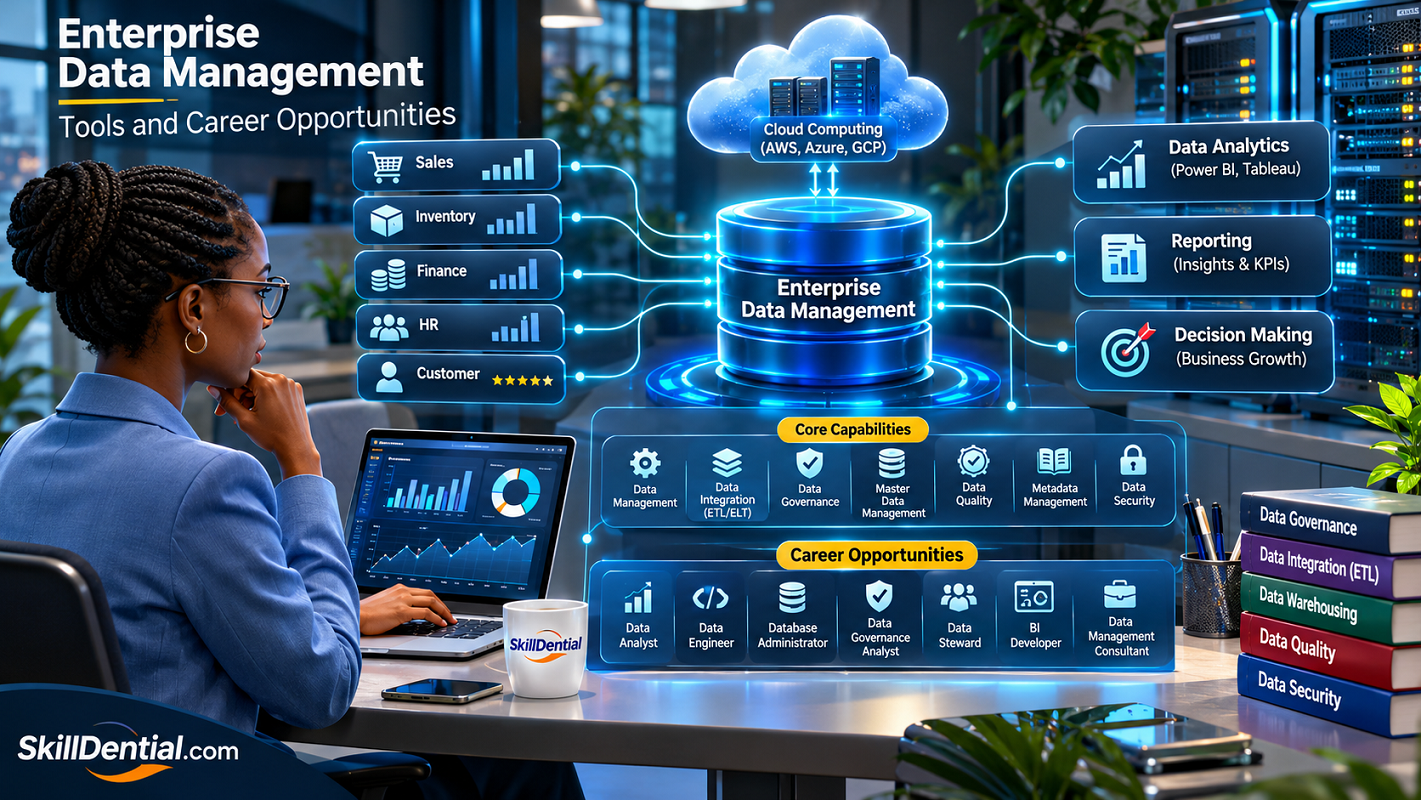
Data is no longer just a byproduct of business operations—it is the underlying infrastructure powering modern analytics, reporting, and artificial intelligence. Yet, as organizations ingest petabytes of information from web applications, transactional databases, financial systems, and customer touchpoints, volume without structure creates operational risk.
Enterprise data management (EDM) solves this challenge. It is the discipline of organizing, governing, securing, and integrating an organization’s data across its entire lifecycle to keep it accurate, accessible, and protected.
Implementing robust enterprise data management requires more than just storage infrastructure; it demands a deliberate architecture for data quality, cross-functional accessibility, and compliance.
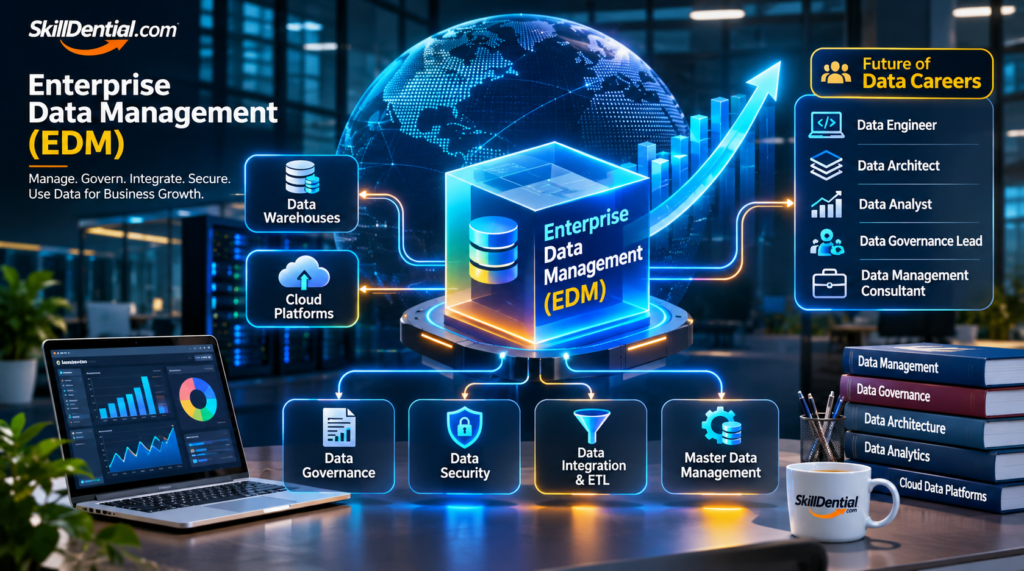
For organizations, effective enterprise data management directly translates to lower operational friction, tighter regulatory adherence, and reliable inputs for AI models. For professionals, mastering enterprise data management opens high-leverage career paths spanning data engineering, governance, architecture, and analytics leadership.
Whether you are scaling an organization’s data infrastructure, sharpening your technical capabilities, or mapping your next career move, mastering enterprise data management is essential for navigating today’s data-driven landscape. This guide breaks down what enterprise data management involves, the critical tooling ecosystem, essential skills, and the high-growth career opportunities available in the space.
What Is Enterprise Data Management?
Enterprise data management (EDM) is a comprehensive, cross-functional framework for governing, integrating, and securing an organization’s data assets across every department, system, and business workflow.
Rather than treating data as an isolated technical byproduct, EDM aligns people, processes, and technology to ensure that organizational information remains accurate, reliable, compliant, and actionable throughout its lifecycle.
The Problem: Data Silos and Operational Friction
To understand why enterprise data management is critical, consider a typical enterprise maintaining disconnected systems:
- Customer data lives in a CRM.
- Financial transactions reside in an ERP.
- Inventory and order metrics are locked in legacy databases.
When these systems operate independently without enterprise data management, organizations encounter systemic failures:
- Duplicated and conflicting records: Multiple versions of the same customer profile create confusion and flawed analytics.
- Reporting errors: Leadership decisions are made on stale or misaligned metrics.
- Compliance exposure: Unmonitored data growth increases vulnerability to regulatory breaches and privacy violations.
An effective enterprise data management strategy resolves these bottlenecks by establishing single sources of truth, strict access rules, and automated synchronization.
Core Objectives of Enterprise Data Management
A mature enterprise data management architecture delivers value through seven core pillars:
- Data Accuracy: Validating that recorded information is correct, untampered, and reliable for high-stakes decision-making.
- Data Consistency: Maintaining synchronized records so that disparate applications interpret metrics identically.
- Data Accessibility: Providing seamless, role-based access to authorized teams without compromising security.
- Data Security: Enforcing encryption, auditing, and protection standards for sensitive corporate and customer information.
- Data Governance: Defining clear ownership, data dictionaries, accountability frameworks, and regulatory compliance protocols (e.g., GDPR, CCPA).
- Data Integration: Orchestrating ingestion pipelines that unify structured and unstructured feeds from legacy databases, SaaS platforms, and real-time event streams.
- Data Quality: Continuously monitoring for completeness, validity, and fitness for intended business use—especially critical for feeding downstream AI and machine learning models.
Ultimately, enterprise data management is not a single database product or software purchase. It is an organizational discipline requiring strategic technical architecture, cross-functional policies, and continuous operational oversight.
Why Is Enterprise Data Management Important?
Data is only an asset if it is trustworthy, accessible, and secure. Without a structured enterprise data management (EDM) strategy, organizations quickly accumulate data debt—manifesting as fragmented silos, recurring reporting errors, compliance exposure, and unreliable analytics.
Implementing a rigorous enterprise data management framework delivers six foundational benefits across the organization:
Improved Business Decision-Making
Enterprise leadership relies on data to steer everything from day-to-day operations to long-term market strategy. When information is clean, unified, and easily accessible across departments, managers make high-stakes decisions backed by empirical evidence rather than intuition or conflicting reports.
Elevated Data Quality
Inaccurate, stale, or incomplete information propagates errors across financial ledgers, customer profiles, and business intelligence dashboards. A robust enterprise data management strategy introduces continuous monitoring protocols to catch discrepancies, remove duplicate entries, and maintain single sources of truth.
Stronger Data Security
Organizations process massive volumes of sensitive assets, including proprietary intellectual property, employee records, and customer personally identifiable information (PII). Enterprise data management policies establish strict role-based access controls (RBAC), encryption standards, and auditing procedures that dramatically reduce vulnerability to data breaches and leaks.
Simplified Regulatory Compliance
Data privacy legislation—such as GDPR, CCPA, and industry-specific mandates—requires organizations to maintain absolute transparency over how information is collected, processed, retained, and deleted. Enterprise data management provides the necessary governance framework and lineage tracking to meet these legal requirements and pass audits smoothly.
Elimination of Data Silos
Data silos occur when individual departments (e.g., sales, marketing, finance, and engineering) lock information inside disconnected systems or custom spreadsheets. Enterprise data management breaks down these barriers by integrating disparate data sources, ensuring that a customer update made in the CRM instantly reflects in billing and support platforms.
Scalable Support for Artificial Intelligence
Enterprise AI and machine learning models are entirely dependent on their inputs—the adage “garbage in, garbage out” applies directly to AI adoption. Poorly organized or biased data undermines model accuracy, creates hallucination risks, and causes operational failure. Enterprise data management provides the strict data quality, governance, and structural pipelines required to fuel reliable, enterprise-grade AI applications.
Key Components of Enterprise Data Management
Enterprise data management (EDM) is not a monolithic toolset; it is an integrated framework composed of seven core disciplines. Each component addresses a specific vulnerability in how organizations handle information, collectively transforming raw data into a governed, reliable asset.
Data Governance
Data governance establishes the foundational policies, standards, accountability frameworks, and procedures used to manage organizational information. It functions as the operational constitution for data usage, answering critical enterprise questions:
- Who owns specific datasets across business units?
- Who holds access permissions for sensitive records?
- How must information be securely stored, shared, and transferred?
- Who is directly accountable for maintaining and verifying data quality?
- What are the legal retention windows and secure disposal protocols?
By setting clear rules, data governance prevents chaos in organizations operating across distributed departments, hybrid clouds, and global jurisdictions.
Data Architecture
Data architecture defines the technical blueprint for how information is structured, stored, interconnected, and retrieved across an enterprise. It provides the core engineering foundation that bridges raw applications, transactional databases, cloud infrastructure, and modern analytics stacks. Architects in this space design database schemas, conceptual data models, and enterprise information flows to ensure scalability and low-latency access.
Data Integration
Data integration focuses on unifying fragmented information streams into a single, cohesive environment. For example, generating a consolidated executive dashboard often requires merging real-time sales transactions, CRM profiles, and inventory logs from disparate third-party apps.
This process relies heavily on data pipeline architectures:
- ETL (Extract, Transform, Load): Data is extracted from source systems, cleaned and restructured in a staging area, and then loaded into a target data warehouse.
- ELT (Extract, Load, Transform): Modern cloud data platforms load raw data immediately into storage repositories (like cloud data lakes) before running transformations natively using scalable compute.
Data Quality Management
Data quality management ensures that organizational data meets rigorous standards for fitness and reliability. Common data quality dimensions include:
- Accuracy: Does the data reflect reality?
- Completeness: Are required fields populated?
- Consistency: Is the data uniform across all systems?
- Validity: Does the data conform to defined syntax or business rules?
- Uniqueness: Are there unwanted duplicate entries?
- Timeliness: Is the data available when needed?
Continuous monitoring tools automatically flag anomalies, deduplicate records, and correct errors before faulty metrics corrupt business intelligence or AI models.
Metadata Management
Metadata is quite simply “data about data.” For instance, a customer database table contains fields like ID, name, email, and registration date; metadata explains the context, schema definitions, data lineage, point of origin, and transformation history of those fields. Robust metadata management—often powered by enterprise data catalogs—drastically improves data discovery, technical lineage tracing, and cross-functional understanding.
Master Data Management (MDM)
Master Data Management (MDM) targets core business entities—such as customers, products, employees, vendors, and locations—that are frequently duplicated across isolated business applications. An MDM strategy establishes a single, authoritative “golden record” for each entity, synchronizing updates across all connected systems to eliminate conflicting versions of the truth.
Data Security and Lifecycle Management
Data security protects sensitive corporate assets and customer PII against unauthorized access, malicious modifications, exposure, or loss through role-based access control (RBAC), encryption, and audit logs.
Complementing security is data lifecycle management (DLM), which governs information from its initial point of creation and active utility through long-term archiving and secure, compliant disposal.
Essential Enterprise Data Management Tools
Enterprise data management tools help organizations perform specific data-related tasks. Different tools serve different purposes. Some support data integration, while others focus on governance, storage, data quality, or analytics.
The following are useful platforms to understand if you are considering a career in this area.
Microsoft Purview
Microsoft Purview is Microsoft’s data governance and compliance platform. It provides capabilities for discovering, cataloguing, governing, and managing organizational data across supported environments.
Its features include data discovery, metadata management, data classification, data lineage, and governance workflows.
Relevant applications:
- Data governance.
- Data cataloguing.
- Data discovery.
- Data classification.
- Data lineage.
Who should explore it?
Aspiring data governance analysts, data stewards, data architects, and professionals working with Microsoft data environments. Official website.
AWS Glue
AWS Glue is a serverless data integration service provided by Amazon Web Services. It helps organizations discover, prepare, transform, and integrate information from different data sources.
It also includes the AWS Glue Data Catalog, which stores metadata about datasets.
Relevant applications:
- ETL processes.
- Data integration.
- Data discovery.
- Data cataloguing.
- Data pipeline development.
Who should explore it?
Aspiring data engineers, cloud data professionals, and analytics engineers. Official website.
Snowflake
Snowflake is a cloud-based data platform designed to support data storage, processing, analytics, and data sharing. Organizations use it to manage and analyze large volumes of information without having to manage traditional database infrastructure in the same way.
Relevant applications:
- Cloud data warehousing.
- Data storage.
- Data analytics.
- Data sharing.
- Data processing.
Who should explore it?
Data engineers, data analysts, analytics engineers, and cloud data professionals. Official website.
Informatica
Informatica provides enterprise data management and integration solutions. Its platform offerings cover areas such as data integration, data quality, master data management, and data governance.
Relevant applications:
- Enterprise data integration.
- Data quality management.
- Master data management.
- Metadata management.
- Data governance.
Who should explore it?
Enterprise data engineers, data architects, data governance professionals, and data management consultants. Official website.
Collibra
Collibra is an enterprise data intelligence and governance platform. It helps organizations manage data governance, data cataloguing, data lineage, and data quality processes.
Relevant applications:
- Data governance.
- Data cataloguing.
- Metadata management.
- Data lineage.
- Data stewardship.
Who should explore it?
Data governance analysts, data stewards, data management consultants, and governance professionals. Official website.
Understanding the different tool categories
| Tool category | Main purpose | Example |
|---|---|---|
| Data integration | Connecting and transforming data | AWS Glue |
| Data governance | Managing data policies and accountability | Microsoft Purview |
| Data warehousing | Storing and querying analytical data | Snowflake |
| Enterprise data management | Managing data across organizational systems | Informatica |
| Data cataloguing | Discovering and documenting data assets | Collibra |
Important
These products are not direct substitutes for one another. Organizations often combine several tools to create a complete data management environment. Their capabilities also vary by product edition, deployment, and integration requirements.
Essential Skills for Enterprise Data Management Professionals
Mastering enterprise data management (EDM) requires a multi-disciplinary skill set that bridges technical database architecture, governance frameworks, and cross-functional business communication. Because data touches every corner of an organization, professionals must balance hands-on technical execution with high-level strategic thinking.
The most critical competencies required to succeed in the field span seven core areas:
SQL and Relational Database Management
Structured Query Language (SQL) is the foundational lingua franca for querying, retrieving, and manipulating data stored in relational database management systems (RDBMS). Regardless of whether you specialize in governance or engineering, you must be able to interact directly with databases.
- Core Competencies: Complex multi-table JOINs, aggregations, subqueries, data filtering, and stored procedures.
- Database Fundamentals: Understanding primary/foreign keys, database normalization, schema design, and entity-output relationships.
Data Modeling
Data modeling is the practice of creating visual and structural blueprints for how data is stored, related, and accessed within an enterprise. Effective data modeling translates messy business requirements into structured database schemas (such as star schemas, snowflake schemas, and relational entity-relationship diagrams) that optimize performance and scalability.
Data Integration and ETL/ELT Pipelines
Data rarely originates where it is analyzed. Professionals need a firm grasp of how information flows across systems, including how to ingest, clean, and orchestrate datasets.
- Key Concepts: Building Extract, Transform, Load (ETL) and Extract, Load, Transform (ELT) pipelines, managing API integrations, handling streaming data, and resolving schema drift.
Data Governance and Compliance
As regulatory scrutiny intensifies, organizations actively seek professionals who understand how to control and protect data assets.
- Key Competencies: Defining data ownership, designing role-based access control (RBAC) policies, managing data dictionaries, establishing master data management (MDM) workflows, and ensuring compliance with privacy standards like GDPR and CCPA.
Cloud Computing Infrastructure
Modern enterprise data management has largely migrated away from on-premises servers to elastic cloud ecosystems.
- Key Competencies: Familiarity with core cloud services, serverless computing architectures, and data warehousing environments across major providers like Amazon Web Services (AWS), Microsoft Azure, and Google Cloud Platform (GCP).
6. Data Analysis and Visualization
Data professionals must be able to validate their work and communicate insights visually to stakeholders.
- Key Tools: Advanced Microsoft Excel (pivot tables, data modeling) and business intelligence tools like Microsoft Power BI or Tableau to build operational dashboards and monitor data quality health metrics.
Cross-Functional Communication and Problem-Solving
Data management is as much about people and processes as it is about software. Enterprise data professionals frequently bridge technical engineering teams and non-technical business stakeholders.
- Key Competencies: Translating complex technical bottlenecks into business risks, gathering end-user requirements, driving organizational alignment, and troubleshooting systemic data pipeline failures.
Enterprise Data Management Career Opportunities
Enterprise data management (EDM) is a vast, multidisciplinary field. You do not need to step directly into an enterprise-level leadership role on day one; instead, professionals build high-leverage careers by starting in specialized technical or governance roles and advancing into senior architecture or consulting positions.
The enterprise data management career landscape spans eight primary paths:
Data Analyst
Data analysts bridge raw datasets and business strategy, collecting, cleaning, and interpreting information to help organizations track and understand performance.
- Core Responsibilities:
- Preparing Analytical Datasets,
- Writing SQL Queries,
- Building Executive Dashboards,
- Tracking Operational Trends,
- Communicating Insights.
- Key Skills:
- SQL,
- Advanced Excel,
- Power BI or Tableau,
- Data Visualization,
- Business Acumen.
Data Engineer
Data engineers design, build, and scale the underlying infrastructure and data pipelines that ingest, process, and store enterprise information.
- Core Responsibilities:
- Constructing high-throughput data pipelines,
- Developing ETL/ELT workflows,
- Integrating multi-cloud data sources,
- Optimizing query performance.
- Key Skills:
- Python, SQL,
- Cloud Computing (AWS/Azure/GCP),
- Data Warehousing,
- Distributed Processing Frameworks.
Database Administrator (DBA)
DBAs focus on the operational health, reliability, and security of an organization’s relational databases and storage instances.
- Core Responsibilities:
- Database installation and configuration,
- Monitoring system performance,
- Managing disaster recovery and backups,
- Enforcing database security.
- Key Skills:
- Relational Database Management Systems,
- SQL Tuning,
- User Access Management,
- Server Administration.
Data Governance Analyst
Data governance analysts design and enforce the operational frameworks, policies, and quality standards required to keep corporate data clean and compliant.
- Core Responsibilities:
- Developing Data Governance Frameworks
- Monitoring Enterprise Data Quality Metrics
- Supporting Data Classification
- Documenting System Ownership.
- Key Skills:
- Data Governance Policies
- Metadata Management,
- Data Quality Standards
- Cross-functional Communication.
Data Steward
Data stewards act as the operational custodians of specific business datasets, ensuring they are accurately documented, understood, and maintained across departments.
- Core Responsibilities:
- Maintaining business glossaries and data dictionaries,
- Supporting data quality initiatives,
- Coordinating with data owners,
- Enforcing data standards.
- Key Skills:
- Data Documentation
- Data Quality Tracking
- Business Communication
- Governance Tool Familiarity
Business Intelligence (BI) Developer
BI developers build analytical reporting systems, semantic models, and visual dashboards that translate complex operational data into actionable executive insights.
- Core Responsibilities:
- Designing interactive business dashboards,
- Connecting disparate data sources,
- Creating semantic data models
- Maintaining BI infrastructure.
- Key Skills:
- Power BI or Tableau,
- SQL,
- Dimensional Data Modeling
- Data Warehousing Concepts
Data Architect
Data architects design the overarching technical blueprint and enterprise data models that govern how information is structured, stored, and integrated.
- Core Responsibilities:
- Designing enterprise data architectures,
- Defining logical and physical data models,
- Evaluating database technologies,
- Establishing integration standards.
- Key Skills:
- Advanced Data Modeling
- Cloud Architecture Patterns
- Enterprise Systems Design
- Database Security
Enterprise Data Management Consultant
EDM consultants advise external organizations on how to evaluate, upgrade, and optimize their data strategies, architecture, and governance maturity.
- Core Responsibilities:
- Assessing legacy data systems
- Diagnosing architectural bottlenecks
- Recommending enterprise software stacks
- Leading digital transformation projects
- Key Skills:
- Enterprise Data Management Frameworks
- Business Analysis
- Technology Evaluation
- Project Management
How to Start a Career in Enterprise Data Management
Breaking into enterprise data management (EDM) does not require mastering every cloud ecosystem or governance platform on day one. Because the field spans technical engineering, data quality, and organizational governance, the most effective entry strategy is to build your capabilities progressively along a structured roadmap.
The following seven-step roadmap outlines how to transition from data fundamentals to a specialized career in the enterprise space:
Step 1: Master Data Fundamentals
Before writing complex code or configuring governance rules, build a firm conceptual grasp of how organizations handle information.
- Key Distinctions to Learn:
- Structured vs. unstructured data.
- Relational (SQL) vs. non-relational (NoSQL) databases.
- Data management vs. individual database management.
- Data governance vs. data quality management.
- Centralized data warehouses vs. scalable data lakes.
Step 2: Learn SQL and Relational Database Management
SQL is the foundational technical requirement for any data role. Start practicing creating tables, writing multi-table joins, filtering records, and aggregating data.
- Recommended Practice: Install a local relational database management system (RDBMS) such as PostgreSQL or Microsoft SQL Server and practice querying sample databases.
Step 3: Develop Data Analysis and Visualization Skills
Before moving into heavy engineering or governance, learn how to clean, manipulate, and present information clearly.
- Key Milestones: Master advanced Excel (pivot tables, lookup functions, data modeling) before transitioning to business intelligence tools like Microsoft Power BI or Tableau to build analytical reports.
Step 4: Learn Data Integration and Pipelines
Understand how data moves across disparate corporate applications.
- Key Milestones: Study the mechanics of Extract, Transform, Load (ETL) and Extract, Load, Transform (ELT) pipelines, data transformation logic, and how cloud tools like AWS Glue automate data movement.
Step 5: Explore Cloud Data Platforms
Modern enterprise data management relies almost entirely on cloud infrastructure.
- Key Milestones: Learn the core cloud computing services provided by Amazon Web Services (AWS), Microsoft Azure, or Google Cloud Platform (GCP), and explore cloud data platforms like Snowflake.
Step 6: Understand Data Governance and Security
Familiarize yourself with the human and policy side of data management—how organizations protect sensitive data, assign ownership, and adhere to compliance regulations (e.g., GDPR, CCPA).
- Key Milestones: Explore enterprise governance suites such as Microsoft Purview or Collibra to understand how metadata catalogs and compliance workflows operate.
Step 7: Build a Practical Portfolio of Projects
Theoretical knowledge is best validated through hands-on proof. Build concrete projects that demonstrate your ability to solve real-world data challenges:
- Relational Database: Design and query a sample customer database using SQL.
- Data Cleaning: Take a messy dataset and clean, transform, and validate it using Excel or Python.
- BI Dashboard: Build an interactive executive performance dashboard in Power BI.
- ETL Pipeline: Create a simple script or pipeline that extracts data, transforms it, and loads it into a cloud destination.
- Governance Framework: Draft a comprehensive data governance policy or data dictionary for a hypothetical enterprise.
Portfolio Tip
Document your projects clearly, explaining the business problem, your technical approach, and the final impact. Host your code, documentation, and architecture diagrams on GitHub or a personal portfolio site to showcase your readiness to potential employers.
Certifications and Learning Resources to Consider
Industry certifications provide formal validation of your technical competency and dedication to professional standards. While credentials alone do not guarantee employment, they act as powerful signals to recruiters and hiring managers—especially when combined with a strong portfolio of practical projects.
When navigating enterprise data management (EDM) credentials, it is helpful to distinguish between vendor-specific platform certifications and vendor-neutral professional frameworks:
Vendor Learning Platforms & Certifications
Vendor ecosystems offer targeted training for the specific tools and cloud services powering modern enterprise data stacks:
- Microsoft Learn
- Focus: Cloud data services, Azure data architecture, SQL Server, and data governance via Microsoft Purview.
- Best For: Professionals pursuing roles in Microsoft-centric enterprise environments.
- Resource: Microsoft Learn Training
- AWS Skill Builder
- Focus: Cloud computing fundamentals, data engineering pipelines, serverless orchestration (AWS Glue), and analytics.
- Best For: Aspiring cloud data engineers and analytics specialists.
- Resource: AWS Skill Builder
- Snowflake University
- Focus: Cloud data warehousing architecture, data sharing, and analytics engineering within Snowflake.
- Best For: Data engineers and analytics professionals working with modern cloud storage platforms.
- Resource: Snowflake University
- IBM SkillsBuild
- Focus: Broad digital learning resources covering foundational technology, core data skills, and professional development.
- Best For: Beginners looking to build a well-rounded baseline before specializing.
- Resource: IBM SkillsBuild
Vendor-Neutral Professional Frameworks
Unlike platform-specific credentials, vendor-neutral pathways focus on universal data management principles, governance frameworks, and organizational strategy.
- DAMA International & the CDMP
- Focus: DAMA International publishes the Data Management Body of Knowledge (DAMA-DMBOK)—the definitive industry reference framework covering data governance, architecture, quality, security, and master data management.
- Certification: Professionals looking to validate senior-level expertise can pursue the Certified Data Management Professional (CDMP) credential, which is widely recognized across enterprise governance and consulting roles.
- Resource: DAMA International
Strategic Strategy for Certifications
Do not attempt to collect every certification available. Instead, align your learning pathway with your target career direction:
- For Data Engineers: Prioritize cloud and integration credentials (e.g., AWS Certified Data Engineer, Snowflake SnowPro, or Azure Data Engineer).
- For Data Governance Professionals: Prioritize foundational governance literature, enterprise frameworks, and the CDMP pathway.
- For Analysts and BI Developers: Prioritize data modeling, SQL proficiency, and visualization platform certifications (e.g., Microsoft Power BI Data Analyst).
The Future of Enterprise Data Management in the AI Era
Artificial intelligence has fundamentally shifted how organizations view information. While organizations frequently race to deploy advanced machine learning models and generative AI platforms, a critical realization has emerged: successful AI adoption is entirely dependent on the underlying data foundation.
Advanced algorithms cannot compensate for fragmented silos, poor data quality, or unmonitored data lineages—the adage “garbage in, garbage out” is magnified at enterprise scale. Consequently, enterprise data management (EDM) has transitioned from a back-office IT function to a core strategic driver of AI readiness.
AI-Ready Data: The Prerequisite for Reliable Intelligence
Generative AI applications, large language models (LLMs), and automated decision systems require datasets that are accurate, clean, contextualized, and continuously updated.
Without a rigorous EDM framework, organizations risk deploying models that ingest biased information, hallucinate due to incomplete data, or breach proprietary data boundaries. Data management ensures that information is properly structured, formatted, and made accessible to authorized AI pipelines safely.
Automated Data Management and Intelligent Tooling
Paradoxically, AI is also transforming how enterprise data management is performed. Modern platforms leverage machine learning and automation to streamline traditionally labor-intensive EDM tasks:
- Automated Data Classification: AI models automatically tag and categorize sensitive PII or confidential IP across distributed cloud storage.
- Anomaly Detection: Machine learning algorithms flag unusual data spikes or silent pipeline failures before they corrupt analytics or AI training sets.
- Metadata Discovery and Lineage: Intelligent catalogs automatically map how data flows from source applications to downstream AI models, ensuring complete auditability.
However, automation does not eliminate human oversight. Governance policies, rigorous validation, and ethical stewardship remain strictly human responsibilities to ensure compliance and prevent algorithmic drift.
Data Governance as the Foundation of Responsible AI
As AI systems ingest massive volumes of corporate and customer data, regulatory and ethical concerns multiply. Organizations must maintain absolute transparency over:
- Where training data originates and whether it was legally acquired.
- How confidential or copyrighted information is handled within AI environments.
- What access controls prevent unauthorized users or external prompts from exposing sensitive records.
Robust data governance provides the necessary guardrails for responsible AI implementation, ensuring that data privacy mandates (like GDPR and CCPA) are strictly upheld throughout the AI lifecycle.
The Expanding Role and Value of Data Professionals
The intersection of enterprise data management and artificial intelligence has accelerated demand for skilled professionals. Organizations no longer just need engineers who can build models; they need talent that understands data architecture, integration pipelines, governance frameworks, and data quality.
For aspiring and transitioning professionals, this convergence offers a powerful career opportunity: combining traditional data fundamentals (like SQL and database management) with modern cloud platforms, automated pipelines, and an understanding of AI data requirements positions you at the center of enterprise digital transformation.
What is enterprise data management in simple terms?
Enterprise data management is the structured process of organizing, storing, protecting, integrating, and governing an organization’s information. It ensures that employees, analytics systems, and AI applications can access consistent, secure, and reliable data when needed.
Is enterprise data management the same as database management?
No. Database management focuses primarily on the administrative, operational, and performance tasks required to maintain individual databases (such as tuning queries or managing server backups).
Enterprise data management is a broader, strategic discipline that encompasses database management alongside data governance, architecture, integration, quality, security, and lifecycle management across the entire organization.
Which tools are used in enterprise data management?
Organizations deploy a curated stack of specialized platforms depending on their technical architecture. Commonly used tools include:
Microsoft Purview for data governance and cataloging.
AWS Glue for serverless data integration and ETL.
Snowflake for cloud data warehousing and processing.
Informatica for enterprise-scale data integration, quality, and MDM.
Collibra for data intelligence, stewardship, and governance workflows.
Can beginners learn enterprise data management?
Yes. While enterprise architectures are complex, beginners can break into the field by starting with fundamental building blocks—such as SQL and database management, basic data analysis, and core governance concepts—before progressing to cloud data platforms and specialized enterprise tools.
What qualifications are required for enterprise data management careers?
Qualifications vary by specific role and employer. Relevant academic degrees often include computer science, information technology, information systems, or data science. However, employers heavily weigh practical technical skills (like SQL and cloud platforms), portfolio projects, and relevant certifications over formal credentials alone.
Is enterprise data management a good career path?
It is a high-demand, high-leverage career path for professionals interested in data engineering, governance, architecture, analytics, and enterprise technology. As organizations scale their reliance on business intelligence and artificial intelligence, the need for professionals who can secure and structure data continues to grow.
What is the difference between data governance and enterprise data management?
Data governance is a component of enterprise data management. Governance specifically establishes the policies, standards, accountability frameworks, and procedures for managing data. Enterprise data management is the overarching discipline that includes data governance alongside technical architecture, integration pipelines, storage, quality control, and security.
Do I need to learn programming to work in enterprise data management?
Not every role requires extensive software engineering. However, proficiency in SQL is essential across almost all data roles. While administrative and governance roles may not require heavy coding, skills in languages like Python become increasingly valuable if you pursue data engineering, pipeline automation, or advanced data processing.
In Conclusion
Enterprise data management (EDM) is no longer a back-office IT administrative function—it is the foundational strategic discipline that separates organizations that harness data from those drowning in data debt. By uniting data governance, integration, cloud storage, quality assurance, and master data management, EDM transforms fragmented information into a trustworthy asset.
For organizations, a mature EDM framework drives accurate decision-making, streamlines regulatory compliance, eliminates costly silos, and provides the strict data readiness required for successful artificial intelligence adoption.
For aspiring professionals, mastering enterprise data management opens high-leverage career opportunities across data engineering, analytics, governance, and enterprise architecture. Because the field bridges technical execution with strategic oversight, success relies on taking a structured, progressive approach.
Your Actionable Next Steps
- Select a Clear Direction: Review the career paths outlined in this guide (such as Data Analyst, Data Engineer, Data Governance Analyst, or Data Architect) and choose the track that best aligns with your background and interests.
- Master the Fundamentals: Commit to mastering SQL and relational database concepts as your baseline technical skill.
- Build a Portfolio: Apply your knowledge by constructing hands-on projects—such as a relational database, an ETL pipeline, or a governance policy framework—and showcase your work in a public repository or professional portfolio.