The Redmi Note 17 Pro 5G and TECNO CAMON Slim 5G represent two contrasting philosophies in mid-range smartphone engineering. Built for sheer endurance, the Redmi Note 17 Pro 5G pairs a massive 8,340mAh silicon-carbon battery and IP69K-rated durability with a bright 6.83-inch 1.5K AMOLED display.
By contrast, the TECNO CAMON Slim 5G prioritizes featherweight portability and camera versatility, packing a 144Hz AMOLED screen and a 32MP selfie shooter into an ultra-thin 6.39mm chassis.
Deciding between them comes down to a clear trade-off: multi-day battery stamina and rugged reliability versus sleek ergonomics and front-facing photography.
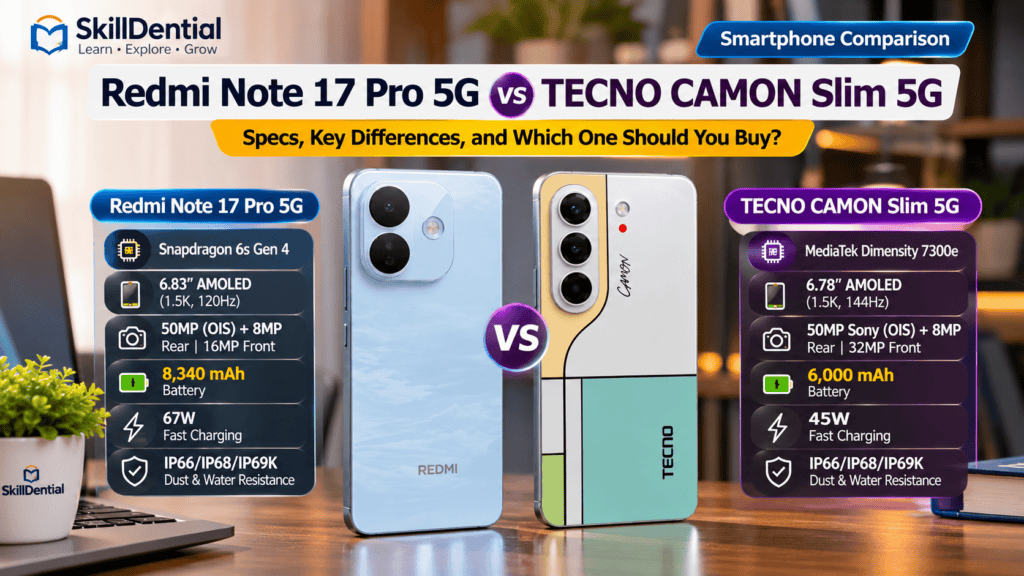
On paper, both devices cover essential modern baselines—including 5G connectivity, 1.5K AMOLED panels, 50MP main cameras with optical image stabilization (OIS), and power-efficient processors.
However, critical gaps in battery capacity, charging wattage, refresh rate, and physical weight make the Redmi Note 17 Pro 5G and its TECNO rival suited to very different daily workflows.
Redmi Note 17 Pro 5G vs. TECNO CAMON Slim 5G: Specifications Compared
While both smartphones share 1.5K AMOLED panels, 50MP OIS main cameras, and top-tier IP69K ingress protection, the Redmi Note 17 Pro 5G separates itself with a massive 8,340mAh silicon-carbon battery and faster 67W charging.
Meanwhile, the TECNO CAMON Slim 5G counters with an ultra-thin 6.39mm frame, a 144Hz refresh rate, and a sharper 32MP front camera.
| Specification | Redmi Note 17 Pro 5G | TECNO CAMON Slim 5G |
| Processor | Qualcomm Snapdragon 6s Gen 4 (4nm) | MediaTek Dimensity 7300e (6nm) |
| Display | 6.83-inch AMOLED | 6.78-inch AMOLED |
| Resolution | 1.5K (2772 × 1280) | 1.5K (2644 × 1208) |
| Refresh Rate | Up to 120Hz | Up to 144Hz |
| Rear Camera | 50MP main (OIS) + 8MP ultrawide | 50MP Sony LYTIA 700C (OIS) + 8MP ultrawide |
| Front Camera | 16MP | 32MP |
| Battery | 8,340mAh (Silicon-Carbon) | 6,000mAh |
| Charging | 67W wired (22.5W reverse wired) | 45W wired |
| Thickness | 8.6mm | 6.39mm |
| Weight | 223g | 171g – 190g (varies by finish) |
| Durability | IP66 / IP68 / IP69 / IP69K + Gorilla Glass Victus 2 | IP66 / IP68 / IP69 / IP69K + MIL-STD-810H |
| Operating System | Xiaomi HyperOS 3 (Android 16) | HiOS 16 (Android 16) |
| Network | 5G (Dual Nano-SIM / eSIM) | 5G (Dual Nano-SIM / eSIM) |
Sources: Manufacturer-published specifications from Xiaomi and TECNO.
Design and Build Quality
Physical design represents the sharpest philosophical divide between the Redmi Note 17 Pro 5G and the TECNO CAMON Slim 5G.
Built like a tank to house its massive 8,340mAh battery and expansive 6.83-inch screen, the Redmi Note 17 Pro 5G measures 163.45 × 78.27 × 8.6mm and weighs 223g. Xiaomi pairs that substantial footprint with tougher front glass—upgrading to Corning Gorilla Glass Victus 2 alongside SGS 5-star drop resistance and IP68/IP69K dust and water protection.
Available in understated finishes like Black, Purple, and Sky Blue, the Redmi Note 17 Pro 5G prioritizes structural rigidity and impact survival over pocket lightness.
The TECNO CAMON Slim 5G takes the opposite engineering route. At just 6.39mm thin (162.58 × 77.27 × 6.39mm) and roughly 171g–190g depending on the finish, it is over 2.2mm thinner and more than 30g lighter than the Redmi—making a noticeable difference during one-handed scrolling or extended calls.
Despite its featherweight chassis, TECNO still includes IP68/IP69K ingress ratings, MIL-STD-810H compliance, and Gorilla Glass 7i on the front. It also leans heavily into expressive styling, offering art-inspired colorways—Matisse Black, Van Gogh Blue, Burgundy Red, Neo Mondrian, Gossamer White, and Rebel Pink—depending on your region.
Which Has the Better Design?
- Choose the TECNO CAMON Slim 5G if ergonomics, pocketability, and bold aesthetic finishes matter most. Getting IP69K water resistance and a 6,000mAh battery inside a 6.39mm frame makes it one of the easiest mid-range phones to carry all day.
- Choose the Redmi Note 17 Pro 5G if you prefer a larger, more substantial handset and stronger front-glass protection. Its Gorilla Glass Victus 2 panel and extra heft give it superior drop resilience for heavy outdoor or everyday use.
Display Comparison
Both the Redmi Note 17 Pro 5G and TECNO CAMON Slim 5G feature crisp 1.5K AMOLED panels capable of deep contrast, wide DCI-P3 color coverage, and strong outdoor legibility. However, each brand optimizes its screen for different strengths—panel protection and eye comfort on the Redmi versus curved aesthetics and faster motion on the TECNO.
The Redmi Note 17 Pro 5G uses a larger 6.83-inch flat AMOLED display (2772 × 1280 pixels, ~447 ppi) with a 120Hz refresh rate and up to 3,500 nits of peak brightness.
Xiaomi builds this panel for long-term endurance and viewing comfort, pairing 3,840Hz high-frequency PWM dimming and TÜV Rheinland eye-care certifications with Corning Gorilla Glass Victus 2. Gamers also benefit from a 240Hz standard touch sampling rate that boosts up to 3,200Hz instantaneously in Game Turbo mode.
The TECNO CAMON Slim 5G counters with a slightly more compact 6.78-inch 3D curved AMOLED screen (2644 × 1208 pixels, ~429 ppi). Its standout advantages are a faster 144Hz refresh rate and an advertised 4,500 nits peak brightness (with 1,600 nits max full-screen rating and 2,160Hz–2,304Hz PWM dimming).
While the jump from 120Hz to 144Hz is subtle in everyday scrolling—and only active in supported apps and system settings—the curved edges give the TECNO a sleeker, flagship-style visual profile.
Which Has the Better Display?
- Choose the Redmi Note 17 Pro 5G if you prefer a slightly larger flat screen, superior flicker reduction (3,840Hz vs. ~2,160Hz PWM dimming) for late-night reading, and tougher Gorilla Glass Victus 2 scratch and drop protection.
- Choose the TECNO CAMON Slim 5G if you want a higher 144Hz refresh rate, higher peak HDR brightness (4,500 nits), and the immersive wrap-around look of a 3D curved AMOLED panel.
Processor and Performance
Raw speed and thermal efficiency play a major role in how smoothly a mid-range phone handles split-screen multitasking, social media feeds, and extended gaming sessions.
The Redmi Note 17 Pro 5G runs on Qualcomm’s Snapdragon 6s Gen 4 mobile platform, built on a power-efficient 4nm process.
Its octa-core CPU pairs four performance Cortex-A78 cores clocked up to 2.4GHz with four efficiency Cortex-A55 cores at 1.8GHz, alongside an Adreno 710 GPU. Depending on the configuration (6GB, 8GB, or 12GB LPDDR4X RAM), Xiaomi pairs the chip with UFS 2.2 or faster UFS 3.1 storage on select variants, running on Xiaomi HyperOS 3.
The TECNO CAMON Slim 5G is powered by MediaTek’s Dimensity 7300e chipset, manufactured on a 6nm node. It uses a similar octa-core layout—four Cortex-A78 cores clocked slightly higher at up to 2.5GHz and four Cortex-A55 cores at 2.0GHz—paired with a Mali-G610 GPU, 8GB of LPDDR4X RAM, and HiOS 16.
On paper, both chips share the exact same Cortex-A78 / Cortex-A55 core architecture and deliver comparable day-to-day responsiveness. However, silicon specs alone do not tell the whole story under sustained loads.
The Redmi Note 17 Pro 5G benefits from a newer 4nm lithography and a thicker 8.6mm chassis that provides greater thermal headroom during long gaming sessions. Conversely, the TECNO CAMON Slim 5G squeezes its 6nm processor into an ultra-thin 6.39mm frame, where heat dissipation is inherently tighter during prolonged 3D gaming.
Which Is Better for Performance?
- For everyday multitasking and reliability: Both the Redmi Note 17 Pro 5G and TECNO CAMON Slim 5G handle browsing, messaging, 1.5K video streaming, and app switching effortlessly with 5G support across both devices.
- For gaming and sustained workloads: The Redmi Note 17 Pro 5G holds a practical advantage in thermal stability and power efficiency thanks to its 4nm Snapdragon 6s Gen 4 chip and larger body, though serious mobile gamers should still check frame-rate and thermal throttling tests for their specific titles before buying.
Camera Comparison
Camera hardware is where the TECNO CAMON Slim 5G pulls noticeably ahead of the Redmi Note 17 Pro 5G on paper—not just in megapixel count, but in physical sensor size and secondary lens versatility.
Redmi Note 17 Pro 5G Camera Hardware:
- Main Camera: 50MP wide sensor (1/2.76-inch, f/1.8 aperture, 0.64µm pixels) with optical image stabilization (OIS)
- Ultrawide Camera: 8MP fixed-focus lens (f/2.2 aperture)
- Front Camera: 16MP selfie shooter (f/2.4 aperture)
- Video: Capped at 1080p Full HD at 30fps
The Redmi Note 17 Pro 5G relies on OIS and a comprehensive Pro mode (with 50MP RAW capture) to produce clean daylight shots and steady handheld video.
However, its smaller 1/2.76-inch primary sensor gathers less light after dark, its fixed-focus 8MP ultrawide softens quickly in dim lighting, and its lack of 4K video recording limits flexibility for content creators.
TECNO CAMON Slim 5G Camera Hardware:
- Main Camera: 50MP Sony LYTIA 700C sensor (1/1.56-inch, f/1.8 aperture, 1.0µm pixels) with OIS
- Ultrawide Camera: 8MP lens (f/2.2 aperture, 112° field of view) with autofocus
- Front Camera: 32MP high-resolution selfie shooter
- Video: Up to 2K (1440p) at 30fps on the rear camera; 1080p at 30fps on the front
While both main cameras carry a 50MP label, the TECNO CAMON Slim 5G houses a significantly larger 1/1.56-inch Sony LYTIA 700C sensor—roughly triple the surface area of the Redmi’s 1/2.76-inch sensor.
Paired with TECNO’s Universal Tone processing, FlashSnap 2.0 motion capture, and multi-focal portrait modes (24mm, 35mm, and 50mm), it captures stronger low-light detail and cleaner dynamic range.
Adding autofocus to its 8MP ultrawide lens also allows close-up macro shots, while its 32MP front camera doubles the selfie resolution of the Redmi Note 17 Pro 5G.
Which Has the Better Camera?
- Choose the TECNO CAMON Slim 5G if photography, night shots, video resolution (2K vs. 1080p), or front-facing selfies are high priorities. Its larger Sony LYTIA 700C sensor, autofocus ultrawide, and 32MP selfie camera give it a clear hardware edge.
- Choose the Redmi Note 17 Pro 5G if you primarily shoot casual daylight stills on the main 1x lens and prioritize battery endurance over camera versatility.
Battery Life and Charging
Endurance is the Redmi Note 17 Pro 5G’s headline advantage—and the single clearest reason to choose it over a thinner competitor.
Xiaomi equips the Redmi Note 17 Pro 5G with a massive 8,340mAh silicon-carbon battery paired with 67W HyperCharge support.
According to Xiaomi’s lab figures, the phone delivers over two days of typical mixed use (up to 60 hours of endurance), reaches 50% charge in roughly 34 minutes, and retains at least 80% of its capacity after 1,600 charge cycles—equivalent to up to six years of regular use.
It also doubles as a portable power bank with up to 22.5W wired reverse charging for topping up earbuds, smartwatches, or a secondary phone.
The TECNO CAMON Slim 5G packs a 6,000mAh battery with 45W wired Super Charge. While it trails the Redmi by 2,340mAh—a 39% capacity advantage for Xiaomi—squeezing a 6,000mAh cell into a 6.39mm frame is an impressive feat of high-density engineering.
In real-world use, the TECNO comfortably clears a full day of moderate activity and charges from empty to 100% in roughly 65 to 80 minutes using its bundled 45W adapter. (Note: Keep in mind that regional charger availability varies—while TECNO includes its 45W brick in the box in most markets, Xiaomi omits the 67W adapter in select regions.)
| Battery Feature | Redmi Note 17 Pro 5G | TECNO CAMON Slim 5G |
| Battery Capacity | 8,340mAh (Silicon-Carbon) | 6,000mAh |
| Wired Charging | 67W HyperCharge (50% in ~34 mins) | 45W Super Charge (100% in ~66–82 mins) |
| Reverse Charging | Up to 22.5W wired | Not officially listed |
| Wireless Charging | No | No |
| Rated Longevity | 1,600 cycles (≥80% capacity / ~6 years) | 5-year battery durability rating |
Of course, real-world screen-on time still depends on your 120Hz vs. 144Hz refresh rate settings, 5G signal strength, outdoor screen brightness, and gaming habits.
Which Has the Better Battery?
- Choose the Redmi Note 17 Pro 5G if battery anxiety is a dealbreaker. Its 8,340mAh silicon-carbon cell, faster 67W charging, and 22.5W wired reverse charging make it built for heavy commuters, travelers, and power users who spend long stretches away from wall outlets.
- Choose the TECNO CAMON Slim 5G if you want reliable all-day endurance without carrying a heavy phone. Getting 6,000mAh inside a 6.39mm chassis gives you solid daily stamina with far less pocket bulk.
Water Resistance and Durability
Both the Redmi Note 17 Pro 5G and TECNO CAMON Slim 5G go far beyond typical mid-range splash resistance, carrying full IP66, IP68, IP69, and IP69K certifications against dust, freshwater submersion, and high-pressure, high-temperature water jets. However, each brand backs up its ingress ratings with different structural safeguards.
Xiaomi builds the Redmi Note 17 Pro 5G around its reinforced REDMI Titan Structure, pairing Corning Gorilla Glass Victus 2 on the front with SGS 5-star certified drop resistance for impacts up to 3 meters onto smooth granite.
On the water side, Xiaomi certifies the handset through TÜV SÜD to survive freshwater submersion up to 2 meters deep for 72 hours, and includes a dedicated Underwater Camera Mode with speaker auto-drain vibration.
The TECNO CAMON Slim 5G matches the Redmi Note 17 Pro 5G’s IP66/IP68/IP69/IP69K ingress suite (rated for 30-minute freshwater submersion and underwater photography) despite its ultra-thin 6.39mm body.
To counter concerns about flex or bending in a slim chassis, TECNO certifies the phone to MIL-STD-810H standards—validating it against 3,000 anti-twisting lift tests, 22,000 micro-drop tests, and 25kg soft-extrusion pressure tests.
Important Caveat:
Laboratory IP69K and drop certifications measure resistance under controlled freshwater and flat-surface conditions—not permanent waterproofing. Seals naturally degrade over time, and neither manufacturer covers liquid damage from seawater, chlorinated pools, or hot water under standard warranty terms.
Which Is More Durable?
- Choose the Redmi Note 17 Pro 5G for superior impact and screen durability. Its Corning Gorilla Glass Victus 2, thicker 8.6mm frame, 3-meter SGS drop certification, and 72-hour submersion rating give it stronger real-world protection against accidental drops onto hard pavement.
- Choose the TECNO CAMON Slim 5G if you want an ultra-thin phone that does not compromise on ingress protection. It delivers the same high-pressure IP69K water resistance and verified bend resistance in a far slimmer profile.
Software and AI Features
Both phones ship with Android 16-based custom interfaces packed with generative AI tools, though Xiaomi holds a major advantage in long-term software longevity.
The Redmi Note 17 Pro 5G runs Xiaomi HyperOS 3 out of the box, combining deep Google ecosystem integration with Xiaomi’s cloud and on-device editing suite:
- Google Gemini & Circle to Search: System-wide assistant access and instant visual search from any screen.
- AI Image Editing Suite: AI Erase Pro (object removal), AI Glare Removal, AI Image Expansion (generative outpainting), AI Sky replacement, and AI Beautify.
More importantly, Xiaomi backs the Redmi Note 17 Pro 5G with an extended security update commitment running through August 2032 on its official Security Center schedule—giving buyers roughly six years of patch coverage alongside major Android OS upgrades.
The TECNO CAMON Slim 5G runs HiOS 16 (based on Android 16), anchoring its software experience around TECNO AI and the upgraded Ella assistant.
Notable built-in tools include real-time call translation and live subtitles, automatic call summaries, AI photo editing in the Gallery app,
YouTube video summarization, offline one-tap file sharing with iPhones, and Gaming Bypass Charging (which routes power directly to the motherboard during plugged-in play to reduce heat).
Important Note on AI & Updates:
Individual AI features on both HyperOS 3 and HiOS 16 depend on regional firmware builds, active internet connections, and server-side rollout schedules. Buyers should also check local warranty and authorized service center availability in their country before committing.
Which Has the Better Software?
- Choose the Redmi Note 17 Pro 5G if long-term security patches (supported until August 2032), Google Gemini integration, and generative photo-editing tools matter most.
- Choose the TECNO CAMON Slim 5G if you want practical communication AI—such as live call translation, automatic call summaries, and hands-free WhatsApp integration via Ella—plus Gaming Bypass Charging.
Price and Availability in Nigeria
Both smartphones sit in virtually the same mid-range price bracket in Nigeria, making direct value-for-money comparisons especially tight for local buyers.
| Model & Configuration | Indicative Nigerian Retail Price | Availability & Notes |
| Redmi Note 17 Pro 5G (8GB / 256GB) | ₦520,000 – ₦559,000 | Widely stocked at authorized retailers (e.g., SLOT at ₦559,000; independent dealers from ₦520,000–₦545,000) |
| Redmi Note 17 Pro 5G (8GB / 512GB) | ₦615,000 – ₦640,000 | Higher-storage tier available at major outlets (SLOT listed at ₦639,500) |
| TECNO CAMON Slim (8GB / 256GB) | ₦545,000 – ₦550,000 | Officially launched in Nigeria at ₦550,000 (SLOT listed at ₦549,100); 4G-only local variant |
(Note: Prices reflect indicative Nigerian market rates and fluctuate based on storage tier, FX shifts, store promotions, and regional stock.)
Critical Buyer Warning (4G vs. 5G Variant Trap):
TECNO sells two distinct hardware versions under the CAMON Slim name. The CAMON Slim officially distributed in Nigeria is the 4G LTE variant powered by a MediaTek Helio G200 Ultimate processor with a 5,600mAh battery—not the global CAMON Slim 5G (Dimensity 7300e, 6,000mAh battery, 45W charging).
Meanwhile, every Nigerian retail unit of the Redmi Note 17 Pro 5G ships with native 5G connectivity and the Snapdragon 6s Gen 4 chipset. Before paying for a TECNO listing, verify the box label, exact model number, and processor under Settings > About Phone to confirm whether you are getting the local 4G edition or an imported 5G unit.
Value Verdict for Nigerian Buyers
At roughly ₦520,000–₦559,000, the Redmi Note 17 Pro 5G delivers noticeably stronger hardware per naira in Nigeria—offering true 5G support, an 8,340mAh battery built to handle erratic power supply, and 67W charging for the same price as TECNO’s 4G-only local variant.
Which Smartphone Should You Buy?
At roughly ₦520,000–₦559,000 for the 8GB/256GB variant, both phones deliver strong mid-range value, but each is engineered for a completely different type of daily user.
Choose the Redmi Note 17 Pro 5G if:
- You want multi-day battery confidence: Its massive 8,340mAh silicon-carbon battery comfortably stretches past two days of moderate use, making it ideal for heavy commuters, mobile hotspot users, and areas with inconsistent power.
- You need faster top-ups and reverse charging: 67W HyperCharge gets you back up to speed quickly, while 22.5W wired reverse charging lets you top up earbuds or a secondary device on the go.
- You prioritize screen size, eye comfort, and drop toughness: Its larger 6.83-inch 1.5K flat AMOLED display pairs Corning Gorilla Glass Victus 2 with 3,840Hz PWM dimming for reduced eye strain during long reading or streaming sessions.
- You want guaranteed 5G connectivity and long-term updates: Every Nigerian retail unit of the Redmi Note 17 Pro 5G includes native 5G support and security patches running through August 2032.
Choose the TECNO CAMON Slim 5G if:
- You hate bulky, heavy phones: At just 6.39mm thin, it slips effortlessly into tight pockets and feels noticeably lighter during one-handed scrolling.
- You want smoother motion and curved-edge styling: Its 6.78-inch 1.5K AMOLED panel pushes a faster 144Hz refresh rate with a sleek 3D curved profile.
- Camera versatility and selfies come first: Its larger 50MP Sony LYTIA 700C main sensor (1/1.56-inch) and 32MP front camera give social media creators and portrait shooters superior low-light capture and sharper self-portraits.
- You value expressive design: Its art-inspired colorways stand out visually compared to traditional mid-range finishes.
For most buyers—especially in Nigeria—the Redmi Note 17 Pro 5G is the stronger all-around investment. Between its 8,340mAh battery, Gorilla Glass Victus 2 durability, guaranteed 5G modem, and six-year security support window, it solves practical everyday pain points better than any ultra-thin rival.
Only pick the TECNO CAMON Slim 5G if featherweight 6.39mm ergonomics and front-facing camera resolution outweigh battery endurance—and make sure you confirm you are buying the true 5G model rather than Nigeria’s standard 4G Helio G200 Ultimate edition.
Is the Redmi Note 17 Pro 5G better than the TECNO CAMON Slim 5G?
For most buyers, yes—the Redmi Note 17 Pro 5G delivers stronger overall value thanks to its massive 8,340mAh battery, faster 67W charging, Gorilla Glass Victus 2 durability, and six-year security update commitment through August 2032.
However, the TECNO CAMON Slim 5G is the better pick if you prioritize an ultra-thin 6.39mm profile, a 144Hz curved AMOLED display, and higher-resolution selfie photography.
Which phone has a bigger battery?
The Redmi Note 17 Pro 5G has a significantly larger 8,340mAh silicon-carbon battery (paired with 67W wired charging and 22.5W wired reverse charging), giving it a 2,340mAh advantage over the TECNO CAMON Slim 5G’s 6,000mAh battery (45W charging).
Which phone has a better camera?
The TECNO CAMON Slim 5G holds the hardware advantage for photography, pairing a larger 50MP Sony LYTIA 700C main sensor (1/1.56-inch) and autofocus ultrawide with a sharper 32MP front camera.
The Redmi Note 17 Pro 5G features a 50MP OIS main camera, an 8MP ultrawide, and a 16MP selfie camera—reliable for everyday daylight shots, though less capable in low light and selfies.
Which phone has a higher display refresh rate?
The TECNO CAMON Slim 5G supports a higher 144Hz refresh rate on its 6.78-inch 3D curved AMOLED display, whereas the Redmi Note 17 Pro 5G runs at up to 120Hz on its slightly larger 6.83-inch flat AMOLED.
Does the TECNO CAMON Slim support 5G in Nigeria?
Not by default—buyers must check the exact variant before paying. TECNO sells two separate models: the global CAMON Slim 5G (MediaTek Dimensity 7300e, 6,000mAh battery) and the standard CAMON Slim officially distributed in Nigeria, which runs on a 4G-only MediaTek Helio G200 Ultimate processor with a 5,600mAh battery.
By contrast, every Nigerian retail unit of the Redmi Note 17 Pro 5G includes native 5G connectivity.
How much do the Redmi Note 17 Pro 5G and TECNO CAMON Slim cost in Nigeria?
In Nigeria, the Redmi Note 17 Pro 5G (8GB/256GB) retails between ₦520,000 and ₦559,000 (with the 512GB model around ₦608,000–₦640,000), while the local 4G TECNO CAMON Slim (8GB/256GB) sells for approximately ₦545,000–₦550,000.
In Conclusion
The Redmi Note 17 Pro 5G and TECNO CAMON Slim 5G represent two well-executed but fundamentally different priorities in the mid-range smartphone market.
Built around pure stamina and durability, the Redmi Note 17 Pro 5G stands out with its massive 8,340mAh silicon-carbon battery, 67W HyperCharge, Corning Gorilla Glass Victus 2 protection, and 6.83-inch 1.5K AMOLED display. It is the clear pick for power users, heavy travelers, and anyone who wants multi-day endurance with fewer charging interruptions.
By contrast, the TECNO CAMON Slim 5G wins on ergonomics, motion smoothness, and selfie hardware. Packing a 144Hz AMOLED screen, a 50MP Sony LYTIA 700C OIS sensor, and a 32MP front camera into a featherweight 6.39mm frame makes it an ideal choice for style-conscious buyers and social media creators who value pocketability over maximum battery size.
Ultimately, neither phone is a one-size-fits-all winner—your decision comes down to whether multi-day battery life and screen toughness or ultra-thin portability and camera versatility matter more in your daily routine.
If you are buying in Nigeria, be sure to verify the exact TECNO model number and network specs before paying, as local retail units officially ship as the 4G-only CAMON Slim rather than the global CAMON Slim 5G—whereas every Nigerian unit of the Redmi Note 17 Pro 5G includes native 5G connectivity out of the box.