AI Automation Engineer Roadmap: No-Code to Production
An AI Automation Engineer connects AI models to real business systems, transforming promising ideas into dependable workflows that run reliably every day. The role combines artificial intelligence, automation platforms, APIs, data handling, testing, security, and deployment to solve practical business problems at scale.
This AI Automation Engineer roadmap will guide you from building your first no-code automations with tools such as Zapier, Make, and n8n to creating coded integrations and production-ready systems.
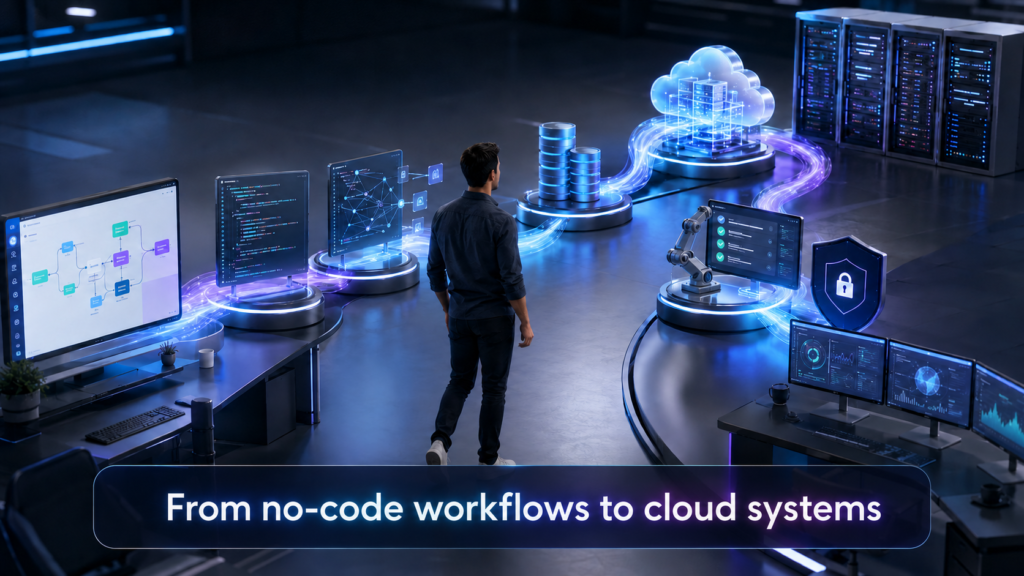
Along the way, you’ll develop portfolio projects, learn essential engineering practices, and gain the skills needed to build AI workflows that are secure, maintainable, and ready for real-world use.
Who This Article Is For
This AI Automation Engineer roadmap is designed for professionals and learners at a beginner to intermediate level who want a structured path toward shipping dependable, production-grade AI workflows.
This guide is for:
- Career changers & beginners looking for a clear, step-by-step entry point into AI engineering without getting lost in theoretical noise.
- No-code builders (Zapier, Make, n8n) who want to level up by integrating custom AI models and coded APIs.
- Developers & technical professionals transitioning into specialized AI automation and production architecture.
- Freelancers & agency owners scaling their service offerings with high-value AI process automation.
- Operations professionals aiming to design and deploy scalable automated workflows across business units.
By following this AI Automation Engineer roadmap, you will gain a clear, staged plan to build portfolio-ready projects, master end-to-end deployment, and become job-ready for modern AI engineering roles.
What You Will Learn
This AI Automation Engineer roadmap breaks down the end-to-end skill stack required to transition from basic script building to enterprise-grade AI architecture.
By following this guide, you will learn:
- The Core Role: Exactly what an AI Automation Engineer does and how they bridge business operations with scalable AI models.
- The Step-by-Step Learning Path: A structured progression moving systematically from no-code foundation to production-ready deployments.
- Essential Technical Skills: Practical mastery of AI integration, workflow automation, custom APIs, testing frameworks, and cloud deployment.
- Stage-by-Stage Tool Stacks: The exact software and platform stacks to use at each milestone (No-Code → Low-Code → Full-Code).
- Portfolio-Building Projects: Hands-on projects engineered to prove your practical execution capabilities to clients and hiring managers.
- Production Standards: How to implement unit testing, data security, error handling, real-time monitoring, and system scalability.
- Career Execution: Actionable strategies to monetize your skills—whether securing a full-time position, pitching freelance clients, or scaling an AI automation agency.
What an AI Automation Engineer Does
At its core, any comprehensive AI Automation Engineer roadmap focuses on execution over theory. An AI Automation Engineer builds and maintains systems that integrate artificial intelligence—especially Large Language Models (LLMs)—directly into live business workflows.
Unlike data scientists who concentrate on training models or academic research, AI automation engineers specialize in real-world deployment, system integration, and production reliability.
Key responsibilities covered in this AI Automation Engineer roadmap include:
- Workflow Design: Architectural design of AI features tailored for customer support, operations, finance, and marketing systems.
- API & System Integration: Connecting LLM APIs (like OpenAI, Anthropic, or open-source alternatives) with internal databases, custom software, and third-party tools.
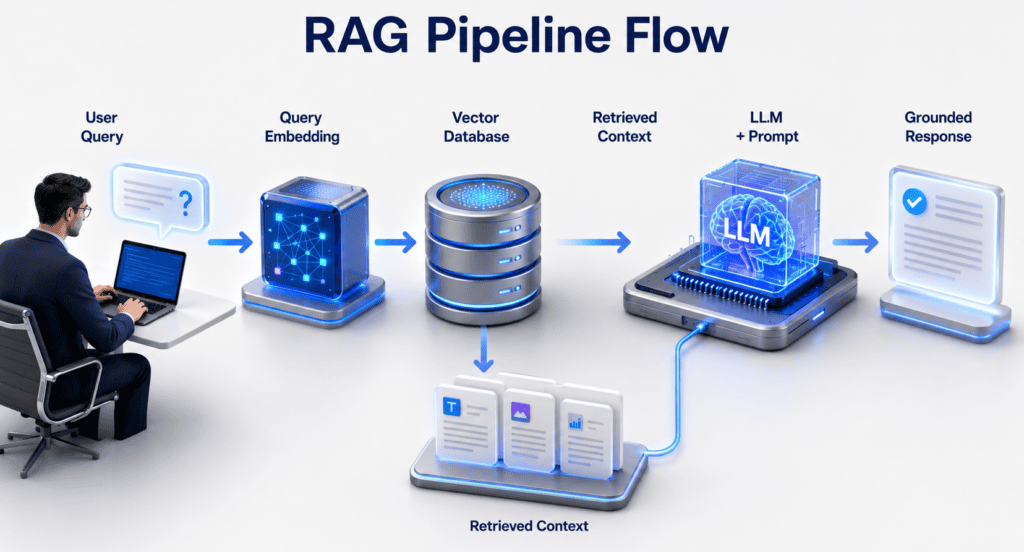
- Knowledge Retrieval Systems: Building Retrieval-Augmented Generation (RAG) pipelines that allow AI systems to retrieve and answer accurately from proprietary company data.
- Autonomous AI Agents: Engineering multi-step agents capable of tool calling, database lookups, and executing automated business actions.
- Production Operations: Testing, securing, monitoring, and scaling these automated systems for enterprise resilience.
In practice, this path aligns far more closely with software engineering than traditional data science: you ship production-ready systems that must run continuously, handle edge cases gracefully, and balance performance against cost constraints.
The Roadmap at a Glance
This AI Automation Engineer roadmap is structured into four sequential phases, taking you from fundamental automation logic to advanced cloud infrastructure:
- Phase 1: No-Code Foundations — Automate simple tasks with Zapier, Make, and n8n using basic AI steps and pre-built modules.
- Phase 2: Low-Code + APIs — Implement custom logic, process webhooks, and integrate direct LLM API calls for greater flexibility.
- Phase 3: Code + Production Patterns — Transition into production software development using Python, FastAPI, Docker, and core cloud infrastructure.
- Phase 4: Production-Grade Systems — Fortify your architecture with automated testing, security standards, observability tools, and horizontal scaling.
Estimated Time to Job-Ready
The timeline to complete this AI Automation Engineer roadmap varies based on your existing technical foundation:
| Your Background | Estimated Timeline | Focus Area |
| Complete Beginner (No programming background) | 8–12 months | Master core logic via no-code first, then build Python fundamentals. |
| Data / Operations Roles | 6–9 months | Leverage existing logic/data skills; focus on APIs, code, and deployment. |
| Software Engineers | 3–5 months | Fast-track low-code tools; focus heavily on LLM integration, RAG, and AI agents. |
Note: These timelines reflect the investment needed to become job-ready with a proof-of-concept portfolio, rather than mastery.
Phase 1 — No-Code Foundations (0–2 Months)
Establish foundational automation logic and construct your initial AI-enhanced workflows without writing code—the critical first step in any AI Automation Engineer roadmap.
Core Learning Areas
- Process Mapping: Identify repetitive operational tasks suitable for automation (e.g., lead capture, support triage, reporting).
- No-Code Platforms: Master platform mechanics using Zapier, Make, and n8n to link systems and execute scheduled triggers.
- Basic AI Steps: Incorporate pre-built AI actions or native LLM nodes to summarize, classify, and extract data inside live workflows.
Tool Stack
| Platform | Core Strengths | Ideal Use Case |
| Zapier | Easiest onboarding, 6,000+ app integrations | Simple, linear single-step or multi-step tasks |
| Make | Visual flow architecture, advanced error handling | Complex multi-branch logic and data parsing |
| n8n | Open-source, self-hostable, developer-friendly | Custom node patterns, data privacy, early agent builds |
Key Concepts to Master
- Triggers & Actions: Understanding event-driven logic (what initiates a process vs. what executes downstream).
- Filters & Routers: Implementing conditional logic to split execution paths based on incoming payloads.
- Basic Error Handling: Setting up retries, fallback paths, and instant error notifications (Slack/Email) when execution fails.
Portfolio Projects (No-Code Stage)
Build and document 2–3 end-to-end automations as the initial portfolio layer of your AI Automation Engineer roadmap:
- AI Lead Qualifier
- Trigger: Form submission (Typeform / Google Forms).
- AI Step: Analyze lead input using an LLM to assign a quality score and recommend next steps.
- Action: Update CRM records (HubSpot / Airtable) and send priority alerts to Slack.
- Support Ticket Triage
- Trigger: Inbound email or web form entry.
- AI Step: Extract customer intent, sentiment score, and urgency level.
- Action: Route ticket to the correct department channel or assigned rep in Zendesk / Help Scout.
- Weekly Insights Report
- Trigger: Scheduled time trigger (e.g., every Monday at 8:00 AM).
- AI Step: Synthesize raw metrics from Google Sheets or Notion into executive summaries.
- Action: Generate a formatted digest, post to Slack, and log the report in a central doc.
Portfolio Standard: Document every project with four key assets: the business problem, tools used, workflow architecture diagram (screenshot), and measurable outcomes (time saved or error reduction).
Phase 2 — Low-Code + APIs (2–5 Months)
Transition beyond pre-built connectors to execute direct LLM API calls, manipulate structured data payloads, and architect resilient, low-code automation systems—a pivotal milestone in your AI Automation Engineer roadmap.
Core Learning Areas
- HTTP & APIs: Master REST fundamentals, authentication standards (API Keys, OAuth 2.0), status codes, rate limiting, and handling paginated responses.
- LLM APIs: Execute native API calls to providers like OpenAI and Anthropic, leveraging function calling (tool use) and enforcing strict JSON schemas for outputs.
- Webhooks: Replace polling loops with real-time, event-driven webhooks to handle incoming payloads instantly.
- Data Processing: Parse JSON data, transform arrays/objects, and store persistent records in lightweight data layers (Airtable, PostgreSQL, Google Sheets).
Tool Stack
| Platform / Tool | Technical Role | Best For |
| n8n (Self-Hosted / Cloud) | Custom HTTP nodes & code steps (JS/Python) | Building complex webhooks, data pipelines, and scalable micro-workflows |
| Make / Zapier (Custom API) | Native HTTP / Webhook modules | Extending existing platform setups with raw API endpoints |
| OpenAI / Anthropic APIs | Core intelligence layer | System prompts, structured JSON outputs, and native tool/function calling |
Key Concepts to Master
- Production Prompt Engineering: Writing bulletproof system instructions, embedding few-shot examples, and enforcing structured JSON output schemas (
response_format). - Function Calling & Tool Use: Instructing models to dynamically determine when and how to execute an external API request (e.g., database lookup, updating a record).
- Fault Tolerance & Oversight: Implementing timeout rules, automated retries with exponential backoff, fallback logic, and human-in-the-loop checkpoints for critical actions.
Portfolio Projects (Low-Code Stage)
Build and document 2–3 low-code integrations to demonstrate system execution capabilities in your AI Automation Engineer roadmap:
- RAG-Powered AI Customer Support Assistant
- Architecture: Ingest documentation/FAQs into a vector store (e.g., Pinecone or Chroma via API).
- Execution: Build a Retrieval-Augmented Generation (RAG) flow: catch user query via webhook $\rightarrow$ fetch relevant document chunks $\rightarrow$ prompt LLM with retrieved context $\rightarrow$ return grounded response.
- Deployment: Expose the endpoint through a custom webhook or lightweight web widget.
- Operations Copilot for Internal Tools
- Architecture: Connect to a CRM or project management API (e.g., HubSpot, Jira).
- Execution: Use LLM function calling to interpret freeform requests, search database records, update fields, and create tasks dynamically.
- Safety Guard: Add an automated human-approval step (e.g., Slack interactive button) before executing high-impact state changes.
- Automated Document Processing Pipeline
- Architecture: Monitor cloud storage for new PDF/image uploads (invoices, receipts, contracts).
- Execution: Run OCR + LLM data extraction to isolate target key-value pairs and validate values.
- Action: Insert structured data into a relational DB and trigger downstream fulfillment webhooks.
Portfolio Standard: Include complete architecture diagrams, core system prompts, JSON payload examples, and edge-case handling logic to prove your builds go beyond basic demos.
Phase 3 — Code + Production Patterns (5–9 Months)
Acquire core software engineering competencies in Python, FastAPI, Docker, and cloud infrastructure to architect, package, and deploy production-ready AI microservices—a critical bridge in your AI Automation Engineer roadmap.
Core Learning Areas
- Python Fundamentals: Master object-oriented programming (OOP), asynchronous execution (
asyncio), error handling, and type hinting. - Web Frameworks: Build lightweight, high-performance APIs and microservices using FastAPI.
- Containerization: Package applications with Docker and configure multi-container environments using Docker Compose.
- Cloud Infrastructure: Gain deep practical experience with a major cloud ecosystem (AWS, Azure, or GCP) covering compute, object storage, serverless functions, and managed databases.
Tool Stack
| Layer | Primary Tech | Role in Stack |
| Language & Env | Python 3.11+ | Core application logic, virtual environments (venv/uv), dependency management |
| API Framework | FastAPI | Asynchronous LLM endpoints, Pydantic validation schemas, auto-generated OpenAPI docs |
| Containerization | Docker & Compose | Consistent local/production runtime environments, service orchestration |
| AWS Cloud Services | Lambda, ECS/Fargate, S3, RDS, API Gateway | Serverless execution, container hosting, document storage, and managed relational databases |
Key Concepts to Master
- API Service Design: Designing RESTful endpoints (
/v1/query), strict request/response validation using Pydantic, and API versioning. - Secrets & Configuration: Managing multi-environment setups (dev, staging, prod) via environment variables (
.env) and cloud secret managers. - Observability & Logging: Implementing structured JSON logging, correlation IDs for request tracking, and latency/error tracking.
Portfolio Projects (Coded Stage)
Construct 1–2 production-grade repositories to form the technical bedrock of your AI Automation Engineer roadmap:
- Production-Ready RAG Microservice
- Architecture: Ingest documents, extract text, process chunking strategies, and store vector embeddings in Pinecone/pgvector.
- Execution: Build a FastAPI endpoint (
POST /api/v1/query) that executes semantic search, formats grounded prompt context, and returns cited answers. - Deployment: Containerize application dependencies with Docker and deploy to AWS ECS/Fargate or GCP Cloud Run.
- Domain-Specific Autonomous AI Agent
- Architecture: Build a “Finance Ops Agent” designed to query invoices, reconcile payments against database records, and flag financial anomalies.
- Execution: Implement LLM tool calling to execute parameterized SQL queries and interact with internal REST APIs dynamically.
- Evaluation: Include an automated evaluation suite testing the agent across 20+ query edge cases with expected deterministic outputs.
Portfolio Standard: Publish fully documented repositories on GitHub containing a clean
README.md, architectural diagrams,docker-compose.ymlconfigs, setup instructions, and a live API documentation link (Swagger UI).
Phase 4 — Production-Grade Systems (9–12+ Months)
Harden your applications for enterprise delivery by making them reliable, secure, observable, and cost-efficient—the final mastery stage of this AI Automation Engineer roadmap.
Core Learning Areas
- AI System Testing & Evaluation:
- Implement automated unit tests for core logic and integration tests for external API endpoints.
- Construct evaluation harnesses to assess LLM outputs across accuracy, groundedness, relevance, and safety metrics.
- Security, Privacy & Guardrails:
- Implement input validation rules and prompt-injection defenses (e.g., NeMo Guardrails, automated sanitization).
- Enforce PII detection/redaction and strict API access controls to align with data protection frameworks (GDPR, SOC2).
- Observability & Telemetry:
- Track performance metrics: latency (p50/p95/p99), system error rates, token usage, and per-request costs.
- Capture real-time quality signals: user feedback loops, manual overrides, and escalation triggers.
- Monitor data drift to detect changes in input distributions or degrading output accuracy over time.
- Scalability & Cost Optimization:
- Implement dynamic model routing (routing lightweight tasks to smaller models like GPT-4o-mini/Claude Haiku, and complex reasoning to GPT-4o/Claude Sonnet).
- Deploy semantic caching for repeated prompts and batch processing for asynchronous workloads.
- Configure API rate limits, user quotas, and automated cost budget alerts.
Tool Stack
| Engineering Pillar | Recommended Stack | Core Function |
| Testing & Evals | DeepEval, RAGAS, LangSmith | Automated LLM benchmarks, regression testing, and output quality scoring |
| Security & Auditing | Guardrails AI, Presidio, Trivy | Prompt injection protection, PII masking, and container vulnerability scanning |
| Observability | Datadog, OpenTelemetry, Arize Phoenix | Real-time trace collection, latency tracking, and token cost attribution |
| CI/CD & Infra | GitHub Actions, Terraform | Automated testing pipelines, secrets management, and Infrastructure-as-Code |
Portfolio Projects (Production Stage)
To complete your AI Automation Engineer roadmap, elevate one of your Phase 3 coded microservices into a production-hardened system:
- Enterprise-Ready AI Microservice Hardening
- Automated Testing & Evals: Integrate a continuous evaluation suite running DeepEval on every PR to verify system accuracy remains $>90\%$.
- Guardrails & Security: Embed middleware for PII redaction and active prompt-injection detection prior to calling LLM APIs.
- Observability Dashboard: Build a Grafana or Datadog dashboard tracking token spend, response latencies (p95), error rates, and user satisfaction metrics.
- Production Operations: Author an architectural runbook detailing system failure modes, fallback procedures, and escalation workflows.
Portfolio Standard: Publish a comprehensive case study write-up detailing the initial problem, technical architecture choices, production trade-offs, and before/after metrics (e.g., 70% reduction in API costs via caching, 99.4% uptime).
Tool Stacks by Stage
| Stage | Primary Tools | Recommended Primary Tool | Ideal Use Case & Trade-offs |
| Stage 1: No-Code | Zapier, Make, n8n (Visual) | Make (or Zapier for simple setups) | Quick prototypes, visual routing, non-technical stakeholder enablement. |
| Stage 2: Low-Code | n8n (Self-Hosted/Cloud) + HTTP Modules | n8n | Complex custom logic, raw API calls, webhooks, structured JSON handling. |
| Stage 3: Code + Deploy | Python 3.11+, FastAPI, Docker, Cloud (AWS/GCP) | Python + FastAPI + Docker | Reusable microservices, custom endpoints, database vector search, granular performance control. |
| Stage 4: Production | DeepEval, Guardrails AI, OpenTelemetry, GitHub Actions | DeepEval + OpenTelemetry + GitHub Actions | Enterprise workflows, strict security/PII policies, automated CI/CD evaluation, latency/cost telemetry. |
Strategy: Go Deep on a Single Recommended Stack
Trying to master every tool simultaneously slows down real skill acquisition. The most direct progression path through this AI Automation Engineer roadmap requires specializing in one flagship stack:
- Start with Make or Zapier to quickly grasp trigger-action architectures, JSON data structures, and conditional paths.
- Transition to n8n as your primary bridge between low-code and full-code development. Because n8n runs natively on node workflows and allows JavaScript/Python execution directly inside nodes, it trains you on webhooks, custom API parameters, and data transformations before writing full applications.
- Standardize on Python, FastAPI, and Docker for production software engineering. FastAPI provides high-speed asynchronous processing suited for slow LLM API calls, while Docker ensures your service deploys reliably across any cloud environment.
Portfolio Strategy That Gets You Hired
When evaluating candidates across an AI Automation Engineer roadmap, hiring managers look for production-grade engineering signals, system resilience, and architectural reasoning—not an exhaustive list of generic tutorial projects.
Focusing on three well-documented, production-ready builds will demonstrate significantly higher technical authority than publishing ten shallow API wrappers.
Focus on Production Signals Over Project Count
To stand out in the hiring pool, your portfolio must highlight how your applications handle real-world operational friction:
- Production Signals: Demonstrate active handling for non-deterministic LLM behavior, API rate limits, non-conforming payloads, time-outs, and unexpected schema changes.
- Real Data & Constraints: Show how your system manages messy inputs (e.g., malformed JSON, dirty CSVs, unformatted text) and enforces input/output guardrails.
- Architecture Over Frameworks: Document why specific trade-offs were made—such as choosing n8n over Zapier to control cost per execution, or selecting a lightweight local model vs. a frontier LLM to lower response latencies.
The Ideal Balanced 3-Project Portfolio
Structure your portfolio repositories to reflect progressive technical depth across the core phases of your AI Automation Engineer roadmap:
| Project Tier | Focus Area | High-Signal Deliverables |
| Project 1: Business Process Automation (No-Code / Low-Code) | Real-world business operations, Webhook triggers, CRM / ERP state changes. | Process flow diagrams, webhook payload transformations, error fallback logs, Slack alert integration. |
| Project 2: Autonomous Agent or RAG System (Low-Code / Code) | API function calling, tool selection, vector search, document chunking strategy. | System prompt templates, structured output schemas (response_format), evaluation datasets, hallucination safeguards. |
| Project 3: Production AI Microservice (Coded & Containerized) | Python, FastAPI endpoints, Docker packaging, CI/CD, cloud deployment. | Public GitHub repository, docker-compose.yml, unit/integration test suites, telemetry dashboard (Datadog/Grafana), live API URL. |
Case-Study Documentation Blueprint
Every project in your portfolio should be presented as an engineering case study. Use the following structure for your repository README.md and personal site:
- Problem Statement: Frame the business inefficiency, human labor bottleneck, or operational cost.
- System Architecture: Include an visual system diagram detailing data flow between client inputs, vector DBs, LLMs, external APIs, and persistent storage.
- Key Engineering Decisions: Explain technical choices, runtime constraints, and cost optimization techniques (e.g., semantic caching, prompt chunking).
- Failure Modes & Edge Cases: Detail how the application handles model hallucinations, network drops, rate limits, or invalid user inputs.
- Measurable Outcomes: Quantify system metrics like average latency reduction, cost savings per request, token efficiency, or unit test coverage.
Hiring Signal: Always include a 30-to-60-second video demo or GIF at the top of your GitHub
README.mdshowing the live system handling both successful inputs and fallback triggers.
From Learning to Income
Completing an AI Automation Engineer roadmap gives you a highly transferable skill set that can be monetized through multiple career tracks. Whether your goal is securing a full-time role, freelancing, or building a scalable productized agency, success depends on positioning your technical skills around measurable business value rather than tool mechanics.
Full-Time Employment Track
Companies across sectors are aggressively hiring talent capable of integrating non-deterministic AI models into legacy tech stacks and live operations.
- Target Roles: AI Automation Engineer, AI Engineer (Integration/Deployment), Automation Engineer, RPA + AI Specialist, and AI Operations (AIOps) Engineer.
- Resume & CV Positioning: Focus heavily on outcomes rather than listing tools. Emphasize metrics such as hours saved per week, percent reduction in manual data processing errors, latency optimizations, and cost reduction through semantic caching or model routing.
- Interview Strategy: Use your three core portfolio builds as the centerpiece of technical interviews. Walk hiring managers through your system architecture diagrams, failure modes, and why you chose specific tool trade-offs (e.g., n8n vs. custom Python services).
Freelance & Agency Track
If you choose to consult or start an AI automation agency (AAA), avoid selling generic “AI consultation.” Instead, package specific, high-ROI business outcomes.
- Target Narrow Offers: Lead with clear, high-pain problems:
- “AI-Powered Customer Support Triage for E-Commerce”
- “Automated Invoice Extraction & Reconciliation for Accounting Firms”
- “AI Ops Copilot for Real Estate Agencies”
- Skill Progression Strategy: Start by delivering no-code and low-code builds (Zapier, Make, n8n) for rapid turnarounds and early cash flow. As your software engineering skills grow, upsell clients on custom Python microservices, vector search implementations, and dedicated database integrations.
Productized Services & Retainers
To scale beyond trading hours for dollars, standardize your custom builds into recurring, high-margin offerings.
- Repeatable Solution Framework: Turn your proven architectures into standardized packages with a fixed onboarding fee plus an ongoing monthly maintenance retainer.
- Service-Level Agreements (SLAs): Define clear parameters around uptime, response latencies, data privacy standards, and bug resolution windows.
- The Enterprise Differentiator: Differentiate your agency from basic no-code setup shops by highlighting your Phase 4 engineering standards: automated output evaluation, active security guardrails, data monitoring, and real-time error logging.
Common Mistakes to Avoid
Navigating an AI Automation Engineer roadmap requires avoiding traps that stall technical growth and result in brittle applications. Steering clear of these four critical missteps will keep your career transition on track:
- Skipping the Fundamentals: Attempting to build complex multi-agent orchestrations or advanced RAG pipelines without mastering core Python, HTTP request flows, and basic REST API architectures inevitably results in fragile, unpredictable codebases.
- Adopting a “Demo-Only” Mindset: Building impressive front-end prototypes that lack error handling, fallback retries, structured logging, or LLM evaluation frameworks creates fragile systems that collapse under real-world production conditions.
- Endless Tool Hopping: Switching constantly between competing frameworks, low-code platforms, and orchestration libraries instead of mastering one end-to-end tool stack per stage slows learning down without adding meaningful skill depth.
- Ignoring Security and Cost Controls: Deploying live AI integrations without strict input validation guardrails, prompt-injection defenses, API rate limiting, and automated budget alerts creates severe operational risks and unpredictable cloud bills.
Summary Checklist
To maintain clear momentum throughout your AI Automation Engineer roadmap, track your progress across these four milestones:
- Phase 1 (No-Code): Map business processes and build 2–3 complete visual workflows in Zapier, Make, or n8n using native LLM steps.
- Phase 2 (Low-Code): Execute custom HTTP API requests, configure webhooks, implement prompt engineering standards, and build a basic RAG or function-calling pipeline.
- Phase 3 (Code): Write clean, async Python code using FastAPI, containerize services with Docker, manage secrets securely, and deploy a custom microservice to the cloud.
- Phase 4 (Production): Implement automated LLM output evaluations (DeepEval/RAGAS), security guardrails, data privacy controls, and real-time observability telemetry (OpenTelemetry/Datadog).
Do I need strong coding skills to become an AI Automation Engineer?
No, not at the beginning. You can start with no-code tools like Zapier, Make, and n8n to build functional AI workflows. However, to advance into higher-paying roles and build resilient, production-grade applications, learning Python, FastAPI, and core API development is essential for handling complex logic, custom data payloads, and cloud deployments.
What is the main difference between an AI Automation Engineer and a Traditional Data Scientist?
Data scientists focus on training models, statistical analysis, and algorithmic research. AI Automation Engineers focus on deployment, system integration, and production reliability—connecting existing AI models (like OpenAI or Claude) into live business databases, APIs, and operational workflows.
How long does it take to become job-ready following this roadmap?
Timeline varies based on your technical background:
Complete Beginners: 8–12 months to build logic, learn Python, and ship portfolio projects.
Data / Ops Professionals: 6–9 months by leveraging existing data/logic skills.
Software Engineers: 3–5 months by fast-tracking low-code tools and focusing on RAG, agents, and LLM evaluation patterns.
Which low-code automation tool should I focus on first: Zapier, Make, or n8n?
Start with Zapier or Make to quickly understand triggers, routing, and basic logic. As you transition toward developer-grade automation, prioritize n8n. Because n8n allows self-hosting, native JavaScript/Python execution inside nodes, and advanced webhook setups, it serves as the ultimate bridge between no-code building and custom code deployment.
How can I stand out to employers and clients if I don’t have prior work experience?
Focus on production signals rather than project quantity. Build 3 well-documented, portfolio-ready projects (one no-code, one low-code RAG/agent, and one containerized FastAPI microservice) that demonstrate how you handle real-world friction—such as rate limits, API failures, input guardrails, cost controls, and output evaluations. Include architecture diagrams, short video demos, and a clean GitHub repository.
In Conclusion
The gap between creating an impressive demo and building a reliable AI system comes down to execution. AI Automation Engineers stand out not by tweaking prompts, but by designing resilient, production-grade integrations that run seamlessly inside real business workflows.
The Road Ahead
Following a structured path—No-Code $\rightarrow$ Low-Code + APIs $\rightarrow$ Coded Services $\rightarrow$ Production-Grade Systems—gives you a scalable framework to systematically build job-ready expertise.
- Demos show possibilities; production skills build careers. Advanced testing, security guardrails, real-time observability, and cost-routing optimizations turn side projects into high-value infrastructure.
- Impact over project count. A concise portfolio detailing real-world data constraints, failure handling, and measurable ROI carries far more weight with employers and clients than dozens of shallow prototypes.
Take Your First Step Today
Pick one repetitive task in your daily work or business ops—such as triaging support tickets, summarizing data, or processing forms.
- Automate it end-to-end using a no-code platform (Zapier, Make, or n8n) paired with a simple LLM step.
- Document the workflow: Note the business problem, system prompt, error fallbacks, and time saved.
That single live automation will serve as the foundation of your portfolio and the launchpad for your career as an AI Automation Engineer.