Do Employers Value Free Online Course Certificates?
Whether free online course certificates actually move the needle on a resume depends entirely on execution, platform credibility, and tangible proof of skill. While employers rarely hire someone based solely on a digital badge, free online course certificates from recognized institutions can validate continuous learning, bridge technical skill gaps, and highlight proactive career development when leveraged correctly.
This article is designed for job seekers, students, recent graduates, career changers, and early-career professionals who want an unvarnished assessment of whether dedicating time to free online course certificates translates into hiring traction.
It breaks down which programs warrant your time, how to position free online course certificates on a resume without inflating their weight, and how to transition from passive certificate collection to demonstrating high-leverage, job-ready capabilities.
When do employers actually value free online certificates?
Employers actually value free online course certificates when they clear a high bar of credibility, direct job relevance, and practical execution. They serve as tactical proof of initiative and continuous upskilling rather than replacements for formal degrees, professional credentials, or hands-on experience.
A free credential delivers maximum hiring impact when it satisfies three distinct criteria:
- Institutional Credibility: The issuing organization must carry recognized authority in the domain. A certificate issued by an industry titan like Google, Microsoft, AWS, or an accredited university signals rigorous curriculum standards compared to obscure platforms.
- Direct Job Alignment: The credential must bridge an immediate, practical skill gap required for the role. Earning a specialized machine learning or data analytics badge directly targets technical screening requirements for analytical positions.
- Practical Proof of Execution: The certificate must be backed by tangible evidence—such as a live GitHub repository, a portfolio of projects, or a case study—proving the candidate can execute the work independently.
Free credentials carry the highest weight for entry-level candidates, career changers, and tech-adjacent roles where demonstrating digital confidence, modern tooling proficiency, and proactive learning outweighs traditional pedigree.
When are free certificates unlikely to impress employers?
Free online course certificates fail to move the needle and often trigger skepticism when they lack verification, context, or execution proof. Employers dismiss these credentials under specific conditions:
- Unknown or Unverified Issuers: Certificates from obscure platforms that require minimal effort, lack proctored assessments, or offer automatic completion signal low value.
- Zero Job Relevance: Collecting random, unrelated credentials (such as a digital marketing badge for a software engineering role) looks like an unfocused distraction rather than strategic upskilling.
- Inflated Equivalency: Presenting a self-paced online completion certificate as an equivalent to formal academic degrees, state licenses, or rigorous industry certifications (like a CPA, AWS Solutions Architect, or CompTIA Security+) damages candidate credibility.
- “Badge Collecting” Without Output: Listing a dozen free online course certificates on a resume without a corresponding portfolio, GitHub repo, or measurable work sample exposes a resume padded with passive watching instead of active building.
- Strictly Regulated Fields: In industries requiring legal compliance, formal licensure, or accredited hours (such as healthcare, legal services, or structural engineering), free course certificates carry zero substitute value for mandatory credentials.
Certificate vs certification vs digital badge: what is the difference?
Navigate hiring discussions and resume positioning with precision by understanding the distinct tiers of modern credentials. Confusing a basic completion document with an accredited credential undermines your professional credibility.
The differences between credential types break down as follows:
| Credential Type | What It Proves | Who Issues It | Typical Employer Perception |
| Course Completion Certificate | You finished a specific curriculum or module. | Online platforms, universities, or training providers (e.g., Coursera, edX, Alison). | Signals initiative and continuous learning; does not guarantee job-ready competency. |
| Professional Certificate | You completed a structured, multi-course program designed for career readiness. | Major tech companies or universities (e.g., Google, IBM, Microsoft). | Stronger signal than a single course, particularly when backed by employer consortia or recognized industry brands. |
| Industry Certification | You passed a rigorous, independent, standardized exam proving strict competency standards. | Professional associations or hardware/software vendors (e.g., CompTIA, AWS, Cisco, PMI). | High value; frequently required or strongly preferred for technical, specialized, or regulated roles. |
| Digital Badge / Micro-Credential | Specific, verifiable skills backed by metadata regarding learning outcomes and assessments. | Universities, platforms, or standards bodies using open badge protocols. | Growing acceptance; major hiring studies indicate that micro-credentials positively influence recruitment decisions. |
Free online course certificates almost exclusively issue basic completion documents or introductory professional certificates rather than independent industry certifications. A certificate signals participation and learning, whereas a true certification validates verified competency against an external, standardized benchmark.
Which free or low-cost providers carry more credibility?
Not all platforms carry equal weight in the eyes of hiring managers. Credibility scales directly with the institutional reputation of the provider, brand recognition, and alignment with industry tools.
Providers that command the highest credibility among recruiters include:
- Coursera & edX (Top-Tier Academic & Corporate Partnerships): Platforms partnering with elite institutions (such as Harvard, MIT, and Stanford) or global tech giants (Google, IBM, Meta) provide immediate signaling value because hiring managers recognize the underlying curriculum rigor.
- Google Career Certificates (Hosted on Coursera): Backed by a recognized employer consortium of over 150 major companies (including Deloitte, Walmart, and Target) committed to considering certificate holders for entry-level roles. Approximately 75% of graduates report a positive career outcome (such as a new job, promotion, or raise) within six months.
- Vendor-Specific Ecosystem Leaders (Microsoft Learn, AWS Training, IBM SkillsBuild): Highly respected for technical, cloud, and engineering tracks because the curricula are tied directly to proprietary infrastructure and software environments that companies use daily.
- HubSpot Academy & LinkedIn Learning: Highly regarded within specific domains like digital marketing, sales operations, and general professional upskilling. While they function primarily to signal continuous learning or tactical platform familiarity, they validate functional tool competence.
- Alison: Widely used for administrative and entry-level compliance, offering CPD-accredited certificates that demonstrate initiative, though they carry less weight for senior technical roles.
Data on alternative credentials highlights their growing market penetration: industry research shows that the vast majority of hiring managers view digital badges and micro-credentials as positive influences on candidate evaluations, with many organizations actively factoring them into initial screening and hiring decisions.
How to decide if a specific free certificate is worth your time
Determine whether a specific credential warrants your time by running a rigorous ROI and credibility audit before enrollment. Evaluate potential free online course certificates against three strict decision filters to ensure your time translates directly into career leverage:
Run the Credibility Check
Avoid wasting hours on credentials that carry zero signaling power in the market. Assess the issuing body and delivery mechanism against three criteria:
- Brand Recognition: Is the issuer a respected university, a top-tier tech enterprise (Google, Microsoft, IBM), or an established industry leader?
- Verification Mechanisms: Does completion require passing actual quizzes, coding assessments, or practical capstone projects, or is it handed out automatically just for playing videos? Does it issue a secure, verifiable digital badge?
- Accreditation and Standards: Is the course CPD-accredited or mapped directly to recognized industry benchmarks?
If a program comes from an unknown provider, lacks assessments, and offers no public verification link, skip it entirely.
Map Against Real Job Descriptions
Never choose a program based on catchy titles or general interest. Force the certificate to prove its alignment with active market demand:
- Scan job boards (such as LinkedIn or regional platforms like Jobberman) for target roles.
- Extract the recurring tools, frameworks, and hard skills dominating the requirements section (e.g., Python, SQL, Tableau, Google Ads).
- Select free online course certificates that explicitly teach and test those exact tools rather than vague conceptual theories.
Build the “Certificate + Output” Combination
Never treat a certificate as the final destination. The most strategic job seekers pair credentials with tangible proof of execution to eliminate recruiter skepticism. For every certificate you earn, build and publish at least one piece of evidence:
- Applied Projects: Build a data dashboard, a mock marketing campaign, a functional script, or a business case study.
- Public Portfolios: Host your code on GitHub, publish your strategy documents on a personal site, or link your project directly to your LinkedIn profile.
- Public Documentation: Write a short technical breakdown on LinkedIn detailing the problem you solved, the tools used, and the final output.
A credential backed by a portfolio asset beats a dozen passive course certificates every time.
How to list free online certificates on your resume and LinkedIn
Positioning free online course certificates correctly on your resume and LinkedIn prevents misrepresentation while maximizing your professional signaling power. Treat these credentials as tactical proof of upskilling rather than academic cornerstones.
On Your Resume
Establish a dedicated section to separate self-directed learning from institutional credentials, ensuring hiring managers immediately grasp the distinction.
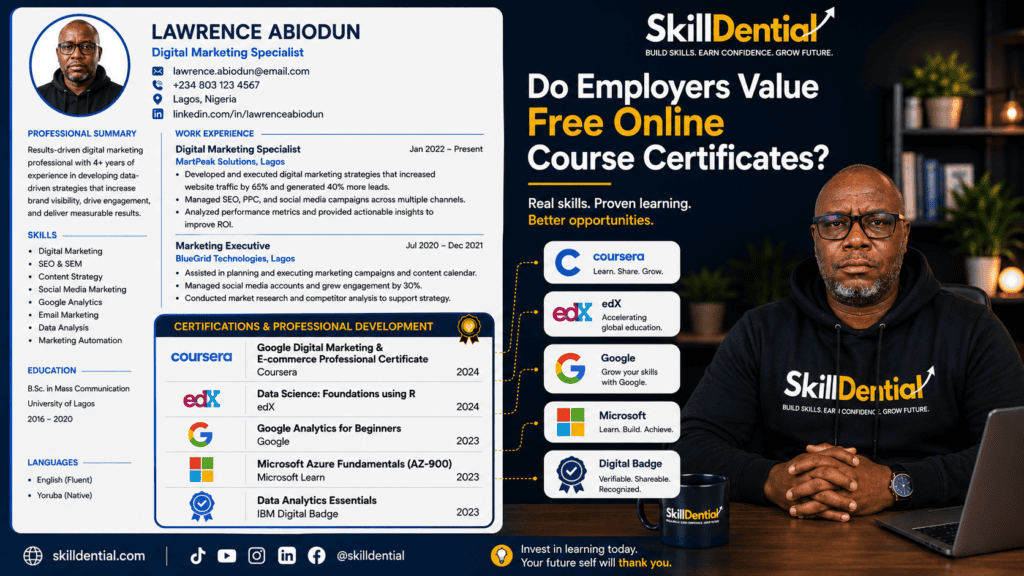
- Section Placement: Create a dedicated section titled “Certifications & Professional Development” or “Technical Certifications.” Never list free online course certificates under your formal “Education” section alongside university degrees, which can be interpreted as intentionally misleading.
- Formatting Structure: For each entry, list the certificate name, issuing organization (specifying both the platform and the creator, such as Google via Coursera), and the completion date (month and year).
- Selection Limit: Curate aggressively. Restrict your resume to the 3 to 5 most relevant free online course certificates that directly match the requirements of the role you are targeting.
Example Format:
- Google Data Analytics Professional Certificate – Coursera (Google), June 2026
- CPD-Accredited Diploma in Customer Care – Alison, March 2026
On Your LinkedIn Profile
Leverage LinkedIn’s dedicated infrastructure to make your credentials easily verifiable for recruiters and hiring managers.
- Section Placement: Add your credentials directly to the official Licenses & Certifications section.
- Data Fields to Complete: Include the exact certificate name, issuing organization, issue date, and—critically—the credential URL or verification link so recruiters can click through to authenticate the badge.
- Contextual Integration: Use your About summary or specific Experience bullet points to highlight how you actively applied the knowledge gained from these courses to build real projects or solve practical problems.
Common Resume and LinkedIn Mistakes to Avoid
Protect your professional credibility by steering clear of these frequent pitfalls:
- Badge Stuffing: Overloading your profile with dozens of unrelated, random certificates, which signals unfocused distraction rather than strategic upskilling.
- Inflated Equivalency: Implying that a self-paced completion certificate carries the weight of a formal degree, state license, or rigorous proctored industry certification.
- Orphaned Credentials: Listing free online course certificates without anchoring them to a project, portfolio piece, or measurable outcome.
- Vague Naming: Using ambiguous labels like “Online Course” without explicitly naming the platform, issuer, and specific skill acquired.
Free certificates in the Nigerian and African job market context
Navigating the Nigerian and African job markets requires shifting away from credentialism toward demonstrable value creation. While formal university degrees still hold traditional prestige in Nigeria—particularly in legacy sectors like banking, oil and gas, and public administration—they no longer guarantee employment amid high graduate unemployment rates.
In this landscape, free online course certificates serve specific, high-impact strategic functions for local and global job seekers:
- Overcoming Local Degree Deficits: Nigerian employers across tech, fintech, telecommunications, and modern services increasingly recognize that traditional university curricula lag behind industry tools. Earning credentials from recognized global platforms bridges the gap between academic theory and immediate workplace requirements.
- Unlocking Remote Work and Global Gigs: For professionals targeting remote international roles, freelancing, or fast-growing African startups (such as Flutterwave, Paystack, or Andela), formal local degrees carry less weight than a verified portfolio. Free online course certificates act as baseline indicators of digital literacy, allowing candidates to bypass initial automated resume screens.
- Signaling Drive in Hyper-Competitive Pools: With hundreds of applicants competing for single entry-level roles in Lagos, Nairobi, or Accra, certificates from platforms like Coursera, edX, or Google demonstrate personal agency, resourcefulness, and a commitment to continuous self-improvement.
How to Maximize Free Certificates in the Local Market
- Pair Credentials with Practical Local Context: A data analysis or digital marketing certificate gains immense weight when applied to local market datasets or Nigerian consumer behavior. Building a portfolio project analyzing local fintech adoption or e-commerce trends proves you can execute, not just watch videos.
- Target High-Demand Sectors: Focus your certificate acquisition on sectors with acute talent shortages where employers prioritize practical skill over pedigree—such as cloud computing, data analytics, product management, and digital growth marketing.
- Leverage Professional Networks Strategically: Share your completed projects and verified badges on LinkedIn and local professional communities, tagging mentors or industry practitioners to build visibility beyond standard job boards.
Ultimately, Nigerian and African employers care about what you can build, fix, or optimize. Use free online course certificates as the foundation, but let your portfolio and execution track record close the hire.
Practical checklist: before you start a free online certificate
Ensure every hour you invest in upskilling yields maximum career returns by running potential credentials through this pre-enrollment audit.
Verify that your chosen program meets the following criteria before committing your schedule:
- [ ] High-Credibility Issuer: The issuing body is a recognized university, major tech enterprise, or established professional platform (e.g., Coursera, edX, Google, Microsoft, HubSpot, Alison).
- [ ] Active Assessment Mechanisms: The curriculum includes graded quizzes, coding challenges, or capstone projects rather than passive video-watching.
- [ ] Market Relevance: The hard skills and tools taught match the recurring requirements found in active job descriptions for your target roles.
- [ ] Verifiable Credentialing: The program issues a secure digital badge, certificate ID, or public verification link that recruiters can independently authenticate.
- [ ] Realistic Time Commitment: You can realistically balance the weekly workload within your current schedule without burning out or abandoning existing commitments.
- [ ] Execution Plan: You have a dedicated plan to build at least one practical project, case study, or portfolio asset using the knowledge gained.
If you answer “no” to several of these checkpoints, pivot toward a higher-leverage alternative that guarantees both learning and tangible proof of execution.
Do free online course certificates look bad on a resume?
No, provided they originate from credible providers and are categorized correctly. They signal proactive initiative, modern skill acquisition, and a dedication to continuous professional growth. Negative perceptions only arise when candidates pad their resumes with dozens of unverified credentials, present completion badges as formal degrees, or fail to back them up with actual project execution.
Are Google Career Certificates worth it for job seekers?
Yes, particularly for entry-level professionals and career changers breaking into technical fields. Data indicates that a significant majority of graduates experience positive career outcomes—such as job placement, promotions, or salary increases—within six months of completion, backed by an employer consortium of major global companies that consider certificate holders for open roles. They deliver maximum value when paired with a public portfolio and targeted applications.
Can free online course certificates replace a degree or professional certification?
No. Free course completion certificates cannot substitute for accredited academic degrees or rigorous, proctored industry certifications (such as a CPA, AWS Solutions Architect, or CompTIA Security+). They function best as tactical supplements that demonstrate specific technical proficiencies and continuous upskilling.
How many certificates should I put on my resume?
Prioritize quality over volume. Listing 3 to 5 of your most relevant free online course certificates that directly align with the requirements of your target role is optimal. Avoid listing an exhaustive inventory of unrelated courses.
Do employers in Nigeria and Africa value online certificates?
Yes, particularly across technology, fintech, digital marketing, and modern service sectors where traditional university curricula often lag behind industry tooling. While legacy industries still weigh formal degrees heavily, employers across the continent increasingly prioritize practical ability, problem-solving, and demonstrable portfolios over credentials alone.
In Conclusion
Employers value free online course certificates not for their price tag or completion badge, but for the credibility of the institution behind them and the practical capabilities they represent. A certificate functions as a tactical signal of initiative, but it will never replace rigorous industry certifications, formal academic degrees, or proven execution.
Succeeding with alternative credentials requires strategic alignment. Target programs from recognized platforms and tech leaders like Google, Microsoft, Coursera, or edX that map directly to the requirements of your target role. More importantly, always pair your credentials with tangible proof—such as GitHub repositories, portfolio dashboards, or applied case studies—that demonstrate you can execute the work independently.
Structure your profile cleanly by placing your top three to five relevant free online course certificates in a dedicated professional development section rather than inflating your formal education. By shifting your focus from collecting passive certificates to building verifiable proof of skill, you transform online learning into genuine hiring leverage.
Take immediate action by selecting one target role, analyzing two active job descriptions to isolate the most critical required skills, and choosing a single credible free online course certificate that bridges that gap—backed by a concrete plan to build and publish your first project.