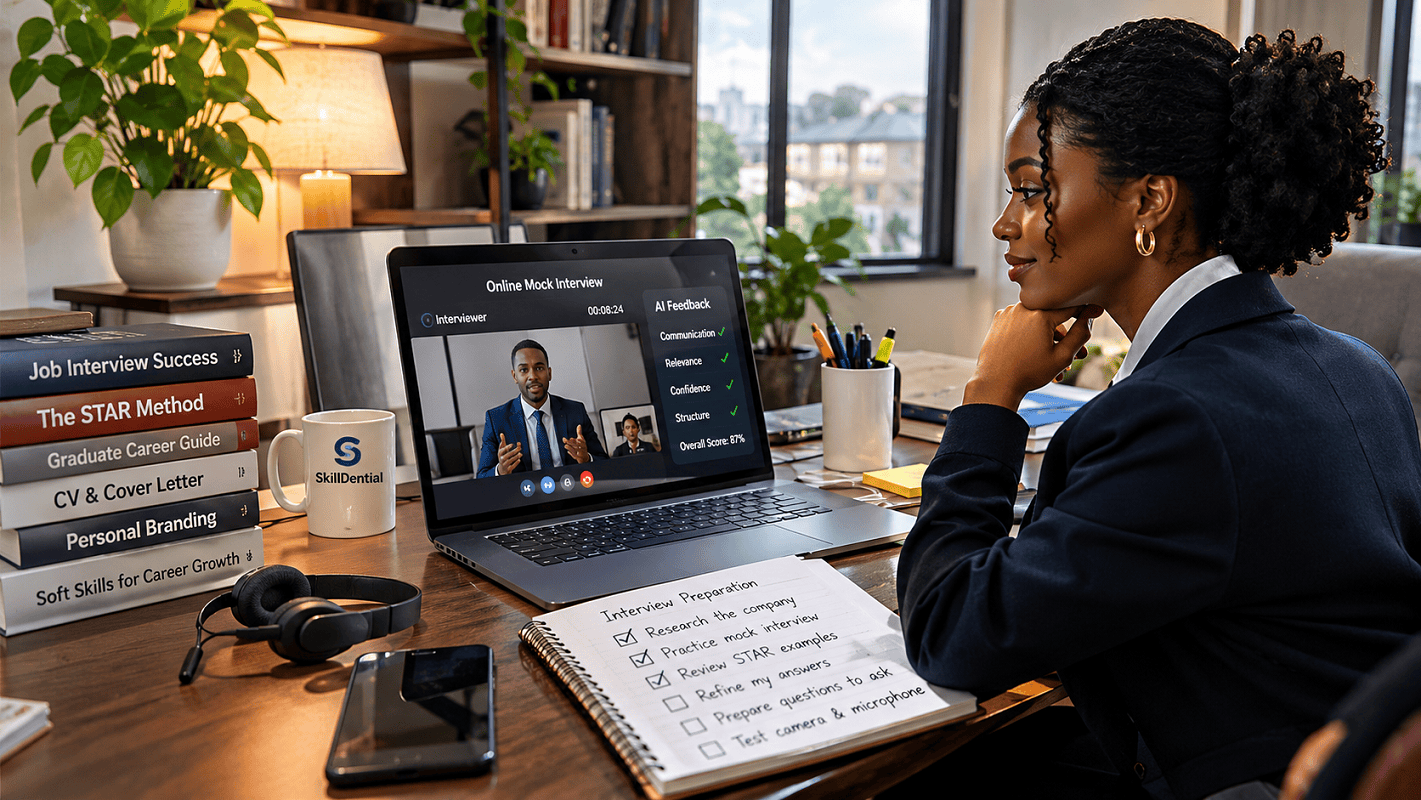
Entering the job market as a graduate with limited professional experience is a distinct hurdle. You may possess strong academic qualifications, relevant projects, and high enthusiasm, yet still experience friction when an interviewer asks you to handle behavioral scenarios, walk through technical problems, or articulate your core competencies under pressure.
Waiting for a live interview to uncover communication gaps or hesitation is a high-cost strategy. To bridge this gap, online mock interview practice tools provide a controlled, low-stress environment to simulate real interview formats, refine your delivery, and benchmark your answers before stakes are high.

These platforms range from automated systems that evaluate your cadence and content to peer networks and expert-led coaching ecosystems. Selecting the right platform depends heavily on your target role, interview format, budget, and the granularity of feedback you require.
In this guide, we break down the 15 best online mock interview practice tools for graduates, categorizing them into AI-powered simulators, peer-to-peer platforms, technical preparation suites, and coaching services. For each tool, we analyze core features, ideal user profiles, and potential limitations so you can build an efficient, high-leverage interview prep system.
Quick Comparison: Best Online Mock Interview Practice Tools
The table below provides a high-level overview of the top platforms covered in this guide, categorized by their primary use case and practice format.
| Tool | Best For | Practice Format |
| Big Interview | Structured interview preparation | Video and AI practice |
| Shortlist.Me | Graduate interview preparation | Recorded video |
| Huru | AI-powered interview feedback | AI simulations |
| Yoodli | Communication and speaking skills | AI roleplay |
| Teal | Job-specific interview practice | AI simulations |
| Careerflow | Role-specific AI practice | AI simulations |
| Final Round AI | Multiple interview formats | AI simulations |
| Aced | Peer-to-peer interview practice | Live interviews |
| interviewing.io | Technical interviews | Expert and AI practice |
| InterviewBuddy | Expert-led interview coaching | Live interviews |
| Prepfully | Company-specific preparation | Expert-led interviews |
| CodeSignal | Coding assessments | Technical simulations |
| HackerRank | Software engineering interviews | Coding and AI practice |
| ChatGPT | Custom interview simulations | Text and voice |
| Microsoft Interview Resources | Employer-specific preparation | Guided preparation |
Note: These platforms vary significantly in methodology. While some offer full-cycle interactive simulations, others focus exclusively on asynchronous video responses, technical code execution, peer networking, or human coaching.
Big Interview
- Best for: Structured interview preparation
- Platform Metrics: Over 2,000,000 users
- Website: biginterview.com
Big Interview is a comprehensive online interview preparation platform designed to bridge the gap between theoretical knowledge and live execution. It combines step-by-step instructional modules, extensive question banks, and interactive practice simulations to help graduates systematically build confidence.
The platform is exceptionally well-suited for university students, recent graduates, and career transitioners who want a methodical curriculum rather than just random practice questions.
Core Features
- Guided Interview Lessons: Video-based tutorials teaching proven frameworks (such as the STAR method) for handling behavioral, technical, and situational questions.
- Extensive Question Libraries: Categorized question banks covering specific industries, competencies, and common interview hurdles.
- Recorded Mock Practice: Tools to record, review, and self-critique your video responses.
- Answer Builder: Step-by-step frameworks to help you draft and structure compelling interview responses from scratch.
- PracticeAI Simulator: Generates adaptive, role-specific interview conversations using uploaded job descriptions and résumés, evaluating role alignment, delivery, and clarity (where enabled).
Who Should Use It?
Final-year students and graduates who prefer a structured curriculum—learning interview strategy and techniques before jumping into live practice sessions.
Potential Limitations
- Institutional Dependency: While individual tiers exist, full access to certain premium enterprise or advanced AI features may rely on whether your university career center or alumni network has an active institutional subscription. Always check for institutional access before purchasing out of pocket.
Shortlist.Me
- Best for: Graduate video interview practice
- Website: shortlist.me
Shortlist.Me is a specialized digital platform designed to help candidates master asynchronous—or “one-way”—video interviews, which have become a staple of modern graduate recruitment programmes.
Instead of interacting with a live person or an AI chatbot, candidates are prompted with timed questions on screen and record their video answers under realistic assessment conditions. This format directly prepares applicants for the screening tools used by major corporate employers, consulting firms, and financial institutions.
Core Features
- Asynchronous Video Simulation: Replicates the exact experience of one-way video assessments, requiring you to think on your feet and speak directly to a webcam under time constraints.
- Industry & Employer-Specific Scenarios: Practice paths tailored to specific graduate schemes, corporate internships, and professional sectors.
- Performance Review: Ability to play back your recorded responses to analyze body language, tone, eye contact, and pacing.
- Employer Insights: Built-in guidance detailing what prominent hiring managers and graduate recruiters look for in video submissions.
Who Should Use It?
Graduates and students preparing for corporate graduate schemes, structured internships, and automated video screening rounds who need to overcome camera shyness and master timed delivery.
Potential Limitations
- Institutional Access Model: Similar to other enterprise tools, access often depends on subscriptions provided through partner universities or career services. It is worth checking your institutional portal before securing an individual license.
Huru
- Best for: AI-powered interview feedback
- Website: huru.ai
Huru is an advanced AI-powered interview preparation platform designed to help job seekers rehearse interview scenarios and refine their responses through automated diagnostics. By leveraging AI to simulate realistic interview dynamics, Huru provides a scalable way to integrate online mock interview practice tools into your daily preparation routine without needing human partners.
The platform allows you to target specific career paths or upload custom job descriptions to generate tailored question sets. As you answer aloud and record your responses, the system analyzes your performance across multiple dimensions.
Core Features
- Role-Specific & Custom AI Questions: Generate targeted question sets tailored to specific professions, industries, or pasted job descriptions.
- Live AI Simulations: Engage in conversational mock interviews where the AI asks follow-up questions dynamically based on your previous answers.
- Granular Performance Metrics: Automated feedback evaluating your response relevance, structural clarity, impact, specificity, and vocal delivery.
- Unlimited Practice Environment: Accessible structure allowing graduates to iterate on weak answers repeatedly until delivery feels natural.
Who Should Use It?
Graduates who want to practise independently, receive instant structural feedback, and leverage online mock interview practice tools without the scheduling friction of human-led sessions.
Potential Limitations
- Automated Scoring Variance: AI evaluations serve as coaching guides rather than definitive predictors of hiring success. Always cross-reference the feedback with core job requirements and human intuition.
Yoodli
- Best for: Communication and speaking skills
- Website: yoodli.ai
Yoodli is an AI-powered communication coaching and roleplay platform that helps candidates improve how they articulate their thoughts during professional interactions. For recent graduates, mastering delivery, confidence, and clarity through online mock interview practice tools is often just as critical as having the correct technical answers.
Rather than focusing purely on résumé alignment, Yoodli evaluates your verbal performance, helping you break down interview anxiety and refine your spoken delivery.
Core Features
- AI-Powered Interview Roleplay: Engage in realistic, interactive interview simulations with dynamic, contextual follow-up questions.
- Delivery & Pacing Metrics: Deep analysis of your speech patterns, tracking speaking speed, pauses, and clarity.
- Filler Word Tracking: Identifies subconscious crutches (such as “um,” “like,” or “you know”) to help you project greater poise.
- Custom Scenarios: Tailor practice prompts to match behavioral questions or high-stakes presentation formats.
Who Should Use It?
Graduates who experience interview nervousness, speak too quickly under pressure, rely on excessive filler words, or want to ensure their communication sounds polished and authoritative.
Potential Limitations
- Broad Scope: Because Yoodli is a general communication coach rather than a dedicated recruiter tool, it lacks native applicant tracking integration. Candidates should pair it with other online mock interview practice tools to ensure they are covering industry-specific content alongside communication mechanics.
Teal
- Best for: Interview practice linked to job applications
- Website: tealhq.com
Teal is a comprehensive career management and job search platform that bridges the gap between application tracking and interview preparation. By integrating online mock interview practice tools directly into your active job hunt, Teal allows you to transition seamlessly from tracking positions to rehearsing for them without switching ecosystems.
The platform’s Interview Practice Hub is designed around the specific roles you are targeting, ensuring your preparation is tied directly to real-world job descriptions rather than generic question banks.
Core Features
- Job Application Integration: Automatically pulls details from your saved job tracker to ground your mock interviews in actual job descriptions and requirements.
- Mock & Coaching Modes: Choose between a strict simulation mode to test your readiness or a coaching mode that offers guidance as you work through questions.
- Dynamic AI Interviewer: Generates targeted questions and adaptive follow-ups based on the specific role.
- Review Transcripts & Recordings: Complete post-session breakdown with full text transcripts and video/audio recordings to evaluate your delivery.
Who Should Use It?
Graduates managing multiple simultaneous job applications who want to keep their resume tracking, pipeline management, and interview preparation organized in one unified platform.
Potential Limitations
- Tiered Access Restrictions: While Teal offers a robust free tier, its advanced features and practice limits apply restrictions. Free users are typically capped at a limited number of practice sessions (such as two free sessions), requiring an upgrade to Teal+ for unlimited mock interview practice.
Careerflow
- Best for: Role-specific AI practice
- Website: careerflow.ai
Careerflow is an end-to-end career optimization and job search platform featuring a powerful AI mock interview tool. It is engineered to help applicants move away from generic question banks by grounding their practice in actual job listings and target company profiles.
By integrating online mock interview practice tools directly into your broader career management workflow, Careerflow ensures every practice session simulates the exact competencies required for your specific career path.
Core Features
- Role & Company Customization: Configure your practice sessions based on specific job titles, target companies, and industry standards.
- Résumé & JD Integration: Upload your résumé alongside a target job description to generate high-relevance behavioral, technical, and mixed interview scenarios.
- Dynamic Follow-Up Questions: The AI interviewer adapts in real time, probing deeper into your initial answers just like a human hiring manager would.
- Performance Insights: Detailed automated feedback evaluating response clarity, confidence, keyword utilization, and thematic relevance.
Who Should Use It?
Graduates who want to align their online mock interview practice tools directly with specific job applications, ensuring they rehearse the exact skills demanded by their target employers.
Potential Limitations
- Subscription Gates: While Careerflow offers valuable freemium features, many advanced AI practice capabilities and deep analytics require a paid subscription. Be sure to check the current pricing tiers and feature gates before relying on it as your primary prep suite.
Final Round AI
- Best for: Different interview formats
- Website: finalroundai.com
Final Round AI is an advanced career platform featuring Interview CoPilot, designed to support candidates through every stage of the hiring pipeline. It stands out by accommodating a wide range of specialized professional evaluation formats that go far beyond standard behavioral Q&A.
For graduates targeting competitive sectors like technology, product management, and quantitative data analysis, the platform provides tailored simulation environments for multi-stage hiring tracks.
Core Features
- Diverse Interview Scenarios: Supports specialized formats including technical coding, system design, product case studies, data/ML evaluations, recruiter screenings, and traditional behavioral rounds.
- Context-Aware Practice: Links your practice sessions directly to a unified profile containing your specific career goals, résumé, and target job descriptions.
- Post-Interview Debriefs: Automated analytics following each session that isolate weak points and generate targeted re-drill targets.
- Real-Time CoPilot Integration: Offers advanced assistance tools designed to help streamline performance across various remote video environments.
Who Should Use It?
Graduates applying for technology, product management, engineering, and data roles who need experience with rigorous, multi-format technical interview styles.
Potential Limitations
- Subscription Requirements: While basic preparation tracking and material setup are accessible, live practice sessions and interactive mock modules require an active paid subscription tier. Be sure to evaluate your budget against the platform’s pricing model before mapping it out as your primary test-prep engine.
Aced
- Best for: Peer-to-peer mock interviews
- Website: aced.io/practice (formerly Exponent)
Aced (built on the Exponent ecosystem) takes a collaborative approach to interview readiness by combining peer-to-peer mock interviews with AI-supported preparation. Instead of relying solely on automated chatbots, the platform connects candidates with other professionals and graduates preparing for similar roles, allowing them to take turns acting as the interviewer and interviewee.
This two-sided format gives applicants a realistic feel for live human pacing, unexpected follow-up questions, and interpersonal dynamics that static AI models often miss.
Core Features
- Live Peer-to-Peer Matching: Automated pairing system that matches you with fellow job seekers targeting similar industries and seniority levels.
- Dual-Perspective Practice: Gain insights by experiencing both sides of the table—evaluating peers sharpens your own critical eye for spotting effective answer structures.
- Collaborative Coding & Case Environments: Built-in shared whiteboards and code editors tailored for technical and product management rounds.
- Diverse Track Support: Practice paths spanning behavioral questions, product management cases, data structures and algorithms, system design, finance, and data science.
Who Should Use It?
Graduates who want to complement their use of online mock interview practice tools with live, human-to-human conversation, enabling them to build social confidence and handle unpredictable interview dynamics.
Potential Limitations
- Scheduling Coordination: Because sessions rely on live human participants, you must coordinate schedules and commit time to interviewing others in return for feedback. Additionally, premium features and expert coaching upgrades require a paid membership.
interviewing.io
- Best for: Software engineering interviews
- Website: interviewing.io
interviewing.io is a specialized technical interview preparation platform designed primarily for software engineers, data scientists, and computer science graduates aiming for roles at top-tier technology companies.
Setting itself apart from general online mock interview practice tools, the platform connects applicants with seasoned engineering interviewers—including hiring managers and senior developers from major tech firms—who provide unfiltered, anonymous feedback. For candidates looking for lower-stakes introductory practice, the platform also features an automated AI technical interviewer for coding and system design tracks.
Core Features
- Anonymous Expert Mocks: Conduct rigorous live technical interviews with real industry insiders without exposing your identity, removing hiring bias from the practice loop.
- Specialized Technical Tracks: Dedicated practice environments for data structures and algorithms, system design, machine learning engineering, and behavioral assessment.
- Flexible Practice Options: Switch between human-led expert sessions and on-demand AI interview simulations for coding and design challenges.
- Detailed Replay & Analytics: Review comprehensive performance reports, transcripts, and session replays to spot architectural or algorithmic blind spots.
Who Should Use It?
Computer science graduates, software developers, and technical candidates targeting competitive engineering roles at high-growth tech firms or major enterprises.
Potential Limitations
- Highly Niche Focus: Because the platform is built strictly for technical and engineering pipelines, it is unsuitable for graduates preparing for general business, healthcare, creative, or administrative careers. Additionally, live sessions with senior industry experts carry premium pricing.
InterviewBuddy
- Best for: Expert-led interview coaching
- Website:interviewbuddy.net
InterviewBuddy moves beyond automated chatbots and asynchronous software by offering live, one-on-one mock interview sessions with industry professionals and seasoned hiring managers.
For graduates who have already ironed out their basic delivery using automated platforms, incorporating human insight from online mock interview practice tools with real industry veterans is an effective way to test how you handle unexpected follow-up questions, industry-specific pressure, and complex human dynamics.
Core Features
- Live 1:1 Simulated Interrogations: Replicates high-stakes interview pressure through live video sessions with real professionals from your target field.
- Role-Specific Expert Matching: Select your industry, track, or specific job function to get paired with an interviewer who understands the nuances of the role.
- Comprehensive Performance Scorecards: Detailed post-session evaluations highlighting your communication clarity, structural coherence, and technical depth.
- Session Recordings & Replays: Full video playback options allowing you to study your body language and review the coach’s verbal advice.
Who Should Use It?
Graduates who have already practiced independently using automated systems and want granular, human-led critique from experienced professionals before walking into real hiring loops.
Potential Limitations
- Paid Expert Sessions: Unlike automated software with free tiers, human-led coaching requires session-based or package purchases. Be sure to review coach bios, session costs, and cancellation terms before booking your slot.
Prepfully
- Best for: Company-specific interview preparation
- Website: prepfully.com
Prepfully is a comprehensive interview preparation platform that connects candidates directly with industry professionals who have inside experience at specific high-profile companies and specialized job functions.
Rather than relying entirely on generic question banks, Prepfully allows graduates to ground their online mock interview practice tools and coaching sessions in the actual hiring standards, rubrics, and cultural nuances of their target organizations—whether they are gunning for top-tier consulting firms, major tech companies, or elite financial institutions.
Core Features
- Company-Insider Coaching: Book mock interviews with coaches who currently work or have previously worked at your exact target companies.
- Targeted Role Simulations: Access specialized interview formats for product management, software engineering, investment banking, consulting case studies, and marketing.
- Personalized Advice & Feedback: Receive granular, actionable feedback tailored to how specific corporate recruitment committees evaluate candidates.
- Supplementary Prep Resources: Extensive company guides, interview teardowns, and preparation frameworks built by industry veterans.
Who Should Use It?
Graduates preparing for highly competitive corporate positions where deep familiarity with company-specific interview formats, cultural values, and evaluation frameworks is critical to passing the screen.
Potential Limitations
- Paid Expert Model: Live sessions with company insiders are premium, paid services rather than free automated tools. Additionally, the quality and style of the session depend heavily on the specific coach you choose, making careful profile and review vetting essential before booking.
CodeSignal
- Best for: Technical assessment practice
- Website: codesignal.com
CodeSignal is an industry-leading technical assessment and skill-evaluation platform widely used by top technology companies to vet software engineering candidates. Rather than focusing on conversational or behavioral Q&A, CodeSignal is built to test practical programming proficiency, algorithm design, and problem-solving execution under realistic evaluation constraints.
For computer science graduates and aspiring software developers, mastering the platform’s assessment environment is critical, as many major employers use its standardized tests (such as the General Assessment) as an automated initial screening filter before inviting candidates to live loops.
Core Features
- Standardized Technical Assessments: Practice environments that mimic the actual automated coding tests used by corporate engineering recruiters.
- Comprehensive Coding Practice Library: Thousands of programming challenges ranging from basic data structures to complex algorithmic problem-solving.
- Multi-Language Support: Write, execute, and test code across a wide variety of modern programming languages.
- Integrated Development Environment (IDE): Real-time code execution, syntax highlighting, and debugging features within a browser-based IDE.
Who Should Use It?
Computer science graduates, bootcamp alumni, and aspiring software engineers preparing to pass rigorous automated technical screening tests and live coding rounds.
Potential Limitations
- Strictly Technical Focus: CodeSignal is purpose-built for hard coding and software engineering assessments. It does not provide behavioral interview practice, situational Q&A, or general communication coaching, meaning it must be paired with other online mock interview practice tools to cover non-technical hiring rounds.
HackerRank
- Best for: Software engineering preparation
- Website: hackerrank.com
HackerRank is one of the most widely adopted technical assessment platforms in the global tech industry, serving both as a vetting tool for enterprise employers and a rigorous training ground for developers.
While many online mock interview practice tools focus heavily on conversational behavioral tracks, HackerRank specializes in hard-skills mastery, offering an extensive library of data structures, algorithms, system design challenges, and structured preparation kits. It bridges the gap between theoretical computer science education and practical, timed code execution.
Core Features
- Software Engineer Prep Kits: Curated, structured learning paths covering core programming domains including arrays, sorting, dictionaries, strings, graphs, trees, and dynamic programming.
- Timed Mock Tests: Simulated technical assessment environments designed to replicate high-pressure coding challenges used in corporate recruitment pipelines.
- AI-Powered Mock Interviews: Interactive AI features (available on eligible preparation tiers) that guide candidates through technical problem-solving and provide automated feedback.
- Skill Certifications: Verified certifications that graduates can display on their résumés and LinkedIn profiles to prove foundational coding proficiency to recruiters.
Who Should Use It?
Computer science graduates, aspiring software engineers, and technical applicants preparing to ace automated coding assessments, take-home challenges, and technical screening rounds.
Potential Limitations
- Purely Technical Scope: HackerRank is built entirely around code execution and algorithmic logic. It does not provide behavioral interview practice, situational Q&A, or interpersonal communication coaching, requiring candidates to pair it with complementary tools for non-technical interview rounds.
ChatGPT
- Best for: Flexible, customized interview simulations
- Website: chatgpt.com
While not built exclusively as a recruitment platform, OpenAI’s ChatGPT serves as a highly versatile and customizable AI preparation partner. By leveraging advanced language processing and voice conversation features, graduates can use it as one of the most flexible online mock interview practice tools available to simulate unique interview scenarios on demand.
Whether you are breaking into an unfamiliar industry, testing out unconventional career paths, or needing a quick round of behavioral drills, ChatGPT adapts instantly to your exact prompts and requirements.
Core Features
- Real-Time Voice Conversations: Practice speaking your answers aloud with natural back-and-forth dialogue rather than typing out responses.
- Infinite Customization: Tailor the persona, industry strictness, company culture, and difficulty level of your interviewer instantly via text prompts.
- Behavioral & Competency Drills: Test your ability to structure stories using frameworks like the STAR method with immediate structural feedback.
- Iterative Follow-Ups: Ask the AI to probe deeper into your weaknesses, suggest alternative phrasing, or rephrase questions to test your agility.
Who Should Use It?
Graduates who want an adaptable, on-demand practice partner that can mold itself to hyper-specific job descriptions, unconventional career paths, or quick iteration loops without subscription caps.
Potential Limitations
- General-Purpose AI: Because ChatGPT is not a dedicated recruitment tool, it lacks native applicant tracking, video recording analytics, or standardized scoring rubrics used by corporate hiring platforms. Its feedback reflects general AI training rather than proprietary employer evaluation criteria.
Recommended Starter Prompt
Copy and paste this prompt into ChatGPT to kick off your first custom simulation:
Act as an experienced recruitment interviewer. I am a recent graduate preparing for an entry-level [job title] position. Conduct a realistic mock interview, asking one question at a time. Include behavioural, competency-based, situational, and role-specific questions.
Wait for my response before asking the next question. After each answer, evaluate its relevance, clarity, structure, and use of evidence. Give me constructive feedback and suggest how I can improve without inventing experience or achievements.
Microsoft Careers Interview Resources
- Best for: Employer-specific preparation
- Website: careers.microsoft.com
When preparing for an interview with a specific enterprise employer, official recruitment guides and documentation can offer insights that generic platforms miss. Microsoft Careers provides targeted guidance specifically built for students, interns, and early-career applicants navigating their hiring pipeline.
Rather than offering an automated simulator, these resources break down what recruiters and hiring managers look for during virtual interviews, ensuring your online mock interview practice tools align with actual corporate expectations.
Core Features
- Early-Career Recruitment Guidance: Tailored advice for university students, recent graduates, and entry-level applicants breaking into the tech industry.
- Virtual Interview Preparation: Actionable instructions on how to set up your environment, manage remote communication, and present yourself effectively over video.
- Role-Specific Evaluation Standards: Detailed breakdowns of how different positions are assessed—covering coding challenges, project portfolio reviews, and technical problem-solving.
- Insider Recruiter Tips: Direct guidance from Microsoft employees and recruiters detailing what separates a strong candidate from a weak one.
Who Should Use It?
Graduates and students actively applying for internships, graduate schemes, or early-career roles directly within Microsoft.
Potential Limitations
- Highly Employer-Specific: These materials are optimized exclusively for Microsoft’s hiring ecosystem. They do not function as general-purpose mock interview simulators and must be supplemented with other tools if you are applying across multiple companies.
How to Choose the Right Online Mock Interview Practice Tool
With a wide array of options available, selecting the right preparation stack can feel overwhelming. However, you do not need a dozen active subscriptions to become interview-ready. The most efficient approach starts by mapping your specific target role against the precise type of feedback you require.
Use the framework below to narrow down your selection:
| Your Preparation Need | Recommended Tools |
| General graduate interviews | Big Interview, Huru |
| AI-powered interview practice | Huru, Teal, Careerflow |
| Video interview confidence | Shortlist.Me, Big Interview |
| Communication and speaking skills | Yoodli |
| Live practice with another candidate | Aced |
| Technical and coding interviews | CodeSignal, HackerRank |
| Experienced interviewer feedback | InterviewBuddy, Prepfully |
| Company-specific preparation | Prepfully, Microsoft Careers |
| Custom interview simulations | ChatGPT, Final Round AI |
AI Mock Interviews vs. Human Mock Interviews
Both AI-driven platforms and human-led coaching serve distinct functions in a high-leverage preparation workflow.
| Consideration | AI Mock Interviews | Human Mock Interviews |
| Availability | On-demand, instant access | Requires scheduling |
| Practice Frequency | Easily repeated multiple times daily | Limited by time and cost |
| Feedback Type | Automated diagnostic metrics and analytics | Personalized, contextual human insights |
| Interview Realism | Simulated text or voice conversation | Natural, unpredictable human interaction |
| Cost Profile | Typically free tiers or flat subscriptions | Session-based fees |
| Follow-Up Depth | Rule-based or generative AI follow-ups | Complex human judgment and situational intuition |
Strategic Recommendation
For optimal career results, combine both methodologies.
Utilize automated online mock interview practice tools for high-frequency, daily repetition to iron out basic delivery mechanics, refine your STAR stories, and eliminate filler words. Then, schedule at least one live human simulation—whether through a peer network like Aced, a career advisor, or an expert coach—before entering a high-stakes final hiring loop.
AI excels at exposing patterns in your answers, but human interaction remains irreplaceable for understanding how your executive presence and communication style translate in a live professional environment.
How Graduates Can Practise for Job Interviews Online
Having access to the right online mock interview practice tools is only the foundation. To translate simulated practice into real-world job offers, you need a disciplined, repeatable framework that bridges the gap between preparation and live execution.
Here is a practical six-step process graduates can use to structure their interview preparation effectively:
Step 1: Find a Real Job Description
Never practise in a vacuum. Start by sourcing an active position you genuinely intend to apply for. Carefully review the job listing and isolate:
- Required technical and professional skills.
- Main responsibilities and day-to-day expectations.
- Desired personal qualities and cultural indicators.
- Communication and collaboration requirements.
Using live job descriptions ensures your practice sessions are anchored to actual market demands rather than abstract preparation questions.
Step 2: Identify Your Strongest Examples
A common barrier for graduates is the concern over limited professional experience. However, corporate interviewers do not expect multi-year employment histories from entry-level candidates. You can source powerful competency examples from:
- University capstone or group projects.
- Industrial attachments, internships, or co-ops.
- Student leadership roles and campus organizations.
- Voluntary initiatives and community work.
- Research assignments and freelance projects.
Example: If an interviewer asks how you handled a conflict, you can draw from a stressful university group assignment where you managed deadline friction or reallocated tasks—focusing entirely on your specific contribution and agency.
Step 3: Prepare Answers Using the STAR Method
The STAR method provides an objective, structured framework for delivering behavioral and situational responses without rambling.
- Situation: Set the context and background of the challenge.
- Task: Define your specific responsibility, objective, or hurdle.
- Action: Detail the concrete steps you took to resolve the issue.
- Result: Quantify the outcome, what you delivered, and what you learned.
Hypothetical Example:
- Question: “Tell me about a time you worked with a team to complete a challenging task.”
- Situation:During my final-year software engineering capstone project, our team faced a compressed timeline to deliver our prototype.
- Task:I was tasked with coordinating code integration and managing version control issues.
- Action:I instituted daily stand-up checks, set up automated testing scripts, and established a clean branch merging protocol.
- Result:We shipped our MVP 48 hours ahead of schedule and achieved the highest presentation grade in our cohort.
This structure is infinitely more persuasive than making vague assertions like “I am a dedicated team player.”
Step 4: Practise Answering Questions Aloud
Reading model answers in your head creates a false sense of security. You must train your vocal cords, pacing, and cognitive reflexes. Use your chosen online mock interview practice tools to rehearse out loud.
Incorporate standard baseline questions into your daily drills:
- Tell me about yourself.
- Why are you interested in this position?
- What are your greatest professional strengths?
- Describe a challenging project you completed.
- How do you handle disagreements within a team?
- What motivates you professionally?
- Why should we consider you for this position?
- Where do you see yourself in five years?
- What do you know about our organization?
- What would you like to accomplish in your first 90 days?
Always record your sessions when video or audio playback is available. Reviewing your own tape will instantly expose verbal crutches and poor posture that you cannot detect while speaking.
Step 5: Review Your Feedback and Improve
After completing a practice module, rigorously audit your results. Look beyond automated scoring metrics and evaluate:
- Did you directly answer the core question asked?
- Were your examples specific and evidence-backed?
- Did you maintain a steady cadence, or did you speak too quickly under pressure?
- Did you rely excessively on filler words (“um,” “like,” “you know”)?
Treat AI and diagnostic feedback as coaching indicators rather than absolute truths. Iterate on weak answers until your delivery sounds natural, confident, and professional.
Step 6: Simulate the Complete Interview Environment
Before walking into a live hiring loop, execute a full, end-to-end dress rehearsal. Treat your practice session exactly like the real recruitment event:
- Dress in professional interview attire.
- Test your internet bandwidth, microphone, and webcam positioning.
- Ensure your environment is quiet, clean, and well-lit.
- Keep your résumé, portfolio links, and notes accessible off-camera.
- Prepare 2 to 3 intelligent questions to ask the interviewer at the end of the session.
Eliminating technical and environmental friction during rehearsal ensures you can focus 100% of your cognitive energy on your core message when it matters most.
A Practical Seven-Day Mock Interview Preparation Plan
If you have an upcoming hiring loop, structured repetition beats cramming. You do not need to spend hours every single day memorizing rigid scripts; consistent, focused practice blocks will yield far better results.
Here is a high-leverage, seven-day schedule designed to take you from initial research to full interview readiness:
| Day | Preparation Activity | Expected Outcome |
| 1 | Research the employer and job description | Deeply understand the role, core competencies, and cultural expectations. |
| 2 | Prepare common interview answers | Build a versatile core answer bank (background, strengths, motivations). |
| 3 | Practise behavioural questions using STAR | Improve your answer structure and narrative clarity. |
| 4 | Complete AI mock interview sessions | Identify verbal and structural weaknesses using automated diagnostics. |
| 5 | Practise with a friend or peer | Build conversational adaptability and human-to-human comfort. |
| 6 | Complete a full simulated interview | Establish technical, environmental, and mental interview readiness. |
| 7 | Review feedback and refine answers | Final polish, pacing adjustments, and confidence consolidation. |
Common Mistakes to Avoid When Practising Online
Even with access to the best online mock interview practice tools, certain traps can limit your progress and hinder your performance during live hiring loops. Keep these common pitfalls in mind to ensure your preparation translates into real-world offers:
Memorising Answers Word for Word
Scripting your answers and trying to recite them verbatim creates an unnatural, robotic delivery. When an interviewer asks a slight variation of your prepared question, memorization causes cognitive panic. Instead, memorize the core structure and key data points of your stories, and practise delivering them conversationally in your own words.
Using AI-Generated Answers Without Personalising Them
While AI platforms are exceptional for outlining frameworks (like the STAR method), they cannot manufacture genuine personal experience. If you parrot generic AI responses, interviewers will quickly spot the lack of authentic ownership. Always back up your answers with real projects, internships, or academic examples from your own background.
Practising Only Generic Questions
Generic behavioral questions are important, but every industry has unique evaluation rubrics. A finance graduate will face technical case and market questions that look entirely different from a software engineering live-coding screen or a healthcare administration situational query. Tailor your practice sessions to the specific demands of your target sector.
Ignoring Body Language and Delivery
In virtual and video interviews, technical perfection means little if your non-verbal cues signal discomfort. Poor posture, darting eyes, slouching, and an overly rapid speaking pace can undermine your credibility. Pay attention to how you project confidence through your physical framing and vocal cadence.
Relying Entirely on Automated AI Feedback
AI diagnostic metrics provide useful coaching indicators, but they are not infallible predictors of corporate hiring success. Automated tools measure tone and keyword frequency, but they miss emotional resonance and cultural fit. Balance your automated drills with human critique from mentors, career advisors, or peer networks.
Failing to Research the Employer
No amount of mock interview practice can compensate for a lack of foundational company knowledge. Candidates frequently stumble because they do not understand the target organization’s business model, recent milestones, core values, or the specific expectations of the hiring team. Ground your preparation in deep company research before stepping into any interview room.
What is online mock interview practice?
Online mock interview practice involves using digital platforms, AI interviewers, recorded video sessions, or live conversations with other people to simulate actual job interviews. It allows candidates to practise answering questions, improve communication, and receive feedback before attending real interviews.
Are there free online mock interview practice tools?
Yes. Several platforms offer free access or limited free practice opportunities. Examples include Huru, Careerflow, Aced, and ChatGPT.
Some university career centres also provide access to platforms such as Big Interview and Shortlist.Me. Always check current access conditions, as free features and tier limits can change over time.
Which AI tool is best for practising job interviews?
The best choice depends entirely on your specific preparation needs:
Huru is ideal for structured AI feedback and role-specific simulations.
Yoodli excels at communication and speaking skill coaching.
Teal connects interview practice directly with active job application tracking.
ChatGPT provides flexible, on-demand voice and text customization for unique scenarios.
Can graduates practise interviews without work experience?
Absolutely. Graduates can draw powerful competency examples from university capstone projects, internships, volunteering, student leadership roles, research assignments, and personal projects. The goal is to demonstrate relevant skills, problem-solving abilities, and your specific individual contribution honestly.
How often should I practise for a job interview?
There is no universal number of hours, but consistent, focused sessions over a structured period (such as a seven-day prep plan) yield the best results.
Focus on answering questions aloud, reviewing your video or audio performance, and refining weak responses rather than rushing through high volumes of uncritical repetition.
Is AI mock interview practice better than practising with a real person?
Neither approach is universally superior—they solve different problems. AI is highly convenient for high-frequency repetition, instant structural feedback, and low-stress drills.
Human mock interviews, on the other hand, provide unpredictable interaction, emotional resonance, and deeper contextual observations. Combining both approaches provides the most robust preparation.
Can I use ChatGPT for mock interview practice?
Yes. ChatGPT can simulate an experienced interviewer, generate custom questions based on a target job description, ask adaptive follow-up questions, and evaluate your answer structure.
Its voice-chat capabilities also allow you to practise speaking aloud. However, keep in mind that its feedback is general AI guidance rather than proprietary employer evaluation criteria.
What should graduates prepare before a mock interview?
Before starting any mock session, you should prepare:
The active job description and required competencies.
An updated, polished résumé.
A bank of structured behavioral examples (using the STAR framework).
Responses to common baseline questions (strengths, motivations, career goals).
Two or three intelligent questions to ask the interviewer at the end of the session.
In Conclusion
Preparing for your first professional interview does not have to be an overwhelming hurdle.
Online mock interview practice tools give graduates a controlled, low-stress environment to develop communication skills, refine answer structures, and build familiarity with diverse corporate evaluation formats before facing live hiring managers.
However, having a list of 15 tools does not mean you need to test all of them. Keep your workflow lean and high-leverage:
- Start with one primary AI simulator (such as Huru or Big Interview) for high-frequency repetition and automated feedback.
- Combine it with human interaction—whether through peer networks like Aced or expert coaches—to test your executive presence and conversational adaptability.
- Layer in technical platforms (like CodeSignal or HackerRank) if you are targeting software engineering or technical tracks.
- Ground everything in reality by using live job descriptions and drawing genuine competency examples from your academic projects, internships, and extracurricular leadership.
Your Next Step
Select one tool from this guide that matches your career path, pull up an active job description for a position you genuinely want to land, and complete your first mock interview simulation today.