ElevenLabs vs Murf AI: Which AI Voice Generator Is the Best?
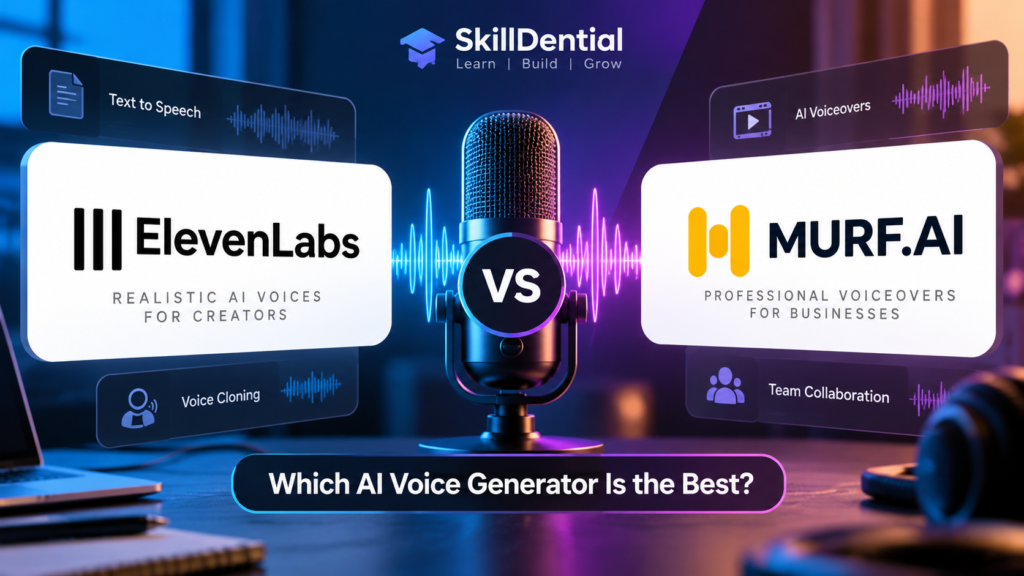
Choosing the best AI voice generator depends heavily on your specific production goals and workflow. ElevenLabs is a powerful option for ultra-realistic, expressive voice cloning and multilingual narration, whereas Murf AI excels at structured business voiceovers, slide presentations, and e-learning content production.
Both solutions convert text into human-like speech, but their underlying architectures, editing suites, and pricing models vary significantly. This analysis evaluates both tools to help you identify the ideal text-to-speech platform for your requirements.
The Evolution of Text-to-Speech Production
Advanced AI voice generators are fundamentally transforming how digital creators, marketing teams, educators, and enterprises produce audio content. Rather than spending hours in a recording booth or hiring external voice actors, users can instantly convert written scripts into natural narration using deep learning models.
When evaluating options for professional audio workflows, ElevenLabs and Murf AI consistently emerge as industry leaders. While both deliver high-grade text-to-speech capabilities, voice customisation, and professional-grade rendering, their core optimization paths differ:
- ElevenLabs prioritizes hyper-realistic acoustic modeling, emotional nuance, complex voice cloning, and API integrations for developers.
- Murf AI focuses on end-to-end voiceover production, robust timeline editing controls, and collaboration workflows tailored for corporate communications and educational modules.
An independent YouTuber seeking cinematic storytelling delivery has vastly different technical requirements than a corporate learning and development team localizing hundreds of training modules. This guide provides a rigorous, feature-by-feature comparison of both platforms to help you make an informed software investment.
At-a-Glance: High-Level Platform Comparison
Before diving into individual features and technical benchmarks, review how these two leading AI voice generators stack up across core performance metrics, workflow capabilities, and publishing use cases.
| Comparison | ElevenLabs | Murf AI |
| Main strength | Realistic and expressive speech | Structured voiceover production |
| Text-to-speech | Yes | Yes |
| Voice cloning | Instant and professional options | Available options depend on product and plan |
| Multilingual generation | Supports dozens of languages across its model family | 35+ languages and accents |
| Voice customisation | Expressive generation and voice controls | Pronunciation, pacing, emphasis, and narration controls |
| Video and presentation workflows | Studio and dubbing tools | Studio, presentation, and video-oriented workflows |
| API access | Yes | Yes |
| E-learning applications | Suitable | Particularly suitable |
| Developer applications | Strong API and conversational AI capabilities | API and real-time voice capabilities |
| Team collaboration | Plan-dependent | Enterprise collaboration features |
| Pricing | Free and paid plans | Free and paid plans |
Feature availability varies by model, product, subscription, and region. Language and accent counts differ across platforms due to model-specific training data and regional localization scopes.
The key distinction isn’t simply which platform has more features. It is which platform makes your intended production process easier.
What Is ElevenLabs?
ElevenLabs is an industry-leading artificial intelligence platform specializing in advanced speech synthesis, hyper-realistic voice cloning, AI dubbing, and conversational voice technologies. As a premier AI voice generator, its core text-to-speech engine transforms written scripts into natural, human-like spoken audio with nuanced emotional delivery.
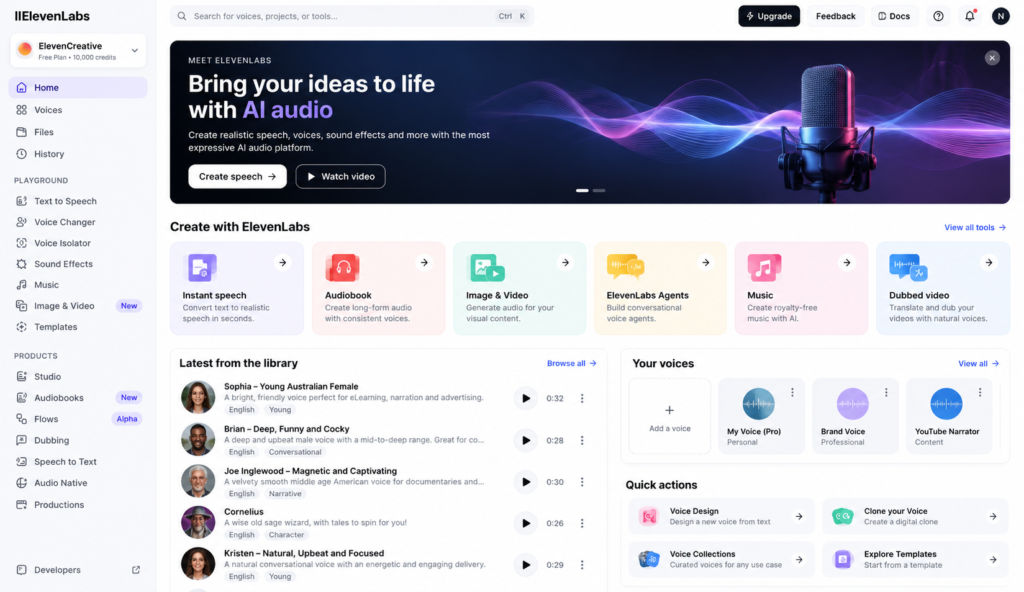
The platform serves creators, enterprises, and developers who need expressive narration or scalable voice duplication. Beyond standard text-to-speech rendering, ElevenLabs offers a comprehensive suite of audio tools, including AI dubbing, speech-to-text, real-time voice changing, and robust API integrations.
Core Features of ElevenLabs
- AI Text-to-Speech: ElevenLabs converts written content into spoken audio using sophisticated deep-learning models. Creators and businesses utilize it to generate narration for:
- YouTube and social media videos
- Podcasts and audiobooks
- E-learning modules and educational courses
- Marketing campaigns and localized digital media
- Advanced Voice Cloning: Voice cloning enables users to replicate a specific voice using reference audio samples. ElevenLabs supports two distinct tiers:
- Instant Voice Cloning (IVC): Quickly generates a digital replica from short audio clips.
- Professional Voice Cloning (PVC): Utilizes extensive training data and strict verification processes to produce ultra-high-fidelity reproductions, subject to platform compliance policies.
- Multilingual Generation: Powered by advanced model architectures (such as the Eleven v4 family), ElevenLabs supports dozens of languages—ranging from major European and Asian languages to African languages like Hausa, Yoruba, and Swahili. This allows global brands and creators to localize content efficiently.
- AI Dubbing: The platform’s dubbing suite translates video and audio files into different languages while preserving the original speaker’s vocal characteristics and tone, streamlining cross-border content distribution.
- Developer API & Conversational AI: Software developers can embed ElevenLabs’ speech-generation pipelines directly into applications, websites, and autonomous AI agents using its high-performance API.
Advantages & Limitations
- Pros: Industry-leading vocal expressiveness and emotional nuance; powerful instant and professional voice cloning; broad multilingual support; robust developer API.
- Cons: Credit-based pricing requires careful volume monitoring; advanced features are restricted to higher-tier plans; generated audio may still require minor manual editing and pacing adjustments.
What Is Murf AI?
Murf AI is a dedicated, production-oriented AI voice generator and voiceover platform designed specifically to help businesses, educators, and creators produce professional narration for videos, slide presentations, training materials, and corporate communications.

Unlike platforms that focus purely on raw speech generation, Murf provides a comprehensive workspace—Murf Studio—that integrates text-to-speech synthesis with precise timeline editing, script organization, and project management tools.
Core Features of Murf AI
- AI Text-to-Speech: Murf converts written scripts into spoken audio using an extensive library of AI voices. Users can filter and select voices based on specific use cases, age brackets, accents, gender presentations, and professional tones, making it ideal for:
- Corporate and client-facing presentations
- E-learning tutorials and instructional videos
- Product demos and marketing explainers
- Internal company communications
- Granular Voice Customization: Murf offers fine-tuned controls that allow creators to manipulate how generated speech sounds. Depending on the voice and subscription tier, users can adjust:
- Pronunciation and word emphasis
- Pacing and speaking speed
- Pauses and pitch, ensuring clarity in instructional materials
- Structured Voiceover Editing Suite: Murf Studio provides a dedicated timeline where scripts and audio blocks sync directly. This allows producers to edit text and automatically update the corresponding audio chunks without having to re-render entire tracks from scratch.
- Presentation & Video Integrations: Murf features built-in integrations designed to streamline multimedia production—such as Canva integrations on selected creator plans and PowerPoint add-ins for enterprise workflows. This significantly cuts down the friction of timing voiceovers to visual slides.
- Team Collaboration & Enterprise Controls: Tailored for organizational scale, Murf offers robust collaboration capabilities. Higher tiers and Enterprise packages include multiple editor seats, centralized administration, single sign-on (SSO), and custom voice cloning options.
Advantages & Limitations
- Pros: Highly structured, user-friendly voiceover studio environment; precise controls for pacing, pronunciation, and emphasis; excellent integrations for presentations and e-learning platforms; strong multi-user collaboration tools.
- Cons: Advanced editing and custom voice features are locked behind higher-tier subscriptions; voice generation limits can restrict heavy, high-volume production projects; individual creators may find enterprise administration tools unnecessary.
ElevenLabs vs. Murf AI: Voice Realism and Acoustic Quality
Voice quality is the single most critical factor when evaluating any AI voice generator. A truly realistic synthetic voice must transcend robotic monotone delivery, accurately capture human cadence, handle complex punctuation, and convey subtle emotional shifts without sounding artificial.
When comparing ElevenLabs and Murf AI, both platforms deliver high-grade audio, but their underlying modeling approaches lead to distinct listening experiences.
Voice Realism Comparison
- ElevenLabs (Leader in Expressive & Emotional Realism): ElevenLabs is widely recognized as an industry benchmark for raw vocal fidelity and emotional range. Powered by advanced deep-learning architectures (such as the Eleven v4 model family), the platform excels at capturing organic human nuances—including breathing patterns, laughter, hesitation, and dynamic emotional inflections (such as excitement, urgency, or empathy). If your project requires cinematic storytelling, conversational podcasts, or highly dramatic narration, ElevenLabs consistently produces a more lifelike result out of the box.
- Murf AI (Leader in Clean, Corporate Clarity): Murf AI produces clean, highly professional, and polished audio tailored specifically for business presentations, tutorials, and e-learning courses. While its default voices sound natural and articulate, they lean toward a more controlled, professional broadcast style rather than raw, highly emotive speech. Its primary advantage lies in giving you granular timeline tools to manually override pacing, emphasis, and pronunciation if a generated line feels unnatural.
Practical Evaluation Framework
Because synthetic voice performance depends heavily on the specific script, accent, and model selected, promotional audio samples should never be your only metric. Test both platforms using this evaluation framework:
| Evaluation Metric | What to Look For | ElevenLabs Performance | Murf AI Performance |
| Naturalness | Does the voice sound conversational and human? | Exceptionally high; captures subtle pauses and breath sounds. | Very clean; optimized for professional clarity and business contexts. |
| Emotional Delivery | Can it communicate excitement, gravity, or empathy? | Outstanding; highly responsive to prompt-driven emotional context. | Moderate; reliable for professional tones, but less suited for dramatic acting. |
| Pronunciation | Are names, acronyms, and technical terms correct? | Good, though complex terms may require phonetic spelling. | Strong, bolstered by dedicated pronunciation adjustment tools. |
| Consistency | Does the voice remain stable over long scripts? | Stable, though long-form blocks benefit from careful paragraph chunking. | Highly consistent across structured project timelines and multi-slide decks. |
Strategic Recommendation
- Choose ElevenLabs if your priority is hyper-realistic expression, emotional depth, advanced voice cloning, or creative storytelling where the naturalness of the voice makes or breaks the content.
- Choose Murf AI if your primary goal is producing clean, precise narration for structured corporate training, video walkthroughs, or slide presentations where manual control over pacing and pronunciation is paramount.
ElevenLabs vs. Murf AI: Voice Cloning Comparison
Voice cloning is a defining capability when evaluating any modern AI voice generator. It enables creators, enterprises, and developers to capture a distinct vocal identity and reuse it across future projects without returning to a recording booth. However, ElevenLabs and Murf AI handle access tiers, workflows, and deployment strategies quite differently.
ElevenLabs Voice Cloning
ElevenLabs is widely considered an industry leader in voice replication, offering flexibility for both individual creators and large-scale applications:
- Instant Voice Cloning (IVC): Designed for rapid deployment, IVC allows users to generate a synthetic voice clone using a relatively short audio sample (typically a clean recording of a few minutes). It is accessible on lower-tier and creator plans, making it easy to test and implement quickly.
- Professional Voice Cloning (PVC): Built for ultra-high-fidelity reproduction, PVC requires a more extensive dataset of high-quality audio and strict identity verification processes. It is optimized for professional narrators, actors, and public figures who demand maximum acoustic accuracy.
- API & Developer Integration: ElevenLabs integrates voice cloning directly into its core API pipelines, allowing developers to scale cloned voices across conversational AI agents, interactive software, and automated content generation workflows.
Murf AI Voice Cloning
Murf AI offers voice cloning capabilities, but access is much more tightly restricted compared to ElevenLabs:
- Enterprise-Level Focus: Murf’s Instant Voice Cloning API is designated as an Enterprise-tier feature. It allows organizations to build workspace-owned custom voice models from short reference recordings to use with supported API endpoints (such as its Falcon 2.1 architecture).
- Subscription Limitations: Unlike ElevenLabs, you cannot assume that voice cloning is available out-of-the-box on standard, lower-cost Murf Studio subscription tiers. Individual creators seeking casual voice cloning will generally find Murf’s enterprise gating restrictive.
Which Platform Wins for Voice Cloning?
- ElevenLabs is the clear winner for individual creators, agencies, and developers who want immediate, frictionless access to instant and professional voice cloning tools without enterprise-level hurdles.
- Murf AI is best suited for corporate environments where custom voice cloning needs to be strictly administered, workspace-owned, and integrated into secure, large-scale enterprise API workflows.
Compliance & Ethics Warning
Always secure explicit, verifiable permission from the speaker before cloning any voice. Never use voice cloning tools to impersonate real individuals, generate deceptive audio, or mislead audiences.
ElevenLabs vs. Murf AI: Language Support & Localization
Global reach and localization capabilities are critical if your content strategy targets international markets or multilingual audiences. While both platforms provide robust multilingual text-to-speech generation, their language breadth, accent handling, and model architectures vary significantly.
ElevenLabs Language Support
ElevenLabs offers extensive global coverage, with its advanced model family (such as the Eleven v4 architecture) supporting over 90 languages.
- Broad Global Reach: Includes major international languages such as English, Spanish, French, German, Arabic, Hindi, Japanese, Korean, and Portuguese.
- Regional & Localized Support: Particularly notable for creators producing regional content, ElevenLabs includes coverage for several African languages—such as Yoruba, Hausa, and Swahili. This provides unique opportunities for creators and brands targeting diverse audiences across Nigeria and broader African markets with localized educational, entertainment, or promotional narration.
Murf AI Language Support
Murf AI supports over 40 languages and accents across its platform offerings, though exact availability can vary depending on the specific voice model and subscription tier you choose.
- Core Business Languages: Covers major commercial languages including English (with multiple regional accents like US, UK, Australian, and Indian English), Spanish, French, Arabic, Hindi, Japanese, Korean, Portuguese, and Tamil.
- Studio-Optimized Delivery: Murf’s language models are fine-tuned specifically for clear corporate communication, training videos, and structured presentations, ensuring that translated or localized narration remains professional and easy to understand.
Which Platform Wins for Multilingual Content?
- ElevenLabs wins on sheer scale and diversity: If you need access to a wider variety of global languages, dialects, and specific regional tongues (including West African languages like Yoruba and Hausa), ElevenLabs offers broader out-of-the-box coverage.
- Murf AI excels in structured multi-accent business workflows: If your localization needs center on standard commercial languages and corporate training decks, Murf provides dependable, clear-sounding multilingual options tailored for business contexts.
Pro-Tip for Content Creators
Raw language support numbers do not guarantee native-sounding accents. Always run a test script using your target language and dialect combination on both platforms before committing to a paid plan, as pronunciation nuances can vary significantly between models.
ElevenLabs vs. Murf AI: Pricing Comparison
Evaluating the financial commitment required for an AI voice generator involves more than just looking at the headline subscription price. Both platforms use freemium entry points, but their underlying monetization structures, usage quotas, and scaling mechanics differ significantly.
ElevenLabs Pricing Structure
ElevenLabs operates on a unified credit-based system where credits pool across features like text-to-speech, dubbing, and developer APIs.
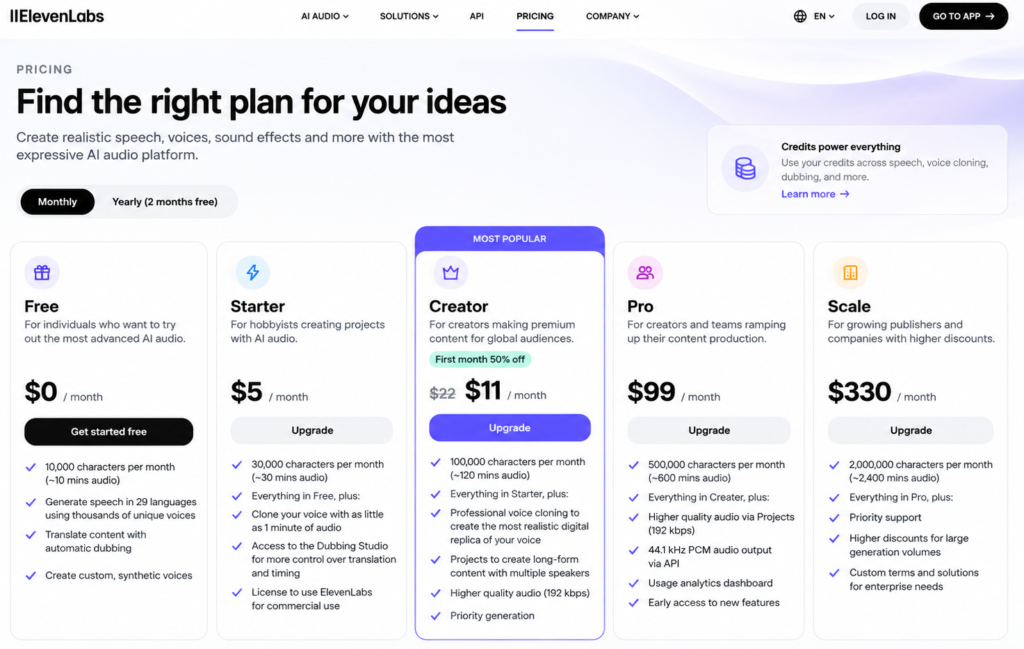
- Free ($0/mo): Includes 10,000 credits per month (roughly 10 minutes of audio) for testing, but restricts commercial usage and requires mandatory attribution.
- Starter ($6/mo): The entry-level paid plan; introduces commercial-use rights, instant voice cloning, and higher-quality audio output.
- Creator ($22/mo): Aimed at regular content creators; offers around 121,000 credits per month and unlocks professional voice cloning.
- Pro ($99/mo): Scales up to 600,000 credits per month with higher concurrency limits and 44.1 kHz PCM output.
- Scale ($299/mo) & Business ($990/mo): Built for high-volume teams and enterprises, offering multi-seat workspaces and lower per-unit credit costs.
Murf AI Pricing Structure
Murf AI structures its pricing around allotted generation time per month or year within a dedicated Studio workspace, with discounts for annual billing.
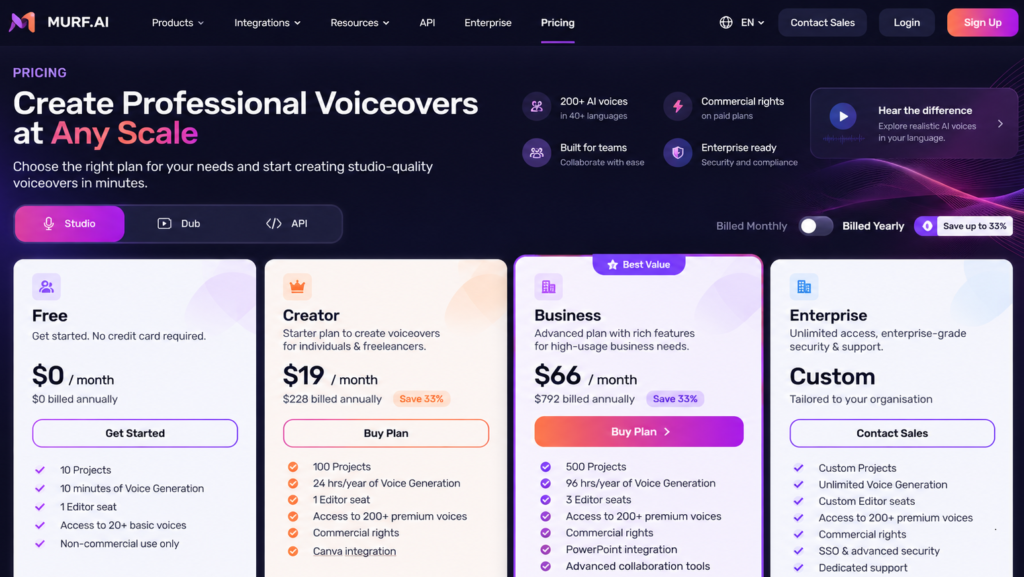
- Free ($0): Provides 10 minutes of total voice generation and browser preview access, but blocks audio downloads and commercial use.
- Creator ($19/mo billed annually / $29/mo monthly): Tailored for freelancers and solo creators; includes roughly 2 hours of voice generation per month (24 hours annually) plus commercial usage rights and project downloads.
- Business ($66/mo billed annually / $99/mo monthly): Designed for small teams and agencies; provides about 8 hours of generation per month (96 hours annually) across multiple editor seats.
- Enterprise (Custom quote): Unlocks custom voice cloning, security compliance, single sign-on (SSO), and dedicated support.
Which Platform Is More Affordable?
- For low-volume users, casual creators, and developers: ElevenLabs offers a lower financial barrier to entry. Its $6 Starter tier provides an affordable commercial license without forcing you into a higher monthly commitment.
- For structured, predictable project budgeting: Murf AI provides clear time-based quotas (e.g., set hours of audio generation per month), which appeals to course creators and marketing teams who map production hours directly to client deliverables.
Strategic Cost-Calculation Framework
Instead of relying purely on sticker prices, evaluate your expected output using these variables:
- Cost per Finished Minute: Divide the monthly subscription cost by your actual usable minutes of generated audio. Heavy script revisions and frequent re-generations can burn through ElevenLabs credits or Murf generation hours rapidly.
- Commercial Licensing Requirements: Ensure your chosen tier legally permits monetization if you plan to use the audio for client work, paid advertising, or monetized YouTube channels.
- Voice Cloning Access: Check whether voice cloning is included in base plans (as with ElevenLabs Creator) or gated behind enterprise tiers (as with Murf).
Note: Pricing tiers, allowances, and promotional discounts change frequently. Always review official vendor pricing pages before committing to a plan.
Strategic Decision Framework: Matching Platforms to Use Cases
The best AI voice generator is not the one with the most marketing hype; it is the one engineered for your specific production workflow. Here is how to evaluate the decision based on your primary use case and user profile.
YouTube Creators & Social Media Content Creators
- Recommended Platform: ElevenLabs
YouTube creators and social media producers require narration that captures attention immediately and maintains viewer retention across fast-paced edits.
ElevenLabs excels in this space for several reasons:
- Faceless Channels & Documentaries: Its advanced models deliver the dramatic pacing, breath sounds, and emotional variety necessary to sustain viewer interest over long-form narratives.
- Short-Form & Explainer Content: The platform’s responsiveness to punctuation and contextual cues makes it easy to generate dynamic voiceovers for TikTok, Instagram Reels, and YouTube Shorts.
- Expressive Delivery: Unlike traditional text-to-speech tools that sound uniform and robotic, ElevenLabs adds organic inflections that make automated narration feel genuinely conversational.
- When to switch to Murf AI: If your video production relies heavily on slide decks, synchronized presentation timing, or structured corporate explainers where you need to manually adjust pacing and word-level pronunciation on a visual timeline, Murf AI serves as a strong alternative.
E-Learning & Educational Institutions
- Recommended Platform: Murf AI
Educational institutions, online course creators, and corporate training teams require structured, clear, and highly predictable narration across large volumes of instructional content.
Murf AI is ideally suited for this sector due to several distinct workflow advantages:
- Structured Lesson Production: Its studio environment is specifically designed for multi-slide courses, learning management systems (LMS), and employee onboarding modules, allowing you to manage long scripts systematically.
- Precise Pronunciation & Pacing Controls: Instructional content demands absolute clarity. Murf enables you to manually adjust word emphasis, insert precise pauses, and correct technical jargon or acronym pronunciation.
- Presentation-Oriented Workflows: Features like PowerPoint integrations and slide-syncing capabilities significantly reduce the friction of pairing audio tracks with educational slide decks.
- When to switch to ElevenLabs: If your e-learning curriculum relies heavily on immersive storytelling, documentary-style historical modules, or requires expansive multilingual localization (such as native African or regional dialects), ElevenLabs provides superior vocal expressiveness and language coverage.
Podcasters & Audiobook Creators
- Recommended Platform: ElevenLabs
Long-form audio projects like podcasts and audiobooks place the absolute highest demand on vocal realism, listener engagement, and long-term acoustic stability.
ElevenLabs stands out as the superior choice for narrative-driven audio production:
- Immersive Storytelling & Fiction: Its advanced models capture subtle emotional nuances, dramatic inflection, and natural breathing patterns that prevent listener fatigue during hours of continuous listening.
- Podcast Intros & AI-Assisted Narration: Creators can quickly generate professional-grade guest introductions, ad spots, or companion audio articles with authentic conversational warmth.
- Multilingual Audiobooks: Publishers looking to translate and distribute audiobooks across international markets can leverage ElevenLabs’ extensive language models to maintain a consistent voice identity globally.
- Crucial Production Caveat: Long-form narration requires rigorous testing. Always check your generated chapters for pronunciation consistency, artifact stability, and pacing to ensure the synthetic voice maintains high quality across extended listening sessions.
- When to switch to Murf AI: If your podcasting or audio production workflow requires strict script compliance, multi-speaker collaborative editing, or precise manual control over word-level emphasis for instructional podcasts, Murf AI provides a dependable, highly structured studio environment.
Marketing Agencies & Businesses
- Recommended Platform: Murf AI or ElevenLabs (Depending on Campaign Requirements)
For marketing agencies and commercial enterprises, the ideal AI voice generator hinges entirely on whether your campaigns demand structured corporate scalability or high-impact creative expression.
- Choose Murf AI When: Your agency produces repeatable client deliverables, product demonstration videos, B2B explainers, or localized training decks. Murf’s structured studio timeline, presentation integrations, and team collaboration seats make it efficient for managing multiple client accounts and maintaining brand consistency.
- Choose ElevenLabs When: Your campaigns rely heavily on attention-grabbing social media advertisements, high-converting video sales letters (VSLs), or dynamic brand storytelling where emotional resonance is paramount. ElevenLabs is also the go-to choice if you need to rapidly localize ad creative across multiple global markets using its extensive multilingual model family.
Developers & Technology Companies
- Recommended Platform: ElevenLabs
For software engineers, product managers, and technology companies embedding voice infrastructure directly into applications, the evaluation shifts away from traditional editors toward API reliability, latency benchmarks, concurrency limits, and developer tooling.
ElevenLabs stands out as the primary choice for technical teams due to several key factors:
- Conversational AI & Real-Time Voice Agents: ElevenLabs provides robust low-latency endpoints optimized for real-time conversational applications, autonomous AI agents, and voice-enabled software.
- Comprehensive Developer Ecosystem: Its API architecture is widely documented and natively supports dynamic audio generation, webhook integrations, and scalable multi-seat developer environments.
- Flexible Voice Cloning APIs: Developers can programmatically instantiate and manage custom voice models, opening up unique product use cases in gaming, interactive customer support, and personalized software experiences.
- When to evaluate Murf AI: Murf also provides developer-facing APIs and real-time speech capabilities. Technical teams should evaluate Murf if their application specifically requires enterprise-governed voice cloning (such as secure workspace-owned models) or tightly integrated business system workflows. Always review the respective API documentation, rate limits, and latency profiles to ensure they match your technical stack.
Head-to-Head Breakdown: Weighing the Strengths and Trade-Offs
To finalize your software selection, review this direct, side-by-side comparison of the core advantages and operational limitations for each AI voice generator.
| Platform | Pros | Cons |
| ElevenLabs | Hyper-realistic expressive speech, advanced instant and professional voice cloning, expansive multilingual model support, and robust developer APIs. | Credit-based consumption requires careful volume tracking; advanced features are restricted to higher subscription tiers. |
| Murf AI | Structured production studio, precise pronunciation, pacing, and emphasis controls, slide presentation workflows, and enterprise team collaboration. | Advanced capabilities and voice cloning are gated behind higher-tier or enterprise plans; generation allowances can limit heavy projects. |
Neither platform is perfect for every production environment. The most important question is whether you need a raw, high-performance speech-generation engine or a structured studio environment for producing and managing complex voiceover projects.
How to Choose Between ElevenLabs and Murf AI: A Step-by-Step Decision Framework
Choosing the right AI voice generator requires looking past marketing claims and evaluating your exact operational workflow. Use this structured decision process before committing to a paid subscription:
Step 1: Define Your Core Content Format
Identify what you are producing, as different formats demand distinct platform strengths:
- Faceless YouTube Videos & Podcasts: Prioritize listener retention and organic emotional delivery (leaning toward ElevenLabs).
- Corporate Training, E-Learning & Presentation Decks: Prioritize structured slide syncing, clear instructional pacing, and script organization (leaning toward Murf AI).
Step 2: Weigh Voice Realism Against Production Workflows
- Choose ElevenLabs First if your project hinges on raw acoustic fidelity, emotional depth, breathing patterns, and conversational nuance.
- Choose Murf AI First if you need a dedicated timeline studio where you can manually adjust word-level emphasis, pacing, and pronunciation to meet strict brand or instructional guidelines.
Step 3: Audit Your Voice Cloning Requirements
- ElevenLabs offers a smoother, more accessible path for individual creators and developers seeking instant and professional voice cloning across lower-tier plans.
- Murf AI restricts its custom cloning capabilities primarily to enterprise and API tiers, making it better suited for strictly governed, workspace-owned organizational assets.
Step 4: Validate Language and Accent Support with Real Tests
Never rely purely on advertised language counts. If you are localizing content—whether into major global languages or regional dialects like Yoruba, Hausa, or Swahili—run your actual production script through both platforms’ free tiers to verify accent accuracy and pronunciation naturalness.
Step 5: Estimate Volume and Budget Based on Cost per Finished Minute
- Calculate how many minutes of audio you will generate monthly, factoring in script revisions and re-generations.
- Compare ElevenLabs’ unified credit consumption model against Murf AI’s structured generation-time allotments to see which model aligns with your project budget.
Step 6: Run a Head-to-Head Sandbox Test
Before entering your credit card details, take a representative 100-word sample of your actual script and test it across the free entry points of both platforms. Comparing the raw output side-by-side will immediately reveal which tool fits your production standard.
Important Considerations Before Using an AI Voice Generator
While deploying an AI voice generator can dramatically accelerate content production and reduce overhead, it introduces critical legal, ethical, and operational responsibilities. Before integrating synthetic audio into your commercial workflows, keep these five pillars in mind:
Voice Cloning Ethics, Consent, and Compliance
Voice cloning presents profound legal and ethical challenges regarding identity ownership, consent, and malicious impersonation:
- Obtain Explicit Permission: Never clone a person’s voice without clear, verifiable authorization. Assuming that publicly available videos, podcasts, or social media clips are fair game for cloning is both legally and ethically hazardous.
- Review Platform Policies: Both ElevenLabs and Murf AI enforce strict identity verification and compliance protocols—particularly for professional voice cloning or enterprise deployments. Violating platform terms can result in immediate account termination.
- Prohibit Deceptive Usage: Never use cloned voices to fabricate statements, impersonate real individuals without consent, or mislead audiences in a way that constitutes defamation, fraud, or deepfake manipulation.
Commercial Usage Rights and Licensing
A common and costly mistake among creators is publishing synthetic audio generated on a free account for commercial gain:
- Verify License Tiers: Free plans on platforms like ElevenLabs and Murf AI typically restrict generated audio to non-commercial, personal use.
- Check Monetization Terms: Paid subscriptions generally grant commercial-use rights, but you must review the underlying license terms regarding attribution requirements, copyright ownership of input scripts, and limits on client-facing deliverables.
Quality Control, Pronunciation, and Artifact Auditing
Synthetic speech is remarkably advanced, but it remains susceptible to rendering errors:
- Anticipate Mispronunciations: AI models frequently stumble over niche technical terminology, complex acronyms, foreign proper nouns, regional colloquialisms, and unusual brand names.
- Mandatory QA Audits: Never publish generated audio without a complete listening pass. Always budget time for manual script adjustments, phonetic spelling modifications, or punctuation tuning to ensure professional delivery.
Data Privacy and Confidentiality
If your production pipeline involves sensitive materials—such as internal corporate communications, unreleased product specs, proprietary training modules, or customer data—security is paramount:
- Inspect Data Retention Policies: Review how each platform stores, processes, and protects your uploaded text and audio inputs.
- Model Training Clauses: Enterprise users must confirm whether proprietary data is used to train public models. Organizations handling sensitive data should verify platform compliance, security certifications, and data-processing agreements (DPAs).
Transparency, Disclosure, and Audience Trust
Maintaining long-term credibility with your audience requires ethical transparency:
- Disclose AI Narration Where Appropriate: Depending on your niche—such as educational content, journalism, corporate announcements, or public-facing media—clearly signaling that a voice is AI-generated helps manage expectations and preserves trust.
- Avoid Deception: Synthetic voice tools should be utilized to scale creative production efficiently, never to trick consumers or forge statements from real people.
Is ElevenLabs better than Murf AI?
ElevenLabs excels at ultra-realistic speech generation, emotional expression, advanced voice cloning, and developer integrations. Murf AI stands out for structured voiceover production, slide presentation workflows, and corporate e-learning materials. The superior choice depends entirely on your specific project requirements.
Which AI voice generator is best for YouTube videos?
ElevenLabs serves as the primary choice for YouTube creators who prioritize natural narration, engaging storytelling, and expressive vocal delivery. Murf AI remains a viable alternative for creators whose production style relies on structured timelines and presentation-oriented layouts.
Can ElevenLabs clone my voice?
Yes. ElevenLabs offers both Instant Voice Cloning (for rapid creation from short clips) and Professional Voice Cloning (utilizing extensive recordings and identity verification). You must always secure explicit legal authorization and permission before cloning any voice.
Does Murf AI support voice cloning?
Yes. Murf provides voice cloning capabilities, but access is tightly controlled. Its Instant Voice Cloning API is restricted to Enterprise-tier customers and specific enterprise workspaces, meaning standard individual or creator plans do not automatically include cloning access.
Which platform supports more languages?
ElevenLabs supports over 90 languages across its advanced model family (including diverse regional dialects and African languages like Yoruba, Hausa, and Swahili). Murf AI supports over 40 languages and accents tailored primarily for global commercial and corporate markets.
Can I use ElevenLabs and Murf AI for commercial projects?
Yes, provided you subscribe to a paid plan that explicitly grants commercial-use rights and complies with platform terms. Free-tier accounts on both platforms generally restrict generated audio to non-commercial, personal use.
Are ElevenLabs and Murf AI free?
Both platforms offer free entry points:
ElevenLabs provides a free tier with a monthly credit allowance for testing.
Murf AI offers a free Studio plan with limited generation time, though it restricts audio downloads and blocks commercial usage.
Which platform is better for businesses?
Murf AI is ideal for corporate teams producing structured training modules, employee onboarding courses, and presentation voiceovers. ElevenLabs is better suited for businesses that require expressive marketing narration, AI dubbing, voice cloning, or custom API integrations for software products.
In Conclusion
Both ElevenLabs and Murf AI are exceptional AI voice generator platforms, but they are engineered for fundamentally different priorities:
- ElevenLabs leads the market for creators, storytellers, and developers who demand hyper-realistic acoustic quality, emotional depth, advanced voice cloning, expansive multilingual support, and powerful developer APIs.
- Murf AI excels for educators, corporate training teams, and business communicators who require a structured studio environment, precise pronunciation controls, presentation slide-syncing, and multi-seat enterprise collaboration.
Quick Recommendation Summary
| If You Are… | Recommended Platform | Why? |
| A YouTube Creator | ElevenLabs | Unmatched vocal expressiveness and audience-engaging storytelling delivery. |
| An Audiobook Narrator | ElevenLabs | Superior emotional range and acoustic stability across long-form scripts. |
| A Podcaster | ElevenLabs | Professional conversational warmth for intros, ads, and AI-assisted narration. |
| A Software Developer | ElevenLabs | Low-latency APIs, conversational AI agents, and programmable voice cloning. |
| An E-Learning Creator | Murf AI | Structured script management and clear instructional pacing for courses. |
| A Corporate Trainer | Murf AI | Seamless LMS integration and dependable broadcast-quality clarity. |
| A Presentation Creator | Murf AI | Direct PowerPoint and Canva workflows that eliminate slide-audio friction. |
| A Marketing Agency | Either | ElevenLabs for high-impact social ads; Murf AI for structured client explainers. |
The Bottom Line
- Choose ElevenLabs if voice realism is the core product of your content.
- Choose Murf AI if the structured voiceover workflow is the product of your operation.
Before committing your budget to a monthly or annual subscription, take a 100-word sample of your actual script and test it across the free entry points of both platforms. Comparing the raw output side-by-side remains the most reliable way to determine which AI voice generator truly fits your production standards.