Best Gemini 4 Alternatives: Which Is Better and Cheaper?
Choosing the best Google Gemini 4 alternative depends on your primary use case, usage volume, and budget. Top frontier models from OpenAI, Anthropic (Claude), DeepSeek, Mistral, and Perplexity offer distinct capabilities across complex software engineering, academic research, long-form writing, and enterprise workflows. While some platforms excel at autonomous research and live web synthesis, others provide significant API cost savings or greater deployment flexibility.
Evaluating alternatives to Google Gemini 4 (officially designated as Google Gemini 4 Argon) requires weighing raw model performance against long-term operational costs. Google’s introductory API pricing for Gemini 4 Argon stands at $2.00 per million input tokens and $10.00 per million output tokens through November 30, 2026, with standard pricing taking effect on December 1, 2026. This guide compares the leading AI models to Google Gemini 4 Argon so you can choose the optimal tool for your tech stack and ROI.
What Is Google Gemini 4 Argon?
Google Gemini 4 Argon is Google’s flagship frontier reasoning model. It is engineered for complex software engineering, long-running multi-step agent workflows, enterprise knowledge work (such as legal and financial analysis), and advanced cybersecurity operations.
According to Google’s developer documentation, key features of Google Gemini 4 Argon include:
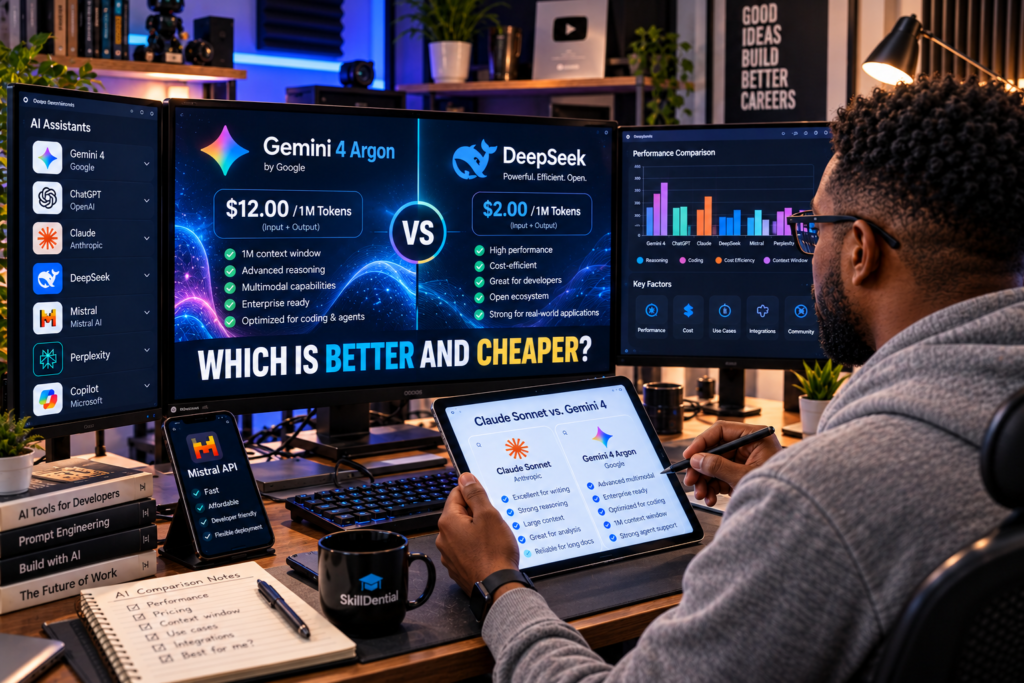
- Unified Context Window: Supports up to 1 million tokens of combined input and output, allowing developers to process massive codebases, research archives, and complex document suites in a single request.
- Adjustable Reasoning Levels: Enables developers to tune the model’s depth of thought depending on whether speed or deep logic is required.
Understanding Google Gemini 4 Argon API Pricing
When comparing Google Gemini 4 alternatives, evaluating unit economics is critical. Google introduced Gemini 4 Argon with a limited-time promotional rate, followed by a scheduled standard price increase:
| Billing Period | Input Tokens (per 1M) | Output Tokens (per 1M) |
| Introductory Rate (Through Nov 30, 2026) | $2.00 | $10.00 |
| Standard Rate (Effective Dec 1, 2026) | $4.00 | $20.00 |
Note on Prompt Caching
Under Google’s documented caching arrangement, cached input tokens receive up to a 95% discount ($0.10 per million tokens under introductory rates), significantly lowering cost overhead for repeated system prompts or static code repositories.
API Pricing vs. Monthly Subscriptions
These rates reflect developer API consumption, not consumer monthly subscription plans (like ChatGPT Plus or Claude Pro). Developers pay strictly based on token usage volume, whereas end-users pay flat monthly fees for web application access. Keeping this distinction clear is essential when calculating total cost of ownership against top Google Gemini 4 alternatives.
What Are the Best Google Gemini 4 Alternatives?
Choosing the best Google Gemini 4 alternative comes down to finding the ideal balance of reasoning quality, system reliability, token economics, and workflow compatibility. Because Google Gemini 4 Argon sets a high benchmark for software engineering, deep reasoning, and long-context analysis, different competitors shine in specific operational areas.
The table below outlines the top models and platforms challenging Google Gemini 4 Argon across enterprise and developer workloads:
| AI Platform / Model | Best Suited For | Key Advantage vs. Google Gemini 4 | Important Considerations |
| OpenAI Models (ChatGPT / API) | General reasoning, advanced coding, and enterprise productivity | Massive developer ecosystem, extensive tool integration, and proven API maturity | Plan selection and token costs vary significantly across model tiers |
| Anthropic Claude | Software architecture, long-form writing, and deep document analysis | Exceptional nuance in professional knowledge work and code generation | Model pricing and context window limits differ between API and Pro subscriptions |
| DeepSeek | Cost-conscious API development and high-volume reasoning | Extremely low published token rates and high-efficiency architectures | Requires verification of peak/off-peak latency, infrastructure uptime, and API compliance |
| Mistral AI | Enterprise deployment flexibility and open-weights development | High customization control with both proprietary and open-weight models | Capabilities, hosting needs, and resource overhead vary by specific model size |
| Perplexity AI | Real-time web synthesis, source discovery, and academic research | Up-to-date live research answers with direct inline citations | Tailored primarily for search and synthesis, not a direct drop-in for complex API workflows |
| Microsoft Copilot | Microsoft 365 enterprise productivity and workflow automation | Native, deep integration across Word, Excel, Teams, and the Windows ecosystem | Feature availability and AI capabilities depend heavily on enterprise licensing tiers |
Evaluating API Workflows vs. End-User Applications
When evaluating Google Gemini 4 alternatives, it is important to note that these platforms are not interchangeable in every environment. While services like Perplexity and Microsoft Copilot are end-user applications designed for web search and office productivity, providers like OpenAI, Anthropic, DeepSeek, and Mistral offer robust developer APIs that directly compete with Google Gemini 4 Argon‘s 1-million-token context window and adjustable reasoning capabilities.
Comparing developer API unit economics against flat-rate application subscriptions ensures you choose the tool that is truly better—and cheaper—for your specific stack.
OpenAI Models: A Versatile Ecosystem Alternative to Google Gemini 4
For development teams and enterprises evaluating Google Gemini 4 alternatives, OpenAI remains the primary benchmark in general reasoning, complex software engineering, and tool integration. While Google Gemini 4 Argon focuses heavily on unified 1M-token context windows and adjustable reasoning levels, OpenAI provides a tiered model ecosystem ranging from lightweight task-specific models to flagship reasoning systems.
Developers can access OpenAI’s portfolio via the direct API, while non-technical users and business teams access these capabilities through ChatGPT subscriptions.
Why Choose OpenAI Over Google Gemini 4?
- Ecosystem Maturity & Tooling: Supported OpenAI models integrate natively with function calling, structured outputs, code interpreters, vector database file search, and web retrieval workflows.
- Advanced Software Engineering: Dedicated models like the GPT series and specialized agentic coding tools compete directly with Google Gemini 4 Argon in multi-step code generation, continuous debugging, and repo-level refactoring.
- Granular Cost-to-Performance Control: Rather than relying on a single frontier model, developers can route simpler tasks (such as classification or field extraction) to high-volume, lower-cost models while reserving flagship models for high-stakes reasoning.
- Versatile Multi-Modal Workflows: Offers built-in capabilities across text, vision, audio processing, and image generation within unified API pipelines.
Key Considerations When Comparing to Google Gemini 4 Argon
- Context Window vs. Cost: Google Gemini 4 Argon offers a 1-million-token context window out-of-the-box. While top-tier OpenAI models match large context windows, processing massive prompt inputs on flagship models can quickly raise token expenditures unless cached input discounts are utilized.
- Subscription vs. API Billing Separation: A monthly ChatGPT Plus/Pro subscription does not grant unrestricted API credits. API token usage is billed separately based on exact input and output consumption.
- Right-Sizing Your Model Selection: Running a flagship reasoning model for simple formatting or routine text generation creates unnecessary overhead. Lower-tier models handle high-frequency, low-complexity API calls far more economically.
Best For
Developers, product managers, and enterprises looking for a highly versatile AI ecosystem with established tool integration and flexible model tiering to compete with Google Gemini 4 Argon.
Claude: A High-Precision Alternative for Coding, Writing, and Document Analysis
For organizations comparing Google Gemini 4 alternatives for technical execution and long-form synthesis, Claude (developed by Anthropic) stands out as a primary competitor. While Google Gemini 4 Argon focuses heavily on unified reasoning across 1-million-token contexts, Anthropic’s Claude models excel in natural language nuance, extended reasoning, and high-accuracy software engineering.
Claude is accessible to end-users via web and desktop apps (including specialized features like Claude Projects and Artifacts) and to developers via the Claude API and major cloud platform integrations.
Why Choose Claude Over Google Gemini 4?
- Refined Technical Writing: Known for producing clear, human-like output with exceptional tone control, structural coherence, and minimal hallucination.
- Agentic Software Development: Highly effective at repository-level code architecture, continuous debugging, refactoring, and multi-file implementation.
- Complex Document Synthesis: Purpose-built to ingest and analyze massive text files, legal contracts, financial reports, and technical documentation with low error rates.
- Enterprise Features: Offers specialized tools like Projects (for context management) and extended thinking capabilities designed for prolonged reasoning workflows.
Is Claude Cheaper Than Google Gemini 4 Argon?
Determining if Claude is a more cost-effective Google Gemini 4 alternative depends on the specific model, access tier, and production workload.
| Model Tier | Input Rate (per 1M) | Output Rate (per 1M) | Comparison to Google Gemini 4 Argon |
| Claude Sonnet 5 | $2.00 | $10.00 | Parity with Google Gemini 4 Argon introductory rates ($2/$10); significantly cheaper than Gemini 4 Argon’s scheduled standard rates ($4/$20). |
Total Cost Considerations
While headline API prices show strong competitiveness, calculating total ROI against Google Gemini 4 Argon involves broader factors:
- Token Efficiency: Differences in model tokenizers mean the exact same prompt may consume varying token counts across Anthropic and Google APIs.
- First-Pass Quality vs. Retries: A slightly more expensive API call can end up cheaper overall if it successfully executes a complex task on the first attempt without requiring follow-up repair prompts.
- Prompt Caching & Extended Thinking: Both providers offer steep prompt caching discounts, but enabling higher effort levels or extended reasoning in Claude increases output token usage.
- Subscription vs. API: Flat-rate web subscriptions (such as Claude Pro or Team) follow different usage limits and billing structures than pay-as-you-go API keys.
Best For
Software architects, lead developers, technical writers, and researchers who require high-precision reasoning, top-tier code generation, and deep document analysis from a Google Gemini 4 alternative.
DeepSeek: A Cost-Conscious Alternative for High-Volume API Workloads
For product developers, startup founders, and engineering teams evaluating Google Gemini 4 alternatives to minimize API overhead, DeepSeek presents a compelling value proposition. Known for its aggressive pricing models and high-efficiency architectures, DeepSeek allows developers to scale production applications without incurring prohibitive token costs.
DeepSeek exposes OpenAI-compatible API endpoints, enabling engineering teams to swap existing model calls into their pipeline with minimal refactoring.
Why Choose DeepSeek Over Google Gemini 4 Argon?
- Aggressive Unit Economics: DeepSeek’s published API rates sit significantly lower than standard frontier model pricing, making it an optimal engine for high-volume, repetitive text generation, classification, and continuous data ingestion.
- Model Routing Options: Provides lightweight, high-speed models (such as DeepSeek-V4.1-Flash) for routine tasks alongside heavier reasoning tiers (such as DeepSeek-V4-Pro) for more complex problem-solving.
- Developer Ecosystem Support: Supports standard developer workflows, including structured JSON outputs, function calling, tool use, and system prompt caching.
- High Caching Savings: Provides substantial input token discounts when reusing common system instruction prefixes across iterative requests.
Comparing DeepSeek vs. Google Gemini 4 Argon API Pricing
When benchmarking Google Gemini 4 alternatives on pure token economics, DeepSeek provides a major cost advantage—especially for background processing and batch workloads:
| AI Model & Billing Tier | Input Rate (per 1M) | Output Rate (per 1M) | Key Pricing Note |
| DeepSeek-V4.1-Flash (Off-Peak) | $0.15 (Cache Miss) / $0.003 (Cache Hit) | $0.60 | DeepSeek’s most economical, high-throughput model tier. |
| DeepSeek-V4-Pro (Off-Peak) | $0.66 (Cache Miss) / $0.022 (Cache Hit) | $1.98 | Targeted at more demanding reasoning and complex code tasks. |
| Google Gemini 4 Argon (Introductory) | $2.00 (Cache Miss) | $10.00 | Promotional rate effective through November 30, 2026. |
| Google Gemini 4 Argon (Standard) | $4.00 (Cache Miss) | $20.00 | Standard rate scheduled to take effect December 1, 2026. |
Critical Considerations & Trade-offs
- Quality vs. Absolute Cost: While DeepSeek-V4.1-Flash offers drastic savings compared to Google Gemini 4 Argon, developers should not assume a low-cost model matches Google’s flagship performance on highly complex software engineering or multi-step agent logic. Always run evaluations using representative product benchmarks.
- Peak vs. Off-Peak Rate Schedules: DeepSeek utilizes dynamic pricing where peak usage hours carry higher rates. Production pipelines should be designed to run batch processing, evals, or cron jobs during off-peak windows to capture maximum cost reductions.
- Enterprise Compliance & Uptime: Organizations working with sensitive proprietary data or requiring strict service level agreements (SLAs) should evaluate DeepSeek’s hosting infrastructure, data privacy policies, and rate limits before routing mission-critical business systems through external endpoints.
Best For
AI builders, SaaS developers, and cost-focused engineering teams looking for a cheap Google Gemini 4 alternative to power high-volume, structured API pipelines.
Mistral AI: An Option for Flexible, Self-Hosted, and Open-Weight AI Deployment
When evaluating Google Gemini 4 alternatives for enterprise software architecture, Mistral AI provides a distinct advantage through its hybrid deployment model. While Google Gemini 4 Argon operates exclusively as a hosted Google Cloud API service, Mistral offers both proprietary hosted APIs (via La Plateforme) and open-weight models that can be self-hosted on private cloud infrastructure (Azure, AWS, or on-premises GPU clusters).
This flexibility makes Mistral a top consideration for organizations with strict data sovereignty, GDPR compliance, or custom infrastructure requirements.
Why Choose Mistral Over Google Gemini 4 Argon?
- Deployment & Infrastructure Control: Open-weight models allow enterprise teams to host weights internally, preventing sensitive data from leaving their private VPCs.
- Versatile Model Lineup: Offers a spectrum of models targeting distinct trade-offs between speed, cost, and context size—ranging from ultra-fast edge models to specialized coding engines (Codestral) and flagship reasoning platforms (Mistral Large).
- Native Tooling & Function Calling: Fully supports agentic workflows, structured JSON outputs, function calling, and system prompt caching.
- High Token Efficiency: Highly optimized tokenizers lower raw input volume, reducing infrastructure overhead on high-throughput application workloads.
API Cost Breakdown: Mistral vs. Google Gemini 4 Argon
For teams utilizing hosted endpoints, Mistral provides aggressive API pricing compared to Google Gemini 4 Argon:
| Model Tier | Input Rate (per 1M) | Output Rate (per 1M) | Comparison to Google Gemini 4 Argon |
| Mistral Small 4 | $0.15 | $0.60 | ~92% cheaper input / 94% cheaper output than Gemini 4 Argon’s introductory rates ($2/$10). |
| Mistral Large 3 (Flagship) | $0.50 | $1.50 | Significantly lower token cost than Gemini 4 Argon’s standard rates ($4/$20). |
| Google Gemini 4 Argon (Introductory) | $2.00 | $10.00 | Effective through November 30, 2026. |
| Google Gemini 4 Argon (Standard) | $4.00 | $20.00 | Scheduled effective date starting December 1, 2026. |
Key Trade-offs: Self-Hosting vs. Fully Managed APIs
- Total Cost of Ownership (TCO): While lightweight API models like Mistral Small 4 carry low published rates, self-hosting open-weight variants requires dedicated GPU hardware (e.g., NVIDIA H100/A100 instances), orchestration pipelines, monitoring, and engineering maintenance.
- Context Window Requirements: Google Gemini 4 Argon provides a unified 1-million-token context window out of the box. In contrast, self-hosting large context windows on open-weight models demands significant VRAM scaling.
- Task-Specific Performance: For routine extraction, classification, and lightweight code synthesis, low-cost Mistral models excel. However, highly complex, multi-file software engineering tasks may still warrant testing against Google Gemini 4 Argon or flagship frontier models.
Best For
Developers, enterprise architects, and engineering teams that prioritize deployment flexibility, data privacy compliance, or low-cost API scaling over single-provider lock-in.
Perplexity: A Research-Focused Alternative for Real-Time Verification
For teams evaluating Google Gemini 4 alternatives specifically for market research, factual synthesis, and source verification, Perplexity offers a distinct approach. While Google Gemini 4 Argon operates as a foundational reasoning engine, Perplexity functions primarily as an answer engine that combines live web retrieval with multi-model AI synthesis.
Perplexity allows paid users to switch between underlying foundation models (including Claude, OpenAI, and custom search-optimized models like Sonar) within a single citation-backed research interface.
Why Choose Perplexity Over Google Gemini 4 Argon?
- Live Web Synthesis with Inline Citations: Every answer is explicitly grounded in real-time web results with direct references, making it easy to audit claims and discover source materials.
- Multi-Model Access: Subscriptions allow users to toggle between top frontier models to test different reasoning styles without maintaining separate subscriptions.
- Specialized Deep Research Workflows: Designed specifically for competitive analysis, academic literature reviews, market intelligence, and continuous topic monitoring.
- Unified Computer & Assistant Capabilities: Paid tiers feature agentic research tools and app integrations through dedicated interfaces like Perplexity Computer and the Comet browser assistant.
Understanding the Cost and Structure Comparison
Comparing Perplexity to Google Gemini 4 Argon requires distinguishing between consumer search platforms and raw developer model APIs:
| Tier / Access Method | Pricing Model | Primary Focus |
| Perplexity Free | $0 | Standard real-time web search with inline citations. |
| Perplexity Pro | $20/month (or ~$17/mo billed annually) | Pro Search, Deep Research, model switching, and document analysis. |
| Perplexity Max / Enterprise | $200/month (Max) / $40/seat/mo (Enterprise Pro) | Heavy agentic execution, expanded API credits, and enterprise security. |
| Google Gemini 4 Argon API | $2.00 / $10.00 (Introductory) $4.00 / $20.00 (Standard per 1M tokens) | Raw API token processing for custom app development and enterprise pipelines. |
Important Considerations for Developers & Researchers
- Research Tool vs. Direct Developer API: Perplexity is built primarily for human-in-the-loop search, background research, and factual discovery. Developers building standalone AI products or deep software engineering agent workflows require a dedicated model API like Google Gemini 4 Argon or Perplexity’s specialized Sonar API endpoints.
- Verifying Sources: While inline citations reduce hallucinations, source attribution alone does not guarantee accuracy. Fact-checking the primary source document remains a best practice for high-stakes business decisions.
- Flat Monthly Fees vs. Usage Billing: Flat-rate subscriptions ($20/mo) offer predictable costs for active researchers, whereas pay-as-you-go APIs charge dynamically per token.
Best For
Researchers, strategy analysts, content strategists, students, and journalists who need rapid web synthesis, citation verification, and factual research over raw API execution.
Microsoft Copilot: An Alternative for Microsoft 365 Workflows
For organizations evaluating Google Gemini 4 alternatives to boost enterprise employee productivity, Microsoft Copilot offers a deeply integrated software experience. While Google Gemini 4 Argon operates as a standalone foundation model API designed for software development and raw reasoning, Microsoft Copilot brings AI assistance directly into existing Microsoft 365 applications—including Word, Excel, PowerPoint, Outlook, Teams, and corporate SharePoint data stores.
Its primary value lies in workflow automation, document synthesis, and internal enterprise data access within a secure workspace.
Why Choose Microsoft Copilot Over Google Gemini 4 Argon?
- Native Workplace Integration: Generates executive presentations, analyzes spreadsheets, drafts emails, and summarizes missed Teams meetings without leaving Microsoft 365 apps.
- Enterprise Graph Context: Accesses internal company documents, emails, calendars, and chat logs securely to provide hyper-contextualized workplace assistance.
- Enterprise Security & Compliance: Adheres to established Microsoft 365 security, tenant isolation, compliance boundaries, and data retention rules.
- No-Code Agent Building: Enables non-technical teams to deploy custom workplace copilots and internal automation agents using Microsoft Copilot Studio.
Understanding the Total Cost: Microsoft Copilot vs. Google Gemini 4 Argon
When evaluating whether Microsoft Copilot is a cheaper Google Gemini 4 alternative, businesses must consider licensing tiers, required base plans, and usage models:
| Plan / Licensing Tier | Listed Pricing | Prerequisites & Licensing Details |
| Copilot Pro (Individual) | $20.00 / user/month | Designed for individuals; requires an active Microsoft 365 Personal or Family subscription. |
| Microsoft 365 Copilot Business | $21.00 / user/month (Standard) $18.00 / user/month (Promo through Dec 31, 2026) | Add-on for SMBs (up to 300 seats); requires a qualifying Microsoft 365 Business base license. |
| Microsoft 365 Copilot Enterprise | $30.00 / user/month | Annual commitment; requires a qualifying Enterprise base plan (e.g., Office 365 E3/E5 or Microsoft 365 E3/E5). |
| Google Gemini 4 Argon API | $2.00 / $10.00 (Introductory) $4.00 / $20.00 (Standard per 1M tokens) | Pay-as-you-go API consumption based strictly on processed token volume. |
Key Operational Differences
- Integrated Application vs. Developer Model API: Microsoft Copilot is an end-user productivity tool priced per seat, whereas Google Gemini 4 Argon is a raw API priced per token. Developers building custom applications or agentic coding systems require model APIs, whereas business users drafting reports benefit more from Copilot’s application layer.
- True Total Cost of Ownership (TCO): A complete cost comparison for Copilot must factor in the price of the mandatory Microsoft 365 base subscription (e.g., E3 or E5) alongside the Copilot add-on.
- Task Alignment: For real-time document transformation, calendar scheduling, and corporate chat retrieval, Copilot excels. For large-scale software engineering, massive 1M-token document context windows, or custom app development, Google Gemini 4 Argon remains the more appropriate tool.
Best For
Enterprises, operations teams, and corporate knowledge workers whose daily workflows revolve around the Microsoft 365 ecosystem.
Which Google Gemini 4 Alternative Is Cheapest?
For software developers, AI engineers, and product builders, evaluating developer API token pricing provides the most objective baseline for cost comparisons.
To illustrate raw unit economics across top Google Gemini 4 alternatives, the table below models a baseline API workload of 1 million input tokens and 1 million output tokens using published standard rates:
API Token Cost Comparison (1M Input + 1M Output Tokens)
| AI Model & Billing Tier | Input Rate (per 1M) | Output Rate (per 1M) | Combined Baseline Cost | Primary Value Proposition |
| DeepSeek-V4.1-Flash (Off-Peak) | $0.003 | $0.60 | $0.603 | Lowest overall token cost for high-volume automated processing. |
| DeepSeek-V4.1-Flash (Peak) | $0.006 | $1.20 | $1.206 | Highly affordable tier even during peak usage windows. |
| Mistral Small 4 | $0.15 | $0.60 | $0.750 | Ultra-cheap, fast European model for structured API workloads. |
| DeepSeek-V4-Pro (Off-Peak) | $0.022 | $1.98 | $2.002 | Deep reasoning model at a fraction of frontier API rates. |
| DeepSeek-V4-Pro (Peak) | $0.044 | $3.96 | $4.004 | Economical reasoning engine for complex code and agentic tasks. |
| Claude Sonnet 5 | $1.00 | $5.00 | $6.000 | High-precision technical writing and coding at lower rates than standard Gemini 4. |
| Google Gemini 4 Argon (Introductory) | $2.00 | $10.00 | $12.000 | Google’s promotional rate effective through November 30, 2026. |
| OpenAI GPT-6.1 Sol (Short Context) | $2.00 | $10.00 | $12.000 | Direct flagship price parity with Google Gemini 4 Argon. |
Important Pricing Disclaimer
Rates reflect base published API token prices and exclude additional costs such as custom prompt caching discounts, system hosting, tool call executions, web retrieval fees, and local taxes. Rates are subject to provider updates over time.
Key Takeaways for Cost Optimization
- Massive Savings with Specialized Models: Specialized lightweight engines like DeepSeek-V4.1-Flash and Mistral Small 4 deliver up to 90% to 95% API cost savings compared to flagship models like Google Gemini 4 Argon or OpenAI GPT-6.1 Sol.
- Peak vs. Off-Peak Scheduling: Providers like DeepSeek use dynamic pricing tiers. Engineering teams can shave costs nearly in half by scheduling high-volume batch jobs, offline evaluations, and background data transformations during off-peak hours.
- Price Does Not Equal Total ROI: While smaller models are ideal for cost-sensitive applications (such as routing, text classification, and simple extraction), premium models like Google Gemini 4 Argon and Claude Sonnet 5 remain superior for complex multi-file software architecture, long-context document analysis, and extended agentic reasoning.
Bottom Line
If your primary goal is minimizing production API expenses, DeepSeek and Mistral AI represent the cheapest Google Gemini 4 alternatives available today. However, teams should always run benchmark evaluations on representative product prompts before replacing a flagship reasoning model entirely.
How Much Could You Save Switching from Google Gemini 4 Argon?
To illustrate potential API cost reductions, consider a baseline production workload processing 1 million input tokens and 1 million output tokens (a standard 1:1 token ratio mix).
Evaluating the unit economics between Google Gemini 4 Argon and an efficient alternative like Mistral Small 4 highlights the dramatic price gap between flagship reasoning engines and high-throughput utility models:
- Google Gemini 4 Argon (Introductory API Rate): $12.00 per 1M input / 1M output tokens ($2.00 input + $10.00 output).
- Mistral Small 4 (Published Standard Rate): $0.75 per 1M input / 1M output tokens ($0.15 input + $0.60 output).
- Potential Cost Savings: $11.25 per 1M token unit, representing an approximate 93.75% API expenditure reduction.
  [Google Gemini 4 Argon]  $12.00  ████████████████████████ (100%)
  [Mistral Small 4]       $0.75   █ (6.25%)
  -------------------------------------------------------------
  NET SAVINGS: $11.25 PER MILLION TOKEN PAIR (93.75% REDUCTION)
Important Context & Testing Best Practices
While mathematical comparisons of published API rates showcase massive potential savings, unit prices alone do not measure overall production value or task performance.
When conducting a technical ROI evaluation across Google Gemini 4 alternatives, keep these real-world factors in mind:
- Output Quality & Completion Accuracy: A cheaper model that fails to solve a multi-step code refactor on the first pass may require multiple follow-up retries or human developer intervention, rapidly eroding initial token savings.
- Tokenization Density: Different model tokenizers process text at varying rates. A 1,000-word prompt may require 1,200 tokens under one model family and 1,400 tokens under another, shifting the final billed total.
- Prompt Caching Efficiency: Both Google Gemini 4 Argon and top competitors offer prompt caching discounts (up to 95% on cached inputs). Heavy system prompt reuse can shrink the pricing gap for long-context applications.
Evaluation Methodology
To determine the true cost-to-performance winner for your application, run a standardized benchmark using a test suite of representative product prompts. Track total cost per completed request, first-pass accuracy, latency, API error rates, and human correction time required.
API Pricing vs. Monthly Subscriptions: Which Should You Compare?
Before selecting a Google Gemini 4 alternative, it is essential to map your choice directly to your deployment architecture and usage model. AI providers monetize their platforms through two primary avenues: flat-rate monthly consumer/business application subscriptions and pay-as-you-go developer model APIs.
Choosing the wrong billing framework can lead to significant cost inefficiencies. Here is how to evaluate each path when benchmarking against Google Gemini 4 Argon.
Choose a Monthly Subscription for Interactive Workflows & Assistant Tools
If your primary goal is leveraging AI for individual or team productivity—such as drafting reports, brainstorming, researching web topics, analyzing uploaded documents, or writing code interactively—a consumer or enterprise application subscription is usually the most straightforward option.
Key Factors to Benchmark:
- Predictable Monthly Expenses: Subscriptions charge a flat recurring fee (e.g., $20/month for ChatGPT Plus, Claude Pro, or Perplexity Pro; $19.99/month for Google AI Pro featuring Google Gemini 4 Argon).
- Usage Caps & Fair-Use Policies: Evaluate request limits, rate limits during peak hours, and file upload sizes.
- Built-in Workspace Features: Consider integrated capabilities such as canvas mode, code interpreters, artifact generation, web searching, and project knowledge bases.
Choose a Developer API for Software Architecture & Custom Applications
If you are engineering software products, multi-agent automated systems, backend data pipelines, customer-facing chatbots, or custom dev tools, pay-as-you-go API token pricing is the correct metric.
               +----------------------------------------+
               |  EVALUATING YOUR PRODUCTION WORKLOAD   |
               +----------------------------------------+
                                   |
         +-------------------------+-------------------------+
         |                                                   |
  [API WORKLOADS]                                   [APPLICATION USERS]
  - Measured in Tokens ($/1M)                       - Fixed Monthly Seats ($/mo)
  - Pay-as-you-go Usage                              - Flat-Rate Uncapped Access
  - Focus: Latency, ROI, Retries                    - Focus: Tools, UI, File Limits
  - Best: DeepSeek, Mistral, Gemini API             - Best: ChatGPT, Claude Pro, Copilot
Key Factors to Benchmark:
- Unit Economics (Input vs. Output Tokens): Estimate your expected monthly volumetric traffic, average prompt length (inputs), generated answer length (outputs), and tool-call frequency.
- Caching & Batch Discounts: Assess provider-specific discount schemes. For instance, Google Gemini 4 Argon provides a 95% discount on cached prompt inputs, while providers like DeepSeek and Mistral offer substantial reductions for off-peak batch processing.
- Production Reliability & Execution: Measure first-pass completion success rates, error rates, average response latency, and function-calling reliability under load.
Consider Self-Hosting for Total Infrastructure & Data Control
For enterprises with strict data sovereignty rules, internal compliance mandates, or custom fine-tuning requirements, self-hosting open-weight models (such as those offered by Mistral AI) provides an alternative to third-party cloud APIs.
Key Factors to Benchmark:
- True Infrastructure Cost (TCO): A model with no per-token provider fee is not free to operate. You must factor in compute instances (dedicated GPU cloud servers like NVIDIA A100/H100 clusters), VRAM storage, and bandwidth.
- Operational Overhead: Factor in engineering expenses for orchestration, model serving frameworks, security hardening, system monitoring, and ongoing maintenance.
Summary Checklist: Choosing Your Google Gemini 4 Alternative
| Primary Goal | Recommended Deployment | Primary Benchmark Metrics |
| Individual / Team Productivity | App Subscription (e.g., ChatGPT, Claude Pro, Copilot) | Fixed monthly fee, UI features, document limits, web search |
| High-Volume Application Scaling | Low-Cost API (e.g., DeepSeek-V4.1-Flash, Mistral Small 4) | Input/output token rates, off-peak discounts, API uptime |
| Complex Software Engineering | Frontier API (e.g., Google Gemini 4 Argon, Claude Sonnet 5, OpenAI) | Reasoning accuracy, 1M context limits, first-pass code completion |
| Data Privacy & Custom Control | Self-Hosted Open-Weight Models (e.g., Mistral) | GPU hardware costs, VPC isolation, self-managed maintenance |
How to Choose the Right Google Gemini 4 Alternative
Selecting the best Google Gemini 4 alternative requires matching model capabilities and cost structures against your specific operational requirements. Use this 5-step framework to evaluate candidates against Google Gemini 4 Argon.
  [Step 1: Core Task] ---> [Step 2: Budgeting] ---> [Step 3: Benchmark Testing]
                                                             |
  [Step 5: Compliance] <--- [Step 4: True TCO Calculation] <--+
Step 1: Define Your Primary Task & Workload
Start by identifying the primary execution requirement for your application or team:
- Complex Software Engineering & Architecture: Test Claude Sonnet 5 or flagship OpenAI models on your specific codebase alongside Google Gemini 4 Argon.
- High-Volume & Low-Cost API Processing: Evaluate lightweight models like DeepSeek-V4.1-Flash or Mistral Small 4 for data classification, routing, and high-frequency extraction.
- Real-Time Web Research & Verification: Benchmark Perplexity Pro and ChatGPT (with web retrieval enabled) against raw search APIs.
- Large Context & Long Document Analysis: Compare Claude and Google Gemini 4 Argon using actual legal, financial, or technical documents (evaluating up to 1M token contexts).
- Enterprise Microsoft 365 Workflows: Assess Microsoft 365 Copilot for native integration with Word, Excel, Teams, and SharePoint.
- Data Control & Local Deployment: Investigate open-weight offerings from Mistral AI to retain full infrastructure and model weight management.
Step 2: Establish a Clear Budgeting Framework
Determine whether you are budgeting for a flat-rate monthly application subscription (e.g., $20/month per user), a pay-as-you-go developer API, or self-hosted infrastructure.
If you are using developer APIs, model both input and output volume:
- Output Token Overhead: Generated output tokens cost significantly more than input tokens across all major model providers.
- Reasoning/Thinking Tokens: Deep-thinking reasoning models consume additional internal output tokens during execution that are billed at standard output rates.
Step 3: Run Standardized Benchmark Tests
Never select a Google Gemini 4 alternative based on a single sample query or generic vendor marketing claims. Build an evaluation suite containing real-world edge cases:
- Coding Tasks: Verify if generated code compiles, passes unit test suites, and adheres to security standards without requiring manual intervention.
- Research Tasks: Check primary source citations for accuracy, currency, and factual correctness.
- Writing & Refactoring: Evaluate nuance, structural formatting, first-pass quality, and time spent on human editing.
Step 4: Calculate True Total Cost of Ownership (TCO)
The headline API price per million tokens represents only a fraction of your real operational bill. Factor in these additional TCO variables:
- Uncached vs. Cached Input Rates: Calculate expected savings from prompt caching (e.g., Google’s 95% discount on cached inputs for Google Gemini 4 Argon).
- Batch Processing & Off-Peak Discounts: Take advantage of lower pricing tiers (such as DeepSeek’s off-peak rates) for non-urgent tasks.
- Tool & Grounding Execution Fees: Account for supplementary fees incurred when invoking web search tools, code execution environments, or file retrieval stores.
- Retry Overhead: Factor in the cost of failed API requests and re-prompts needed to fix incorrect outputs.
- Human Oversight & Corrective Labor: Quantify the engineering and operational hours required to review, correct, or monitor AI outputs.
Step 5: Verify Data Privacy, Security, and Compliance
Before connecting proprietary codebase repositories or customer data to an external provider, perform a thorough compliance audit:
- Data Retention & Training Policies: Confirm whether the provider uses customer API inputs for model retraining or human review.
- Contractual Enterprise Controls: Verify availability of zero-data-retention (ZDR) agreements, SOC 2 Type II compliance, and HIPAA/GDPR safeguards.
- Self-Hosting Licensing Limits: If deploying open-weight models internally (e.g., Mistral), ensure the model’s license explicitly allows commercial usage for your intended scope.
Common Mistakes When Comparing AI Models
Benchmarking AI models and developer APIs is rarely as simple as line-item price comparisons. Failing to evaluate total workflow context leads to hidden costs, unexpectedly high latency, and mismatched software expectations.
Avoid these six common pitfalls when evaluating Google Gemini 4 alternatives:
       +--------------------------------------------------------------+
       |             PITFALLS TO AVOID IN MODEL EVALUATION            |
       +--------------------------------------------------------------+
       | 1. Token-Only Pricing Focus   | 4. Overlooking Prompt Caching |
       | 2. Confusing APIs with Apps   | 5. Assuming Global Access     |
       | 3. Unchecked Model Hype       | 6. Relying Only on Benchmarks |
       +--------------------------------------------------------------+
Choosing Solely by Base Token Price
Focusing strictly on low headline rates (e.g., input/output price per million tokens) creates a false sense of economy.
A lower-tier or cheaper model that produces inaccurate logic, broken code, or hallucinated outputs forces multiple follow-up retries, additional repair prompts, and extensive human developer correction. In production, a slightly more expensive frontier model—like Google Gemini 4 Argon or Claude Sonnet 5—often delivers a lower net cost per completed task due to first-pass execution accuracy.
Confusing Monthly Subscriptions with Developer APIs
A common point of confusion is assuming a flat monthly chatbot subscription (such as ChatGPT Plus, Claude Pro, or Gemini Advanced) includes backend API execution credits.
- Consumer App Subscriptions: Charge flat monthly fees ($20 to $30/month) for interactive web interfaces, capped messaging limits, and end-user productivity features.
- Developer APIs: Charge dynamically on a pay-as-you-go model per processed token ($/1M tokens) with separate rate limits, system controls, and endpoint configurations.
Assuming Every Alternative Beats Google Gemini 4
No single AI model dominates every operational domain. While certain competitors hold specific advantages—such as DeepSeek on raw API token economy or Perplexity on real-time citation discovery—Google Gemini 4 Argon sets a premier standard for 1-million-token context windows, deep reasoning, and multi-step agentic software engineering.
Selecting an alternative without testing it against your exact functional needs often results in unexpected capability gaps.
Ignoring Prompt Caching & Tokenization Differences
Failing to factor in provider-specific optimization features skews your financial calculations:
- Prompt Caching Discounts: Providers offer massive cost reductions on repeated context. For instance, Google Gemini 4 Argon offers a 95% discount on cached input tokens ($0.10/1M cached tokens under introductory pricing). Teams that reuse long system prompts or codebase context can achieve dramatically lower costs than raw rates suggest.
- Tokenizer Density: Model tokenizers process text at different ratios. A 1,000-word prompt may translate to 1,200 tokens on one model and 1,500 tokens on another. Always measure actual billed token output rather than word count alone.
Overlooking Access Limitations & Regional Constraints
An advertised AI feature, model tier, or API pricing model may carry specific deployment restrictions:
- Geographic Availability: Certain models or API endpoints are restricted by region or data-residency compliance.
- Tiered Access & Quotas: High-tier models may require enterprise account verification, organizational usage history, or specialized deployment arrangements before unlocking high rate limits.
- Integrations & SDKs: A model may perform well in a playground environment but lack official SDK wrappers or native cloud platform support for your infrastructure.
Relying Entirely on Public Vendor Benchmarks
Public benchmark scores (such as MMLU or HumanEval) provide useful macro-level context, but they rarely reflect how a model handles your proprietary codebase, specialized industry jargon, or multi-step business logic.
Best Practice
Always build an internal test suite using 20 to 50 real-world production prompts. Measure candidates on first-pass accuracy, latency, API error rates, and total cost per completed workflow before committing to an architecture change.
What is the best Google Gemini 4 alternative?
There is no single best Google Gemini 4 alternative for every workload. The optimal choice depends on your primary execution needs:
For Complex Coding & Knowledge Work: OpenAI models and Claude Sonnet 5 offer comparable deep reasoning and multi-step agentic execution.
For High-Volume, Cost-Sensitive APIs: DeepSeek and Mistral AI provide drastically lower token consumption rates for high-throughput applications.
For Real-Time Web Research: Perplexity excels at citation-backed source discovery and fact verification.
For Enterprise Workplace Automation: Microsoft Copilot is ideal for native integration across Microsoft 365 applications.
Which Google Gemini 4 alternative is the cheapest?
Among the major developer APIs evaluated, DeepSeek-V4.1-Flash offers the lowest published token prices (starting at $0.003 per 1M input tokens off-peak and $0.60 per 1M output tokens). Mistral Small 4 is another top low-cost competitor ($0.15 input / $0.60 output per 1M tokens).
However, absolute operational cost depends on your prompt structure, prompt caching rates, model completion accuracy, and total human evaluation time required.
Is Claude cheaper than Google Gemini 4 Argon?
Yes, under standard rates. Claude Sonnet 5 lists API rates of $1.00 per 1M input tokens and $5.00 per 1M output tokens.
By comparison, Google Gemini 4 Argon carries a promotional introductory rate of $2.00 input / $10.00 output per 1M tokens through November 30, 2026, which is scheduled to increase to $4.00 input / $20.00 output starting December 1, 2026. While Claude Sonnet 5 features lower list prices, total costs will vary depending on tokenizer density, prompt caching hit rates, and output length.
Is ChatGPT cheaper than Google Gemini 4?
Comparing ChatGPT to Google Gemini 4 depends on whether you are comparing consumer web app subscriptions or developer API models:
Consumer Subscriptions: Flat-rate web plans (e.g., ChatGPT Plus at $20/month vs. Google AI Pro) offer predictable monthly pricing for interactive use.
Developer APIs: Usage-based API models charge dynamically per million input and output tokens.
To determine which is cheaper, compare the specific model endpoints or plan tiers you intend to deploy.
Can I replace Google Gemini 4 with an open-source or open-weight AI model?
Yes, you can replace hosted API workloads with open-weight models (such as those offered by Mistral AI) deployed on private cloud infrastructure.
While open-weight models eliminate per-token provider charges and give you total data sovereignty, they require investment in cloud GPU hardware (such as NVIDIA A100/H100 clusters), model serving orchestration, security monitoring, and engineering maintenance. Always verify that the open-weight model’s license permits your specific commercial use case.
Should I switch from Google Gemini 4 Argon to a cheaper model?
Not necessarily. If Google Gemini 4 Argon consistently handles complex software engineering, long-context analysis (up to 1 million tokens), or multi-step reasoning tasks on the first attempt, switching to a cheaper, lower-capability model may increase overall costs.
A cheaper model that produces errors or broken code will require multiple follow-up retries and developer intervention, quickly eroding raw token savings. Before switching, benchmark candidate alternatives on a representative test suite of real-world tasks and compare total cost per successful completion alongside output quality.
In Conclusion
There is no universal solution when selecting a Google Gemini 4 alternative. The right platform or developer API depends entirely on your specific workload, operational budget, and infrastructure requirements.
Quick Decision Matrix
- For Complex Reasoning, Software Engineering & Knowledge Work: Benchmark OpenAI models and Claude Sonnet 5 directly against Google Gemini 4 Argon on your primary codebase or technical documents.
- For Maximum API Cost Savings & High-Volume Scaling: Evaluate lightweight models like DeepSeek-V4.1-Flash or Mistral Small 4 for data processing, routine classification, and high-frequency extraction.
- For Real-Time Web Research & Fact Verification: Choose Perplexity for fast, citation-backed factual synthesis.
- For Microsoft 365 Enterprise Automation: Deploy Microsoft 365 Copilot to bring AI directly into Word, Excel, Teams, and SharePoint workflows.
Key Takeaway
Avoid making an architectural or subscription choice based solely on advertised token pricing. A cheaper model that fails to solve complex logic on the first pass will increase retry requests and human oversight costs, quickly eroding raw API savings.
Always evaluate candidates on first-pass completion rate, latency, prompt caching efficiency, and the total cost of getting useful work completed.
Next Steps
- Identify Your Core AI Workload: Determine whether your team primarily needs interactive app subscriptions or pay-as-you-go developer APIs.
- Estimate Monthly Volume: Calculate expected input/output token counts, system prompt sizes, and tool execution needs.
- Run a Standardized Benchmark: Select at least two Google Gemini 4 alternatives, execute a test suite of 20–30 real-world production prompts, and measure overall quality, latency, and net unit cost before committing.