Top Cybersecurity Skills for Professionals in the AI Era
The most important cybersecurity skills in the AI era combine established security fundamentals with newer capabilities in AI security, threat detection, security automation, cloud security, DevSecOps, identity and zero-trust architecture, incident response, and cybersecurity governance.
Professionals do not need to abandon traditional cybersecurity skills; they need to learn how AI changes the systems they defend, the attacks they face, and the tools they use. Artificial intelligence is creating an unusual situation for security professionals.
Attackers can use AI to accelerate parts of reconnaissance, social engineering, content generation, and vulnerability research. At the same time, defenders can use AI-assisted tools to analyze large volumes of security data, investigate alerts, and automate repetitive work.
The result is not simply “AI versus cybersecurity.” AI is becoming part of cybersecurity itself.
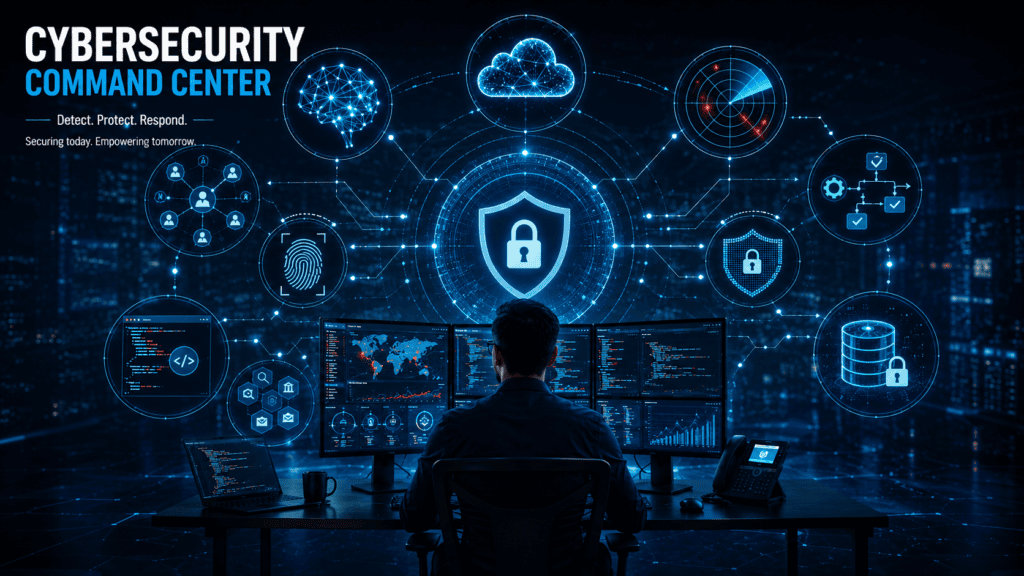
This matters particularly for SOC analysts, security engineers, penetration testers, software engineers, IT administrators, engineering managers, and CISOs deciding which cybersecurity skills deserve their attention.
The World Economic Forum’s Future of Jobs Report ranked AI and big data as the fastest-growing technology skill category, followed closely by networks and cybersecurity. Recognizing this shift, the National Institute of Standards and Technology (NIST) expanded its NICE Cybersecurity Workforce Framework to establish formal competency areas covering AI Security and DevSecOps alongside core protective disciplines.
For security professionals, the practical question is therefore:
Which cybersecurity skills should you develop to remain effective as AI becomes embedded in both attacks and defense?
Here are the key capability areas worth prioritizing.
AI and Machine Learning Security
Developing strong cybersecurity skills in AI and Machine Learning security requires understanding how traditional security concepts adapt to an expanded threat landscape. While application security traditionally focuses on software logic, APIs, networks, and databases, AI architectures introduce unique attack surfaces—such as model weights, training pipelines, retrieval stores, prompt interfaces, and autonomous agent frameworks.
To build well-rounded cybersecurity skills in this domain, security teams and technical professionals should master the core threat mechanisms outlined in industry standards like the NIST Adversarial Machine Learning taxonomy and the OWASP Top 10 for LLM Applications:
- Prompt Injection (Direct & Indirect): Crafting inputs that hijack an LLM’s control flow, overriding system instructions or manipulating downstream tools.
- Data and Model Poisoning: Tampering with pre-training data, fine-tuning sets, or vector stores to introduce malicious backdoors or deliberate bias.
- Sensitive Information Disclosure: Preventing the unintentional leakage of PII, internal system prompts, proprietary data, or API keys through model outputs.
- AI Supply Chain Vulnerabilities: Vetting untrusted third-party foundation models, open-source datasets (e.g., from Hugging Face), and fine-tuning packages for backdoors or vulnerabilities.
- Excessive Agency & Autonomous Risk: Securing AI agents with execution privileges and ensuring tools operate under strict least-privilege guardrails.
- RAG & Vector Security: Securing vector databases, embeddings, and retrieval pipelines against malicious document injection and unauthorized data exfiltration.
Key Role-Based Focus Areas
| Role | Primary Skill Depth | Practical Focus |
| SOC Analysts | Threat Monitoring & Telemetry | Recognizing prompt injection signatures, anomalous agent activity, and unusual data exfiltration via model APIs. |
| Security Engineers | Architecture & Guardrails | Implementing API gateway sanitization, vector database access controls, model firewalls, and least-privilege agent permissions. |
| Penetration Testers | Red Teaming & Exploitation | Executing jailbreaks, evaluating RAG pipeline limits, testing system prompt resilience, and probing the boundaries of tool execution. |
Practical Learning Framework
When evaluating or threat-modeling any modern AI integration, structure your assessment around the primary request pipeline:
User Input ➔ App Gateway ➔ System / Model ➔ Tools / APIs ➔ Data Sources (RAG) ➔ OutputAsking these core security questions ensures high-signal analysis without needing to build machine learning models from scratch:
- Identity & Access: How are users and service accounts authenticated before interacting with the model API or retrieval store?
- Input Boundaries: Is direct user input isolated from system instructions, or can an attacker manipulate model behavior via indirect injection?
- Privilege Isolation: What tools or functions can the AI execute, and are those executions bounded by strict permission scopes?
- Data Integrity: How is sensitive data filtered out before entering the prompt context or training pipeline?
- Logging & Telemetry: Are full prompt payload hashes, model decisions, and executed tool calls captured for incident response?
LLM and Generative AI Application Security
Large Language Models (LLMs) and Generative AI applications introduce non-deterministic security challenges that bypass conventional web-application vulnerability scans. Mastering cybersecurity skills in this domain requires extending traditional web application security (AppSec) into probabilistic, prompt-driven execution environments.
The OWASP GenAI Security Project identifies critical risks that security teams must evaluate:
- Prompt Injection (Direct & Indirect): Attackers craft inputs—or embed untrusted content in external documents—that hijack model instructions, bypass safety guardrails, and alter application flow.
- Excessive Agency: Granting LLM-based applications broad autonomy, unchecked permissions, or direct execution power over external systems (e.g., databases, APIs, messaging) without human-in-the-loop controls.
- System-Prompt & Sensitive Data Leakage: Inadequate output filtering resulting in the unintended disclosure of internal instructions, intellectual property, or PII through model outputs.
- Insecure Tool Calls & Plugin Design: Vulnerabilities in how the LLM formats and sends parameters to third-party APIs or system functions.
- RAG & Vector Vulnerabilities: Risks associated with poisoned context documents, unauthorized retrieval scope, and unvalidated outputs generated from retrieval-augmented databases.
Expanding Application Security Methodologies
Security engineers and penetration testers must expand traditional assessment criteria to cover both deterministic software flaws and non-deterministic model behaviors:
| Traditional AppSec Testing | AI-Era AppSec Testing Expansion |
| Authentication & Authorization | Model API Access Controls & Role-Based Context Limits |
| SQL Injection (SQLi) | Direct & Indirect Prompt Injection |
| Cross-Site Scripting (XSS) | Insecure Output Handling & Indirect Payload Rendering |
| API Boundary Validation | Insecure Tool Calls & Agent Autonomy Limits |
| Business Logic Testing | System Prompt Leakage & Jailbreak Resilience |
| Third-Party Dependencies | AI Supply Chain & Unvetted Open-Source Models |
Key Practical Takeaway
Developing practical cybersecurity skills for GenAI does not mean throwing away established security principles. Traditional AppSec—such as input validation, output encoding, identity management, and least-privilege architecture—remains the baseline foundation. GenAI security simply extends that foundation to handle dynamic, model-driven interfaces.
AI-Assisted Threat Detection and Threat Hunting
Cybersecurity teams generate massive, overwhelming volumes of telemetry. Endpoint events, authentication records, DNS queries, firewall logs, cloud audit trails, email security events, and application logs can easily flood analysts with noise.
AI-assisted analysis serves as a force multiplier, helping security teams correlate events, summarize incident timelines, prioritize suspicious activity, and drastically accelerate investigations. However, AI does not replace core defensive reasoning. Building effective cybersecurity skills in threat detection requires deep domain knowledge to validate whether an AI’s automated hypothesis is actually correct.
To maintain strong cybersecurity skills in AI-driven Security Operations Centers (SOCs), analysts and threat hunters should focus on key technical areas:
- Log & Telemetry Analysis: Interpreting structured and unstructured logs across operating systems, network perimeters, and cloud environments.
- Endpoint & Network Traffic Analysis: Recognizing anomalous process execution, unusual persistence mechanisms, lateral movement patterns, and C2 beaconing.
- Detection Engineering: Writing, tuning, and maintaining rules (e.g., Sigma, YARA, Snort) to capture novel attack patterns and minimize false positives.
- Attacker TTPs & Behavioral Analytics: Understanding adversary tactics, techniques, and procedures mapped to frameworks like MITRE ATT&CK.
- Threat Intelligence Interpretation: Validating raw Indicators of Compromise (IOCs) and contextualizing intelligence to separate true threats from benign activity.
AI Telemetry vs. Human Security Judgment
Consider a real-world scenario where an AI-assisted Security Information and Event Management (SIEM) platform alerts on a suspicious event chain:
New Unrecognized Device ➔ Privileged Admin Login ➔ Anomalous Cloud API Calls ➔ Bulk Data Storage Access
Code language: PHP (php)| Security Analysis Phase | AI Copilot Role | Human Analyst Role |
| Ingestion & Correlation | Aggregates logs across endpoint, IAM, and cloud provider APIs in real time. | Defines key data sources and ensures proper telemetry ingestion parameters. |
| Alert Summarization | Flags the event as high-severity based on historical behavioral baselines. | Evaluates organizational context (e.g., is there an active maintenance window or emergency release?). |
| Triage & Contextualization | Maps API activity to MITRE ATT&CK techniques (e.g., Valid Accounts T1078, Data from Cloud Storage T1530). | Investigates whether the user account was compromised, if credentials were leaked, or if an authorized admin is performing legitimate routine maintenance. |
| Remediation & Response | Suggests immediate containment actions (e.g., revoking API session tokens). | Authorizes response workflows, verifying that revoking access will not take down critical production workloads. |
Core Takeaway
AI tools dramatically reduce Mean Time to Detect (MTTD) and Mean Time to Respond (MTTR) by handling data correlation and alert aggregation. However, human cybersecurity skills remain essential for threat hunting, contextual validation, and final decision-making. AI accelerates the investigation; human security judgment determines the truth.
Security Automation and SecOps Engineering
Developing strong cybersecurity skills in Security Operations (SecOps) and automation allows defenders to scale their impact, reduce manual fatigue, and eliminate operational bottlenecks. Security operations centers yield immense volumes of repetitive tasks; modern SecOps engineering shifts focus from manual alert handling to building resilient, programmatic workflows.
ISC2’s July 2026 research into AI’s impact on cybersecurity roles highlights that AI-driven automation is heavily altering routine tasks—particularly alert triage, log analysis, report generation, vulnerability prioritization, and initial threat hunting. As AI platforms accelerate these workflows, the value of human cybersecurity skills shifts toward orchestrating systems, writing custom automations, and verifying automated outputs.
Core Technical Competencies for SecOps Engineering
To successfully build and maintain automated security pipelines, professionals should build proficiency across a specific technical stack:
[ Data Pipelines & Logs ] ➔ [ APIs & Scripting ] ➔ [ Orchestration & SOAR ] ➔ [ Policy as Code ]
 (SIEM / Regex / JSON)     (Python / PowerShell)    (Automated Workflows)     (Terraform / CI/CD)
Code language: JavaScript (javascript)- Scripting & Execution: Writing clean, modular Python, PowerShell, or Bash scripts to interact with network endpoints and cloud environments.
- API & Data Handling: Parsing JSON, XML, and structured data payloads from REST APIs using Regular Expressions (
regex) to transport data between tools. - SIEM Query Languages: Querying complex datasets using language-specific syntax (e.g., KQL for Microsoft Sentinel, SPL for Splunk, Lucene for Elastic).
- SOAR Platforms: Designing visual and programmatic playbook flows in Security Orchestration, Automation, and Response tools (e.g., Cortex XSOAR, Swimlane, Tines).
- Infrastructure as Code (IaC): Managing security policies and detection rules through version-controlled code repositories (Git) using tools like Terraform or Ansible.
High-Impact Automation Targets vs. Human Approval
Automation should handle repetitive evidence-gathering long before taking irreversible enforcement actions.
| Task Category | Automated Workflow Action | Human Approval Requirement |
| Alert Enrichment | Automatically queries VirusTotal, AbuseIPDB, and threat intel feeds for incoming IP/hash alerts. | Fully Automated (Zero human intervention needed). |
| Evidence Collection | Pulls endpoint memory dumps, user login histories, and cloud audit trails upon detection. | Fully Automated (Prepares timeline for analyst review). |
| Ticket Creation | Generates Jira/ServiceNow tickets with enriched threat data, pre-categorized by severity. | Fully Automated. |
| Containment Action | Isolates a compromised host endpoint from the corporate network. | Semi-Automated (Requires analyst click-to-approve). |
| Enforcement & Blocking | Revokes production identity tokens, terminates active sessions, or modifies core firewall rules. | Human-in-the-Loop (Requires senior analyst or SOC manager authorization). |
Guiding Principle for SecOps Automation
Automate repetitive evidence gathering before automating irreversible decisions.
The core objective of building SecOps cybersecurity skills is not to automate every single operational decision. High-impact or destructive actions—such as shutting down production cloud clusters, blocking critical enterprise domains, or revoking executive access—demand human context and accountability. Automation delivers the context; humans deliver the judgment.
Cloud Security
Modern AI models and workloads rely heavily on cloud infrastructure. This makes cloud security and AI security tightly connected.
Without foundational cybersecurity skills in cloud environments, securing AI models, vector stores, or automated pipelines becomes impossible. Traditional on-premises network boundaries do not apply in cloud setups. A single permissive IAM policy or misconfigured S3 bucket can expose proprietary model weights, vector databases, or customer telemetry.
To build well-rounded cybersecurity skills in cloud-native AI security, focus on these critical control points:
- Cloud Identity and Access Management (IAM): Enforcing least-privilege policies, managing short-lived service account tokens, and preventing privilege escalation across AI workloads.
- Secrets Management: Keeping database credentials, API keys, and model access tokens out of source code or container images by using managed secrets stores (e.g., AWS Secrets Manager, HashiCorp Vault).
- Data Lake & Storage Protection: Securing S3 buckets, Blob storage, and vector databases (e.g., Pinecone, Milvus) that hold sensitive training, fine-tuning, or retrieval-augmented generation (RAG) data.
- Container & Workload Security: Hardening Docker containers and Kubernetes clusters hosting inference APIs, model runtimes, and training jobs.
- API Gateway & Serverless Security: Protecting model endpoints using rate limiting, web application firewalls (WAF), and strict schema validation.
- Cloud Logging & Audit Trails: Monitoring control-plane audit logs (AWS CloudTrail, GCP Audit Logs) to spot unusual API calls, unauthorized model exports, or abnormal data access.
Cloud Identity vs. Network Boundaries in the AI Stack
In cloud environments, identity is the primary security boundary:
| Traditional On-Premises Control | Cloud-Native AI Security Equivalent |
| Perimeter Firewalls & VLANs | Fine-Grained Identity Access (IAM Roles & Attributes) |
| Hardened Physical Servers | Isolated Container Environments & Serverless Workloads |
| Database Password File | Ephemeral Secrets & Managed Key Vaults |
| Static Network Taps | API Gateway Inspection & Centralized Cloud Log Storage |
Practical Learning Framework
Rather than attempting to master every cloud provider at once, choose one primary ecosystem (AWS, Azure, or GCP) and develop great technical skills across these core areas:
[ IAM & Identity ] ➔ [ Secrets & Key Vaults ] ➔ [ Workload Security ] ➔ [ Centralized Logging ]
(Policy Scoping) (API Key Protection) (Containers / Kubernetes) (Control-Plane Auditing)- Identity First: Learn how role assumptions, condition keys, and resource policies interact to grant minimal required access.
- Data Isolation: Implement strict encryption at rest and in transit for cloud storage buckets hosting AI models and embeddings.
- Audit Visibility: Configure automated alerts for sensitive actions, such as downloading large objects from storage or modifying IAM policy definitions.
Mastering these core principles in one primary platform makes it straightforward to transfer those cybersecurity skills across any multicloud architecture.
Identity Security and Zero Trust
In modern cloud and AI environments, identity has replaced the network perimeter as the primary security control point. NIST’s Zero Trust Architecture (ZTA) dictates a fundamental shift: trust is never implicitly granted based on network location or hardware ownership. Every single request must be explicitly authenticated and authorized before granting access to enterprise resources.
Developing advanced cybersecurity skills in identity management is critical because AI agents now act autonomously on behalf of users. When an AI agent can read emails, access cloud storage, query databases, and execute workflow actions, its identity and permission scope become a massive, highly targeted attack surface.
- Identity and Access Management (IAM): Designing robust directories, enforcing Conditional Access policies, and deploying phishing-resistant Multifactor Authentication (MFA).
- Machine & Service Identities: Securing non-human access, including API keys, service accounts, OAuth tokens, and managed identities used by AI models and automated pipelines.
- Privileged Access Management (PAM): Restricting administrative access through just-in-time (JIT) provisioning, credential vaulting, and strict access reviews.
- Zero Trust Execution: Implementing continuous validation and enforcing the principle of least privilege across all distributed systems.
The AI Agent Identity Problem
AI agents should never receive unlimited or persistent access simply because they are automated. The principle of least privilege applies equally to machines and humans. If an AI agent only needs to query a database to retrieve public records, it should not possess write permissions or database administrator roles.
| Identity Control | Human User | Autonomous AI Agent |
| Authentication | Passwords, FIDO2 Keys, Biometrics | OAuth Scopes, Short-Lived Tokens, Mutual TLS |
| Authorization | Role-Based Access Control (RBAC) | Strict API boundaries and function-level execution limits |
| Monitoring | User Entity Behavior Analytics (UEBA) | Tool call logging, token usage tracking, API rate limiting |
Securing the AI era requires treating every model, retrieval-augmented generation (RAG) pipeline, and autonomous agent as a distinct identity that must continuously prove its trustworthiness before executing an action.
DevSecOps and Secure Software Development
Security professionals increasingly need to understand how software moves from source code to production. Integrating security into modern development pipelines—rather than treating it as a final roadblock—is a core requirement for engineering teams.
Reflecting this shift, the NIST NICE Cybersecurity Workforce Framework includes DevSecOps as a formal competency area. Building technical cybersecurity skills in DevSecOps ensures that security controls are automated throughout the software development lifecycle (SDLC) rather than relying exclusively on a point-in-time penetration test before release.
Key DevSecOps Technical Capabilities
To secure modern build pipelines and cloud-native deployments, security engineers and AppSec specialists should focus on mastering these foundational mechanisms:
- Continuous Integration / Continuous Deployment (CI/CD) Security: Hardening build servers (e.g., GitHub Actions, GitLab CI, Jenkins), securing pipeline triggers, and enforcing signed commits.
- Automated Secrets Detection: Scanning source repositories for exposed API keys, private certificates, and database credentials before code reaches production branches.
- Software Composition Analysis (SCA): Tracking third-party dependencies and open-source packages to identify known vulnerabilities (CVEs) and license compliance issues.
- Static & Dynamic Testing (SAST/DAST): Integrating static code analysis and dynamic runtime scanning directly into developer pull requests.
- Infrastructure as Code (IaC) Scanning: Auditing Terraform, CloudFormation, and Ansible scripts for cloud misconfigurations before resources are provisioned.
- Software Supply Chain Security: Verifying Software Bills of Materials (SBOMs), validating package integrity, and preventing dependency confusion or supply chain attacks.
The Impact of AI-Generated Code
The rise of AI coding assistants (e.g., GitHub Copilot, Cursor) makes DevSecOps cybersecurity skills more vital than ever. While AI tools accelerate software production, they frequently generate code containing subtle vulnerabilities—such as missing input validation, insecure cryptographic calls, hardcoded secrets, or deprecated dependencies.
Developer Prompt ➔ AI Code Generation ➔ Automated DevSecOps Pipeline ➔ Secure Production Deploy
                                        (SAST / Secrets / SCA)
| Security Scanning Stage | Traditional Purpose | AI-Generated Code Specifics |
| Secrets Scanning | Detects hardcoded keys accidentally committed by human engineers. | Flags hallucinated or placeholder credentials generated by LLMs during code completion. |
| SAST (Static Analysis) | Identifies logic flaws, injection risks, and buffer overflows. | Catches common AI patterns that omit sanitization routines or use unsafe default parameters. |
| SCA (Dependency Analysis) | Audits third-party open-source libraries. | Prevents “slopsquatting” or importing non-existent, hallucinated package names targeted by attackers. |
Core Takeaway
AI tools allow developers to write code faster, but speed without verification creates severe security debt. Mastering DevSecOps cybersecurity skills equips professionals to design automated guardrails that validate every line of code—whether written by a human or an AI model—before it ever reaches production.
Vulnerability Management and Prioritisation
Modern enterprise scanners routinely surface thousands of vulnerabilities across cloud assets, containers, identity systems, endpoints, and code repositories. Finding vulnerabilities is no longer the operational bottleneck in vulnerability management—prioritizing them effectively is.
Developing advanced cybersecurity skills in vulnerability management requires moving away from static, legacy metrics (such as relying solely on raw CVSS base scores) toward dynamic, context-aware risk prioritization.
Core Prioritization Factors
High-signal vulnerability management combines multiple technical and business data points to determine actual exploitability and risk:
- Exploitability Signals: Incorporating the Exploit Prediction Scoring System (EPSS) to evaluate real-time probability of weaponization, alongside mandatory tracking of CISA’s Known Exploited Vulnerabilities (KEV) Catalog.
- Asset Exposure & Network Context: Evaluating whether an asset is publicly internet-facing, placed behind an API gateway, or strictly isolated inside a restricted management subnet.
- Business Criticality: Assessing the data sensitivity (e.g., PII, source code, financial records) and operational impact if the host or service is compromised.
- Runtime Execution Data: Verifying whether a vulnerable software library is actively executed at runtime or merely loaded as dead, uncalled code.
- Compensating Controls: Factoring in secondary protective layers, such as Web Application Firewalls (WAF), microsegmentation, or strict WebAuthn/MFA requirements.
Contextual Risk: Same Vulnerability, Different Threat Profile
While AI models and automated risk engines can accelerate vulnerability classification, blindly accepting an automated severity rating without human validation introduces severe business risk.
Consider how the same critical flaw (e.g., a Remote Code Execution vulnerability rated CVSS 9.8) demands vastly different prioritization based on asset context:
[ Critical Vulnerability (CVSS 9.8) ]
       │
       ├─► Scenario A: Internet-Facing Production SSO Gateway ──► [ Priority 1: Immediate Patch ]
       │
       └─► Scenario B: Air-Gapped Isolated R&D Testing Lab ────► [ Priority 3: Scheduled Maintenance ]
Code language: CSS (css)| Risk Dimension | Scenario A: Production Identity Gateway | Scenario B: Air-Gapped Lab Machine |
| Asset Exposure | Directly exposed to public traffic. | Isolated local network; no incoming external routing. |
| Data & Identity Impact | Controls enterprise-wide user access and secrets. | Contains synthetic, non-sensitive testing data. |
| Threat Intelligence | Active scanning observed via threat feeds. | Low risk of automated discovery or remote exploitation. |
| Remediation Urgency | Immediate Emergency Patching (24-48 hr SLA). | Standard Maintenance Cycle (30-60 day SLA). |
Key Takeaway
A vulnerability scanner or AI tool provides raw operational data, but cybersecurity skills lie in contextual risk judgment. Security professionals must align technical vulnerability metrics with business impact, system posture, and active threat intelligence to direct remediation resources where they matter most.
Incident Response and Digital Forensics
Incident response and digital forensics remain core operational disciplines. While AI tools can drastically reduce the time to detect suspicious behavior, human security judgment is indispensable for containing attacks, preserving evidence, and performing root-cause analysis when a breach occurs.
Modern incident handling relies on standard framework stages—such as those reflected in NIST SP 800-61 Rev. 3 (Detect, Respond, Recover, Improve):
- Preparation & Prevention: Establishing incident playbooks, access controls, logging standards, and baseline telemetry configs before an intrusion occurs.
- Detection & Investigation: Validating alerts, correlating event sequences, isolating compromise vectors, and verifying whether an anomaly represents an active attack.
- Containment & Eradication: Quarantining infected systems, revoking compromised access tokens, patching exploited vulnerabilities, and removing malicious persistence mechanisms.
- Recovery & Evidence Preservation: Safely restoring production workloads from verified backups while maintaining strict chain-of-custody for digital evidence.
- Root-Cause Analysis & Improvement: Conducting post-incident reviews to identify structural weaknesses and feed lessons learned back into defensive controls.
How AI Changes Digital Forensics & Telemetry
Investigating security incidents in traditional environments primarily meant analyzing host memory dumps, disk images, firewall logs, and network packet captures. In AI-enabled architectures, threat actors can target model interactions, data pipelines, and agent permissions.
To investigate incidents involving AI applications, responders must analyze a broader, highly specialized telemetry stack:
| Traditional Investigation Focus | AI-Era Investigation Telemetry Expansion |
| Authentication & SSH Logs | API Gateway Token Grants, Model Access Credentials & OAuth Scopes |
| Database Query Logs | Vector DB Queries, Retrieval Context Ingestion & RAG Index Mutexes |
| Application Process Trees | Prompt Payload Hashes, System Prompt Modifications & Model Inference Calls |
| Network Traffic (PCAP) | LLM API Endpoint Calls, External Tool Execution Logs & Agent Webhooks |
| Host Memory & Storage | Training Data Modification Records, Model Weight Hashes & Fine-Tuning Logs |
Core Forensics Requirement: Observability
An incident investigation cannot succeed if the required evidence was never logged. AI applications cannot be treated as opaque black boxes; every prompt, external API tool call, vector store retrieval, and system output must generate immutable, time-stamped logs.
Mastering cybersecurity skills in incident response requires designing robust AI logging architectures before an incident occurs, ensuring digital forensics teams have the visibility needed to reconstruct complex attack paths.
Threat Modelling for AI Systems
Threat modeling shifts security from reactive patching to proactive design. By asking “How could this system fail or be abused?” during the design phase, security professionals identify architectural flaws long before code reaches production or undergoes penetration testing.
Because AI applications combine non-deterministic model behaviors, complex data pipelines, dynamic memory stores, and autonomous execution capabilities, traditional software threat modeling frameworks (like STRIDE) must be expanded to account for AI-specific attack paths.
Threat Modeling an AI Assistant System
Consider a common enterprise deployment: an internal AI assistant connected to corporate databases via Retrieval-Augmented Generation (RAG) and integrated with external communication APIs.
                  ┌─────────────────────────────────────────────────────────┐
                  │                 ATTACK SURFACE BOUNDARY                 │
                  └─────────────────────────────────────────────────────────┘
                                               │
┌──────────────┐     Prompts     ┌─────────────▼────────────┐  RAG Queries  ┌──────────────┐
│ Human User / ├────────────────►│ AI App & Prompt Gateway  ├──────────────►│ Vector DB /  │
│ Threat Actor │◄────────────────┤  (LLM Execution Engine)  │◄──────────────┤ Knowledge Base│
└──────────────┘    Responses    └──────────────┬───────────┘  Context Data └──────────────┘
                                                │
                                         Tool / API Calls
                                                │
                                                ▼
                                   ┌────────────────────────┐
                                   │  Enterprise Services   │
                                   │ (Email / Slack / SQL)  │
                                   └────────────────────────┘
A structured threat modeling assessment for this system evaluates key architectural risk areas:
- Prompt & Input Interfaces: Who can submit prompts? Can an attacker perform direct jailbreaks or introduce indirect prompt injection through external documents?
- Context & Retrieval Security: Which documents can the model retrieve? Can an unauthorized user use the model as a proxy to exfiltrate restricted HR or financial records?
- Data Pipeline Integrity: Can malicious or untrusted content enter the vector database, poisoning the knowledge base and corrupting future model outputs?
- Tool Execution & Excessive Agency: What tools can the agent invoke (e.g., sending emails, executing database writes)? Are those tools operating under strict, least-privilege service permissions?
- Downstream Output Validation: Are model outputs trusted blindly by downstream applications, creating secondary SQL injection or Cross-Site Scripting (XSS) risks?
- Human-in-the-Loop Controls: Are sensitive or irreversible actions (e.g., deleting accounts, transferring funds, granting permissions) gated by mandatory human authorization?
Core Threat Modeling Framework for AI
| Threat Category | Traditional App Risk | AI System Equivalent | Key Mitigation Capability |
| Spoofing / Identity | User impersonation | Unauthenticated API agent triggers | Mutual TLS, OAuth scopes, and strict token validation. |
| Tampering | Modifying database records | Poisoning training data or RAG vector stores | Cryptographic hashes on retrieval data, immutable audit logs. |
| Information Disclosure | Unencrypted HTTP traffic | Model system-prompt leakage or PII extraction | Output sanitization filters, strict RAG role-based access controls. |
| Elevation of Privilege | Exploiting buffer overflows | Indirect prompt injection hijacking agent tool calls | Human-in-the-loop gates for high-risk executions, minimal tool permissions. |
Key Takeaway
Developing threat modeling cybersecurity skills for AI systems ensures that security considerations are baked into the system architecture from day one. Uncovering a flawed agent permission model during the design phase costs a fraction of the time and resources required to remediate an active production breach.
AI Governance and Cybersecurity Risk Management
Technical expertise alone is insufficient for senior cybersecurity roles. Engineering managers, security architects, and CISOs must understand how technical AI risks connect directly with enterprise governance, regulatory frameworks, and operational strategy.
Modern cybersecurity governance relies on established framework updates:
- NIST Cybersecurity Framework (CSF) 2.0: Formally introduced the Govern function as a core pillar, placing cybersecurity policies, roles, risk tolerances, and executive accountability on equal footing with technical identification and protection controls.
- NIST AI Risk Management Framework (AI RMF): Offers structured guidance to manage risks specific to artificial intelligence, focusing on trustworthy characteristics such as valid, reliable, safe, secure, resilient, transparent, and explainable AI systems.
- ISO/IEC 42001 (Artificial Intelligence Management System): Provides the international certifiable standard for establishing, implementing, and continually improving an organization’s AI governance and risk controls.
Key Pillars of AI Governance
Effective governance does not mean blocking employees from leveraging AI tools. Instead, it establishes explicit parameters around data usage, operational execution, and accountability:
| Governance Domain | Strategic Focus | Operational Controls |
| Asset Discovery & Inventory | Visibility | Maintaining real-time inventories of all approved AI models, RAG vector stores, APIs, and shadow AI usage. |
| Data Classification & Privacy | Protection | Enforcing acceptable-use policies to prevent employees from feeding confidential source code, customer PII, or internal financials into third-party LLMs. |
| Third-Party & Vendor Risk | Supply Chain | Assessing external AI software vendors, foundation model APIs, and data providers for safety, compliance, and security posture. |
| Access & Model Scoping | Identity | Implementing continuous authorization and monitoring to ensure AI agent permissions align strictly with business role requirements. |
| Accountability & Response | Escalation | Defining clear ownership structures so human managers bear explicit responsibility when an AI system fails or makes an unauthorized execution. |
Core Takeaway
Developing governance cybersecurity skills enables security leaders to align technical defenses with legal obligations, corporate strategy, and risk tolerance. High-signal governance transforms security from a reactive blocker into a business enabler—allowing organizations to innovate safely with AI while maintaining strict operational resilience.
Human Judgement, Communication and Analytical Thinking
One of the most vital cybersecurity skills in the AI era is also one of the least technical: knowing when the machine is wrong.
While AI excels at rapidly ingesting telemetry, summarizing alerts, and suggesting code optimizations, it remains probabilistic. Generative models can produce confidence-driven explanations that are contextually blind, incomplete, or outright inaccurate—a phenomenon that presents severe risks if accepted without human validation.
Security professionals must cultivate essential cognitive and interpersonal capabilities to complement their technical expertise:
- Evidence Validation & Analytical Skepticism: Treating AI-generated summaries, vulnerability scores, and incident hypotheses as initial leads rather than definitive truth.
- Contextual Risk Decision-Making: Weighing business impact, operational uptime, and regulatory obligations against automated recommendations before executing high-impact responses.
- Cross-Functional Communication: Translating complex AI-driven threats, technical vulnerabilities, and operational trade-offs into plain language for executives, legal teams, and non-technical stakeholders.
- Business Awareness: Understanding how enterprise workflows function so that security controls protect critical revenue streams without introducing unnecessary operational friction.
The Evolution of the Cybersecurity Professional
As AI automates routine data collection, log triage, and report generation, the core value of human security expertise fundamentally shifts:
    TRADITIONAL ROLE                       AI-ERA ROLE
┌──────────────────────┐              ┌──────────────────────┐
│ Information Gatherer │  ─────────►  │  Contextual Evaluator│
│  Data Collection &   │   Shift To   │  Evidence Validation │
│   Manual Telemetry   │              │  & Accountable Risk  │
└──────────────────────┘              └──────────────────────┘
| Operational Dimension | The Role of AI Automation | The Role of Human Judgment |
| Data Processing | Rapidly correlates millions of log lines and signals. | Verifies whether the correlated events represent a real security incident or benign operations. |
| Threat Hypothesis | Generates probable attack paths and mitigation options. | Evaluates whether applying a mitigation will break production systems or interrupt critical business. |
| Reporting & Comms | Drafts incident summaries and technical documentation. | Refines the narrative to deliver high-signal, accountable updates to leadership and regulators. |
Practical Takeaway
The goal of developing cybersecurity skills in the AI era is not to compete with machines at processing speed, but to excel where machines fail. AI provides velocity; human judgment, critical thinking, and contextual awareness provide direction, safety, and accountability.
AI Is Both a Cybersecurity Threat and a Defensive Tool
It is a mistake to frame artificial intelligence solely as a threat vector, just as it is misleading to view it as an autonomous, silver-bullet cybersecurity solution.
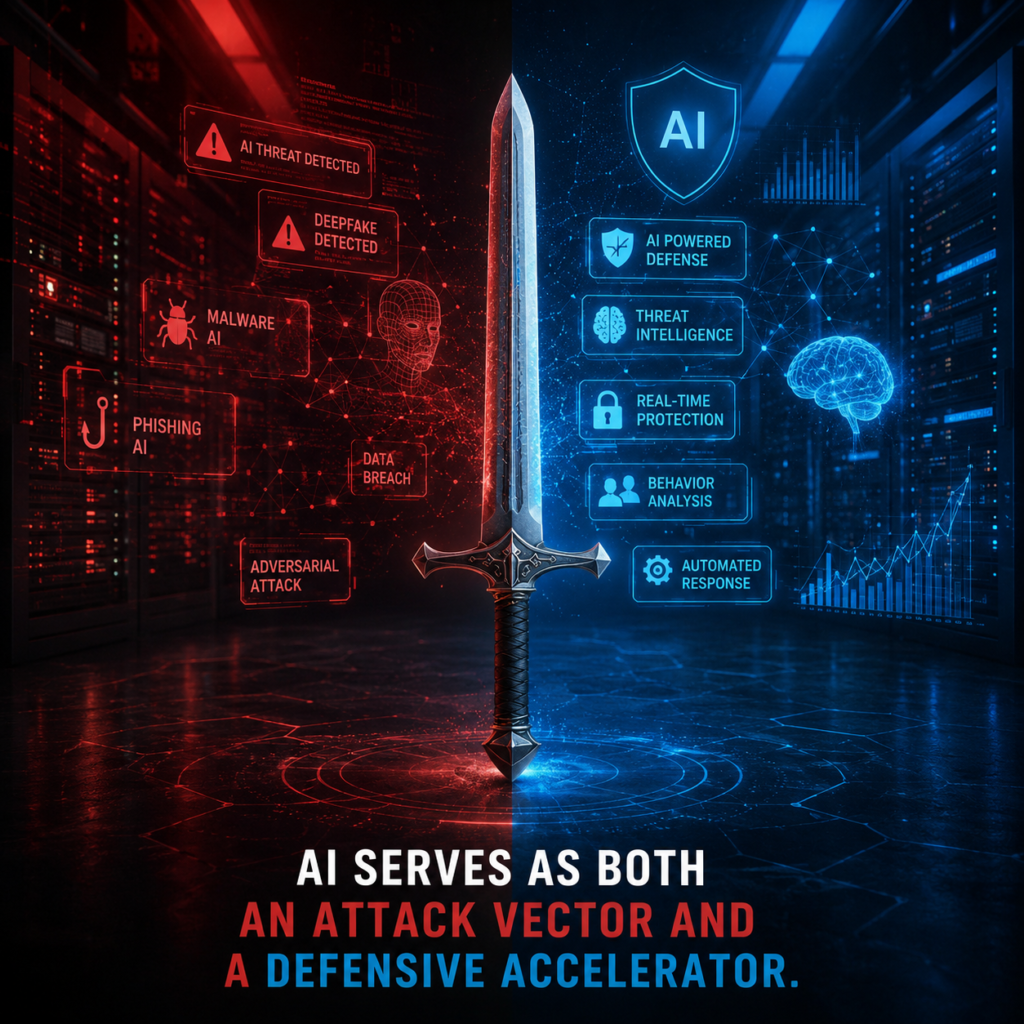
To build high-signal cybersecurity skills, security professionals must evaluate AI through a dual-lens framework that balances emerging adversarial exploitation against defensive acceleration capabilities:
| AI as an Attack Consideration (Threat Vector) | AI as a Defensive Accelerator (Force Multiplier) |
| Prompt Injection & Hijacking: Direct and indirect prompt manipulation aimed at overriding model system instructions. | Alert Summarization & Triage: Automatically condensing complex, multi-stage telemetry alerts into clear incident timelines. |
| Data & Model Poisoning: Tampering with training datasets, fine-tuning samples, or RAG vector embeddings to introduce backdoors. | Log Analysis at Scale: Parsing gigabytes of heterogeneous SIEM, endpoint, and cloud audit logs in real time. |
| AI-Assisted Social Engineering: Scaling highly persuasive, personalized phishing campaigns and automated pretexting. | Threat-Intelligence Analysis: Cross-referencing raw IOCs with global threat feeds to contextualize active campaigns. |
| Agent & Pipeline Exploitation: Hijacking autonomous AI agent execution loops to achieve unauthorized system access. | Investigation Assistance: Guiding SOC analysts through query construction, root-cause isolation, and evidence gathering. |
| Sensitive-Data Leakage: Exfiltrating proprietary code, PII, or internal credentials through unmonitored model prompts or outputs. | Contextual Vulnerability Prioritization: Combining asset criticality, exposure, and EPSS scores to direct remediation resources. |
| AI Supply-Chain Risks: Importing unvetted third-party foundation models, packages, or open-source weights with embedded flaws. | Security Workflow Automation: Automating repetitive SOAR tasks, ticketing, and non-destructive incident containment. |
| Excessive Agent Permissions: Exploiting dynamic tool calls and over-privileged agent API keys to bypass access controls. | Detection Engineering Assistance: Accelerating the creation and tuning of Sigma, YARA, and SIEM detection rules. |
Core Strategic Takeaway
Developing future-proof cybersecurity skills requires operating comfortably at the intersection of both domains. The most valuable security leaders, engineers, and analysts will not treat cybersecurity and AI as isolated disciplines—they will master the dynamic feedback loop of how AI alters the systems they protect, the threats they face, and the defensive architectures they build.
Which Cybersecurity Skills Should You Prioritise?
To build maximum leverage without overwhelming yourself, align your learning roadmap directly with your functional area:
| Role | High-Priority Cybersecurity Skills | Primary Focus |
| SOC Analyst | AI-assisted threat hunting, SIEM, detection engineering, automation, incident response | Accelerating telemetry correlation and using human judgment to validate AI alerts. |
| Security Engineer | Cloud security, IAM, zero trust, automation, AI security | Hardening infrastructure, service accounts, model endpoints, and secrets pipelines. |
| Penetration Tester | LLM security, prompt injection testing, API security, AppSec, agentic AI testing | Adversarial red teaming, jailbreaking models, and probing tool execution boundaries. |
| Software Engineer | Secure coding, DevSecOps, AI application security, secrets management | Auditing AI-generated code and securing continuous deployment pipelines. |
| IT Administrator | Cloud security, identity security, logging, zero trust, automation | Managing least-privilege access, machine identities, and cloud audit logs. |
| Security Architect | AI threat modeling, cloud architecture, zero trust, governance | Designing secure AI execution environments and resilient system topologies. |
| Engineering Manager | DevSecOps, AI governance, secure development lifecycle, risk management | Integrating security automation into developer workflows and managing risk. |
| CISO | AI governance, enterprise risk, third-party risk, workforce planning, incident readiness | Establishing accountability, policy frameworks, and aligning AI usage with business risk. |
Key Takeaway for Career Progression
Attempting to master every security domain simultaneously is inefficient. Focusing on your core domain builds deep technical proficiency, allowing you to gradually add complementary capabilities—such as scripting, cloud IAM, or model evaluation—as your career evolves.
A Practical 90-Day Upskilling Blueprint
A structured 90-day implementation plan prevents information overload and ensures measurable career ROI. Rather than attempting to master every emerging tool simultaneously, focus on sequential, high-leverage milestones:
Phase 1 (Days 1–30): Master AI Security Fundamentals
- Core Objectives: Understand how modern LLM applications, retrieval-augmented generation (RAG) pipelines, and agentic workflows operate in production.
- Key Topics: OWASP GenAI Top 10, direct and indirect prompt injection, excessive agency, data flows, and NIST AI Risk Management Framework concepts.
- Actionable Step: Set up a test environment or inspect a local LLM application to map its end-to-end input/output attack surface.
Phase 2 (Days 31–60): Build Security Automation Literacy
- Core Objectives: Move from manual alert handling to programmatic workflow orchestration and API-driven telemetry analysis.
- Key Topics: Python scripting, REST APIs, JSON data handling, regular expressions, and SOAR platform playbooks.
- Actionable Step: Automate a repetitive evidence-gathering workflow:
Security Alert ➔ Extract Indicators ➔ Query Reputation APIs ➔ Summarize Evidence ➔ Create Ticket - Operational Rule: Maintain human-in-the-loop controls for any irreversible or high-impact enforcement actions.
Phase 3 (Days 61–90): Role-Specific Application & Execution
- Core Objectives: Apply your newly acquired cybersecurity skills directly to your daily operational responsibilities.
- Role Implementations:
- SOC Analysts: Build AI-assisted investigation and alert triage playbooks.
- Penetration Testers: Practice assessing deliberately vulnerable LLM applications and agentic frameworks.
- Security Engineers: Threat-model an enterprise cloud AI deployment.
- Software Engineers: Integrate SAST, SCA, and secrets scanning into CI/CD pipelines.
- Managers & CISOs: Perform an AI security skills-gap assessment across your technical teams.
The ultimate objective is demonstrable capability, operational confidence, and practical execution—not simply collecting another list of theoretical tools.
Common Mistakes to Avoid
Avoiding common strategic traps ensures that your effort yields long-term career growth and operational value:
- Chasing Tools Over Core Fundamentals: Specific vendor software and AI products will rapidly evolve. Identity management, least-privilege architecture, threat modeling, logging, and incident response remain timeless cybersecurity skills.
- Trusting AI Outputs Blindly: Treating AI analysis as ground truth without human validation creates severe operational risk, particularly when executing actions that affect production workloads.
- Neglecting Traditional Attack Surfaces: While prompt injection and model vulnerabilities demand attention, compromised credentials, unpatched APIs, misconfigured cloud storage, and excessive permissions remain the leading causes of real-world breaches.
- Granting Unbounded Agent Permissions: Deploying autonomous AI agents without strict API boundaries and function-level permission caps violates basic Zero Trust principles.
- Learning Theory Without Building: Theoretical knowledge is a starting point, but practical capability—identifying a flaw, reproducing it safely, configuring defensive guardrails, and documenting the risk—demonstrates true technical mastery.
Key Takeaway
Technology stacks will shift, but the core objective remains constant: protecting business continuity, securing critical data, and managing risk. Focus on foundational principles, validate machine outputs, and prioritize practical execution.
Will AI replace cybersecurity professionals?
AI is changing cybersecurity workflows rather than replacing human expertise. Research from organizations like ISC2 highlights that AI is heavily automating repetitive tasks like alert triage, log analysis, report generation, and vulnerability prioritization.
However, human judgment, contextual risk evaluation, accountability, and strategic decision-making remain completely irreplaceable.
Do cybersecurity professionals need to learn machine learning?
Not every security professional needs to become a machine learning engineer or know how to train transformer models from scratch.
However, anyone securing AI-enabled systems should understand basic AI application architecture, common threat vectors (like prompt injection and data poisoning), data flows, and model access controls.
Is prompt engineering a cybersecurity skill?
Prompt engineering can be a useful tactical technique when querying AI-assisted security tools or crafting jailbreaks during red-teaming exercises. However, it is not a standalone cybersecurity competency.
True security expertise requires broader mastery over system architecture, access control, threat modeling, API security, and risk validation.
Which programming language is most useful for cybersecurity automation?
Python is the industry standard and most versatile language for cybersecurity automation, API interactions, data parsing, and security scripting. PowerShell is essential for Microsoft and Active Directory environments, while Bash/shell scripting remains critical for Linux systems and cloud infrastructure.
Is Zero Trust still important in the AI era?
Zero Trust is more critical than ever. The deployment of autonomous AI agents and model integrations expands an organization’s non-human identity footprint.
Enforcing explicit authentication, continuous authorization, and strict least-privilege permissions ensures that AI systems cannot be weaponized to move laterally or exfiltrate sensitive enterprise data.
In Conclusion
The AI era is not eliminating the need for cybersecurity skills—it is expanding the scope of what security professionals must protect.
Traditional foundational capabilities such as network security, identity management, secure software development, incident response, vulnerability management, and risk assessment remain as critical today as ever. The emerging layer that elevates a practitioner into an AI-era professional includes:
- AI and Machine-Learning Security (Model hardening, prompt injection defense, vector DB security)
- LLM Application Security (OWASP GenAI Top 10 mitigation, output sanitization)
- AI-Assisted Threat Hunting (Accelerating telemetry analysis without losing analytical rigor)
- Security Automation & SecOps (Python, APIs, and SOAR workflow orchestration)
- Cloud Security & DevSecOps (Automated pipeline guardrails, IaC scanning, least-privilege IAM)
- AI Threat Modeling & Agent Security (Bounding autonomous agent permissions and tool calls)
- AI Governance & Risk Management (Aligning technical controls with NIST AI RMF and ISO/IEC 42001)
The most effective career strategy is not to abandon core cybersecurity fundamentals in pursuit of every shiny new AI vendor tool. Instead, build specialized AI security and automation capabilities on top of a strong, principled security foundation.
Ready to Future-Proof Your Cybersecurity Career?
Whether you are an analyst automating your first alert workflow or a security leader designing an enterprise AI governance framework, continuous, high-signal upskilling is your greatest competitive advantage.
- Take Action: Choose one high-impact workflow in your current role and apply the 90-Day Blueprint outlined above.
- Stay Informed: Explore our latest in-depth career guides, technical frameworks, and AI tool reviews on Skilldential.com to build high-leverage skills that scale.
Your Next Step
Choose one cybersecurity skill directly related to your current role and build a small, practical project around it:
- SOC Analyst: Automate an alert enrichment playbook using Python and a threat intelligence API.
- Penetration Tester: Set up a local LLM application lab to test direct and indirect prompt injection vectors safely.
- Security Engineer: Perform a structured threat model on a Retrieval-Augmented Generation (RAG) pipeline.
- Software Engineer: Integrate automated SAST and secrets-scanning checks into a CI/CD pipeline.
- Security Manager: Map your team’s current capabilities against the NIST NICE Framework to identify specific AI-era skill gaps.
Executing a single, focused project transforms AI-era cybersecurity from an abstract industry trend into a concrete, demonstrable professional capability.