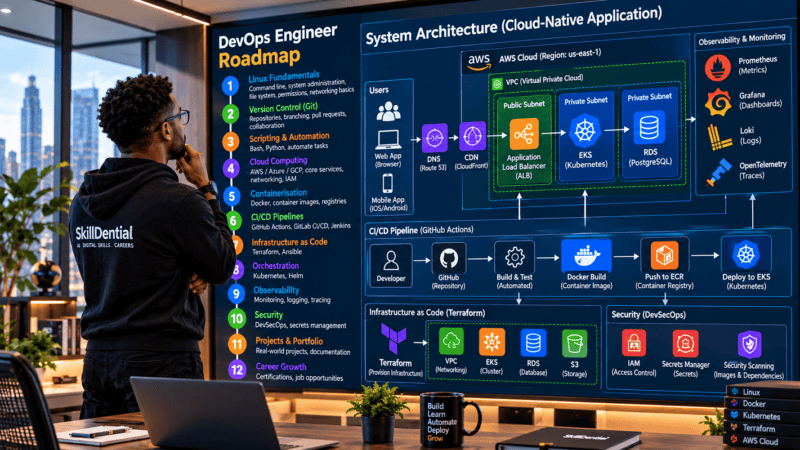
How to Become a CTO Without a Programming Background
Can you reach executive leadership without starting as a software engineer? Yes, you can become a CTO without a traditional coding background. While a Chief Technology Officer must have deep technical literacy to evaluate architecture, security, infrastructure, and engineering risk,the role extends far beyond writing code.
Modern technology leadership is fundamentally about aligning technical strategy with business outcomes, managing cross-functional teams, and making high-stakes decisions under uncertainty.
For aspiring leaders evaluating how to become a CTO, the most pragmatic route requires building strategic technical competence alongside executive presence, product vision, and financial acumen. Success is defined by owning overall technology outcomes rather than merely executing individual technical tasks.
What Does a CTO Actually Do?
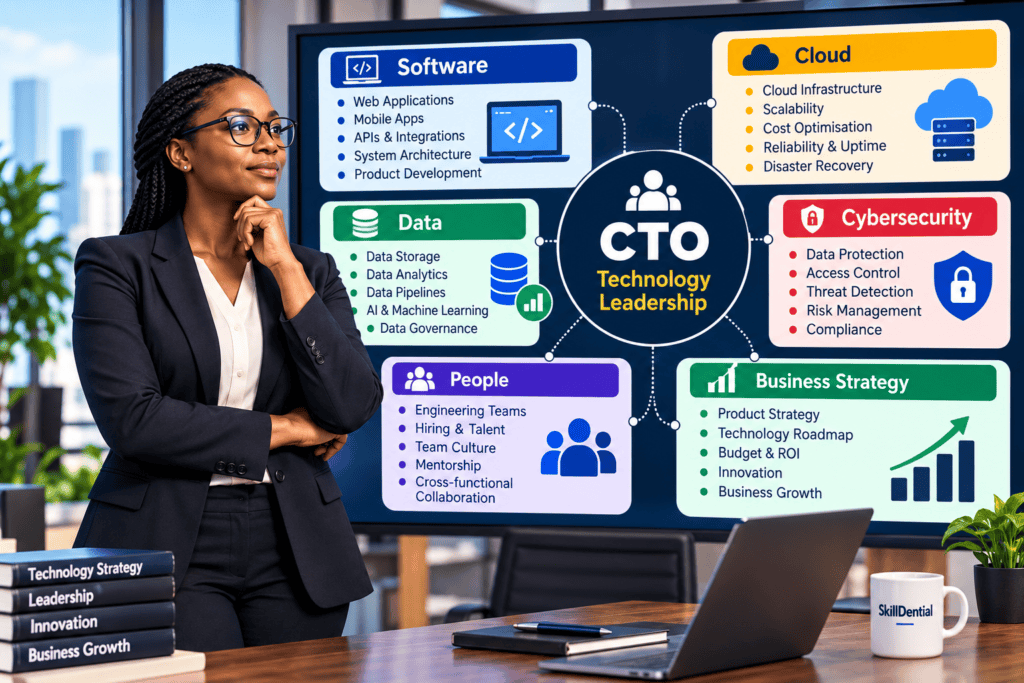
At its core, a Chief Technology Officer is responsible for aligning an organization’s technology infrastructure and capabilities with its overarching business objectives. However, the operational reality of how to become a CTO depends entirely on the scale and stage of the company:
- Early-Stage Startups: The CTO acts as a player-coach—writing code, selecting vendors, collaborating directly with developers, and designing core product architecture.
- Growth and Enterprise Organizations: The role pivots entirely toward technology strategy, enterprise architecture, engineering leadership, cybersecurity, financial governance, risk management, and organizational design.
For professionals figuring out how to become a CTO without a traditional programming background, this distinction is critical. You do not need to be the engineer who writes the most complex algorithms; you must become the executive who understands technology well enough to make high-stakes decisions and lead experts who possess deeper technical specialization.
The Executive Inquiry Framework
An effective technology leader evaluates the business through strategic technical questions rather than syntax-level execution. When mastering how to become a CTO, your value lies in your ability to answer and interrogate questions such as:
- What technology should we build, buy, or outsource?
- Is this architecture appropriate for our current scale and growth trajectory?
- What happens to our systems if our user base increases tenfold?
- Where are our biggest security, compliance, and reliability risks?
- How much will this technology infrastructure cost to build and operate over time?
- Do we have the right engineering capabilities and team structure in place?
- Are we accumulating technical debt faster than we can sustainably manage it?
- Should we prioritize speed to market, system reliability, security, or cost efficiency in this scenario?
- What technology investments will directly accelerate the company’s long-term strategy?
These are not purely programming questions—they are high-leverage technology leadership decisions that define the modern CTO mandate.
Do You Need to Be a Programmer to Become a CTO?
The short answer is no—with one critical qualification.
While you do not need to be an expert programmer, anyone figuring out how to become a CTO quickly learns that they cannot afford to be technically illiterate. A non-programmer CTO must understand the foundational mechanics behind modern technology systems, even if they never write a line of production code.
Essential Technical Literacy Matrix
To lead technical teams effectively without a coding background, you must master the conceptual landscape of software engineering. Your value lies in understanding what these systems are, why they matter, the trade-offs they introduce, and precisely when to delegate to a deeper specialist:
- Architecture & Infrastructure: APIs, databases, servers and cloud infrastructure, frontend and backend systems, system architecture, scalability, and reliability.
- Engineering Operations: Software development life cycles (SDLC), version control, testing, deployment, and CI/CD pipelines.
- Security & Governance: Authentication, authorization, cybersecurity, monitoring, observability, and technical debt management.
- Data Strategy: Data storage, processing pipelines, and data governance frameworks.
You do not need to implement these components yourself. When mastering how to become a CTO, your core capability is translating these technical primitives into business strategy and managing experts who execute them at scale.
The difference between coding ability and technical leadership
Programming and technical leadership overlap, but they are fundamentally different skill sets. While a senior software engineer spends their time solving implementation details, a Chief Technology Officer must zoom out to evaluate the entire system surrounding those problems.
When evaluating how to become a CTO, the cognitive shift requires moving from tactical execution to overarching system design and business alignment:
- The Engineer’s Question: “How should we implement this feature efficiently?”
- The CTO’s Question: “Should we build this feature at all, what underlying technology should support it, what will it cost, what risks does it introduce, and how does it fit our three-year technology roadmap?”
Both questions are critical to a healthy organization, but they operate at entirely different altitudes. As you progress toward executive responsibility, your organizational value comes from making high-stakes decisions, setting technical direction, hiring and empowering capable teams, and mitigating technology risk.
Why Technical Fluency Trumps Prettense
This division does not render technical depth irrelevant. In fact, as an enterprise scales, the greatest risk for a technology leader is complete dependence on others to interpret, vet, and justify technical decisions.
For those navigating how to become a CTO from a non-programming background, your operational goal must be technical fluency—not masquerading as a hands-on engineer. Fluency gives you the radar to spot architectural flaws, challenge assumptions constructively, and earn the respect of world-class engineering teams without writing a single line of production code.
A realistic path to becoming a CTO without a programming background
There is no single universal career path to executive technology leadership. However, professionals without a traditional programming background can deliberately build the capabilities required to run modern engineering organizations. A practical progression follows this trajectory:
$$\text{Business or functional expertise} \longrightarrow \text{Technical literacy} \longrightarrow \text{Technology ownership} \longrightarrow \text{Technical leadership} \longrightarrow \text{CTO-level responsibility}$$
Mastering how to become a CTO requires executing a structured, ten-step competency map designed to bridge the gap between business strategy and systems architecture.
Here is how to approach it.
Build a strong understanding of technology fundamentals
Start by learning how modern software systems work.
You don’t need to begin with advanced algorithms or competitive programming. Start with the architecture of the systems you use every day.
Learn the basics of:
Software development
Understand how an idea becomes a working product.
Learn about:
- requirements
- product specifications
- development
- testing
- deployment
- maintenance
- bug fixing
- version control
- technical debt
You should understand the difference between development and production environments and why software needs testing before users depend on it.
Web technology
If you want to lead a technology company, learn how the web works.
Understand:
- browsers
- domains
- DNS
- HTTP and HTTPS
- servers
- hosting
- APIs
- databases
- frontend applications
- backend services
You do not have to become a full-stack developer.
But if an engineer explains that a product uses a frontend application communicating with backend services through APIs and storing information in a relational database, you should understand what they mean.
Cloud computing
Learn the basic concepts behind platforms such as AWS, Microsoft Azure and Google Cloud.
You should understand concepts such as:
- compute
- storage
- databases
- networking
- identity and access management
- monitoring
- backups
- availability
- scalability
- cloud costs
This is particularly important because technology decisions increasingly involve balancing performance, reliability, security and cost.
AWS’s Well-Architected Framework, for example, organises cloud architecture around operational excellence, security, reliability, performance efficiency, cost optimisation and sustainability.
Google Cloud’s current architecture framework similarly addresses security, reliability, performance, cost, operations and sustainability.
You don’t need to memorise these frameworks. Use them to develop the habit of thinking about technology decisions systematically.
Learn enough coding to understand developers
There is an important difference between becoming a programmer and learning to program.
You may not need to become a professional software engineer, but learning basic programming can dramatically improve your technical judgement.
Consider learning one accessible language such as:
- Python
- JavaScript
- TypeScript
Focus on fundamentals:
- variables
- functions
- conditions
- loops
- data structures
- APIs
- error handling
- files and databases
- basic debugging
- reading existing code
Then build a small project.
For example, you could build a simple:
- personal dashboard
- API-powered web application
- content management tool
- data analysis application
- internal business automation
- AI-powered utility
The objective isn’t to become an elite developer.
The objective is to experience what developers experience.
Once you have struggled through debugging a small application, working with APIs and deploying something yourself, technical conversations become much easier to understand.
Learn system architecture
This is one of the most important areas for an aspiring CTO.
System architecture is essentially about how the components of a technology system fit together and how that system behaves as requirements change.
You should gradually become comfortable discussing:
- monolithic versus distributed systems
- databases
- caching
- queues
- APIs
- authentication
- microservices
- cloud infrastructure
- load balancing
- backups
- monitoring
- disaster recovery
- scalability
- availability
You don’t need to design a hyperscale system yourself.
You need to understand the consequences of architectural decisions.
For example, a simple architecture might be cheaper and easier to operate for a small startup. A more distributed architecture might provide advantages at greater scale but introduce additional operational complexity.
There is rarely one universally correct architecture.
The CTO’s job is often to understand the trade-off.
AWS explicitly describes architecture as involving trade-offs between qualities such as cost, reliability and performance, while Google Cloud’s framework similarly emphasises balancing different architectural priorities against business requirements.
That is CTO thinking.
Learn cybersecurity and technology risk
A CTO cannot delegate all security thinking to the security team.
You should understand the major categories of technology risk, including:
- identity and access management
- authentication
- authorisation
- data protection
- secrets management
- software vulnerabilities
- phishing and social engineering
- backups
- incident response
- third-party risks
- regulatory and privacy considerations
You don’t have to become a cybersecurity specialist.
You do need to know enough to recognise when your organisation has a serious problem.
The NIST Cybersecurity Framework 2.0 is one useful starting point because it provides organisations with a structured way to understand and manage cybersecurity risk.
A good CTO should be able to ask:
What data do we hold?
Who can access it?
What happens if those credentials are compromised?
How would we detect an incident?
How quickly could we recover?
Those questions are often more important at executive level than knowing how to write a particular security script.
Develop business and financial skills
This is where people from business, operations, finance and product backgrounds can have a significant advantage.
Technology exists to create business value.
A CTO therefore needs to understand:
- revenue
- margins
- operating costs
- budgets
- customer acquisition
- product strategy
- business models
- return on investment
- risk
- opportunity cost
Consider two technology options.
Option A costs £10,000 and can be deployed quickly.
Option B costs £100,000 but provides substantially greater control and scalability.
The technical question is:
Which system is technically better?
The CTO question is:
Which option makes sense for this company’s current strategy, risk profile, resources and expected growth?
Those are not necessarily the same question.
Technology leaders increasingly have to understand the financial consequences of infrastructure and architecture decisions. Google’s cloud architecture guidance, for example, explicitly treats cost optimisation as a strategic concern for executives including CTOs and CIOs.
Become excellent at product thinking
A CTO should understand the customer, not just the technology.
Learn how to connect:
Customer problem → Product → Technology → Business outcome
Suppose a company wants to reduce customer support calls.
A technically focused response might be:
“Let’s build an AI chatbot.”
A CTO should first ask:
- What are customers actually struggling with?
- How many support requests could realistically be automated?
- What information does the system need?
- What happens when the AI gives an incorrect answer?
- Does the business need a chatbot or simply better documentation?
- What will the solution cost?
- How will success be measured?
Sometimes the best technology solution is less technology.
That is an important leadership skill.
Take ownership of technology projects
You cannot become a CTO simply by consuming courses.
You need evidence that you can lead technology-related outcomes.
If you currently work in operations, product, marketing, finance or another field, look for opportunities to own technology projects.
Examples include:
- implementing a CRM
- automating a manual workflow
- leading a website redevelopment
- managing a software vendor
- introducing an analytics platform
- coordinating a mobile or web product
- implementing cybersecurity improvements
- managing a cloud migration
- introducing AI into business processes
- creating an internal knowledge system
Your responsibility should go beyond administration.
You should understand why the technology is being introduced, how it will work, what risks exist and whether it delivered the expected result.
That creates something more valuable than a certificate: evidence of technology leadership.
Learn how to work with engineers
This may become your most important skill.
If you become a CTO without a traditional engineering background, you will probably work with people who know substantially more about particular technical subjects than you do.
That is normal.
Your job is not to compete with them.
Your job is to create an environment where their expertise produces good outcomes.
Learn to:
- ask precise questions
- listen carefully
- challenge assumptions without micromanaging
- understand technical trade-offs
- distinguish disagreement from incompetence
- give engineers room to solve problems
- establish clear priorities
- hold teams accountable for outcomes
- communicate business constraints clearly
Avoid pretending to know something you don’t.
A strong CTO can say:
“I don’t know enough about this architecture to make that decision yet. Walk me through the trade-offs.”
That is leadership, not weakness.
Build credibility through increasingly difficult responsibilities
Your career progression should gradually demonstrate greater ownership.
For example:
| Stage | What you should demonstrate |
|---|---|
| Technical literacy | You understand fundamental technology concepts |
| Project ownership | You can deliver technology initiatives |
| Team leadership | You can coordinate technical and non-technical people |
| Technology management | You can manage vendors, budgets and priorities |
| Technical strategy | You can connect technology decisions to business goals |
| CTO level | You can own technology direction, risk, people and outcomes |
This is why simply adding “CTO” to your LinkedIn profile will not make you a CTO.
Responsibility should precede the title.
Decide whether you actually need the CTO title
This is an often-overlooked question.
If you are a startup founder, you may be tempted to call yourself CTO because you are responsible for the company’s technology.
That can be reasonable.
But there are situations where it may be better to remain CEO or CPO and hire a technical leader.
Ask yourself:
- Can I evaluate senior engineers effectively?
- Can I understand major architecture decisions?
- Can I identify serious technical risks?
- Can I set technology priorities?
- Can I communicate effectively with engineers?
- Can I make informed build-versus-buy decisions?
- Can I understand our security responsibilities?
- Can I manage technology vendors?
- Can I take responsibility when the technology strategy fails?
If the answer to most of these questions is no, you may not need to become the CTO.
You may need to hire one. That is not a failure.
For some founders, the highest-value decision is recognising that technology leadership requires expertise they do not currently possess.
The T-Shaped Competency Framework for Non-Programmer CTOs
When mastering how to become a CTO without a traditional programming background, you do not need to become an expert in every operational domain. Instead, your objective is to develop a T-shaped capability: a broad, foundational understanding across both technology and business, paired with deep expertise in the functional area where your career gives you a strategic advantage (such as product, finance, or operations).
The essential capabilities are organized into five core pillars:
| Skill Area | What to Learn |
| Technical Literacy | Programming fundamentals, APIs, databases, cloud infrastructure, and system architecture. |
| Technology Strategy | Roadmaps, architectural trade-offs, build-versus-buy analysis, and technical debt management. |
| Security & Risk | Identity and access management, data protection, vulnerability identification, and incident response. |
| Business & Finance | Financial literacy, operating budgets, return on investment (ROI), business models, and product strategy. |
| Leadership & Execution | Hiring engineering talent, executive communication, prioritization, team design, and decision-making under uncertainty. |
The 12-Month Roadmap for Becoming CTO-Ready
Transitioning into executive technology leadership without a traditional programming background requires a disciplined, phased approach. Instead of trying to master every discipline simultaneously, structure your development over four distinct quarters to bridge the gap between technical comprehension and executive execution.
| Quarter / Timeframe | Core Focus Area | Actionable Milestones & Deliverables |
| Months 1–3 | Build Technical Literacy | Master programming fundamentals, web architecture, databases, APIs, cloud concepts, and the SDLC. Build a small functional application or internal automation to understand construction mechanics. |
| Months 4–6 | Master Architecture & Infrastructure | Study system and cloud architecture, scalability, reliability, monitoring, and technical debt. Exercise: Reverse-engineer an existing product’s architecture and stress-test it for a 10x user surge. |
| Months 7–9 | Execute a Real Technology Initiative | Take end-to-end ownership of a live project (e.g., business workflow automation, digital product launch, cloud migration, or AI integration). Document all trade-offs, budgets, risks, and performance metrics. |
| Months 10–12 | Operate at the Executive Level | Transition from understanding technology to leading it. Produce formal executive deliverables: technology roadmaps, budgets, risk registers, security plans, and build-versus-buy evaluations. |
The Executive Pivot
As you progress through this 12-month blueprint, your primary cognitive shift moves from:
“I understand how technology works.”
to:
“I can lead technology to drive business outcomes.”
That shift marks the boundary between a technical manager and a true Chief Technology Officer.
Translating Competence to Credibility: CV and LinkedIn Optimization
When positioning yourself for executive technology leadership, your CV or LinkedIn profile must not read like a transcript of completed courses or generic technical certifications. Hiring managers, boards, and founders evaluating candidates on how to become a CTO look for concrete proof of execution, risk management, and business impact.
Your profile should highlight applied ownership rather than passive learning.
Examples of High-Impact Profile Positioning
- Weak (Passive Knowledge):“Completed a cloud computing course.”
- Strong (Applied Responsibility):“Led the evaluation and implementation of a cloud-based analytics platform, coordinating business requirements, vendor selection, deployment, and ongoing cost governance.”
- Weak (Generic Skill Listing):“Learned cybersecurity and risk management.”
- Strong (Demonstrated Impact):“Coordinated an enterprise access-control review that identified and eliminated unnecessary user privileges across key operational systems, strengthening overall security posture.”
This shift transforms your professional narrative from someone who understands technology into a proven leader capable of owning complex technical outcomes.
Common Pitfalls: Mistakes Non-Programmers Make When Pursuing CTO Roles
Aspiring leaders navigating how to become a CTO without a traditional programming background often fall into predictable tactical traps. Recognizing these pitfalls prevents costly missteps during your career pivot:
- Mistake 1: Believing the CTO Must Be the Best Coder. The CTO role requires enough technical fluency to challenge assumptions, vet architecture, and evaluate trade-offs, not necessarily to write the most complex production code in the organization.
- Mistake 2: Swinging to Complete Technical Illiteracy. Overcorrecting on the premise that “CTOs don’t code” leaves leaders completely dependent on subordinates for core system decisions, security posture, and infrastructure design.
- Mistake 3: Collecting Certificates Instead of Proof. Accumulating courses provides baseline knowledge, but boards and founders look for applied responsibility. Transform learning experiences into concrete project outcomes.
- Mistake 4: Micromanaging Engineering Teams. Technical understanding should empower your team, not invite you to dictate syntax-level implementation details. Hire world-class experts, set clear guardrails, and evaluate outcomes.
- Mistake 5: Ignoring the Financial Impact of Technology. A solution that performs flawlessly under load can still fail as a business decision if cloud costs, vendor licenses, or infrastructure overhead destroy operating margins.
- Mistake 6: Treating Security as an IT Afterthought. At the executive level, cybersecurity is an enterprise-wide risk management mandate involving data integrity, legal compliance, customer trust, and corporate reputation.
The Founder’s Dilemma: Navigating Early-Stage Technology Leadership
The operational reality shifts significantly for startup founders. In the earliest pre-seed or bootstrap phases, a founder must make critical technology decisions long before the company has the capital to hire a full-scale engineering department.
To bridge this gap, modern early-stage founders often leverage an augmented stack rather than building from scratch:
- No-code and low-code platforms for rapid prototyping and validation.
- AI-assisted development tools to accelerate feature delivery.
- Freelancers, specialized agencies, and third-party SaaS products to handle specialized workloads.
- Technical co-founders and founding engineers to write core production code.
When the Paradigm Shifts
As the business scales, revenue grows, and product complexity increases, these lightweight solutions eventually hit their limits. At that critical juncture, founders figuring out how to become a CTO face a stark strategic choice: evolve your own capabilities to meet the technical leadership demand, or hire a dedicated technical executive.
Never choose the CTO title simply because it looks prestigious on a pitch deck or LinkedIn profile. Choose the role based on the operational responsibility, risk oversight, and technical governance you are genuinely prepared to carry.
AI-Assisted Development and the Modern CTO
Artificial intelligence is fundamentally lowering the barrier to building software. For professionals and founders figuring out how to become a CTO, modern AI coding assistants and generative agents make it possible to prototype applications, automate manual workflows, and explore technical concepts without writing raw syntax from scratch.
This acceleration is a powerful learning accelerator. However, generating functional code snippets is not equivalent to engineering or maintaining a secure, production-grade system.
What AI Cannot Replace: Executive Technical Judgment
While AI dramatically compresses development velocity, it does not absolve a technology leader from architectural oversight. A modern CTO must still evaluate the broader ecosystem surrounding any AI-generated output:
- Security & Data Privacy: Ensuring sensitive corporate data or customer PII is not leaked into public model training pipelines or exposed via insecure endpoints.
- Architecture & Reliability: Determining whether AI-generated code fits cleanly into a scalable system design rather than creating isolated, brittle components.
- Maintainability & Technical Debt: Managing complex codebases where automated tools may obscure underlying structural flaws or poor design patterns.
- Licensing & Compliance: Auditing third-party libraries and model outputs for intellectual property risks.
- Performance & Operational Costs: Monitoring the true compute and API costs associated with running AI-heavy infrastructure at scale.
- Testing & Vendor Dependency: Establishing rigorous QA protocols and avoiding over-reliance on a single proprietary AI coding or infrastructure vendor.
AI helps you move faster, but it never removes your ultimate accountability. When mastering how to become a CTO, your core mandate remains unchanged: deciding whether a technical solution should exist, verifying that it is safe to operate, and ensuring it delivers sustainable business value.
The Mindset Shift of a Modern Technology Leader
From Coder to Executive
The most critical realization on the path to executive leadership is mastering the ultimate psychological and professional pivot:
Moving away from thinking: “I need to learn enough programming to become a CTO.”
Moving toward thinking: “I need to become capable of leading technology.”
These are fundamentally different objectives. While learning the basics of coding, APIs, and cloud infrastructure provides essential technical literacy, true technology leadership requires mastering a much broader ecosystem: people, products, systems, capital allocation, risk management, and long-term business strategy.
The strongest non-programmer Chief Technology Officers do not waste energy trying to imitate senior software engineers. Instead, they focus on becoming technically credible business leaders—executives who bridge the gap between engineering execution and commercial growth.
Key Takeaways for Aspiring CTOs
- Build Technical Fluency: Understand architecture, security, and infrastructure well enough to challenge assumptions and vet decisions without writing production code daily.
- Focus on Applied Ownership: Exchange passive course certificates for demonstrable project leadership and real-world business impact.
- Align Technology with Strategy: Evaluate every technical choice through the lens of financial cost, scalability, and long-term business objectives.
- Empower Engineering Talent: Hire world-class experts, establish clear outcomes, and create an environment where technical specialists can thrive.
By following this roadmap, non-technical professionals, product leaders, and startup founders can successfully navigate how to become a CTO and build sustainable, high-leverage technology organizations.
Can You Really Become a CTO Without a Programming Background?
Yes—you can become a Chief Technology Officer without a traditional programming background.
However, you must never confuse not being a coder with being technically illiterate. A credible, non-programmer CTO does not need to write production code every day, but they must possess the executive capability to:
- Comprehend System Architecture: Understand how modern software systems, cloud infrastructure, and data pipelines function.
- Bridge the Communication Gap: Speak the language of engineering, ask precise questions, and earn the respect of technical specialists.
- Evaluate Trade-Offs & Risk: Assess architectural decisions, technical debt, and cybersecurity vulnerabilities without micromanaging.
- Govern Financials & Strategy: Manage technology budgets, make rigorous build-versus-buy choices, and align every technical investment with commercial goals.
- Lead People & Outcomes: Build high-performing teams, establish clear operational priorities, and take ultimate accountability for the organization’s technical direction.
You may never author the underlying codebase. That is entirely acceptable. Your mandate as an executive is ensuring that the organization deploys the right technology, empowers the right talent, maintains robust risk controls, and executes a scalable strategy to win in the market.
Can you become a CTO without a computer science degree or coding background?
Yes. While you do not need a computer science degree or a background as a professional software engineer, you cannot be technically illiterate. A successful non-programmer Chief Technology Officer must build technical literacy in cloud architecture, data systems, cybersecurity, and APIs to make informed executive decisions and lead engineering teams effectively.
What is the difference between a CTO and a VP of Engineering?
While responsibilities overlap in smaller organizations, a VP of Engineering typically focuses inward—managing engineering teams, hiring, internal processes, delivery schedules, and day-to-day software execution. A CTO focuses outward and forward—driving long-term technology strategy, evaluating external market tech, aligning infrastructure with business models, and managing high-level technology risk and R&D.
How long does it take to transition into a CTO role from a non-technical background?
For professionals and founders following a structured roadmap, transitioning from a business, product, or operational background into a CTO-ready state typically takes 12 to 24 months. This timeframe requires systematically building technical literacy, mastering system architecture trade-offs, and taking demonstrable ownership of live technology projects.
Do I need to know how to use AI coding tools to become a modern CTO?
AI-assisted development is rapidly changing how software is prototyped and built, making it easier for non-programmers to explore technical concepts. However, AI cannot replace executive technical judgment. A modern CTO must still evaluate system security, data privacy, architecture scalability, technical debt, and long-term operational costs regardless of how the code was generated.
How do I prove my technical credibility to founders and boards if I don’t write code?
Credibility is established through applied responsibility, not certificates. Instead of listing completed courses on your CV, highlight concrete outcomes: leading cloud migrations, managing complex software vendor selections, conducting security access-control audits, or aligning technology budgets directly with revenue growth and business strategy.
Let me know if you would like to compile all sections into a final, publish-ready draft
In Conclusion
Transitioning into executive technology leadership without a traditional programming background is entirely achievable, but it requires rejecting shortcuts in favor of genuine technical credibility.
True capability is forged through progressive application: mastering the foundational mechanics of software, cloud infrastructure, data pipelines, and cybersecurity, and then immediately moving from passive consumer to active owner. By leading real technology initiatives, managing trade-offs, governing risks, and directly tying infrastructure investments to commercial growth, you cross the boundary from a technical learner to an authentic technology leader.
Your Immediate Next Step
If you are serious about mastering how to become a CTO, your execution plan starts today:
Choose one real technology project within your current organization or venture, and take end-to-end responsibility for understanding and delivering it—from initial business requirement through technical implementation to measurable commercial outcome.
That single project marks the exact point where your transition to executive technology leadership officially begins.