11 Best Websites to Find Cloud Computing Jobs
Securing a high-paying role in cloud computing starts with knowing where to look. With cloud adoption driving enterprise technology, relying on generic boards often leads to noise rather than results. To cut through the clutter, utilizing the right websites to find cloud computing jobs is critical for targeting roles efficiently.
The top websites to find cloud computing jobs span major general platforms, direct tech provider portals, and specialized remote hubs:
- General & Tech Job Boards: LinkedIn, Indeed, Dice
- Big Tech Provider Portals: Google Careers, AWS Careers, Microsoft Careers
- Startup & Remote Platforms: Wellfound, Built In, Remote OK, Remote.co, Toptal
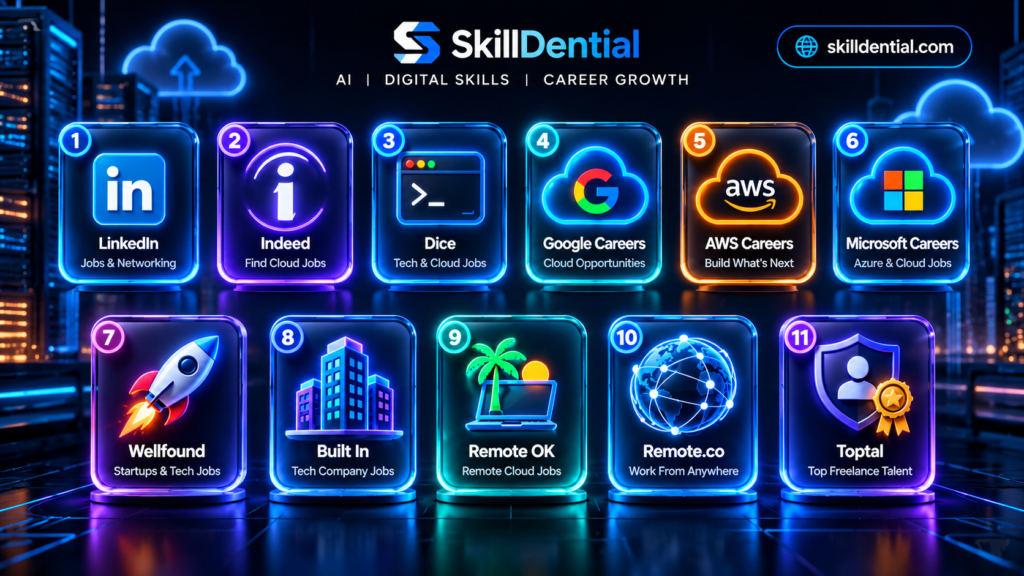
Using broad job boards provides volume, provider career pages secure direct employer roles, and remote or startup platforms unlock specialized opportunities.
Who This Guide Is For
- Beginners and certified cloud learners breaking into the industry.
- System administrators and DevOps engineers transitioning to native cloud stacks.
- Experienced professionals targeting Cloud Engineer, Cloud Architect, Cloud Administrator, Cloud Security Engineer, DevOps Engineer, or Site Reliability Engineer positions.
Quick Comparison of Websites to Find Cloud Computing Jobs
Here is the clean, structured markdown table format for your quick comparison section:
| Website | Best for | Strongest role types | Remote suitability |
| Networking plus job search | All cloud and DevOps roles | High | |
| Indeed | High-volume searching | Entry-level to senior roles | High |
| Dice | Technology-focused roles | Cloud, DevOps, security, infrastructure | Moderate to high |
| Google Careers | Direct Google Cloud roles | Cloud engineer, architect, SRE | Moderate |
| AWS Careers | Direct AWS roles | Cloud support, solutions architect, infrastructure | Moderate |
| Microsoft Careers | Direct Azure roles | Azure engineer, administrator, architect | Moderate |
| Wellfound | Startup jobs | DevOps, platform, infrastructure | High |
| Built In | Local tech ecosystems | Cloud, DevOps, SRE | Moderate |
| Remote OK | Remote-first roles | Cloud engineer, DevOps, SRE | Very high |
| Remote.co | Curated remote roles | Cloud security, infrastructure, engineering | Very high |
| Toptal | Freelance and contract work | Cloud engineering, DevOps, architecture | High |
LinkedIn is the strongest all-round platform for cloud computing jobs because it combines listings, recruiter visibility, company research, and professional networking. Search titles such as Cloud Engineer, AWS Engineer, Azure Administrator, DevOps Engineer, Platform Engineer, and Site Reliability Engineer.
How to Use It Effectively
- Set alerts for each target job title and cloud platform.
- Add AWS, Azure, Google Cloud, Terraform, Kubernetes, Linux, CI/CD, and relevant certifications to your profile.
- Follow cloud teams at companies you want to join.
- Message employees or recruiters only after tailoring your application; a short, specific message performs better than a generic connection request.
LinkedIn is especially useful for mid-level and senior candidates because hiring managers often review profiles before interviewing. Its job listings also benefit from the platform’s wider professional network and company research tools.
Best for: All experience levels, especially candidates who want referrals and recruiter contact.
Indeed
Indeed is a large general job-search engine that aggregates listings from many employer sites, making it useful for finding cloud roles across industries and locations. It is particularly helpful for entry-level applicants because it surfaces junior IT, support, and cloud-adjacent roles that may not appear on niche tech boards.
Useful Searches
- “Cloud Engineer”
- “Cloud Support Associate”
- “Cloud Administrator”
- “AWS Cloud Engineer”
- “Azure Engineer”
- “Google Cloud Engineer”
- “Junior DevOps Engineer”
- “Cloud Infrastructure Engineer”
How to Use It Effectively
- Filter by remote, hybrid, entry level, salary, and date posted.
- Apply within the first few days of a listing appearing.
- Use several title variations; employers do not use identical job titles.
- Check the original employer career page before applying when possible.
Best for: Beginners, career changers, and job seekers who want the widest possible listing volume.
Dice
Dice is a technology-focused job board with strong coverage of software, cloud, cybersecurity, infrastructure, and contract roles. If you are looking for specialized websites to find cloud computing jobs that cater specifically to technical specialists rather than general administrative hires, Dice is a primary destination. It is particularly useful for candidates targeting enterprise, consulting, government-adjacent, or contract-based cloud work.
Search Combinations to Try
- Cloud Engineer + Terraform
- DevOps Engineer + Kubernetes
- AWS Engineer + CI/CD
- Azure Engineer + Active Directory
- Cloud Security Engineer + IAM
- SRE + Prometheus
- Platform Engineer + Infrastructure as Code
How to Use It Effectively
- Create a detailed technical profile on the platform rather than uploading only a generic CV.
- Save alerts for your top three cloud specialisations among the best websites to find cloud computing jobs.
- Use salary estimates to benchmark offers, but treat them as estimates rather than guarantees.
Best for: Intermediate and experienced cloud, DevOps, security, and infrastructure professionals.
Google Careers
Google Careers is the official channel for roles across Google and Google Cloud. For professionals evaluating top websites to find cloud computing jobs, direct employer portals like this offer the highest level of accuracy and direct access to internal teams. It is the right place to apply directly for positions such as Cloud Engineer, Cloud Consultant, Solutions Architect, Customer Engineer, Technical Account Manager, and Site Reliability Engineer.
Why Use It
- Listings come directly from the employer, ensuring complete authenticity.
- You can review the exact team, location, qualifications, and responsibilities.
- Applying directly on official websites to find cloud computing jobs reduces dependence on third-party listings that may be outdated or reposted by recruiters.
How to Use It Effectively
- Search “Google Cloud,” “Cloud Engineer,” “Solutions Architect,” and “Site Reliability Engineer.”
- Read the required qualifications carefully; Google roles often expect strong programming, systems, networking, or customer-facing experience.
- Prepare examples that show measurable impact, such as improving deployment reliability, reducing infrastructure costs, or automating operations.
Best for: Candidates targeting Google Cloud specifically or seeking large-scale platform and infrastructure roles.
AWS Careers
AWS Careers is Amazon’s official careers destination for AWS roles. When evaluating specialized employer websites to find cloud computing jobs, this portal is essential for anyone focusing heavily on Amazon Web Services. It includes cloud computing, network engineering, infrastructure, and security positions, and its talent network lets candidates receive updates about relevant openings.
Roles to Search For
- Cloud Support Associate
- Cloud Infrastructure Engineer
- Solutions Architect
- DevOps Engineer
- Security Engineer
- Technical Account Manager
- Professional Services Consultant
How to Use It Effectively
- Create a profile and join the AWS Talent Network if you are not ready to apply immediately.
- Search both AWS-specific titles and broader infrastructure titles across various regions.
- Match your CV to the job description’s required services, such as EC2, S3, IAM, VPC, Lambda, EKS, or CloudFormation.
Best for: Candidates who want to work directly for AWS or build a career around AWS services.
Microsoft Careers
Microsoft Careers is the official site for Azure-related roles across Microsoft and its business units. For professionals navigating enterprise websites to find cloud computing jobs, this portal is indispensable. It is valuable for Azure administrators, cloud engineers, solutions architects, security engineers, and professionals targeting enterprise Microsoft environments.
Roles to Search For
- Azure Administrator
- Azure Cloud Engineer
- Cloud Solutions Architect
- DevOps Engineer
- Cloud Security Engineer
- Technical Specialist
- Customer Success Manager
How to Use It Effectively
- Search by “Azure,” “cloud,” “infrastructure,” and “security” on one of the top employer websites to find cloud computing jobs.
- Highlight experience with Microsoft identity, networking, virtual machines, Azure DevOps, Microsoft Entra ID, or hybrid cloud where relevant.
- Tailor your CV to enterprise-scale experience, such as migration, governance, cost management, or multi-region deployment.
Best for: IT professionals moving from Windows Server, networking, or enterprise systems into Azure-focused cloud roles.
Wellfound
Wellfound, formerly AngelList Talent, focuses on startup and scale-up hiring. Among websites to find cloud computing jobs, it stands out for professionals who want early-stage engineering, DevOps, platform, and infrastructure roles, often with more visible information about compensation and company stage than traditional boards.
How to Use It Effectively
- Filter by remote policy, job function, company size, and funding stage when exploring various websites to find cloud computing jobs.
- Search for “DevOps,” “Platform Engineer,” “Cloud Engineer,” “Infrastructure Engineer,” and “SRE.”
- Review the company’s product, engineering stack, and growth stage before applying.
- Be clear about whether you want equity, remote work, contract work, or a stable established company.
Trade-off: Startup roles can offer broad ownership and faster learning, but they may involve less structure, changing priorities, and greater on-call responsibility.
Best for: DevOps engineers, platform engineers, and cloud professionals interested in startups.
Built In
Built In focuses on technology jobs within major tech ecosystems and company career communities. When searching through specialized websites to find cloud computing jobs, Built In is useful when you want to target product companies, scale-ups, and employers with a strong engineering culture rather than scrolling through unrelated listings.
How to Use It Effectively
- Choose your target city or remote preference across regional hubs on these websites to find cloud computing jobs.
- Search for cloud, DevOps, SRE, infrastructure, and platform engineering roles.
- Use company profiles to understand the technology stack before applying.
- Set alerts for companies that repeatedly hire cloud talent.
Trade-off: Listing volume is lower than Indeed or LinkedIn, but relevance can be higher for candidates targeting product-led technology companies.
Best for: Candidates seeking quality-focused searches in established tech hubs or remote-friendly product companies.
Remote OK
Remote OK is a remote-first job board with dedicated cloud and cloud-engineer search pages. For professionals evaluating remote websites to find cloud computing jobs, it is one of the most direct platforms for finding distributed roles in cloud engineering, DevOps, infrastructure, and platform engineering.
Useful Searches
- Cloud Engineer
- AWS Cloud Engineer
- DevOps Engineer
- Kubernetes Engineer
- Terraform Engineer
- Site Reliability Engineer
- Platform Engineer
How to Use It Effectively
- Check whether the role is “worldwide,” region-limited, or restricted to specific employer locations on these remote-focused websites to find cloud computing jobs.
- Confirm time-zone expectations before applying.
- Look for salary transparency and contract type.
- Verify the company’s official careers page before submitting personal information.
Best for: Remote job seekers, digital nomads, and engineers who want location-flexible cloud roles.
Remote.co
Remote.co curates remote jobs across engineering, software, system administration, and cloud-related functions. Its listings include roles such as Cloud Security Engineer, Cloud Infrastructure Engineer, and associate-level cloud engineering positions, making it a reliable destination among dedicated remote websites to find cloud computing jobs.
How to Use It Effectively
- Browse the engineering, software engineering, and system administration categories across curated remote websites to find cloud computing jobs.
- Filter carefully between fully remote, hybrid remote, and location-specific roles.
- Search for security-focused titles if you have IAM, compliance, network security, or cloud governance experience.
- Confirm whether “remote” means remote within one country or genuinely global.
Best for: Candidates seeking remote cloud security, infrastructure, and engineering roles with clearer work-location details.
Toptal
Toptal is a vetted freelance network for cloud engineers, DevOps engineers, cloud architects, Kubernetes specialists, and related technical professionals. Unlike standard job boards, Toptal functions as an exclusive talent marketplace where candidates must pass a rigorous screening process, and accepted freelancers are matched directly with high-end client projects. For independent contractors exploring elite websites to find cloud computing jobs, Toptal offers access to enterprise clients without the friction of cold outreach.
How to Use It Effectively
- Apply only when you can demonstrate proven production experience with cloud infrastructure, automation, or architecture on your professional profile.
- Prepare a portfolio of real projects, such as Terraform modules, CI/CD pipelines, Kubernetes deployments, or cost-optimisation case studies to showcase on competitive freelance websites to find cloud computing jobs.
- Treat it as a long-term freelance channel rather than a quick entry-level job source.
Trade-off: The screening process is selective, and freelance work may be less predictable than full-time employment. However, it can suit experienced engineers seeking contract flexibility and higher hourly rates.
Best for: Experienced cloud engineers, DevOps specialists, and architects seeking freelance or contract engagements.
Best Websites by Career Stage
To maximize your efficiency, match your target experience level with the platform types that yield the highest return on investment. Below is a breakdown of the best websites to find cloud computing jobs organized by career stage and professional focus:
| Career stage | Recommended websites | Why |
| Beginner or career changer | Indeed, LinkedIn, AWS Careers, Microsoft Careers | Broad listing volume, junior IT roles, and direct employer training-to-hire or associate-level openings. |
| Certified but inexperienced | LinkedIn, Indeed, AWS Careers, Wellfound | Setting alerts for entry-level filters, networking with certified peers, and surfacing startup opportunities. |
| Cloud engineer or administrator | Dice, LinkedIn, Built In, Remote OK | Advanced technical filtering and specialized mid-level infrastructure roles. |
| DevOps or platform engineer | Wellfound, Dice, Remote OK, Toptal | Strong alignment with modern infrastructure, containerization, startup, contract, and remote-first scaling environments. |
| Cloud architect or senior engineer | LinkedIn, Google Careers, AWS Careers, Microsoft Careers | Direct access to senior enterprise positions and high-visibility employer-brand channels. |
| Remote-first candidate | Remote OK, Remote.co, LinkedIn, Wellfound | Dedicated remote filters, timezone transparency, and distributed engineering teams. |
| Freelancer or contractor | Toptal, Dice, LinkedIn | Exclusive client matching, high-paying contract listings, and professional contracting visibility. |
How to Search Smarter
A generic “cloud jobs” search yields too much noise and misses specialized listings. To cut through the clutter across different websites to find cloud computing jobs, you need precision. Use combinations of job title, platform, tool, and seniority to uncover hidden opportunities.
High-Value Search Strings
- “Cloud Engineer” AND Terraform
- “DevOps Engineer” AND Kubernetes
- “AWS” AND “Infrastructure as Code”
- “Azure” AND “Cloud Security”
- “Site Reliability Engineer” AND SRE
- “Platform Engineer” AND CI/CD
- “Cloud Support Associate” AND entry level
- “Cloud Architect” AND multi-cloud
Set Up Automated Alerts For
- Your primary target title.
- Two alternative titles to catch variations in how companies name roles.
- Your preferred cloud platform.
- Your strongest infrastructure tool, such as Terraform, Kubernetes, or Ansible.
Pro Tip for Beginners
A beginner with an AWS certification should run separate alerts for “Cloud Support Associate,” “Junior Cloud Engineer,” “AWS Cloud Engineer,” and “IT Support Engineer AWS.” This captures realistic entry points that broad searches on major websites to find cloud computing jobs often overlook.
How to Improve Your Hiring Chances
Job boards help you find openings, but a focused, high-signal profile helps you win interviews. When navigating the top websites to find cloud computing jobs, optimize your application strategy using these principles:
- Choose One Primary Cloud Platform: AWS, Azure, and Google Cloud skills transfer over time, but employers usually hire for a specific ecosystem first. Master one core stack before expanding.
- Build Practical Projects: Stand out from generic applicants with real evidence of your technical skill. Examples include a Terraform-provisioned environment, a fully automated CI/CD pipeline, a containerised application deployed on Kubernetes, or a monitored cloud infrastructure setup.
- Use the Employer’s Exact Language: If a role asks for Infrastructure as Code, automation, observability, and incident response, reflect those exact capabilities where truthful to beat automated ATS (Applicant Tracking System) filters.
- Quantify Outcomes on Your CV: Instead of writing passive duties like “managed AWS resources,” use high-impact phrasing like “automated deployment of a three-tier AWS environment using Terraform and GitHub Actions, reducing deployment time by 40%.”
- Apply Early and Directly: When a listing allows it, use aggregator boards for discovery, but always apply through the employer’s official careers page for maximum visibility.
- Protect Your Data: Avoid providing sensitive identity documents, bank details, or payment upfront during an application process. Legitimate employers on any of these websites to find cloud computing jobs will never ask candidates to pay to apply.
Common Mistakes to Avoid
When leveraging websites to find cloud computing jobs, avoid these common strategic pitfalls that slow down job searches and reduce interview conversion rates:
- Limiting Your Search Scope: Applying only to exact “Cloud Engineer” titles and ignoring high-demand adjacent roles such as DevOps Engineer, Infrastructure Engineer, Platform Engineer, or Site Reliability Engineer (SRE).
- Using a One-Size-Fits-All CV: Relying on a single generic resume for every application instead of tailoring your skills to match specific tech stacks and job descriptions.
- Misinterpreting Remote Policies: Assuming that “remote” means global remote; many remote cloud listings carry strict residency restrictions, legal entity limits, or mandatory time-zone overlaps.
- Putting All Your Eggs in One Basket: Relying on just a single job board rather than combining aggregator volume, specialized tech boards, and direct employer portals.
- Over-Indexing on Certifications: Listing cloud certs like AWS Solutions Architect or Azure Administrator without demonstrating practical, hands-on project implementation.
- Skipping Entry-Level Stepping Stones: Ignoring contract gigs, apprenticeships, IT support, and junior infrastructure roles that provide vital entry points into full-time cloud engineering.
What are the best websites to find cloud computing jobs?
The best websites to find cloud computing jobs depend on your experience level and search style. LinkedIn and Indeed offer the highest listing volume and are ideal for broad searches.
Dice and Built In cater to technical professionals and regional tech ecosystems. For remote roles, Remote OK and Remote.co provide specialized filtering. Finally, direct employer portals like Google Careers, AWS Careers, and Microsoft Careers offer direct access to ecosystem-specific roles.
How do I find entry-level cloud computing jobs with no experience?
Breaking into the industry requires targeting junior and adjacent roles rather than mid-level engineering positions. Use job boards like Indeed and LinkedIn to search for titles such as Cloud Support Associate, Junior DevOps Engineer, IT Support Engineer, or Cloud Administrator.
Combine your cloud certifications (such as AWS Certified Cloud Practitioner or Azure Fundamentals) with personal projects showcasing hands-on work with Terraform, GitHub Actions, or basic containerization.
Are remote cloud computing jobs common?
Yes, remote work is widespread in cloud engineering, DevOps, and site reliability engineering (SRE). However, “remote” rarely means global. Many companies restrict remote cloud roles to specific countries, states, or strict time-zone overlaps due to data security compliance, tax regulations, and team collaboration needs. Always check regional restrictions before applying on remote-focused platforms.
Should I use general job boards or tech-specific job boards for cloud roles?
You should use a hybrid approach. General boards like Indeed and LinkedIn give you maximum visibility and volume across all industries. Tech-specific boards like Dice, Wellfound, and Remote OK filter out non-technical administrative noise and surface engineering-heavy roles, startups, or distributed teams more efficiently.
How can I make my CV stand out for cloud computing roles?
To beat Applicant Tracking Systems (ATS) and catch recruiter attention, tailor your CV directly to the job description’s tech stack (e.g., highlighting specific tools like Kubernetes, Terraform, or AWS IAM).
Instead of listing passive duties, quantify your technical outcomes—for instance, detailing how you automated infrastructure deployment or reduced cloud hosting costs. Always back up certifications with proof of practical projects.
In Conclusion
Finding the right role doesn’t require scouring every platform on the internet—it requires a systematic approach using the right mix of channels.
- Start with LinkedIn and Indeed for volume, automated alerts, and broad market coverage.
- Use AWS Careers, Microsoft Careers, and Google Careers to apply directly for cloud provider roles.
- Add Dice, Wellfound, and Built In for more technology-specific, enterprise, and startup-focused searches.
- Use Remote OK and Remote.co for specialized remote cloud opportunities.
- Consider Toptal once you have demonstrable production-level cloud or DevOps experience.
Next Step
Choose three websites to find cloud computing jobs from this list, create job alerts for five exact role titles, and tailor one CV version for your preferred cloud platform this week.