Cloud Networking Jobs: Roles, Skills, and How to Get Started
Cloud networking jobs sit at the intersection of traditional infrastructure, software-defined systems, and multi-cloud architecture. Professionals in these roles design, configure, secure, monitor, and troubleshoot the virtual pipelines connecting applications, databases, and users across platforms like AWS, Microsoft Azure, and Google Cloud. Key titles include cloud network engineers, cloud network architects, cloud infrastructure engineers, and cloud security engineers.
A common misconception is that cloud networking is simply traditional routing and switching hosted remotely. In reality, modern cloud networking jobs require mastering software-defined networking (SDN), automation, Infrastructure as Code (IaC) tools like Terraform, identity-based security, and cloud-native transit services.
Breaking into high-demand cloud networking jobs requires a deliberate, high-leverage strategy. This guide breaks down:
- The major roles and day-to-day responsibilities
- Essential technical skills and platform proficiencies
- High-ROI certifications worth pursuing
- Portfolio projects that validate your expertise
- A step-by-step execution roadmap for getting started
What Is Cloud Networking?
Cloud networking is the architecture, provisioning, and management of communication infrastructure across virtualized cloud environments. It replaces physical hardware with software-defined resources, enabling applications, databases, users, and external systems to communicate securely, reliably, and at scale.
Securing high-paying cloud networking jobs requires mastering how these virtualized layers operate across major hyperscalers. While terminologies shift by vendor, the underlying architecture remains consistent.
Core Architectural Components
To design and manage these environments effectively, professionals must understand five core functional categories:
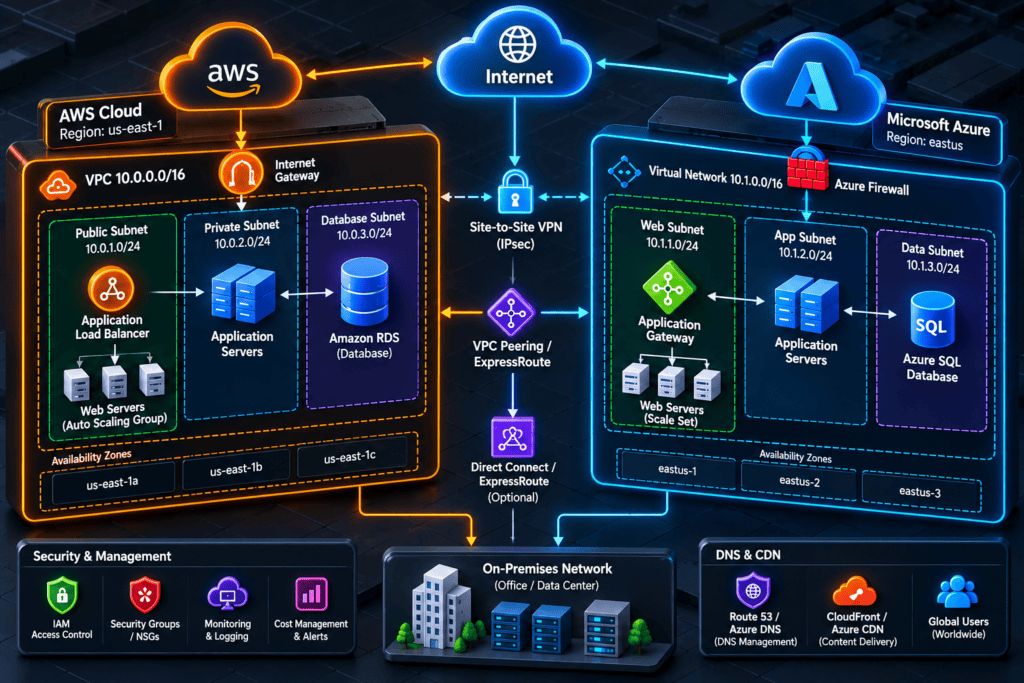
- Isolation & Addressing: Virtual Private Clouds (AWS VPC), Virtual Networks (Azure VNet), subnets, and custom IP address ranges that segment workloads.
- Routing & Traffic Flow: Route tables, internet gateways, and Network Address Translation (NAT) services that dictate how traffic moves in and out of the network.
- Security & Segmentation: Stateful security groups, stateless firewalls, and Network Access Control Lists (NACLs) enforcing zero-trust boundaries.
- Traffic Distribution & Scaling: Load balancers, Domain Name System (DNS) services, and Content Delivery Networks (CDNs) ensuring high availability and low latency.
- Hybrid & Inter-Cloud Connectivity: Site-to-site VPNs and dedicated private links (such as AWS Direct Connect or Azure ExpressRoute) bridging on-premises data centers with the cloud.
Hyperscaler Implementation Mapping
While foundational networking principles—such as IP addressing, routing tables, and traffic segmentation—remain universal, every cloud provider implements them under a distinct nomenclature:
| Component Function | AWS | Microsoft Azure | Google Cloud Platform (GCP) |
| Virtual Network | VPC (Virtual Private Cloud) | VNet (Virtual Network) | VPC |
| Network Segmentation | Subnets | Subnets | Subnets |
| Traffic Control | Security Groups & NACLs | Network Security Groups (NSGs) | Firewall Rules |
| Dedicated Interconnect | AWS Direct Connect | Azure ExpressRoute | Cloud Interconnect |
Why Do Cloud Networking Jobs Matter?
Every cloud-native application, database, and distributed service relies entirely on networking infrastructure to function. Without robust virtual networks, workloads cannot communicate, scale, or remain secure.
In modern architectures, a single application often requires engineers to:
- Communicate securely with internal databases and microservices
- Accept and balance incoming user traffic globally
- Connect securely to third-party APIs and external systems
- Establish hybrid links back to corporate data centers or branch offices
- Distribute workloads across multi-region availability zones for high availability
- Enforce strict zero-trust access boundaries and firewalls
- Resolve domain names and monitor real-time network throughput and latency
Someone must architect, automate, and secure the data paths enabling these interactions. Cloud networking jobs exist to bridge this gap, ensuring that scalability does not compromise security or performance.
Cross-Functional Value
Beyond dedicated titles like cloud network engineer, networking expertise is a force multiplier across adjacent disciplines:
- Cloud Security: Micro-segmentation, encryption in transit, and security groups form the frontline of defense against cloud breaches.
- DevOps & Platform Engineering: Infrastructure as Code (IaC) pipelines routinely provision VPCs, subnets, and transit gateways alongside compute instances.
- Distributed Systems: Low-latency communication and multi-region peering dictate the design of high-scale applications.
Mastering cloud networking provides foundational leverage, making it one of the most critical skill sets for long-term career growth in cloud computing.
What Does a Cloud Network Engineer Do?
A cloud network engineer designs, implements, operates, and troubleshoots the virtual infrastructure that keeps cloud-based applications running smoothly and securely.
While traditional networking relies on physical routers and switches, cloud networking jobs require managing software-defined infrastructure at scale. The day-to-day responsibilities span several core pillars:
Core Responsibilities
- Designing Virtual Networks: Architecting VPCs, VNets, subnets, custom IP address ranges, and multi-tier segmentation. For example, a production architecture safely isolates public-facing web servers from internal application tiers and sensitive databases.
- Managing Routing & Traffic Flow: Configuring route tables, default gateways, and inter-network peering. Engineers ensure that packets take the most efficient, secure path across complex multi-region environments.
- Establishing Hybrid & Multi-Cloud Connectivity: Connecting the cloud environment to external systems—including corporate data centers, branch offices, SaaS platforms, and secondary hyperscalers—using site-to-site VPNs, dedicated direct links, and transit gateways.
- Implementing Network Security: Enforcing zero-trust boundaries using stateful security groups, stateless Network ACLs (NACLs), virtual firewalls, and private service endpoints to block unauthorized access and mitigate data exfiltration risks.
- Configuring Load Balancing & High Availability: Deploying Layer 4 and Layer 7 load balancers to distribute incoming user traffic across multiple backend instances, ensuring fault tolerance, high availability, and optimal performance under load.
- Monitoring & Troubleshooting: Diagnosing complex connectivity bottlenecks, latency spikes, and routing misconfigurations. This requires deep familiarity with VPC flow logs, packet captures, and cloud monitoring telemetry.
- Automating Infrastructure with IaC: Moving away from manual console clicks, modern cloud networking jobs heavily emphasize automation. Engineers use Infrastructure as Code (IaC) tools like Terraform to define networks in version-controlled configuration files, enabling repeatable, scalable deployments.
Cloud Networking Jobs You Can Pursue
There is no single universal title for cloud networking jobs. Organizations structure their technical teams differently based on their architecture, scale, and maturity. While some companies hire dedicated specialists, others fold networking responsibilities into broader infrastructure or platform teams.
The major roles in this domain span specialized network architecture to cross-functional engineering:
| Role | Main Focus | Typical Core Skills |
| Cloud Network Engineer | Cloud network design, deployment, and day-to-day operations | Core networking, AWS/Azure/GCP, routing protocols, security controls |
| Cloud Network Architect | Large-scale enterprise network design and strategic planning | Advanced multi-region routing, hybrid connectivity, enterprise architecture |
| Cloud Infrastructure Engineer | General cloud infrastructure with a heavy emphasis on networking | Cloud platforms, Linux systems, networking fundamentals, automation |
| Cloud Security Engineer | Securing cloud environments, data in transit, and traffic flow | Network security, IAM, cloud firewalls, zero-trust frameworks |
| Hybrid Network Engineer | Bridging legacy on-premises data centers with modern cloud environments | TCP/IP, BGP/OSPF, MPLS, site-to-site VPNs, dedicated interconnects |
| DevOps Engineer | Automating deployment pipelines and underlying application infrastructure | CI/CD, Infrastructure as Code (Terraform), containers, cloud networking |
| Site Reliability Engineer (SRE) | Production system uptime, incident response, and performance | Observability, incident troubleshooting, automation, network telemetry |
| Platform Engineer | Building internal developer platforms, self-service infrastructure, and shared tooling | Kubernetes, IaC, service meshes, cloud networking |
The Overlap in Modern Engineering
The boundaries across cloud networking jobs are increasingly porous. For instance, a DevOps engineer may not carry “network” in their job title, yet they spend significant time provisioning VPCs, configuring load balancers, managing DNS records, and setting up private Kubernetes clusters.
Similarly, a cloud security engineer must thoroughly understand packet inspection, routing tables, and perimeter defense to secure traffic effectively. Whether you pursue a dedicated networking track or a broader infrastructure path, mastering cloud networking fundamentals is a powerful career accelerant.
What Skills Do You Need for Cloud Networking Jobs?
Breaking into cloud networking jobs requires a structured, multi-layered approach. Rather than attempting to master every hyperscaler service at once, successful engineers build their expertise progressively—starting with core networking fundamentals and layering on cloud-native automation, architecture, and security.
Layer 1: Master Traditional Networking Fundamentals
Before provisioning virtual infrastructure in AWS, Azure, or GCP, you must master the foundational principles of computer networking. Cloud networking jobs build directly on top of these core concepts; you cannot configure a secure virtual private cloud if you do not understand how packets move across layers.
You need a firm grasp of the following baseline concepts:
- TCP/IP Model & Encapsulation: How data moves from application layers down to physical bits.
- Addressing & Segmentation: IPv4/IPv6 addressing, subnetting, and Classless Inter-Domain Routing (CIDR) notation.
- Name Resolution & Allocation: Domain Name System (DNS) resolution and Dynamic Host Configuration Protocol (DHCP).
- Transport Protocols: TCP (connection-oriented, reliable) versus UDP (connectionless, low-latency).
- Ports & Protocols: Standard port assignments (e.g., HTTP 80, HTTPS 443, SSH 22, RDP 3389) and protocol behavior.
- Traffic Control & Security: Static routing, Network Address Translation (NAT), Virtual Private Networks (VPNs), and stateful firewalls.
- Application Traffic: HTTP, HTTPS, and TLS handshakes.
- Diagnostic Methodology: Systematic network troubleshooting using tools like
ping,traceroute,nslookup, andtcpdump.
The Practical Reality Check
You do not need to memorize every legacy routing command or hardware configuration before entering the cloud. However, if you are targeting competitive cloud networking jobs, you should be able to instantly answer foundational diagnostic questions such as:
- What exactly happens behind the scenes when a user types a URL into a browser?
- Why can’t Server A communicate with Server B across a network boundary?
- How does a route table dictate packet forwarding decisions?
- What is the architectural purpose of dividing a network into subnets?
- Why must sensitive backend databases reside on private IP addresses rather than public internet interfaces?
Mastering these core principles demystifies how virtual networks operate, making cloud-native abstractions significantly easier to design and troubleshoot.
Layer 2: Master IP Addressing & Subnetting
Subnetting is a non-negotiable competency for anyone pursuing cloud networking jobs. While traditional data centers allowed for flexible ad-hoc re-cabling, cloud environments lock you into strict foundational parameters from day one.
In platforms like AWS and Azure, your initial Virtual Private Cloud (VPC) or Virtual Network (VNet) CIDR block is rigid and cannot be easily changed after creation. Poor upfront IP planning inevitably causes catastrophic failures later—especially when organizations scale, peer virtual networks, or attempt hybrid integrations with corporate data centers.
Essential Competencies
To design scalable cloud networks and pass technical interviews, you must be completely comfortable with:
- CIDR Notation & Subnet Masks: Translating prefix lengths (e.g.,
/16,/24,/28) into exact host counts and usable address ranges. - Private Address Space (RFC 1918): Optimizing the usage of
10.0.0.0/8,172.16.0.0/12, and192.168.0.0/16blocks. - Network and Host Portions:Calculating network boundaries, broadcast addresses, and gateway reservations.
- Functional Segmentation: Separating public-facing tiers, internal application nodes, backend databases, and management planes into isolated, non-overlapping subnets.
- IPv4 vs. IPv6: Understanding native IPv4 exhaustion limits and configuring modern dual-stack cloud environments.
The Architecture Rule of Thumb
As Azure and AWS architectural guidelines emphasize, always design your top-level IP space with future multi-site expansions and hybrid connectivity in mind. Avoiding overlapping address spaces early prevents routing nightmares when connecting multiple VPCs or bridging on-premises environments via dedicated links.
Layer 3: Master One Major Cloud Platform First
Trying to learn AWS, Microsoft Azure, and Google Cloud Platform (GCP) simultaneously is a recipe for surface-level knowledge. To land competitive cloud networking jobs, pick one hyperscaler and build deep, production-level proficiency before branching out.
The underlying principles of virtual networking remain identical across providers, but each ecosystem uses proprietary nomenclature and tooling.
Option A: Amazon Web Services (AWS)
If you choose AWS, focus on the core components that power enterprise cloud architectures:
- Virtual Infrastructure: Amazon VPC, subnets, route tables, Internet Gateways, and NAT Gateways.
- Security & Traffic Control: Security Groups (stateful) and Network ACLs (stateless).
- Traffic Distribution & Resolution: Elastic Load Balancing (ALB/NLB/GWLB) and Route 53 (DNS).
- Connectivity & Scaling: VPC Peering, AWS Transit Gateway, Site-to-Site VPN, and AWS Direct Connect for hybrid setups.
- Edge & Content Delivery: Amazon CloudFront.
Option B: Microsoft Azure
If your target market or enterprise stack relies on Microsoft, prioritize these core Azure networking services:
- Virtual Infrastructure: Azure Virtual Network (VNet), subnets, and Network Security Groups (NSGs).
- Routing & Security: Route tables and Azure Firewall for centralized traffic inspection.
- Traffic Distribution & Resolution: Azure Load Balancer (Layer 4), Application Gateway (Layer 7), and Azure DNS.
- Connectivity & Private Access: VNet peering, VPN Gateway, Azure ExpressRoute, and Private Link for secure service exposure.
Option C: Google Cloud Platform (GCP)
If you lean toward GCP’s data and container-centric ecosystem, master these components:
- Virtual Infrastructure: VPC networks, subnets, and custom routes.
- Security & Routing: Firewall rules (applied at the instance/network level) and Cloud NAT.
- Traffic Distribution & Resolution: Cloud Load Balancing (global HTTP(S) load balancing) and Cloud DNS.
- Connectivity & Private Access: Cloud VPN, Cloud Interconnect, VPC Network Peering, and Private Service Connect.
Layer 4: Integrate Cloud Security & Zero Trust Architecture
In modern cloud environments, networking and security are inseparable. Security can no longer be treated as an afterthought bolted on after the infrastructure is built; network architecture and security architecture must be engineered concurrently.
Professionals targeting competitive cloud networking jobs must master the controls that protect data in transit and prevent unauthorized lateral movement.
Core Security Competencies
To design resilient cloud environments, you must master these foundational concepts:
- Network Segmentation & Isolation: Dividing VPCs/VNets into public, private, and isolated tiers to restrict blast radii during a security incident.
- Stateful vs. Stateless Controls: Leveraging stateful Security Groups alongside stateless Network ACLs (NACLs) or virtual firewalls to filter inbound and outbound traffic precisely by source, destination, port, and protocol.
- Private Endpoints & Services: Accessing cloud platform services (such as managed databases or storage buckets) securely over internal private IP addresses rather than traversing the public internet.
- Encryption in Transit: Implementing TLS, IPsec, and mTLS to protect data as it moves across virtual networks, peering links, and hybrid tunnels.
- Identity-Driven Access: Aligning network boundaries with Identity and Access Management (IAM) policies to enforce granular, least-privilege access.
- Observability & Threat Detection: Configuring VPC flow logs, packet mirroring, firewall telemetry, and SIEM integrations to detect unauthorized traffic spikes and security anomalies.
The Zero Trust Imperative
Modern enterprise security relies on Zero Trust principles—the philosophy of “never trust, always verify.”
In a cloud networking context, this means assuming the network perimeter is always porous. Engineers must build architectures where micro-segmentation, continuous authentication, and strict traffic encryption protect every interaction between microservices, applications, and users, regardless of whether traffic originates inside or outside the corporate network.
Layer 5: Build Practical Linux Proficiency
While you don’t need to be a full-time Linux system administrator, a strong grasp of Linux is non-negotiable for anyone pursuing cloud networking jobs. The vast majority of cloud infrastructure, virtual machine instances, and containerized workloads run on Linux distributions.
When a network connection drops or a service fails, you cannot rely on graphical user interfaces (GUIs). You need to be comfortable diagnosing issues directly from the command line.
Essential Linux Competencies
Focus your learning on these core operational areas:
- Command-Line Navigation & File Management: Moving efficiently through directories, manipulating files, and managing text files (
grep,awk,sed). - Permissions & Ownership: Configuring file permissions (
chmod,chown) and managing user access and sudo privileges. - Remote Access & Tunneling: Managing secure shell (
ssh) connections, generating and configuring SSH keys, and setting up port forwarding or SSH tunnels. - Process & Service Management: Monitoring system processes (
ps,top,htmp,kill) and managing system services (systemctl). - Package Management: Installing and updating software packages using package managers like
apt(Ubuntu/Debian) oryum/dnf(RHEL/Amazon Linux). - System Logs: Inspecting and filtering system and application logs located in
/var/log/or viajournalctl. - Network Diagnostics Suite: Utilizing command-line troubleshooting tools to inspect interfaces, sockets, and traffic:
ip/ifconfig(checking network interfaces and IP configurations)ss/netstat(inspecting active listening ports and socket connections)pingandtraceroute/tracepath(testing reachability and packet paths)digandnslookup(debugging DNS queries and name resolution)tcpdump(capturing and analyzing raw packet data for deep troubleshooting)
- Basic Shell Scripting: Writing simple Bash scripts to automate repetitive tasks, configuration checks, or deployment steps.
Layer 6: Master Automation & Infrastructure as Code (IaC)
Manual console clicking does not scale. If you want to stand out in the applicant pool for cloud networking jobs, mastering Infrastructure as Code (IaC) is your single biggest competitive differentiator.
Modern engineering teams expect networks to be defined, version-controlled, tested, and deployed with the same rigorous pipelines used for application software.
The Power of Terraform
Terraform by HashiCorp is the industry standard for multi-cloud infrastructure automation. It allows you to provision and manage complex networking stacks—including VPCs, subnets, route tables, security groups, and transit gateways—across AWS, Azure, and GCP using declarative configuration files.
To build production-grade competency, focus on mastering these core Terraform concepts:
- Providers & Initialization: Connecting Terraform to cloud APIs (
terraform init). - Declarative Syntax & Resources: Writing resource blocks for VPCs, subnets, gateways, and firewalls.
- Variables & Outputs: Creating reusable, parameterized configurations instead of hardcoding IP ranges and resource names.
- Modules: Organizing infrastructure code into clean, reusable, and version-controlled components.
- State Management: Understanding local versus remote state (
terraform state), locking state files to prevent team conflicts, and utilizing backend storage (such as AWS S3 with DynamoDB locking). - Execution Lifecycle: Safely previewing changes (
terraform plan), applying configurations (terraform apply), and tearing down test resources (terraform destroy).
Version Control with Git & GitHub
IaC code belongs in version control. Learning Git and GitHub is essential not only for team collaboration but also for building a professional portfolio. Storing your Terraform networking modules, automation scripts, and architecture diagrams in a public GitHub repository gives hiring managers tangible proof of your technical capabilities before you even step into an interview.
Layer 7: Learn Scripting & Operational Programming
You do not need to become a full-time software developer to excel in cloud networking jobs. However, understanding basic scripting and data serialization formats is essential for automating repetitive tasks, interacting with cloud APIs, and building operational tooling.
The goal is practical leverage: using code to eliminate manual overhead and speed up troubleshooting.
Essential Scripting & Data Languages
Focus your learning on these foundational tools:
- Bash Scripting: Writing straightforward shell scripts to chain networking commands, parse logs, automate backups, or run routine health checks.
- Python: The industry standard for infrastructure automation. Learn how to read and write basic scripts, handle errors, parse JSON responses, and interact with cloud APIs using Software Development Kits (such as AWS Boto3).
- JSON & YAML: Mastering these data serialization formats is mandatory, as cloud CLI outputs, configuration files, and Infrastructure as Code pipelines rely heavily on them.
- Cloud Command Line Interfaces (CLIs): Becoming fluent in native management tools—such as the AWS CLI, Azure CLI, and Google Cloud SDK (
gcloud)—allows you to inspect resources, test connectivity, and run diagnostic queries directly from your terminal.
Practical Application in Networking
Instead of treating programming as an isolated subject, apply it directly to your networking workflows. Write scripts that automatically audit your security groups for overly permissive rules, query cloud APIs to map out active VPC subnets, or parse VPC flow logs to spot unusual traffic patterns during an incident.
Layer 8: Master Observability & Systematic Troubleshooting
Building a virtual network is only half the battle. When production applications fail, users experience latency spikes, or databases lose connectivity, the ability to diagnose and resolve the issue quickly separates senior professionals from junior engineers.
Securing high-level cloud networking jobs requires moving away from guesswork and adopting a disciplined, methodical approach to troubleshooting.
Common Failure Modes to Master
When investigating network outages in cloud environments, you will routinely encounter and diagnose issues such as:
- Latency & Jitter: Identifying bottlenecks across VPC peering links, transit gateways, or hybrid interconnects.
- Packet Loss: Tracing dropped packets caused by misconfigured MTU sizes, overloaded interfaces, or exhausted bandwidth quotas.
- DNS Failures: Debugging incorrect record resolution, private hosted zone routing issues, or upstream resolver timeouts.
- Routing Misconfigurations: Spotting missing route table entries, conflicting static routes, or incorrect next-hop targets.
- Traffic Blocking: Uncovering overly restrictive stateful Security Groups, stateless NACLs, or virtual firewall rules dropping legitimate traffic.
- Load Balancing Failures: Troubleshooting unhealthy target groups, failing health checks, or misconfigured Layer 4/Layer 7 routing rules.
- Hybrid Connectivity Drops: Diagnosing IPsec tunnel instability, Border Gateway Protocol (BGP) peer flaps, or routing leaks over VPN and direct interconnects.
Native Cloud Diagnostic & Observability Tooling
Cloud providers offer robust telemetry suites to inspect traffic and pinpoint failures without blindly toggling settings. Master the native toolsets for your chosen platform:
- AWS: Leverage VPC Flow Logs (for traffic analysis), Amazon CloudWatch (for metrics and alarms), AWS X-Ray (for distributed tracing), and Reachability Analyzer (for automated configuration validation).
- Azure: Utilize Azure Network Watcher (including IP Flow Verify, Next Hop diagnostics, and Connection Monitor) alongside Azure Monitor and Log Analytics.
- GCP: Use VPC Flow Logs, Connectivity Tests (to statically verify reachability), and Cloud Monitoring dashboards.
The Systematic Troubleshooting Methodology
When an incident hits, approach the problem like an engineer:
- Define the Scope: Is the failure affecting a single instance, an entire subnet, or global users?
- Verify the Path: Trace the expected packet journey from source to destination (Client $\rightarrow$ DNS $\rightarrow$ Load Balancer $\rightarrow$ Subnet Route $\rightarrow$ Security Group $\rightarrow$ Target Instance).
- Inspect the Telemetry: Check flow logs, firewall audit logs, and load balancer metrics to see where packets are dropping or stalling.
- Test Isolate: Use command-line utilities (
nc,telnet,curl, ortcpdump) to isolate the exact layer of failure (transport vs. application vs. network). - Validate & Document: Apply a targeted fix, verify full end-to-end connectivity, and document the root cause to prevent recurrence.
Do You Need a Degree for Cloud Networking Jobs?
The short answer is no. A traditional degree in computer science, information technology, or electrical engineering can provide a helpful theoretical foundation, but it is not a strict prerequisite for landing high-paying cloud networking jobs.
Cloud networking is an intensely practical, skills-based discipline. Employers hiring for these roles care far more about what you can configure, automate, and troubleshoot than what is written on a diploma.
Proving Competence Without a Degree
Opting out of a university degree does not mean cutting corners. To bypass traditional academic credentials and convince hiring managers you are ready for production environments, you must build an undeniable portfolio of capability.
Successful non-degree candidates prove their competence through a combination of:
- Deep Foundational Knowledge: A rock-solid understanding of TCP/IP, subnetting, routing, and traffic flow.
- Industry Certifications: Validated credentials (such as AWS Certified Advanced Networking or Azure Network Engineer Associate) that prove you understand platform-specific architectures.
- Hands-On Lab Experience: Real-world troubleshooting practice and virtual lab setups that mirror production setups.
- GitHub Repositories: Production-grade Infrastructure as Code (IaC) templates, Terraform modules, and automation scripts hosted in a public GitHub profile.
- Adjacent IT Experience: Practical background in system administration, helpdesk support, Linux engineering, or general IT operations.
A degree is merely one signal of competence. If you lack one, you must replace academic pedigree with verifiable execution—demonstrating through code, projects, and certifications that you can architect and manage robust cloud networking infrastructure.
Which Certifications Are Useful for Cloud Networking?
Certifications validate technical knowledge, but they should reinforce—not replace—hands-on architectural experience. Because cloud platforms evolve rapidly, hiring managers look at credentials as baseline proof of commitment and structured learning rather than a substitute for practical labs and automation projects.
The AWS Certification Path
- Foundational: AWS Certified Cloud Practitioner
- Best for: Absolute beginners with no prior IT background.
- What it covers: Core AWS services, cloud concepts, security, terminology, and billing models.
- Associate: AWS Certified Solutions Architect – Associate
- Best for: Learners who understand basic networking and want to learn how to design secure, resilient, high-performing, and cost-optimized AWS architectures. It serves as a solid checkpoint before tackling complex design concepts.
- Note on Professional/Specialty Tracks: While AWS previously offered the Advanced Networking – Specialty credential, AWS has retired this specific exam. For advanced validation, engineers now typically pivot toward the AWS Certified Solutions Architect – Professional, which heavily tests multi-account architectures, hybrid connectivity, and enterprise-scale networking.
The Microsoft Azure Certification Path
- Intermediate: Microsoft Certified: Azure Network Engineer Associate (Exam AZ-700)
- Best for: Engineers focusing directly on Microsoft’s ecosystem.
- What it covers: Designing, implementing, and maintaining Azure networking infrastructure. The scope spans core virtual networks, hybrid connectivity (VPN/ExpressRoute), application delivery (load balancers and application gateways), private access, and network security.
- Broad Administration: Microsoft Certified: Azure Administrator Associate (Exam AZ-104)
- Best for: Those who need a broader foundation in general cloud administration before specializing. It covers virtual networks alongside compute, identity, storage, and governance.
The Google Cloud (GCP) Certification Path
- Professional: Google Cloud Professional Cloud Network Engineer
- Best for: Experienced engineers with a strong technical foundation.
- What it covers: Designing, implementing, and managing VPC networks, managed network services, hybrid and multi-cloud interconnects, network security, and operational troubleshooting. Google explicitly recommends hands-on industry experience before sitting for this professional-tier exam.
Do You Need Multiple Cloud Certifications?
No. A common and costly beginner mistake is “certification collection”—accumulating badges across AWS, Azure, and Google Cloud Platform (GCP) without developing deep, practical skills in any single environment.
Hiring managers filtering résumés for cloud networking jobs easily spot candidates with a stack of associate-level certificates and zero hands-on GitHub repositories or automation experience. True expertise comes from execution depth, not exam paper collection.
The High-Leverage Learning Pipeline
Instead of jumping between multiple vendors, follow a disciplined, sequential progression to build real-world competency:
- Master Networking Fundamentals: Build an unshakeable grasp of TCP/IP, subnetting, CIDR notation, routing, and DNS.
- Pick One Cloud Platform: Focus exclusively on AWS, Azure, or GCP until you can architect, secure, and troubleshoot virtual environments instinctively.
- Build Hands-On Projects: Construct real-world architectures, private subnets, and secure transit gateways in your chosen sandbox.
- Automate with Infrastructure as Code: Translate your manual network designs into reusable Terraform modules and store them in version control.
- Earn a Targeted Certification: Validate your platform expertise with a recognized credential (such as Azure Network Engineer Associate or AWS Solutions Architect).
- Execute Job Applications: Leverage your verified portfolio and deep platform knowledge to stand out in the applicant pool.
The Reality of Multi-Cloud Architecture
True multi-cloud proficiency is valuable in enterprise engineering, but it is built on a foundation of depth, not breadth. Once you deeply understand virtual networking, routing protocols, and security controls on one hyperscaler, learning a second or third cloud provider becomes an exercise in translating terminology rather than re-learning core networking concepts.
Build deep mastery on one platform first; expand into multi-cloud environments only after you have mastered production-grade execution.
A Practical Cloud Networking Roadmap for Beginners
Transitioning into cloud networking jobs requires a structured, deliberate progression. Attempting to learn multi-cloud environments, enterprise routing protocols, and automation pipelines all at once leads to burnout and superficial knowledge.
By following a staged, high-leverage roadmap, you build both foundational mastery and verifiable proof of competence.
Stage 1: Learn Networking Fundamentals
Before deploying virtual infrastructure on any hyperscaler, master the foundational physics of computer networking.
- Core Concepts to Study: TCP/IP model, IPv4/IPv6 addressing, subnetting, CIDR notation, DNS resolution, static and dynamic routing, Network Address Translation (NAT), Virtual Private Networks (VPNs), firewalls, and HTTP/HTTPS traffic.
- Practical Action: Set up local networking labs (using tools like Cisco Packet Tracer, GNS3, or basic virtual machines) to observe how packets move across interfaces.
- Stage Goal: Deeply understand how data moves from source to destination across a network boundary.
Stage 2: Learn Linux and Git
Cloud infrastructure, virtual machines, and containerized workloads run overwhelmingly on Linux. You must be comfortable managing them without a graphical user interface.
- Core Concepts to Practice: Linux command-line navigation, file permissions, SSH key management, system services, logs, network diagnostic commands (
ip,ss,tcpdump,traceroute), Git version control, and GitHub workflows. - Stage Goal: Become completely comfortable interacting with, troubleshooting, and version-controlling infrastructure directly from the command line.
Stage 3: Choose One Cloud Platform
Pick a single hyperscaler—AWS, Microsoft Azure, or Google Cloud—and focus entirely on mastering its networking ecosystem.
- Core Concepts to Master: Virtual Private Clouds (VPCs/VNets), subnets, route tables, internet/NAT gateways, security groups, network ACLs, load balancing, DNS, and hybrid connectivity services.
- Stage Goal: Seamlessly translate traditional on-premises networking concepts into their cloud-native equivalents on your chosen platform.
Stage 4: Build Portfolio-Grade Networking Projects
Tutorials and video courses only take you so far. To stand out when applying for cloud networking jobs, you must build, document, and publish your own production-grade environments.
Project 1: Multi-Tier Cloud Network
- What to Build: A highly secure, isolated VPC/VNet segmented into a public subnet (for internet-facing load balancers or bastion hosts), a private application subnet, and an isolated database subnet. Configure proper route tables, NAT gateways for outbound traffic, and strict security groups.
- Deliverable: A clean architecture diagram and a README document explaining your security choices.
Project 2: Secure Application Architecture
- What to Build: A scalable web application topology featuring a Layer 4/Layer 7 load balancer distributing traffic to backend application servers residing in private subnets, fronted by custom DNS routing and active monitoring telemetry.
- Deliverable: A functioning deployment with documented health checks and traffic flow validations.
Project 3: Hybrid Connectivity Simulation
- What to Build: A simulated hybrid architecture demonstrating how an external environment connects securely to your cloud network using a site-to-site IPsec VPN tunnel. (Note: You do not need expensive physical hardware; local software-based VPN appliances or cloud-native tunneling emulators are sufficient).
- Deliverable: Documentation proving end-to-end encrypted packet transmission across the hybrid link.
Project 4: Infrastructure as Code (Terraform) Project
- What to Build: Rebuild one of your previous cloud environments entirely using Terraform. Structure your code with variables, outputs, and reusable modules, and store the codebase in a public GitHub repository.
- Documentation Checklist: Include architecture overviews, variable definitions, deployment instructions, security considerations, cost management notes, and troubleshooting logs.
Why This Matters
A well-documented Terraform repository on GitHub serves as undeniable proof of your capabilities to hiring managers, giving you a massive competitive edge in the job market over candidates who only rely on console clicks and multiple unverified certifications.
How to Build a Cloud Networking Portfolio
Your portfolio should answer one central question for hiring managers: “Can this person actually design, deploy, and operate cloud infrastructure under real-world constraints?”
For competitive cloud networking jobs, a collection of static course certificates or unverified resumes will never outweight tangible proof of execution. A professional-grade project repository must communicate technical depth, engineering rigor, and clear communication.
The Anatomy of a Production-Grade Repository
When structuring your GitHub repositories for cloud networking projects, avoid dumping raw code without context. Every professional project should include a comprehensive README.md and codebase structured around the following 14 sections:
- Project Overview: A concise summary of what the project builds, its primary objectives, and the technologies utilized.
- Architecture Diagram: A clear visual map (using tools like Lucidchart, Excalidraw, or Draw.io) displaying VPCs, subnets, gateways, routing paths, and security boundaries.
- The Problem Statement: The business or technical challenge the architecture solves (e.g., isolating a multi-tier database from public internet exposure while enabling secure administrative access).
- Network Design: Deep-dive notes on how your virtual network topology is organized across availability zones.
- IP Addressing Plan: Explicit documentation of your CIDR block allocations, subnet divisions, and reservation strategies (proving you avoided overlapping address spaces).
- Security Approach: How you implemented least-privilege principles, stateful Security Groups, stateless NACLs, and private service endpoints.
- Routing Design: Detailed explanation of route tables, internet gateways, NAT gateways, and transit routing logic.
- Infrastructure-as-Code (IaC) Files: Clean, modular, and version-controlled Terraform configuration files (
main.tf,variables.tf,outputs.tf, and custom modules). - Deployment Instructions: Step-by-step terminal commands (
terraform init,plan,apply) allowing anyone to reproduce your environment safely. - Evidence & Verification: Terminal outputs,
curltests, traceroute logs, or dashboard screenshots proving the network functions correctly. - Troubleshooting Notes: A breakdown of real errors encountered during construction (e.g., routing loops or blocked security groups) and how you systematically diagnosed and fixed them.
- Lessons Learned: Architectural trade-offs, limitations encountered, and what you would optimize in a production redesign.
- Cost Considerations: An estimation of ongoing cloud resource costs (such as NAT gateway hourly fees or VPN tunnel charges) and how to minimize spend.
- Cleanup Instructions: Explicit commands (
terraform destroy) to tear down all resources so testers don’t incur unexpected cloud bills.
The Communication Imperative
The ability to write clear technical documentation is just as valuable as writing clean code. When an engineering lead reviews your portfolio, they are evaluating how well you document design decisions, explain trade-offs, and communicate complex topologies.
Treat every GitHub repository as if it were a production runbook for your future engineering team. High-signal documentation paired with robust IaC is your strongest asset for landing high-paying cloud networking jobs.
How Can Nigerians Get Cloud Networking Jobs?
The core competencies required for cloud networking jobs—such as TCP/IP mastery, Infrastructure as Code, routing logic, and virtual private cloud design—are entirely location-agnostic. Global enterprises and remote-first technology companies care about verifiable execution, not your physical postal code.
However, aspiring cloud engineers in Nigeria often face unique practical constraints, particularly regarding foreign exchange costs, payment card limitations on international platforms, and internet access stability.
Overcoming these barriers requires a resource-efficient, high-leverage execution strategy:
Maximize Free, High-Quality Educational Resources
You do not need expensive training bootcamps to master cloud networking. The absolute best technical documentation is entirely free:
- Official Hyperscaler Docs: AWS Documentation, Microsoft Learn, and Google Cloud Architecture Center offer world-class, regularly updated learning paths.
- Open-Source Guides & Communities: Platforms like GitHub, Reddit (
r/ccna,r/aws,r/devops), and specialized Discord/Slack engineering communities provide free, peer-driven mentorship. - Linux & Open-Source Tooling: Linux distributions, Git, and Terraform are entirely free to download, practice, and master locally on your existing hardware.
Navigate Cloud Costs and Free Tiers Safely
Practicing in the cloud requires a credit card or digital dollar card (such as grey, chipper, or virtual cards provided by fintech platforms like Eversend or Geegpay that support international billing). Because billing surprises can be stressful:
- Beware the “Free Tier” Trap: A cloud provider’s free tier does not mean every service is permanently free. Always read the fine print regarding monthly hour limits, trial expiration dates, and eligible resource sizes.
- Monitor and Clean Up: Build a strict operational habit: the moment you finish a hands-on lab or testing session, immediately run
terraform destroyor manually delete your resources via the console. - Set Up Billing Alarms: Configure strict budget alerts and billing notifications in your cloud account dashboard to alert you instantly if resource usage exceeds zero.
Overcome Local Infrastructure Constraints
- Optimize for Offline/Local Labs: When internet connectivity is unstable, focus on local tooling. You can run lightweight Linux virtual machines using VirtualBox or WSL (Windows Subsystem for Linux), practice containerization with Docker, and learn Terraform locally before pushing code to the cloud.
- Asynchronous Learning: Download official documentation PDFs, video courses (via platforms offering offline viewing), and lab guides during periods of stable connectivity so you can study uninterrupted.
Accessing Global Remote Work and Local Opportunities
Once you have built your portfolio of Terraform projects and mastered cloud networking fundamentals, you can target two distinct markets:
- Global Remote Roles: Apply to international remote-first companies through platforms like Remote.com, We Work Remotely, and specialized tech job boards. Focus your resume heavily on your GitHub repository links, architecture diagrams, and demonstrable IaC code rather than where you live.
- The Local Nigerian Ecosystem: Major Nigerian commercial banks, fintech unicorns (such as Flutterwave, Paystack, and Moniepoint), and telecommunications giants run massive, complex distributed infrastructure and actively hire cloud and infrastructure engineers locally.
By combining rigorous self-study, disciplined cost management, and a robust GitHub portfolio, Nigerian engineers can successfully break into high-paying cloud networking jobs on a global scale.
Where Can You Find Cloud Networking Jobs?
When searching for employment, restricting your search strictly to the exact phrase “cloud networking jobs” will severely limit your visibility. Because companies organize their infrastructure teams differently, networking responsibilities are often distributed across various department titles.
To uncover high-paying roles, you need to expand your search terms and leverage the right global and regional platforms.
High-Yield Job Titles to Search For
Cast a wider net by looking up roles where cloud networking is a core daily requirement:
- Specialized Titles: Cloud Network Engineer, Network Architect, Cloud Architect, Hybrid Network Engineer, Network Automation Engineer.
- Infrastructure & Platform Titles: Cloud Infrastructure Engineer, Cloud Engineer, Infrastructure Engineer, Platform Engineer, Site Reliability Engineer (SRE), DevOps Engineer.
- Security Titles: Cloud Security Engineer, Network Security Engineer.
High-Precision Keyword Combinations
Instead of generic searches like “IT jobs,” combine target roles with specific cloud and automation technologies to surface high-intent openings:
AWS Network EngineerAzure Network EngineerGCP Network EngineerCloud Infrastructure Engineer TerraformNetwork Automation EngineerCloud Security Engineer VPC
Best Platforms for Remote and Local Searches
- Global Remote Job Boards: Focus on remote-first platforms that hire internationally, such as We Work Remotely, Remote.com, Wellfound (for fast-growing startups), and LinkedIn Jobs (filtered by remote or target regions).
- Nigerian Enterprise & Fintech Ecosystem: For local opportunities with major institutions, check the career pages of top Nigerian fintechs (e.g., Flutterwave, Paystack, Moniepoint), Tier-1 commercial banks (e.g., GTBank, Access Bank), and telecommunications leaders (e.g., MTN Nigeria, Airtel), which heavily invest in robust cloud and hybrid network infrastructure.
Landing one of the competitive cloud networking jobs outlined in this guide comes down to execution.
- Master the fundamentals of networking and Linux.
- Pick one hyperscaler and build real-world labs.
- Automate your infrastructure using Terraform and publish your work on GitHub.
- Search intelligently across a broad spectrum of infrastructure titles.
Start building your first multi-tier cloud network repository today, and turn your technical competence into career leverage.
Cloud Networking vs. DevOps: What’s the Difference?
While cloud networking jobs and DevOps engineering frequently intersect in modern tech stacks, their core mandates, daily responsibilities, and primary objectives are distinct. Understanding where these disciplines diverge—and where they overlap—helps you choose the right career path or position your skill set more effectively to hiring managers.
Core Comparison Matrix
| Dimension | Cloud Networking Professional | DevOps Engineer |
| Primary Focus | Connectivity, routing, traffic flow, segmentation, and perimeter security | Software delivery pipelines, automation frameworks, CI/CD, and system reliability |
| Daily Operational Scope | VPCs, subnets, route tables, load balancers, firewalls, VPNs, and hybrid interconnects | Build pipelines, container orchestration, configuration management, deployment workflows, and observability |
| Core Expertise | TCP/IP, BGP/OSPF, DNS, IP addressing, zero-trust network boundaries, and packet flow | Linux systems, container runtimes (Docker/Kubernetes), scripting, infrastructure as code, and release engineering |
| Primary Goal | Ensuring secure, reliable, and low-latency communication across distributed cloud environments | Accelerating software delivery velocity while maintaining system uptime and operational stability |
Where the Roles Overlap
The boundaries between cloud networking and DevOps are increasingly porous due to the widespread adoption of Infrastructure as Code (IaC) and software-defined networking:
- Infrastructure as Code: A DevOps engineer routinely provisions VPCs, subnets, and load balancers using Terraform. Conversely, a modern cloud network engineer must use Terraform and version control (Git) to deploy their network topologies.
- Automation & CI/CD: Both roles rely on automated deployment pipelines. Network changes are now frequently tested, reviewed, and deployed via pull requests rather than manual console updates.
- Kubernetes & Container Networking: Container platforms require deep knowledge of both worlds—overlay networks, service meshes, and ingress controllers demand advanced networking expertise combined with container lifecycle management.
Why This Matters for Your Career
Even if your primary goal is landing one of the specialized cloud networking jobs, developing basic DevOps competencies—such as Git workflows, Terraform automation, and CI/CD pipeline principles—is no longer optional. Modern infrastructure engineering rewards professionals who combine deep domain expertise in networking with modern software automation skills.
Cloud Networking vs. Traditional Networking
A common misconception is that mastering cloud computing means throwing out everything you know about legacy infrastructure. In reality, traditional networking knowledge is not becoming irrelevant; rather, it provides the indispensable foundation upon which cloud networking jobs are built.
The core physics of networking—how packets move, how IP addressing works, how routing tables make forwarding decisions, and how transport protocols behave—remain identical whether you are configuring a physical Cisco switch or an Amazon Virtual Private Cloud (VPC).
Comparison: Traditional vs. Cloud Networking
| Feature / Dimension | Traditional Networking | Cloud Networking |
| Infrastructure Medium | Physical hardware (switches, routers, firewalls) | Software-defined infrastructure (SDN, virtual appliances) |
| Routing Mechanisms | Physical routers, BGP/OSPF hardware configurations | Virtual route tables, cloud routers, cloud peering gateways |
| Security Controls | Physical firewalls, Access Control Lists (ACLs) on hardware | Stateful Security Groups, stateless NACLs, cloud-native firewalls |
| Network Segmentation | Virtual Local Area Networks (VLANs) | Virtual subnets, VPCs/VNets, micro-segmentation |
| Deployment Method | Manual console/CLI configuration, physical cabling | APIs, Infrastructure as Code (Terraform), automated pipelines |
| Scale & Topology | Static enterprise data centers | Elastic cloud regions, availability zones, global edge networks |
| Connectivity | Leased lines, MPLS, physical site-to-site VPN appliances | Cloud VPN, dedicated hybrid links (Direct Connect, ExpressRoute) |
| Traffic Distribution | Hardware load balancers (F5, NetScaler) | Managed elastic load balancers (ALB, NLB, Azure Load Balancer) |
The Paradigm Shift: Evolution, Not Replacement
The distinction between the two approaches is not that cloud networking replaces traditional networking, but rather that it extends and abstracts it:
- From Hardware to APIs: Instead of physically racking switches and running patch cables, you provision virtual networks through declarative code and API calls.
- From Static to Elastic: Capacity changes from a multi-week hardware procurement cycle to an instant, auto-scaling software configuration.
- From Local to Global: Multi-region availability and global edge routing can be deployed in minutes rather than months.
Why This Matters for Your Career
If you come from a traditional networking background (such as CCNA/CCNP certifications), you hold a massive competitive advantage when pursuing cloud networking jobs—provided you learn how those physical concepts map to software-defined environments. Understanding why a route table drops a packet or how a subnet boundary operates makes learning cloud infrastructure significantly faster and more intuitive.
Common Mistakes When Starting a Cloud Networking Career
Entering the cloud infrastructure space is rewarding, but many self-taught engineers and career switchers hit predictable roadblocks. Avoiding these seven common missteps will accelerate your path to landing competitive cloud networking jobs:
Mistake 1: Learning Only the Cloud Console
Clicking through graphical AWS, Azure, or Google Cloud web consoles makes you familiar with user interfaces, not network engineering. When the UI changes or an automation pipeline fails, console-only engineers struggle. Always learn the underlying architectural concepts and terminal commands behind the buttons.
Mistake 2: Ignoring Subnetting
Some beginners dismiss subnetting as a legacy topic, relying on default CIDR blocks provided by automated setups. In the cloud, a poorly planned IP address space cannot be easily changed later, leading to catastrophic routing failures when scaling or integrating hybrid architectures.
Mistake 3: Collecting Certifications Without Projects
Accumulating a stack of associate-level certificates without building anything will not pass a technical interview. Certifications validate theoretical knowledge, but public GitHub repositories, Terraform code, and real troubleshooting experience prove you can actually execute.
Mistake 4: Trying to Learn Every Cloud Provider Simultaneously
Jumping between AWS, Azure, and Google Cloud at the same time results in shallow, confusing knowledge. Pick one hyperscaler, build deep production-level expertise in its networking stack, and only expand into multi-cloud environments after mastering the fundamentals.
Mistake 5: Treating Security as an Afterthought
A network that connects successfully but exposes sensitive databases or internal APIs to the public internet is a production failure waiting to happen. Network architecture and security controls (like stateful security groups, NACLs, and zero-trust segmentation) must be engineered concurrently.
Mistake 6: Relying Exclusively on Manual Configuration
Click-ops (manually creating every resource via a GUI) is fine for initial learning, but it does not scale. Modern engineering teams expect infrastructure to be version-controlled, repeatable, and automated using Infrastructure as Code (IaC) tools like Terraform.
Mistake 7: Avoiding Troubleshooting
Building greenfield environments in tutorials is easy; fixing broken production routing under pressure is where engineers earn their keep. Avoiding log analysis, packet captures, and systematic debugging leaves you unprepared for real-world cloud networking jobs.
What Does a Job-Ready Cloud Networking Skill Set Look Like?
To successfully land your first role in cloud networking jobs, you do not need to be a principal architect who has memorized every service code across multiple hyperscalers. However, hiring managers do expect a well-rounded foundation that proves you can build, automate, secure, and troubleshoot virtual environments safely.
A competitive junior-to-intermediate candidate portfolio should demonstrate proficiency across five core competency pillars:
Traditional & Cloud Networking
- Foundations: Mastery of TCP/IP, IPv4 addressing, CIDR subnetting calculations, DNS resolution, and routing mechanics.
- Cloud Architecture: Deep familiarity with one hyperscaler (AWS, Azure, or GCP), specifically designing Virtual Private Clouds (VPCs/VNets), subnets, route tables, internet/NAT gateways, and VPC peering.
- Traffic Management: Configuring Layer 4/Layer 7 load balancers and setting up hybrid connectivity (Site-to-Site VPNs or direct interconnects).
Automation & Infrastructure as Code (IaC)
- Terraform: Ability to provision, update, and destroy modular networking stacks using declarative configuration files.
- Version Control: Active use of Git and GitHub to manage codebases, write clean
README.mddocumentation, and store project templates. - Scripting & Shells: Proficiency with the Linux command line, cloud CLIs (
aws,az,gcloud), Bash automation, and basic Python scripting.
Security & Zero-Trust Architecture
- Traffic Filtering: Implementing stateful Security Groups alongside stateless Network ACLs or cloud firewalls.
- Access Control: Applying Identity and Access Management (IAM) principles and least-privilege permissions.
- Data Protection: Utilizing private service endpoints to keep sensitive database and storage traffic off the public internet, alongside encryption in transit.
Observability & Systematic Operations
- Diagnostic Tooling: Using VPC Flow Logs, packet captures,
traceroute,ss, and native monitoring dashboards to audit traffic. - Incident Response: Following a structured troubleshooting methodology to isolate latency bottlenecks, dropped packets, and routing loops.
- Cost Awareness: Designing resource topologies with financial efficiency in mind, managing NAT gateway and data transfer costs, and enforcing strict cleanup habits.
The Realistic Execution Path
You do not need to check every single box on this list before submitting your first job application. Instead, treat this competency blueprint as a progressive roadmap.
As you build and publish your GitHub projects—moving from foundational subnetting labs to automated Terraform infrastructure deployments—your technical confidence and market readiness will naturally scale to meet what employers demand in modern cloud networking jobs.
Is Cloud Networking a Good Career Path?
Yes, cloud networking is an exceptional career path. As modern enterprises migrate away from physical data centers and toward distributed, cloud-native applications, the demand for professionals who understand how to design, secure, and scale virtual networks has never been higher.
Unlike volatile software fads, networking is an indispensable pillar of technology. Every application, database, microservice, and AI model relies entirely on robust infrastructure to transmit data.
Why Cloud Networking Offers High Leverage
- High Barrier to Entry: Because networking requires mastering abstract concepts like TCP/IP, subnetting, and routing, fewer engineers possess deep networking competence. Overcoming this barrier makes you significantly more competitive in the job market.
- Transferable Foundations: The core principles of cloud networking—traffic segmentation, routing, and zero-trust security—do not change when a company switches from AWS to Azure or adopts a multi-cloud strategy.
- A Launchpad to Advanced Disciplines: Mastering cloud networking provides an elite foundation for scaling into some of the most lucrative and high-demand roles in tech:
- Cloud Security Engineering: Securing data in transit and enforcing strict micro-segmentation.
- DevOps & Platform Engineering: Automating infrastructure pipelines and managing complex Kubernetes container networks (service meshes, ingress controllers).
- Site Reliability Engineering (SRE): Diagnosing production latency bottlenecks and systemic failures.
- AI Infrastructure: Designing ultra-low-latency, high-bandwidth networks required to interconnect distributed GPU clusters for machine learning workloads.
If you enjoy solving complex problems, understanding how underlying systems communicate, and building resilient infrastructure that powers global applications, cloud networking jobs offer long-term career stability, intellectual fulfillment, and excellent earning potential.
Focus on building deep fundamentals, mastering Infrastructure as Code, and proving your competence through hands-on projects rather than certification collection, and you will position yourself at the core of modern cloud engineering.
What is the best cloud networking job for a beginner?
An entry-level network support, cloud support engineer, junior infrastructure engineer, or cloud operations role is typically more accessible than immediately targeting a senior Cloud Network Engineer or Architect position. The ideal starting point depends heavily on whether you have a background in traditional IT, system administration, or are transitioning into tech from scratch.
Can I become a cloud network engineer without a CCNA?
Yes. The Cisco Certified Network Associate (CCNA) is not a mandatory prerequisite for landing cloud networking jobs. However, the core foundational knowledge covered in traditional networking courses—such as IP addressing, routing tables, TCP/IP mechanics, and diagnostic troubleshooting—remains entirely relevant and necessary when working inside virtual cloud networks.
Can I get a cloud networking job without prior professional experience?
You can break into the field without prior cloud employment, but you must replace job history with verifiable proof of competence. Hiring managers look for evidence through hands-on labs, public GitHub repositories containing Terraform configurations, architecture documentation, relevant certifications, and adjacent IT or technical support experience.
Is AWS or Azure better for cloud networking?
Neither platform is universally superior. The right choice depends on the dominant cloud providers used by enterprises in your target job market or region. For beginners, the specific hyperscaler matters less than focusing on a single platform. Pick either AWS, Azure, or Google Cloud, build deep production-level expertise in its networking stack, and avoid jumping between multiple providers prematurely.
Is Terraform necessary for cloud networking?
While not every company uses Terraform, Infrastructure as Code (IaC) is an increasingly vital competency for modern cloud infrastructure roles. Knowing how to define VPCs, subnets, route tables, and security groups using Terraform allows you to deploy repeatable, version-controlled environments that stand out dramatically in technical interviews.
How long does it take to learn cloud networking?
There is no fixed timeline. The duration depends entirely on your starting baseline: an engineer with a strong traditional networking background (such as CCNA-level experience) will transition much faster than someone simultaneously learning basic networking, Linux, cloud computing, and automation. Instead of counting months, measure your readiness by functional capabilities:
Can you design a secure multi-tier virtual network?
Can you deploy it using Infrastructure as Code?
Can you troubleshoot connectivity bottlenecks systematically?
Can you document and explain your design decisions?
In Conclusion
Cloud networking jobs represent one of the most stable, high-leverage career paths in modern technology. By combining time-tested networking fundamentals with software-defined infrastructure, automation, and zero-trust security, you position yourself at the core of enterprise engineering.
Whether you are building from scratch or transitioning from traditional IT, your success depends on a structured, sequential approach:
$$\text{Networking Fundamentals} \rightarrow \text{Linux \& Git} \rightarrow \text{One Cloud Platform} \rightarrow \text{Security} \rightarrow \text{Terraform/IaC} \rightarrow \text{Portfolio Projects} \rightarrow \text{Job Applications}$$
Your Immediate Action Plan
Do not wait until you have collected every certificate or memorized every cloud service. Take concrete action today:
- Pick Your Hyperscaler: Choose either AWS, Azure, or Google Cloud and commit to mastering its networking stack.
- Build the First Lab: Design a simple multi-tier network featuring a public subnet, an isolated private subnet, proper route tables, and strict security controls.
- Automate and Document: Rebuild your environment using Terraform, write a comprehensive
README.mdexplaining your architectural decisions, and publish your code on GitHub.
Real execution beats passive learning every time. Start building your portfolio today and turn your technical competence into long-term career leverage.