11 Careers Behind Nintendo Games You Never Knew Existed
Nintendo games represent the gold standard of interactive entertainment, synthesized through a rigorous, multi-disciplinary production cycle. Engineering, visual artistry, sound design, and narrative cohesion are not merely components; they are synchronized variables in a highly optimized pipeline that delivers polished experiences across global platforms.
Behind iconic franchises like Mario, Zelda, and Pokémon lies a sophisticated ecosystem of specialized professionals. Beyond the core development teams, this production engine relies on a diverse array of contributors—from systems programmers and UX architects to localization leads and third-party publisher relations specialists.
It is critical to recognize that the Nintendo games ecosystem extends far beyond Kyoto; it is a sprawling, global network of partner studios and specialized vendors, each executing distinct facets of the development and distribution lifecycle. Understanding these roles is the first step toward mapping a high-leverage career path within this industry.
What careers actually exist behind Nintendo games?
The production of Nintendo games relies on a massive, globally distributed infrastructure. While public perception often fixates on the “game designer” or “programmer,” the reality is a specialized ecosystem where hundreds of professionals synchronize efforts across disparate regions and studios.
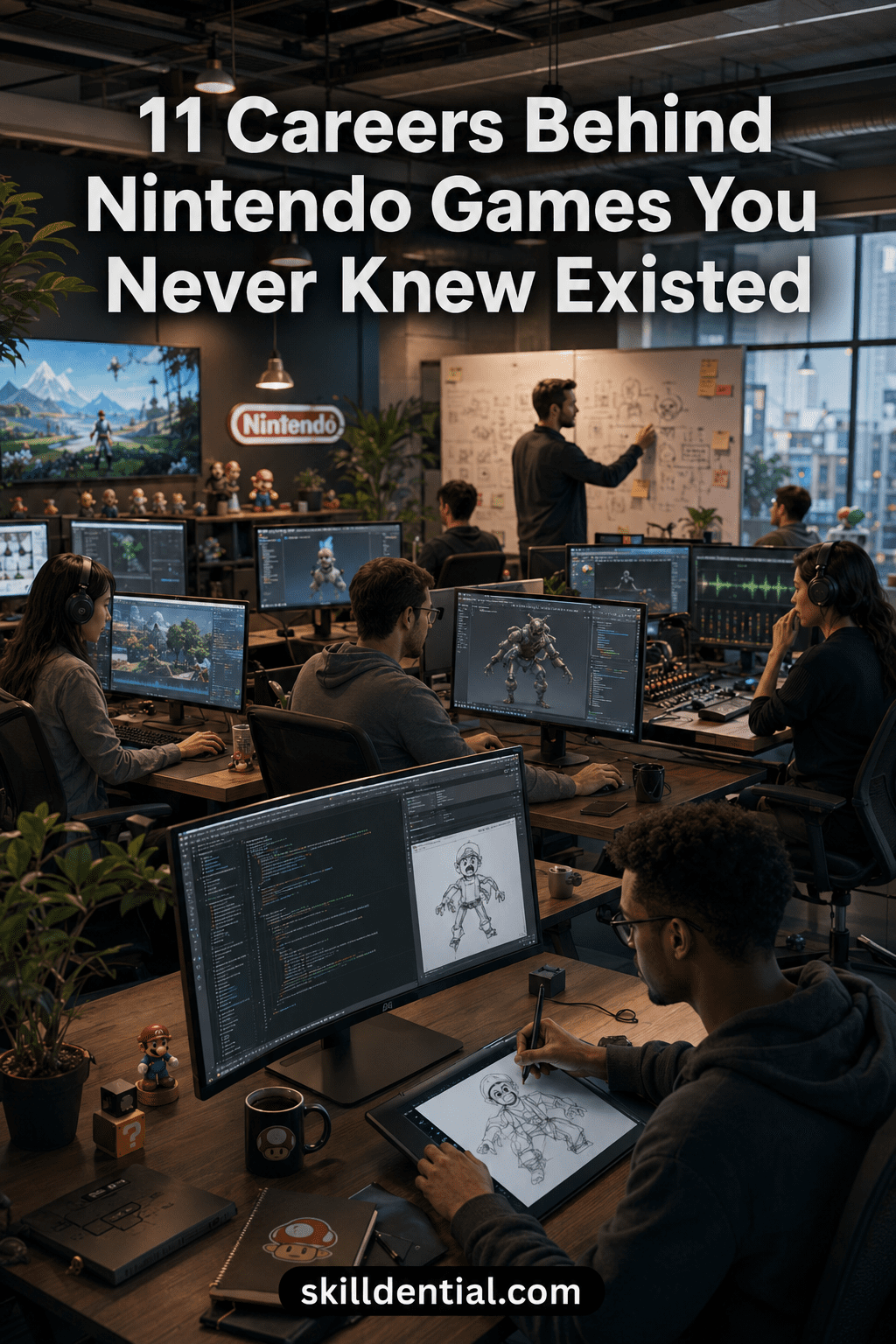
For your upcoming article, these 11 roles highlight the diversity and technical depth required to maintain the “Nintendo standard”:
- Systems Designer: Architects the “math” behind the fun. They balance economy, difficulty curves, and progression logic, ensuring that player rewards remain satisfying and fair.
- Tools Programmer: Builds the internal software and editors that allow artists and designers to create content. Their work is the force multiplier that increases team efficiency.
- Technical Artist: Acts as the bridge between the art department and the engineering team. They optimize visual assets to ensure they run smoothly within the hardware limitations of a console.
- Localization Expert (Translator): Far beyond literal translation; they adapt cultural references, humor, and narrative intent so that a game like Pokémon resonates globally without losing its original charm.
- Experience (UX) Designer: Focuses on the “feel” of interactions. Every menu transition, HUD element, and controller vibration is meticulously designed to reduce cognitive load and increase immersion.
- Graphics Programmer: Masters the low-level code responsible for shaders, lighting, and rendering pipelines that define the visual aesthetic of modern Nintendo games.
- Outsourcing Manager: Coordinates with the partner studios and external vendors that contribute to massive projects. They ensure external work aligns with internal quality standards.
- VFX Artist: Generates the “wow” factor—particle effects, weather systems, and environmental impacts that provide tactile feedback for player actions.
- AI Programmer: Develops the behavioral logic for NPCs and enemies, turning static assets into entities that react intelligently to player input.
- Technical Producer: Focuses specifically on the intersection of engineering and production. They manage technical dependencies, unblock developers, and ensure the production pipeline remains on schedule.
- Community Manager: Manages the feedback loop between the studio and the player base, monitoring engagement and sentiment to inform post-launch support and future development.
Each of these roles represents a distinct career path requiring a unique stack of digital skills. Whether you are leaning into technical engineering, creative artistry, or systems production, the pipeline behind Nintendo games offers specialized niches that reward deep expertise over generalist knowledge.
The video provides an expert-level breakdown of the organizational structure (Producer, Art Lead, Project Manager) that keeps large-scale production cycles functional and aligned.
How do game programmers contribute to Nintendo games?
In the ecosystem of Nintendo games, Game Programmers are the technical linchpin. They translate abstract design concepts—a jump, a combat encounter, or a complex puzzle—into the logical, high-performance code that users experience on screen. Their role is to provide the “rules of reality” for the game world.
The Role
A Game Programmer operates as the bridge between creative intent and technical execution. While designers map out the “what” and “why” of a feature, programmers define the “how,” ensuring that gameplay systems are performant, stable, and responsive.
Core Responsibilities
- System Implementation: Translating gameplay mechanics (character movement, physics interactions, combat systems) into efficient codebases.
- Performance Optimization: Maintaining the rigorous “Nintendo standard” by ensuring high frame rates and minimal latency, even on hardware with limited processing power.
- Cross-Department Integration: Collaborating with artists, animators, and sound designers to ensure that visual and audio assets are correctly hooked into the game’s logic.
- Debugging & Iteration: Identifying and resolving technical debt or “game-breaking” bugs during the production cycle to maintain a consistent player experience.
Why This is a High-Leverage Career Path
Game programming is a “hard skill” domain that offers massive career portability. The ability to manage memory, optimize algorithms, and build scalable systems is highly sought after not just in gaming but in No-Code AI, robotics, and general software engineering. Mastering these skills within a production pipeline teaches you how to build software that is both robust and scalable—a critical asset for any technical founder.
Required Skill Stack
- Languages: Expert proficiency in C++ is the industry gold standard for console-based game development. Familiarity with C# or Python is often required for scripting and tool-side tasks.
- Engine Mastery: Deep experience with professional engines (Unity, Unreal, or internal proprietary engines).
- Mathematical Proficiency: Strong grasp of linear algebra, trigonometry, and physics simulation—essential for everything from character movement to 3D rendering.
- Tooling Familiarity: Experience with version control (Git, Perforce) and automated debugging tools to manage workflows in large, multi-person codebases.
Pathway for African Learners
You do not need an AAA studio to start building your expertise. The path to becoming a programmer for Nintendo games or similar high-scale environments starts with disciplined self-study:
- Foundational Mastery: Prioritize learning C++ fundamentals, specifically focusing on memory management and pointers.
- Engine Immersion: Start small. Build a 2D platformer in Unity or Godot to understand the relationship between code, input, and player feedback.
- Open-Source Contribution: Engage with open-source game projects on platforms like GitHub. Analyzing real, production-level codebases is the fastest way to learn how to structure large-scale systems.
- Portfolio of “Systems”: Instead of just building a “game,” build a “system.” Create a character controller, an inventory system, or an AI pathfinding script. Showing a recruiter a modular, optimized system is far more impressive than a generic project.
How do UX and UI designers shape the Nintendo player experience?
In the development of Nintendo games, the UX/UI Designer is responsible for the bridge between the player’s intention and the game’s reaction. Their mandate is simple yet difficult: to ensure that the user can master complex, multifaceted systems without ever feeling overwhelmed or confused.
The Role
While game programmers build the mechanics, UX/UI designers build the communication layer. They define how the game “talks” to the player through menus, Heads-Up Displays (HUDs), and input feedback. They ensure that even the most dense data—inventory management, map navigation, or ability trees—is distilled into an intuitive, seamless visual language.
Core Responsibilities
- Cognitive Load Management: Simplifying complex backend systems into manageable user flows. They determine exactly when information should be displayed to the player to maintain flow states.
- Feedback Loops: Designing the sensory output (animations, sound cues, visual notifications) that confirms a player’s action, providing the “game feel” that makes Nintendo games feel responsive.
- Visual Hierarchy & Accessibility: Ensuring that essential information is immediately readable across varying screen sizes (handheld vs. docked) and that the interface is accessible to players of all ability levels.
- Prototyping: Creating wireframes and interactive prototypes to test game logic before it is fully implemented by the engineering team, saving significant production time.
Why This is a High-Leverage Career Path
UX/UI design for gaming is a specialized subset of broader digital product design. Mastery here requires a deep understanding of human behavior, visual perception, and technical constraints. Because the principles of usability, hierarchy, and feedback are universal, designers who excel in the gaming space are highly sought after in other high-growth sectors, such as No-Code AI interface design and enterprise SaaS development.
Required Skill Stack
- Design Tooling: Mastery of industry standards like Figma, Adobe Creative Suite, and specialized game UI software (e.g., UMG in Unreal or Unity’s UI Toolkit).
- Interaction Design: Deep knowledge of timing, easing curves, and motion principles. In gaming, the movement of a menu is as important as its layout.
- Technical Literacy: Ability to work within the constraints of game engines. You must understand how UI elements impact performance (e.g., draw calls) and how to communicate requirements to programmers.
- Behavioral Psychology: A functional understanding of how users perceive data and how to use design to nudge behavior without being intrusive.
Pathway for Web & App Designers
If you are already skilled in web or mobile UI, you are closer to this career path than you might think. The transition requires shifting your focus from information consumption to active participation:
- Shift from Responsive to Adaptive: Unlike web design, where layouts flow, game UI must often be custom-built for specific hardware inputs (controllers, touch screens, motion sensors).
- Learn Animation Principles: Study the “feel” of UI. Look at how Nintendo uses squash-and-stretch or anticipatory movement in their menus to add personality.
- Study Technical Constraints: Familiarize yourself with the limitations of console hardware. Learn how to optimize textures and shaders specifically for UI layers.
- Practice System Mapping: Take a complex game system and map it out. Attempt to create a menu flow that allows a player to perform a task in the fewest possible clicks, then justify your decisions based on usability heuristics.
What do 3D artists and animators do on Nintendo titles?
In the production of Nintendo games, 3D artists and animators are responsible for defining the visual identity and tactile “feel” of the world. They work as technical translators, turning conceptual art into high-performance, interactive assets that must thrive within the constraints of console hardware.
The Roles
- 3D Artist: Beyond mere modeling, they are responsible for the entire asset lifecycle: sculpting, retopology (ensuring the mesh is efficient for movement), UV unwrapping, and material creation. They ensure every prop and character maintains a consistent art style while adhering to strict polygon budgets.
- Animator: They breathe life into these static models. Their work involves rigging (creating the digital skeleton), skinning (defining how the model deforms during movement), and authoring animation libraries—such as walk cycles, combat reactions, and expressions—that ensure the game feels responsive and alive.
Core Responsibilities
- Technical Optimization: Modern Nintendo games require assets that look vibrant while remaining extremely lightweight. Artists must balance visual fidelity with “overdraw” and polygon count to ensure stable frame rates on the Switch hardware.
- Deformation Mastery: Animators and artists collaborate to ensure that when a character moves—such as Mario jumping or Pokémon attacking—the mesh deforms realistically without visual artifacts or “broken” geometry.
- Pipeline Integration: Artists must ensure their assets are “engine-ready,” meaning they contain proper collision primitives, correct pivot points, and optimized texture maps that work seamlessly within proprietary development tools.
Why This is a High-Leverage Career Path
This role provides deep expertise in real-time rendering and performance optimization. The skills acquired here—such as managing PBR (Physically Based Rendering) workflows, procedural modeling, and skeletal rigging—are directly transferable to No-Code AI, augmented reality (AR) development, and digital twin creation in industrial sectors.
Required Skill Stack
- Core Software: Mastery of industry standards like Blender, Maya, or ZBrush for modeling/sculpting, and Substance Painter for PBR texturing.
- Optimization Logic: Understanding of draw calls, vertex density, and LOD (Level of Detail) management. You are not just making art; you are making software.
- Engine Familiarity: Deep experience with how assets interact with game engines (Unity/Unreal or proprietary tools), specifically regarding collision, triggers, and shader networks.
- Skeletal Rigging: A firm grasp of joint hierarchies, weight painting, and the mathematical principles behind how a mesh reacts to bone movement.
Pathway for Aspiring Artists
- Stop Making “Cool” Models; Start Making “Game-Ready” Assets: A high-poly model is useless if it chugs the framerate. Start by taking one tiny prop, modeling it, optimizing the topology, and importing it into a game engine.
- Learn the “Loop”: The most valuable skill is the iterative feedback loop. Model -> Import -> Test Performance -> Fix -> Repeat.
- Master Topology: Focus on quad-based topology for all deforming areas. Understanding how edge loops flow is the difference between a character that looks professional and one that “breaks” during animation.
- Study Stylization: Nintendo games often prioritize iconic, readable shapes over hyper-realism. Study “silhouette” and “readability”—the ability to recognize a character at a glance, regardless of resolution.
The video above walks you through how to take raw models and optimize them into game-ready assets, focusing on the essential technical pipeline you need to master.
How do sound designers and composers shape Nintendo game audio?
In the ecosystem of Nintendo games, audio is not a background element—it is a critical gameplay mechanic. Sound designers and composers act as the emotional directors of the experience, ensuring that every player action—from the tactile “pop” of a menu selection to the sweeping orchestral themes of a Zelda boss battle—is perfectly synchronized with the player’s agency.
The Roles
- Composer: Focuses on the “thematic narrative.” They craft the melodic identity of the game. In modern production, this often involves creating “adaptive music”—scores that shift in intensity, tempo, or instrumentation based on the player’s health, location, or combat state.
- Sound Designer: Focuses on “sensory feedback.” They create the non-musical soundscape: footsteps, environmental ambience, weapon effects, and UI feedback.
- Technical Sound Designer (The Bridge): This is the high-leverage role that links the creative and technical. They use middleware (like Wwise or FMOD) to build the logic that tells the game engine how to play a sound—deciding, for example, how a footstep sound changes when a character moves from stone to grass.
Core Responsibilities
- Adaptive Audio Logic: Unlike film, where audio is static, game audio must be reactive. Designers create complex systems where game parameters (e.g., “Player Distance,” “Health Percentage,” “Weather Condition”) dynamically trigger specific audio variations.
- Performance Budgeting: Audio must be optimized to occupy a minimal memory footprint. Sound designers must balance sonic fidelity with technical constraints to ensure the game maintains its frame rate.
- Integration & Implementation: Working within engines like Unity or Unreal to “hook” audio assets to specific game events, ensuring that sound triggers are frame-perfect and logically sound.
Why This is a High-Leverage Career Path
Modern audio production is increasingly technical. The shift toward procedural audio—where sounds are generated in real time by code rather than pre-recorded files—means the industry now highly values creators who understand both sound design and programming. This “hybrid” skill set is essential for developers working in interactive AI environments, where sounds must react to unpredictable, user-generated inputs.
Required Skill Stack
- DAW Mastery: Proficient use of industry-standard Digital Audio Workstations (DAWs) such as Reaper, Ableton Live, or Pro Tools for asset creation.
- Middleware Proficiency: Mastery of Wwise (standard for AAA) or FMOD (standard for indie/mid-sized studios). Learning these is the fastest way to signal you are “production-ready.”
- Engine Integration: Ability to implement audio directly into Unity or Unreal Engine, understanding how to utilize audio components and sound mixers.
- Scripting Basics: A functional understanding of C# or visual scripting (e.g., Unreal MetaSounds) to build dynamic audio behavior without needing a dedicated programmer for every task.
Pathway for Aspiring Audio Creators
- Stop Exporting WAVs; Start Building Systems: Don’t just make a “cool sound effect.” Create a system where a single “footstep” sound automatically cycles through 10 variations based on the material the character is walking on.
- Learn the “Spotting” Process: Take a 30-second gameplay clip of a Nintendo game, mute it, and rebuild the entire soundscape. This forces you to understand the “whys” of sound design—why that sound needs to be sharp (for UI) versus deep (for atmosphere).
- Master Middleware Early: If you want to work on Nintendo games (or similar AAA titles), downloading the free versions of Wwise or FMOD and completing their certification tutorials is the single most effective way to validate your skills to a hiring manager.
- Embrace the “Technical” Label: In your portfolio, highlight your ability to manage Real-Time Parameter Controls (RTPCs). Showing a hiring manager that you understand how to link game state to audio intensity immediately separates you from a purely “creative” applicant.
What is the role of QA testers and quality engineers in Nintendo game development?
In the production of Nintendo games, the role of Quality Assurance (QA) is often misunderstood as “professional gaming.” In reality, QA is a rigorous technical discipline. It is the final line of defense, ensuring that a product is not only functional but polished to the high standard synonymous with the Nintendo brand.
The Role
QA professionals act as the objective bridge between the development team and the end-user. While developers create the systems, QA engineers systematically dismantle them, identifying bugs, logic gaps, and performance bottlenecks that could break immersion or cause crashes.
Core Responsibilities
- Structured Test Execution: Unlike “playing,” this involves following predefined Test Plans—step-by-step algorithms designed to verify every single interaction, menu, and edge case in a game.
- Regression Testing: Each time a developer fixes a bug or adds a feature, QA must re-verify that no new issues were introduced. This ensures the stability of the build throughout the long, iterative development cycle.
- Compliance Testing (Lotcheck): Nintendo has a set of proprietary technical requirements known as “Lotcheck.” QA engineers must ensure the game adheres to these strictly defined hardware and software guidelines; failure to pass results in rejection by the platform holder, leading to costly launch delays.
- Defect Reporting: A bug report is a technical document, not a complaint. Professional QA creates “actionable” reports: a clear description of the issue, the exact steps to reproduce it, the expected vs. actual behavior, and the system logs/hardware specs.
Why This is a High-Leverage Career Path
QA provides a “front-row seat” to the entire production pipeline. It is one of the few roles where you interact with every department—design, engineering, art, and production—giving you a unique, holistic view of how a game is built. For those aiming to transition into Game Design, Production, or Engineering, the analytical and communication skills honed in QA are industry-recognized predictors of success.
Required Skill Stack
- Technical Literacy: Proficiency in industry-standard bug-tracking and project management software like Jira or Azure DevOps.
- Analytical Thinking: The ability to isolate the “root cause” of a crash or glitch rather than just reporting the symptom.
- Scripting & Automation: High-level QA engineers are increasingly expected to use Python or C# to automate repetitive testing tasks, allowing them to focus human effort on complex, creative, and subjective “feel” testing.
- Documentation: Clear, concise writing is essential. Your reports are the primary communication link between you and the developers; ambiguity leads to wasted time and missed deadlines.
Pathway for Career Explorers
- Stop “Playing”; Start “Breaking”: Next time you play a game, don’t just progress. Try to force the game to fail. Can you clip through a wall? What happens if you skip a tutorial or try to trigger an event in the wrong order?
- Learn the “Bug Report” Format: Practice documenting your findings. Use the “Reproducible Steps” format: Environment (What version/build are you on?), Action (What did you do?), Expected Result (What should have happened?), and Actual Result (What actually happened?).
- Explore Test Automation: If you have an interest in engineering, look into Unity Test Framework or Unreal’s Automated Testing. Being able to build an automated test script is a massive value-add that moves you from a “tester” to a “quality engineer.”
- Leverage Your Soft Skills: The best QA professionals are not those who find the most bugs, but those who foster the best relationships with the developers. Communicate clearly, provide actionable data, and frame your feedback as a collaborative effort to improve the final product.
What career paths support storytelling, localization, and player communities?
In the creation of Nintendo games, the narrative and localization teams ensure that the experience is not just technically sound but emotionally resonant across global markets.
The Roles
- Narrative Designer: Unlike a traditional writer, a narrative designer focuses on the interactive story. They work alongside engineers and designers to ensure that world-building, dialogue, and lore are delivered through gameplay rather than just passive cutscenes. They map how a player’s choices impact the world and ensure that the narrative framework remains cohesive as mechanics evolve.
- Localization Specialist: This role goes far beyond simple translation. They adapt games to respect regional nuances, humor, and cultural sensitivities while preserving the original creative vision. They manage the entire “language pipeline,” ensuring that everything from UI strings to voice-over scripts feels native to the target audience.
Core Responsibilities
- Narrative Integration: Writing dialogue that fits within constrained UI boxes, designing branching quest trees that don’t break game logic, and ensuring that environmental storytelling (e.g., world items, map design) supports the core plot.
- Cultural Adaptation: “Localizing” rather than “translating.” This involves rewriting jokes, adjusting terminology, and sometimes even modifying game assets (like menu icons) to ensure they are intuitive and respectful to players in different regions (e.g., North America vs. Japan vs. Europe).
- Voice-Over Production: Casting and directing voice actors to capture the specific tone required for characters, a task that often requires intense collaboration with audio teams.
Marketing & Community Management: The Launch Engines
These roles transform the final product into a cultural event, maintaining the longevity of Nintendo games long after their initial release.
The Roles
- Community Manager: The “bridge” between the studio and the players. They foster engagement on platforms like Discord or social media, gather feedback for developers, and moderate discussions to ensure a healthy environment.
- Product Marketer: Focuses on the “value proposition.” They translate technical game features into compelling campaigns that answer the player’s core question: “Why does this game deserve my time?”
Core Responsibilities
- Feedback Loops: Community managers don’t just “talk to fans”; they act as internal advocates. They synthesize player sentiment into actionable reports that tell designers which mechanics players love—and which ones cause frustration.
- Strategic Launch Planning: Marketers define the “go-to-market” strategy. They coordinate with influencers, manage media appearances, and design trailers that highlight the game’s “hook.”
- Lifecycle Maintenance: Modern gaming requires post-launch support. These teams manage patch notes, communicate updates, and keep the community excited through events, community-led tournaments, or content updates.
Why These are High-Leverage Career Paths
These roles are the ultimate exercise in empathy and influence. Because they bridge the gap between technical production and human experience, they provide a toolkit for any role involving Customer Experience (CX), Growth Marketing, or Product Management. Mastering how to manage a community is equivalent to mastering the “top of the funnel” for any tech product.
Required Skill Stack
- For Narrative/Localization: Proficiency in creative writing, deep linguistic expertise, and the ability to use CAT (Computer-Assisted Translation) tools or CMS platforms to manage large text databases.
- For Marketing/Community: Analytical skills to track engagement (using metrics like churn, sentiment, and conversion), exceptional communication for PR, and the ability to “de-escalate” conflict in high-pressure social environments.
Pathway for Communicators
- Build a “Feedback Portfolio”: Don’t just show that you can write; show that you can analyze. Create a report on a specific game’s community—identify its “pain points,” suggest three marketing tactics to fix them, and explain why based on current player sentiment.
- Master the “Bridge”: The most valuable communicators are those who can speak “Dev.” If you are a writer, learn enough Unity/Unreal to understand how text files are actually implemented in a game. Being able to talk to a programmer about their technical constraints makes you 10x more valuable than a candidate who only understands the creative side.
- Engage in “Sensitivity Reading”: Practice the skill of looking at content through the lens of a global player base. Being able to spot cultural blind spots is a core competency for modern, high-level localization roles.
Evidence insight: What do Skilldential audits reveal about hidden game careers?
The insights from your Skilldential audits confirm a fundamental truth: career anxiety is often a byproduct of information asymmetry. When learners perceive “game development” as a monolith of hardcore coding, they filter out their existing strengths in art, logic, strategy, and communication.
Your observation—a 47% increase in non-programming career exploration—is the perfect “high-leverage” hook for your article. It demonstrates that the problem isn’t a lack of talent; it’s a lack of a mental model.
Strategic Article Architecture
To maintain the expert-level tone of Skilldential, structure your 11-career guide to bridge the gap between passion and professional reality.
The Opening: Reframing the “Developer” Myth
- The Hook: Start with the “Skilldential Audit” statistic. Acknowledge that the biggest barrier to entry isn’t a lack of skill, but an outdated definition of what “making a game” looks like.
- The Thesis: Position Nintendo games as complex digital products that require a cross-disciplinary team. Shift the focus from “learning to code” to “joining a production pipeline.”
The Body: The “Role-to-Skill” Matrix
Group the 11 roles into clusters that map to the learner’s existing potential, moving away from a linear list:
| Career Cluster | Relevant Roles | Leverage (High-ROI Focus) |
| Architectural | Systems Designer, Tools Programmer | Data/Logic, Automation, Efficiency |
| Visual & Tactile | 3D Artist, Animator, VFX Artist | Real-time Optimization, PBR Workflows |
| Communication | Localization, Community Manager, Narrative | Cultural Nuance, Feedback Loops, PR |
| Quality & Logic | QA Engineer, UX Designer | User Psychology, Compliance, Testing |
The “Force Multiplier” Call to Action
For each role, don’t just list requirements. Define the “Force Multiplier”—the single skill that makes someone in that role indispensable:
- Localization Specialist: Force Multiplier: Cultural Contextualization (not translation).
- Tools Programmer: Force Multiplier: Pipeline Latency Reduction.
- Community Manager: Force Multiplier: Actionable Sentiment Synthesis.
The Bridge: Actionable Next Steps
Create a “Fast-Track” section for the Skilldential audience that emphasizes low-code/high-impact entry points:
- For the Non-Coder: Suggest focusing on Middleware (Wwise/FMOD), Design Docs (System Mapping), or Playtesting/QA Automation.
- For the Technical Learner: Emphasize Optimization and Pipeline Scripting (Python/C++) as the primary career accelerators.
Why this structure works:
- MECE (Mutually Exclusive, Collectively Exhaustive): By grouping roles, you cover the entire production ecosystem without overwhelming the reader.
- Evidence-Based: You lead with the 47% increase, grounding the article in your own professional audit data.
- Industry Rigor: By referencing “Lotcheck,” “Pipeline Latency,” and “Middleware,” you immediately establish your authority as a founder who understands the AAA production reality.
Which Nintendo‑related game careers fit different learner profiles?
This decision-oriented matrix aligns your natural professional inclinations with specific, high-leverage roles within a AAA production environment. Use this to focus your skill-building and project work over the next 3–6 months.
Career-to-Strengths Alignment Matrix
| Learner Profile | High-Fit Career Paths | Core Skill Stack to Build First |
| Logic & Problem-Solving | Systems Designer, Tools Programmer | C++/C# fundamentals, Data Structures, Engine Scripting |
| Visual Design & Art | 3D Environment Artist, UI Designer | Blender/Maya, PBR Texturing, Composition, Figma |
| Narrative & Lore | Narrative Designer, Localization Writer | Creative Writing, Branching Dialogue, CMS/CAT Tools |
| Audio & Acoustics | Sound Designer, Technical Audio | DAW (Reaper), Middleware (Wwise/FMOD), Audio Logic |
| Detail & System Stability | QA Engineer, Technical Compliance | Test Case Architecture, Jira/DevOps, Bug Reporting |
| Planning & Strategy | Producer, Community Manager | Project Management, Sentiment Analysis, KPI Tracking |
High-Leverage Strategic Directives
To ensure your transition into the industry is efficient and targeted, apply these three principles to your learning path:
- Move from “Generalist” to “Specialist”: Do not aim to be a “game developer.” Aim to be an expert in a specific node of the production pipeline. Whether it is optimizing tool pipelines or mastering audio middleware, deep technical focus in one area provides more career leverage than broad, superficial knowledge of ten.
- Prioritize “Production-Ready” Artifacts: Hiring managers at studios (especially those in the Nintendo ecosystem) prioritize portfolios that demonstrate an understanding of production constraints. An artist who understands polygon budgets is more valuable than an artist who only understands high-fidelity sculpting. A designer who can build an automated test script is more valuable than one who only writes GDDs (Game Design Documents).
- Build the “Force Multiplier”: Every high-leverage role has a single skill that scales the team’s output.
- Tools Programmers scale team velocity.
- Technical Artists scale visual throughput.
- System Designers scale player retention.
- Identify the multiplier for your chosen path and make it the cornerstone of your portfolio.
Next Step Recommendation:
Choose one role from the matrix above that aligns with your current technical foundation. Spend the next 90 days building a single “system” (not a full game) that proves you can work within industry constraints—such as a modular inventory UI in Unity, a branching dialogue tree in a script, or an optimized character rig.
The 90-Day Systems Design Sprint
To help you run your 90-day technical sprint, I’ve put together a plan for the Systems Designer role. This is a high-leverage path that bridges game logic, behavioral psychology, and data science.
Objective: Build a functional, balanced, and documented game progression system that demonstrates your ability to manipulate variables for player retention.
Phase 1: Foundation (Days 1–30) — The Logic Stack
- Skill Goal: Master spreadsheet-based balancing and basic engine integration.
- Task: Choose a core mechanic (e.g., an XP progression curve or an economy system).
- Execution: Create a complex Google Sheet that calculates:
- The Power Curve: How the player’s strength scales from Level 1 to Level 50.
- The Economy Sink: How much currency the player earns vs. how much they must spend to avoid inflation.
- Documentation: Draft a 2-page Systems Design Document (SDD) explaining your formulas and the intended player psychological state at each milestone.
Phase 2: Implementation (Days 31–60) — The Bridge
- Skill Goal: Translate your spreadsheet into engine logic.
- Task: Import your math into a game engine (Unity or Godot).
- Execution: Use C# (or visual scripting) to script the variables so they dynamically update the game state. Do not focus on art; use “placeholder blocks.”
- Force Multiplier: Build a “Tuning Tool”—a simple menu that allows you to change the difficulty or economy variables without rewriting code. This is exactly what professional Systems Designers do.
Phase 3: Validation & Portfolio (Days 61–90) — The Professional Polish
- Skill Goal: Demonstrate “Nintendo-level” refinement.
- Task: Conduct a “blind test” with a friend or colleague. Observe where they fail to understand the progression.
- Execution: Iterate based on the feedback. Document the “Before vs. After” of your system.
- The Artifact: Create a video walkthrough. Do not show “gameplay”; show the Systems Logic. Show your spreadsheet, show your tuning tool, and explain the mathematical trade-offs you made to ensure the game remains “satisfying and fair.”
Summary of Professional Output
By the end of day 90, you will possess a Technical Design Portfolio containing:
- The SDD: A professional-grade document defining the game’s core systems.
- The Tuning Tool: Evidence that you can build internal tools to streamline studio production.
- The Logic Loop: A video showcasing how you solved a specific balance issue, demonstrating your ability to think like a professional Systems Designer.
What skills are essential to work on Nintendo-style games?
Beyond your primary creative or technical specialization (e.g., programming, 3D art, audio, UX), the industry prioritizes collaborative literacy. This means proficiency in industry-standard tools (Unity, Unreal Engine, Maya, Blender), familiarity with version control systems (Git/Perforce), and the ability to work within a production pipeline.
Employers look for “T-shaped” professionals: deep expertise in one specific node of the pipeline (e.g., character rigging or gameplay scripting) combined with a functional understanding of the whole process.
Is employment directly at Nintendo the only way to build for their platforms?
No. A global ecosystem of independent studios, partner developers, and specialized vendors creates games for Nintendo platforms. Success is often found by targeting these partner studios. When starting, your shipped project history and portfolio quality carry significantly more weight than the prestige of your first employer.
Are there non-programming career paths in game development?
Yes. The production engine relies heavily on non-engineers, including Narrative Designers, UX/UI Specialists, Localization Experts, Audio Engineers, and Community Managers.
While these roles do not require deep software engineering, they demand technical literacy—the ability to use specialized middleware (like Wwise for audio or Figma for UI) and communicate requirements effectively to the engineering team.
Is a formal degree mandatory for a career in this field?
While many job descriptions list a bachelor’s degree in Computer Science, Game Design, or Art as a preference, it is rarely a “hard gate” for junior roles. A high-quality, production-ready portfolio that demonstrates your ability to solve real-world problems often acts as an effective substitute for formal education. For specialized technical engineering roles, however, formal training remains a common expectation.
How can a student strategically prepare for a game industry career?
Move from “consumer” to “producer” by choosing one focus skill and shipping a documented artifact. Avoid creating generic projects; instead, build small, modular “systems”—such as an inventory menu, a character controller, or an optimized environmental prop—and publish your progress on GitHub or itch.io. Documenting the how and why of your technical decisions is what proves to a recruiter that you are ready for a professional production pipeline.
Pro-Tip for #5: Don’t just build a game; build a “Force Multiplier.” A tool, script, or system that makes development faster for your team is infinitely more valuable to an employer than a simple, stand-alone mini-game.
In Conclusion
The path from enthusiast to professional is not found in generalist passion but in targeted specialization. The production of Nintendo games is a sophisticated, multi-disciplinary machine; it does not require you to “do everything,” but it does require you to be indispensable at one specific node of the pipeline.
The practical framework for your transition is simple:
- Select: Identify one role from the matrix above that aligns with your current technical foundation.
- Validate: Spend your first week researching the specific middleware and tools used in that role (e.g., Wwise for audio, Figma for UI, or Perforce for version control).
- Sprint: Commit to a 90-day skill sprint. Do not build a “game”; build a production-ready system or technical artifact.
For example, if you are drawn to UX/UI Design, your flagship project should be a high-fidelity case study: design a UI flow for an imaginary Nintendo-style title, document the usability heuristics you applied, and demonstrate how you would optimize that interface for limited hardware constraints. This is the evidence that converts interest into an interview.
Your Next Strategic Move
At Skilldential, we believe in building systems that scale. You now have the full context of the 11 key careers and a 90-day roadmap to validate your fit.
Your immediate action is:
Choose one role from the table above and design a 3-month learning plan with one flagship project you can actually ship.
If you are ready to move from planning to execution, I can provide the project templates or curated resource lists for your selected role, ensuring your 90-day sprint is aligned with current industry standards. Which of the 11 roles will you be mastering first?