Remote Dental Billing Jobs: How to Get Hired From Home
Remote dental billing jobs let you process insurance claims, verify patient eligibility, and manage accounts receivable for dental practices without commuting to an office. This comprehensive guide explains what remote dental billers do, the essential skills and qualifications employers expect, where to find legitimate openings, how to optimize your résumé and ace interviews, and how to spot and avoid common work-from-home scams.
Whether you are a dental receptionist seeking schedule flexibility, a medical biller transitioning into dental administration, or a beginner exploring healthcare roles, this article provides a direct, step-by-step path from your current experience level to landing remote dental billing jobs.
Who This Guide Is For
This article is designed for professionals and career seekers targeting remote dental billing jobs, including:
- Dental receptionists, dental assistants, and front-desk office administrators transitioning to work-from-home roles.
- Experienced medical or dental billers moving from brick-and-mortar practices to remote employment.
- Beginners and career changers exploring entry-level healthcare administration and flexible remote dental billing jobs.
- Independent freelancers and contractors looking to offer billing and revenue cycle management services to dental practices.
- Parents, caregivers, and remote professionals seeking secure, legitimate home-based employment in the dental sector.
Note: The content focuses primarily on US-based job seekers, as insurance frameworks, dental coding standards (CDT), and clearinghouse systems vary significantly by region.
What is remote dental billing?
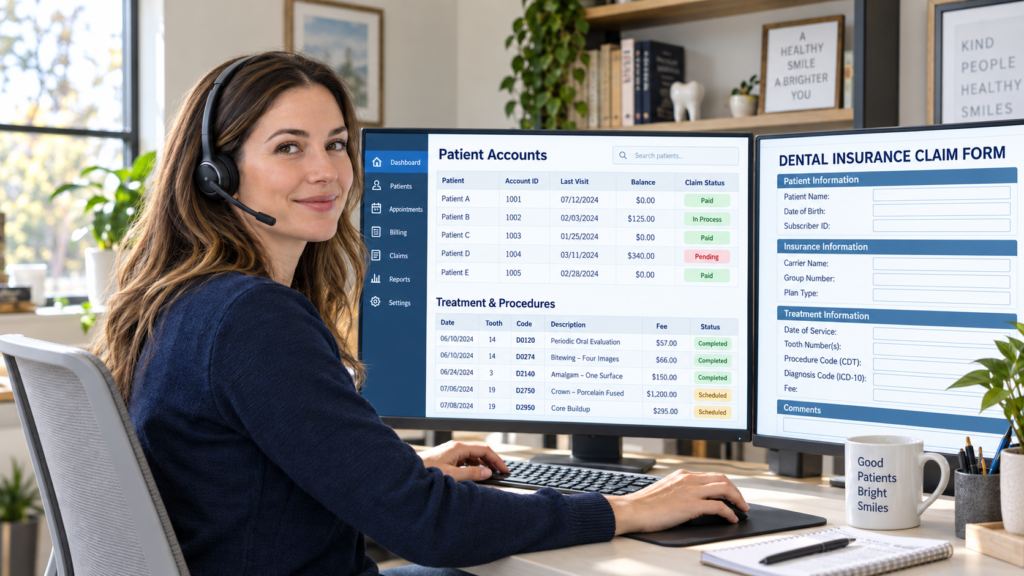
Remote dental billing is the practice of managing a dental clinic’s revenue cycle management (RCM) workflow entirely from a home office. Professionals securing remote dental billing jobs handle the financial back-end of dental practices without needing to be physically present at the front desk.
Core Responsibilities
- Insurance Verification: Checking patient coverage, benefit maximums, deductibles, and waiting periods before appointments.
- Claims Processing: Creating, scrubbing, and submitting electronic or paper claims (typically via the ADA Dental Claim Form or 837D format) using CDT (Current Dental Terminology) codes.
- Accounts Receivable (A/R) Management: Tracking aging reports, following up on unpaid claims, appealing denied or rejected claims, and posting patient and insurance payments.
- Patient & Payer Communication: Managing billing inquiries, processing patient statements, and negotiating or explaining balances.
Dental Billing vs. Medical Billing
While both sectors handle healthcare claims, remote dental billing jobs require distinct operational knowledge:
- Coding Systems: Dental uses CDT codes for specific procedures, whereas medical billing relies heavily on CPT (procedures) and ICD-10 (diagnoses).
- Coverage Caps: Dental insurance typically features strict annual maximums (frequently capped between $1,000 and $2,000 per patient), requiring precise tracking of benefits used versus remaining balances.
- Claim Volume & Complexity: Dental claims are generally shorter and procedure-oriented compared to multi-layered medical claims, but require granular attention to narrative attachments, X-rays, and charting details.
Employment Models & Earnings
Professionals pursuing remote dental billing jobs operate under several structural models:
- W-2 Employees: Traditional remote staff working set hours for a single dental practice or corporate dental support organization (DSO).
- 1099 Contractors: Independent workers providing billing services to multiple independent clinics.
- Commission/Performance Models: Companies like eAssist Dental Solutions utilize performance-based models where remote consultants earn a percentage of collections, with full-time earning potentials commonly ranging from $40,000 to $80,000+ per year.
Can beginners get remote dental billing jobs?
Beginners can secure remote dental billing jobs, though the entry path depends entirely on your current background and transferable skill set. While many remote positions require 12 to 18 months of claim processing experience, structured pathways exist for newcomers entering the workforce.
Pathways to Entry-Level Remote Dental Billing
- No Prior Healthcare Experience: Certain dental support organizations (DSOs) and billing agencies hire candidates with no background in billing, provided you hold a high school diploma, demonstrate strong attention to detail, maintain a reliable home office setup, and complete HIPAA and compliance training.
- Dental Office Background: If you have worked as a dental receptionist, treatment coordinator, or dental assistant, you already understand clinical terminology, patient communication, and basic insurance verifications. You can leverage this direct dental background into remote dental billing jobs by completing targeted training on insurance claims and revenue cycle software.
- Medical Billing Transition: Experienced medical billers possess a foundational understanding of revenue cycles, clearinghouses, and payment posting. Transitioning into remote dental billing jobs requires learning CDT code sets, navigating annual dental maximums, and mastering dental-specific practice management software.
Overcoming the Experience Barrier
If you are starting from zero without direct office experience, consider the following strategies to make your profile competitive for remote dental billing jobs:
- Complete a Dental Billing Certification: Enrolling in a specialized online certification course signals baseline competence in CDT coding and claim scrubbing to employers.
- Target Entry-Level Hybrid or On-Site Roles First: Gaining 6 to 12 months of local front-desk or billing experience makes landing a permanent work-from-home position significantly easier.
- Highlight Transferable Skills: Emphasize administrative accuracy, data entry speed, proficiency in accounting or spreadsheet software, and customer service experience on your résumé.
Qualifications and skills employers require
Employers seeking candidates for remote dental billing jobs look for a precise combination of baseline credentials, technical competencies, and remote work soft skills. Meeting these expectations ensures you can manage revenue cycle workflows independently from a home office.
Minimum Qualifications
- Educational Background: A high school diploma or GED is required by virtually all employers, while some prefer an associate degree or vocational training in healthcare administration.
- Experience Level: 1 to 2 years of prior dental billing, insurance verification, or dental front-office experience is commonly preferred, though entry-level remote dental billing jobs do exist for trained candidates.
- Home Office Infrastructure: A secure, quiet workspace equipped with a high-speed internet connection, a modern computer (Windows or macOS), and secure hardware complying with employer IT standards.
- Compliance: Mandatory completion of HIPAA compliance training and a thorough understanding of patient health information (PHI) confidentiality.
Technical Skills
Proficiency in the following systems and protocols is essential for success in remote dental billing jobs:
- Dental Practice Management Software: Hands-on familiarity with industry platforms such as Dentrix, Eaglesoft, Open Dental, Curve Dental, or CareStack.
- CDT Coding: Accurate navigation and application of Current Dental Terminology codes for diagnostic, preventive, restorative, and surgical procedures.
- Insurance Verification: The ability to audit dental plan designs, including PPO/DHMO structures, annual maximums, deductibles, frequencies, and waiting periods.
- Claims Management: Expertise in electronic claim submission (837D format), electronic remittance advice (ERA) and explanation of benefits (EOB) posting, denial management, and formal appeals.
- Productivity Tools: Working knowledge of Google Workspace or Microsoft Office (particularly Excel or Google Sheets) for tracking aging reports and financial data.
Soft Skills
Because remote dental billing jobs operate with minimal direct supervision, employers explicitly screen for:
- Attention to Detail: Absolute accuracy in data entry and claim scrubbing to prevent claim rejections and revenue loss.
- Autonomous Time Management: Self-discipline, organization, and the ability to hit daily production and collection metrics independently.
- Communication: Clear, professional written and verbal skills for resolving billing disputes with insurance carriers and explaining account balances to patients.
- Problem-Solving Ability: Analytical persistence when tracking down unpaid claims, investigating rejections, and finding root causes for clearinghouse errors.
Employee vs contractor vs freelance arrangements
Choosing the right employment structure for remote dental billing jobs depends on your appetite for stability versus independence. Professionals can secure work through three primary operational models:
| Arrangement | Typical Setup | Pros | Cons |
| W-2 Employee | Working directly for a single dental practice, corporate Dental Support Organization (DSO), or remote agency as a regular staff member. | Stable, predictable income; employer-provided benefits (health insurance, 401(k)); company-supplied software, training, and equipment. | Less schedule flexibility; often requires fixed daily working hours. |
| 1099 Contractor | Contracting with one or more dental practices, frequently coordinated through third-party platforms. | Higher earning potential; flexible schedule; ability to scale workload across multiple clients. | No employer-sponsored benefits; responsible for self-employment taxes; may need to supply your own software and hardware. |
| Freelance Consultant | Operating an independent billing business and marketing services directly to local or regional dentists. | Full control over pricing, client rosters, and workload; uncapped high-income potential. | Requires active business setup, client acquisition, marketing, and handling variable monthly income. |
The Hybrid Commission Model
Major players in the remote space, such as eAssist Dental Solutions, utilize a hybrid commission structure for their remote billing specialists. In this arrangement, billers are supported with an hourly draw (such as local minimum wage guarantees treated as an advance) combined with performance commissions tied directly to the insurance collections recovered for assigned dental offices.
This model allows dedicated remote billers to manage their hours flexibly while scaling their total annual compensation between $40,000 and $80,000+ based on practice volume and collection performance.
Where to find legitimate remote dental billing jobs
Finding legitimate remote dental billing jobs requires filtering out generic administrative postings and focusing on specialized medical/dental platforms, reputable Dental Support Organizations (DSOs), and verified remote job boards.
Major Job Boards & Search Strategies
- Indeed & ZipRecruiter: Use exact keyword matches such as
"remote dental billing","virtual dental biller", or"dental insurance verification". Filter results explicitly by remote location. Entry-level to mid-tier listings on these platforms show average remote hourly pay ranging from $20 to $28 per hour. - LinkedIn & AshbyHQ Job Boards: Tech-forward dental RCM (Revenue Cycle Management) companies and modern startups post specialized remote roles—such as Insurance Verification Specialist or Dental Billing Success Consultant—directly on LinkedIn and applicant tracking platforms like Ashby.
- Remotive & We Work Remotely: While broader tech-focused remote boards, these occasionally feature distributed healthcare admin and billing consultant roles.
Specialized Dental Billing Companies & Agencies
Targeting specialized third-party billing providers often yields more stable, structured remote work than hunting down individual private dental practices:
- eAssist Dental Solutions: The nation’s largest outsourced dental billing provider regularly hires remote Dental Billing and Insurance Verification Success Consultants. They primarily utilize a hybrid commission/performance model where dedicated billers scale earnings between $40,000 and $80,000+ per year.
- Wisdom:Frequently recruits remote Insurance Billing Specialists and Verification Specialists to handle claims aging, payment posting, and clearinghouse management for modern dental practices using platforms like Dentrix and Eaglesoft.
- Your Smile Partners PLLC: Known for offering structured remote training paths for candidates transitioning into dental billing from other administrative backgrounds.
Professional Networks & Communities
- Niche Networking Groups: Active dental billing communities on LinkedIn and Facebook groups (such as dental management and billing networks) frequently share unlisted job openings, direct referrals, and critical warnings about predatory work-from-home scams.
- Direct Outreach to DSOs: Researching mid-to-large regional Dental Support Organizations and visiting their dedicated “Careers” pages can uncover remote back-office openings that are never syndicated to massive job aggregates.
How to avoid fake job listings and scams
Work-from-home scams targeting remote dental billing jobs are a persistent risk given the high demand for flexible healthcare administration roles. Fraudsters frequently impersonate legitimate dental practices or create shell agencies to harvest personal data.
Key Red Flags to Watch For
- Upfront Fees for Equipment or Training: Legitimate employers cover all necessary computer hardware, software licenses, onboarding, and background check costs. Never pay out-of-pocket for training kits, office setups, or software access.
- Vague Descriptions & Generic Requirements: Scam posts often feature broad, poorly written summaries with minimal technical details, focusing almost entirely on weekly pay or “no experience needed” flexibility rather than specific duties like CDT coding or insurance verification.
- Lack of Verifiable Corporate Presence: If a company lacks an official website, an active LinkedIn corporate page, or has zero footprint on industry reviews, treat the listing with extreme skepticism.
- Text-Only or Chat-Only Interviews: Scammers frequently conduct interviews entirely via messaging apps (such as Telegram, WhatsApp, or instant messaging platforms) to hide voice identities and avoid face-to-face video verification.
- Premature Requests for Sensitive Data: Do not provide your Social Security number, banking information for direct deposit, copies of government IDs, or tax forms until you have received a formal written offer and completed a verified onboarding process through an official HR portal.
Actionable Verification Steps
- Cross-Reference Corporate Channels: Visit the employer’s official website directly and confirm the opening is listed on their dedicated careers page. If you found the job on a third-party board, check if the direct company domain matches.
- Run Reputation Checks: Search the hiring company’s name alongside keywords like
"scam","fraud", or"reviews"on platforms like Glassdoor, LinkedIn, and scam-tracking forums. - Independent Phone Verification: Look up the company’s main office phone number independently (using their official website or Google Maps) and call their front desk or HR department to confirm whether the hiring manager or job posting is genuine.
Training and certification options
While no single credential is universally mandatory to secure remote dental billing jobs, completing targeted training and earning a recognized industry certification significantly accelerates hiring and differentiates your profile from competing applicants.
Recommended Dental Billing Certifications
- Certified Dental Billing Specialist (CDBS) / Certified Dental Coder (CDC): Issued by the American Dental Coders Association (ADCA), these credentials validate specialized expertise in dental revenue cycles, CDT code structures, and insurance protocols.
- ADA Dental Coding Certificate: An assessment-based program offered by the American Dental Association that trains professionals on proper CDT code application, claim forms, and electronic submission standards.
- Certified Professional Biller (CPB) or Certified Billing and Coding Specialist (CBCS): Broad healthcare billing credentials from organizations like AAPC or NHA. While weighted heavily toward medical billing, they establish baseline financial competency that can be cross-applied to dental workflows.
- HIPAA Compliance Certification: Frequently required across all remote healthcare roles to demonstrate a legal understanding of patient privacy and secure data transmission.
Structured Training Programs & Pathways
- Dental-Specific Continuing Education:Targeted courses—such as those focusing on dental anatomy, charting, and advanced CDT code application—bridge the gap for administrative professionals entering the sector.
- Employer-Sponsored Onboarding: Select remote agencies and DSOs provide structured internal training paths specifically designed to teach their proprietary billing workflows to candidates with strong transferable office skills.
- Software-Specific Tutorials: Demonstrating active proficiency in industry practice management software (such as Dentrix, Eaglesoft, or Open Dental) via vendor documentation or focused online modules provides immediate technical proof-of-competence to prospective remote employers.
Preparing your résumé and application
Optimizing your application materials for remote dental billing jobs requires balancing automated tracking system (ATS) keyword optimization with proof of remote autonomy.
Résumé Structure
- Header:Full name, city and state (to establish regional time zone or licensing alignment), phone number, email address, and LinkedIn profile URL.
- Professional Summary: A concise 2–3 line pitch highlighting your core revenue cycle background, software command, and remote readiness.
Example: “Detail-oriented dental billing specialist with 2+ years of experience managing remote claims submission, insurance verification, and AR follow-up. Proficient in Dentrix, Eaglesoft, and CDT code navigation. Proven track record of accelerating cash flow and reducing claim rejections.” - Skills Section: Integrate exact-match keywords targeted by recruiters:
- Hard Skills: CDT coding, dental insurance verification, electronic claims submission (837D), accounts receivable (A/R) management, denial management, HIPAA compliance, Dentrix, Eaglesoft, Open Dental.
- Soft Skills: Attention to detail, time management, remote workflow discipline, problem-solving.
- Experience Section: List past roles (dental receptionist, billing specialist, insurance coordinator) in reverse chronological order. Use action verbs and metrics to quantify impact:
- “Reduced claim denials by 15% through meticulous pre-verification and accurate CDT coding.”
- “Managed accounts receivable lifecycle for over 300 active monthly patient accounts in a distributed environment.”
- Education & Certifications: High school diploma or degree, alongside any specialized credentials (e.g., CPB, CBCS, HIPAA compliance certifications).
Cover Letter Strategies
- Connect to Dental Workflows: Explicitly state your familiarity with dental insurance structures, annual maximums, and CDT coding right in the opening paragraphs.
- Prove Remote Discipline: Address your home office environment, self-motivation, and independent time-management skills to reassure the hiring manager that you require zero oversight to hit production quotas.
- Bridge the Gap for Transitions: If you are transitioning from a medical billing background or a front-desk dental assistant role, explicitly map how your previous competencies translate directly to managing remote dental billing jobs efficiently.
Interview preparation and practical assessments
Preparing for interviews and practical assessments for remote dental billing jobs requires demonstrating both technical revenue cycle knowledge and the independent work discipline needed for a remote environment.
Common Interview Questions & Strategies
- “Describe your experience with dental insurance verification and claim submission.”
- Strategy: Walk the interviewer through your exact workflow. Mention how you check patient eligibility, verify benefit maximums and deductibles before procedures, and use electronic clearinghouses or software to scrub and submit claims.
- “How do you handle denied claims or unpaid balances?”
- Strategy: Emphasize analytical persistence. Explain how you review the Explanation of Benefits (EOB), identify the root cause of the denial (such as missing narrative attachments or incorrect CDT codes), correct and resubmit the claim, or follow up on aging A/R reports.
- “What dental practice management software have you used, and how comfortable are you learning new systems?”
- Strategy: Name-drop specific platforms you know (e.g., Dentrix, Eaglesoft, Open Dental, Curve Dental). If you only know one, emphasize your adaptability and experience quickly picking up new software interfaces.
- “How do you ensure accuracy and HIPAA compliance in a remote setting?”
- Strategy: Detail your physical workspace security—such as working in a private, locked room, using privacy screens, ensuring encrypted internet connections, and maintaining strict confidentiality regarding Protected Health Information (PHI).
Practical Assessments & Tests
Many remote agencies and DSOs require a pre-employment skills test (such as a Dental Billing Assessment or data entry test) to evaluate your real-world competency before extending an offer. These tests typically require passing scores (such as 85% or higher accuracy) and evaluate:
- CDT Coding Accuracy: Selecting the correct code for specific diagnostic, preventive, or restorative procedures.
- Claim Form Completion: Navigating fields on a sample ADA Dental Claim Form or 837D electronic layout.
- Scenario-Based Math: Calculating patient co-pays, remaining annual maximums, and insurance percentages correctly.
Practical Preparation Checklist
- Review CDT Code Frameworks: Brush up on common diagnostic (D0100-D0999), preventive (D1000-D1999), and restorative (D2000-D2999) codes using official ADA or dental coding references.
- Master Industry Terminology: Refresh your understanding of dental insurance concepts, including annual maximums, deductibles, frequencies, missing tooth clauses, and waiting periods.
- Simulate Data Entry: Practice fast, error-free data entry and insurance verification workflows to ensure you can meet the production benchmarks expected in remote positions.
Earnings and working arrangements
Explore how much remote dental billing professionals can earn and how pay varies by experience, location and employment type. This section compares full-time employment, part-time roles, independent contracting, and freelance arrangements, including common payment structures, working hours, benefits, and tax responsibilities.
Compensation & Financial Potential
Earning potential for professionals securing remote dental billing jobs varies based on experience level, certifications, and the chosen operational structure.
- Base Hourly Pay & Annual Salaries: Entry-to-mid-tier remote dental billers typically earn an average hourly wage of $20.21 to $21.22/hour, translating to annual salaries between $35,000 and $55,000.Top earners and supervisors managing complex portfolios frequently scale past $58,000+ annually.
- Performance & Commission Models: Third-party remote agencies (such as eAssist Dental Solutions) deploy hybrid commission structures where billing consultants earn a baseline draw coupled with performance percentages based on recovered insurance collections, unlocking an earning potential of $40,000 to $80,000+ per year for full-time operators.
- Contractor & Freelance Rates: Independent 1099 contractors and agency owners billing multiple dental clinics directly often command higher hourly equivalents or monthly retainer fees per practice, though they must factor in self-employment taxes and overhead.
Typical Working Hours & Schedule Dynamics
- Core Operating Hours: Because remote dental billing jobs require active communication with dental front desks, clearinghouses, and insurance carrier customer service departments during business hours, most positions require daytime availability (typically aligned with standard time zones, such as 8:00 AM to 5:00 PM).
- Schedule Flexibility: While many W-2 positions enforce set operating hours to match clinic schedules, contract and output-based freelance arrangements frequently afford professionals the autonomy to complete claim scrubbing, A/R tracking, and payment posting during flexible daily windows.
Step-by-step path to getting hired
- Assess your starting point: Determine if you have direct dental office experience, a medical billing background, or are starting from scratch without prior healthcare administrative history.
- Gain foundational knowledge: Enrol in a targeted medical billing and coding program or dental billing training course to master CDT code sets, insurance reimbursement workflows, and mandatory HIPAA compliance protocols.
- Learn key software: Familiarize yourself with industry practice management platforms like Dentrix, Eaglesoft, or Open Dental through online tutorials, vendor webinars, or community practice resources.
- Earn certifications (optional but helpful): Pursue recognized credentials—such as a dental coding certificate, CPB, CBCS, or HIPAA compliance verification—to immediately strengthen your résumé’s credibility.
- Build a targeted résumé: Highlight core billing competencies, dental software proficiency, and remote work discipline using precise keywords optimized for applicant tracking systems when applying for remote dental billing jobs.
- Apply strategically: Focus your job search on reputable employment boards (Indeed, LinkedIn, ZipRecruiter) and specialized company career pages (such as eAssist Dental Solutions or Your Smile Partners).
- Prepare for assessments: Practice CDT coding lookups, insurance math, and ADA claim form accuracy to confidently pass pre-employment skills tests.
- Verify legitimacy: Research prospective companies thoroughly using official websites and professional reviews to avoid predatory work-from-home scams; never pay upfront fees for training or equipment.
- Negotiate terms: Clarify whether the position operates under a W-2 employee, 1099 contractor, or freelance arrangement, and ensure you fully understand the compensation structure (hourly base, salary, or commission).
- Start strong: Once hired into remote dental billing jobs, prioritize absolute data entry accuracy, proactive communication, and timely A/R follow-up to build a lasting reputation for professional reliability.
Do I need a degree to become a remote dental biller?
No college degree is required. Most employers hiring for remote dental billing jobs ask for a high school diploma or GED, combined with a strong preference for candidates who have completed specialized billing training or hold industry certifications.
Can I work remotely if I live outside the US?
While the vast majority of positions require US residency due to domestic insurance regulations and clearinghouse standards, some agencies hire international contractors.
International workers typically complete a W-8BEN tax form and focus on backend tasks like claims follow-up and accounts receivable rather than full-cycle local insurance submission. Always verify international compliance and tax implications before applying.
How long does it take to become job-ready?
Structured trade school and online training programs typically range from 4 to 15 months. However, dedicated beginners can become job-ready in 3 to 6 months by focusing intensively on CDT coding, software practice, and insurance workflows—a timeline accelerated significantly if you bring prior dental front-office experience.
Is dental billing stressful?
The role involves managing deadlines, navigating claim denials, and handling insurance disputes, which can occasionally be demanding. However, the autonomy and schedule flexibility of remote work help mitigate daily friction, and many professionals find the analytical, problem-solving nature of revenue cycle management deeply rewarding.
In Conclusion
Remote dental billing is accessible to motivated beginners, seasoned dental office staff, and experienced medical billers willing to master CDT code sets and dental insurance workflows. Employers actively prioritize candidates who demonstrate hands-on proficiency in industry software like Dentrix, Eaglesoft, or Open Dental, alongside rigorous attention to detail and strict HIPAA compliance.
Legitimate remote dental billing jobs are readily available across major job boards and specialized corporate career pages; always protect yourself by verifying corporate presence and avoiding any listings that demand upfront fees. Earnings scale attractively from entry-level hourly rates of $15 to $25 per hour up to $40,000 to $80,000+ per year for commission-based consultants managing established dental office portfolios.
Your immediate next step is to choose one training program, certification, or software tutorial—such as a targeted dental billing course or HIPAA certification—and commit to starting this week. At the same time, update your résumé with targeted billing keywords and configure active job alerts on Indeed and LinkedIn specifically for remote dental billing jobs to catch fresh openings as they drop.