How to Become a Freelance Writer With No Experience
You can start freelance writing without professional experience, a journalism degree, or existing clients. The key is to treat writing as a business from day one: choose a profitable niche, create spec samples to prove your competence, build a simple portfolio, master cold pitching, and apply consistently to legitimate job boards. Most dedicated beginners land their first paid client within 4 to 8 weeks by following a structured system rather than waiting for permission or credentials.
Who This Guide Is For
- Complete beginners who want to figure out how to become a freelance writer with no experience and land their first paid gigs.
- Students and recent graduates seeking flexible online income that fits around an academic schedule.
- Remote-work seekers looking to build a location-independent career path.
- Professionals and civil servants building a high-margin part-time side hustle.
- Content creators and bloggers pivoting their skills toward commercial B2B or B2C writing clients.
- Career changers transitioning into full-time professional writing.
- International writers based in markets like Nigeria who want to secure remote contracts with global clients paying in hard currency.

If you can communicate clearly in English and are willing to learn the practical, operational, and business aspects of freelancing, you already have the foundation you need to begin your journey as a freelance writer.
What Freelance Writing Actually Involves
Freelance writing is a self-employed business model where you are paid per project, word, or hour to produce written content for commercial and editorial clients. When you learn how to become a freelance writer with no experience, you are stepping into a B2B service industry where your deliverables include:
- Blog posts and long-form articles
- Website landing pages and copy
- Email newsletters and sequences
- Social media copy and captions
- E-commerce product descriptions
- Case studies and white papers
- Technical documentation and user guides
Operational Responsibilities
As a freelance writer, you operate as a micro-business owner rather than an employee. Your daily workflow includes:
- Business Development: Finding prospects, writing cold pitches, and marketing your services.
- Client Management: Negotiating rates, scoping project deliverables, and enforcing deadlines.
- Production: Researching, drafting, self-editing, and revising work to meet client briefs.
- Finance: Invoicing, tracking expenses, managing payments, and handling local and international taxes.
- Administration: Setting up contracts, maintaining a digital portfolio, and managing client communications.
Unlike staff writing positions, you do not receive fixed salaries, health benefits, or paid leave. Your revenue ceiling is directly tied to your niche selection, pricing strategy, marketing consistency, and the business value you deliver to your clients.
Step 1: Confirm You Have the Core Skill Set
Knowing how to become a freelance writer with no experience starts with auditing your foundational capabilities. You do not need a literature degree, a background in journalism, or prior publishing credits, but you do need a baseline skill set that commercial clients are willing to pay for:
- Clear, functional writing: Grammatically correct, natural phrasing in your target language without overly flowery or academic prose.
- Research fluency: The ability to rapidly parse complex topics, cross-reference multiple sources, and extract accurate information.
- Content structure: A basic understanding of digital readability, including compelling headlines, hierarchical subheadings, and scannable formatting.
- Feedback receptivity: The willingness to accept editorial criticism, implement revisions quickly, and separate your ego from your copy.
- Professional reliability: Strong time management, clear communication, and the discipline to meet strict deadlines.
If you are a complete beginner and feel unsure about your writing mechanics, sharpen your baseline skills using targeted free resources:
- Upskilling platforms: Take foundational communication, business writing, or digital marketing courses on Coursera, edX, or Google Digital Garage.
- Editing stacks: Use tools like Grammarly, Hemingway Editor, or LanguageTool to catch mechanical errors and tighten your sentence structures before sending work to clients.
Step 2: Choose a Writing Niche (Even as a Beginner)
Specialising early helps you stand out, command higher rates, and attract targeted clients rather than competing in a race-to-the-bottom generalist pool. When figuring out how to become a freelance writer with no experience, selecting a lucrative vertical accelerates your income growth.
Beginner-Friendly Niches and Entry-Level Rates
| Niche | Why It Works for Beginners | Typical Entry-Level Rate |
| Personal finance & budgeting | High demand, evergreen topics | $0.08–$0.15/word |
| Health & wellness (non-medical) | Constant content needs | $0.07–$0.12/word |
| Technology & SaaS | B2B budgets are larger | $0.10–$0.20/word |
| Digital marketing & SEO | Many agencies outsource | $0.08–$0.15/word |
| Career advice & productivity | Relatable, easy to research | $0.06–$0.12/word |
| Travel & lifestyle | Good for building portfolio | $0.05–$0.10/word |
Rates vary by client, region, and complexity. Beginners typically earn $0.05–$0.15 per word, with specialised writers scaling to $0.20–$0.40+ per word after 1 to 2 years of consistent execution.
How to Select Your Niche
- Audit your background: List industries, hobbies, or professional domains you already understand (e.g., tech tools, personal finance, fitness, productivity).
- Verify market demand: Search active job boards for your chosen topics to ensure companies are actively hiring freelance writers in that space.
- Focus your scope: Commit to one primary niche and one secondary niche to build authority without spreading yourself too thin.
- Bridge the experience gap: If you have zero professional background in your chosen niche, prepare to create spec samples (covered in Step 4) that prove you can research and write at an expert level.
Step 3: Set Up Your Basic Freelance Infrastructure
Before you pitch your first client or figure out how to become a freelance writer with no experience, you need to operationalize your business backend. Professional infrastructure reduces friction, builds instant trust, and ensures you get paid smoothly across borders.
Set up these foundational elements:
- Professional email address: Use a clean email format based on your name (e.g.,
yourname@yourdomain.comoryourname@gmail.com). Avoid outdated or informal handles. - Cross-border payment infrastructure: Set up accounts capable of receiving international currencies. If you are operating internationally or from regions like Nigeria, platforms like Payoneer, Wise, and reliable multi-currency payout methods are essential for capturing USD, GBP, or EUR income without losing money to high conversion fees.
- Simple contract template: Never start a project without an agreement. Grab free boilerplate contract templates from HelloBonsai, PandaDoc, or LawDepot. Ensure every contract explicitly defines project scope, word counts, agreed rates, deadlines, and a strict limit on revision rounds (e.g., two free revisions).
- Reusable invoice template: Design a clean, repeatable invoice using Google Docs, Canva, or free accounting software like Wave. Every invoice must include your business details, client details, a clear project description, total amount, currency, due date (e.g., Net-15 or Net-30), and preferred payment instructions.
- Time-tracking tool: Use lightweight time trackers like Toggl Track or Clockify. Even if you plan to charge per word or project, tracking your hours during your first few months helps you calculate your true hourly earnings and price future projects accurately.
You do not need an expensive multi-page website or custom branding immediately. However, you do need a centralised digital hub to host your writing samples, which brings us to the next step.
Step 4: Create Writing Samples Without Client Experience
The ultimate catch-22 for beginners is needing experience to get hired, but needing clients to get experience. When learning how to become a freelance writer with no experience, you bypass this barrier by building a self-directed spec portfolio.
You do not need previous bylines to prove capability. You just need to show that you can execute a professional brief.
Method 1: Publish on Self-Hosted or Public Platforms
- Launch a free digital publication on Substack, Medium, WordPress.com, or LinkedIn Articles.
- Publish 3 to 5 comprehensive, high-value posts (800 to 1,500 words each) tailored directly to your chosen niche.
- Treat each piece as a live commercial assignment: craft a compelling headline, an engaging hook, structured subheadings, actionable takeaways, and a clear closing.
Method 2: Simulate Client Briefs
- Invent 3 to 5 hyper-specific, realistic B2B or consumer briefs (e.g., “Write a 1,200-word product comparison guide for SaaS accounting software” or “Draft a 1,000-word personal finance breakdown on budgeting tips for remote earners”).
- Execute the articles to a professional standard.
- Format and clean them up inside dedicated Google Docs or clean PDFs, making them instantly shareable via link when pitching prospective clients.
Method 3: Secure Strategic Pro-Bono or Guest Byline Pieces
- Approach non-profits, small niche websites, or reputable community blogs and offer to write one or two high-value pieces for free.
- In exchange, secure a formal byline and explicit permission to showcase the published article in your portfolio.
- Strict boundary: Avoid exploitative “content mills” or platforms demanding full rights for pennies. Protect your intellectual property while building early social proof.
The Portfolio Quality Checklist
Rather than hoarding 20 mediocre drafts, aim for 3 to 5 polished flagship samples that meet these standards:
- Benefit-driven headline: A clear title that tells the reader exactly what problem the article solves.
- Hook-driven introduction: Opens with a pain point and outlines the promise of the piece.
- Hierarchical scannability: Uses logical H2 and H3 subheadings with short, readable paragraphs.
- Evidence and utility: Incorporates practical examples, data points, or step-by-step frameworks rather than vague fluff.
- Flawless execution: Fully proofread and polished using your self-editing stack (Grammarly or Hemingway) for natural rhythm and grammatical accuracy.
Step 5: Build a Beginner Portfolio (No Website Required)
A portfolio is a curated collection of your best writing samples that proves you can execute commercial briefs. When figuring out how to become a freelance writer with no experience, you do not need to spend weeks coding a complex website. You can launch a professional portfolio for free using tools you already use.
Free Portfolio Options
- Google Drive Folder: Organise your spec samples or published pieces as clean Google Docs or PDFs with professional filenames (e.g.,
SaaS_Software_Comparison_Sample.pdf). Set share permissions to “Anyone with the link can view” and use the folder URL as your portfolio link. - LinkedIn Profile & Articles: Publish your samples directly as LinkedIn Articles or feature them prominently in your profile’s “Featured” section.
- Dedicated Portfolio Platforms: Use free tiers on platforms like JournoPortfolio, Contently, or Clippings.me to assemble a clean, professional landing page in minutes.
- Medium or Substack: Maintain an active publication profile showcasing your niche-specific articles.
Affordable Paid Options (Optional Later)
- Carrd or Canva Websites: Sleek, high-converting one-page portfolio sites costing between $10 and $20 per year.
- Self-hosted WordPress or Wix: Advanced customisation options ranging from free tiers to ~$100/year for custom domains.
What Your Portfolio Must Include
- A concise headline and bio: 2 to 4 sentences stating who you are, your specific niche, and the exact writing services you offer.
- 3 to 5 flagship writing samples: Clear titles, one-sentence descriptions of the target audience or objective, and direct links to read the work.
- A frictionless call-to-action (CTA): Tell prospects exactly how to reach out (e.g., “Available for B2B tech blogs and newsletter copywriting. Email: yourname@email.com”).
- Social proof (optional): Early testimonials from volunteer clients, colleagues, or mentors who can vouch for your reliability and communication.
Keep your portfolio lean and updated. As you land paid assignments, immediately swap out your spec pieces for real published work.
Step 6: Learn Where to Find Legitimate Writing Jobs
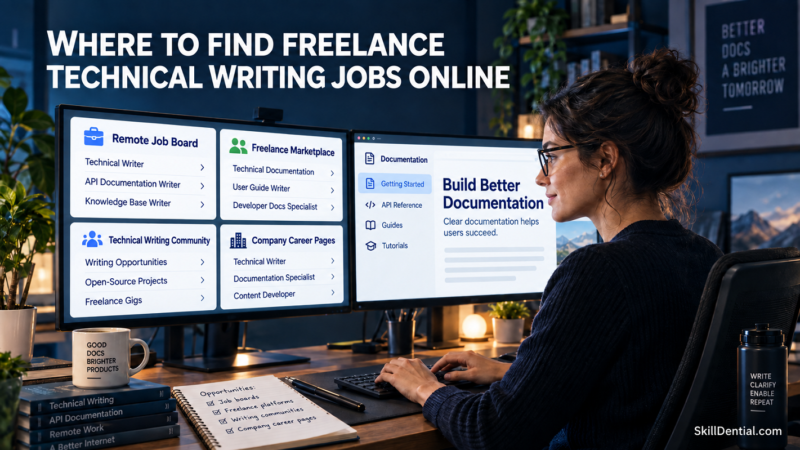
Beginners often waste weeks wading through scam-filled forums or underpaying platforms. When learning how to become a freelance writer with no experience, you need to channel your energy toward high-yield sourcing channels: freelance marketplaces, content agencies, direct outreach, and localized networks.
Freelance Marketplaces (Best for Your First Paid Clients)
| Platform | Fee Structure | Pros | Cons |
| Upwork | 10% flat service fee | High volume of active writing gigs, built-in escrow protection | Hyper-competitive, requires strong proposal writing |
| Fiverr | 20% commission | Easy to set up packaged service gigs, global traffic | Heavy race-to-the-bottom price competition |
| Freelancer.com | 10% or $5 minimum | Massive variety of remote projects | High volume of low-quality or spam listings |
| ProBlogger Job Board | Free to apply | Dedicated strictly to legitimate writing opportunities | Highly competitive; zero platform payment protection |
| LinkedIn Jobs | Free | Direct access to hiring managers, founders, and agencies | Requires an optimized profile and proactive networking |
Regional Note: Writers operating from hubs like Nigeria frequently start building international portfolios on Upwork, Fiverr, and ProBlogger to earn in foreign currencies (USD/GBP) before transitioning to direct, off-platform clients.
Content Marketing Agencies (Steady Volume, Lower Rates)
Agencies like Verblio, Scripted, ClearVoice, and Contently hire vetted freelancers to handle ongoing content production for corporate clients.
- The Pay: Typically ranges from $0.03 to $0.10 per word for entry-level assignments.
- The Benefit: Low marketing effort. You don’t have to pitch; they supply the briefs, editors, and steady workflow, making them reliable training grounds for beginners.
Direct Outreach & Cold Pitching (Highest Long-Term Payoff)
Skip the middlemen entirely by pitching businesses directly.
- Identify blogs, early-stage startups, SaaS companies, or marketing agencies operating within your chosen niche.
- Locate the Content Marketing Manager, Editor, or Founder via LinkedIn or the company’s team page.
- Send a short, hyper-personalized pitch email proving you understand their audience and offering a specific, actionable content idea. While conversion takes longer, this method bypasses platform fees and yields the highest-paying, recurring retainers.
Local and Regional Opportunities (Nigeria & Global)
If you are looking for local opportunities or remote contracts based in West Africa:
- Job Boards: Search Jobberman or BeBee Nigeria using keywords like “content writer,” “copywriter,” or “SEO writer” to find contract and remote roles.
- Community Forums: Use Nairaland’s Jobs/Vacancies section carefully to spot remote content writing positions posted by local businesses.
- Agency Partnerships: Reach out to digital marketing and PR agencies based in commercial hubs like Lagos, Abuja, or Ibadan. Many agencies rely heavily on external freelancers to handle overflow writing work for their clients.
Step 7: Write a Winning Pitch Email (With Template)
Most beginners send generic, desperate pitches that scream “amateur” and immediately land in the spam folder. When learning how to become a freelance writer with no experience, your outreach must treat the recipient’s time as valuable. A high-converting cold pitch is short, hyper-specific, and entirely client-focused.
Structure of a High-Yield Cold Pitch
- Subject Line: Clean, professional, and descriptive (avoid clickbait).
- Personalised Hook: Prove you actually read their blog or understand their business by mentioning a specific piece of content.
- The Value Proposition: State clearly what you do and the business outcome you drive (e.g., traffic, leads, organic rankings).
- The Proof: Link directly to 1 or 2 relevant writing samples from your spec portfolio.
- Low-Friction Call-to-Action (CTA): Ask an easy, low-pressure question to initiate a conversation.
The Proven Cold Pitch Template
Plaintext
Subject: Freelance writer for [Company Name]'s blog

Hi [First Name],

I’ve been following [Company Name]’s content on [topic] and really enjoyed your recent article on [specific article title].

I’m a freelance writer specialising in [your niche, e.g., personal finance and remote career growth]. I help companies in your space publish SEO-optimised blog posts that rank in search engines and convert readers into loyal users.

Since you’re expanding your content footprint, I put together a quick sample piece that matches your publication style:

- [Sample Title 1 – Hyperlinked Google Doc or Portfolio Link]
- [Sample Title 2 – Hyperlinked Google Doc or Portfolio Link]

Would you be open to a quick 15-minute chat this week to discuss how I could support your editorial calendar?

Best regards,

[Your Full Name]
[Portfolio Link]
[Email Address] | [WhatsApp/Phone, optional]
Code language: HTTP (http)
Execution Rules
- Volume and Consistency: Send 5 to 10 deeply personalized pitches every single week. Do not rely on one or two emails.
- Pipeline Tracking: Maintain a simple Google Sheets tracker logging the company name, contact person, email address, date sent, and response status.
- The Polite Follow-Up: If you do not hear back within 5 to 7 days, reply to the same email thread with a polite bump: “Hi [First Name], just bumping this up in case it got buried in your inbox. Let me know if you have space for freelance writing support this month!”
Step 8: Set Your Rates and Understand Payment Terms
Pricing is one of the most stressful hurdles for beginners, who frequently undercharge out of fear of rejection. When figuring out how to become a freelance writer with no experience, your rates should reflect commercial value rather than arbitrary guesswork.
Per-Word Baseline Rates (Global Standards)
- Beginner (0–1 year): $0.05 – $0.15 per word. (A standard 1,000-word post yields $50–$150).
- Intermediate (2–4 years): $0.20 – $0.50 per word.
- Experienced (5+ years): $0.75 – $2.50+ per word for specialised B2B, white papers, technical documentation, or ghostwriting.
Alternative Pricing Models
- Per-Project Pricing: Quote a flat, fixed fee based on your estimated time investment (e.g., $150 or equivalent regional value for an exhaustive 1,500-word SEO article). Flat fees prevent clients from penalising you for writing efficiently.
- Hourly Pricing: Ideal for consulting, heavy research, content auditing, or unstructured editorial assignments ($20 – $40/hour for beginners).
Strategic Pricing for International Clients (From Nigeria and Emerging Markets)
- Initial Launch Target: Aim for $0.08 to $0.12 per word for standard niche articles to build traction and momentum.
- Rapid Scaling: Once you secure 3 to 5 verified client testimonials and real-world bylines, immediately bump your baseline to $0.15 to $0.25 per word.
- Cross-Border Payout Optimisation: Direct your USD/GBP/EUR payouts through Wise or Payoneer rather than standard PayPal whenever possible. Wise consistently offers superior mid-market exchange rates and lower conversion friction when withdrawing to local bank accounts in Nigeria.
Essential Payment Terms to Enforce in Every Contract
- Milestone Deposits: Require a 50% upfront deposit for brand-new clients before starting major projects.
- Payment Windows: Set strict Net-7 or Net-14 payment terms (meaning invoices are due within 7 to 14 days). Avoid Net-30 terms early on, as cash flow is vital.
- Late Fee Structure: Include a clause outlining a small penalty for overdue invoices (e.g., a 5% late fee per week past the due date).
- Revision Cap: Explicitly define your revision policy (e.g., “Includes two rounds of minor structural or stylistic revisions requested within 7 days of delivery”). Major rewrites requested due to a change in the client’s original brief should be billed as separate scope additions.
Never write a single word or execute a task without a signed agreement or clear email confirmation outlining the scope, word count, total fee, timeline, and payment terms.
Step 9: Avoid Common Freelance Writing Scams
Scammers frequently prey on newcomers who are eager to land their first gig. When figuring out how to become a freelance writer with no experience, protecting your time, intellectual property, and financial security is just as important as writing great copy.
Major Red Flags to Watch For
- Unverified Profiles: Clients on platforms like Upwork or Fiverr who have unverified payment methods, zero historical spending, or empty profile histories.
- Requests for Sensitive Personal Information: Any “employer” asking for your government-issued ID, passport scan, bank login details, or SSN/NIN before a formal contract is signed.
- Unpaid “Test Tasks”: Demands for massive, free trial assignments (e.g., asking you to write a complete 2,000-word article for “evaluation purposes”). Legitimate clients pay for test pieces.
- Predatory or Suspiciously High Rates: An unknown publisher offering exorbitant sums for massive word counts (e.g., $100 for a 5,000-word technical white paper with no prior communication) — this is often a setup to steal your content or commit payroll fraud.
- Platform Circumvention Pressure: Clients on Upwork or Fiverr who immediately pressure you to move conversations and payments off-platform before any contract is established, exposing you to outright scams and account bans.
- Generic Mass-Blasted Emails: Outreach messages that omit your name, ignore your portfolio, and use vague corporate jargon like “Dear Writer, we have a great job for you.”
Defensive Protocols for Beginners
- Conduct Background Checks: Vet every prospective client by inspecting their official company website, checking their LinkedIn corporate page, and reviewing their domain registration or footprint.
- Establish Clear Scope Upfront: Demand a signed contract or formal platform milestone before you type a single word of copy.
- Leverage Escrow Protection: Always utilize platform escrow systems (Upwork, Fiverr) for early transactions until trust is established.
- Trust Your Intuition: If a client communication feels chaotic, overly demanding, or evasive about payment structures, politely decline and walk away. Your energy is better spent pitching legitimate prospects.
Step 10: Land Your First Paid Writing Job (30-Day Action Plan)
Transitioning from beginner to a paid professional requires strict operational discipline. When learning how to become a freelance writer with no experience, momentum matters more than perfection.
Execute this structured 30-day roadmap to secure your first paying client:
Week 1: Foundation & Skill Alignment
- Select your focus: Choose your primary niche and secondary vertical (refer to Step 2).
- Set up financial rails: Open your international payment accounts (Wise, Payoneer, or PayPal) to ensure you are ready to accept foreign currency payouts (refer to Step 3).
- Draft your spec assets: Write 2 to 3 pristine, 1,000-word samples tailored specifically to your chosen niche and publish them on Medium, Substack, or LinkedIn Articles (refer to Step 4).
Week 2: Portfolio & Profile Optimisation
- Assemble your digital hub: Compile your writing samples into a clean Google Drive folder or a free portfolio builder (JournoPortfolio or Contently) (refer to Step 5).
- Optimize your LinkedIn footprint: Rewrite your professional headline to clearly communicate your service (e.g., “Freelance B2B Writer & Content Strategist | Personal Finance & SaaS”).
- Initialize freelance marketplace profiles: Set up targeted profiles on Upwork or Fiverr focusing strictly on your niche, utilizing your spec samples as portfolio proof.
Week 3: Active Outreach & Networking
- Apply across job boards: Submit 5 to 10 tailored applications on verified boards like ProBlogger, LinkedIn Jobs, or Upwork (refer to Step 6).
- Execute cold outreach: Dispatch 5 deeply personalized cold pitches to startups, agencies, or blogs in your niche using the proven template from Step 7.
- Join peer communities: Plug into professional networks such as Reddit’s
r/freelanceWriters, specialized Slack groups, or LinkedIn creator networks to learn industry standards and spot unadvertised gigs.
Week 4: Follow-Ups, Closing & Client Retention
- Pursue your pipeline: Follow up on all unanswered pitches and pending applications from earlier in the month.
- De-risk for the client: Offer a low-friction, paid trial article (e.g., an 800-word post at a standard entry-level rate of $0.10/word) to lower psychological barriers for hesitant prospects.
- Overdeliver and harvest social proof: Submit your trial piece on time, incorporate feedback gracefully, and immediately ask the client for a written testimonial and referrals for future projects upon successful delivery.
By following this systematic execution plan rather than waiting for opportunities to find you, you can realistically secure your first paid assignment within 4 to 8 weeks.
Common Beginner Mistakes to Avoid
When figuring out how to become a freelance writer with no experience, avoiding common operational pitfalls will save you months of frustration and stalled momentum. Steer clear of these five beginner traps:
- Waiting for a “perfect” portfolio: Do not fall into analysis paralysis. Launch with 3 to 5 solid, niche-specific spec samples and upgrade them as you secure real-world bylines.
- Underpricing forever: While starting with entry-level rates ($0.05–$0.15/word) is normal to build traction, do not stay there. Systematically raise your rates after every 3 to 5 successful projects or happy clients.
- Saying yes to everything (The Generalist Trap): Taking on every random writing gig under the sun dilutes your expertise. Niche down early so you can master your subject matter, command higher rates, and attract serious B2B clients.
- Ignoring the business side: Freelancing is a micro-business, not just a creative outlet. Track your revenue, software subscriptions, transaction fees, and local or international tax obligations from day one.
- Relying on a single acquisition channel: Never put all your eggs in one basket. If you rely solely on Upwork or a single content agency, algorithm changes or policy updates can wipe out your income overnight. Diversify by combining job boards, direct cold pitching, and client referrals.
Do I need a degree to become a freelance writer?
No. Many successful freelance writers do not hold journalism or English degrees. Commercial clients care far more about your writing quality, adherence to briefs, deadline reliability, and niche expertise than formal academic credentials.
How much can I earn as a beginner freelance writer?
Beginners typically earn $0.05 to $0.15 per word. A 1,000-word article priced at $0.10 per word yields $100. Writing 5 to 10 articles a month generates a dependable part-time income of $500 to $1,000+. Your rates scale upward as you accumulate experience, deepen your specialisation, and pitch direct clients.
Can I start freelance writing from Nigeria?
Yes. Countless Nigerian writers build thriving freelance careers by connecting with international clients via Upwork, Fiverr, ProBlogger, and direct cold outreach. You can easily receive global payouts in USD, GBP, or EUR using multi-currency platforms like Wise, Payoneer, or reliable payment channels.
How do I get clients without a website?
You can easily launch your career without custom hosting by using free portfolio hubs such as a Google Drive folder containing clean PDF samples, a LinkedIn profile featuring published articles, or free tiers on platforms like JournoPortfolio, Contently, and Medium. A polished portfolio site is a great long-term upgrade, but it is entirely optional to secure your first paid client.
Is freelance writing still viable with AI tools?
Yes, but the quality bar is significantly higher. Artificial intelligence easily automates generic, low-value text. Human writers who choose a specialized niche, understand business strategy, conduct primary research, and inject original insights or brand voice continue to command top-tier rates. Focus on verticals where human expertise, real-world experience, and critical thinking matter most (such as B2B tech, finance, health, and strategy).
In Conclusion
Learning how to become a freelance writer with no experience does not require a journalism degree, industry connections, or waiting for a lucky break. It requires treating writing as a legitimate, scalable business from day one: choosing a profitable niche, assembling a high-impact spec portfolio, mastering cold outreach, and committing to consistent daily execution.
The demand for clear, strategic, and human-crafted content is higher than ever. While AI tools can generate generic text, brands and agencies will always pay premium rates for writers who understand strategy, research deeply, and solve real business problems.
Your Immediate Next Steps
- Pick your niche today: Select one primary vertical where you want to build authority (e.g., SaaS, personal finance, or digital marketing).
- Draft your spec pieces: Write two to three polished, 1,000-word samples and drop them into a clean Google Drive folder.
- Launch your outreach: Send your first five personalized cold pitches or platform applications this week.
The gap between wanting to be a writer and earning a living as one is closed by consistent action. Set up your infrastructure, refine your pitch, and land your first paid client within the next 30 days.