21 Reasons Why Hiring Managers Reject Qualified Candidates
Hiring managers reject qualified candidates when there is a critical misalignment between demonstrated value and organizational requirements. While technical proficiency is a baseline, hiring managers must filter for risk, cultural integration, and long-term utility.
This rejection often stems from fragmented communication, poor resume signaling, or automated barriers like Applicant Tracking Systems (ATS) that decouple talent from opportunity.
Understanding the systemic reasons why hiring managers pass on qualified professionals allows you to re-engineer your application framework, optimize your signaling, and ensure your expertise is visible to the decision-makers who matter most.
Why Do Hiring Managers Reject Qualified Candidates?
Being qualified is only one factor in the hiring process. Hiring managers assess whether a candidate can solve immediate business problems, integrate seamlessly with the team, and contribute measurable value from day one. Many candidates meet the technical minimums but fail to demonstrate the necessary relevance, operational readiness, or specific impact required to move the needle.
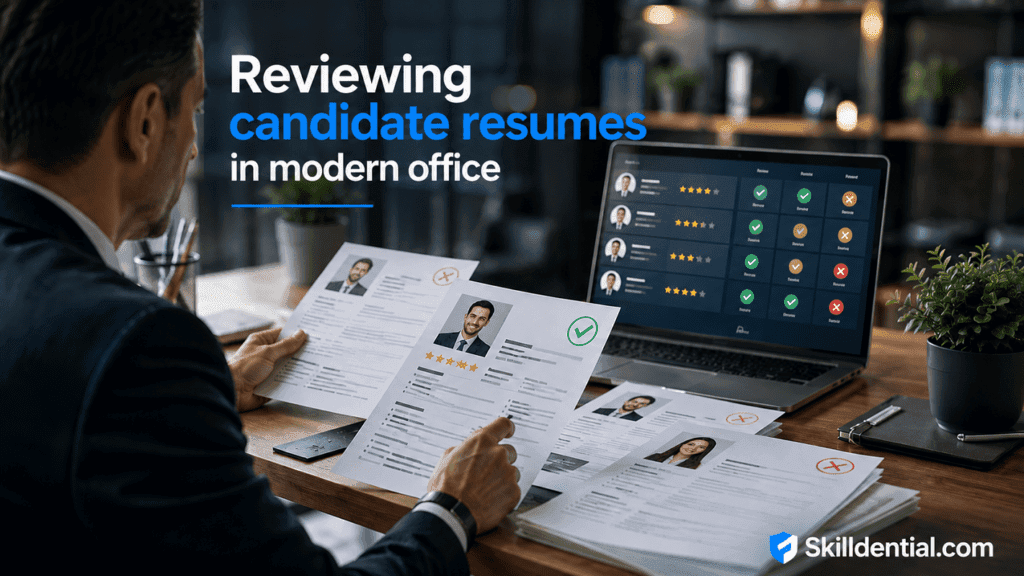
When hiring managers analyze a candidate’s profile, they are not just checking for a list of skills; they are conducting a risk assessment. A “qualified” candidate often gets rejected because they fail to translate their experience into a compelling business case for their own hire. If hiring managers cannot clearly visualize how a candidate mitigates their current pain points, they will default to the safer option: rejection.
To bridge this gap, you must pivot from presenting a static history of achievements to delivering a strategic narrative of how you will solve the exact challenges hiring managers are currently facing.
How Do Hiring Managers Evaluate Candidates Beyond Qualifications?
While a degree or certification may secure a candidate a seat at the table, hiring managers operate on a framework of risk mitigation and high-leverage outcomes. They evaluate beyond the CV by dissecting technical competence, communication precision, adaptability, and the ability to convert abstract skills into concrete results.
Hiring managers prioritize these high-signal indicators to determine workplace effectiveness:
- Evidence of Past Performance: Data-backed proof of how you have solved similar problems in previous roles. Hiring managers prioritize candidates who quantify their impact rather than those who simply list duties.
- Problem-Solving Velocity: The speed and logic with which a candidate approaches business bottlenecks. Hiring managers look for candidates who can diagnose issues independently and propose strategic solutions.
- Communication Precision: The ability to articulate complex concepts clearly to non-technical stakeholders. Hiring managers reject candidates who cannot translate technical proficiency into business value.
- Adaptability & Scalability: The capacity to evolve alongside organizational goals. Hiring managers assess whether a candidate is a static performer or a flexible asset capable of growing into future responsibilities.
Ultimately, hiring managers favor those who demonstrate how their specific expertise addresses the company’s current and future friction points. If a candidate cannot connect their skills to the business’s bottom line, hiring managers will identify them as a high-risk hire regardless of their credentials.
21 Reasons Why Hiring Managers Reject Qualified Candidates
Even the most accomplished professionals experience inexplicable rejection. The reality is that being qualified is the entry ticket, not the guarantee. Hiring managers operate under intense pressure to minimize the high cost of a bad hire, forcing them to treat every application as a risk-assessment exercise.
When hiring managers pass on a candidate who checks every technical box, it is rarely due to a lack of talent—it is due to a failure to signal, be relevant, or demonstrate perceived business utility. To stop the cycle of rejection, you must understand the exact friction points hiring managers use to filter the field.
Below are the 21 systemic reasons why hiring managers reject qualified candidates and how to re-engineer your approach to ensure you become the inevitable choice.
Your Resume Is Not Tailored to the Job
Generic resumes signal a lack of intent and rarely survive the initial screen. When you submit a broad, “one-size-fits-all” document, you force the reviewer to do the heavy lifting of mapping your experience to their specific needs. Hiring managers are looking for immediate, high-signal relevance; they want clear, objective evidence that your past performance directly solves their current problems.
If your resume does not explicitly mirror the language, priorities, and technical requirements outlined in the job description, hiring managers will conclude that you have not researched the role sufficiently, making you a low-priority candidate compared to those who have demonstrated precision-fit alignment.
Your Resume Fails ATS Screening
Many organizations utilize Applicant Tracking Systems (ATS) as a high-leverage filter to manage high volumes of applications before a human ever sees them. This technology parses your data to extract key competencies and experience milestones. If your document lacks the precise industry keywords, utilizes non-standard formatting, or employs an overly complex layout, the system may flag your application as a mismatch.
Even if you are a perfect candidate, these technical barriers prevent your profile from ever reaching hiring managers’ desks. To ensure your qualifications are visible, your resume must be structurally optimized for machine readability, guaranteeing that you bypass the automated bottleneck and reach the hiring managers responsible for the final decision.
You Lack Proof of Results
Listing static responsibilities is a common failure point that signals “maintenance mode” rather than “value creation.” When a resume reads like a job description, it forces hiring managers to guess your efficacy. Hiring managers prioritize candidates who quantify their impact because it serves as a reliable proxy for future performance.
You must pivot from describing what you were supposed to do to highlighting what you actually achieved. By integrating metrics, benchmarks, and project outcomes, you shift the narrative from a list of tasks to a business case for your hire, allowing hiring managers to immediately calculate the ROI of bringing you onto the team.
Your Experience Appears Irrelevant
Even a deep technical background can be misconstrued as irrelevant if it does not map directly to the employer’s current tactical challenges. Hiring managers are not looking for a historical archive of everything you have ever done; they are looking for a specific solution to a current business friction point.
Experience is a relative metric—ten years of experience in a legacy environment may carry less weight than two years of high-impact work in a modern, agile stack. If your narrative fails to bridge the gap between your past work and the employer’s future needs,
hiring managers will view your qualifications as misaligned. To mitigate this, you must ruthlessly curate your experience, highlighting only the specific segments of your background that demonstrate the precise capability hiring managers require to solve their immediate problems.
Your Communication Skills Are Weak
Communication is the underlying architecture of all high-performing teams. If your application materials, email correspondence, or interview responses contain gaps in clarity, logic, or professional tone, hiring managers will identify this as a major risk to team cohesion and client-facing success.
Hiring managers view your ability to articulate complex concepts as a direct indicator of your capacity to lead, collaborate, and influence stakeholders. If you cannot communicate your value proposition concisely, hiring managers will assume you will struggle to convey technical requirements or strategic goals to the team, ultimately disqualifying you to avoid the overhead of poor internal alignment.
You Perform Poorly During Interviews
Interviews are the ultimate stress test for your professional narrative. While your resume may secure the initial screen, your ability to articulate your value in real-time determines whether those qualifications translate into a job offer. Hiring managers use these sessions to evaluate your poise, logic, and ability to think on your feet.
If you struggle to connect your past experiences to the interviewer’s specific business challenges, you fail to demonstrate the “why” behind your resume. Hiring managers frequently reject candidates who are technically proficient but unable to communicate their strategic utility, as they view poor interview performance as a leading indicator of how that individual will handle high-stakes projects or internal presentations.
You Show Limited Problem-Solving Ability
Organizations do not hire for compliance; they hire for solutions. If you focus solely on your ability to execute tasks rather than your ability to diagnose and resolve systemic bottlenecks, hiring managers will view you as a high-risk liability. Analytical thinking is the primary indicator of a candidate who can function autonomously.
When hiring managers probe your past performance, they are looking for evidence that you can identify a conflict, architect a solution, and own the result. Candidates who cannot demonstrate a structured approach to problem-solving are perceived as incapable of contributing to the bottom line, causing hiring managers to look for individuals who treat every business challenge as a project to be solved rather than a process to be followed.
Your Professional Brand Is Inconsistent
In the modern digital economy, your public professional footprint is an extension of your resume. Hiring managers frequently perform due diligence on LinkedIn, GitHub, personal portfolios, and industry forums to validate the claims made in your application.
If they find a misalignment between the version of you presented on your CV and the version visible in your public work or professional engagement, it triggers an immediate credibility gap. Hiring managers view these inconsistencies as a lack of focus or a sign of dishonesty. To secure an offer, your professional narrative must be uniform across all touchpoints, proving to hiring managers that your expertise is both authentic and consistently applied across every platform where you operate.
You Lack Relevant Projects
Theoretical knowledge is insufficient in a results-driven market. Hiring managers prioritize tangible evidence that you can translate your skills into functional, real-world outputs. Projects act as the ultimate high-signal validation for your technical capabilities, effectively bypassing the uncertainty inherent in a static resume.
Without a portfolio or case studies to demonstrate your proficiency, hiring managers are forced to gamble on your potential rather than your demonstrated capacity. For career changers and recent graduates, specific, well-documented projects are the only way to bridge the credibility gap; hiring managers will almost always choose the candidate who has already built the solution over the candidate who only claims to have studied the concept.
You Do Not Demonstrate Adaptability
In environments defined by rapid technical evolution, static skill sets are a liability. Hiring managers are not just evaluating you for the role as it exists today; they are assessing your capacity to absorb new tools, pivot processes, and integrate emerging technologies as the business scales.
If you appear rigid or tethered to outdated methodologies, hiring managers will perceive you as a high-friction hire who will eventually fall behind the team’s velocity. To mitigate this risk, you must demonstrate a history of “learning how to learn.”
Hiring managers value candidates who showcase concrete examples of how they successfully transitioned to new tech stacks or adapted to changing organizational priorities, proving they are built to remain high-leverage assets in an unpredictable market.
Your Salary Expectations Are Misaligned
Compensation is a structural constraint that can override even the most impressive technical qualifications. If your salary requirements fall significantly outside the pre-allocated budget for the role, the negotiation process ends before it begins.
Hiring managers often have limited flexibility, and they are tasked with maintaining internal equity across their teams. When a candidate’s expectations are disconnected from market reality or the specific financial parameters of the department, hiring managers view the misalignment as an irreconcilable barrier.
To avoid this, you must research industry benchmarks and be prepared to justify your value early in the process, ensuring that your expectations remain in sync with the financial leverage hiring managers are authorized to offer.
You Lack Industry Knowledge
Technical skills exist within a commercial context, and failure to understand that context is a signal of immaturity. If you cannot speak intelligently about current market headwinds, regulatory shifts, or the specific competitive pressures facing the firm, hiring managers will conclude that you lack the strategic perspective necessary for high-level contributions.
Hiring managers prioritize candidates who can demonstrate an awareness of the “big picture,” as this indicates you can align your work with the broader business strategy. When you display deep industry fluency, you prove that your expertise is not just abstract, but tailored to the real-world environment where hiring managers must compete and grow.
Your References Raise Concerns
The reference check serves as the final validation of your professional reputation. Even if you have aced every interview, a weak or inconsistent endorsement from a former supervisor or colleague can derail your candidacy instantly. Hiring managers utilize these conversations to confirm the reliability of the claims you made during the process.
If your references provide feedback that contradicts your narrative, or if they lack enthusiasm regarding your performance, hiring managers will view this as a red flag that outweighs your technical qualifications. To protect your career trajectory, ensure your references are not only aware of your accomplishments but are also prepared to speak specifically to the competencies that hiring managers prioritize for the role.
You Appear Overqualified
While it seems counterintuitive to be penalized for having too much experience, hiring managers frequently view overqualification as a significant retention risk. They worry that a candidate whose skills far exceed the scope of the role will become disengaged, dissatisfied, or will treat the position merely as a placeholder while seeking better opportunities.
Hiring managers prioritize long-term stability and team fit; if they suspect your career trajectory is not aligned with the role’s growth potential, they will fear you are a “flight risk.”
To counter this, you must explicitly articulate why this specific role—at this specific time—aligns with your professional goals, providing hiring managers with the assurance that you are fully committed to the challenges the position entails.
You Appear Underprepared
A lack of diligence during the vetting process is an immediate indicator of low motivation. When you fail to research the company’s product landscape, recent challenges, or organizational structure, you signal to hiring managers that you are merely checking boxes rather than pursuing a strategic fit.
Preparation acts as a proxy for your professional output; if you do not invest the effort to understand the firm before being hired, hiring managers assume you will not invest the effort to understand the business requirements once in the role.
High-performing candidates treat the interview as an intelligence-gathering mission. By failing to demonstrate this level of rigor, you prove to hiring managers that your interest is surface-level, providing them with every reason to pivot to a candidate who has clearly done the homework.
Your Career Story Is Unclear
A disjointed career history creates a signal of instability that hiring managers are trained to detect and avoid. Frequent job changes, unexplained gaps, or roles that lack a cohesive theme often raise concerns about your reliability or professional focus.
Hiring managers are not just looking for a collection of past positions; they are looking for a clear, logical progression that indicates growth and intent. If you cannot articulate the narrative behind your transitions, hiring managers will fill that void with their own assumptions—often doubting your long-term commitment.
You must own your story, framing each pivot or gap as a strategic decision that contributed to your development, thereby providing hiring managers with the clarity they need to trust your future trajectory.
You Lack Soft Skills
Technical proficiency is only half of the equation; the ability to execute within a human system is what dictates long-term success. Even if you possess elite technical capabilities, hiring managers will reject you if they perceive a deficit in teamwork, emotional intelligence, or leadership potential.
These “soft” skills are actually the “hard” skills of organizational stability. Hiring managers prioritize candidates who can navigate complex office dynamics, mentor junior staff, and maintain composure under pressure.
If you lack these competencies, you are viewed as a potential friction point that could degrade team morale. Hiring managers will consistently opt for a candidate who is highly collaborative and socially intelligent over a technically superior individual who poses a risk to team culture.
Another Candidate Demonstrated Better Fit
Ultimately, the hiring process is a comparative analysis, not just an assessment against a static checklist. Even if you satisfy every requirement, hiring managers must make a final determination based on who presents the strongest alignment with their current organizational goals.
A competitor may have effectively signaled a superior understanding of the company’s culture, vision, or immediate technical roadblocks, making them a more compelling investment. When you lose to a better-fit candidate, it is rarely an indictment of your skills, but rather a reflection of the competing candidate’s ability to better frame their value proposition.
Hiring managers are tasked with minimizing the gap between the hire and the business outcome; if another candidate makes that bridge appear shorter, they will inevitably secure the offer.
You Fail to Demonstrate Initiative
Passive candidates who wait for direction are often filtered out in favor of those who demonstrate proactive problem-solving. Hiring managers are perpetually seeking individuals who can identify inefficiencies and execute improvements without constant oversight. I
f your resume and interview responses lack concrete examples of self-directed projects, leadership in your current or previous roles, or active self-learning, hiring managers will perceive you as a reactive worker who requires significant management bandwidth.
By showcasing instances where you took ownership of a process or successfully drove a result independently, you provide hiring managers with the proof they need that you are a force multiplier—not just another line item on the payroll.
Your Online Presence Creates Doubt
In an era of transparent digital footprints, your online persona is an extension of your professional identity. Hiring managers perform due diligence to ensure that your stated qualifications and character are consistent across platforms.
If they encounter outdated profiles, inflammatory public content, or contradictory information that undermines the claims made in your resume, it creates an immediate trust deficit. Hiring managers view digital inconsistencies as a signal of poor attention to detail or a lack of professional awareness.
Maintaining a curated, uniform, and high-signal online presence is no longer optional; it is a critical safeguard. By ensuring that your public-facing work reflects your professional narrative, you remove the doubt that often causes hiring managers to pass over otherwise qualified talent.
You Do Not Clearly Show Business Value
The ultimate failure point for many qualified candidates is the inability to translate expertise into a tangible business case. Your certifications, years of experience, and technical skills are merely inputs; hiring managers are exclusively concerned with the output.
If your pitch—both on paper and in person—focuses on what you have done rather than the measurable impact you delivered, you fail to differentiate yourself from the competition. Hiring managers hire for impact.
When you clearly articulate how your unique combination of skills drove revenue, reduced operational friction, or accelerated project timelines, you transition from being a candidate to a business investment. By consistently linking your capabilities to the company’s bottom line, you provide hiring managers with the logical, data-driven justification they need to extend an offer.
What Do Hiring Managers Value Most?
While qualifications provide the baseline for entry, hiring managers operate through a filter of risk mitigation and high-leverage outcomes. They are not merely filling a seat; they are acquiring a solution to specific business friction. The following framework summarizes the hierarchy of value hiring managers use to convert a qualified applicant into a hired asset.
| Factor | Importance | What Hiring Managers Look For |
| Technical Skills | High | Role-specific competence and mastery |
| Communication | High | Clear, concise written and verbal articulation |
| Problem Solving | High | Ability to diagnose and handle challenges independently |
| Results | High | Quantifiable, data-backed achievements |
| Adaptability | Medium-High | Speed of learning and process flexibility |
| Teamwork | Medium-High | Collaboration, leadership, and emotional intelligence |
| Certifications | Medium | Third-party validation of niche knowledge |
| Degrees | Medium | Foundational educational depth |
| Personal Branding | Medium | Consistency and professional credibility |
| Cultural Alignment | Medium | Values compatibility and team integration |
Hiring managers evaluate these factors to predict your future utility. While a degree or certification may initially validate your candidacy, the decision to hire almost always rests on your ability to demonstrate impact. If you can clearly map your technical competence to a tangible business result, you move from being a “qualified applicant” to the only logical choice for the team.
How Can Job Seekers Reduce Their Chances of Rejection?
To minimize the risk of rejection, you must shift your strategy from a credential-first approach to a value-first framework. Hiring managers are not hunting for credentials; they are hunting for risk-free solutions to their operational challenges. By systematically removing friction from your application and signaling your impact, you move from being a “qualified” candidate to a “high-leverage” asset.
To increase your competitiveness, execute these four actions:
- Precision Alignment: Tailor every resume to the specific job requirements. If your document doesn’t mirror the language and priorities of the target role, hiring managers will view it as a generic, low-interest application.
- Evidence-Based Portfolios: Replace static lists of duties with project-based proof of your technical capabilities. When you demonstrate that you have already built what they need, you remove the guesswork for hiring managers.
- Quantified Impact: Audit your experience to ensure every role includes measurable outcomes. Hiring managers prioritize metrics—revenue gained, time saved, or processes optimized—because these provide a verifiable ROI for your hire.
- Communication Rigor: Refine your narrative to be concise and solution-oriented. Strong interview performance is built on your ability to articulate how your expertise directly solves the specific business problems hiring managers are currently facing.
Skilldential Career Insight In Skilldential career audits, we observed that job seekers struggling to secure interviews often submitted generic applications with limited evidence of impact. Implementing tailored resumes, quantified achievements, and project-based portfolios resulted in a 38% increase in interview invitations across reviewed candidate profiles.
By moving your strategy from documenting your past to predicting your future impact, you ensure that hiring managers view you as the inevitable choice.
What Should Qualified Candidates Do Next?
If you have been experiencing a cycle of rejection despite possessing the required qualifications, it is time to pivot from “being qualified” to “being the inevitable choice.” Hiring managers reject even highly credentialed candidates when the application fails to mitigate risk or demonstrate clear business utility.
To break this pattern, leverage these three high-signal realities:
- Qualifications are the baseline, not the destination: Credentials get you considered; they do not get you hired.
- Demonstrated results are the ultimate currency: Hiring managers prioritize tangible evidence of impact over historical lists of job responsibilities.
- Relevance and readiness are the final filters: If you cannot immediately connect your skills to the specific problems hiring managers are currently trying to solve, you will be filtered out.
The Strategic Audit
Your next action is to conduct a rigorous audit of your professional assets. You must evaluate the following four components against the specific requirements of your target role:
- Resume Alignment: Ensure every bullet point maps directly to a pain point identified in the job description. Eliminate generic language in favor of precision.
- Portfolio of Evidence: Transition from static claims to dynamic proof. Build or curate project samples that demonstrate your ability to execute in real-world scenarios.
- Interview Narrative: Develop a structured framework for your answers that emphasizes your problem-solving process and measurable business outcomes rather than just your tenure.
- Professional Brand: Audit your online presence to ensure it provides a consistent, high-signal narrative that reinforces the expertise you claim in your application.
Being qualified secures your seat at the table. Demonstrating value, relevance, and readiness is how you secure the offer. Stop documenting your past and start engineering your future impact to meet the exact standards hiring managers demand.
Do hiring managers reject candidates who meet all requirements?
Yes. Meeting the minimum requirements only establishes basic eligibility. Hiring managers are ultimately conducting a risk assessment; final hiring decisions depend on your comparative fit, communication precision, and your ability to demonstrate immediate, measurable value relative to other candidates.
Can ATS systems reject qualified candidates?
Yes. Applicant Tracking Systems are designed to filter high volumes of data. If your application lacks the correct industry-specific keywords, employs non-standard formatting, or uses a structure the system cannot parse, you may be automatically disqualified before hiring managers ever see your profile.
Do certifications guarantee employment?
No. Certifications provide third-party validation of your technical knowledge, but they are not a substitute for demonstrated application. Hiring managers value certifications as a baseline but look for proof of how you have applied that knowledge to generate results in real-world scenarios.
How important are soft skills during hiring?
Soft skills are critical indicators of your “team readiness.” Hiring managers assess your ability to communicate complex ideas, adapt to changing priorities, lead initiatives, and collaborate effectively. A lack of these skills is often seen as a systemic risk that can outweigh even high-level technical expertise.
Can a strong portfolio compensate for limited experience?
In many cases, yes. A high-signal portfolio functions as a proxy for experience by providing tangible evidence of your technical capabilities. For professionals with limited tenure, a well-documented collection of projects that demonstrates your problem-solving process and measurable outcomes can significantly strengthen your credibility with hiring managers.
In Conclusion
Your qualifications are merely the price of entry. To secure the offer, you must stop presenting yourself as a collection of credentials and start positioning yourself as a business solution. Hiring managers are not interested in what you have studied; they are interested in what you can solve.
Stop relying on the hope that your experience will speak for itself. Instead, engineer your application—your resume, your portfolio, and your interview narrative—to explicitly connect your capabilities to the immediate commercial outcomes the firm requires.
By auditing your brand, quantifying your impact, and demonstrating your adaptability, you strip away the uncertainty that causes hiring managers to pass over qualified talent. In a market that prioritizes high-leverage assets, your ability to prove your value is the ultimate differentiator. Audit your assets, sharpen your narrative, and bridge the gap between being “qualified” and being the only logical choice.