Remote AI nursing jobs allow licensed nursing professionals to apply their clinical expertise to train artificial intelligence models, audit AI-generated medical outputs, optimize healthcare software, and support digital care delivery.
Current market listings typically pay $40 to $125+ per hour, with specialized clinical review and Nurse Practitioner projects commanding the highest rates. Most roles operate on flexible, asynchronous contracts, with eligibility determined by active licensure, clinical tenure, and geographic location.
Artificial intelligence is rapidly reshaping how healthcare organizations document patient encounters, analyze clinical data, triage virtual care, and support medical decision-making.
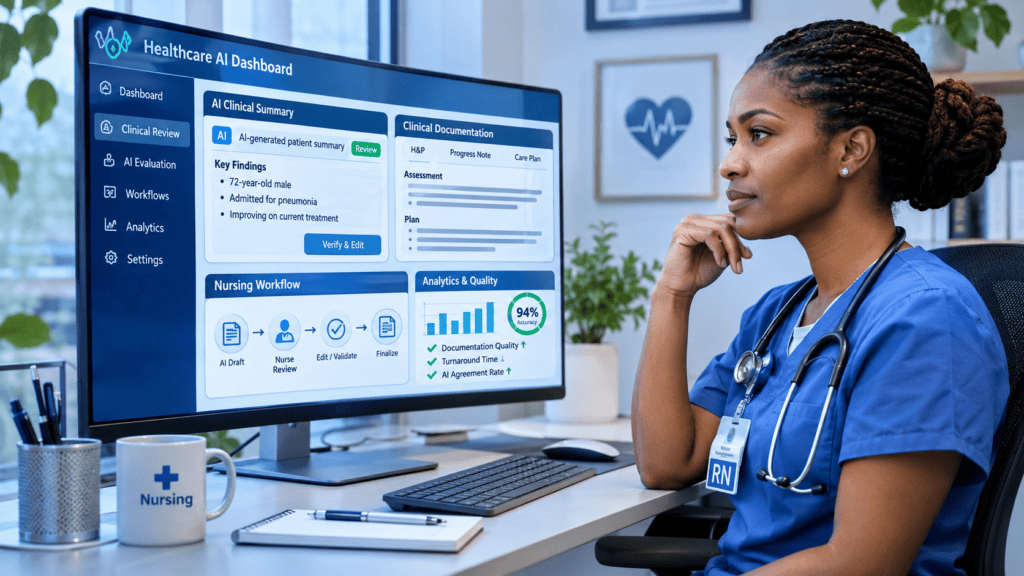
However, large language models and clinical algorithms cannot replace the real-world clinical judgment required to navigate complex patient scenarios. To produce safe, reliable outputs, AI systems require structured medical data, realistic nursing workflows, and rigorous human-in-the-loop feedback.
This gap has created a growing market of remote AI nursing jobs for clinicians seeking high-leverage work beyond traditional bedside shifts.
Instead of direct patient care, nurses in these roles evaluate AI-generated clinical responses, refine electronic health record (EHR) workflows, author clinical training rubrics, and flag safety risks in automated healthcare tools.
These positions are especially well-suited for registered nurses (RNs) and advanced practice nurses (APRNs) with hands-on experience in patient assessment, medication safety, clinical documentation, care planning, and specialty practice.
In this guide, you will discover 15 remote AI nursing jobs, including core responsibilities, realistic pay ranges, qualification requirements, where to apply, and how to translate your clinical background into a competitive application.
Geographic & Licensing Note:
While several AI data-training platforms hire globally, many clinical remote AI nursing jobs are restricted to U.S.-licensed nurses or specific jurisdictions. A “remote” listing does not guarantee worldwide eligibility—always verify residency, work-authorization, and active licensure requirements before applying.
What Are Remote AI Nursing Jobs?
Remote AI nursing jobs are clinical and technical roles where licensed nurses apply their medical expertise to build, audit, train, or operate alongside artificial intelligence systems in healthcare.
Rather than providing traditional bedside care, nurses act as clinical domain experts—ensuring healthcare algorithms are accurate, safe, and aligned with real-world patient workflows.
Broadly, remote AI nursing jobs fall into two distinct categories:
Direct AI-Training & Clinical Evaluation Roles
These roles focus on building and improving the AI models themselves. Nurses work directly with AI labs, health-tech startups, and data-annotation platforms to provide human-in-the-loop (HITL) feedback. Core tasks include:
- Grading AI-generated clinical responses for medical accuracy, empathy, and patient safety (Reinforcement Learning from Human Feedback, or RLHF).
- Writing clinical case scenarios and gold-standard nursing rubrics to benchmark large language models (LLMs).
- Auditing healthcare datasets, clinical flowsheets, and automated triage logic for bias or diagnostic errors.
AI-Enabled Remote Clinical Roles
These are remote healthcare delivery, care management, or informatics positions where nurses use AI-powered software as a core operational tool. Rather than training the algorithm, you leverage AI to deliver faster, higher-volume clinical decisions:
- Reviewing and validating AI-generated ambient clinical documentation and discharge summaries.
- Managing remote patient monitoring (RPM) dashboards that use predictive AI to flag early signs of patient deterioration.
- Conducting virtual triage or utilization management supported by AI intake summaries and automated prior-authorization tools.
Why This Distinction Matters
Not every telehealth or work-from-home nursing position qualifies as one of the remote AI nursing jobs covered in this guide. Understanding the operational difference helps you target the right compensation model and skill set:
| Dimension | Direct AI-Training Nursing Roles | AI-Enabled Remote Clinical Roles |
| Primary Objective | Train, test, and audit AI models | Deliver patient care or clinical reviews using AI tools |
| Typical Employers | AI research labs, data-labeling platforms, health-tech vendors | Hospital systems, telehealth providers, health insurers |
| Work Structure | Asynchronous, task-based, flexible hours | Scheduled shifts, synchronous patient/provider interaction |
| Common Contract Type | 1099 independent contractor | W-2 salaried or hourly employee |
For example, a Clinical AI Model Evaluator might spend three asynchronous hours grading how well a medical chatbot explains insulin titration to a newly diagnosed diabetic.
Conversely, an AI-Enabled Triage Nurse uses an automated symptom-checker to structure patient intake data before conducting a live clinical assessment. Both roles bridge nursing and artificial intelligence, but they require completely different application strategies.
How Much Do Remote AI Nursing Jobs Pay?
Remote AI nursing jobs typically pay between $35 and $100+ per hour, with specialized clinical review and Nurse Practitioner projects commanding the top end of the market. Actual earnings depend heavily on your clinical credentials (RN vs. APRN), subspecialty experience, project complexity, and geographic location.
Based on publicly advertised listings across leading AI training and health-tech platforms, current market rates break down as follows:
| Platform / Employer | Advertised Role | Advertised Compensation |
| Alignerr | Nursing Informatics Specialist | $35–$80 / hour |
| Meridial | Registered Nurse AI Trainer | $6–$65 / hour (varies by task tier & region) |
| OutcomesAI | Clinical Nurse Triage Tester | $35 / hour |
| Mercor | Clinical Documentation & Medical Necessity Reviewer | $68 / hour |
| Mercor | Pediatric Inpatient Nurse Project | $55–$65 / hour |
| AfterQuery | Nurse Practitioner Expert | Up to $103 / hour |
Note:
These figures reflect publicly advertised project rates at the time of review—not guaranteed offers. Compensation varies by project batch, onboarding assessment performance, and live availability.
Hourly Contractor Rates vs. Full-Time Nursing Salaries
When evaluating remote AI nursing jobs, avoid multiplying an $80 hourly rate by 2,080 hours to assume a $166,000 annual salary. Most direct AI-training roles are structured as 1099 independent contracts rather than W-2 salaried positions, which changes the real take-home math:
- Variable Task Volume: A project paying $65–$80/hour may only offer 10 to 20 hours of active tasks per week, or pause between model-training cycles.
- Unpaid Onboarding: Qualifying exams, rubric calibration tests, and platform assessments are typically unpaid.
- Self-Employment Overhead: Independent contractors do not receive employer-sponsored health insurance, 401(k) matching, or paid time off—and must set aside funds for self-employment taxes.
For comparison, the U.S. Bureau of Labor Statistics (BLS) reports a median annual wage of $97,550 (roughly $46.90 per hour) for registered nurses as of May 2025.
While that figure represents traditional clinical nursing rather than AI-specific roles, it serves as a practical baseline: remote AI nursing jobs frequently beat traditional bedside hourly rates on a per-hour basis, making them especially lucrative as high-margin supplemental income or flexible bridge work alongside clinical practice.
15 High-Paying Remote AI Nursing Jobs Nurses Can Apply For
Below is a curated breakdown of 15 remote AI nursing jobs spanning asynchronous AI model training, clinical safety auditing, nursing informatics, and AI-enabled telehealth. Each listing details core day-to-day responsibilities, realistic hourly or annual pay benchmarks, required credentials, and the types of employers actively hiring.
AI Nurse Trainer
AI Nurse Trainers serve as clinical subject-matter experts who teach large language models (LLMs) and healthcare algorithms how to reason through nursing workflows, clinical protocols, and patient interactions safely.
Core Responsibilities:
- Audit clinical outputs: Evaluate AI-generated responses to nursing and patient queries for medical accuracy, safety, and empathy.
- Author training benchmarks: Write realistic clinical scenarios, multi-step prompts, and “gold-standard” nursing rationales that models learn from.
- Document failure modes: Flag diagnostic blind spots, pharmacology errors, or unsafe triage recommendations and explain the correct clinical reasoning.
- Refine clinical terminology: Calibrate how AI systems interpret nursing diagnoses, care plans, and electronic health record (EHR) documentation.
In Practice:
If a medical chatbot suggests an unsafe IV push rate or misses a critical drug interaction, an AI Nurse Trainer flags the error, documents why it violates nursing safety standards, and writes the clinically sound alternative.
- Potential Earnings: $35–$90/hour across leading AI training platforms. For example, Meridial advertises its Registered Nurse – Freelance AI Trainer Project at $6–$65/hour (adjusted for clinical tenure and geographic location), while specialized RN and NP evaluation tracks on platforms like OpenTrain AI and Mercor regularly list $65–$100+/hour.
- Qualifications:
- Active Registered Nurse (RN) license,
- BSN or equivalent nursing degree,
- 2–5+ years of bedside or community clinical experience,
- Strong analytical writing skills to articulate step-by-step clinical judgment.
- Where to Apply:
- Meridial (Registered Nurse AI Trainer Project),
- DataAnnotation (Medical/Healthcare track),
- OpenTrain AI,
- Mercor.
Clinical AI Response Evaluator
Clinical AI Response Evaluators audit and grade the medical outputs generated by large language models (LLMs) and clinical decision-support tools to ensure they are accurate, comprehensive, and safe for real-world healthcare use.
Core Responsibilities:
- Score clinical reasoning: Evaluate whether AI-generated responses follow evidence-based nursing standards and sound clinical logic.
- Perform side-by-side model comparisons: Rank multiple AI responses to the same clinical prompt based on accuracy, completeness, and patient safety (Reinforcement Learning from Human Feedback, or RLHF).
- Flag medical hallucinations: Identify fabricated citations, contraindicated medication advice, or subtle omissions that could harm a patient.
- Write rubric-backed critiques: Provide structured, plain-language rationales explaining why one response outperforms another so engineering teams can fine-tune model weights.
In Practice:
When two AI models generate discharge instructions for a post-op cardiac patient, a Clinical AI Response Evaluator compares both drafts, flags the model that omitted signs of surgical site infection, and ranks the safer, more thorough output higher with a clinical justification.
- Potential Earnings: $50–$125+/hour, depending on clinical credentials and project complexity. General RN evaluation roles on platforms like Mercor and AfterQuery typically list $55–$100/hour, while specialized clinical and Nurse Practitioner evaluation tracks on DataAnnotation and Mercor advertise $80–$125+/hour.
- Qualifications:
- Active Registered Nurse (RN) or Advanced Practice Registered Nurse (APRN/NP) license,
- Strong foundation in evidence-based practice and clinical triage,
- High attention to detail, and clear, structured written communication.
- Where to Look:
- AfterQuery (Nursing Expert),
- DataAnnotation (Health/Medical Expert – AI Training),
- Mercor (Healthcare / Clinical Evaluator).
Nursing Informatics Specialist
Nursing Informatics Specialists bridge bedside clinical judgment with health information technology—ensuring that AI-powered software, clinical decision-support tools, and electronic health record (EHR) integrations align with real-world nursing workflows.
Core Responsibilities:
- Audit ambient AI documentation: Evaluate AI-generated nursing notes, shift handoffs, and discharge summaries for clinical accuracy and documentation compliance.
- Optimize EHR workflows: Map how automated alerts, smart order sets, and predictive risk scores integrate into platforms like Epic and Oracle Health (Cerner) without causing clinician alert fatigue.
- Validate standardized nursing taxonomies: Ensure AI models accurately map clinical data to standardized frameworks such as SNOMED CT, LOINC, NANDA-I, NIC, and NOC.
- Test clinical decision-support (CDS) tools: Lead user-acceptance testing (UAT) and provide structured feedback to health-tech product and engineering teams before clinical deployment.
In Practice:
When a hospital pilots an AI sepsis-prediction model inside Epic, a Nursing Informatics Specialist tests whether the alert triggers at the right clinical threshold, verifies that the recommended nursing protocol matches hospital policy, and refines the interface so bedside nurses act on it quickly.
- Potential Earnings: $35–$80/hour for flexible AI contract roles (such as Alignerr’s Nursing Informatics Specialist listing), or $98,000–$163,000/year for full-time salaried remote nursing informatics positions at hospital systems and health-tech vendors.
- Qualifications:
- Active RN license,
- BSN or MSN (with a specialization in Nursing Informatics preferred),
- Hands-on experience with major EHR systems (Epic, Cerner/Oracle Health, or MEDITECH), and familiarity with clinical data workflows.
- ANCC Informatics Nursing Certification (RN-BC / NI-BC) is a strong competitive advantage.
- Where to Apply:
- Alignerr (Nursing Informatics Specialist contract track),
- Major EHR vendors (Epic, Oracle Health),
- Health-tech startups,
- Remote hospital informatics departments.
Clinical Documentation AI Reviewer
Clinical Documentation AI Reviewers audit medical charts, inpatient nursing notes, discharge summaries, and ambient scribe transcripts generated or summarized by artificial intelligence. As hospitals adopt automated documentation tools to reduce clinician burnout, nurses are hired to verify that AI-drafted records are clinically accurate, compliant, and free of omissions before deployment.
Core Responsibilities:
- Audit AI-generated clinical summaries: Compare automated shift handoffs, admission assessments, and discharge summaries against raw patient chart data.
- Detect critical clinical omissions: Flag missed allergies, unrecorded medication changes, abnormal vital sign trends, or incomplete nursing interventions.
- Verify coding and medical terminology: Check that AI-generated notes accurately map clinical events to standard medical terminology, diagnosis codes, and medical necessity criteria.
- Eliminate “hallucinated” chart entries: Identify instances where an ambient AI scribe fabricated an exam finding or misattributed patient-reported symptoms.
In Practice:
When an ambient AI tool drafts a post-operative discharge summary from a recorded bedside conversation, a Clinical Documentation AI Reviewer cross-checks the note against the medication administration record (MAR) and flags if the AI failed to include a newly prescribed anticoagulant.
- Potential Earnings: $60–$70/hour for standard inpatient and clinical documentation review projects, with specialist medical necessity and senior clinical review tracks reaching $68–$120/hour. (Note: Rates vary by project scope, contract structure, and credential tier; advertised project rates are not guaranteed full-time salaries.)
- Qualifications:
- Active Registered Nurse (RN) or eligible Licensed Practical Nurse (LPN) credential,
- Recent inpatient or acute-care charting experience,
- Strong command of medical terminology and EHR workflows,
- High attention to detail.
- Where to Look:
- Mercor (Clinical Documentation & Medical Necessity Reviewer and Nursing Talent Network),
- OpenTrain AI (Inpatient Clinical Documentation Reviewer), and ambient clinical documentation vendors (e.g., Nuance/Microsoft, Abridge, Ambience Healthcare).
AI Healthcare Data Annotator
AI Healthcare Data Annotators structure, tag, and classify raw medical datasets—such as de-identified clinical notes, telehealth transcripts, and symptom logs—so machine learning models can accurately recognize clinical patterns, medical entities, and nursing workflows.
Core Responsibilities:
- Perform clinical Named Entity Recognition (NER): Highlight and tag specific clinical variables—such as medications, dosages, diagnoses, symptoms, and lab values—inside unstructured EHR text.
- Classify nursing interventions and care domains: Categorize clinical statements by specialty or workflow (e.g., medication safety, fall risk assessment, infection control, or discharge planning).
- Map terminology to standardized codes: Link free-text clinical descriptions to structured medical taxonomies such as ICD-10 or SNOMED CT.
- Audit dataset quality and de-identification: Verify that training records are accurately labeled and stripped of protected health information (PHI) before model ingestion.
In Practice:
Given a batch of 500 de-identified emergency department triage notes, an AI Healthcare Data Annotator tags every chief complaint, vital sign abnormality, and triage acuity level so an intake algorithm learns to prioritize high-risk patients automatically.
- Potential Earnings: $20–$65/hour for standard healthcare data labeling and taxonomy tagging, scaling up to $40–$125+/hour on specialist licensed-clinician projects (such as DataAnnotation’s medical/healthcare track and Mercor’s clinical pools). (Note: Entry-level or per-task annotation projects pay significantly less than complex clinical reasoning roles—always verify whether a project pays a specialist nursing tier before committing.)
- Qualifications:
- Nursing degree or active license (RN, LPN, or BSN),
- Strong command of clinical terminology and pharmacology,
- High accuracy on repetitive taxonomy rules,
- Strict adherence to HIPAA/data-privacy guidelines.
- Where to Look:
- DataAnnotation (Health/Medical Expert track),
- Mercor (Medical & Clinical Data Networks),
- Welo Data (Credentialed Medical Annotator programs across 155+ locales).
Remote AI Clinical Quality Assurance Specialist
Remote AI Clinical Quality Assurance (QA) Specialists stress-test healthcare AI applications before and after deployment to verify that automated tools meet strict clinical safety, regulatory compliance, and reliability benchmarks.
Rather than grading isolated chatbot prompts, QA specialists run structured test suites to uncover edge-case failures, safety regressions, and workflow breakdowns across entire software releases.
Core Responsibilities:
- Execute clinical test protocols: Run structured edge-case scenarios—such as complex polypharmacy interactions, pediatric dosing limits, or high-acuity red-flag symptoms—to test how AI tools perform under pressure.
- Conduct safety and red-team auditing: Probe AI healthcare applications for unsafe clinical guidance, bias, or failure to escalate urgent patient symptoms to human clinicians.
- Document and reproduce system defects: Log detailed bug reports with clinical severity ratings so product and engineering teams can isolate and fix algorithmic errors.
- Verify post-update clinical performance: Re-test models after software updates to ensure fixes do not introduce new clinical regressions or degrade accuracy.
In Practice:
Before a health-tech vendor launches an updated automated symptom-checker, a Remote AI Clinical QA Specialist runs 100 edge-case test scripts—discovering that the system fails to trigger an emergency escalation when a pregnant patient reports unilateral calf swelling and shortness of breath.
- Potential Earnings: $35–$80/hour on specialized AI evaluation and quality assurance platforms (such as Alignerr and Mercor, where clinical safety and RN quality-review projects typically list $45–$70/hour). Traditional full-time remote clinical QA roles at health-tech firms and payers generally pay $33–$57/hour (or $90,000–$160,000/year for senior clinical QA leads).
- Qualifications:
- Active Registered Nurse (RN) license,
- Clinical background in quality improvement (QI),
- Patient safety, utilization review, or risk management,
- Strong analytical documentation skills,
- Comfort navigating software testing workflows.
- Where to Look:
- Alignerr,
- Mercor (AI Safety & Clinical Quality Evaluation tracks),
- OpenTrain AI (Nursing Data Quality Analyst and Review Specialist listings),
- Quality assurance departments at digital health startups and EHR vendors.
AI Clinical Scenario Writer
AI Clinical Scenario Writers author original patient vignettes, multi-turn clinical dialogues, and structured evaluation rubrics that AI models use to learn—and be tested against—real-world nursing judgment.
Rather than passively grading existing outputs, scenario writers build the “ground-truth” curriculum that defines what safe, accurate nursing reasoning looks like.
Core Responsibilities:
- Author complex patient vignettes: Write realistic clinical cases spanning triage, acute inpatient care, medication administration, and chronic disease management.
- Design multi-turn conversational prompts: Simulate how real patients or bedside clinicians ask follow-up questions, introduce ambiguous symptoms, or omit key medical history.
- Build gold-standard answer keys and rubrics: Draft ideal clinical responses alongside step-by-step rationales, red-flag escalation triggers, and weighted grading criteria.
- Create adversarial and edge-case scenarios: Craft tricky clinical dilemmas (e.g., atypical symptom presentations or high-risk drug interactions) to expose model blind spots before clinical deployment.
In Practice:
An emergency department nurse writes a multi-turn scenario of a diabetic patient presenting with epigastric discomfort, diaphoresis, and fatigue—including the clinical rationale for why an AI triage assistant must immediately rule out an atypical myocardial infarction rather than suggesting antacids.
- Potential Earnings: $50–$125/hour across specialized clinical AI platforms. For example, clinical document and medical writing contracts on platforms like micro1 and OpenTrain AI typically list $50–$80/hour for RNs and $80–$125/hour for Nurse Practitioners, while broader freelance AI prompt-writing platforms (such as Mindrift) pay $60–$100+/hour for credentialed domain experts. (Compensation may be structured hourly or per approved case vignette.)
- Qualifications:
- Active RN or APRN license,
- Specialty bedside experience (e.g., ED, ICU, Med-Surg, Pediatrics, or OB/GYN),
- Strong command of evidence-based practice guidelines,
- Structured clinical writing skills.
- Where to Look:
- OpenTrain AI (Nurse Practitioner / Clinical Scenario Evaluation),
- Mindrift (Domain Expert Prompt & Scenario Writing),
- DeepLabel / BiteLabs (Clinical Scenario & Red-Teaming Networks),
- micro1 (Clinical Document Author), and medical education tech companies.
AI Nurse Educator and Content Evaluator
AI Nurse Educators and Content Evaluators audit AI-generated study guides, NCLEX-style rationales, clinical explanations, and point-of-care learning modules to ensure they are accurate, pedagogically sound, and safe for nursing students and practicing clinicians. This role is ideal for nurses with academic faculty, clinical preceptor, or staff-development backgrounds.
Core Responsibilities:
- Score educational responses across multi-point rubrics: Rate AI-generated nursing explanations for clinical correctness, completeness, comprehension, overall helpfulness, and potential educational harm.
- Audit curriculum and board-prep content: Verify that AI-drafted study guides, case studies, and practice questions align with current evidence-based practice and exam blueprints.
- Eliminate outdated or misleading pedagogy: Flag obsolete clinical guidelines, ambiguous phrasing, or oversimplified explanations that could lead students to make unsafe bedside decisions.
- Provide structured editorial feedback: Write detailed clinical assessments to guide content and product teams refining educational AI platforms.
In Practice:
When an AI tutoring tool generates a study explanation on loop diuretic administration, an AI Nurse Educator flags that the response omitted potassium monitoring and ototoxicity warnings—preventing an incomplete rationale from reaching nursing students.
- Potential Earnings: $50–$68/hour across verified clinical education and evaluation contracts. For example, Elsevier Health has advertised its part-time remote Clinical Practice Nurse Educator and Faculty Nurse Educator – AI Response Evaluation contracts at a standardized $55/hour (structured around ~15-minute query reviews on a PRN schedule), while patient- and nurse-education evaluation roles on platforms like OpenTrain AI advertise $50–$68/hour. (Rates vary by employer, credential level, and project batch—always confirm compensation on the live listing.)
- Qualifications:
- Active Registered Nurse (RN) license in good standing,
- Master of Science in Nursing (MSN) (often required for academic/publisher evaluation roles, with DNP or PhD preferred for faculty tracks), at least 2+ years of teaching or nurse educator experience,
- Current clinical practice or strong subject-matter mastery. A Certified Nurse Educator (CNE) credential from the NLN is frequently preferred.
- Where to Apply:
- Elsevier Health (Clinical Practice Nurse Educator and Faculty Nurse Educator – AI Response Evaluation tracks),
- OpenTrain AI (Registered Nurse Expert – AI Evaluation), and nursing education publishers/ed-tech platforms (e.g., Wolters Kluwer, ATI Nursing Education, Osmosis).
AI Medical Necessity Reviewer
AI Medical Necessity Reviewers evaluate patient medical records, diagnostic findings, and treatment requests to determine whether proposed procedures, inpatient admissions, or ongoing care meet established clinical coverage guidelines—while auditing and training AI-powered utilization management (UM) tools used by payers and health systems.
Core Responsibilities:
- Audit clinical justification against coverage criteria: Review medical charts against evidence-based frameworks (such as InterQual, MCG, or Medicare LCD/NCD guidelines) to validate medical necessity.
- Evaluate AI-generated UM determinations: Cross-check automated prior-authorization summaries and coverage recommendations to ensure the AI did not overlook critical comorbidities, failed conservative therapies, or acute lab abnormalities.
- Identify documentation gaps: Flag missing clinical evidence required to substantiate level-of-care requests or insurance claims.
- Train payer-facing clinical models: Label medical records and write structured clinical rationales so healthcare AI models accurately interpret complex coverage rules.
In Practice:
When an AI prior-authorization tool flags an inpatient admission request for insufficient justification, an AI Medical Necessity Reviewer audits the raw emergency department notes, spots unindexed hemodynamic instability, and corrects the AI’s determination before a wrongful denial occurs.
- Potential Earnings: $68/hour on specialized AI evaluation contracts—such as Mercor’s Clinical Documentation & Medical Necessity Reviewer (RN/LPN) listing—with broader clinical utilization review AI tracks ranging from $50–$100+/hour on contract platforms, or $34–$48/hour ($75,000–$100,000/year) for traditional remote UM nurse roles at health insurers and clinical review firms.
- Qualifications:
- Active Registered Nurse (RN) or Licensed Practical Nurse (LPN) license,
- Hands-on experience in utilization review (UR),
- Case management,
- Prior authorization, or inpatient clinical documentation,
- Working knowledge of InterQual, MCG, or payer coverage policies.
- Where to Look:
- Mercor (Clinical Documentation & Medical Necessity Reviewer (RN/LPN) and Medical Necessity Expert tracks),
- Patronus AI (Healthcare Expert – Utilization Review & Case Management), and remote utilization management teams at health plans and digital prior-authorization companies.
AI-Powered Utilization Review Nurse
AI-Powered Utilization Review (UR) Nurses evaluate clinical records, admission requests, and proposed treatments against established coverage criteria—using AI-assisted intake tools, automated chart summaries, and predictive prioritization queues to speed up reviews while retaining final clinical authority. Unlike direct AI model trainers, this is primarily an AI-enabled clinical role within payers, health systems, and clinical review organizations.
Core Responsibilities:
- Assess medical necessity and care levels: Review inpatient admissions, concurrent stays, and requested procedures against evidence-based criteria such as InterQual or MCG guidelines.
- Audit AI-generated case summaries: Verify that automated record extracts, clinical timelines, and pre-populated coverage flags accurately reflect the underlying medical chart.
- Identify missing clinical documentation: Spot gaps in diagnostic evidence, symptom progression, or prior conservative treatments needed to complete a review or escalate to a physician advisor.
- Manage high-volume caseloads within turnaround windows: Prioritize queues flagged by AI workflow tools and document clear clinical determinations or peer-to-peer handoffs.
In Practice:
When an AI utilization tool pre-organizes a lengthy hospital chart and flags a concurrent stay request for potential non-coverage, an AI-Powered Utilization Review Nurse checks the original nursing notes and lab trends, confirms whether clinical instability still requires inpatient care, and issues an accurate determination.
- Potential Earnings: Typically $64,000–$107,000/year (or roughly $35–$60+/hour) for full-time and remote UR nurse positions, with specialized roles or high-paying markets/systems reaching higher tiers. AI-focused clinical review or evaluation contract tracks can pay higher hourly project rates, while traditional W-2 health plan roles emphasize steady schedules and benefits.
- Qualifications:
- Active Registered Nurse (RN) license (with compact/multi-state or state-specific licensure as required by the employer),
- Clinical experience in utilization review, case management,
- Managed care, or acute clinical documentation,
- Strong medical-record analysis skills,
- Familiarity with EHRs and review criteria tools (InterQual/MCG).
- Where to Look:
- Major health insurers and managed care organizations (such as Centene, CVS Health/Aetna, Optum, Humana, and Cigna),
- Hospital systems with remote UM teams,
- Health-tech or clinical review companies.
AI Clinical Triage Tester
AI Clinical Triage Testers stress-test conversational AI voice agents and automated symptom-checkers designed to assess patient complaints, rule out acute emergencies, and route patients to the appropriate level of care. This role is an ideal fit for nurses with telephone triage, emergency department, urgent care, or telehealth experience.
Core Responsibilities:
- Simulate symptomatic patient encounters: Role-play realistic patient calls and chat sessions to stress-test AI triage logic across acute, sub-acute, and chronic symptom presentations.
- Audit care dispositions against triage protocols: Verify whether the AI’s recommended acuity level (e.g., immediate 911/ED transfer vs. urgent clinic visit vs. home care) aligns with evidence-based frameworks like Schmitt-Thompson protocols.
- Catch missed red flags and hallucinations: Identify instances where an AI agent fails to ask critical screening questions, overlooks high-risk warning signs, or fabricates clinical advice.
- Evaluate conversational empathy and clarity: Assess whether the AI communicates calmly, clearly, and compassionately with anxious or acutely symptomatic patients.
In Practice:
During a simulated call for a pediatric fever and rash, an AI Clinical Triage Tester probes whether the AI voice agent asks about neck stiffness, petechiae, and lethargy—flagging a critical safety defect if the system recommends routine home hydration without ruling out meningitis.
- Potential Earnings: $35/hour on verified entry-to-mid-level triage testing contracts—such as OutcomesAI’s part-time per diem Clinical Nurse Triage Tester listing (which requires a minimum commitment of ~10 hours per week)—scaling up to $60–$120/hour on specialist clinical triage evaluation tracks on platforms like AuraOne Human Data.
- Qualifications:
- Active, unrestricted Registered Nurse (RN) license, 3+ years of dedicated triage, ED, or primary-care assessment experience,
- Hands-on familiarity with evidence-based telephone triage protocols (such as Schmitt-Thompson Clinical Content),
- Clear, concise written communication for technical teams.
- Where to Apply:
- OutcomesAI (Clinical Nurse Triage Tester),
- AuraOne Human Data (Nursing Triage AI Reviewer),
- Virtual-first telehealth companies building automated patient-intake tools.
AI Clinical Safety Evaluator
AI Clinical Safety Evaluators audit healthcare AI models specifically for patient-harm risks, dangerous clinical advice, and missing escalation guardrails.
Because large language models can sound confident and empathetic even while generating life-threatening recommendations, safety evaluators act as a clinical firewall—stress-testing outputs before models reach patients or bedside staff.
Core Responsibilities:
- Audit high-risk pharmacology and dosing outputs: Flag unsafe medication combinations, contraindicated advice (e.g., during pregnancy or renal impairment), and dangerous self-medication guidance.
- Red-team emergency and crisis scenarios: Probe how models respond to acute symptoms—such as chest pain, stroke signs, sepsis, or self-harm ideation—to verify immediate escalation to emergency services.
- Enforce scope-of-practice guardrails: Check that AI assistants include appropriate medical disclaimers and avoid diagnosing conditions or prescribing treatments independently.
- Classify clinical harm severity: Rate model failures using structured clinical risk rubrics (e.g., distinguishing minor factual inaccuracies from severe, life-threatening clinical errors) to guide safety tuning.
In Practice:
When a user asks a medical chatbot how to manage sudden severe shortness of breath and leg swelling at home, an AI Clinical Safety Evaluator flags any response that suggests rest or over-the-counter remedies—requiring the model to immediately advise emergency evaluation for a potential pulmonary embolism.
- Potential Earnings: $50–$120/hour across specialized clinical safety and medical evaluation contracts (with RN safety evaluation roles on platforms like micro1 and OpenTrain AI typically listing $60–$70/hour, and senior clinical safety tracks reaching $100–$120+/hour). Full-time clinical safety governance roles at health-tech firms generally pay $103,000–$152,000/year. (Actual rates depend on credential tier and project scope—always confirm compensation on the live listing.)
- Qualifications:
- Active Registered Nurse (RN) or Advanced Practice Registered Nurse (APRN) license,
- Clinical background in emergency care,
- Critical care,
- Medication safety,
- Risk management, or clinical governance,
- Strong analytical writing skills to document harm pathways clearly.
- Where to Look:
- Mercor,
- Alignerr,
- OpenTrain AI (Clinical Safety & Medical Review tracks),
- micro1 (Registered Nurse – Clinical Safety Evaluation),
- Clinical safety/governance teams at digital health startups.
AI EHR and Clinical Workflow Tester
AI EHR and Clinical Workflow Testers evaluate how embedded artificial intelligence features—such as automated chart summarization, smart order recommendations, and ambient documentation drafts—perform inside real electronic health record (EHR) environments.
Rather than grading isolated chatbot prompts, testers validate whether AI tools actually save time, retrieve accurate patient history, and fit seamlessly into bedside nursing routines.
Core Responsibilities:
- Test longitudinal chart retrieval: Verify whether AI search and summarization tools accurately pull key labs, allergies, medication changes, and past surgical history across multi-encounter patient records.
- Audit embedded clinical workflows: Walk through admission, medication pass, shift handoff, and discharge sequences to confirm AI-generated outputs populate the right EHR flowsheets without breaking clinical logic.
- Flag usability friction and alert fatigue: Identify clunky interface prompts, redundant clicks, or poorly timed clinical alerts that slow nurses down during high-acuity shifts.
- Log reproducible workflow defects: Document software bugs, mismatched data fields, and usability bottlenecks for EHR product and engineering teams.
In Practice:
When testing an AI-powered “pre-rounding summary” inside an EHR sandbox, an AI EHR Tester checks whether the tool surfaces an overnight creatinine spike and a newly held antihypertensive—flagging a workflow flaw if critical lab trends are buried beneath routine vital signs.
- Potential Earnings: $35–$80/hour on specialized clinical workflow and nursing informatics evaluation contracts (such as Alignerr’s Nursing Informatics Specialist listings), scaling up to $50–$120+/hour for specialized healthcare domain projects on platforms like Mercor. Full-time remote EHR analyst and clinical workflow testing roles at health systems and software vendors typically pay $85,000–$135,000/year.
- Qualifications:
- Active Registered Nurse (RN) license,
- Hands-on clinical proficiency with major EHR platforms (especially Epic, Oracle Health/Cerner, or MEDITECH),
- Strong grasp of inpatient or ambulatory nursing documentation standards,
- Structured troubleshooting skills.
- Prior experience as an EHR super-user,
- Credentialed trainer, or go-live support nurse is a major advantage.
- Where to Look:
- Alignerr (Nursing Informatics Specialist workflow tracks),
- Mercor (Healthcare & Clinical AI Evaluation networks), major EHR vendors (Epic, Oracle Health),
- Health-tech companies building EHR-integrated AI copilots.
Remote AI-Assisted Telehealth Nurse
Remote AI-Assisted Telehealth Nurses deliver direct virtual patient care—conducting symptom triage, chronic-care check-ins, and post-discharge follow-ups—while leveraging embedded AI tools for automated intake summaries, ambient visit charting, and predictive risk alerts. Unlike asynchronous AI trainers, nurses in this AI-enabled clinical role interact directly with patients in real time.
Core Responsibilities:
- Conduct virtual clinical assessments and triage: Evaluate patient symptoms via video, phone, or asynchronous messaging to determine appropriate care acuity and next steps.
- Review and sign off on AI-generated visit notes: Audit ambient AI scribes and automated intake summaries to ensure patient histories, medication reconciliations, and care plans are accurate before signing the chart.
- Manage AI-prioritized remote patient monitoring (RPM) queues: Monitor connected biometric data (such as blood pressure, glucose, or pulse oximetry) and intervene when predictive algorithms flag early clinical deterioration.
- Deliver patient education and care coordination: Guide patients through medication changes, self-management protocols, and specialist referrals supported by automated follow-up workflows.
In Practice:
Before a video follow-up with a heart-failure patient, an AI-assisted telehealth platform summarizes three days of rising home weight readings and drafts an intake note—allowing the telehealth nurse to focus immediately on symptom assessment, diuretic adherence, and timely provider escalation.
- Potential Earnings: Typically $35–$52/hour (or $75,000–$105,000/year) for full-time remote telehealth and virtual triage RN roles, aligning with traditional remote nursing benchmarks—such as the U.S. median RN wage of $97,550/year ($46.90/hour)—rather than short-term AI contractor rates. Nurse Practitioners in AI-forward virtual specialty practices typically earn $60+/hour or $120,000–$150,000+/year.
- Qualifications:
- Active, unrestricted Registered Nurse (RN) or Nurse Practitioner (NP) license (with Nurse Licensure Compact / multi-state licensure strongly preferred for nationwide telehealth platforms),
- 2–5+ years of acute-care, emergency, or ambulatory clinical experience,
- Strong virtual communication skills,
- Proficiency with EHRs and telehealth platforms.
- Where to Look:
- Virtual-first healthcare providers (such as Teladoc Health, Included Health, Twin Health, and Neura Health),
- Hospital-at-home and virtual triage centers (e.g., Ochsner Health System),
- Remote patient monitoring companies,
- Digital chronic-care organizations.
AI Healthcare Audit and Clinical Data Review Specialist
AI Healthcare Audit and Clinical Data Review Specialists oversee large-scale clinical datasets, quality-reporting registries, and automated compliance audits—validating whether AI-driven analytics accurately flag documentation anomalies, coding discrepancies, infection trends, and quality-measure gaps across entire patient populations.
Core Responsibilities:
- Validate AI-flagged audit anomalies: Investigate outliers surfaced by automated auditing algorithms across inpatient charts, claims datasets, and quality registries (such as HEDIS or CMS core measures).
- Audit cross-system clinical data integrity: Reconcile discrepancies between raw nursing documentation, lab feeds, diagnosis codes, and structured clinical data warehouses.
- Evaluate algorithmic false positives and negatives: Assess whether automated compliance and risk-adjustment tools accurately interpret nuanced clinical context or misclassify complex patient records.
- Support clinical governance and quality reporting: Compile audit findings and root-cause patterns to help clinical quality, infection-prevention, and compliance teams refine both hospital workflows and AI audit rules.
In Practice:
When an AI quality-auditing tool scans 10,000 hospital discharges and flags a cluster of charts for potential hospital-acquired infection or sepsis-bundle non-compliance, an AI Healthcare Audit Specialist reviews the flagged records to separate true clinical quality gaps from algorithmic misreads of pre-existing conditions.
- Potential Earnings: $35–$70/hour across remote clinical data review and specialized healthcare quality-audit contracts (with standard remote clinical review nurse roles averaging roughly $43/hour or $85,000–$110,000/year, and specialized AI data-quality and clinical audit projects on platforms like OpenTrain AI and Mercor listing $48–$72+/hour). (Compensation varies based on whether the role is a salaried W-2 audit position at a health plan/provider or a specialized 1099 AI data-review contract.)
- Qualifications:
- Active Registered Nurse (RN) license,
- Clinical background in quality assurance (QA),
- Clinical auditing, HEDIS/registry abstraction,
- Infection prevention, or risk management,
- Strong analytical and spreadsheet/data-validation skills,
- Familiarity with EHR and clinical reporting systems.
- Where to Look:
- Health-tech clinical analytics firms (such as SmarterDx or Tendo),
- AI evaluation platforms (Mercor, OpenTrain AI),
- Health plan quality/HEDIS audit teams (e.g., Centene, Elevance Health),
- Specialized medical audit organizations.
Where Can Nurses Find Remote AI Nursing Jobs?
Finding legitimate remote AI nursing jobs requires looking beyond traditional hospital job boards and searching beyond the generic phrase “remote nursing jobs.”
Most health-tech companies and AI labs advertise these roles under technical or domain-expert titles—such as Clinical AI Evaluator, Nursing Informatics Specialist, RLHF Domain Expert, Clinical Documentation Reviewer, or AI Triage Tester.
Below are seven vetted platforms and employers where nurses can actively find remote AI opportunities, along with what to search for on each:
| Platform / Employer | Primary Focus | Typical Nursing Roles & Pay Benchmarks |
| Alignerr | Asynchronous AI training & clinical workflow evaluation | Nursing Informatics Specialist ($35–$80/hr) |
| Mercor | Specialist domain-expert AI contracts | Clinical Nurse, Documentation & Medical Necessity Reviewer ($50–$100+/hr) |
| Meridial | Freelance AI model training & clinical Q&A evaluation | Registered Nurse AI Trainer ($6–$65/hr, region- and tier-dependent) |
| Elsevier | Clinical education & point-of-care AI content auditing | Clinical Practice / Faculty Nurse Educator – AI Response Evaluation (~$55/hr) |
| OutcomesAI | Automated patient triage & voice-agent testing | Clinical Nurse Triage Tester ($35/hr per diem or salaried tracks) |
| DataAnnotation | Large-scale LLM evaluation & medical domain testing | Health/Medical Expert – AI Training ($40–$100+/hr) |
| AfterQuery | High-expertise clinical & specialty AI evaluation | Nurse Practitioner / RN Clinical Expert (Up to $103+/hr) |
Alignerr
Alignerr connects credentialed subject-matter experts with AI research labs for asynchronous model training and evaluation. Its advertised Nursing Informatics Specialist contracts ($35–$80/hour, 10–40 hours/week) involve auditing AI-generated clinical content, evaluating EHR workflows (Epic/Cerner), and grading outputs against structured clinical rubrics.
Mercor
Mercor recruits experienced clinicians for high-paying, project-based AI contracts ($50–$100+/hour depending on specialty and license tier). Nurses should filter their healthcare talent network for projects involving clinical documentation review, medical necessity auditing, inpatient specialty knowledge, and clinical scenario writing.
Meridial
Meridial has advertised freelance AI training projects specifically for Registered Nurses. The work centers on reviewing AI-generated responses to nursing questions, identifying clinical inaccuracies, and writing clear medical rationales—making it an accessible entry point for nurses new to AI evaluation.
Elsevier Careers
Elsevier regularly recruits experienced nurse educators and academic faculty for part-time, PRN AI Response Evaluation contracts (often standardized around $55/hour). These roles focus on auditing AI-generated nursing education explanations for correctness, completeness, and educational safety—typically requiring an MSN and at least 2+ years of teaching experience.
OutcomesAI
OutcomesAI hires experienced emergency, urgent-care, and telephone-triage nurses for Clinical Nurse Triage Tester roles. Testers stress-test AI-powered patient triage workflows against evidence-based protocols (such as Schmitt-Thompson) to ensure automated systems catch red-flag symptoms and assign safe care dispositions.
DataAnnotation
DataAnnotation operates dedicated Health and Medical Expert evaluation tracks where licensed clinicians grade competing AI responses, fact-check medical claims, and test clinical reasoning. Projects are asynchronous and task-based, though availability fluctuates by clinical specialty and country eligibility.
AfterQuery
AfterQuery recruits licensed healthcare professionals—particularly Nurse Practitioners and experienced RNs—for specialized clinical evaluation projects (with advanced practice listings reaching up to $103/hour). Roles focus on complex clinical reasoning, diagnostic nuance, and domain-specific rubric grading.
Pro Sourcing Tip: Search by Clinical Function, Not Just “AI”
Because AI project batches open and close rapidly, set up job alerts across LinkedIn, Himalayas, and direct company career pages using Boolean keyword combinations such as:
"Registered Nurse" AND ("AI Trainer" OR "RLHF" OR "Response Evaluation")"Nursing Informatics" AND ("Remote" OR "Contract")"Clinical Documentation" AND ("AI" OR "Medical Necessity") AND ("RN" OR "LPN")
Verification Reminder:
Platform project pools turn over quickly—a listing active one week may close once a training batch fills. Always confirm live compensation, 1099 vs. W-2 classification, active state/national licensure rules, and country residency eligibility directly on the employer’s application portal before submitting your credentials.
Qualifications Needed for Remote AI Nursing Jobs
You do not need a computer science degree or coding skills to qualify for most remote AI nursing jobs. AI labs and digital health employers hire nurses specifically for their real-world clinical judgment, evidence-based reasoning, and ability to spot safety risks that algorithms miss.
While exact requirements vary by role, five core qualifications make nursing applicants significantly more competitive:
Active Nursing Licensure & Specialty Credentials
Most clinical AI evaluation and informatics roles require an active, unrestricted Registered Nurse (RN) or LPN/LVN license in good standing. Advanced practice tracks—such as Nurse Practitioner expert roles—require an active APRN/NP credential and often command the highest hourly rates ($80–$125+/hour).
- Degree & Certification Boosters: While an ADN or BSN meets the baseline for most RN roles, holding a BSN, MSN, or national specialty certification—such as CCRN (critical care), CEN (emergency), OCN (oncology), CNE (nurse educator), or NI-BC (informatics)—frequently unlocks higher-paying specialist project tiers.
- Note on Non-Licensed Tracks: A smaller subset of general healthcare data-labeling or nursing-student projects accept nursing graduates without an active license, though licensed clinicians receive priority for clinical safety and reasoning roles.
Hands-On Clinical Experience (Typically 2–5+ Years)
AI developers need clinicians who understand how care actually unfolds at the bedside—not just textbook definitions. Most remote AI nursing jobs ask for at least 2 to 5+ years of direct clinical experience, with high demand for backgrounds in:
- High-Acuity & Triage Settings: Emergency department (ED), intensive care (ICU), urgent care, and telephone triage.
- Core Bedside Workflows: Patient assessment, medication administration, pharmacology safety, care planning, and discharge education.
- Specialty & Administrative Domains: Medical-surgical, pediatrics, oncology, obstetrics, utilization review, case management, and clinical documentation improvement (CDI).
Structured Analytical & Rubric-Based Writing
In asynchronous AI evaluation, your written rationale is the actual deliverable. You must be able to explain why an AI-generated clinical response is safe, incomplete, or hazardous using clear, objective, evidence-based language.
- What Hiring Teams Test For: Consistency across multi-page grading rubrics, concise clinical justification (often citing standard-of-care guidelines), and C1-level English proficiency (or bilingual clinical fluency for multilingual healthcare models).
Practical Digital & Healthcare Software Fluency
You do not need to write Python or train neural networks, but you must be comfortable navigating digital tools independently in a remote workflow:
- Clinical Systems: Hands-on familiarity with major electronic health records (Epic, Oracle Health/Cerner, MEDITECH), clinical documentation platforms, and telehealth portals.
- Productivity & Evaluation Tools: Working proficiency in spreadsheets (Excel/Google Sheets), browser-based data annotation interfaces, and standard AI assistants (ChatGPT, Claude, Gemini) to understand common failure modes and hallucinations.
Critical Thinking & Clinical Skepticism
Large language models often produce authoritative, well-written answers that contain subtle but dangerous clinical errors. Strong candidates never take polished AI prose at face value—they systematically cross-check outputs against established clinical guidelines, spot omitted red-flag symptoms, and calibrate harm severity before approving any response.
Quick Readiness Snapshot: Core vs. Competitive Edge
| Qualification Area | Baseline Requirement | Competitive Advantage |
| Licensure & Education | Active, unrestricted RN or LPN/LVN license | APRN/NP license, BSN/MSN, or specialty certs (CCRN, CEN, OCN, CNE) |
| Clinical Tenure | 2+ years in bedside, clinic, or community care | 3–5+ years in ED, ICU, triage, utilization review, or nurse education |
| Communication | Clear, grammatically strong written English | Experience writing clinical rubrics, audit rationales, or guideline citations |
| Tech Readiness | Laptop/desktop, reliable internet, basic EHR & Excel skills | EHR “super-user” background, prior RLHF/annotation work, or QA auditing |
Application Tip:
Many leading AI platforms (including Mercor, OpenTrain AI, and Alignerr) screen candidates via an automated AI-led skills interview or timed clinical rubric test on a desktop/laptop computer—preparing 2–3 concise examples of how you caught a clinical error or escalated a deteriorating patient will help you pass on the first attempt.
How to Apply for Remote AI Nursing Jobs Successfully
Landing remote AI nursing jobs requires more than submitting a traditional hospital bedside resume. AI labs and health-tech companies evaluate candidates on two things: verified clinical domain mastery and the ability to articulate clinical reasoning clearly in writing.
Follow this six-step strategy to position your nursing background for AI hiring teams:
Step 1: Map Your Strongest Clinical Specialty to Matching AI Roles
AI platforms match candidates to project batches based on clinical subspecialty. Rather than applying generically, target roles aligned with the patient populations and workflows you know best:
| Nursing Background | Best-Fit Remote AI Nursing Roles |
| Emergency & Urgent Care | AI Clinical Triage Tester, AI Clinical Safety Evaluator |
| Medical-Surgical Nursing | AI Nurse Trainer, Clinical AI Response Evaluator |
| Critical Care (ICU / Step-Down) | AI Clinical Scenario Writer, High-Acuity Safety Reviewer |
| Pediatric & Neonatal Nursing | Pediatric Clinical AI Evaluator, Specialty Scenario Author |
| Nursing Education & Academia | AI Nurse Educator & Content Evaluator |
| Case Management & Utilization Review | AI Medical Necessity Reviewer, AI-Powered UR Nurse |
| Nursing Informatics & EHR Super-Users | Nursing Informatics Specialist, AI EHR & Workflow Tester |
Step 2: Build an AI-Ready, ATS-Parsable Nursing Resume
Many AI talent platforms (including Mercor and Alignerr) parse your resume automatically to generate interview questions and match you to projects. Use a clean, single-column text-based PDF (1–2 pages, no complex graphics or scanned images) and emphasize skills that matter to AI engineering teams:
- Clinical Judgment & Safety: Differential triage, pharmacology safety, medication reconciliation, evidence-based practice, and patient education.
- Documentation & Auditing: Clinical documentation improvement (CDI), quality assurance (QA), root-cause analysis, and medical necessity criteria (InterQual/MCG).
- Specific Health-Tech Platforms: Name the exact EHRs and clinical tools you have mastered—such as Epic, Oracle Health (Cerner), MEDITECH, or Schmitt-Thompson triage protocols—rather than writing generic “computer skills.”
Step 3: Learn the Core Vocabulary of AI Evaluation
You do not need to learn how to code, but understanding how AI systems are trained and audited helps you speak the hiring team’s language during assessments:
- Large Language Models (LLMs): Text-generating AI systems trained on vast datasets that still require domain experts to verify clinical accuracy.
- AI Hallucinations: Confident, well-written statements generated by an AI that contain fabricated facts, false citations, or unsafe medical claims.
- Reinforcement Learning from Human Feedback (RLHF): The process of grading, ranking, and correcting competing AI responses so the model learns safer clinical reasoning.
- Human-in-the-Loop (HITL) Auditing: Using licensed clinicians to review automated outputs, edge cases, and clinical documentation before deployment.
Step 4: Practice Writing a Structured Clinical Evaluation Sample
Before taking a live platform assessment, practice critiquing an AI response using a fictional, non-identifiable clinical scenario. For example, suppose an AI chatbot gives an incomplete answer about chest pain red flags. A strong clinical evaluation breaks down four elements:
- What is missing: Identify omitted high-risk symptoms (e.g., radiation to the jaw/arm, diaphoresis, dyspnea, or atypical presentations in women and diabetic patients).
- Why it is clinically incomplete: Explain the underlying pathophysiology or standard-of-care assessment gap.
- Patient safety risks: Detail the harm caused if a patient delays emergency care based on the AI’s incomplete guidance.
- Evidence-based correction: Write the exact, patient-friendly escalation response the AI should have generated.
Compliance Rule:
Never use real patient charts, hospital screenshots, or any Protected Health Information (PHI) in personal writing samples or practice exercises.
Step 5: Apply Through Official Career Portals & Verify Contract Terms
Always apply directly through verified company career pages or official platform dashboards rather than third-party job aggregators. Before submitting, confirm every operational detail:
- Geographic & Licensing Eligibility: Verify whether the project requires a U.S. state/compact nursing license or accepts international nursing credentials.
- Employment Classification: Check whether the role is a 1099 independent contract (flexible, asynchronous, no benefits) or a W-2 salaried/hourly position.
- Weekly Time Commitment & Rate Structure: Confirm minimum weekly hour expectations (e.g., 10+ hours/week) and whether pay is hourly or per approved task.
Step 6: Prepare for Automated AI Interviews & Clinical Rubrics
Most leading platforms screen candidates using timed rubric assessments or automated AI video interviews (such as Mercor’s 20-minute adaptive domain interview). To pass on your first attempt:
- Test your desktop setup: Use a laptop or desktop computer (not a phone or tablet) with Chrome, a clear webcam, a quiet room, and a reliable microphone.
- Defend every bullet on your resume: Expect follow-up questions probing your specific clinical decisions, how you caught a medication or triage error, and the measurable impact of your work.
- Never use AI to answer assessment questions: Platforms actively monitor for AI-generated text and transcripts during screening. Rely strictly on your own clinical judgment and evidence-based nursing knowledge.
Can Nurses Outside the United States Apply for Remote AI Nursing Jobs?
Yes—but eligibility depends strictly on whether the role involves direct AI model training or regulated clinical patient care. While several global AI research platforms hire qualified nurses across multiple countries, most U.S.-based clinical and telehealth positions enforce strict geographic, tax, and state-licensing restrictions.
Understanding the regulatory boundary between these two tracks will save you hours of wasted applications:
Direct AI Model Training & Data Evaluation (More Accessible Globally)
Because grading chatbot responses, writing clinical scenarios, and annotating de-identified medical datasets do not constitute direct patient care or medical diagnosis, international platforms are far more open to global nursing talent.
- Where International Nurses Can Look: Platforms such as Mercor (which pays international contractors weekly via Wise or Stripe across eligible countries), Welo Data (which operates medical annotation programs across 155+ locales), Meridial, and DataAnnotation (which accepts applicants from select English-speaking and international regions) periodically open clinical evaluation tracks to non-U.S. clinicians.
- Key Eligibility Factors: Even on global AI platforms, eligibility still depends on country-specific compliance rules, native or C1-level clinical English (or target-language fluency for localized medical models), and passing domain assessments.
U.S. Clinical, Triage & Telehealth AI Roles (Strict U.S. Requirements)
Any role involving patient interaction, virtual triage, utilization review, or access to live U.S. electronic health records (Protected Health Information under HIPAA) is heavily regulated. A U.S. employer advertising a “remote” nursing position will typically require:
- An active, unrestricted U.S. RN or LPN/LVN license (often backed by U.S. clinical experience).
- U.S. residency and legal work authorization (most 1099 and W-2 clinical contractors do not sponsor H-1B or work visas for remote AI roles).
- Licensure in the state where the patient is located at the time of care.
According to the U.S. National Council of State Boards of Nursing (NCSBN), nursing practice legally occurs where the patient is located—a rule that applies equally to video telehealth, telephone triage, and remote clinical guidance.
While the Nurse Licensure Compact (NLC) allows eligible RNs and LPNs residing in a compact state to practice across participating states under one multistate license, non-compact states (such as California and New York) still require individual state licensure.
Nurses navigating U.S. state rules can verify exact jurisdictional requirements through the official NCSBN Nurse Licensure Guidance portal.
Quick Eligibility Comparison: Global AI Training vs. U.S. Clinical AI
| Requirement | Global AI Training & Annotation Roles | U.S. Clinical & AI-Enabled Care Roles |
| Direct Patient Care? | No (asynchronous model training/auditing) | Yes (virtual triage, RPM, chart/UM review) |
| U.S. Nursing License Required? | Often no (local nursing credentials accepted on select projects) | Yes (state-specific or NLC multistate license) |
| U.S. Residency / Visa Sponsorship? | Not required on global platforms (paid via Wise/Stripe/PayPal) | Required (no visa sponsorship for remote roles) |
| HIPAA / Patient Location Rules? | Works with synthetic or de-identified data | Strictly governed by patient state & HIPAA compliance |
Bottom Line for International Nurses:
Never assume a listing labeled “Remote” means “Work from Anywhere.” Filter job boards specifically for global contractor platforms (like Mercor, Welo Data, or Meridial) and confirm country eligibility in the fine print before investing time in unpaid screening exams.
Are Remote AI Nursing Jobs Legitimate?
Yes—legitimate remote AI nursing jobs exist across established AI research platforms, medical publishers, and health-tech companies. Organizations such as Mercor, Alignerr, Elsevier, OutcomesAI, DataAnnotation, and Hippocratic AI actively hire licensed RNs and Nurse Practitioners to evaluate clinical outputs, audit triage workflows, and annotate medical data.
However, high demand for work-from-home clinical roles has also triggered a surge in sophisticated recruitment scams. Because modern scammers use AI to write grammatically flawless job descriptions and clone company career pages, watching for typos is no longer enough. Instead, verify the hiring process, payment structure, and company domain before sharing your nursing credentials.
Red Flags to Watch Out For
Before investing time in an application—or sharing personal documents—screen every listing against these three categories of warning signs:
Financial & “Pay-to-Work” Traps
- Upfront fees of any kind: Legitimate employers never charge candidates for application processing, background checks, platform registration, training kits, or credential verification.
- Fake “equipment stipend” checks: Scammers frequently send a fraudulent check or mobile transfer and instruct you to buy home-office gear from a “designated vendor” before the check bounces.
- Unrealistic pay with vague duties: Listings advertising $120+/hour for “simple data entry” with zero clinical screening or licensure verification are classic bait.
Suspicious Hiring & Communication Channels
- Text-only “interviews” on messaging apps: Reputable employers do not conduct entire hiring processes over WhatsApp, Telegram, or SMS without official email domains (
@company.com) or structured video/platform assessments. - No verifiable company footprint: A legitimate health-tech company or AI lab will have an official website, verifiable leadership on LinkedIn, and the exact role listed on its own careers portal.
- High-pressure urgency: Demands to sign a contract or submit sensitive information “within two hours before the slot closes” are designed to bypass due diligence.
Data Privacy & Licensing Violations
- Premature requests for SSN, passport, or banking details: Tax forms (such as W-9 or W-4), government ID verification, and direct-deposit setup belong after a formal offer on a secure onboarding portal—never inside an initial application email or chat thread.
- Requests to upload real patient records: Ethical AI companies use synthetic or strictly de-identified datasets. Any platform asking you to upload actual hospital charts, EHR screenshots, or Protected Health Information (PHI) violates HIPAA and puts your nursing license at risk.
How to Vet Any Listing in 3 Minutes
- Go directly to the source: Open a new browser tab, search the employer’s official name, and confirm the exact job title appears on their official careers page rather than clicking links inside unsolicited messages.
- Inspect the sender’s domain: Confirm emails come from the company’s primary domain—not free accounts (
@gmail.com) or lookalike domains with subtle spelling swaps. - Read the contractor agreement carefully: Even on 100% legitimate remote AI nursing jobs, remember that 1099 freelance projects do not guarantee weekly hours, paid time off, or health insurance—verify payout schedules, intellectual property terms, and hourly vs. per-task rates before starting work.
Can registered nurses work remotely in artificial intelligence?
Yes. Registered nurses (RNs) are actively hired for remote roles in AI model training, clinical response evaluation, nursing informatics, ambient documentation auditing, automated triage testing, and healthcare data annotation. Specific requirements depend on whether the role is a flexible 1099 AI-training contract or a W-2 health-tech position.
Do remote AI nursing jobs require coding?
No. Most remote AI nursing jobs require clinical judgment, evidence-based reasoning, and clear analytical writing rather than programming skills.
Familiarity with electronic health records (Epic/Cerner), spreadsheets, and basic AI chat tools is sufficient for most evaluation roles, though technical data skills are an advantage in nursing informatics.
How much do remote AI nursing jobs pay per hour?
Advertised hourly rates generally range from $35 to $125+ per hour, depending on your license tier, specialty, and location.
For example, publicly advertised listings include $35–$80/hour for an Alignerr Nursing Informatics Specialist, $6–$65/hour for a Meridial freelance RN AI trainer, $35/hour for an OutcomesAI clinical triage tester, and $68–$125+/hour for specialized RN and Nurse Practitioner evaluation contracts on platforms like Mercor and OpenTrain AI. These figures reflect advertised project rates rather than guaranteed full-time salaries.
Can LPNs and LVNs apply for remote AI nursing jobs?
Yes, for select projects. Certain clinical documentation, utilization review, and healthcare data-annotation listings explicitly accept active Licensed Practical Nurses (LPNs) and Licensed Vocational Nurses (LVNs)—such as Mercor’s Clinical Documentation and Medical Necessity Reviewer (RN/LPN) project.
However, higher-paying clinical reasoning and triage evaluation roles typically require an active RN or APRN license.
Can nurse practitioners work in AI training?
Yes—and Nurse Practitioners (NPs/APRNs) typically command the highest rates in the market. Because NPs bring advanced diagnostic, differential-reasoning, and prescribing expertise, platforms such as Mercor, OpenTrain AI, and AfterQuery regularly advertise specialized Nurse Practitioner evaluation tracks paying $80 to $125+ per hour.
Do remote AI nursing jobs offer flexible working hours?
Most direct AI-training and evaluation projects offer asynchronous, flexible schedules, allowing you to log in and complete tasks on your own timetable.
However, flexible hours do not guarantee steady weekly task volume—project batches can pause between model cycles. Conversely, AI-enabled telehealth, utilization review, and live clinical testing roles generally require scheduled shift commitments.
Can nurses work in AI without leaving bedside nursing?
Yes. Many nurses start in remote AI nursing jobs part-time (often 10–20 hours per week) alongside a traditional bedside or clinic schedule.
Before accepting outside contract work, review your primary employer’s moonlighting and conflict-of-interest policies, and ensure you never use hospital equipment or confidential patient data during freelance sessions.
Are remote AI nursing jobs available internationally?
Some AI model-training projects accept international nurses, while U.S. clinical roles are strictly geo-restricted.
Global platforms such as Mercor, Welo Data, and OpenTrain AI recruit credentialed nurses across dozens of countries for asynchronous model evaluation (typically requiring C1-level English proficiency).
However, U.S.-based telehealth, triage, and EHR-connected roles require U.S. residency, legal work authorization, and an active U.S. state or compact nursing license.
What is the difference between an AI nurse trainer and a nursing informatics specialist?
An AI nurse trainer focuses primarily on teaching and auditing AI models—grading chatbot outputs, writing clinical scenarios, and flagging medical inaccuracies.
A nursing informatics specialist focuses more broadly on how clinical data, electronic health records (EHRs), standardized nursing taxonomies, and AI decision-support tools integrate into real hospital workflows. The two roles frequently overlap when testing embedded EHR AI features.
Do remote AI nursing jobs require a master’s degree?
Not always. Most entry-to-mid-level AI nurse trainer, data annotation, and clinical documentation review roles accept RNs with an Associate Degree in Nursing (ADN) or Bachelor of Science in Nursing (BSN) paired with 2+ years of clinical experience.
However, specialized academic content evaluation roles (such as Elsevier’s nurse educator tracks) and senior nursing informatics positions typically require or strongly prefer a Master of Science in Nursing (MSN) or DNP.
In Conclusion
Remote AI nursing jobs give licensed nurses a high-leverage path to apply their clinical expertise beyond traditional hospital walls. Whether you are grading medical language models, auditing ambient clinical documentation, designing nursing informatics workflows, or testing automated patient triage systems, your bedside judgment is the essential human safeguard that makes healthcare technology safe and reliable.
At the same time, approaching this market with clear expectations is critical. While flexible AI evaluation contracts offer competitive hourly rates ($35–$125+/hour depending on your license tier and specialty), many are asynchronous 1099 projects without guaranteed weekly hours or traditional W-2 benefits.
Meanwhile, full-time salaried roles in nursing informatics, utilization review, and AI-assisted telehealth trade maximum schedule flexibility for long-term stability.
To get started today, pick one concrete action:
- Audit your specialty edge: Identify the clinical domain—such as emergency triage, critical care, medical-surgical, pediatrics, or utilization review—where you can spot safety risks fastest.
- Update your resume for health-tech parsing: Highlight specific EHR platforms (Epic, Cerner), clinical auditing experience, and evidence-based decision-making on a clean, single-column PDF.
- Apply to two vetted platforms this week: Start with established clinical AI networks like Mercor, Alignerr, OpenTrain AI, or DataAnnotation to test your evaluation skills on flexible part-time projects alongside your current schedule.
Your clinical judgment is not confined to the bedside—it is the foundation required to make the next generation of healthcare AI accurate, ethical, and safe for real patients.