How to Transition from DevOps to MLOps Without a Degree
Making a successful transition from DevOps to MLOps does not require a formal computer science degree or starting your career over. Your existing production experience—spanning CI/CD pipelines, container orchestration, cloud infrastructure, and monitoring—already solves the majority of the operational complexity unique to machine learning systems.
The core objective of transitioning from DevOps to MLOps is to expand your technical stack to handle the non-deterministic nature of AI workloads: managing model registries, tracking experiments, orchestrating data feature stores, and detecting model drift in production. For infrastructure professionals, this transition from DevOps to MLOps is a high-leverage career evolution, not a restart, that directly translates systems engineering expertise into the AI economy.
What Is MLOps, and Why Does It Matter?
MLOps (Machine Learning Operations) applies DevOps, software engineering, and automation principles to the machine learning lifecycle. While traditional DevOps standardizes software delivery and infrastructure management, a transition from DevOps to MLOps requires extending those core competencies to systems driven by probabilistic models, dynamic datasets, and evolving statistical distributions.
Software vs. Machine Learning Systems
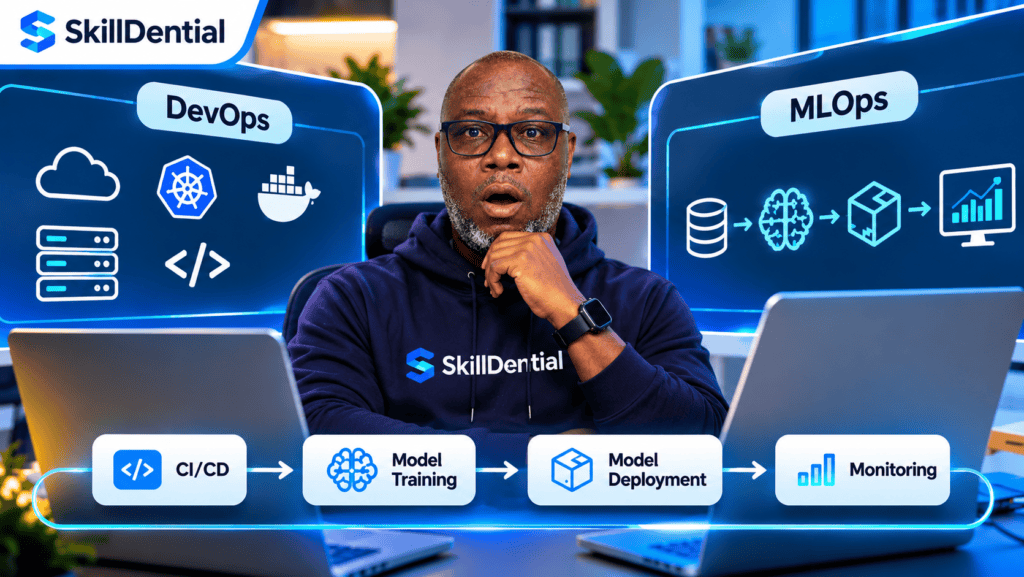
- Traditional Software: Behavior is deterministic. Code updates dictate functional changes. CI/CD pipelines build, test, and deploy code packages, while monitoring tracks latency, throughput, and error rates.
- Machine Learning Systems: Behavior is probabilistic and dependent on both code and data. Successfully navigating a transition from DevOps to MLOps means adapting your pipeline to manage non-deterministic variables where code stability does not guarantee system reliability.
The Operational Delta in Machine Learning
Beyond standard containerized deployment, production machine learning introduces distinct operational layers that require automated governance:
- Data & Feature Engineering: Managing versioned training datasets, data validation schemas, and centralized feature stores.
- Experiment Tracking: Logging hyperparameter configurations, evaluation metrics, and model artifacts.
- Model Registry & Governance: Managing model lineage, audit trails, and staging-to-production approval gates.
- Continuous Monitoring & Drift Detection: Tracking data drift, concept drift, and inference degradation post-deployment.
- Automated Retraining Pipelines: Triggering automated retraining workflows when performance metrics cross defined thresholds.
As Google Cloud defines it, MLOps unifies ML development and operations through automated integration, testing, releasing, and infrastructure management. For engineers executing a transition from DevOps to MLOps, the objective is not merely deploying a static model artifact, but building observable, resilient infrastructure around probabilistic systems that maintain performance over time.
Why DevOps Engineers Have an Advantage in MLOps
When making a transition from DevOps to MLOps, you are not starting from zero. The core operational challenges of machine learning—reliability, scalability, reproducibility, and automation—are direct extensions of traditional systems engineering. The primary difference lies in the workload: you are now operating systems driven by code, massive data dependencies, and probabilistic model outputs rather than deterministic logic alone.
Direct Skill Transfers: DevOps to MLOps
Your existing background provides immediate leverage across the entire infrastructure lifecycle. The table below outlines how core DevOps competencies map directly to MLOps requirements:
| Existing DevOps Skill | MLOps Application |
| CI/CD Pipelines | Automating model training, validation, testing, and deployment workflows. |
| Docker & Containers | Packaging model-serving applications, dependencies, and inference runtimes. |
| Kubernetes | Orchestrating heavy model-serving workloads, distributed training jobs, and ML pipelines. |
| Infrastructure as Code (IaC) | Provisioning reproducible, scalable compute environments (GPUs/TPUs) for training and inference. |
| Monitoring & Observability | Tracking service health, infrastructure utilization, model quality, and data drift. |
| Git & Version Control | Managing source code, pipeline configurations, and pipeline definitions. |
| Cloud Infrastructure | Executing distributed training jobs, managing object storage for artifacts, and serving low-latency predictions. |
| Incident Response | Investigating model-serving failures, latency spikes, and degraded prediction quality. |
| Security & Access Control | Protecting sensitive datasets, model artifacts, and inference endpoints. |
Bridging the Infrastructure-to-ML Gap
While these operational synergies accelerate the transition from DevOps to MLOps, infrastructure expertise alone is insufficient. To bridge the gap, you must also understand the data science layer:
- Model Mechanics: Knowing how models are constructed, trained, and validated.
- Evaluation Metrics: Understanding domain-specific metrics (e.g., Precision, Recall, F1-score, ROC-AUC) beyond standard HTTP 500 errors or CPU utilization.
- Statistical Behavior: Recognizing why model outputs degrade when real-world data patterns diverge from training distributions.
Mastering these data fundamentals while leveraging your core infrastructure background transforms your DevOps career into an advanced, high-demand specialization in modern AI systems engineering.
What You Need to Learn Before Moving into MLOps
Executing a successful transition from DevOps to MLOps does not require a background in academic research or a machine learning PhD. However, operating production AI systems demands functional ML literacy—enough understanding of model development, data lifecycles, and evaluation metrics to effectively automate, monitor, and troubleshoot modern AI workflows.
To bridge the gap efficiently, focus your learning path on the following core domains:
Python for Machine Learning Workflows
Python is the operational language of the AI ecosystem. During your transition from DevOps to MLOps, you do not need to become a software engineer who builds complex algorithms from scratch, but you must be fluent enough to read, modify, and troubleshoot code across the entire pipeline.
Focus on mastering these practical Python competencies:
- Core Programming Constructs: Variables, functions, object-oriented classes, modules, and efficient file handling (I/O).
- Data Serialization: Processing and transforming structured data formats like JSON, CSV, and Parquet.
- Environment & Dependency Management: Utilizing virtual environments (
venv,poetry,conda) to guarantee clean, reproducible execution contexts. - Scripting & Automation: Writing robust command-line tools and scripts equipped with rigorous exception handling and structured logging.
- Essential Data & ML Libraries: Building working familiarity with
pandasfor data manipulation andscikit-learnfor foundational data transformations and model evaluation.
Your objective is practical code literacy: maintaining training scripts, automating data ingestion tasks, and packaging model-serving endpoints rather than authoring deep learning research code.
Machine Learning Fundamentals
A successful transition from DevOps to MLOps requires more than just deploying code; it requires understanding the lifecycle of data and probabilistic models. While you do not need to design algorithms from scratch, you must grasp how models ingest data, learn patterns, and degrade over time.
Core ML Lifecycle Concepts
| Concept | Operational Definition for MLOps |
| Dataset | The historical and streaming data used to train, validate, and evaluate a model. |
| Features | The specific input variables extracted from raw data that a model uses to generate predictions. |
| Training | The computational process where algorithms learn patterns and weights from historical datasets. |
| Evaluation | Measuring model performance against rigorous statistical metrics (e.g., precision, recall, RMSE) rather than binary success. |
| Overfitting | When a model memorizes training data rather than generalizing, resulting in poor performance on unseen production data. |
| Model Artifact | The serialized output of training (weights, configuration, and metadata) packaged for deployment. |
| Inference | Using a deployed model to generate real-time or batch predictions on new inputs. |
| Data Drift | Statistical changes in production input data distribution compared to the original training data. |
| Performance Degradation | A silent decline in prediction accuracy or business value caused by underlying environmental or behavioral changes. |
The Operational Reality: Why Drift Matters
Consider a predictive model designed to flag customer churn. During training and early deployment, it performs exceptionally well because the test data mirrors current user behavior. However, market shifts or seasonal changes alter customer patterns—leading to data drift.
Unlike traditional software where code errors throw explicit exceptions or crash logs, a degraded model continues to return responses—they are simply inaccurate. An engineer executing a transition from DevOps to MLOps must build the automated monitoring, logging, and retraining pipelines necessary to catch these silent failures before they impact business outcomes.
Data Pipelines and Data Versioning
In traditional software engineering, a deployment artifact is driven almost entirely by version-controlled source code. During your transition from DevOps to MLOps, you will quickly discover that machine learning systems are fundamentally data-driven: changing the data changes the product, even when the code remains identical.
To operate production AI pipelines reliably, you must master the mechanics of data engineering and provenance:
- Automated Data Ingestion: Building reliable pipelines to pull data from disparate operational databases, object stores, and streaming sources.
- Data Validation & Quality Gates: Implementing automated checks (using frameworks like Great Expectations or TFDV) to intercept missing values, schema violations, and corrupt records before they pollute training sets.
- Feature Engineering Pipelines: Transforming raw, unstructured, or semi-structured data into normalized features ready for consumption by training routines.
- End-to-End Reproducibility: Structuring pipelines so that any historical training run can be re-executed using the exact combination of code, configuration, and data snapshot.
The Imperative of Data Versioning
Unlike static application assets, datasets evolve continuously. When a model’s performance degrades in production, root-cause analysis requires absolute traceability. Must you be able to answer definitively: Did performance shift because of a new model architecture, a bug in preprocessing, a hyperparameter tweak, or a fundamental change in the underlying training dataset?
Implementing robust data versioning tools (such as DVC or lakeFS) bridges the gap between infrastructure state management and machine learning provenance, ensuring complete accountability across the entire AI lifecycle.
Model Serving
A trained model artifact sitting in an object store is not a production service. During your transition from DevOps to MLOps, you must learn how to package machine learning models into robust, low-latency web services that can handle real-time or batch inference requests at scale.
While your background in containerization provides a massive head start, model serving introduces unique operational challenges compared to standard microservices:
- Model Loading & Initialization: Efficiently loading heavy model weights into memory during container startup without causing prolonged health-check timeouts.
- API Frameworks & Inference Runtimes: Utilizing lightweight web frameworks (like FastAPI) or dedicated inference servers (like Triton Inference Server or TorchServe) to expose model endpoints.
- Payload Validation & Schema Enforcement: Ensuring incoming request data matches the exact feature schemas and types expected by the model to prevent runtime exceptions.
- Resource Optimization: Managing CPU/GPU memory allocation, concurrency limits, and thread pools to maintain low latency under heavy load.
- Resilience & Health Endpoints: Exposing standard Kubernetes-compatible liveness, readiness, and startup probes to manage traffic routing and automated restarts.
Your existing expertise in Docker, Kubernetes, and API gateway management ensures you can successfully scale these inference pipelines, turning static model artifacts into high-availability production services.
Model Monitoring and Observability
Standard application monitoring ensures a service is running, but it cannot determine whether an AI system is actually generating accurate results. During your transition from DevOps to MLOps, you must expand your observability stack to track both infrastructure health and statistical performance.
Infrastructure vs. ML Monitoring
| Monitoring Domain | What Is Tracked | Operational Focus |
| Infrastructure Monitoring | CPU/GPU utilization, memory footprints, network latency, availability, HTTP error rates, and resource consumption. | Ensuring the serving application is stable, responsive, and properly scaled. |
| ML Monitoring | Data drift, feature distribution shifts, prediction outputs, model quality metrics, and evaluation data availability. | Ensuring the model’s underlying logic remains accurate and aligned with real-world patterns. |
The Challenge of Ground-Truth Latency
In traditional DevOps, errors trigger immediate exceptions or monitoring alerts. In machine learning, a model can maintain 100% API availability while its predictions fail silently due to shifting market dynamics or data drift.
Furthermore, true performance metrics (ground-truth labels) are often delayed. For example, a credit risk model or a fraud detection system might not know if a prediction was correct until weeks or months later. An MLOps engineer must bridge this gap by implementing proxy signals, tracking input distribution changes in real-time, and building automated alerts for statistical anomalies before business impact occurs.
Which MLOps Tools Should You Learn First?
The modern MLOps landscape is dense, featuring dozens of specialized frameworks for data lineage, feature stores, and experiment tracking. Trying to master all of them simultaneously is a recipe for cognitive overload.
To accelerate your transition from DevOps to MLOps, adopt a lean, end-to-end tech stack. Start with tools that complement your existing infrastructure background while introducing essential machine learning capabilities.
The Core MLOps Starter Stack
| Tool | Primary Function in MLOps |
| Python | Writing training scripts, data processing tasks, and workflow automations. |
| scikit-learn | Training, validating, and evaluating baseline machine learning models. |
| Docker | Packaging model-serving applications, runtimes, and system dependencies. |
| FastAPI | Exposing trained models through low-latency, production-grade REST APIs. |
| MLflow | Tracking training experiments, logging hyperparameters, and managing the model registry. |
| GitHub Actions | Automating testing, building container images, and executing deployment workflows (CI/CD). |
| Kubernetes | Orchestrating scalable model-serving workloads and distributed inference. |
| Prometheus & Grafana | Monitoring service health, infrastructure metrics, and resource consumption. |
Strategic Tool Adoption: Crawl, Walk, Run
Avoid tool fatigue by staging your adoption curve:
- Start with MLflow: For experiment tracking and model versioning, MLflow is the industry standard for early-stage MLOps. Its tracking server records parameters, metrics, code versions, and artifacts, while its Model Registry establishes clear staging-to-production lineage.
- Graduate to Kubeflow Pipelines Later: Once you have mastered basic CI/CD workflows and manual deployments, explore Kubeflow Pipelines. It enables portable, scalable ML workflows built from containerized components directly on Kubernetes, but it is unnecessary for your first end-to-end project.
Your 90-Day DevOps to MLOps Transition Roadmap
A structured 90-day execution plan provides a reliable blueprint for your transition from DevOps to MLOps. Rather than chasing endless theoretical courses, this phased timeline focuses on hands-on project delivery, ensuring you build a credible, production-grade portfolio that highlights your infrastructure background.
Days 1–30: Master Machine Learning Fundamentals
- Objective: Understand how machine learning systems work under the hood without getting bogged down in academic research.
- Core Focus: Python scripting, data processing, basic model training, and evaluation metrics.
- Key Activities:
- Write functional Python scripts for automation and data ingestion.
- Manipulate datasets using
pandasand train baseline classification or regression models withscikit-learn. - Learn the fundamental distinction between offline model training and online inference.
- Master standard evaluation metrics (e.g., precision, recall, F1-score, ROC-AUC, RMSE) instead of relying solely on binary success.
- Practice serializing, saving, and reloading model artifacts (e.g., using
jobliborpickle).
- Milestone Deliverable: A working Python script that ingests a dataset, trains a baseline model, evaluates its performance, and saves a reproducible model artifact.
Actionable Tip: Avoid tutorial hell. Spend no more than 25% of your time reading documentation; dedicate the remaining 75% to building and running code repeatedly.
Days 31–60: Build Production Infrastructure & Serving APIs
- Objective: Turn a static model artifact into a secure, containerized, and deployable service.
- Core Focus: API development, containerization, CI/CD automation, and basic experiment tracking.
- Key Activities:
- Build a low-latency model inference endpoint using FastAPI.
- Containerize the serving application using Docker, managing dependencies and environment variables securely.
- Configure automated testing scripts and build a CI workflow using GitHub Actions.
- Integrate MLflow to track training parameters, metrics, and model versions.
- Implement structured logging and exception handling for invalid payload requests.
- Deploy the containerized API to a local Kubernetes environment (e.g., Minikube or kind).
- Milestone Deliverable: A fully containerized, tested model API deployed via an automated CI/CD pipeline, accompanied by a clear explanation of how the service is built, scaled, and monitored.
Days 61–90: Build an End-to-End MLOps Portfolio Project
- Objective: Demonstrate full lifecycle management—proving you can govern data, track lineage, automate retraining, and monitor performance in production.
- Core Focus: Pipeline orchestration, data validation, automated governance, and observability.
- Key Extensions:
- Implement automated data validation checks before training execution.
- Set up automated model training triggered by data or code updates.
- Utilize an ML Model Registry to manage staging-to-production approval gates.
- Establish automated model evaluation against a baseline champion model.
- Configure infrastructure and ML monitoring (tracking resource consumption alongside data drift or prediction distributions).
- Document a clear rollback procedure for degraded model deployments.
- Milestone Deliverable: An end-to-end, production-grade MLOps project hosted in a public repository with professional technical documentation, demonstrating how a model flows seamlessly from raw data ingestion to automated production deployment.
Build a Portfolio Project That Demonstrates MLOps Skills
A theoretical understanding of MLOps is insufficient for career advancement; hiring managers and technical leads want tangible proof that you can operate probabilistic systems in production. During your transition from DevOps to MLOps, the most effective way to validate your competence is by building a production-grade portfolio project.
A classic, highly effective project blueprint is a Customer Churn Prediction System. This domain mirrors real-world enterprise challenges: it utilizes structured tabular data, requires clear business evaluation metrics, and highlights the exact operational hurdles (data drift, model versioning, and inference latency) that MLOps engineers solve daily.
Recommended Project Architecture
The architecture below illustrates a complete, end-to-end MLOps pipeline. Each component maps directly to an operational responsibility you will own in production:
Dataset
   |
   v
Data Validation
   |
   v
Feature Engineering
   |
   v
Model Training
   |
   v
Model Evaluation
   |
   v
MLflow Model Registry
   |
   v
Automated Deployment
   |
   v
FastAPI + Docker
   |
   v
Kubernetes
   |
   v
Monitoring and Alerts
Step-by-Step Implementation Guide
Execute this project sequentially over your learning cycle, ensuring each phase is fully tested before advancing:
Step 1: Prepare the Dataset
- Action: Source a clean public dataset (such as the Telco Customer Churn dataset from Kaggle or the UCI Machine Learning Repository).
- Implementation: Write a validation script using Python to inspect schema types, check for null or missing values, and handle missing feature imputation deterministically. Document your preprocessing steps clearly.
Step 2: Train the Model
- Action: Develop a reproducible Python training script utilizing
scikit-learnorLightGBM. - Implementation: Separate configuration files (e.g., YAML or JSON for hyperparameters) from your execution code. Ensure random seeds are fixed to guarantee deterministic training runs.
Step 3: Track Experiments
- Action: Integrate MLflow into your training pipeline.
- Implementation: Log all critical training parameters, evaluation metrics (ROC-AUC, Precision, Recall), code commit hashes, dataset versions, and output model artifacts to a local or remote MLflow tracking server.
Step 4: Create a Model-Serving API
- Action: Expose your trained model artifact via a production-grade web service.
- Implementation: Build an endpoint using FastAPI that loads the serialized model on startup, validates incoming JSON request payloads against an explicit schema (using Pydantic), handles invalid requests gracefully, and returns structured prediction outputs.
Step 5: Containerize the Service
- Action: Package your application into a lightweight container image.
- Implementation: Write a multi-stage
Dockerfilethat installs minimal system dependencies, copies your application code and model weights, and sets up a non-root user for security. Document local build and execution commands in your README.
Step 6: Automate the Workflow (CI/CD)
- Action: Implement continuous integration and delivery using GitHub Actions.
- Implementation: Configure automated workflows that trigger on pull requests to run unit tests, lint Python code, build the Docker container image, and push artifacts to a container registry.
Step 7: Deploy and Monitor
- Action: Deploy your containerized inference service to a local or cloud Kubernetes cluster.
- Implementation: Write Kubernetes manifests (
Deployment,Service,HorizontalPodAutoscaler) including resource requests, CPU/memory limits, and liveness/readiness probes. Configure Prometheus metrics endpoints to monitor service health and infrastructure resource consumption.
Step 8: Document Rollback Procedures
- Action: Establish a bulletproof disaster recovery protocol.
- Implementation: Document exactly how your system replaces a degraded or problematic model version in production with a previously approved champion model from the MLflow Model Registry via zero-downtime rolling updates.
What Your GitHub Repository Should Contain
A professional repository acts as your primary technical resume. Ensure your public project includes:
- Clear README: A concise executive summary of the project, architecture overview, and quick-start instructions.
- System Architecture Diagram: A visual schematic of your pipeline (matching the architecture above).
- Codebase: Clean, modular training scripts, data validation tasks, and inference code.
- Docker Configuration: Optimized, secure Dockerfiles and
.dockerignorefiles. - CI/CD Workflow Files: Valid GitHub Actions YAML configurations.
- Model Evaluation Reports: Summary metrics, confusion matrices, or baseline comparisons.
- Deployment Manifests: Kubernetes YAML templates and Helm charts (if applicable).
- Monitoring Configurations: Sample Prometheus scraping configs or Grafana dashboard JSON models.
- Reproducibility Instructions: Step-by-step commands allowing another engineer to run the stack locally without needing access to private cloud accounts.
- Rollback Documentation: A dedicated section explaining incident response and model rollback steps.
- Known Limitations & Future Improvements: Honest reflections on architectural trade-offs (e.g., handling high-throughput streaming inference or advanced data drift detection).
Security Reminder
Never publish sensitive cloud credentials, private API keys, or proprietary datasets. Keep your project clean, modular, and fully reproducible using open-source data.
How to Get an MLOps Job Without a Degree
Securing an engineering role without a formal academic background requires shifting the hiring conversation away from credentials and toward verifiable execution. When executing your transition from DevOps to MLOps, the most effective strategy is to target positions where your existing infrastructure competence solves immediate, painful business problems for hiring managers.
While some traditional enterprises still enforce rigid degree requirements—particularly for research-heavy data science teams—production and platform engineering teams care far more about whether you can keep their systems stable, scalable, and secure.
Target the Right Job Titles
Not all MLOps titles involve the same day-to-day responsibilities. Focus your job search on roles that lean heavily into infrastructure, automation, and reliability rather than algorithmic research:
- MLOps Engineer: Focuses on the end-to-end operational lifecycle, bridging data science and production systems.
- ML Platform Engineer: Builds internal developer platforms, tooling, and infrastructure to empower data science teams.
- Machine Learning Infrastructure Engineer: Specializes in provisioning, scaling, and optimizing compute environments (GPUs/TPUs) and storage clusters.
- AI Infrastructure Engineer: Focuses on foundational infrastructure supporting large-scale training and inference workloads.
- ML Deployment Engineer: Concentrates on packaging, containerizing, and releasing models into low-latency production environments.
- Cloud ML Engineer: Manages cloud-native machine learning services (e.g., AWS SageMaker, GCP Vertex AI, Azure ML) and pipelines.
- Platform Engineer, Machine Learning: Combines core platform engineering with specialized knowledge of ML workloads and experiment tracking systems.
Tip: Read job descriptions closely. Look for keywords like CI/CD, Kubernetes, Terraform, Docker, and monitoring rather than deep learning theory, neural network architecture design, or PhD required.
Build Evidence Instead of Credentials
When you lack a university degree, your portfolio serves as your primary proof of work. It demonstrates that you can execute complex engineering tasks from scratch.
Map your portfolio artifacts directly to employer expectations:
| Portfolio Evidence | What It Demonstrates to Hiring Managers |
| Automated ML Pipeline | Workflow orchestration and end-to-end automation discipline. |
| Model-Serving API | Application deployment, API design, and payload validation. |
| Docker & Kubernetes Configuration | Core containerization, scaling, and infrastructure orchestration skills. |
| MLflow Experiments | Experiment tracking, hyperparameter logging, and model lineage awareness. |
| Model Evaluation Checks | Understanding of model quality, performance metrics, and validation gates. |
| Monitoring Dashboards | Operational awareness across both infrastructure and data drift signals. |
| Rollback Documentation | Production reliability, disaster recovery, and incident preparedness. |
| Reproducible Repository | Professional engineering discipline, clean code structure, and clear documentation. |
Reposition Your DevOps Experience
A common pitfall during a career pivot is framing your background as if you are abandoning your past expertise. Instead of positioning yourself as a beginner data scientist, frame your journey as a natural extension of systems engineering into modern AI workloads.
Your resume and LinkedIn summary should emphasize your production foundation while highlighting your new machine learning competencies. For example:
“DevOps and platform engineer with extensive experience in CI/CD, cloud infrastructure, containerization, and Kubernetes. Expanding systems engineering expertise into the MLOps lifecycle—focusing on automated model training, experiment tracking, model deployment, and production monitoring.”
This positioning reassures hiring managers that you already understand enterprise reliability, security, and uptime, while clearly signaling your active upskilling in AI systems.
Consider Internal Mobility as a Catalyst
One of the lowest-friction paths into MLOps is changing teams within your current organization. If your company employs data scientists or machine learning engineers, they are almost certainly struggling with deployment, scaling, or infrastructure bottlenecks.
You can initiate an internal transition by volunteering to solve operational friction:
- Containerize an unmanaged model-serving script.
- Build a basic CI/CD pipeline for model deployments.
- Provision reproducible, containerized ML development environments.
- Improve monitoring and logging for existing model endpoints.
- Automate model artifact packaging and storage.
Solving these operational bottlenecks internally allows you to build real-world ML domain experience on company time, transforming you into a proven internal candidate before you ever apply for an external MLOps role.
Common Mistakes to Avoid During the Transition
Executing a successful transition from DevOps to MLOps requires avoiding common pitfalls that derail self-directed upskilling. By focusing on practical execution and avoiding common traps, you can accelerate your path to a production-ready portfolio.
Trying to Learn Every ML Tool
- The Pitfall: The MLOps ecosystem is crowded with overlapping frameworks for feature stores, experiment tracking, pipeline orchestration, and model serving. Attempting to master multiple tools simultaneously leads to cognitive overload and tutorial paralysis.
- The Fix: Select one lean, practical stack (e.g., Python,
scikit-learn, MLflow, FastAPI, Docker, and Kubernetes) and build a complete end-to-end project before expanding your toolset.
Ignoring Machine Learning Fundamentals
- The Pitfall: Assuming that because you understand infrastructure, you can completely ignore how machine learning models work under the hood.
- The Fix: While you do not need a background in advanced academic research, you must understand core ML concepts (data drift, evaluation metrics, overfitting) to recognize why a model can pass an infrastructure health check while producing failing, inaccurate predictions.
Building a Project That Only Deploys an API
- The Pitfall: Packaging a pre-trained model into a Docker container and deploying it to Kubernetes, then stopping there. While valuable, this only demonstrates traditional software deployment, missing the core challenges of machine learning operations.
- The Fix: Ensure your portfolio project covers the full ML lifecycle—including automated training triggers, experiment tracking, data versioning, performance evaluation against baselines, and production monitoring.
Collecting Certifications Without Building Projects
- The Pitfall: Relying exclusively on cloud provider certifications or online course badges to prove competence to hiring managers.
- The Fix: Use certifications strictly to structure your foundational learning. Prioritize building tangible, well-documented projects with reproducible repositories over passive credential gathering.
Overengineering Your First Project
- The Pitfall: Attempting to build an enterprise-grade, multi-cloud architecture with distributed GPU clusters and complex multi-region streaming pipelines on your first attempt.
- The Fix: Start small. A compact, reproducible system running locally that incorporates meaningful automation, data validation, and monitoring is a far more effective starting point.
Assuming Every MLOps Role Has the Same Requirements
- The Pitfall: Applying to every MLOps opening with a generic resume, assuming all teams look for identical technical stacks.
- The Fix: Read job descriptions carefully. Tailor your focus depending on whether the role leans heavily toward platform infrastructure and CI/CD, or whether it requires deeper expertise in distributed training, feature stores, and data engineering.
Can I become an MLOps engineer without a degree?
Yes. Many MLOps and platform engineering roles evaluate candidates based on practical execution, system design capability, and demonstrated project portfolios rather than strict academic credentials.
However, requirements vary across organizations. If you do not hold a formal degree, your best strategy is to lean heavily into your engineering background while building a robust, reproducible portfolio that proves you can operate machine learning systems in production.
Do I need to learn data science before moving into MLOps?
No. You do not need to become a data scientist or build complex deep learning models from scratch.
Your objective is to achieve functional ML literacy—understanding how datasets are structured, how models are trained and evaluated, and why statistical behavior changes over time. Your primary focus remains on automation, scaling, reliability, and production operations.
Is MLOps harder than traditional DevOps?
MLOps introduces unique non-deterministic complexities that traditional DevOps does not face, such as data drift, silent model degradation, experiment tracking, and complex data dependencies.
However, for an experienced systems or DevOps engineer, the learning curve is entirely manageable. Because MLOps builds directly on top of familiar foundations like CI/CD, containers, and infrastructure as code, you are extending your existing skill set rather than starting over.
How long does it take to execute a transition from DevOps to MLOps?
With a consistent, project-focused study plan, an experienced engineer can build a credible foundational portfolio and master the necessary workflow tools in 60 to 90 days.
Keep in mind that a structured timeline serves as a practical target for skill acquisition and project delivery, rather than an absolute guarantee of immediate employment.
Which MLOps tool should I learn first?
Start with a lean, foundational stack that bridges software engineering and machine learning:
Python and scikit-learn for scripting and baseline model training.
Docker and FastAPI for packaging and exposing model inference endpoints.
MLflow for experiment tracking and model versioning.
Once you have successfully built and deployed a basic end-to-end service with these tools, you can expand into advanced orchestration platforms like Kubeflow Pipelines or enterprise feature stores.
Can I complete this transition while working a full-time job?
Yes. A project-based learning roadmap is well-suited for part-time execution. By dedicating consistent weekly hours to incremental milestones—such as spending a few weeks on Python fundamentals, followed by containerization and CI/CD automation—you can build a complete, production-grade portfolio project without abandoning your current role.
In Conclusion
Executing a transition from DevOps to MLOps without a formal degree is an entirely achievable career evolution for engineers ready to combine systems mastery with machine learning literacy.
Your existing background in automation, cloud infrastructure, CI/CD, containerization, Kubernetes, and observability provides an immediate, formidable advantage. By systematically closing the operational gaps—mastering data pipelines, experiment tracking, model versioning, inference serving, and drift monitoring—you position yourself at the forefront of modern AI infrastructure engineering.
Remember that success relies on practical execution rather than passive credential collection. Follow a structured, incremental approach, avoid tool fatigue, and anchor your learning in a reproducible portfolio project.
Your Next Step:
Initialize a new GitHub repository for a baseline machine learning project and begin turning it into a containerized, automated service. That single action marks the official start of your career as an MLOps-capable engineer.