How Samsung Health AI Improves Smartwatch Health Insights
Samsung Health AI bridges the gap between raw data collection and actionable wellness management. By leveraging machine learning models directly within Galaxy Watches and connected devices, Samsung Health AI interprets continuous biometric signals—moving beyond isolated metrics like heart rate or sleep duration to analyze multi-variable trends in real time.
Raw Biometric Stream ➔ Samsung Health AI Engine ➔ Contextual Energy Score & Guidance
(HRV, Temp, SpO2)      (Pattern Recognition)       (Proactive Daily Insights)
Through this architecture, Samsung Health AI transitions wearable technology from passive tracking to proactive insight generation:
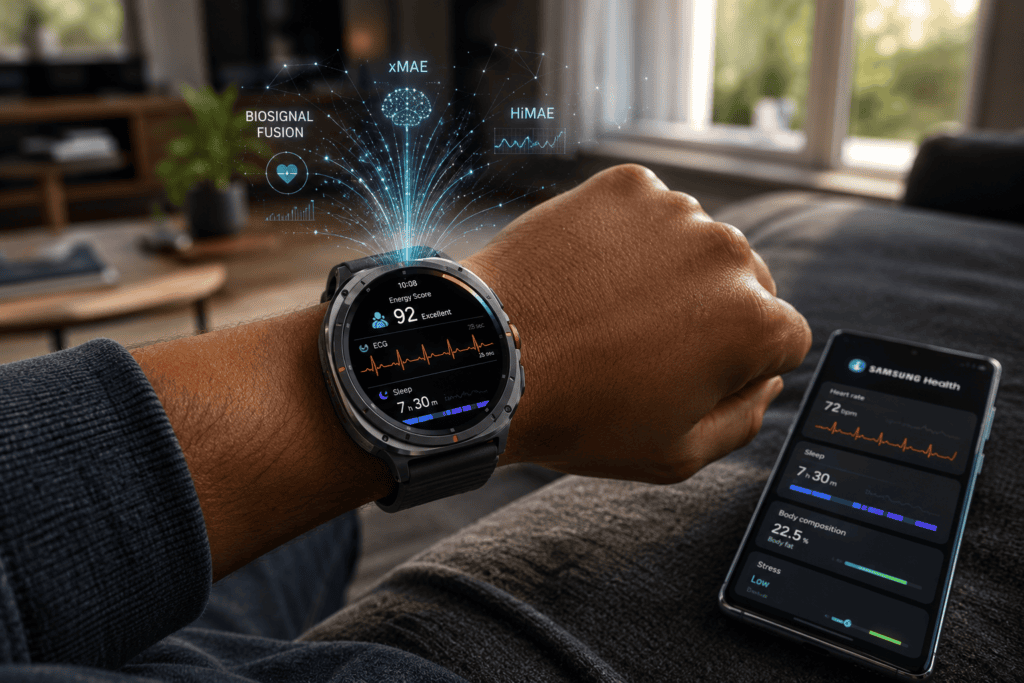
- Baselines & Signal Correlation: The platform cross-references skin temperature, respiratory rate, blood oxygen, and heart rate variability (HRV) against historical baselines via features like Energy Score.
- Proactive Risk Identification: Instead of triggering false alerts over isolated spikes, Samsung Health AI filters biometric noise to highlight systemic shifts in recovery and stress.
- Wellness Focus vs. Clinical Limits: Engineered specifically for preventative wellness, Samsung Health AI delivers high-signal behavioral guidance rather than medical diagnoses—ensuring users receive practical, actionable data within safe regulatory parameters.
How does a smartwatch collect health data?
Smartwatches collect biological signals (biosignals)—measurable electrical, optical, or mechanical outputs produced by the body. On Galaxy Watches, hardware sensors capture raw physiological fluctuations continuously and pass them to Samsung Health AI algorithms for signal processing and context mapping.
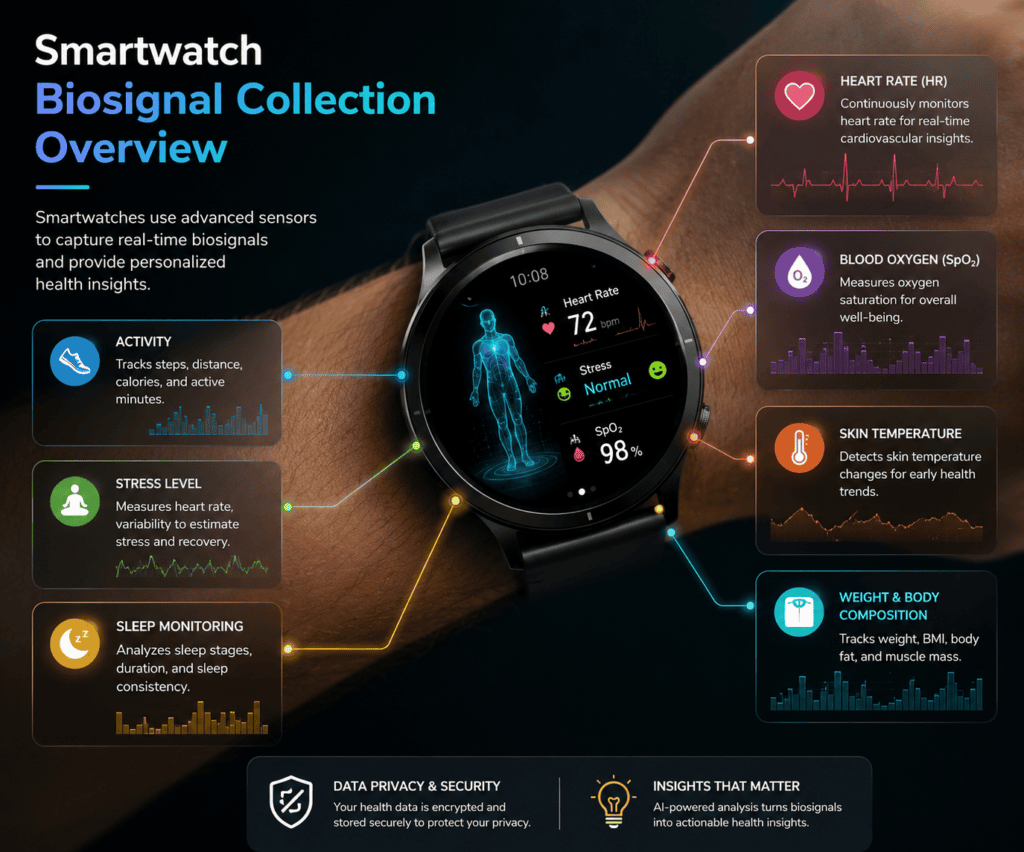
| Biosignal / Sensor Input | Physical Representation | How Samsung Health AI Utilizes the Data |
| Photoplethysmography (PPG) | Volumetric changes in blood flow measured via optical light reflection. | Serves as the primary stream for continuous heart rate tracking, pulse wave analysis, and vascular resistance. |
| Heart Rate (BPM) | Total cardiac cycles (beats) completed per minute. | Establishes intensity zones during active workouts and tracks resting baseline recovery. |
| Heart-Rate Variability (HRV) | Millisecond variations in time between consecutive heartbeats. | Feeds Samsung Health AI stress algorithms and daily recovery metrics (e.g., Energy Score). |
| Electrocardiogram (ECG) | Micro-voltage electrical activity generated by heart muscle depolarization. | Analyzes cardiac waveforms during spot-checks to flag potential Sinus Rhythm anomalies or Atrial Fibrillation. |
| Blood Oxygen ($SpO_2$) | Peripheral capillary oxygen saturation based on red vs. infrared light absorption. | Detects nocturnal hypoxia events to evaluate overall sleep quality and respiratory stability. |
| Respiratory Rate | Calculated breath cycles per minute derived from PPG wave fluctuations. | Cross-references overnight breathing patterns against movement data to identify sleep disturbances. |
| Skin Temperature | Surface temperature changes captured via infrared thermal sensors. | Adds thermal context to baseline shifts, tracking circadian rhythms and menstrual cycle phases. |
| Motion Data (Accelerometer/Gyro) | Multi-axis movement vectors, cadence, and force velocity. | Differentiates active exercise from sleep stages, filtering out motion artifacts during stationary readings. |
The Role of Samsung Health AI in Data Cleaning
Raw sensor inputs are inherently noisy. Motion artifacts, loose wrist contact, skin tone variations, ambient temperature drops, and vascular shifts regularly degrade the signal.
Samsung Health AI applies real-time noise-filtering algorithms to separate physiological data from ambient interference. While machine learning cannot fix hardware placement errors or missing optical readings, it cleans corrupted data streams—ensuring downstream features evaluate true systemic trends rather than physical sensor noise.
What are Samsung’s health foundation models?
Samsung’s health foundation models represent a shift from single-purpose, rule-based algorithms to generalized artificial intelligence capable of decoding complex, multi-variable biosignals directly on wearable hardware.
Instead of relying on supervised models built to perform only one task (such as flagging a high resting heart rate), Samsung Research utilizes Self-Supervised Learning (SSL).
During pre-training, these models learn the underlying structure of human physiology by reconstructing masked or missing segments of raw biosignal data (such as optical PPG or electrical ECG waves) across thousands of hours of recordings.
Once pre-trained, the base model can be adapted to execute diverse tasks—ranging from sleep stage classification to early detection of cardiovascular anomalies.
Key Samsung Research Foundation Models
Samsung introduced two primary health foundation architectures designed to power the next generation of Samsung Health AI insights:
| Model | Full Name & Conference Acceptance | Primary Physiological Function | Architectural Innovation |
| xMAE | Physiology-Aware Masked Cross-Modal Reconstruction (ICML) | Cross-Modal Signal Inference Maps relationships between continuous optical readings (PPG) and spot electrical readings (ECG). | Reconstructs masked ECG signals using background PPG data. Allows Samsung Health AI to derive deep cardiovascular biomarkers from continuous optical sensors without requiring the user to hold the watch bezel for a manual 30-second ECG. |
| HiMAE | Hierarchical Masked Autoencoder (ICLR) | Multi-Time-Scale Processing Analyzes instant biological events alongside macro-level multi-day trends. | Uses a hierarchical multi-encoder structure to evaluate millisecond cardiac intervals, hourly sleep cycles, and weekly baseline shifts simultaneously. |
Core Advantages for Wearable Technology
- Continuous On-Device Inference: HiMAE is engineered to run locally on smartwatch-class chips in under 1 millisecond. This eliminates reliance on cloud servers, delivering zero-latency health insights while protecting sensitive biometric data.
- Passive Clinical-Grade Tracking: By teaching Samsung Health AI how continuous optical PPG data correlates with electrical ECG waveforms via xMAE, Galaxy Watches can continuously evaluate cardiac health in the background without user intervention.
- High Generalization with Limited Labels: Because both models learn general physiological representations from unlabelled data, Samsung Health AI can deploy new preventative features without needing massive, manually annotated clinical datasets for every single metric.
What does xMAE do?
xMAE (Physiology-Aware Masked Cross-Modal Reconstruction) is Samsung’s specialized AI architecture designed to model the physiological delays and structural links between distinct body signals.
Rather than treating biometric inputs like Photoplethysmography (PPG) and Electrocardiogram (ECG) as separate data streams, Samsung Health AI uses xMAE to understand how these signals interact in real time.
The Core Mechanism: Bridging Electrical and Optical Signals
Every heart contraction generates two sequential events captured by smartwatches:
- Electrical Activation (ECG): The instant depolarization of heart muscle tissue.
- Mechanical Blood Wave (PPG): The physical pulse wave traveling through blood vessels, measured optically at the wrist.
[Heart Beats] ➔ Electrical Signal (ECG) ──(Pulse Wave Transit Time)──➔ Optical Signal (PPG)
Code language: CSS (css)
Because blood takes time to travel from the heart to the wrist, there is a distinct time delay between the ECG electrical spike and the PPG optical wave (analogous to the delay between seeing lightning and hearing thunder).
How xMAE Operates
- Cross-Modal Masking: During training, researchers intentionally hide (mask) significant portions of an ECG signal.
- Reconstruction via PPG: xMAE is forced to reconstruct the missing ECG waveforms by analyzing the unmasked, continuous PPG optical stream.
- Cross-Signal Mapping: By learning to predict hidden electrical states using only optical movement data, Samsung Health AI internalizes the underlying cardiovascular mechanics linking the two signals.
Key Advantages for Galaxy Watches
- Continuous Passive ECG Profiling: Traditional ECG readings require the user to stay still and touch the watch bezel for 30 seconds. By teaching Samsung Health AI the precise mathematical relationship between ECG and PPG via xMAE, the system can infer advanced cardiovascular metrics passively in the background using the optical sensor alone.
- Improved Arterial Stiffness Tracking: The precise timing offsets learned by xMAE allow Samsung Health AI to measure changes in Pulse Wave Transit Time (PWTT), an indicator used to assess vascular resistance and baseline blood pressure changes.
- Enhanced Signal Recovery: When motion or poor wrist contact distorts one sensor (e.g., noisy PPG during exercise), xMAE leverages historical cross-modal patterns to reconstruct the corrupted data stream accurately.
Why xMAE matters
xMAE is a technical milestone for Samsung Health AI because it solves a core engineering constraint of wearable hardware: continuous, passive collection of clinical-grade cardiac data without requiring active user intervention.
By training on ~9,400 hours of paired ECG and PPG recordings, xMAE maps the directional, temporal relationships between electrical cardiac activity and peripheral blood volume changes.
Core Technical Benchmarks & Research Findings
According to Samsung’s published evaluations (accepted at ICML 2026), pretraining with xMAE provides several key competitive advantages:
- Outperformed Established Baselines: xMAE surpassed unimodal biosignal models and conventional multimodal learning methods across 15 of 19 evaluation tasks. These downstream tasks included:
- Cardiovascular disease prediction.
- Abnormal laboratory test result detection.
- Sleep-stage classification.
- Demographic inference.
- Cross-Hardware & Multi-Location Generalization: The representations learned by xMAE generalized effectively across different sensor devices, body locations, and data-gathering environments. This is critical for scaling Samsung Health AI across varied hardware forms (smartwatches, smart rings, patches) without needing dedicated, device-specific recalibration.
Key Takeaways for Smartwatch Health Insights
| Technical Shift | Traditional Smartwatch Approach | Samsung Health AI with xMAE Integration |
| Data Collection | Active & episodic (user must hold the bezel still for 30s to get ECG). | Passive & continuous (infers rich cardiac features directly from PPG optical streams). |
| Signal Processing | Evaluates PPG and ECG as separate, isolated data streams. | Maps cross-modal temporal dependencies directly into the model’s latent representation. |
| Model Scope | Narrow, single-task algorithms requiring heavy dataset annotation. | Generalized foundation model capable of powering multiple downstream wellness predictions. |
(Note: While xMAE represents a major advance in research, Samsung clarifies these models serve as foundational frameworks for advancing preventative wellness tools rather than guaranteed, instant medical-grade diagnostics on consumer Galaxy Watches).
What does HiMAE do?
HiMAE (Hierarchical Masked Autoencoder) addresses a fundamental challenge in biosignal processing: physiological data carries different meaning depending on the length of time being observed.
Standard AI architectures typically compress or “flatten” time series data into a single fixed window. Samsung Health AI uses HiMAE’s hierarchical 1D convolutional network to extract multi-resolution embeddings across stacked encoder layers—analyzing micro-level fluctuations and macro-level trends simultaneously.
The Multi-Time-Scale Architecture
| Time Scale | Biological Focus | Physiological Features Analyzed by HiMAE |
| Short-Term (Seconds) | Beat-to-Beat Morphology | Peak intervals, pulse wave velocity, arrhythmia detection, and real-time stress spikes. |
| Medium-Term (Hours) | Circadian Cycles | Sleep stage transitions (REM, deep, light), overnight respiratory stability, and temperature dips. |
| Long-Term (Days to Weeks) | Systemic Baselines | Cumulative workout recovery, baseline shifts in resting heart rate, and hormonal cycle tracking. |
Key Technical Breakthroughs & On-Device Performance
- Hierarchical Masked Autoencoding: Pre-trained on 80,000+ hours of PPG data collected from tens of thousands of participants, HiMAE masks random segments of temporal data and forces the model to reconstruct them across multiple layer resolutions simultaneously.
- Sub-Millisecond On-Device Inference: Unlike massive cloud-dependent transformer models, HiMAE is lightweight (~1.2M parameters). It achieves sub-millisecond inference speeds on smartwatch-class CPUs—enabling Samsung Health AI to compute real-time edge predictions directly on the Galaxy Watch without battery drain or cloud dependency.
- Outperformed Fixed-Scale Foundation Models: Across 14 classification, regression, and generative health benchmarks, HiMAE outperformed significantly larger baseline models that collapse temporal scales.
xMAE vs. HiMAE: Architectural Comparison
While traditional wearable algorithms analyze sensor data in silos, Samsung Health AI combines cross-modal signal reconstruction (xMAE) with multi-temporal scaling (HiMAE). Together, they form a foundation model framework capable of transforming raw smartwatch signals into continuous, contextual health guidance.
| Feature / Model | xMAE (Cross-Modal Reconstruction) | HiMAE (Hierarchical Autoencoder) |
| Main Focus | Relationships Between Biosignals | Patterns Across Time Scales |
| Core Mechanism | Maps the physiological time delay between electrical cardiac signals (ECG) and optical blood flow signals (PPG). | Analyzes biosignal windows across micro (seconds), medium (hours), and macro (weeks) resolutions simultaneously. |
| Plain-Language Function | Teaches Samsung Health AI what a heart’s electrical state looks like using only passive optical light sensors. | Helps Samsung Health AI differentiate between an instantaneous heart-rate spike, an overnight sleep stage, and weekly recovery trends. |
| Primary Technical Benefit | Enables passive, clinical-grade cardiovascular feature extraction from continuous PPG—without requiring manual 30-second ECG readings. | Delivers sub-millisecond edge inference directly on smartwatch CPUs, enabling real-time local processing without cloud latency or battery strain. |
The Synergistic Impact on Samsung Health AI
Rather than building isolated, single-use algorithms for every wellness metric, Samsung Health AI utilizes xMAE and HiMAE as unified foundation models.
- xMAE provides cross-signal intelligence: It allows the watch to infer missing or hard-to-measure biological metrics continuously in the background.
- HiMAE provides temporal depth: It ensures short-term physiological stress isn’t misread as long-term fatigue, organizing health metrics into accurate context.
By combining cross-modal translation with hierarchical temporal analysis, Samsung Health AI shifts smartwatch metrics from reactive data tracking to proactive, personalized health insights.
The Real-World Application: Contextual Intelligence Over Disconnected Metrics
The practical value of Samsung Health AI lies in its ability to synthesize multiple biological signals into cohesive, high-signal health stories—eliminating the need for users to manually cross-reference isolated charts and raw sensor outputs.
Raw Telemetry                Samsung Health AI Fusion                Contextual Narrative
[HR + HRV + SpO2 + Temp] ➔ [HiMAE / xMAE Pattern Matching] ➔ "Elevated recovery strain detected.
                                                               Prioritize light activity today."
Code language: CSS (css)
Core Applications of Samsung Health AI Across Daily Wellness
Samsung Health AI brings artificial intelligence into everyday wellness by turning data from wearables and connected health services into more meaningful insights. From activity and sleep patterns to cardiovascular indicators and personalized guidance, these applications aim to help users better understand their daily health and wellness trends.
Dynamic Baseline Tracking (The Vitals Framework)
Rather than comparing user metrics against population averages, Samsung Health AI establishes dynamic, hyper-personalized baselines.
- Multi-Signal Context: An elevated resting heart rate on its own may simply reflect stress or mild dehydration. When Samsung Health AI cross-references this with reduced sleep duration, elevated respiratory rates, and a spike in overnight skin temperature, the system identifies systemic physiological strain.
- Alert Noise Mitigation: Features like Vitals evaluate these five overnight signals simultaneously, suppressing false-positive notifications and alerting the user only when a true baseline shift occurs.
Deep Sleep Phase Reconstruction
Sleep tracking relies on multi-temporal signal evaluation rather than single-window snapshots:
- Pattern Analysis Across Hours: Through models like HiMAE, Samsung Health AI analyzes high-frequency beat-to-beat variability alongside macro-level multi-hour circadian rhythms.
- Accurate Phase Mapping: Integrating wrist movement, heart rate trends, $SpO_2$ fluctuations, and temperature profiles allows the platform to delineate REM, deep, and light sleep stages far more accurately than basic movement-based accelerometry.
Intelligent Training Load Management
- Daily Cardio Load: Samsung Health AI continuously calculates accumulated cardiovascular strain by measuring heart rate responses across workouts and daily routines against an individual’s maximum aerobic capacity.
- Actionable Training Targets: Instead of prompting static step goals, the system suggests specific cardiovascular targets and optimal rest windows—reducing overtraining risks without guessing.
Shift from Raw Dashboards to Conversational Guidance
The primary usability shift driven by Samsung Health AI is the translation of complex telemetry into structured, plain-language summaries:
| Raw Sensor Outputs (Traditional View) | Samsung Health AI Synthesized Output |
| • Resting HR: +6 BPM vs. avg • Sleep Duration: 5h 40m • $SpO_2$ Dip: 92% • Daily Cardio Load: High | “Your sleep was 75 minutes shorter than your 7-day baseline, and your resting heart rate remained elevated overnight. Given your high Daily Cardio Load from yesterday, your recovery capacity is limited. Consider replacing high-intensity interval training with a light recovery walk today. |
Operational Standard
While Samsung Health AI synthesizes complex bio-data into actionable wellness recommendations, these outputs serve as preventative lifestyle guidance rather than clinical diagnoses or substitutes for medical evaluation.
Samsung Health AI: Research vs. Consumer Features
When evaluating Samsung Health AI, it is critical to distinguish between published academic research and consumer-facing features currently active on Galaxy Watch hardware.
┌─────────────────────────────────────────────────────────────┐
│                    Samsung Health AI                        │
├──────────────────────────────┬──────────────────────────────┤
│  Research AI Foundations     │   Consumer Features (App)    │
│  • xMAE (Cross-Modal)        │   • Energy Score             │
│  • HiMAE (Hierarchical 1D)   │   • Vitals Baseline Matrix   │
│  • SSL Biosignal Models      │   • Daily Cardio Load        │
└──────────────────────────────┴──────────────────────────────┘
Comparison: Lab Research vs. Market Deployment
| Capability Area | Public Research Status | Active Consumer Feature Status |
| Core Health Tracking | Models evaluating raw optical/electrical telemetry. | Tracks sleep, continuous heart rate, workouts, and $SpO_2$. |
| Energy Score | Validated alongside academic exercise physiology studies. | Available on supported devices. Evaluates sleep, snoring, skin temperature, and heart rate. |
| Vitals Baseline | Multi-variable anomaly detection models. | Active in the Samsung Health app. Compares overnight signals against resting baselines. |
| xMAE Engine | Pre-trained research foundation model. | Under research; not established as a standard consumer feature across all watches. |
| HiMAE Engine | Lightweight model demonstrating sub-millisecond local inference. | Research architecture demonstrating on-device processing possibilities. |
| Medical Diagnosis | Clinical biomarker classification studies. | Excluded. Features provide preventative wellness guidance only. |
Hardware, Ecosystem, and Regional Dependencies
Consumer availability of Samsung Health AI features is governed by strict deployment criteria:
- Hardware Generation: Advanced metrics (like Energy Score or Vitals) require targeted sensor configurations.
- Companion Phone & App Version: Requires a compatible Android smartphone paired with updated Samsung Health software.
- Data Calibration Period: Features require up to 7 days of continuous background data collection to establish a reliable baseline.
- Regulatory Approval: Features involving cardiac rhythm monitoring or sleep apnea detection vary by country based on regional health authority clearances.
Why On-Device AI Matters in Modern Wearables
On-device AI processes sensor data directly on smartwatch hardware rather than streaming raw telemetry to remote cloud servers. For Samsung Health AI, executing model inference locally on Galaxy Watch silicon shifts digital health from delayed, batch-processed summaries to immediate, edge-computed feedback.
                  ┌──────────────────────────────────────────────────────────┐
                  │                      GALAXY WATCH                        │
                  │                                                          │
Raw Biosignal ───►│ [Sensors] ──► [HiMAE Engine] ──► Immediate Edge Guidance │
(PPG / ECG / Temp)│                                  (Sub-Millisecond)       │
                  └──────────────────────────────────────────────────────────┘
                                       │ (Filtered Summary)
                                       ▼
                         ┌──────────────────────────┐
                         │   Samsung Cloud / Phone  │
                         └──────────────────────────┘
Core Advantages of On-Device Processing
| Operational Pillar | Cloud-Based Inference | On-Device Samsung Health AI |
| Inference Latency | High (dependent on network request/response cycles). | Zero/Sub-Millisecond (instantaneous edge feedback). |
| Connectivity Dependence | Requires active cellular or Wi-Fi connectivity. | Fully functional offline during outdoor runs, flights, or remote travel. |
| Data Privacy & Security | Streams raw biometric telemetry over external networks. | Retains sensitive biosignals locally, transmitting only aggregated summaries. |
| Infrastructure Scalability | High recurring cloud server compute costs per active user. | Offloads compute load directly to consumer wrist hardware. |
Engineering Trade-Offs & Edge Constraints
While running AI models directly on wrist hardware offers clear speed and privacy benefits, it introduces strict hardware constraints:
- Resource Limitations: Smartwatch CPUs possess restricted thermal dissipation boundaries, limited SRAM, and finite battery capacity compared to cloud server clusters.
- Accuracy vs. Model Size: Ultra-large foundation models must be compressed via techniques like quantization and pruning so they can fit on small processors without sacrificing biological precision.
- System Thermal & Battery Balancing: Continuous neural network execution risks draining battery life or overheating wrist-facing sensors.
The Role of Models Like HiMAE
Samsung Research designed architectures like HiMAE specifically to address these constraints. Achieving sub-millisecond inference speeds on smartwatch-class CPUs demonstrates that generalized, multi-time-scale models can run efficiently on low-power silicon.
This enables Samsung Health AI to handle immediate noise filtering, beat-to-beat detection, and stress tracking locally—reserving cloud servers primarily for long-term historical backups and complex multi-year data synchronization.
Safeguards, Limitations, and Regulatory Standards
While Samsung Health AI accelerates the processing of raw wearable telemetry into actionable context, users and deployment strategies must account for hardware, physiological, and regulatory boundaries.
┌─────────────────────────────────────────────────────────────┐
│                   Samsung Health AI Framework               │
├──────────────────────────────┬──────────────────────────────┤
│  Algorithmic Strengths       │  Operational Boundaries      │
│  • Multi-signal correlation  │  • Preventative, non-clinical│
│  • Personalized baselines    │  • Sensor motion artifacts   │
│  • On-device data privacy    │  • Calibration latency       │
└──────────────────────────────┴──────────────────────────────┘
Core Limitations and Risk Factors
Despite its potential, Samsung Health AI also has important limitations and risks. Factors such as sensor accuracy, individual health differences, data privacy, algorithmic limitations, and the distinction between wellness insights and medical diagnosis can all affect how users should interpret AI-generated health information.
Statistical Estimates vs. Clinical Diagnostics
- Sensor Precision Limits: Smartwatch optical sensors (PPG) measure peripheral capillaries at the wrist—a location susceptible to vasoconstriction, ambient temperature changes, and motion interference.
- Non-Diagnostic Scope: Samsung Health AI models provide high-signal wellness estimations rather than medical-grade clinical diagnoses. Reassuring trends in features like Energy Score or Vitals should never be used to dismiss acute symptoms such as chest pain, syncope, or shortness of breath.
False Positives & Sensor Artifacts
An anomalous reading calculated by Samsung Health AI can stem from non-pathological variables:
- Inadequate strap tension or sensor displacement during high-impact movement.
- Rapid changes in skin hydration or ambient temperature.
- Acute, non-illness stressors (e.g., late-night meals or transient anxiety spikes).
Baseline Calibration Requirements
Systemic algorithms like Samsung Health AI depend heavily on historical continuity. Discontinuous wear, switching across hardware generations without baseline synchronization, or inconsistent overnight wear degrades the model’s capacity to calculate true deviation thresholds.
Privacy, Ecosystem Security, and Governance
Because continuous biometric tracking collects sensitive physiological markers, Samsung Health AI relies on hardware-backed privacy architectures:
| Security Vector | Implementation Architecture | User Impact |
| On-Device Isolation | Knox Vault & KEEP (Knox Enhanced Encrypted Protection) | Isolates biometric data and AI feature weights in hardware-protected execution environments. |
| Data Synchronization | End-to-End Encryption (E2EE) via Samsung Cloud | Ensures raw health telemetry synced across devices remains accessible only to the account owner. |
| App-Level Access | Granular Samsung Health Permission Controls | Allows users to dictate which third-party applications can read or write specific biometric parameters. |
Market Deployment Notice
Features powered by Samsung Health AI are subject to regional regulatory clearance (e.g., FDA 510(k) or CE Mark approvals for specific wellness algorithms), device compatibility constraints, and software updates. Capabilities documented in research publications reflect foundational engineering pathways rather than guaranteed feature availability across all global Galaxy Watch models.
Addressing Misconceptions Surrounding Samsung Health AI
As artificial intelligence becomes deeply embedded in personal health tracking, users often project clinical capabilities or total privacy onto algorithmic systems. Clarifying these common misunderstandings ensures expectations align with the technical realities of Samsung Health AI.
| Misconception | Reality & Technical Clarification |
| “Samsung Health AI understands my body perfectly.” | Samsung Health AI identifies mathematical patterns in sensor streams. It does not “understand” physiology in a human sense, and its outputs can be skewed by sensor displacement, skin temperature drops, dehydration, or unexpected movement artifacts. |
| “xMAE turns passive PPG into a medical-grade ECG.” | False. xMAE learns the physiological time delays and statistical relationships between PPG and ECG during training. While it enables Samsung Health AI to infer advanced cardiac features from continuous light-based PPG sensors, it does not transform optical PPG into a true multi-lead clinical ECG recording. |
| “On-device processing means my data never leaves the watch.” | Not necessarily. While edge models like HiMAE execute inference directly on smartwatch CPUs, full features still sync aggregated metrics to companion phones, back up to Samsung Cloud, or interface with permission-based third-party apps. On-device processing minimizes raw data transmission, but system-wide data isolation depends on hardware-level frameworks like Knox Vault and KEEP (Knox Enhanced Encrypted Protection). |
| “A higher Energy Score always equals better health.” | Composite scores are simplified, heuristic models designed to summarize specific inputs (sleep, resting heart rate, HRV, and movement). A high score reflects favorable trends across those parameters, not immunity from illness or physical strain. Long-term trends offer far higher signal than reacting to an individual daily score. |
Key Summary: The Role of AI in Consumer Health Tracking
┌─────────────────────────────────────────────────────────────┐
│                 Samsung Health AI Paradigm                  │
├──────────────────────────────┬──────────────────────────────┤
│  What It Is                  │  What It Is Not              │
│  • High-signal pattern tool  │  • Clinical diagnostic system│
│  • Personalized baseline AI  │  • Medical ECG substitute    │
│  • Preventative guide        │  • Flawless health oracle    │
└──────────────────────────────┴──────────────────────────────┘- Pattern Recognition Over Diagnosis: Samsung Health AI aggregates noisy, multi-modal sensor streams into contextual narratives, shifting smartwatches from passive metrics displays to proactive lifestyle tools.
- Algorithmic Edge: Foundation models like xMAE and HiMAE allow smartwatches to evaluate cross-signal relationships and multi-time-scale trends efficiently at the hardware edge.
- Contextual Evaluation: Users achieve the highest value from Samsung Health AI by monitoring weekly baseline deviations rather than treating individual scores or real-time metrics as absolute clinical statements.
The video above provides context on how Samsung integrates on-device AI algorithms with security layers like Knox to protect personal health and biometric data locally.
What This Means for the Future of Smartwatch Intelligence
The research behind Samsung Health AI architectures like xMAE and HiMAE signifies a structural shift in wearable computing: moving from isolated data logging to deep, physiological relational awareness.
Instead of asking, “What is my heart rate right now?” smartwatches powered by Samsung Health AI are built to solve a far more complex query: “How do my continuous optical signals, electrical cardiac waveforms, multi-day circadian rhythms, and accumulated training loads interact over time?”
Traditional Approach                Samsung Health AI Future
┌───────────────────────┐          ┌───────────────────────────────────┐
│ Isolated Sensors      │          │ Relational Foundation Engine      │
│ • HR Logger           │  ──────► │ • Cross-Modal Transfer (xMAE)     │
│ • Step Counter        │          │ • Multi-Temporal Scaling (HiMAE)  │
│ • Cloud Processing    │          │ • On-Device Local Inference       │
└───────────────────────┘          └───────────────────────────────────┘
Core Evolutionary Trajectories
Samsung Health AI is likely to evolve alongside advances in wearable sensors, on-device AI, multimodal health data, and personalized computing. These developments could gradually shift smartwatches from basic health trackers toward more intelligent systems capable of identifying patterns and delivering increasingly contextual wellness insights.
Shift to Multi-Signal Correlation
Future iterations of Samsung Health AI will move beyond treating biometric metrics as separate line items. By mapping how respiratory rate, heart-rate variability (HRV), peripheral oxygen saturation ($SpO_2$), and skin temperature influence one another, wearables can detect systemic changes (such as physiological strain or infection onset) long before a single metric trips a basic alert threshold.
2. Fully Autonomous Edge Computing
Demonstrations of sub-millisecond inference speeds on low-power smartwatch CPUs highlight a future where Samsung Health AI executes continuous modeling locally on the wrist. This drastically cuts reliance on cloud synchronization, eliminating internet latency, lowering system power consumption, and enforcing strict local privacy by default.
Proactive Noise Reduction & Alert Fatigue Mitigation
By analyzing micro-scale beat fluctuations alongside macro-scale weekly trends, foundation models like HiMAE allow Samsung Health AI to filter out transient sensor artifacts (such as motion spikes or loose wrist-strap placement). Rather than triggering false alerts, the system notifies users only when true statistical deviations occur from their baseline.
The Responsibility of Explainable Health AI
As Samsung Health AI transitions smartwatches into proactive health partners, algorithmic transparency becomes paramount:
- Communicating Uncertainty: Wearable AI models must clearly state data confidence levels, ensuring users understand that predictive trends represent wellness indicators rather than diagnostic certainty.
- Preserving Privacy: Edge execution via hardware-backed enclaves (such as Knox Vault) must remain standard practice as multi-variable health tracking captures increasingly detailed biometric profiles.
- Maintaining Clinical Boundaries: The most effective implementation of Samsung Health AI will not attempt to replace clinical evaluation. Instead, it will synthesize complex telemetry into clear, contextual narratives—empowering users to make informed daily lifestyle decisions and recognize when to consult medical professionals.
What is Samsung Health AI, and how does it work on Galaxy Watches?
Samsung Health AI is an algorithmic framework that processes biometric signals collected by Galaxy Watches and connected devices. Instead of displaying isolated metrics, it cross-references continuous optical (PPG), electrical (ECG), temperature, and motion signals to detect physiological patterns and generate personalized wellness guidance.
How do research models like xMAE and HiMAE improve smartwatch tracking?
xMAE (Cross-Modal Reconstruction): Learns the temporal relationship between continuous optical signals (PPG) and electrical cardiac signals (ECG). This allows the system to infer advanced cardiac features passively in the background without requiring manual 30-second ECG measurements.
HiMAE (Hierarchical Autoencoder): Analyzes biometric data across multiple time scales simultaneously—from second-by-second heartbeat variations to multi-hour sleep stages and multi-week baseline trends.
Does Samsung Health AI run directly on the watch or in the cloud?
Samsung Health AI uses a hybrid model. Advanced foundation architectures like HiMAE are optimized for sub-millisecond local processing on smartwatch-class CPUs, allowing real-time noise filtering and immediate metric calculation directly on the wrist. Long-term trends, data backups, and account syncing are offloaded to Samsung Cloud.
What is the difference between Samsung Health AI research and actual consumer features?
Models like xMAE and HiMAE represent Samsung’s underlying research foundation. Active consumer features in the Samsung Health app—such as Energy Score, Vitals, and Daily Cardio Load—utilize these algorithmic principles to deliver daily user-facing insights. Research models serve as long-term engineering pathways rather than instant guarantees for every Galaxy Watch.
Can Samsung Health AI be used to diagnose medical conditions?
No. Samsung Health AI features are designed strictly for preventative wellness, fitness tracking, and lifestyle management. They are not clinical diagnostic tools and should never be used to evaluate acute medical symptoms like chest pain, severe dizziness, or shortness of breath.
In Conclusion
Samsung Health AI represents a structural transition in wearable consumer health: shifting hardware capabilities from episodic, isolated data logging to continuous, contextual baseline intelligence. Powered by advanced research foundation models like xMAE (cross-modal signal reconstruction) and HiMAE (hierarchical temporal autoencoding), Samsung is bridging the gap between raw hardware telemetry and proactive, explainable daily guidance.
Key Takeaways
- Relational Intelligence: Advanced models shift tracking from “What is my heart rate right now?” to “How do my optical PPG, HRV, skin temperature, and sleep cycles interact over a 14-day baseline?”
- Passive Clinical Inference: xMAE teaches AI models to infer electrical heart waveforms (ECG) directly from continuous optical light sensors (PPG)—paving the way for passive, non-intrusive cardiovascular tracking.
- On-Device Edge Computing: Models like HiMAE achieve sub-millisecond inference speeds on smartwatch processors, prioritizing local data privacy while eliminating cloud latency and battery drain.
- Consumer Deployment: Active consumer features like Energy Score, Vitals, and Daily Cardio Load reflect these algorithmic principles, whereas models like xMAE/HiMAE remain foundational research frameworks.