Top Scholarships for Students in AI, Agriculture & Farming
Scholarships for students are competitive financial awards designed to offset the rising costs of higher education. Far beyond simple tuition relief, these awards act as professional accelerators, particularly in high-leverage sectors like artificial intelligence (AI), agriculture, and sustainable farming. By securing scholarships for students in these disciplines, you gain not only the capital to fund your degree but also industry recognition, mentorship, and increased career mobility.
Major global opportunities currently exist at the intersection of these fields, including the Erasmus Mundus AI Masters (EMAI), the AIMS-Google DeepMind AI for Science Scholarship, and the USDA 1890 National Scholars Program. Most fully funded scholarships for students require a combination of strong academic performance, relevant project experience, and proactive planning—typically starting 6 to 12 months before your program begins. Eligibility criteria, deadlines, and benefits vary significantly by provider, so verifying details on official portals is a critical first step.
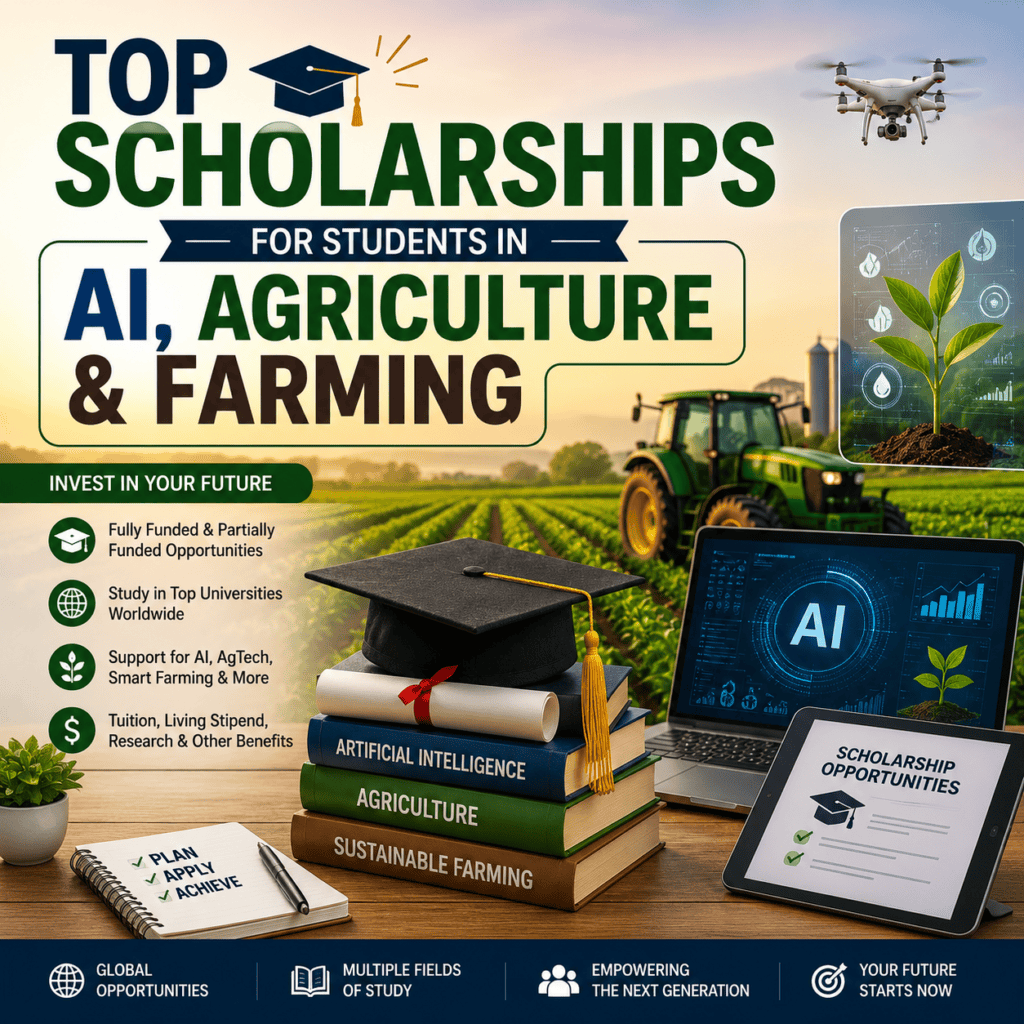
Securing funding for education in high-demand fields like AI, AgTech, and robotics can dramatically reduce financial strain and provide a platform for long-term career growth. This guide is built for high school seniors, undergraduates, postgraduates, and career changers seeking scholarships for students who want to build the future of our food and digital systems.
In this guide, you will learn:
- Top Funding Sources: Which scholarships for students offer full or partial funding in AI, AgTech, and related sciences?
- Strategic Requirements: Essential eligibility criteria, upcoming deadlines, and application workflows.
- Comparative Analysis: How to evaluate the trade-offs between academic-heavy vs. industry-embedded programs.
- Application Excellence: Practical, high-signal strategies to strengthen your application profile.
This article is organized into query-based sections for quick navigation, followed by decision-support assets, FAQs, and optimized metadata to ensure you find the most relevant information efficiently.
Quick-Reference: Key Scholarship Opportunities
| Program | Focus Area | Target Audience | Key Benefit |
| Erasmus Mundus (EMAI) | Artificial Intelligence | International Master’s Students | Full funding (€1,400/mo) |
| AIMS-Google DeepMind | AI for Science/Math | African Postgraduate Students | Full residential funding |
| USDA 1890 National Scholars | Agriculture/Food Science | U.S. Undergraduate Freshmen | Tuition + Employment offer |
| World Bank (JJ/WBGSP) | Development/Agri-Policy | Developing Country Professionals | Full tuition + Stipend |
What Are Scholarships for Students in AI, Agriculture & Farming?
Scholarships for students in AI, agriculture, and farming are specialized financial awards designed to support learners pursuing degrees, technical certifications, or research projects at the intersection of these high-leverage fields. As global food systems increasingly rely on data-driven precision, these scholarships are essential for bridging the gap between traditional agricultural practices and modern technological innovation.
These programs are funded by a diverse ecosystem of universities, government bodies, international foundations, and private tech industry leaders.
Key Characteristics
- Merit-Based: These awards prioritize academic excellence, leadership potential, or the capacity for high-impact research. Committees often look for candidates with a track record of “high-leverage” projects or a clear vision for the industry.
- Need-Based: Designed to democratize access to education, these target students who demonstrate financial hardship, ensuring that talent—not just capital—dictates who leads the next wave of AgTech innovation.
- Field-Specific: These are not general-purpose funds; they are restricted to disciplines like Artificial Intelligence (AI), Machine Learning, agricultural engineering, agronomy, crop science, and sustainable AgTech.
- Funding Tiers:
- Fully Funded: Comprehensive coverage, typically including tuition, living stipends, international travel, and health insurance.
- Partially Funded: Target specific costs, such as tuition waivers, research grants, or the provision of hardware/starter kits for technical programs.
Why They Matter for Your Career
Beyond the financial reduction of education costs, securing scholarships for students in these sectors provides critical “career-proof” advantages:
- Mentorship & Networking: Many industry-backed scholarships (like those from Google DeepMind or private sector AgTech firms) offer direct access to research labs, industry mentors, and conferences.
- Validation of Skill: Winning a competitive scholarship acts as a “signal” to future employers, verifying that your expertise meets industry-standard benchmarks.
- Career Placement: Some programs, such as the USDA 1890 National Scholars, are specifically engineered to transition scholars directly into full-time roles within the organization, drastically reducing the friction between graduation and professional employment.
Pro-Tip: Aligning Your Application
When applying for scholarships for students in these domains, committees are rarely looking for generic “interest.” They are looking for applied intelligence. Whether you are focusing on AI or agriculture, highlight:
- Project-Based Evidence: Links to GitHub repositories, field experiments, or published research.
- Societal Impact: A clear articulation of how your work will solve real-world problems (e.g., using AI for yield optimization or climate-resilient farming).
- Future-Proof Mindset: A demonstration that you are not just learning current tools but are prepared to adapt as these technologies evolve.
Which Fully Funded Scholarships Exist for AI Students?
For high-performing students aiming to specialize in Artificial Intelligence, fully funded scholarships for students represent the gold standard of financial and professional support. These elite programs do more than cover tuition; they typically provide living stipends, travel allowances, and deep integration into global research and industry networks. Because of their prestige and comprehensive benefits, these awards are highly competitive and often require a rigorous, multi-stage application process.
The most impactful opportunities for AI students generally fall into three categories:
- Global Joint Masters Programs: Flagship initiatives like the Erasmus Mundus Joint Master in Artificial Intelligence (EMAI) offer fully funded, multi-country academic experiences. These programs are specifically designed to blend high-level AI theory with practical, industry-aligned research across Europe’s top technical institutions.
- Industry-Partnered Fellowships: Organizations like Google DeepMind collaborate with top-tier universities (e.g., AIMS, University of Oxford, Cambridge, and others) to fund students who demonstrate exceptional research potential. These scholarships for students often include mentorship from leading AI scientists and priority access to specialized research infrastructure.
- Specialized Academic Research Grants: For postgraduates, fellowships such as the Spärck AI Scholarship (or equivalent university-specific government awards) focus on developing leaders who can apply AI across diverse, high-impact domains like healthcare, energy, and data policy.
To succeed in securing these, you must position yourself as an “applied intellectual”—someone who not only excels in the classroom but also demonstrates a clear, technical vision for how their work will solve real-world problems. Most of these programs require an early start, with application cycles often opening up to a year before the academic term begins.
Erasmus Mundus Artificial Intelligence (EMAI) Masters Scholarship
\A prestigious 2-year Joint Master’s Degree (120 ECTS) that blends rigorous AI theory with practical applications across Europe. The program is fully funded by the European Union, providing comprehensive support for high-potential candidates.
Key Details
- Target Audience: Students seeking a globally recognized master’s degree with mandatory mobility across leading European research hubs.
- Financial Benefits:
- Full Tuition Waiver: Covers all program participation costs.
- Monthly Stipend: Approximately €1,400 per month for the duration of the 2-year program (24 months) to cover living and subsistence costs.
- Additional Support: Travel and installation allowances, plus full health insurance.
Eligibility Requirements
- Academic Background: A completed Bachelor’s degree (minimum 180 ECTS) in Computer Science, Engineering, Physics, Mathematics, or a closely related field.
- Technical Prerequisites: Demonstrable coursework (typically 12 ECTS each) in Mathematics, Programming, and Computing Science.
- English Proficiency: Official scores (IELTS Academic ≥ 6.5, TOEFL iBT ≥ 90, or equivalent Cambridge C1/C2 certificates).
- Global Access: The program is open to applicants of all nationalities.
Application Strategy
- Timeline: Applications typically open in November for the following academic year. The primary deadline for scholarship consideration is usually in January.
- Process: Applications are managed through the official EMAI consortium portal (coordinated by Universitat Pompeu Fabra).
- Critical Documents:
- Motivation Letter: 600–800 words articulating your specific interest in AI and research intent.
- Video Introduction: A mandatory 1-minute video explaining your background and intended contribution to the program.
- Recommendation Letters: Two letters, preferably from academic referees.
Expert Insight: The selection process is highly competitive. To stand out, ensure your motivation letter and personal video emphasize applied AI experience—highlighting specific projects, research, or internships that demonstrate your ability to solve real-world problems. For the 2027 intake, plan to have your documentation and English language certifications ready by Q4 2026.
Google DeepMind AI Masters Scholarships (AIMS)
A highly competitive, fully residential one-year Master’s program with a strong research component, hosted at AIMS centers in Africa. This program sits at the intersection of AI and the Sciences, specifically targeting the application of machine learning to fields like cosmology, epidemiology, and ecology.
Through this partnership, 40 scholars are selected annually to receive intensive training and direct mentorship from Google DeepMind researchers and engineers.
Key Details
- Target Audience: African citizens and residents who are passionate about mathematics, artificial intelligence, and machine learning.
- Financial Benefits:
- Full Coverage: Tuition fees, registration, and all research/computational costs.
- Living Support: Comprehensive coverage for accommodation, living expenses, medical insurance, and return flights to South Africa.
- Professional Development: Exclusive access to mentoring, technical support from Google DeepMind experts, and exposure to world-leading AI for Science research.
Eligibility Requirements
- Residency & Citizenship: Must be an African citizen residing in Africa at the time of application (residency requirements are waived for students displaced by conflict).
- Academic Background: Completion of a four-year undergraduate degree, or a three-year undergraduate degree plus an honours year, in Computer Science, Engineering, Mathematics, Statistics, Physics, or a related computational field.
- Prior AIMS Status: Applicants must not have previously held an AIMS scholarship.
Application Strategy
- Timeline: For the 2026/2027 intake, the application deadline was March 6, 2026. Interviews for shortlisted candidates typically occur in May.
- Required Documentation:
- Technical Proof: Submission of a coding problem (provided via the portal) and representative examples of your work in the mathematical sciences.
- Motivation: A ~500-word letter articulating your interest in AI and how you intend to use it for scientific impact.
- Standard Files: Up-to-date CV and complete academic transcripts.
- Selection Process: The evaluation focuses on your analytical thinking and problem-solving methodology rather than standard exams.
Expert Insight: This is not a “quick application.” Treat the coding problem and mathematical work samples as the core of your submission. Since this program heavily prioritizes “AI for Science,” your motivation letter should clearly link your technical skills to specific scientific domains, demonstrating that you understand how AI can solve complex, real-world problems. For those targeting the 2027/2028 cycle, expect the portal to open in December 2026.
Robotics and Artificial Intelligence Nigeria (RAIN) Scholarship
An industry-driven, hands-on training program based in Ibadan, Nigeria, designed to bridge the gap between theoretical knowledge and practical engineering. RAIN focuses on producing “builder-engineers” capable of developing real-world solutions in robotics, drone automation, and AI.
Key Details
- Program Tracks:
- AIML: Artificial Intelligence & Machine Learning (12 months).
- RDA: Robot Development & Automation (12 months).
- Combined: Integrated AIML + RDA track (24 months).
- Financial Benefits:
- Partial Tuition Coverage: Scholarship awards are valued at up to ₦7,700,000, covering a significant portion of the program’s tuition.
- Starter Kit: Essential hardware tools and materials are provided for the practical components of the curriculum.
- Professional Certification: Graduates earn a globally recognized RAIN certification.
- Best For: Students and professionals who want to move beyond academic theory to build actual robots, autonomous drones, and AI systems.
Eligibility Requirements
- Academic/Technical Base: Recent university/polytechnic graduates or exceptional high school graduates with a background in Engineering, Computer Science, Mathematics, or Physics.
- Coding Proficiency: Demonstrable logic and algorithmic thinking (Python, C, or C++). While you don’t need to be an expert, you must be able to showcase your ability through existing projects or portfolios (e.g., GitHub).
- Logistics: Must be legally permitted to study in Nigeria and physically present in Ibadan for the duration of the training.
- Hardware: You must provide your own laptop (Minimum: 16GB RAM, Core i7 processor recommended).
Application Strategy
- Timeline: The 2026 scholarship application cycle concluded on May 4, 2026. Prospective applicants for future cohorts should monitor the RAIN scholarship portal closely.
- Selection Process: Includes a multi-stage process:
- Online Application: Submission of personal details, a motivation essay, and a video pitch.
- Screening Exam: An auto-graded test covering quantitative reasoning, logic, computational thinking, and AI/ML scenarios.
- Interview: Shortlisted candidates are invited for a formal review.
- Decision Asset: If you are planning to apply for future intakes, start building a portfolio of small robotics or AI projects (e.g., a simple Python neural network or an Arduino-based sensor project). This “applied evidence” is often more persuasive than academic credentials alone.
Expert Insight: Unlike traditional academic scholarships, RAIN is highly technical and operational. Your application should emphasize “build-capacity.” Clearly communicate projects you have started or completed, as the institution prioritizes candidates who demonstrate they will actively use their training to create tangible technological solutions in the African market.
Chevening Scholarships (UK)
A flagship global scholarship program funded by the UK Government’s Foreign, Commonwealth and Development Office (FCDO). It supports exceptional, mid-career professionals from over 160 countries to pursue a one-year, full-time taught master’s degree at any UK university. This is a high-prestige award designed to cultivate future leaders who will return to their home countries to drive positive social, economic, and technological change.
Key Details
- Target Audience: Emerging leaders and influential professionals who have a clear vision for their career and a commitment to their home country’s development.
- Financial Benefits:
- Full Funding: Covers university tuition fees (up to a program cap).
- Living Stipend: Monthly allowance for living costs (~£1,347/month outside London; higher for London-based institutions).
- Travel & Extras: Economy class return airfare to the UK, an arrival allowance, a departure allowance, and the cost of one visa application.
Eligibility Requirements
- Nationality: Citizen of a Chevening-eligible country (check the official Chevening portal for the most current list).
- Work Experience: You must demonstrate at least 2,800 hours of work experience (roughly two years of full-time work), which must have been gained after the completion of your undergraduate degree.
- Academic Background: Hold an undergraduate degree that qualifies you for a UK master’s programme (equivalent to a UK 2:1 honours degree).
- Commitment: You must return to your country of citizenship for at least two years following the completion of your scholarship.
Application Strategy
- Timeline: The 2027/2028 cycle is expected to open in August 2026, with a deadline anticipated in early November 2026.
- The “Big Four” Essays: Your application rests on four core essays (reduced to 300 words each): Leadership and Influence, Networking, Study in the UK, and Career Plan.
- Strategic Alignment: Chevening now places a stronger emphasis on how your chosen course aligns with global priorities, such as:
- Promoting prosperity and inclusive growth.
- Building resilience in climate-vulnerable nations (highly relevant for AgTech applicants).
- Strengthening stability and effective governance.
Expert Insight: Chevening is not just an academic scholarship; it is a leadership network. In your essays, avoid generic statements about your “passion for AI.” Instead, demonstrate “impact intelligence.” Describe a specific moment where you identified a problem in your industry (e.g., agricultural inefficiency or digital exclusion) and used your leadership to initiate a tangible, measurable solution. Your application should show that you are already a leader—the scholarship is simply the catalyst to scale your influence.
Gates Cambridge Scholarship
One of the world’s most prestigious awards, the Gates Cambridge Scholarship provides full funding for outstanding international students to pursue a postgraduate degree (Master’s or PhD) at the University of Cambridge. Established by a donation from the Bill and Melinda Gates Foundation, it aims to create a global network of leaders committed to improving the lives of others through their work in AI, agriculture, sustainable development, and beyond.
Key Details
- Target Audience: Exceptional students from any country outside the UK who demonstrate not just academic brilliance, but also leadership and altruistic commitment to solving complex global challenges.
- Financial Benefits:
- Full Funding: Covers the full University Composition Fee at the appropriate rate.
- Maintenance Allowance: A generous stipend (currently ~£22,050 for 12 months) to cover living costs.
- Additional Support: Includes one economy airfare, inbound visa costs, immigration health surcharges, and academic development funding (up to £2,000 for conferences/research).
- Discretionary Aid: Family allowances for children and specialized support for maternity/paternity or fieldwork.
Eligibility Requirements
- Global Access: Open to citizens of any country outside the United Kingdom.
- Academic Excellence: Candidates must possess a record of “outstanding intellectual ability,” typically ranking at the top of their cohort.
- Core Pillars: Applicants are judged on four criteria:
- Outstanding Intellectual Ability.
- Reasons for choice of course (and why Cambridge specifically).
- A commitment to improving the lives of others.
- Leadership potential.
Application Strategy
- Timeline: Applications for the 2027 entry open in September 2026. Deadlines vary by course, generally falling in December 2026 or January 2027 for international applicants.
- Required Documentation:
- The Gates Cambridge Statement: A critical 500-word (approx.) essay articulating your suitability based on the four criteria.
- References: Two academic references plus a specific “Gates reference” regarding your leadership and social impact.
- Research Proposal: Mandatory for PhD applicants.
- Strategic Positioning: For those pursuing scholarships for students in AI or Agriculture, your application must weave a narrative of “impact intelligence.” Do not simply list your GPA; explain how your specific research or project at Cambridge will directly influence global food security, climate resilience, or the ethical development of AI systems.
Expert Insight: The “commitment to improving the lives of others” is the true differentiator. Successful applicants often have a proven track record of community involvement or advocacy. When applying for scholarships for students at this level, ensure your past actions—not just your future intentions—demonstrate a consistent effort to create tangible, positive change in your home country or field of expertise.
What Agriculture and Farming Scholarships Are Available?
As the global food system undergoes a digital transformation, scholarships for students in agriculture and farming have evolved from traditional production-based grants into high-leverage awards covering AgTech, sustainable resource management, and precision agronomy.
These opportunities are no longer just for those entering traditional farm management; they are increasingly aimed at those mastering the intersection of biology, engineering, and data science.
Funding in this sector is diverse, originating from government land-grant initiatives, international development agencies, and private corporations looking to secure the next generation of food systems innovators.
Whether you are seeking to modernize smallholder farming or develop large-scale autonomous agricultural systems, these scholarships for students provide the necessary financial runway to gain specialized expertise.
To maximize your success, these opportunities generally fall into three strategic buckets:
- Industry-Specific & Corporate Grants: Provided by firms (e.g., Agribusiness leaders, tech-enabled seed companies) that prioritize applied skills and industry-aligned research.
- National & Land-Grant Programs: Government-backed awards (like the USDA 1890 National Scholars) designed to build national capacity in food security, often featuring built-in pathways to public sector employment.
- International Development & Sustainability Fellowships: Aimed at students focused on the “Science of Sustainability,” these awards often support research into climate-resilient crops, water management, and the ethical deployment of technology in developing regions.
By strategically targeting scholarships for students that align with your specific sub-discipline—whether it’s regenerative agriculture, agricultural robotics, or food economics—you position yourself as a specialized expert rather than a general candidate.
USDA 1890 National Scholars Program
A high-impact partnership between the U.S. Department of Agriculture (USDA) and the 19 Historically Black Land-Grant Universities (1890 Institutions). This program is designed to build a pipeline of future leaders in food, agriculture, and natural resource sciences, offering scholarships for students that include a direct path to federal employment.
Key Details
- Target Audience: U.S. citizens who are high school seniors, college freshmen, or college sophomores seeking a bachelor’s degree in agricultural and food sciences.
- Financial Benefits:
- Full Coverage: Includes annual tuition, fees, books, and room and board for up to four years.
- Technical Support: Use of a laptop, printer, and necessary software throughout the scholarship period.
- Career Integration: Mandatory participation in the Student Educational Employment Program (SEEP) during school breaks, leading to potential full-time federal employment upon graduation.
Eligibility Requirements
- Academic Standing: Cumulative GPA of 3.0 or better (on a 4.0 scale).
- Standardized Testing: Minimum SAT score of 1080 (math/verbal) or ACT composite score of 21.
- Field of Study: Enrollment or acceptance at one of the 19 designated 1890 Land-Grant Universities in an approved major (e.g., Agribusiness, Agricultural Engineering, Agronomy, Food Science, or related disciplines).
- Character: Demonstrated leadership, community service, and commitment to a career in the agricultural sector.
Application Strategy
- Timeline: The application cycle typically opens in January and closes in early March (e.g., March 8 for the 2026/2027 cycle).
- Institutional Alignment: You must be accepted to an 1890 Land-Grant Institution to receive the award. It is strategically sound to apply for university admission well before you finalize your scholarship application.
- Required Documentation: An official transcript with the school seal, a signed application, and high-quality essays detailing your commitment to community impact and agricultural leadership.
Expert Insight: Unlike general scholarships for students, this program is an employment-linked fellowship. Your application should not just focus on your grades; it must clearly articulate your desire to work for the USDA and your understanding of the agency’s role in food security and environmental stewardship. When drafting your essays, demonstrate “applied intelligence” by discussing specific challenges in U.S. agriculture that you are interested in addressing through your future career.
Participating in 1890 Land-Grant Universities
- Alabama A&M University;
- Alcorn State University (MS);
- Central State University (OH);
- Delaware State University;
- Florida A&M University;
- Fort Valley State University (GA);
- Kentucky State University;
- Langston University (OK);
- Lincoln University (MO);
- North Carolina A&T State University;
- Prairie View A&M University (TX);
- South Carolina State University;
- Southern University (LA);
- Tennessee State University;
- Tuskegee University (AL);
- University of Arkansas Pine Bluff;
- University of Maryland Eastern Shore;
- Virginia State University;
- West Virginia State University.
Joint Japan/World Bank Graduate Scholarship (JJ/WBGSP) — 2026/2027 Status
The JJ/WBGSP is a premier, fully funded master’s scholarship for mid-career professionals from World Bank member developing countries. It specifically targets those pursuing development-related fields—including agriculture, food security, AgTech, and rural development—with the clear expectation that scholars will return home to apply their new expertise to their nation’s social and economic growth.
Key Details for 2026/2027 Applicants
- Target Audience: Mid-career professionals with at least 3 years of recent, paid, development-related work experience.
- Financial Benefits: A comprehensive package covering full tuition, a monthly living stipend (city-dependent), round-trip airfare, health insurance, and specialized allowances for academic materials.
- The “Development” Mandate: This is not a general scholarship. Your work history and proposed field of study must demonstrate a direct link to the development needs of your home country.
Eligibility Requirements
- Nationality: Must be a citizen of a World Bank member developing country (as per the official list). Dual citizenship with any “developed” country is a strict disqualifier.
- Professional Experience: Minimum 3 years of paid, development-related work experience acquired within the last 6 years (post-bachelor’s degree).
- Admission Status: You must secure unconditional admission to a participating JJ/WBGSP master’s program before you can apply for the scholarship. The university itself must nominate you to receive the scholarship application link.
- Geography: Your chosen master’s program must be located outside your country of citizenship and your country of residence.
2026 Application Cycle Update
- Window #1: Closed.
- Window #2: The deadline for Window #2 was May 29, 2026.
- Current Status: As of July 2026, the application windows for the 2026–2027 academic year have concluded.
Strategic Takeaways for Future Applicants
If you are aiming for the next cycle (2027/2028), the competition is high—typically capped at five scholarship slots per participating program. To win, your application must move beyond academic credentials:
- Program Selection: Choose a master’s program that is not only “participating” but strategically aligns with your specific career track in AI or Agriculture.
- Quality of Impact: Assessors prioritize professional recommendations and your “Commitment to Home Country.” Use your essays to provide quantifiable evidence of how your work has already impacted your community’s development.
- The “Residency Trap”: Ensure your target program is in a country where you do not currently reside. Failure to clear this hurdle automatically disqualifies your application.
Expert Insight: Since this scholarship relies on institutional nomination, your first point of contact is the admissions office of your target university. Reach out to them early in the academic cycle to confirm their nomination process and ensure your application profile matches their criteria for the JJ/WBGSP shortlist.
Mastercard Foundation Scholars Program
The Mastercard Foundation Scholars Program is a comprehensive, fully funded initiative designed for academically gifted yet economically disadvantaged African youth. This program goes beyond mere financial assistance; it provides a holistic “transformation ecosystem” that includes leadership development, mentorship, and career transition support, specifically aimed at scholars who will return to their home countries to drive sustainable change.
Key Details
- Target Audience: High-potential African students—including refugees, internally displaced persons (IDPs), and those with disabilities—who demonstrate both academic excellence and a deep commitment to community transformation.
- Financial Benefits:
- Full Coverage: Includes all tuition fees, on-campus accommodation, and a monthly living stipend.
- Comprehensive Support: Covers books, academic materials, travel (flight) costs to and from your home country, and essential visa and immigration expenses.
- Holistic Development: Access to dedicated leadership training, professional mentorship, and internship opportunities that bridge the gap between academic study and career employment.
Eligibility Requirements
- Citizenship: Must be a citizen of an African country (refugees and displaced persons are strongly encouraged to apply).
- Economic Profile: Designed specifically for those facing significant financial barriers. You must provide documentation regarding your family’s financial status to demonstrate need.
- Academic Standing: Must meet the rigorous graduate admission requirements of the partner university (e.g., University of Pretoria, McGill University, University of British Columbia, University of Oxford).
- Leadership Track: Candidates must have a proven track record of community involvement, volunteerism, and service initiatives.
Application Strategy
- The “Dual-Gate” Process: You cannot apply for the scholarship directly. First, you must secure provisional admission to an eligible master’s program at a partner institution. Once admitted, you become eligible to apply for the scholarships for students funded by the Mastercard Foundation.
- Timeline: Cycles vary by partner university. For 2027 intakes, many applications are now open or approaching deadlines (e.g., McGill’s deadline is December 1, 2026; UBC’s expression of interest deadline is September 2026).
- Strategic Focus: Because the program prioritizes fields like sustainable agriculture, food security, public policy, and public health, ensure your application clearly links your proposed research or study path to these critical African development needs.
Expert Insight: The selection committee looks for “transformative leaders.” When drafting your personal statements, avoid focusing solely on your academic grades. Instead, describe a specific challenge you identified in your community and how you took the initiative to solve it. This evidence of leadership is often the deciding factor in securing these highly competitive scholarships for students.
African Development Bank – Japan Africa Dream Scholarship (JADS)
The Japan Africa Dream Scholarship (JADS) is a high-impact, fully funded initiative co-implemented by the African Development Bank (AfDB) and the Government of Japan. It is specifically designed to build technical and leadership capacity in Africa’s “High 5” priority sectors: energy, agriculture, health, environmental sustainability, and engineering.
By providing scholarships for students at the master’s level in Japanese universities, the program aims to cultivate professionals who will return to their home countries to drive socio-economic development.
Key Details
- Target Audience: High-achieving African professionals from AfDB member countries who have a strong history of supporting their nation’s development.
- Financial Benefits:
- Full Tuition Coverage: Covers all program participation fees for up to 24 months.
- Living Stipend: Monthly subsistence allowance (approximately 144,000–150,000 JPY) to cover housing and daily expenses.
- Travel & Insurance: Round-trip economy airfare between your home country and Japan, plus health insurance via the host university.
- Professional Development: An additional 6 months for preparatory study or internships with leading Japanese companies, along with potential grants for research and thesis preparation.
Eligibility Requirements
- Nationality: Must be a citizen of an African Development Bank regional member country.
- Age & Experience: Must be 35 years old or younger, with at least 1 year of paid professional experience in your home country or another African nation post-bachelor’s degree.
- Academic Background: Bachelor’s degree (or equivalent) in energy, agriculture, health, environmental sustainability, or engineering.
- Commitment: Must demonstrate a clear commitment to return to your home country to contribute to its economic and social development upon completion of the program.
Application Strategy
- The “Partner-First” Approach: You do not apply directly to the AfDB. You must first apply for and gain admission to a participating master’s degree program at one of the designated Japanese partner universities.
- Nomination Process: Once you are admitted, the university reviews your profile and nominates eligible candidates to the AfDB JADS Secretariat for the final selection.
- Crucial Documentation:
- Research Plan: A detailed proposal linking your studies to development challenges in Africa.
- Professional Evidence: Your CV, certified transcripts, and at least two professional references.
- Employment Verification: Documented proof of your relevant work experience post-bachelor’s degree.
Expert Insight: Admission to a partner university is not a guarantee of the scholarship. Because the JADS program prioritizes “impact intelligence,” use your research proposal to describe how you will leverage Japanese technical expertise (in sectors like precision agriculture or sustainable energy) to solve a specific problem in your home country. This clear connection between Japanese technology and African development is the cornerstone of a winning application for these scholarships for students.
FAO–Hungarian Government Scholarship
This is a fully funded program established under a long-standing partnership between the Food and Agriculture Organization (FAO) and the Hungarian Government. It is specifically designed to support scholarships for students from FAO member countries to pursue postgraduate studies in critical fields such as agricultural biotechnology, animal nutrition, plant protection, and rural development at top-tier Hungarian universities.
Key Details
- Target Audience: Students from eligible developing and middle-income countries who are passionate about transforming food systems and enhancing agricultural sustainability.
- Financial Benefits:
- Full Coverage: Includes all application and tuition fees for the duration of the program.
- Living Support: Provides dormitory accommodation, a monthly subsistence allowance, and comprehensive health insurance.
- Educational Materials: Covers the cost of basic textbooks and academic notes.
Eligibility Requirements
- Citizenship & Residency: Applicants must be both citizens and residents of one of the designated eligible FAO member countries.
- Academic Excellence: A strong record of previous academic achievement is required.
- Language: High proficiency in English (for programs taught in English).
- Age: Preference is given to candidates under the age of 30.
- Motivation: A demonstrated commitment to applying the knowledge gained to solve food security challenges in your home country.
Application Strategy
- The “Email-Only” Dossier: Unlike programs with central portals, this application is submission-based via email to the FAO Regional Office. Because the process is highly competitive, ensure your dossier is 100% complete; incomplete or improperly named files are automatically discarded during pre-screening.
- Timeline: The 2026/2027 application cycle concluded on February 28, 2026. Prospective applicants for the 2027/2028 academic year should prepare to monitor the FAO scholarship portal starting in late 2026 for the next call for applications.
- Competitive Edge: When preparing your Statement of Purpose, focus on the “why” of your specific field. If you are applying for scholarships for students in Agricultural Biotechnology, clearly link your interest to local food security issues, such as pest resistance or crop yield optimization in your home region.
Expert Insight: The final selection is conducted entirely by the participating Hungarian universities. Since these institutions look for high-caliber researchers, ensure your application includes a clear, professional Letter of Recommendation from a workplace supervisor or academic mentor that highlights your capacity for independent research.
How Do International Scholarships Compare?
Selecting the right financial aid requires balancing your career goals, geographic mobility, and level of study. The table below outlines the core characteristics of the scholarships for students in these high-leverage sectors, allowing you to compare entry requirements and scope at a glance.
Comparative Matrix: Scholarships for Students
| Scholarship | Degree Level | Funding | Deadline (Annual) | Work Experience | Citizenship Restrictions |
| Erasmus Mundus (EMAI) | Master’s | Full | Oct–Jan | None | None |
| Google DeepMind (AIMS) | Master’s | Full | March | None | African Citizens |
| Chevening | Master’s | Full | November | 2+ Years | 160+ eligible countries |
| Gates Cambridge | Master’s/PhD | Full | Dec / Jan | None | Non-UK |
| JJ/WBGSP (World Bank) | Master’s | Full | Feb / May | 3+ Years | Developing countries |
| Mastercard Foundation | Undergrad/Master’s | Full | April | None | African Citizens |
| USDA 1890 | Undergrad | Full | Spring | None | U.S. Citizens |
| AfDB-JADS | Master’s | Full | Varies | 1+ Year | AfDB member countries |
| FAO-Hungary | Master’s/PhD | Full | February | None | FAO member countries |
Strategic Decision Assets: How to Evaluate
When choosing between scholarships for students in AI and AgTech, move beyond the funding amount. Use these three lenses to determine which program offers the highest “career leverage”:
- Professional Pathway: If your goal is a mid-career transition or policy leadership, prioritize Chevening or JJ/WBGSP. These programs are explicitly designed to connect you with high-level professional networks rather than just academic labs.
- Technical Build-Capacity: If you are an “applied intellectual” focused on hardware, software, or AI engineering, programs like RAIN (Nigeria-based) or the AIMS-Google DeepMind scholarship offer the best ROI. They prioritize tangible projects and industry-standard skill sets.
- Global Mobility vs. Specialized Research: Programs like Erasmus Mundus (EMAI) provide unmatched cross-border exposure across European technical hubs, while Gates Cambridge is the superior choice for deep-dive, high-impact research that requires world-class academic infrastructure.
The “High-Leverage” Checklist for Applicants
Before finalizing your application, ensure you can answer “Yes” to these three questions:
- Alignment: Does my research proposal or personal statement explicitly address a specific gap in my home country’s AI or Agricultural landscape?
- Documentation: Are my transcripts, English test scores (IELTS/TOEFL), and professional references tailored to the specific mission of the donor (e.g., development-focused vs. research-focused)?
- Timing: Have I accounted for the 6–12-month lead time required for university admission before the scholarship application deadline?
This guide is designed to help you treat scholarships for students as strategic career assets. By aligning your application with the specific development or research goals of these programs, you maximize your chances of securing the funding needed to scale your impact.
Who Is Eligible for These Scholarships?
Eligibility for scholarships for students in AI, agriculture, and farming is rarely “one-size-fits-all.” Because these awards are investments in specific human capital, donors use stringent criteria to ensure their funds drive measurable impact. Understanding these baseline requirements allows you to audit your profile effectively before dedicating time to an application.
Core Eligibility Criteria
- Academic Excellence: Most programs require a strong academic record, often defined as a minimum GPA of 3.0/4.0 or equivalent. In highly competitive research-based scholarships, committees look for top-decile performance, high-impact thesis work, or published research.
- Targeted Fields of Study: These scholarships for students are strictly discipline-specific. You must be pursuing a degree in AI, machine learning, agricultural engineering, agronomy, food science, or related high-leverage sectors (e.g., AgTech).
- Citizenship & Geographical Focus: Donor mandates dictate regional priority. Many programs are restricted to specific geographies, such as Africa (Mastercard, AIMS-DeepMind), developing nations (World Bank), or specific national corridors (USDA 1890).
- Professional Track Record: For mid-career scholarships for students—such as Chevening or the World Bank’s JJ/WBGSP—academic potential is secondary to your professional experience. You typically need 2–3 years of verifiable, paid, development-related work experience.
- Language Proficiency: For international programs, you must provide proof of language mastery, typically through IELTS Academic or TOEFL iBT scores, unless your previous degree was taught entirely in English.
- Institutional Admission (The Gatekeeper): Many of the most lucrative scholarships for students require you to secure an “unconditional offer” of admission from a participating university before you can even apply for the funding. Failing to prioritize your university application often disqualifies your scholarship bid.
Strategic Evaluation: Are You a Fit?
To avoid wasted effort, audit your status against these variables:
| Eligibility Factor | Why It Matters | Strategy |
| Residency | Some awards require you to be a resident of your home country to apply. | Confirm your “physical location” status early in the cycle. |
| Work History | Development-related experience must be “paid” and “post-bachelor’s.” | Keep detailed logs of your professional projects and contributions. |
| Dual Citizenship | Many “developing country” scholarships disqualify dual citizens of “developed” nations. | Check the fine print of the official donor documentation. |
Pro-Tip: Check the Source
Eligibility criteria are subject to change annually based on donor funding cycles and university partnerships. Always verify current requirements directly on the official program website at least 6 months before you intend to apply.
When Are Application Deadlines?
Deadlines for scholarships for students in AI, agriculture, and farming are strictly enforced. Because funding is limited and competition is fierce, missing a deadline—even by a few minutes—typically results in immediate disqualification.
To maintain a competitive edge, you should treat these dates as hard limits and aim to submit your application at least 72 hours in advance to account for potential technical issues.
Typical Annual Deadline Clusters
| Period | Key Opportunities | Strategic Focus |
| August–November | Chevening, Gates Cambridge, Erasmus Mundus | Early-cycle preparation allows time for university admission processes. |
| January–March | JJ/WBGSP Window #1, DeepMind AI (AIMS), FAO-Hungary, USDA 1890 | Peak season for major government and international agency awards. |
| March–May | JJ/WBGSP Window #2, Australian/U.S. university programs | Mid-year cycle; often targets specific institutional partnerships. |
| April–June | Mastercard Foundation, AfDB-JADS, RAIN (Nigeria) | Final wave for the upcoming academic year. |
Why You Must Apply 6–12 Months Early
Applying well in advance is not just about beating the clock; it is a fundamental part of a high-leverage strategy:
- The “Admission Gatekeeper”: Many of the most prestigious scholarships for students (e.g., JJ/WBGSP, Mastercard Foundation) require you to secure an unconditional offer of admission from a partner university before you can apply for the scholarship. This can take several months.
- Documentation Lead Time: Gathering certified transcripts, obtaining high-quality letters of recommendation, and securing English proficiency scores (IELTS/TOEFL) often takes longer than anticipated.
- Quality Control: Early submission gives you a “cushion” to address any missing components or administrative errors identified by the donor or university admissions office.
- Funding Availability: In some programs, scholarships are awarded on a priority basis. While not always explicitly “rolling,” early applicants often receive greater scrutiny and consideration for limited high-value slots.
Pro-Tip for 2027 Applicants
Since it is currently July 2026, you are entering the optimal window to start your research and preparation for the 2027/2028 intake. Start your “Scholarship Calendar” now. Map out your target programs, identify their admission requirements, and set automated reminders for both the University Admission Deadline and the Scholarship Submission Deadline.
How to Apply Successfully for Scholarships
Securing competitive funding requires a transition from “passive applicant” to “strategic candidate.” Because scholarships for students in high-leverage fields like AI and AgTech are treated as investments, your application must demonstrate not just potential, but return on investment (ROI) for the donor.
Follow this systematic framework to optimize your application process:
The Strategic Roadmap
- Start Early: Begin your search 12 months in advance. This buffer is critical, especially since many scholarships for students require you to have already secured a university offer.
- The Power of Three (Shortlisting): Match your profile to 3–5 high-fit scholarships rather than applying indiscriminately. Aim for a mix of “Reach” (prestigious, high-competition) and “Target” (highly aligned with your specific research or professional track) opportunities.
- Secure Admission First: For programs like the World Bank (JJ/WBGSP) or the Mastercard Foundation, the scholarship application is contingent upon university admission. Prioritize your academic applications to partner institutions as your first gatekeeper.
High-Signal Documentation
Don’t just submit forms; build a “professional case file”:
- Motivation Essays: Stop using generic templates. Tailor every essay to the specific mission of the donor. Connect your personal story to the donor’s goal (e.g., “How will your AI expertise solve food insecurity in Nigeria?”).
- Recommendation Letters: Secure 2–3 letters from mentors or supervisors who can vouch for your applied impact, not just your grades.
- Evidence of Impact: For AI candidates, include a GitHub link or a portfolio of your models. For AgTech, provide case studies or field data from your projects.
- Language & Verification: Keep your certified transcripts and English test scores (IELTS/TOEFL) valid and ready to upload.
Execution & Optimization
- Tailor the Narrative: Ensure your career goals in your CV match the narrative in your motivation letter. Donors want to fund candidates who have a coherent, long-term vision.
- Submit with a Buffer: Technology fails. Submit your application at least 72 hours before the deadline to avoid technical lock-outs or last-minute portal crashes.
- Tracking: Use a simple CRM or spreadsheet to track the status of each application, reference requests, and follow-up emails.
Common Pitfalls to Avoid
| Mistake | Consequence |
| Generic Essays | Immediate rejection signals a lack of serious research. |
| Missing/Late Documents | Automatic disqualification; no second chances. |
| Ignoring Eligibility | Waste of time; donors automate filters for residency/citizenship. |
| Ignoring Institutional Ties | Failing to secure university admission before the scholarship deadline. |
Pro-Tip: The “Founder’s Mindset”
Treat your scholarship application like a pitch deck for a startup. You are the founder, your education is the product, and the donor is the investor. Your application is the pitch: Why you? Why this field? Why now?
How to Apply Successfully for Scholarships
Securing competitive funding requires a transition from “passive applicant” to “strategic candidate.” Because scholarships for students in high-leverage fields like AI and AgTech are treated as investments, your application must demonstrate not just potential, but return on investment (ROI) for the donor.
Follow this systematic framework to optimize your application process:
The Strategic Roadmap
- Start Early: Begin your search 12 months in advance. This buffer is critical, especially since many scholarships for students require you to have already secured a university offer.
- The Power of Three (Shortlisting): Match your profile to 3–5 high-fit scholarships rather than applying indiscriminately. Aim for a mix of “Reach” (prestigious, high-competition) and “Target” (highly aligned with your specific research or professional track) opportunities.
- Secure Admission First: For programs like the World Bank (JJ/WBGSP) or the Mastercard Foundation, the scholarship application is contingent upon university admission. Prioritize your academic applications to partner institutions as your first gatekeeper.
High-Signal Documentation
Don’t just submit forms; build a “professional case file”:
- Motivation Essays: Stop using generic templates. Tailor every essay to the specific mission of the donor. Connect your personal story to the donor’s goal (e.g., “How will your AI expertise solve food insecurity in Nigeria?”).
- Recommendation Letters: Secure 2–3 letters from mentors or supervisors who can vouch for your applied impact, not just your grades.
- Evidence of Impact: For AI candidates, include a GitHub link or a portfolio of your models. For AgTech, provide case studies or field data from your projects.
- Language & Verification: Keep your certified transcripts and English test scores (IELTS/TOEFL) valid and ready to upload.
Execution & Optimization
- Tailor the Narrative: Ensure your career goals in your CV match the narrative in your motivation letter. Donors want to fund candidates who have a coherent, long-term vision.
- Submit with a Buffer: Technology fails. Submit your application at least 72 hours before the deadline to avoid technical lock-outs or last-minute portal crashes.
- Tracking: Use a simple CRM or spreadsheet to track the status of each application, reference requests, and follow-up emails.
Common Pitfalls to Avoid
| Mistake | Consequence |
| Generic Essays | Immediate rejection signals a lack of serious research. |
| Missing/Late Documents | Automatic disqualification; no second chances. |
| Ignoring Eligibility | Waste of time; donors automate filters for residency/citizenship. |
| Ignoring Institutional Ties | Failing to secure university admission before the scholarship deadline. |
Pro-Tip: The “Founder’s Mindset”
Treat your scholarship application like a pitch deck for a startup. You are the founder, your education is the product, and the donor is the investor. Your application is the pitch: Why you? Why this field? Why now?
Buying Guide: Who Should Apply and What to Avoid
Treating scholarships for students as a strategic asset requires an objective assessment of your profile and goals. Use this guide to determine if you are ready to compete for these high-leverage opportunities and how to evaluate the long-term ROI of the programs you pursue.
Who Should Apply
- High Achievers: You have a strong GPA and, more importantly, a portfolio of projects, research, or leadership roles that set you apart.
- Career-Focused Strategists: You aren’t just looking for a degree; you have a clear vision of how expertise in AI, AgTech, or sustainable agriculture will accelerate your professional trajectory.
- Students Seeking Financial Leverage: You aim to minimize student loan debt by securing fully funded pathways to global education.
- Mobile Professionals: You are willing to relocate internationally to access top-tier research hubs.
- Mid-Career Professionals: You have the requisite 2–3 years of professional experience needed for high-prestige development fellowships.
Who Should Avoid (or Postpone)
- Candidates with Low Academic Standing: Most prestigious programs filter based on top-tier class rank. If your GPA is low, focus on fixing your technical portfolio or gaining high-impact work experience first to compensate.
- The Uncommitted: Many scholarships for students—particularly those from the World Bank or Chevening—come with binding obligations to return to their home country. If you are not ready to commit to this, do not apply.
- Last-Minute Applicants: If you haven’t started your research at least 6–12 months in advance, you are likely already too late for the upcoming cycle.
- Non-Eligible Candidates: Don’t waste time on programs with residency or citizenship restrictions that clearly exclude your profile.
Budget & Resource Considerations
- The “Full Funding” Advantage: Programs that cover tuition, living stipends, and travel eliminate the financial risk of high-level education.
- Hidden Costs: Even in “fully funded” packages, ensure you factor in potential out-of-pocket costs for visa processing, health insurance, and pre-departure expenses.
- Partial Funding: If a program only covers partial tuition, verify if you have the personal capital or loan capacity to cover the gap.
Essential vs. Nice-to-Have Features
| Feature | Importance | Why it Matters |
| Living Stipend | Essential | Vital for maintaining focus on study without financial stress. |
| Mentorship | Essential | Provides industry-aligned guidance and networking. |
| Career Placement | Essential | Directly bridges the gap between degree and income. |
| Family/Research Grants | Nice-to-Have | Useful if you are a PhD student or have dependents. |
Ecosystem Compatibility & Technical Support
For scholarships for students in technology and agriculture, the “hardware” of the program matters as much as the “software”:
- AI Students: Prioritize programs that offer access to cloud credits, GPUs, and industry partnerships with labs like DeepMind. This is your professional toolkit.
- AgTech Students: Look for programs that include field placement, farm partnerships, or data-driven research access. Theoretical knowledge in agriculture is insufficient without exposure to real-world deployment.
- Geography: Ensure the scholarship’s “return-home” or “placement” mandate aligns with where you want to build your long-term career.
Privacy & Security Note
Verify how scholarship portals handle your personal data. Only upload documents through official, encrypted university or government portals. Never share sensitive financial information via email or unsecured messaging platforms.
How to Choose Your “Scholarship Portfolio”
Do not apply to every opportunity. Instead, build a portfolio of 3–5 programs that align with your “High-Leverage Career Map”:
- The “Prestige” Anchor: Select one elite, broad-scope scholarship (e.g., Chevening or Gates Cambridge) if you have a strong leadership profile. These offer the greatest networking ROI.
- The “Technical” Anchor: Select one scholarship that provides direct access to the tools you need (e.g., DeepMind for AI/Science, RAIN for hardware/robotics).
- The “Professional” Anchor: Select one scholarship that provides a “soft landing” into a specific sector or region (e.g., USDA 1890 for U.S. government, JJ/WBGSP for international development).
Final Strategic Advice
- Don’t Over-Diversify: Applying to too many programs dilutes your ability to tailor your Statement of Purpose. A targeted application for one “perfect match” program is superior to five generic applications.
- Leverage Local Partnerships: For agriculture and food security, look for scholarships that connect with organizations like CGIAR or NARS (National Agricultural Research Systems). These are the “hidden” signals that scholarship committees look for to verify your commitment to real-world impact.
- Audit Your Constraints: If you are a career changer, emphasize transferable intelligence. If you are a fresh graduate, emphasize potential for research and leadership. Never ignore the “return-home” clauses—if your long-term goal is to migrate, avoid scholarships that strictly require a 2-year home-country commitment.
Scholarships for Students: FAQs
Navigating the competitive landscape of funding for AI and AgTech requires clarity. Here are the most critical answers regarding the logistics and strategic realities of securing scholarships for students.
Can I apply for multiple scholarships at once?
Yes. In fact, it is a recommended high-leverage strategy. Applying to 3–5 well-matched scholarships for students significantly increases your odds. However, ensure each application is tailored to the specific donor’s mission; generic applications are easily spotted by committees and often result in rejection.
Do I need IELTS or TOEFL for AI and agriculture scholarships?
Generally, yes. Most internationally recognized programs taught in English require formal proof of proficiency (IELTS Academic or TOEFL iBT). Some institutions may waive this if you can prove your previous degree was completed entirely in English, but always verify this on the specific university’s admissions page.
Are there scholarships for undergraduate AI students?
Yes, but they are rarer. While most fully funded AI scholarships target Master’s or PhD candidates, you can find opportunities through university-specific merit awards, national-level programs like the USDA 1890 National Scholars, or niche regional initiatives like RAIN (Nigeria).
Can career changers apply for agriculture scholarships?
Absolutely. Many mid-career programs, such as the JJ/WBGSP (World Bank) or Chevening, explicitly value diverse professional backgrounds. If you are a career changer, your advantage lies in your “transferable skills.” Use your application to clearly articulate why your previous experience makes you uniquely suited to tackle modern agricultural challenges.
What if I miss a scholarship deadline?
You must wait for the next cycle. Deadlines are absolute. Use the intervening months to strengthen your “application asset” profile: gain high-impact work experience, publish relevant research, or secure stronger, more specific letters of recommendation.
Are there scholarships for part-time or online programs?
Rarely. The vast majority of fully funded scholarships for students require full-time, on-campus residency to foster deep networking and research integration. Always check the specific program’s residency requirements before applying.
Do I need to repay scholarships?
No. Scholarships are non-repayable awards. However, some programs (like Chevening or JJ/WBGSP) contain “return-home” clauses, legally requiring you to return to your country of citizenship for a set period (usually 2 years) after graduation to apply your skills locally.
How competitive are these scholarships?
Extremely. Acceptance rates for top-tier international awards often hover between 5% and 10%. Success depends on a combination of elite academic records, clear professional goals, and high-signal, compelling essays that demonstrate a clear ROI for the donor.
Can I work while on scholarship?
Most discourage or strictly limit outside employment. The donor’s expectation is that you treat your education as a full-time professional commitment. Working outside the program can also be a violation of your student visa status in many countries.
Where can I find more scholarships?
For the most reliable, high-signal information, regularly check:
University Financial Aid Pages: Specifically, the department pages for Agriculture, AI, or Computer Science.
Government Portals: Websites for your national Ministry of Education or host-country foreign embassies.
Curated Databases: Reliable aggregators like ScholarshipTab, Opportunities for Africans, and WeMakeScholars.
In Conclusion
Securing scholarships for students in high-leverage sectors like AI, agriculture, and farming is an exercise in professional strategy rather than mere financial aid seeking. These opportunities—offered by elite universities, governments, and international organizations—are not just funding pathways; they are accelerators for your long-term career mobility and impact.
Summary of Strategic Assets
- The Funding Landscape: Fully funded programs such as Erasmus Mundus AI, Google DeepMind (AIMS), USDA 1890, JJ/WBGSP (World Bank), Chevening, and the Mastercard Foundation represent the gold standard of professional and financial support in these domains.
- The “Impact” Requirement: Eligibility, deadlines, and benefits are specific to each program’s mission. Success depends on your ability to verify criteria on official portals and align your personal narrative with the donor’s development or research goals.
- The 80/20 Approach: Success is rarely accidental. It requires starting your preparation 6–12 months in advance, curating a shortlist of 3–5 highly matched programs, and treating every application as a high-signal pitch deck for your potential.
Your Action Plan
To move from candidate to scholar, implement this structured approach:
- Build Your Scholarship Tracker: Create a spreadsheet to manage deadlines, eligibility criteria, required documentation, and application status. This is your mission control.
- Audit Your Profile: Match your current academic and professional achievements against the specific mandates of your target programs (e.g., development-focused vs. research-focused).
- Execute Early: Prioritize university admission, as it is the primary gatekeeper for most fully funded awards.
- Tailor, Don’t Template: Your “Statement of Purpose” must explicitly link your technical expertise in AI or AgTech to the specific outcomes the donor prioritizes (e.g., food security, economic growth, or scientific innovation).
By treating these scholarships for students as strategic career investments, you position yourself to build the skills needed to influence the future of our digital and agricultural systems.