What to Do When an Interviewer Challenges a Claim on Your CV
When an interviewer challenges a claim on your CV, stay calm, clarify what they’re asking, and respond with specific examples, numbers, or evidence. If you can’t recall exact details in the moment, state so honestly and offer to follow up. If you overstated an achievement, admit it briefly, correct it, and immediately refocus on the skills you can demonstrate.
This article is for job seekers at any level—students, recent graduates, career changers, and experienced professionals—who want to handle high-pressure interview questions without panicking or damaging their credibility.
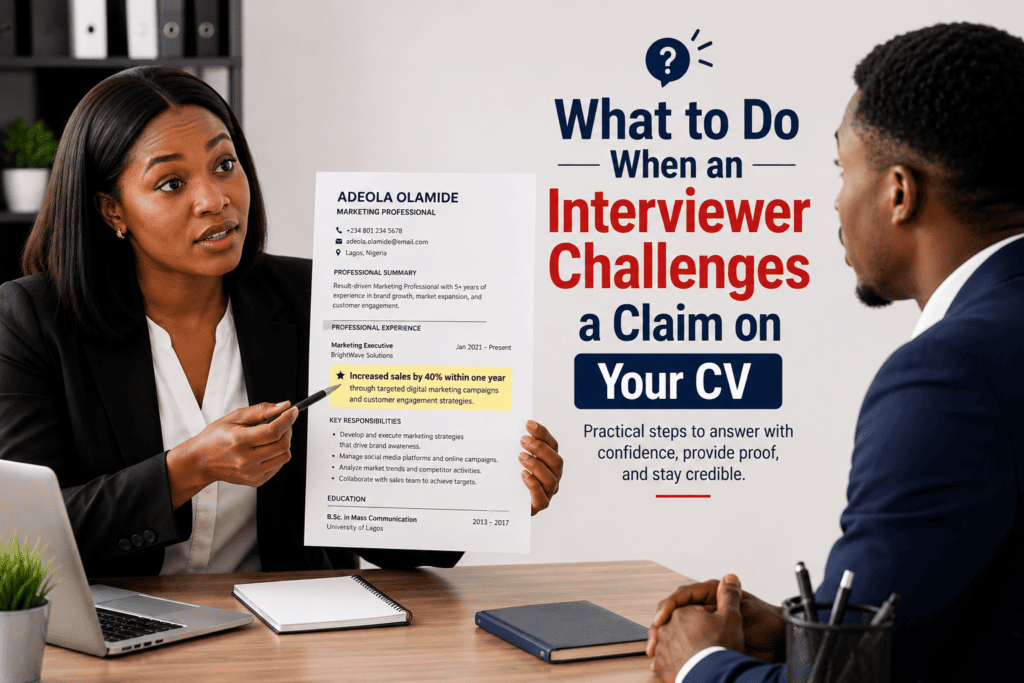
Below, you’ll learn why interviewers probe claims, how to respond using structured frameworks like STAR, what to do when an interviewer challenges a claim on your CV, and how to build a resume that is easy to defend.
Why Interviewers Challenge CV Claims (And Why It’s Not Always an Accusation)
When an interviewer challenges a claim on your CV, it is rarely an outright accusation of dishonesty. Most often, hiring managers probe specific statements to verify depth—testing whether you truly executed the work, how you approached the problem, and the actual impact of your results.
Understanding that probing questions are a standard part of the evaluation process helps you stay composed and maintain control of the conversation.
Common Reasons Interviewers Probe Your CV
- Testing Authenticity: High-impact or generic metrics (e.g., “increased efficiency by 40%” or “managed cross-functional teams”) naturally invite scrutiny. Interviewers ask for specific methodologies to confirm you were the primary driver, not just a passive participant.
- Assessing Role Fit: Hiring teams check whether your technical execution aligns with the day-to-day requirements of the open role and whether you can articulate your contributions clearly under pressure.
- Evaluating Problem-Solving & Ownership: Follow-up questions like “What went wrong?” or “What would you do differently next time?” test your critical thinking, self-awareness, and ability to extract lessons from real-world execution.
When an interviewer challenges a claim on your CV, treat the moment as an invitation to expand on your expertise rather than a test of your integrity. Re-framing these challenges as standard technical checks allows you to deliver structured, evidence-backed answers without getting defensive.
How to Respond When an Interviewer Questions a CV Claim
When an interviewer challenges a claim on your CV, your primary goal is to stay composed, clarify the scope of their concern, and deliver a structured, evidence-backed answer. A strong response demonstrates operational depth, clear communication, and full ownership of your reported outcomes.
                  ┌────────────────────────┐
                  │ 1. Pause & Clarify     │
                  └───────────┬────────────┘
                              │
                  ┌───────────▼────────────┘
                  │ 2. Structure (STAR/CAR)│
                  └───────────┬────────────┘
                              │
                  ┌───────────▼────────────┘
                  │ 3. Quantify & Provide  │
                  │    Concrete Evidence   │
                  └───────────┬────────────┘
                              │
                  ┌───────────▼────────────┘
                  │ 4. Maintain a Confident│
                  │    & Un-defensive Tone │
                  └────────────────────────┘
Pause and Clarify the Scope: Buy thinking time and prevent answering the wrong question.
Before jumping into an explanation, confirm precisely which element the interviewer is questioning—whether it is your specific ownership level, the methodology used, or the final metric.
- “Just to clarify, are you asking about the specific automation tools I used to reduce deployment time by 40%, or my direct management responsibilities during that project?”
- “Are you looking for more detail on how we established the baseline metrics, or the long-term impact on the team’s output?”
Apply a Structured Framework (STAR or CAR): Provide clear context without rambling.
Organizing your response through STAR (Situation, Task, Action, Result) or CAR (Challenge, Action, Result) ensures you highlight your direct contribution rather than hiding behind vague team accomplishments.
- Situation: “Our deployment pipeline took five hours per release, frequently causing deployment bottlenecks and delayed shipping dates.”
- Task: “I was tasked with identifying the main pipeline bottlenecks and leading a three-person team to optimize the deployment workflow.”
- Action: “I containerized the build environment, introduced parallel integration testing, and set up automated rollback triggers.”
- Result: “Average deployment time dropped from five hours to three hours—a 40% reduction—while reducing post-release incidents by 25% over six months.”
Supply Specific Metrics and Verifiable Artifacts: Replace assertions with proof.
Move beyond abstract statements by detailing how you measured success. Where applicable, reference external proof or tangible work samples to reinforce your credibility.
- Baseline & Measurement: Specify how data was tracked (e.g., “We established our benchmark using six weeks of CI/CD telemetry logs before the rewrite”).
- Proof Points: Mention accessible portfolio items, GitHub repositories, or anonymized dashboards: “I have an anonymized case study detailing this architecture on my site if you’d like to review the setup.”
Maintain a Matter-of-Fact Tone: Avoid defensive traps.
Approach probing questions as standard technical validation rather than an attack on your character.
| Avoid | Do Instead |
| Over-explaining or apologizing for your resume phrasing | Give direct, concise technical details |
| Arguing over semantic definitions | Focus on real-world execution and trade-offs |
| Exaggerating secondary metrics to overcompensate | State exact scope and acknowledge team contributions |
Handling these moments professionally shows hiring managers that when an interviewer challenges a claim on your CV, you can navigate pressure, communicate complex work clearly, and back up your achievements with verifiable evidence.
What to Do When You Can’t Remember Specific Details
Interviewers will occasionally probe for exact dates, precise codebase metrics, or granular historical performance data that you cannot recall on the spot. Fabricating numbers under pressure introduces unnecessary risk. If an interviewer challenges a claim on your CV and you do not have the exact figure, handle the memory gap with transparency and professional structure.
                   ┌──────────────────────────────────┐
                   │  1. State Strategic Estimations  │
                   └─────────────────┬────────────────┘
                                     │
                   ┌─────────────────▼────────────────┐
                   │  2. Offer Verifiable Follow-Up   │
                   └─────────────────┬────────────────┘
                                     │
                   ┌─────────────────▼────────────────┐
                   │  3. Pivot to High-Level Impact   │
                   └──────────────────────────────────┘
State Strategic Estimations: Maintain integrity while providing directional context.
Acknowledge the limit of your immediate memory, then provide a reasonable range grounded in the project’s scope rather than pulling a precise number out of thin air.
- “I don’t recall the exact metric offhand, but performance improved in the range of 35–40% based on our quarterly dashboard audits.”
- “I don’t have the exact deployment log date, but this migration took place during our Q3 infrastructure upgrade cycle.”
Offer Verifiable Follow-Up: Turn a memory lapse into an asset.
Demonstrate precision and reliability by offering to verify the precise figure after the conversation concludes.
- “I don’t have the final campaign telemetry in front of me, but I can pull the exact conversion figures from my archived reports and share them via email today.”
- “I can confirm the specific library versions we migrated to and send a short follow-up note after our call.”
Note: Always fulfill follow-up promises within 24 hours of the interview.
Pivot to High-Level System Impact: Shift focus to execution mechanics.
Even if granular metrics escape you, you can still demonstrate competence by walking through the technical architecture, problem statement, and organizational outcome.
- Problem Statement: Frame the core bottleneck you were hired or assigned to fix.
- Execution Framework: Detail the methodology, tools, and cross-functional effort involved.
- Directional Impact: Reiterate broad, qualitative wins (e.g., “reduced customer support ticket volume significantly” or “eliminated manual data ingestion step”).
Demonstrating poise when you do not know an exact data point shows strong professional composure. When an interviewer challenges a claim on your CV, showing that you prioritize accuracy over guessing reinforces your trustworthiness and analytical rigor.
How to Handle a Claim You Exaggerated or Got Wrong
If you realize during a discussion that a statement on your CV is inaccurate, overstated, or poorly framed, address it directly. Trying to defend a shaky or inflated claim under scrutiny risks damaging your credibility far more than admitting a mistake.
When an interviewer challenges a claim on your CV that you know is overstated, use a three-step correction framework to reset expectations while demonstrating professional accountability.
            ┌──────────────────────────────────────────────┐
            │ 1. Acknowledge the Discrepancy Briefly       │
            └──────────────────────┬───────────────────────┘
                                   │
            ┌──────────────────────▼───────────────────────┐
            │ 2. State the Precise, Fact-Based Record     │
            └──────────────────────┬───────────────────────┘
                                   │
            ┌──────────────────────▼───────────────────────┐
            │ 3. Refocus on Lessons Learned & Self-Awareness│
            └──────────────────────────────────────────────┘Code language: PHP (php)
Acknowledge the Discrepancy Briefly: Avoid defensive justifications or lengthy excuses.
State the correction plainly without dramatizing the mistake or offering long excuses.
- “On reflection, the wording on my resume is imprecise. I did not lead the entire multi-department rollout; I specifically managed the backend API integration workstream.”
- “To be completely accurate, the 50% efficiency gain on my CV was an initial projected target. The actual measured impact across Q1 was 30%.”
State the Precise, Fact-Based Record: Supply the exact scope and direct contributions.
Replace the broad statement with an exact description of your role, boundary of authority, or verified metrics.
- Role Scope: “Rather than directly managing all 10 team members, I served as the technical lead guiding their CI/CD code reviews.”
- Metric Precision: “The actual time savings averaged 30% over three months following our initial system launch.”
Refocus on Professional Growth: Demonstrate analytical maturity and self-awareness.
Briefly explain how you now approach data tracking and self-assessment, turning a past mistake into proof of high professional standards.
- “That experience taught me the importance of auditing my resume metrics strictly against verified quarterly reports before publishing them.”
- “I have since refined how I document project outcomes to ensure my CV reflects precise operational impact.”
Tactical Principles for Correcting Mistakes
| Common Pitfall | High-Impact Alternative |
| Doubling down on an inaccurate number | Admitting the precise baseline immediately |
| Blaming former colleagues or poor documentation | Taking full personal ownership of the CV wording |
| Over-apologizing and derailing the interview | Correcting the detail in one sentence and refocusing on your skills |
When an interviewer challenges a claim on your CV and catches an inaccuracy, swift honesty and calm correction showcase maturity, accountability, and strong character—qualities top employers value above flawless marketing.
How to Support CV Claims with Evidence Before the Interview
The most effective way to manage pressure is thorough pre-interview preparation so that no line on your resume catches you off guard. Treat every bullet point on your CV as a statement you must be prepared to defend with technical specifics, baseline metrics, or verifiable artifacts.
                   ┌──────────────────────────────────┐
                   │  1. Conduct a Bullet-by-Bullet   │
                   │     Claim Audit                  │
                   └─────────────────┬────────────────┘
                                     │
                   ┌─────────────────▼────────────────┐
                   │  2. Build STAR Proof Outlines    │
                   └─────────────────┬────────────────┘
                                     │
                   ┌─────────────────▼────────────────┐
                   │  3. Assemble Evidence Artifacts  │
                   └──────────────────────────────────┘
Audit Your CV Claim by Claim: Identify and stress-test weak points.
Review every major accomplishment on your resume and pressure-test it against three core questions:
- Execution Depth: Can I explain step-by-step how I executed this work without relying on vague jargon?
- Verification: Do I have baseline numbers, team references, or code samples to substantiate this metric?
- Scope Clarity: Can I clearly differentiate my individual contribution from the wider team’s output?
Flag any bullet points that rely on unverified estimations or broad generalizations, and refine their phrasing before submitting your applications.
Draft STAR Proof Outlines: Prepare structured narratives for high-impact wins.
For your top 3–5 resume claims, write concise STAR (Situation, Task, Action, Result) outlines. Focus heavily on quantifying the Action (tools used, technical decisions made) and the Result (percentage improvements, revenue impact, hours saved).
Practice articulating these stories out loud so your explanations sound natural and precise rather than rehearsed or defensive.
Assemble Supporting Evidence Artifacts: Build an easily accessible proof portfolio.
Gather concrete evidence that validates your skills and past performance. Depending on your industry, prepare an accessible repository of supporting materials:
- Technical Roles: Live links to GitHub repositories, open-source pull requests, or architecture diagrams.
- Data & Business Roles: Anonymized dashboard screenshots, campaign performance reports, or case studies.
- General Professional: Certifications, awards, or professional references who can explicitly verify your direct ownership.
Pre-Interview Claim Verification Checklist
| Asset Category | What to Prepare | Why It Matters |
| Baseline Data | Original metrics before your intervention | Proves the exact percentage or dollar impact claimed |
| Tooling & Tech | Specific frameworks, libraries, or platforms used | Validates hands-on execution over passive management |
| Artifact Links | Anonymized case studies, repositories, or reports | Provides immediate proof if an interviewer probes your depth |
Preparing these materials in advance ensures that when an interviewer challenges a claim on your CV, you can respond with calm authority, clear logic, and undeniable proof of your capabilities.
Example Interviewer-and-Candidate Dialogues
These real-world examples illustrate the stark difference between a weak, evasive answer and a strong, evidence-backed response when an interviewer challenges a claim on your CV.
Example 1: Questioning a Performance Improvement Claim
Interviewer: “You mention reducing API response time by 40% on your CV. How did you measure that baseline, and what specific code or infrastructure changes did you make?”
- Weak Response: “Um, we just made the backend code run faster. I think it was around 40%. We enabled some caching and optimized a few database queries.”
- Why It Fails: Vague, lacks baseline measurement methodology, omits technical specifics, and sounds entirely guessed.
- Strong Response: “We tracked average response times using Datadog over a six-week baseline before the refactor, which averaged around 350ms. I led the backend effort to implement a Redis caching layer for our high-throughput read endpoints and eliminated three major N+1 query bottlenecks in our ORM. Post-deployment, our p95 latency dropped to 210ms—a verified 40% reduction. I can walk you through the architecture pattern or share an anonymized telemetry report if that’s helpful.”
- Why It Succeeds: Establishes a concrete baseline, details specific technical interventions, quantifies final metrics, and offers verifiable proof.
Example 2: Challenging a Scope or Leadership Claim
Interviewer: “Your resume states that you ‘led a team of 8’. What did that leadership role look like on a daily operational level?”
- Weak Response: “I was basically the lead. I assigned tasks to people and reviewed their work at the end of the day.”
- Why It Fails: Lacks operational detail, fails to define technical authority, and makes leadership sound passive or dictatorial.
- Strong Response: “I served as the technical lead for an eight-developer squad. My daily responsibilities included facilitating sprint planning and retrospectives, balancing task assignments against team capacity, and conducting architectural reviews on critical pull requests. I also partnered with product management to groom the backlog. Across two quarters, we shipped three core releases on schedule while reducing our production bug rate by 20%.
- Why It Succeeds: Clearly defines leadership boundary, specifies management activities, and connects team lead responsibilities directly to delivery outcomes.
Example 3: Correcting an Overstated Claim in Real Time
Interviewer: “You’ve listed ‘managed a $500k project budget’ on your CV. Could you walk me through your direct fiscal authority and allocation decisions?”
- Strong Correction Response: “To be precise, that phrasing on my resume is broader than my actual boundary of authority. I supported our senior program manager in tracking and forecasting the overall $500k department budget, while directly owning vendor cost management for my specific workstream, which totaled roughly $150k. I prepared monthly variance reports and flagged risk items, though final capital approval sat with the PM. I have since refined my documentation to reflect that operational distinction accurately.”
- Why It Succeeds: Immediately corrects the record without defensiveness, states exact personal scope, demonstrates financial literacy, and shows accountability.
Comparative Breakdown: Weak vs. Strong Responses
| Element | Weak Response Pattern | Strong Response Pattern |
| Data & Metrics | Uses vague estimations (“about 40%”, “a lot faster”) | States baseline, post-intervention metric, and monitoring tool |
| Technical Depth | Broad generalizations (“optimized queries”) | Specific execution details (“Redis caching”, “N+1 query refactoring”) |
| Accountability | Defends inaccurate wording or blames team | Corrects record immediately and states exact scope of ownership |
Studying these dialogue patterns ensures that when an interviewer challenges a claim on your CV, you can steer the conversation toward concrete facts, technical competence, and verifiable professional value.
Common Mistakes to Avoid When Your CV Is Challenged
When an interviewer challenges a claim on your CV, your immediate reaction often matters more than the original phrasing on your resume. Even truthful, high-impact claims can backfire if you respond with defensiveness, hesitation, or exaggeration.
To maintain professional credibility and navigate pressure successfully, avoid these five high-risk pitfalls:
┌────────────────────────────────────────────────────────────────────────┐
│                   5 CRITICAL INTERVIEW TRAPS TO AVOID                   │
├────────────────────────────────────────────────────────────────────────┤
│ 1. Inventing/Guessing Details  ────────► Destroys core credibility     │
│ 2. Defensive Arguments        ────────► Signals poor emotional control│
│ 3. Excessive Over-Apologizing ────────► Undermines baseline authority  │
│ 4. Doubling Down on Vague Jargon──────► Exposes surface-level knowledge│
│ 5. Shifting Blame to Others   ────────► Demonstrates lack of ownership │
└────────────────────────────────────────────────────────────────────────┘
What Not to Do (And What to Do Instead)
- Inventing or Guessing Details to Sound Impressive
- The Risk: Pulling numbers or technical details out of thin air creates instant vulnerability under further questioning.
- What to Do Instead: State what you know with certainty, provide a realistic directional range, and offer to follow up with exact figures post-interview.
- Becoming Defensive or Argumentative
- The Risk: Pushing back emotionally or arguing over semantics signals to hiring managers that you struggle with feedback and high-pressure situations.
- What to Do Instead: Treat probing questions as standard technical validation rather than a personal attack. Maintain a calm, neutral, and matter-of-fact tone.
- Over-Apologizing or Telling Long, Emotional Stories
- The Risk: Lengthy explanations or dramatic apologies draw unnecessary attention to minor mistakes and derail the conversation flow.
- What to Do Instead: State brief, one-sentence corrections plainly, present the accurate facts, and immediately refocus on your operational skills.
- Doubling Down on Broad, Vague Statements
- The Risk: Simply repeating a surface-level bullet point (“I just improved efficiency a lot”) confirms to the interviewer that you lack deep execution experience.
- What to Do Instead: Pivot to the specific tools, methodologies, framework steps, or baseline metrics that drove the outcome.
- Shifting Blame to External Factors or Teammates
- The Risk: Claiming “HR formatted it incorrectly” or “My team gave me those numbers” demonstrates a lack of personal accountability.
- What to Do Instead: Take full ownership of every word on your resume. If a phrasing was inaccurate, acknowledge it directly and provide the corrected scope.
Tactical Summary: Pitfalls vs. High-Impact Behaviors
| Avoid This Mistake | Adopt This Strategy |
| Guessing metrics under pressure | Providing verified ranges & post-call follow-ups |
| Defensive pushback or arguments | Calm, evidence-backed framework responses (STAR) |
| Blaming former colleagues or HR | Complete personal ownership of all resume claims |
| Repeating vague resume buzzwords | Walking through technical execution step-by-step |
Avoiding these common pitfalls ensures that when an interviewer challenges a claim on your CV, you remain poised, transparent, and authoritative—turning a potentially stressful moment into proof of your professional maturity.
How to Make Future CV Claims Specific, Accurate, and Defensible
The most effective strategy for managing interview scrutiny is pre-emptive precision. The underlying principle is simple: never put anything on your CV that you cannot explain, demonstrate, quantify, or reasonably evidence when questioned.
Building a resume grounded in verifiable facts ensures that when an interviewer challenges a claim on your CV, you can defend your credentials with complete confidence.
┌────────────────────────────────────────────────────────────────────────┐
│                   THE DEFENSIBLE CV CHECKLIST                           │
├────────────────────────────────────────────────────────────────────────┤
│ 1. Use Precise Action Verbs     ──────► Eliminates ambiguity          │
│ 2. Quantify with Audit Trails   ──────► Replaces guessing with data   │
│ 3. Define Exact Ownership Bounds ─────► Prevents scope inflation       │
│ 4. Perform Pre-Interview Audits ──────► Ensures complete readiness    │
└────────────────────────────────────────────────────────────────────────┘Code language: JavaScript (javascript)
Use Clear, Measurable Language: Replace passive phrases with quantifiable execution.
Avoid weak filler phrases such as “responsible for,” “worked on,” or “helped improve.” Instead, frame achievements around baseline comparisons, clear actions, and explicit outcomes.
- Vague: “Responsible for improving pipeline performance.”
- Defensible: “Reduced average deployment time from 5 hours to 3 hours (40%) over three months by introducing automated testing and parallel build stages.”
- Defensible: “Served as technical lead for an 8-developer team; directly owned CI/CD architecture and pull request code reviews.”
Only Include Numbers You Can Back Up: Ensure all metrics are backed by verifiable reports.
Every percentage, dollar amount, or time-saving metric listed on your CV must have a clear source.
- Audit Trail: Ensure metrics reflect real telemetry, quarterly reports, dashboard screenshots, or documented team reviews.
- Calculation Clarity: Be prepared to explain the calculation methodology, data tracking tools used, and observation period.
- Qualitative Alternatives: If a number cannot be verified with reliable data, describe the operational impact qualitatively (e.g., “significantly reduced support ticket volume” or “noticeably improved client onboarding completion rates”).
Match Claims to Your True Level of Responsibility: Align verbs strictly with your actual boundary of authority.
Precise verb selection accurately reflects your seniority level and prevents awkward scope corrections during technical probing.
| Inflation Risk | Precise Alternative |
| “Led the initiative” | “Co-led execution” or “Contributed core features to” |
| “Managed department budget” | “Tracked and forecasted workstream budget” |
| “Built application platform” | “Maintained and extended core services for” |
Audit Your CV Before Every Interview: Rehearse proof narratives as part of standard preparation.
Treat resume review as a mandatory component of your interview preparation alongside company research and technical practice.
- Re-read Every Bullet Point: Review your CV line by line before every serious interview call.
- Rehearse Short Outlines: Practice delivering 30–60 second STAR explanations for every major project or metric listed.
- Flag Ambiguous Wording: Note any phrasing that feels overstated, so you can proactively clarify or correct it if asked.
Defensive Resume Writing Rules
- Rule 1: If you cannot explain the technical mechanics of a tool listed under your skills section, remove it.
- Rule 2: If a metric was driven by a team of 20, state your individual sub-component contribution clearly.
- Rule 3: Keep an internal “CV Proof Document” with baseline data, links, and notes for every metric cited on your resume.
Structuring your resume with this level of rigor guarantees that whenever an interviewer challenges a claim on your CV, your statements stand up to technical scrutiny, reinforcing your authority, honesty, and professional depth.
Is it okay to admit I don’t remember a detail when an interviewer challenges a claim on my CV?
Yes. Admitting uncertainty is far better than guessing or inventing an answer under pressure. State calmly that you don’t recall the exact metric offhand, provide a reasonable directional range based on your project scope, and offer to follow up via email with the exact figure after the call. Interviewers consistently value technical honesty and accuracy over forced, perfect recall.
What should I do if I realize mid-interview that a CV claim is exaggerated?
Acknowledge the discrepancy briefly, state the accurate record, and refocus on your actual contributions. For example: “On reflection, that wording on my resume is imprecise. I didn’t manage the entire migration; I specifically led the automated testing workstream.” Swiftly correcting the record demonstrates self-awareness and professional maturity, which preserves far more trust than maintaining a shaky defense.
How can I prepare so an interviewer challenging a claim on my CV doesn’t catch me off guard?
Before every interview, conduct a line-by-line audit of your resume. Draft concise STAR (Situation, Task, Action, Result) outlines for your top 3–5 achievements, identify the baselines behind every percentage or metric cited, and assemble an accessible proof portfolio (such as repository links, dashboards, or project case studies). Rehearse your explanations out loud so you can walk through technical details naturally.
Do hiring managers challenge CV claims just to trick or trap candidates?
Rarely. In most cases, probing questions are used to verify operational depth, evaluate how clearly you explain your work, and determine whether your individual execution matches the role’s technical requirements. Viewing these questions as a standard verification step—rather than an interrogation—helps you maintain composure and deliver structured, evidence-backed answers.
In Conclusion
When an interviewer challenges a claim on your CV, it isn’t an obstacle—it’s an opportunity to demonstrate operational depth, emotional intelligence, and structural clarity under pressure.
By maintaining composure, clarifying the core question, and deploying structured frameworks like STAR or CAR, you transform standard interview scrutiny into undeniable proof of your capabilities.
Moving forward, the best defense is pre-emptive precision. Audit every metric on your resume, back up achievements with verifiable baseline data, and align your action verbs strictly with your actual scope of ownership. When every line on your CV is defensible, high-pressure interview questions become your strongest competitive advantage.