How to Briefly Describe Your Work Experience Professionally
Many job applications will ask you to describe your work experience briefly. While the question appears simple, a weak answer can easily turn into a long list of duties, vague claims, or irrelevant details. A strong response gives hiring managers an immediate understanding of your background, key skills, and overall fit for the role.
To briefly describe your work experience, focus on your job title or primary field, the type of organization or industry, your core responsibilities, and one or two measurable achievements. Tailor your description to the target role, lead with strong action verbs, and include concrete numbers to highlight impact.
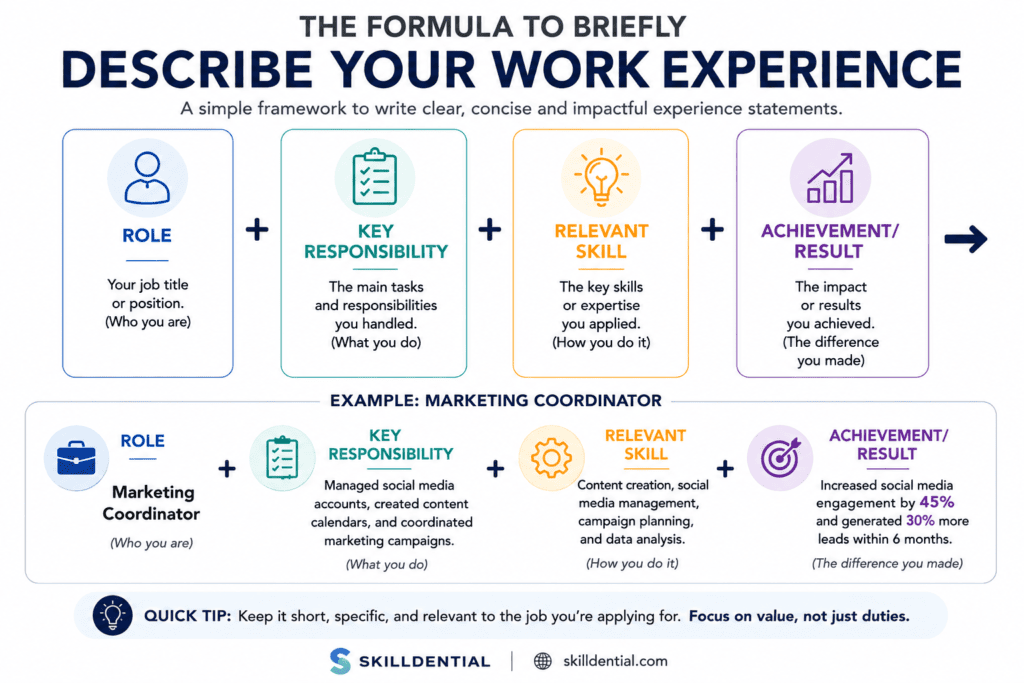
Whether you are a recent graduate, an experienced professional, a career changer, a freelancer, a volunteer, or someone returning to the workforce, learning how to describe your work experience concisely ensures your background stands out clearly and professionally.
What Should a Brief Work-Experience Description Include?
A concise professional summary relies on four core components:
- Role / Professional Area: Your job title or primary functional field.
- Context: The type of organization, industry, or environment.
- Core Responsibilities: Key duties and applied skills relevant to the target position.
- Measurable Result: A tangible achievement, outcome, or contribution.
The Core Framework
To describe your work experience clearly, apply this standard structure:
$$\text{Role} + \text{Context} + \text{Key Responsibilities} + \text{Quantified Result}$$
Example Breakdown
Strong Example
“I worked as a customer service representative for a retail company, handling customer inquiries, resolving complaints, and processing orders. I supported an average of 40 customers daily while maintaining accurate records and contributing to improved response times.”
Weak Example
“I worked in customer service and helped customers.”
Why It Works
The strong example uses clear action verbs and measurable metrics (40 customers daily) to demonstrate direct value and impact rather than listing routine tasks.
A Simple Formula to Describe Your Work Experience
Use this three-part framework to structure your response quickly:
$$\text{[Role \& Organization]} + \text{[Key Responsibility]} + \text{[Value or Achievement]}$$
Plaintext
I worked as a [role] at/in [organization or industry], where I [key responsibility or project]. I [achievement or result], using [relevant skill or tool].
Code language: JavaScript (javascript)
Formula Examples
- With Metrics: “I worked as an administrative assistant in a healthcare organization, where I managed appointments, prepared documents, and maintained confidential records. I improved the filing process by introducing a consistent digital naming system, making documents easier for staff to locate.”
- Without Metrics (Focusing on Value): “I supported the finance team by organizing invoices, updating spreadsheets, and preparing information for monthly reporting, ensuring accurate and timely records.”
How to Describe Your Work Experience Step by Step
Follow this structured six-step process to build a concise, high-impact overview of your professional background.
Step 1: Identify the Target Role
Review the job description to align your response with key skills, tools, and responsibilities.
- Example Focus (Junior DevOps Role): Emphasize deployment automation, cloud infrastructure, and troubleshooting over administrative tasks.
- Key Takeaway: Prioritize experience that directly aligns with what the hiring manager needs.
Step 2: Select Your Most Relevant Experience
Focus only on roles that demonstrate clear value or transferable skills. Relevant experience includes:
- Full-time/part-time employment & internships
- Freelance, contract, or self-employed work
- Volunteer roles & student leadership
- Key academic or personal projects
Step 3: Separate Responsibilities from Achievements
- Responsibility (What you did): Managed stock records and prepared weekly reports.
- Achievement (What you delivered): Reorganized stock records and introduced a weekly reporting template that made discrepancies easier to identify.
- Best Practice: Combine context (responsibility) with impact (achievement) for a well-rounded summary.
Step 4: Add Accurate Evidence & Metrics
Use quantifiable data to make your claims concrete without overstating results.
| Metric Type | Example Application |
| Volume / Scale | Processed ~100 customer orders weekly |
| Team Size | Co-led a cross-functional team of 5 |
| Frequency | Prepared daily reports for senior executives |
Note: Use honest estimates (e.g., “approximately 20 clients”) when exact numbers are unavailable. Avoid fabricating percentages.
Step 5: Use Precise Action Verbs
Lead with strong functional verbs to convey authority and ownership.
- Replace Weak Phrases: “Responsible for social media posts.”
- Use Strong Verbs: “Created and scheduled social media content for weekly campaigns.”
- Recommended Verbs: Analyzed, Built, Coordinated, Delivered, Implemented, Monitored, Resolved, Led.
Step 6: Match Format to Context
Adjust length and density based on where you are sharing your work experience:
| Context | Recommended Format |
| Application Form | 1 short paragraph (3–5 sentences) |
| Interview Answer | 30–90 second spoken response |
| Resume / CV | Role heading followed by bullet points |
| LinkedIn Profile | Brief overview + top achievements |
| Cover Letter | Targeted paragraph tied directly to the job post |
Examples of How to Describe Your Work Experience by Role
Adapt these templates to match your background. Always align details with your experience.
Early Career & Entry Level
- Recent Graduate: “I recently completed a degree in Computer Science and gained practical experience through academic projects and an internship. I developed web applications, worked with databases, and collaborated using Git, building strong problem-solving and programming skills.”
- Entry-Level Applicant: “I am an entry-level administrative professional with internship experience supporting document preparation, data entry, scheduling, and customer communication. I am proficient in spreadsheets and office productivity tools with strong attention to detail.”
- No Formal Work Experience: “While I do not yet have formal employment, I have built transferable skills through coursework, personal projects, and volunteer work. I completed a data analysis project, led group presentations, and managed tasks using modern productivity tools.”
Mid-Level & Technical Professionals
- DevOps / Cloud Professional: “I support software delivery using Git-based workflows, CI/CD pipelines, and cloud environments. I have configured automated build and test processes, resolved deployment issues, and partnered with developers to improve release consistency.”
- IT Support Professional: “I provided technical support by diagnosing hardware, software, and access issues, documenting incidents, and assisting with user setup and maintenance while following internal security protocols.”
- Accountant: “I worked as a junior accountant recording transactions, reconciling accounts, and preparing monthly financial schedules. This role strengthened my skills in financial documentation, accuracy checks, and deadline-driven reporting.”
- Teacher: “As a secondary school teacher, I planned lessons, delivered instruction, assessed student performance, and communicated progress to parents. I adapted learning activities for diverse ability levels using digital tools.”
Operations, Business & Management
- Manager: “I managed an operations team handling workload allocation, performance coaching, and service quality. I introduced streamlined task tracking and collaborated across departments to resolve operational bottlenecks and hit targets.”
- Administrative Assistant: “I supported daily office operations by scheduling appointments, preparing correspondence, organizing files, and maintaining spreadsheets while coordinating cross-departmental information.”
- Customer Service Representative: “I handled customer inquiries, resolved account issues, and explained services in the telecommunications sector. I managed high-volume interactions across phone and digital channels while keeping accurate records.”
Flexible & Non-Traditional Backgrounds
- Freelancer: “I work as a freelance content and digital marketing specialist, helping small businesses plan content and manage campaign materials. I handle client communication, research, writing, and delivery independently.”
- Self-Employed Professional: “I run a digital service business providing web support to local clients. I manage client requirements, project execution, and billing, combining technical execution with client relationship management.”
- Career Changer: “My background is in retail operations, where I managed customer inquiries, stock records, and daily coordination. This experience developed transferable skills in communication, accuracy, and process management that I now apply to business operations.”
- Career Break / Returner: “Before taking a career break for family responsibilities, I managed office administration and records. During my break, I completed online training in spreadsheet management and project coordination to prepare for my return to a full-time role.”
- Volunteer: “I coordinated event logistics and participant communication for a community organization, building practical skills in project coordination, teamwork, and problem-solving.”
How to Write a Strong CV Work Experience Description
To describe your work experience effectively on a CV, use a high-impact, four-part bullet-point framework:
$$\text{Action Verb} + \text{Core Task/Project} + \text{Method/Skill Used} + \text{Result or Purpose}$$
Plaintext
[Action Verb] + [Task/Project] using [Method/Skill] to achieve [Measurable Result/Purpose]
Code language: CSS (css)
Weak vs. Strong CV Descriptions
| Weak Description (Task-Focused) | Strong Description (Impact-Focused) |
| Responsible for social media management. | Created and scheduled weekly social media content aligned with campaign goals, increasing publishing consistency across primary channels. |
| Helped customers. | Resolved customer inquiries via phone and email while maintaining accurate case records and achieving a 95% satisfaction rate. |
| Worked on reports. | Prepared weekly performance reports using advanced Excel formulas and data validation to streamline management reporting. |
Core Writing Principles
- Lead with Action: Start every bullet point with a decisive functional verb (Designed, Led, Streamlined, Spearheaded).
- Show the Method: Specify the tools, skills, or frameworks you used (Python, SQL, Scrum, CRM platforms).
- Quantify the Result: Whenever possible, include metrics (saved 5 hours weekly, reduced error rate by 15%) to prove your value.
How to Answer in an Interview
When asked to describe your work experience in an interview, avoid reciting your entire employment history chronologically. Use a structured, forward-looking narrative framework:
- Current Identity: Start with your present role or core professional focus.
- Relevant Context: Highlight 1–2 previous experiences or projects that directly relate to the job.
- Core Strength / Impact: Emphasize specific skills, tools, or achievements you developed.
- The Pivot: Conclude by explicitly connecting your background to the target role.
Interview Framework
Plaintext
[Current Role / Background] ➔ [1–2 Relevant Highlights] ➔ [Key Strength / Impact] ➔ [Why This Role Next]
Code language: CSS (css)
Spoken Examples
- Early-to-Mid Career Professional: “I am an administrative professional with three years of experience supporting office operations in education and healthcare. My work focuses on scheduling, document management, and cross-departmental reporting. Over time, I’ve developed a strong skill for managing competing priorities and optimizing daily workflows, which is why I’m excited about this Operations Coordinator role.”
- Experienced Professional: “I have spent the last six years in software delivery, transitioning from application support into DevOps engineering. In my recent roles, I’ve focused on CI/CD automation, cloud infrastructure, and platform troubleshooting to maintain release stability. I’m now looking to leverage that background to drive platform reliability and infrastructure automation at scale.”
How to Tailor Your Description
To make your work experience stand out, customize your description for each application by aligning your background with the employer’s specific requirements.
Pre-Writing Checklist
Before drafting your summary, evaluate the job description by asking:
- Core Requirements: What are the top three skills or qualifications the employer prioritizes?
- Direct Evidence: Which of my past roles or projects directly demonstrate these capabilities?
- Transferable Skills: What universal skills (e.g., project management, communication) bridge any experience gaps?
- Keywords & Tools: What industry terms, frameworks, or software should I explicitly include?
- Concrete Proof: What truthful metrics or outcomes can I use to validate my performance?
Tailoring in Action
Notice how the same core background adapts to highlight different competencies based on the target position:
- Generic Base Description: “I worked in a busy office environment, supporting staff and handling documents.”
- Tailored for an Operations Role: “I supported daily office operations by coordinating schedules, maintaining digital records, tracking team requests, and preparing weekly updates for management.”
- Tailored for a Customer Success Role: “I supported internal staff and external visitors by responding to inquiries, resolving routine issues, and communicating information clearly across multiple channels.”
Tailoring does not mean changing your history—it means adjusting your emphasis to showcase the exact value the employer is looking for.
Common Mistakes to Avoid
When writing or speaking about your background, avoid these common traps to ensure your description remains authoritative, concise, and professional:
- Listing Every Single Task: Avoid exhaustive inventories of daily duties. Group minor tasks together and highlight only the top 2–3 responsibilities relevant to the target role.
- Relying on Vague Self-Praise: Generic terms like “team player” or “hard worker” lack persuasive power without context.
- Instead of: “I am a great team player.”
- Write: “Coordinated deliverables with a four-person project team to complete milestones ahead of deadline.”
- Exaggerating Ownership: Match your action verbs to your actual level of involvement. Use Supported, Contributed to, or Coordinated if you were a team member, and reserve Led, Managed, or Spearheaded for direct ownership.
- Over-Sharing Personal Data: Exclude non-professional details such as age, marital status, salary history, or unrelated personal hobbies unless specifically mandated.
- Verbatim Copy-Pasting: Incorporate keywords from the job listing naturally, but do not copy-paste lines directly from the job description.
- Breach of NDA /Confidentiality: Protect sensitive corporate data, clients, and financial figures by using general terms (e.g., “a major healthcare provider” or “a mid-market fintech client”).
- Using a One-Size-Fits-All Summary: Avoid submitting a single generic response for every application. Adjust your emphasis to align with each specific role’s top requirements.
Quick Editing Checklist
Before submitting your description, verify it meets these high-impact standards:
- [ ] Clear Identity: Clearly states your role or primary professional area.
- [ ] Targeted Alignment: Prioritizes experience directly relevant to the specific role.
- [ ] Action-Oriented: Explains what you actually delivered rather than just listing daily tasks.
- [ ] Demonstrated Value: Includes at least one clear skill, key project, measurable result, or contribution.
- [ ] Strong Action Verbs: Starts key statements with precise functional verbs (e.g., Built, Streamlined, Coordinated).
- [ ] Accurate Data: Uses truthful, easy-to-understand numbers or estimates to show scale.
- [ ] Concise Language: Eliminates conversational fluff, passive phrasing, and wordy filler.
- [ ] Consistent Tense: Uses present tense for current positions and past tense for previous roles.
- [ ] Privacy & NDAs: Protects sensitive client data, internal metrics, and unnecessary personal details.
- [ ] Length & Format Constraints: Strictly adheres to character, word, or time limits.
Pro Tip: Read your summary aloud. If it sounds like an exhaustive, disjointed list of routine duties, remove repetitive tasks and reframe the narrative around the tangible value you created.
How long should a brief work-experience description be?
For an online application, one focused paragraph of three to five sentences is standard unless character limits specify otherwise. For an interview response, aim for a concise spoken answer lasting 30 to 90 seconds.
Should I include all my previous jobs?
No. Prioritize roles that directly align with the target position. Mention older or non-adjacent work only if it fills timeline gaps or highlights relevant transferable skills.
How do I describe work experience if I have no formal jobs?
Highlight academic projects, internships, volunteer roles, freelance gigs, student leadership, or self-directed learning. Focus on applied technical skills, tools used, and key project outcomes.
Should I write in the first person?
Use “I” (first person) for online application forms, cover letters, and interview responses. Omit personal pronouns entirely on a CV or resume in favor of direct, action-led statements (e.g., “Managed customer records…” instead of “I managed customer records…”).
How can I describe work experience if I changed careers?
Frame your past roles around transferable competencies such as project management, data analysis, stakeholder communication, or workflow optimization. Highlight shared outcomes rather than technical duties specific to your former industry.
Should I mention a short-term or temporary job?
Include it if it demonstrates relevant skills, showcases project delivery, or accounts for significant timeline gaps. If the role is completely unrelated and displaces stronger evidence, compress or omit it.
In Conclusion
Mastering the art of describing your work experience concisely is one of the most high-leverage strategies you can employ to elevate your professional narrative and stand out to prospective employers.
Rather than presenting hiring managers with an exhaustive, unfiltered catalog of daily duties, an impactful overview strategically distills your background into a cohesive, value-driven summary. By consistently structuring your descriptions around the proven Role + Context + Key Contribution + Result/Value framework, you transform routine job responsibilities into compelling evidence of your professional capability.
To maximize the impact of your narrative, focus on selecting only the most relevant achievements, choosing precise action verbs, and integrating concrete, verifiable metrics whenever possible. Every sentence should serve a distinct purpose, demonstrating not just what you were assigned to do, but how effectively you executed those responsibilities and the tangible value you generated for your organization.
Tailoring this core narrative to align seamlessly with the specific requirements of each target opportunity ensures that your expertise is immediately apparent across application portals, CVs, and live interviews.
Immediate Action Step
To put these principles into practice immediately, begin by drafting a foundational three-sentence overview of your primary professional experience. Once written, critically review your draft to execute two targeted refinements: identify and remove one unnecessary or passive detail, and replace it with one specific, high-impact contribution or quantified outcome.
This simple exercise will instantly sharpen your professional pitch, converting a standard employment summary into an authoritative, performance-focused asset.