How to Verify a Startup Funding Competition Before Applying
Not every startup funding competition is worth your time, capital, or intellectual property. Before you submit a pitch deck or confidential data, you must systematically verify who operates the programme, the source of the capital, what winners actually receive, whether there are hidden application or “pay-to-pitch” fees, and the rights you surrender to the organiser.
A polished website, high-end branding, or a promotional social media post is never enough proof of legitimacy. When evaluating a new startup funding competition, founders should treat every unfamiliar opportunity as a high-risk proposal that requires strict due diligence. Running a brief verification audit on a startup funding competition protects your proprietary business model, prevents wasted cycles, and ensures your team only applies to high-ROI, reputable events.
Why You Should Verify a Startup Funding Competition
Startup founders operate under constant pressure to secure capital, build exposure, attract customers, and find mentors. That operational urgency often makes an attractive funding announcement look far more credible than it actually is.
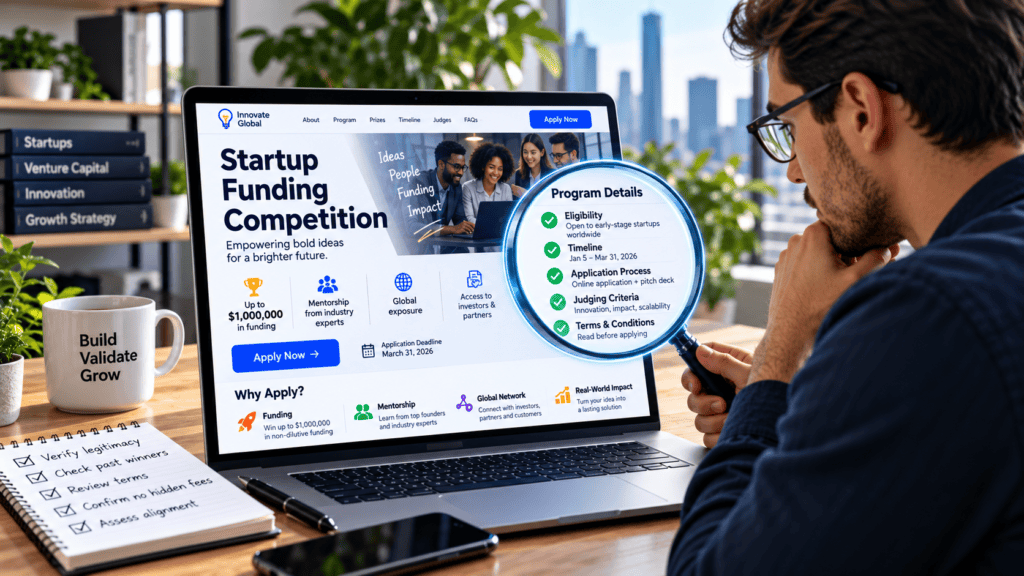
Verification helps you answer a critical strategic question: Is this opportunity worth applying to under its actual terms?
Evaluating a startup funding competition before you commit resources safeguards your venture against several distinct risks:
- Wasted Operational Bandwidth: You could easily spend dozens of high-value hours preparing custom pitch decks and financial models for a startup funding competition that ultimately does not fit your industry vertical, stage, or geographic requirements.
- Hidden Costs & Pay-to-Pitch Traps: An application or subsequent round may involve non-refundable fees, mandatory ticket purchases, or expensive conference packages disguised as entry requirements.
- Unfavorable Equity Surrender: What appears to be a non-dilutive grant or cash prize in a startup funding competition may secretly require equity stakes, warrant coverage, or unfavorable convertible note terms.
- Confidentiality Leaks: Submitting detailed financial projections and proprietary technology overviews without reviewing the organiser’s Non-Disclosure Agreement (NDA) or privacy policy can expose your intellectual property.
- Exaggerated Prize Pools: Organisers frequently market gross or combined package values (such as “value in-kind” services, software credits, and mentorship hours) rather than actual cash capital.
- Data Harvesting & Phishing Scams: A fraudulent startup funding competition may be engineered purely to harvest personal, financial, or sensitive proprietary business information.
Government agencies routinely warn businesses about fraud involving financial opportunities, impersonation, and phishing. For instance, the U.S. Small Business Administration’s Office of Inspector General explicitly advises businesses to verify all communications through official channels and warns against grant fraud and deceptive solicitations.
Not every unfamiliar startup funding competition is a scam, but treating verification as a core component of your operational due diligence ensures your venture remains protected.
Start with the Organisation Behind the Competition
The first and most critical step in evaluating a startup funding competition is identifying who is actually running it. Never rely solely on the branding or title of the event itself. You must trace the competition back to its parent entity and verify whether it has a credible, independently verifiable presence.
Key Verification Checkpoints
When auditing the organiser of a startup funding competition, search for the following baseline indicators:
- Official Corporate Presence: An active, secure official website belonging to the parent organisation, not just a landing page for the event.
- Legal Registration: A valid legal entity name, corporate registration number, or non-profit status where applicable in its operating jurisdiction.
- Verifiable Contact Information: Real physical office addresses, working business phone numbers, and professional support channels.
- Named Leadership & Team: Real human organisers, directors, and judges with verifiable professional backgrounds and LinkedIn profiles.
- Track Record of Past Programmes: Documented evidence of previous editions, historical events, or related initiatives managed by the same team.
- Past Winners & Alumni: Publicly verifiable past participants or portfolio companies that you can independently contact or cross-reference.
- Independent External References: Media coverage, press releases, or industry mentions from trusted third-party publications.
- Digital Consistency: Coherent branding, timelines, and operational histories across their website, LinkedIn, and social media channels.
Pay close attention to inconsistencies. For instance, if a startup funding competition claims to be in its fifth annual cycle, but you cannot find any digital footprint, press mentions, or past winners from years one through four, treat this as a major red flag requiring deep investigation before submitting an application.
Don’t Confuse Branding with Verification
A professional logo, polished website design, high-end promotional video, or a large social media following does not independently establish legitimacy. Anyone can purchase professional web assets in an afternoon.
The U.S. Small Business Administration (SBA) has repeatedly warned that even the presence of an official-looking government logo or seal on a webpage does not guarantee that the information is accurate or officially endorsed. The exact same principle applies to any startup funding competition—slick marketing is never a substitute for empirical due diligence.
Find the Original Application Page
If you discovered a startup funding competition through a social media post on LinkedIn, X, TikTok, Facebook, or messaging apps like WhatsApp and Telegram, do not immediately click through and fill out application forms. Social media ad algorithms and sponsored posts are frequently targeted by bad actors or low-quality promoters.
Instead, execute an independent search to locate the primary source.
Recommended Search Queries
Use targeted search strings to isolate authentic domains and historical records for the startup funding competition:
"Competition Name" official"Competition Name" application"Competition Name" winners"Competition Name" previous edition"Competition Name" organiser"Competition Name" terms and conditions
Cross-Referencing Discrepancies
Compare the social media announcement side-by-side with the official website and check for discrepancies across these core details:
- Domain Integrity: Ensure the website uses a secure, established domain (
.org,.edu,.com, or official government extensions) rather than suspicious free domain extensions or typosquatting URLs. - Deadlines & Timelines: Verify that application windows match across all promotional materials and official portals.
- Eligibility Rules: Check whether geographic restrictions, funding stages, or industry verticals align.
- Prize Structures: Confirm that the advertised cash funding matches the official rulebook.
- Organiser Identity: Validate that the listed legal entity matches across official disclosures and social media profiles.
If the information differs substantially between the promotional post and the official site, stop immediately and investigate the root cause before submitting any company data.
Verify What “Funding” Actually Means
The word “funding” is frequently used as a blanket term to describe vastly different financial arrangements. A startup funding competition might offer several distinct packages under the banner of prize money:
| Funding Type | What It Means |
| Grant | Capital awarded without requiring equity, though strict compliance or reporting conditions may apply. |
| Prize | Cash or other benefits awarded directly to winners based on competitive evaluation. |
| Equity Investment | Capital provided directly in exchange for a percentage of ownership in your company. |
| Convertible Instrument | Financing (such as a SAFE or convertible note) that converts into equity during a future financing round. |
| Accelerator Investment | Capital combined with mandatory mentoring, network access, and programmatic terms. |
| In-Kind Support | Software credits, legal services, workspace, cloud credits, or non-cash perks. |
Never stop at a catchy headline like “Win $100,000 for your startup.” You must dig into the fine print to discover what that $100,000 actually represents:
- Is it actual liquid cash?
- Is it a non-dilutive grant or a taxable prize?
- Is it an equity investment that dilutes your cap table?
- Is a portion of it made up of “in-kind” software credits and service packages?
- Is it a combination of cash and mandatory accelerator participation fees?
For example, programmes like Techstars publicly disclose that their accelerator funding involves standardized equity investments and specific legal terms rather than acting as a simple cash grant. Furthermore, their terms and investment structures evolve, highlighting why founders must read the current legal disclosures rather than relying on outdated blog posts, third-party summaries, or social media announcements.
Headline numbers are designed to capture attention. Understanding the actual structure of a startup funding competition protects your cap table and cash flow.
Check Whether You Are Giving Up Equity
This is one of the most critical legal checks for founders evaluating a startup funding competition. If the programme provides investment rather than a non-dilutive grant or cash prize, you must determine precisely what ownership stake or financial rights the organiser receives.
Key Terms to Look For
Scrutinize the legal terms, FAQ sections, and application rulebooks for words such as:
- Equity
- Shares or Common Stock
- Ownership percentage
- SAFE (Simple Agreement for Future Equity)
- Convertible note or convertible debt
- Valuation cap and discount rate
- Dilution
- Investment agreement or term sheet
- Right of first refusal (ROFR)
Never assume an opportunity is non-dilutive simply because its marketing uses friendly terms like competition, award, prize, or funding.
A Simple Hypothetical Example
Suppose a startup funding competition offers a $50,000 investment in exchange for a 5% equity stake.
- The founder is not simply receiving a $50,000 cash prize.
- The founder is entering into an equity financing transaction that permanently alters the company’s cap table.
This trade-off has profound long-term implications for:
- Founder Ownership: Immediate dilution of your current shareholding.
- Future Fundraising: How incoming seed or Series A investors will view the existing terms.
- Company Control & Governance: Voting rights or board seats granted to the competition organiser.
- Exit Proceeds: How future acquisition or IPO payouts will be distributed.
Because the exact legal and financial consequences depend heavily on corporate jurisdiction and binding contract language, founders should always obtain professional legal counsel before signing material investment agreements tied to any startup funding competition.
Look Carefully at Application Fees
An application fee always deserves close scrutiny, though a fee by itself does not automatically prove that a startup funding competition is fraudulent. Legitimate organisations operate under diverse business models—such as non-profit operational support or covering administrative evaluation costs—and may have valid reasons for charging submission fees.
The core question is whether the fee structure is transparently disclosed upfront and whether the potential ROI justifies the cost.
Key Questions to Ask About Fees
Before submitting any payment for a startup funding competition, audit the fee mechanics against these checkpoints:
- Cost Quantum: Exactly how much is the application fee, and is it scaled by company stage?
- Timing: When in the process is the fee charged (e.g., initial submission vs. semi-finalist review)?
- Refundability: Is the fee entirely non-refundable if your startup is rejected in the first round?
- Value Breakdown: What specific operational services does the fee cover (e.g., dedicated mentor feedback sessions, judge scoring reports, or event access)?
- Fee-Free Alternatives: Is payment mandatory, or does the organiser offer fee waivers for early-stage founders, underrepresented groups, or specific geographic regions?
- Recipient Identity: Is the payment processed through a secure, verifiable merchant account tied to the official legal entity of the organiser?
- Hidden Upsells: Are there subsequent mandatory fees required later in the funnel (e.g., mandatory ticket purchases for pitch days, showcase booth fees, or conference travel costs)?
Watch for Upfront Fee Scams
Exercise extreme caution when an unfamiliar startup funding competition frames itself primarily as a major cash award or grant program, yet repeatedly demands upfront payments, “processing fees,” “insurance deposits,” or “tax clearance charges” before releasing any funds.
Government regulatory bodies and fraud prevention agencies—including the U.S. Small Business Administration (SBA)—consistently warn businesses and consumers about deceptive financial schemes that demand money upfront in exchange for guaranteed loans, grants, or financial assistance. Legitimate investors and reputable sponsors never require founders to pay out of pocket to receive prize capital or grant allocations.
Read the Terms and Conditions Before Submitting
Never treat the terms and conditions or official rulebook of a startup funding competition as an afterthought. Hidden within dense legal clauses are critical disclosures governing your rights, intellectual property, and financial exposure.
Key Clauses to Scrutinize
Carefully review the terms for provisions covering:
- Intellectual Property (IP): Ownership rights to your proprietary software, code, inventions, or trade secrets mentioned in your pitch deck.
- Confidentiality: Whether the organiser guarantees that your submitted financials and business models are kept strictly confidential (or whether judges and attendees sign NDAs).
- Data Usage & Privacy: How the organiser stores, uses, or shares your personal contact data and corporate metrics.
- Publicity Rights: Permissions granted to the organiser to record, broadcast, or market your pitch, logo, and leadership photos.
- Equity & Financial Terms: Binding clauses regarding stock ownership, SAFEs, or convertible note issuance.
- Fee & Refund Structures: Explicit rules regarding application fees, payment processing, and non-refundable deposits.
- Winner Obligations: Mandatory post-winning requirements, such as relocating to a specific city, attending mandatory showcases, or giving up future advisor shares.
- Eligibility & Disqualification: Strict operational rules that could disqualify your startup mid-competition without notice.
- Governing Law & Dispute Resolution: Which legal jurisdiction and courts hold authority if a formal legal dispute arises.
The IP & Publicity Trap
One of the most vital questions to answer before applying to any startup funding competition is: What rights do you give the organiser simply by submitting your application?
Many competitions include broad licenses allowing organisers to use your company name, logo, pitch materials, and video recordings for promotional, marketing, or archival purposes. While granting standard publicity rights is common for legitimate media events, overly aggressive clauses might inadvertently grant organisers the right to distribute your pitch deck publicly or share your proprietary insights with third-party corporate sponsors without your consent.
Reading the terms ensures you retain total control over your intellectual property while evaluating a startup funding competition.
Protect Your Intellectual Property
Founders often become so hyper-focused on securing capital that they overlook the proprietary data they hand over during the application process. For an early-stage venture, safeguarding your intellectual property (IP) is just as critical as winning funding.
Questions to Ask Before You Submit
Before uploading pitch decks, financial models, or technical briefs to any startup funding competition, get clear answers to these operational questions:
- Scope of Disclosure: What information is genuinely required for the initial screening versus what is optional?
- Access Control: Exactly who has permission to view your documents (e.g., administrative staff, external mentors, corporate sponsors, or public audiences)?
- Data Handling: How will your files be stored, and are they permanently deleted after the competition concludes?
- Confidentiality Guarantees: Do the competition rules explicitly address data confidentiality, or are submissions treated as non-confidential public domain information?
- Judge Obligations: Are the evaluation panels and judges bound by written non-disclosure agreements (NDAs)?
- Public Broadcasts: Can your recorded pitch, business plan, or slide deck be published online or shared with media partners without your prior sign-off?
What to Withhold
You should strictly avoid sharing unnecessary, highly sensitive information during early evaluation rounds. Never submit proprietary source code, admin passwords, private API credentials, unreleased cybersecurity vulnerability details, or deep trade secrets unless a rigorous, bilateral NDA is signed and the disclosure is absolutely mandatory for technical due diligence in advanced rounds.
Protecting your core innovations ensures that participating in a startup funding competition accelerates your growth rather than exposing your competitive advantage.
Verify Previous Winners
A credible startup funding competition always leaves a verifiable digital footprint. If an event claims to have a rich history, it should point to real people, companies, and institutions that you can independently investigate.
What to Check and Cross-Reference
Scan the competition’s historical archives or past announcement pages for names and entities you can audit:
- Past Winners & Finalists: Look for named startups and their founders from previous years.
- Cohort Directories: Check for structured batch lists or alumni directories.
- Judges & Mentors: Identify prominent industry experts, venture capitalists, or academic figures listed as past evaluators.
- Partner Organisations: Look for corporate sponsors, venture funds, accelerators, or universities officially tied to past editions.
- Historical Events & Press: Search for archived press releases, media coverage, or video recordings of past pitch days.
How to Run Spot-Checks
You do not need to audit every historical claim, but running a few representative spot-checks will quickly reveal whether the startup funding competition has a genuine track record:
- Founder & Startup Audits: If the website claims that Startup X won the 2024 edition, search for Startup X on LinkedIn or major tech media outlets. Check if their founders acknowledge winning the award and whether their company timeline aligns.
- Judge Outreach: If reputable industry leaders are listed as past judges, a quick search should confirm their association or past public statements regarding the event.
- Alumni Verification: Reach out briefly to a past finalist via LinkedIn to ask about their actual experience with the programme if you have major doubts.
Performing these targeted checks ensures you are investing your time into an established startup funding competition with a real, documented history rather than an unverified pop-up event.
Verify the Judges, Partners, and Sponsors
A startup funding competition often highlights an impressive roster of judges, venture capital partners, academic institutions, corporate sponsors, or government agencies to establish instant credibility.
Never take these association claims at face value.
How to Audit External Partners
If a competition website lists a well-known investor, university, corporation, or accelerator as a partner or sponsor, look for official cross-confirmation from the partner’s own channels:
- Sponsor & Partner Directories: Check the partner organisation’s official website, press room, or partner page to see if the startup funding competition is explicitly listed.
- Judge Public Profiles: Search professional networks like LinkedIn or company bios to confirm whether named judges or mentors publicly acknowledge their involvement with the event.
- Press Releases & Announcements: Look for mutual press releases or co-branded announcements issued by the partner entity during the launch window.
Beware of Unauthorized Logos
The presence of a famous corporate logo or institutional seal on a landing page is simply a claim made by the organiser, not proof of partnership. Unscrupulous operators frequently display the logos of major tech companies, venture funds, or universities without permission to manufacture false prestige.
As noted by regulatory authorities like the U.S. Small Business Administration (SBA), individuals should always cross-reference claims involving official programmes through verified government and corporate channels rather than trusting a standalone webpage logo.
The underlying rule of operational due diligence is simple: A logo on a website is just a marketing claim. Independent confirmation from the partner is actual proof.
Check the People Behind the Programme
Researching the human operators behind a startup funding competition is one of the most reliable ways to separate legitimate initiatives from fraudulent operations or amateur pop-up events.
Key Professional Indicators to Audit
When investigating organisers, directors, and board members, look for a deep, consistent digital footprint:
- Professional History: Verifiable career trajectories spanning multiple years within venture capital, tech accelerators, entrepreneurship education, or economic development.
- Previous Companies & Programmes: Documented evidence of past startups founded, managed, or successfully exited, or prior accelerator cohorts they directed.
- Professional Networks: Active LinkedIn profiles with detailed work histories, peer recommendations, and mutual connections in the industry.
- Public Thought Leadership: Conference appearances, keynote speaking engagements, podcast interviews, or published articles discussing venture funding and ecosystem growth.
- Investment Track Record: For competitions backed by funds or angel syndicates, verify past portfolio investments or public syndicate memberships.
- Consistent Professional Identities: Coherent online personas where an individual’s personal branding aligns seamlessly with the official entity running the startup funding competition.
Red Flags & Impersonation Tactics
Exercise extreme caution when encountering profiles that appear newly created, feature generic or stock photography, contain sparse employment histories, or show no professional connection to the organising entity outside of the current event.
Bad actors frequently use sophisticated impersonation tactics, cloning the digital identities of legitimate industry leaders. They routinely steal:
- High-resolution photographs of well-known venture capitalists or startup founders.
- Executive names and titles to list as fake “advisors” or “head judges.”
- Corporate logos and website templates to mimic reputable institutions.
- Social media posts and promotional copy.
The Ultimate Verification Test
The core question is never simply: “Does this person exist in the real world?”
The critical test you must run is: “Can I verify independently that this specific person is actively and officially associated with this exact startup funding competition?” If a renowned investor or founder is listed as a lead organiser or head judge, look for a public announcement, tweet, or statement on their verified personal channels confirming their involvement.
Check the Communication Channels
Pay close attention to how the organisers of a startup funding competition communicate with applicants. Legitimate initiatives always operate through transparent, institutional communication lines.
Red Flags in Communication
Be immediately cautious if someone claiming to represent the programme reaches out through unverified or informal channels, such as:
- Generic Webmail Accounts: Unrelated personal email addresses or free public domains like
@gmail.comor@outlook.cominstead of a custom corporate domain matching the organiser’s official website. - Direct Messaging Apps: Unsolicited outreach via WhatsApp, Telegram, or Signal from individuals claiming to be judges or directors.
- Altered Social Media Profiles: Accounts on LinkedIn, X, or Instagram featuring slight misspellings, newly created handles, or missing verification badges.
The Verification Protocol
While smaller or grassroots organisations occasionally use third-party messaging tools for logistics, you should never blindly trust an incoming message.
Instead, execute a cross-verification check:
- Independent Outreach: Take the sender’s name and title, go directly to the official website of the startup funding competition, and use their official contact form, support email, or verified corporate directory to confirm if the outreach is genuine.
- Inquire Through Official Portals: If someone contacts you claiming you have advanced to the next round or won a prize, independently log into the competition’s official application dashboard to verify your status.
Regulatory Warnings on Messaging Fraud
Financial regulators frequently issue alerts regarding online investment and funding scams. For instance, the U.S. Securities and Exchange Commission (SEC) has repeatedly highlighted fraud schemes where bad actors leverage online communication platforms, social media groups, and messaging services like WhatsApp to build false credibility, establish rapport, and ultimately solicit upfront fees or private data from unsuspecting victims.
Applying strict communication verification protocols ensures your venture remains safe from impersonators targeting participants in any startup funding competition.
Be Careful With Requests for Sensitive Information
A legitimate startup funding competition will naturally require core business data to evaluate your venture—such as pitch decks, financial summaries, market sizing, team backgrounds, and product roadmaps.
However, you must draw a sharp line between standard business diligence and dangerous requests for private data.
Red Flags: Dangerous Data Requests
Stop immediately if an unfamiliar startup funding competition or its purported organisers ask for:
- Banking Passwords or Login Credentials: Direct access to your business or personal bank accounts.
- Authentication & MFA Codes: One-time passwords (OTPs) or two-factor authentication tokens sent to your phone or email.
- Cryptocurrency Wallet Recovery Phrases: Seed phrases, private keys, or wallet credentials under the guise of “token allocation” or “treasury setup.”
- Full Payment-Card Credentials: Full credit card numbers, CVV codes, or PINs entered outside of a secure, reputable merchant payment processor.
- Excessive Identity Documents: Unnecessary government-issued IDs, tax identification numbers, or social security numbers before any formal, verified background screening or finalist stage.
- Personal Passwords: Credentials for your company’s cloud infrastructure, source code repositories, or email accounts.
- Remote Access: Permission to install third-party software or establish remote desktop access to your computer.
- Upfront Capital Transfers: Large wire transfers, “insurance fees,” or tax deposits before funds are disbursed.
Regulatory Warnings on Phishing
Security and regulatory bodies—including the U.S. Small Business Administration (SBA)—consistently issue alerts warning businesses about sophisticated phishing campaigns designed to harvest personally identifiable information (PII), capture banking credentials, or trick users into installing malicious software under the guise of financial opportunities or grant applications.
If an information request feels disproportionate, intrusive, or completely irrelevant to an early-stage application form, halt the process immediately and verify the request through the official institutional channels of the startup funding competition.
Search for Complaints and Independent Reporting
When researching a startup funding competition, you must actively look beyond the organiser’s marketing materials and positive press releases. A comprehensive due diligence audit requires investigating what independent sources, past applicants, and regulatory bodies have to say about the entity.
Recommended Search Queries
Run targeted searches combining the organiser’s name, parent company, or specific event title with risk-focused keywords:
"Organisation Name" scam"Organisation Name" complaint"Organisation Name" review"Organisation Name" fraud"Organisation Name" lawsuit"Organisation Name" application fee"Organisation Name" previous winners"Organisation Name" founder experience
Where to Look for Independent Evidence
Cast a wide net across credible public repositories:
- Reputable Tech & Business Publications: Look for independent journalism, investigative reports, or startup ecosystem write-ups covering the competition or its parent organisation.
- Professional Communities & Forums: Search discussions on platforms like Hacker News, specialized subreddits, or founder networks (e.g., Indie Hackers, Y Combinator WorkAtAStartUp) where real entrepreneurs share candid experiences.
- Regulatory Databases & Better Business Bureaus: Check regional consumer protection agencies, corporate registries, and fraud reporting databases for active legal actions or formal warnings.
How to Evaluate What You Find
Online feedback requires nuanced interpretation:
- Weighing Anonymous Complaints: A single, isolated anonymous complaint on a forum does not definitively prove an organisation is fraudulent—disgruntled applicants frequently leave harsh reviews after being rejected. Conversely, the complete absence of negative reviews does not guarantee legitimacy, especially for newly minted pop-up entities.
- Spotting Systematic Patterns: Look for consistent patterns across multiple independent sources. If multiple founders report hidden fees, unresponsive organisers, phantom cash prizes, or unannounced equity grabs, treat it as a critical warning sign.
Your ultimate objective is to aggregate verified evidence from diverse, independent channels to build an accurate risk profile before committing your startup’s time and capital to any startup funding competition.
Check Whether the Opportunity Fits Your Startup
An opportunity can be entirely legitimate and still be a poor use of your company’s resources. Before you invest time and capital in a startup funding competition, evaluate strategic alignment across five core operational dimensions:
Stage Alignment
- Target Maturity: Is the competition specifically built for idea-stage founders, pre-seed startups, seed-stage companies, or Series A and beyond? Applying to a growth-stage competition with an unvalidated concept results in an automatic rejection and wasted cycles.
Geographic & Jurisdictional Scope
- Eligibility Rules: Does the competition accept startups from your home country or corporate jurisdiction? Some programmes are strictly local, while others welcome international founders or require physical presence and incorporation in specific regions (e.g., Delaware C-Corps or UK Ltd entities).
Industry Vertical Focus
- Sector Restrictions: Does the event align with your core product? Many programmes focus exclusively on specific sectors such as:
- Fintech or Decentralized Finance
- Healthtech and Digital Health
- Climate Technology and Clean Energy
- Artificial Intelligence and Deep Tech
- Agriculture and Agtech
- Education and Edtech
- Consumer Technology
Traction & Operational Requirements
- Prerequisites: Check what milestones are mandatory before application submission. Does the rulebook require proven monthly recurring revenue (MRR), an active user base, a deployed working prototype, registered intellectual property, an officially incorporated company, or prior institutional investment?
Funding Objective Compatibility
- Strategic Fit: Does the opportunity provide what your business actually needs at this exact growth phase? For example, a bootstrapped founder looking strictly for non-dilutive grant capital should not treat an equity-heavy accelerator competition as an equivalent alternative.
Ensuring tight alignment between your startup’s current metrics and the rules of a startup funding competition guarantees high operational efficiency and maximizes your conversion odds.
Calculate the Real Return on Your Application Effort
Your time, attention, and operational bandwidth are among your startup’s most scarce and valuable resources. Before your team spends days drafting custom pitch decks, refining financial models, and filling out complex application forms, you must calculate the true opportunity cost.
Key Questions to Evaluate ROI
Assess the true return on investment (ROI) of a startup funding competition by answering these operational questions:
- Time Investment: Exactly how many total hours will your leadership team spend researching, writing, and submitting the application?
- Financial Cost: What are the direct monetary expenses, including application fees, software subscriptions, or travel costs?
- Prize Relevance: Is the financial award meaningful enough to move the needle for your company at its current stage?
- Investor Access: Does the programme unlock verifiable access to active angel investors, venture capitalists, or strategic partners who match your sector?
- Geographic & Market Reach: Will participation genuinely accelerate your customer acquisition or brand awareness in your target markets?
- Mentorship Quality: Do the promised mentorship and partnership benefits consist of high-caliber, practical guidance, or are they superficial perks?
- Post-Winning Obligations: What ongoing reporting, residency, or operational burdens are tied to accepting the prize?
- Consolation Outcomes: What do you retain if you do not win—such as reusable slide assets, refined pitch delivery, or initial feedback from judges?
The Decision-Making Principle
You do not need to predict your exact statistical chances of winning a startup funding competition.
Instead, evaluate whether the baseline investment of your team’s time and capital is justifiable based strictly on the potential secondary benefits and the immediate funding reward. If the time spent preparing could be better allocated toward direct sales, product development, or talking to actual customers, skip the competition and protect your runway.
Startup Funding Competition Verification Checklist
Before your team invests valuable hours and capital into a startup funding competition, run through this systematic audit checklist. If several of these core questions remain unanswered or raise red flags, pause your application immediately.
| Audit Category | Verification Question | Key Focus & Action Item |
| Organiser | Can I independently verify who runs it? | Trace the competition back to a real legal corporate entity, not just a temporary promotional landing page. |
| Website | Am I using the genuine official website? | Check domain integrity, avoid typosquatting URLs, and cross-reference links from official corporate channels. |
| History | Can I verify previous editions? | Confirm that past events actually occurred and left a verifiable digital footprint over previous years. |
| Winners | Can I verify previous winners or finalists? | Spot-check past alumni or founders via LinkedIn or independent tech media to validate their experience. |
| Funding | Is the advertised amount clearly explained? | Distinguish between gross marketing totals, service packages, and actual liquid cash awards. |
| Funding Type | Is it a grant, prize, investment or something else? | Clarify whether the capital is non-dilutive or tied to programmatic terms and accelerator structures. |
| Equity | Will I give up ownership? | Review the fine print for SAFEs, convertible notes, or stock ownership transfers that dilute your cap table. |
| Fees | Are there application or participation fees? | Verify whether fees are transparent, justifiable, or indicative of an upfront fee scam. |
| Terms | Have I read the complete terms? | Scrutinize the rulebook for hidden winner obligations, governing law, and disqualification clauses. |
| IP | Do I understand what happens to my submitted material? | Ensure your core intellectual property, source code, and trade secrets remain strictly protected. |
| Data | Do I understand how my information will be used? | Review data privacy policies regarding how corporate metrics and contact details are stored or shared. |
| Judges | Can I verify the listed judges? | Cross-reference expert panels and mentors through their independent professional profiles and channels. |
| Partners | Can I independently confirm important partnerships? | Check partner and sponsor websites to verify that brand logos represent genuine collaborations. |
| Communication | Are emails and messages coming through verifiable channels? | Avoid unverified outreach from personal webmail accounts, WhatsApp numbers, or altered social handles. |
| Security | Is anyone requesting unnecessary sensitive information? | Refuse dangerous requests for banking passwords, crypto keys, or payment credentials. |
| Fit | Does the opportunity match my stage and location? | Confirm strict alignment with your startup’s maturity, industry vertical, and geographic jurisdiction. |
| ROI | Is the application effort justified? | Calculate the true opportunity cost of your team’s time against the potential financial and strategic return. |
Common Red Flags to Investigate
No single warning sign automatically proves that a startup funding competition is fraudulent or predatory. Legitimate programmes can occasionally experience administrative hiccups or poor communication. However, when multiple unexplained red flags cluster together, your level of operational scrutiny should rise immediately.
Key Warning Signs to Watch For
- Guaranteed Funding Claims: Promises of guaranteed capital, grants, or investments with virtually zero eligibility criteria, vetting processes, or competitive hurdles.
- Aggressive Pressure to Pay: Forced urgency requiring immediate payment of application, processing, or “administrative” fees under threat of disqualification.
- Anonymous or Vague Organisers: Organisers who hide behind generic corporate names, lack physical office addresses, or refuse to disclose their parent legal entity.
- Phantom History & Missing Winners: Complete inability to find any verifiable digital footprint, past alumni, or historical records of previous editions.
- Inconsistent or Free Contact Details: Official communications originating from personal webmail addresses (
@gmail.com) rather than secure corporate domains, or mismatched contact info across platforms. - Unexplained Fee Escalations: Hidden fee structures that multiply as you advance through the rounds (e.g., mandatory showcase booth fees or pitch-day ticket purchases).
- Surprise Equity Surrenders: Terms that suddenly introduce mandatory stock ownership, SAFE notes, or warrant coverage after marketing the event as a non-dilutive grant.
- Dangerous Credential Requests: Inappropriate demands for bank passwords, crypto wallet seed phrases, two-factor authentication codes, or remote computer access.
- Intrusive Financial Mining: Requests for deeply sensitive financial data or tax identifiers far beyond what an early-stage application genuinely requires.
- Unverifiable Sponsors & Partners: Prominent institutional logos displayed on landing pages without any matching cross-confirmation on the partner organisations’ official sites.
- Promotional Discrepancies: Major contradictions between viral social media announcements and the actual rules listed in the official terms and conditions.
- Mandatory Secrecy: Instructions requiring founders to keep the competition details strictly confidential, which often serves to isolate applicants from external advice.
- Exclusive Private Messaging: Directing all communication exclusively through unverified messaging apps (such as WhatsApp, Telegram, or Signal) rather than official portals.
- Unsubstantiated Government Claims: Vague assertions of official government backing, public grants, or regulatory endorsement that cannot be cross-referenced via official state channels.
- Too-Good-to-Be-True Promises: Prize structures, valuations, or cash amounts that appear radically disproportionate to the actual scope and reputation of the organising body.
The Regulatory Context
Financial regulators and consumer protection agencies have extensively documented cases where bad actors leverage sophisticated digital deception—including false regulatory claims, forged documentation, professional-looking websites, and encrypted messaging platforms—to manufacture a veneer of legitimacy.
When evaluating any unfamiliar startup funding competition, always trust verified empirical evidence over polished marketing claims. If multiple red flags are triggered, protect your venture by walking away.
Don’t Confuse “Legitimate” with “Worth Applying to”
This distinction is fundamental to strategic founder due diligence. An opportunity can be completely genuine and transparently operated, yet still be an absolute waste of time and capital for your specific venture.
For example, a legitimate, world-class accelerator will require an equity stake in exchange for capital and programming. That does not make it a scam; it simply means you are entering into a formal equity financing arrangement rather than receiving a non-dilutive grant.
Similarly, an authentic competition might charge an application fee to cover the administrative overhead of expert evaluations. Whether that fee makes sense depends entirely on the transparency of the terms, the reputation of the organisers, the tangible benefits provided, and your company’s current cash flow.
To protect your startup’s runway and focus, your pre-application due diligence must answer two distinct questions:
Question 1: Is the opportunity genuine?
- Focus: Verify the organiser’s legal identity, historical track record, official website integrity, funding claims, partner associations, communication channels, and terms and conditions.
Question 2: Is the opportunity suitable for my startup?
- Focus: Evaluate your company’s maturity stage, geographic jurisdiction, industry vertical alignment, funding structure, long-term equity implications, post-winning operational obligations, and true opportunity cost.
You must successfully answer both questions before committing your team’s limited bandwidth and resources to any startup funding competition.
A Faster Five-Minute Screening Process
You do not need to execute exhaustive, multi-day due diligence on every single startup funding competition that crosses your radar. To protect your operational bandwidth, implement a disciplined two-stage evaluation framework.
Stage 1: Quick Five-Minute Screening
Spend no more than five minutes auditing the high-level parameters of the opportunity. If it fails this initial gate, drop it immediately and move on:
- Who runs it? Can you instantly identify a clear, credible parent organisation?
- Is there an official website? Does it operate on a secure, professional domain rather than a sketchy landing page?
- Can I verify the organisation? Does a quick web search confirm an independent corporate presence?
- What exactly is being offered? Is the funding transparently defined, or is it hidden behind vague marketing buzzwords?
- Is there a fee? Are application fees clearly stated upfront?
- Is equity involved? Does the headline prize conceal a mandatory equity grab or SAFE note?
- Does it fit my startup? Does it align with your current stage, industry vertical, and geographic jurisdiction?
- Are there obvious red flags? Do you spot immediate warning signs like guaranteed funding claims or suspicious contact methods?
If an opportunity fails this initial screen, do not waste hours preparing a pitch deck.
Stage 2: Detailed Verification & Deep Dive
Reserve your team’s heavy operational resources exclusively for opportunities that successfully clear Stage 1:
- Read the complete terms and conditions from start to finish.
- Verify the human organisers via LinkedIn and professional track records.
- Check previous winners, finalists, and alumni through independent sources.
- Verify major partners and sponsors directly on their own corporate websites.
- Investigate the exact funding structure (cash, grant, equity, convertible debt, or in-kind perks).
- Review data privacy and intellectual property provisions to protect your core technology.
- Research complaints, lawsuits, and independent forum coverage regarding the organiser.
- Calculate the real opportunity cost of your team’s time against potential returns.
- Seek professional legal and financial advice when material equity or investment agreements are involved.
This two-stage methodology ensures your startup filters out predatory traps and poor-fit events early, allowing your leadership team to focus entirely on high-ROI opportunities that genuinely accelerate growth.
What to Do If You Suspect a Competition Is Fraudulent
If your due diligence raises serious warning signs or you suspect that a startup funding competition is fraudulent, halt all communication immediately. Do not submit any further company data, personal information, or funds until you can independently verify the opportunity.
Preserve All Evidence
Before cutting contact or clearing browser sessions, capture and save physical or digital copies of all touchpoints:
- Email threads and message logs (including headers, sender addresses, and timestamps).
- Screenshots of landing pages, social media ads, and application portals.
- Exact website URLs and domain registration details.
- Downloaded application PDFs, rulebooks, and terms and conditions.
- Payment requests, invoices, wire instructions, or merchant links.
- Direct messages from WhatsApp, Telegram, or LinkedIn.
Take Immediate Defensive Action
If you have already compromised your security or exposed assets, act swiftly to minimize the damage:
- Financial Accounts: If you shared banking details, credit card numbers, or sent wire transfers, contact your bank or financial institution immediately to freeze accounts, halt pending transactions, or report fraudulent charges.
- Credentials & Passwords: If you entered passwords, access tokens, or API keys anywhere on a suspicious portal, change your credentials across all core company systems immediately and enable hardware-backed multi-factor authentication (MFA).
Report to the Appropriate Authorities
Reporting fraudulent or deceptive schemes helps protect the broader entrepreneurial ecosystem. The correct agency or reporting channel depends entirely on your jurisdiction, the nature of the transaction, and the entities involved:
- Securities Regulators: In the United States, bodies like the Securities and Exchange Commission (SEC) provide investor-protection resources and dedicated reporting channels for suspected investment fraud.
- Small Business Authorities: For matters involving government impersonation, grant fraud, or federal programme misuse, organizations like the U.S. Small Business Administration (SBA) Office of Inspector General maintain active fraud-reporting hotlines.
- Local Law Enforcement & Cybercrime Units: Contact your local police cybercrime division, consumer protection agency, or national fraud-reporting center (such as the Internet Crime Complaint Center / IC3 in the U.S., or Action Fraud in the UK) to file an official complaint.
Would you like to review the complete, compiled guide for How to Verify a Startup Funding Competition Before Applying for final publication on Skilldential?
How can I tell if a startup funding competition is legitimate?
Start by independently verifying the organiser, official website, previous winners, funding claims, judges, partners, application terms, and communication channels. Never rely solely on the competition’s own marketing claims or promotional social media ads.
Is an application fee automatically a scam?
No. An application fee by itself does not establish that a startup funding competition is fraudulent. However, the fee must be transparently disclosed upfront, and you should carefully evaluate what you are paying for, whether alternative fee waivers exist, and what additional costs may follow.
Should I give my business bank details when applying?
Only provide information that is genuinely required for initial evaluation, and do so only after thoroughly verifying the organisation. Never provide bank login passwords, authentication codes, wallet seed phrases, or credit card credentials simply because someone claims they are needed to disburse funding.
Are startup competitions the same as startup accelerators?
No. A startup funding competition typically awards a one-off prize or grant to selected winners based on a pitch event, whereas an accelerator provides a structured, time-bound mentorship programme and typically takes an equity stake in participating companies. Always read the current legal terms to confirm the exact structure.
How do I check whether a company listed as a sponsor is really involved?
Visit the sponsor or partner organisation’s own official website, press room, or verified corporate channels to look for independent confirmation of the partnership. A logo displayed on a competition landing page is just a marketing claim, not proof of collaboration.
Should I apply if I cannot find previous winners?
Not necessarily, but the complete absence of publicly available historical records or alumni is a major red flag. If you cannot verify previous editions or winners, pause your application and demand verifiable proof before investing hours of prep time or sharing sensitive business data.
In Conclusion
A startup funding competition should always be evaluated with the exact same rigor you apply to any other critical business or investment opportunity.
Before you commit your team’s limited bandwidth, remember the core rule: Verify first, apply second.
Summary Action Plan
- Verify the Organiser: Trace every event back to a credible parent corporate entity.
- Find the Original Source: Always isolate the genuine official website rather than trusting social media ads.
- Decode the Funding: Distinguish between liquid cash, grants, prizes, and dilutive equity investments.
- Scrutinize Costs & Equity: Audit application fees, hidden upsells, and stock ownership clauses.
- Read the Fine Print: Review terms, conditions, IP protection, and data privacy clauses.
- Audit the Track Record: Cross-reference past winners, judges, and corporate sponsors through independent channels.
- Maintain Operational Security: Reject dangerous requests for passwords, credentials, or upfront fees.
- Test Strategic Fit: Confirm that your startup’s stage, industry vertical, and geographic scope align perfectly with the rules.
The most practical next step is to take the verification checklist from this guide and turn it into a simple, one-page internal screening template. Use it every single time a new startup funding competition crosses your radar, ensuring your venture remains protected, efficient, and focused exclusively on high-ROI growth opportunities.
Jurisdictional Note
This guide is written for a global founder audience and does not treat the legal, tax, securities, or intellectual property regulations of any single country as universally applicable. Because these legal frameworks vary significantly across international jurisdictions, founders should always consult qualified professional legal and financial advisors before signing binding investment agreements.