How to Build a Career Development Plan Using ChatGPT
A career development plan is a practical roadmap that connects your current skills and experience to your long-term professional objectives. Building a comprehensive career development plan requires systematic skill mapping, milestone setting, and execution. You can leverage ChatGPT to accelerate this process by assessing your strengths, exploring viable career paths, identifying skill gaps, and structuring a realistic career development plan.
To maximize accuracy, provide concrete details about your background, cross-reference AI-generated insights with current market demands, and convert your career development plan into measurable quarterly milestones.
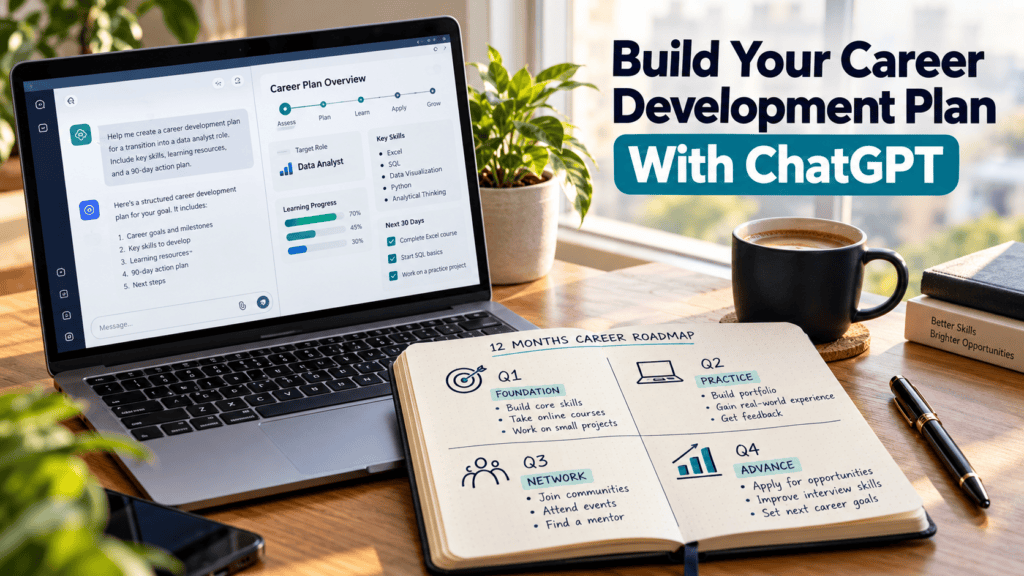
Whether you want to transition into technology, secure a promotion, pivot industries, or master high-leverage digital skills, this guide details how to build a high-impact career development plan using ChatGPT, featuring production-ready prompts and a structured 90-day execution framework.
What Is a Career Development Plan?
A career development plan is a structured document outlining your professional objectives, the competencies and experience required to bridge your current level to your target role, and the tactical execution steps needed to progress.
It transforms abstract professional ambitions—such as transitioning into a data analyst role or securing an executive promotion—into a chronological execution framework backed by strict deadlines and quantifiable outcomes.
An effective career development plan integrates six core components:
- Career Goal: The specific target role, title, or professional outcome you intend to achieve.
- Current Baseline: A rigorous audit of your qualifications, industry experience, existing technical skills, and proven achievements.
- Skill Gaps: The exact delta of technical abilities, domain knowledge, or credentials required to move from your baseline to your target role.
- Learning Architecture: Targeted courses, hands-on projects, industry certifications, and practical portfolio work designed to close your skill gaps.
- Milestones: Time-bound performance targets and output results tied to specific calendar dates.
- Progress Metrics: Objective KPIs and verifiable evidence that validate your skill acquisition and output quality.
Target Audience & Organizational Alignment
A high-impact career development plan serves multiple professional profiles, including job seekers, students, recent graduates, freelancers, employees targeting promotions, and professionals executing full industry pivots.
For corporate professionals, a career development plan also aligns individual capability building with organizational strategy. However, your career strategy must not rely exclusively on employer priorities—your personal risk tolerance, market interests, and long-term financial objectives remain paramount.
Why Use ChatGPT to Build a Career Development Plan?
Leveraging ChatGPT accelerates your career development plan by organizing your thoughts, generating viable pathways, structuring learning curricula, and converting abstract ambitions into granular, execution-ready steps.
Instead of relying on generic queries like “What career should I pursue?”, you can input specific data regarding your professional background, resource constraints, market interests, and target outcomes. This high-context approach yields significantly higher-signal outputs for your career development plan.
| Career-Planning Task | How ChatGPT Supports Your Plan |
| Self-Assessment | Systematically categorizes your existing technical skills, core interests, professional strengths, and work experience. |
| Career Exploration | Evaluates your transferable skill set to surface high-probability alternative roles or industries. |
| Skills-Gap Analysis | Directs a rigorous audit comparing your baseline competencies against real-world target role requirements. |
| Learning Strategy | Drafts chronological learning sequences, hands-on portfolio projects, and targeted practice regimens. |
| Goal Setting | Converts broad professional ambitions into measurable, time-bound objectives. |
| Job-Search Preparation | Refines CV positioning, generates role-specific interview prompts, and drafts cold outreach messaging. |
| Progress Tracking | Audits completed deliverables and helps recalibrate future quarterly milestones. |
The AI Limitation Guardrail
While ChatGPT functions as a force multiplier for structuring a career development plan, it is a planning assistant rather than an authoritative career counselor. AI outputs can occasionally contain confident inaccuracies or lack real-time labor market nuance.
The optimal methodology is to combine ChatGPT’s structural capabilities with rigorous real-world market validation, current job description benchmarking, and direct feedback from experienced operators in your target domain.
How to Build a Career Development Plan Using ChatGPT: Step by Step
Executing a successful professional pivot or securing your next major promotion requires more than wishful thinking—it demands a rigorous, repeatable operating system. To move from abstract career ambitions to tangible market value, you must leverage AI not as an oracle, but as a strategic sounding board that structures your inputs into a concrete blueprint.
Follow these eight comprehensive steps to design, refine, and execute a dynamic career development plan using ChatGPT that you can continuously adapt as your skills compound and market conditions evolve.
Step 1: Assess Your Current Skills, Experience, and Interests
Before determining your future professional trajectory, you must establish an unvarnished baseline of your starting point. Your current market position encompasses far more than a job title or a degree; it includes your practical execution history, transferable capabilities, core interests, tangible achievements, time availability, financial constraints, and personal responsibilities.
For example, an administrative support professional possesses deeply valuable operational competencies—such as technical documentation, schedule optimization, stakeholder communication, metric reporting, and cross-functional coordination. Many of these foundational skills translate directly into project coordination, product operations, or client success roles.
Execute a comprehensive audit of your professional background:
- Current Role: Your present occupation or most recent employment status.
- Education & Credentials: Formal degrees, certifications, bootcamps, and specialized training.
- Competencies: Both hard technical skills and soft execution abilities.
- Experience Ledger: Full-time employment, freelance contracts, volunteer work, and self-directed side projects.
- Core Strengths: Tasks and workflows you execute with complete confidence.
- Improvement Areas: Known skill gaps, knowledge bottlenecks, or workflow friction points.
- Motivations: Genuine professional interests and preferred operating environments.
- Resource Constraints: Weekly hours available for upskilling and your allocated learning budget.
Avoid the trap of undervaluing your experience simply because you lack background in a specific industry. Conversely, maintain strict integrity—do not claim proficiency in tools, languages, or frameworks you have only explored superficially.
ChatGPT Prompt: Assess Your Career Starting Point
Plaintext
Act as a career planning assistant. Help me assess my current career position using the information below.

- Current role or background: [Enter your role or situation]
- Education and qualifications: [Enter relevant details]
- Work experience: [Describe your experience]
- Technical skills: [List your technical skills]
- Transferable skills: [List communication, organisation, analytical, or other skills]
- Interests: [Describe the work you enjoy]
- Career challenges: [Describe your main obstacles]
- Available learning time per week: [Enter hours]
- Learning budget: [Enter your budget and currency]
- Target location or preferred work arrangement: [Enter location or remote preference]

Analyze this input and identify:
1. My strongest existing skills, based strictly on the information provided.
2. Transferable skills I could apply in adjacent roles or industries.
3. Critical skill gaps I may need to strengthen.
4. Strategic career questions I should investigate further.
5. Missing data points that would improve this assessment.

Do not invent qualifications, achievements, or experience. Clearly distinguish the facts I provided from your analytical interpretations.
Code language: CSS (css)
Review the resulting AI assessment thoroughly, correct any hallucinations or misinterpretations, and finalize your baseline data before moving to the next phase of your career development plan.
Step 2: Choose a Realistic Target Career
Your next objective is to identify a career direction that aligns with your core interests, existing strengths, learning capacity, and practical constraints. You do not need to map out a permanent vocation for the rest of your life; you simply need a sufficiently clear target to guide your immediate professional decisions.
If you are exploring a technology or digital career, potential directions might include:
- Data analysis
- Cloud support or cloud engineering
- Cybersecurity
- Software development
- Digital marketing
- Product management
- IT support
- AI-assisted business operations
These tracks carry vastly different entry barriers, daily responsibilities, and upskilling timelines. Base your selection on hard evidence and structural fit rather than assuming a popular role is automatically right for you.
How to Research Potential Career Paths
Use ChatGPT to generate an initial shortlist, then independently audit each option against the real world.
For international occupational standards, platforms like O*NET OnLine supply detailed profiles on job tasks, required skills, and work activities. The U.S. Department of Labor also provides career exploration databases (such as the Occupational Outlook Handbook) to evaluate occupational trends. While these resources provide a strong structural foundation, their data should always be cross-referenced against local economic realities, active job postings, and regional employer expectations.
ChatGPT Prompt: Compare Possible Career Paths
Plaintext
Act as a career planning assistant. Based on my skills, experience, interests, and constraints, help me compare three to five possible career paths.

- My background: [Summarise your current position]
- Existing skills: [List your skills]
- Preferred industries: [List industries]
- Target job market: [Enter country or region]
- Available learning time: [Enter hours per week]
- Learning budget: [Enter budget]
- Career priorities: [For example, stability, flexibility, progression, or meaningful work]

For each career path, explain:
1. Typical daily responsibilities.
2. Core skills commonly required.
3. Likely entry requirements.
4. How my current baseline skills transfer.
5. Potential obstacles and learning demands.
6. Practical ways to test whether the role suits me.
7. What I must verify using current job advertisements and reliable sources.

Separate general guidance from verified facts. Do not invent salaries, hiring trends, job openings, or guaranteed employment outcomes. Conclude by identifying the assumptions that could change your recommendation.
Code language: CSS (css)
Once you have reviewed the comparative breakdown, select one primary target role. You can keep a secondary option as a backup if it shares overlapping competencies, but avoid splitting your focus across multiple unrelated career paths simultaneously.
Step 3: Analyse the Skills Gap Between Your Current Role and Your Target Role
A skills gap is the measurable delta between the competencies you can currently demonstrate and the exact requirements demanded by your target role.
This step converts an abstract career ambition into a precise, high-leverage learning agenda. Instead of collecting random certificates or enrolling in generic courses, you isolate the specific capabilities that drive hiring decisions in your target market.
For example, if your target is a junior data analyst position, typical requirements include advanced spreadsheet manipulation, SQL querying, data visualization tools (like Power BI or Tableau), fundamental statistics, and clear stakeholder communication. However, exact requirements vary significantly depending on the employer, industry sector, and regional job market.
How to Conduct a Rigorous Skills Gap Analysis
- Source Real Data: Collect at least five recent, active job advertisements for your target role in your preferred market.
- Extract Patterns: Note the tools, technologies, methodologies, and credentials that appear repeatedly across listings.
- Triage Requirements: Distinguish between absolute core requirements (non-negotiable prerequisites) and preferred “nice-to-have” skills.
- Perform the Audit: Cross-reference employer requirements against your current demonstrable baseline.
- Rank Priorities: Focus first on high-frequency skill gaps that block employment eligibility.
- Check Regulatory Realities: Confirm whether formal degrees, regulated certifications, or legal licenses are mandatory for the role.
Do not rely solely on AI assumptions to dictate employer priorities. The actual job descriptions from your target market must dictate your learning roadmap.
ChatGPT Prompt: Identify My Priority Skills Gaps
Plaintext
Act as a career planning assistant. Help me conduct a rigorous skills-gap analysis for my target role.

- Target role: [Enter the exact job title]
- Current skills and experience: [Describe what I can demonstrate]
- Job requirements: [Paste key requirements extracted from 3 to 5 real job advertisements]

Create a structured markdown table with these exact columns:
1. Required skill or qualification
2. Evidence from the job requirements
3. My current level, based on the information I supplied
4. Evidence I still need to develop
5. Priority: High, Medium, or Low
6. Suggested learning activity
7. Practical project or portfolio assessment
8. How I can verify that I have mastered this skill

Do not assume I possess skills that I have not explicitly demonstrated. Do not treat preferred requirements as mandatory unless the job description explicitly makes them so. Identify any ambiguous requirements that cannot be assessed from the provided data. Prioritize skills that appear across multiple job advertisements.
Code language: JavaScript (javascript)
The resulting matrix will give you a clear demarcation between skills you already own, competencies that require deliberate practice, and credentials that demand structured formal training as part of your career development plan.
Step 4: Create a Learning Plan That Fits Your Budget
Once you have mapped your skill gaps, you must determine how to acquire those competencies efficiently. A robust learning plan specifies exactly what you will study, where you will learn it, the time commitment required, and the tangible evidence you will produce to prove your capability.
You do not necessarily need an expensive degree or costly bootcamp for every career trajectory. Depending on the role, a combination of free tutorials, official documentation, hands-on portfolio projects, open-source contributions, or internal workplace stretch assignments can provide exceptional upskilling value.
However, free resources do not automatically replace accredited training or mandatory regulatory credentials. Always verify whether your target role strictly requires formal certification or a university degree before allocating your resources.
Prioritizing Learning Activities
| Learning Activity | Best Use Case | Evidence of Progress |
| Online Courses | Acquiring structured theoretical concepts and foundational frameworks. | Completed module assessments and graded exercises. |
| Official Documentation | Learning modern tools, APIs, and software technologies directly from creators. | Working code examples or documented configuration exercises. |
| Portfolio Projects | Demonstrating applied capability and real-world problem-solving. | Live repositories, case studies, or deployed applications with clear outcome metrics. |
| Mentoring & Coaching | Securing expert feedback and accelerating professional growth. | Actionable review notes and iterative improvement milestones. |
| Workplace Assignments | Applying new skills to live operational tasks in your current job. | Verifiable work outcomes, process improvements, or cross-functional deliverables. |
| Professional Certifications | Validating specialized knowledge where demanded by employers. | A legitimately earned, recognized industry credential. |
ChatGPT Prompt: Build a Practical Learning Roadmap
Plaintext
Act as a career planning assistant. Create a practical, modular learning roadmap to help me prepare for my target role as [Enter target role].

- My priority skill gaps: [List the gaps identified in Step 3]
- My weekly study time: [Enter hours available per week]
- My learning budget: [Enter budget and currency]
- My preferred learning formats: [Courses, hands-on projects, reading, video tutorials, etc.]
- My target job market: [Enter country or region]
- My target timeline: [Enter a realistic deadline, e.g., 90 days]

For each priority skill, specify:
1. What core concepts or tools I need to master.
2. A suitable, cost-effective learning method.
3. A practical exercise or portfolio project.
4. The exact evidence of completion I should produce.
5. An achievable execution milestone.
6. How I can objectively assess my progress.
7. Whether a formal qualification or certificate is genuinely required by employers or merely nice-to-have.

Prioritize free or low-cost options where suitable. Recommend official documentation and reputable learning providers, but do not invent course URLs, pricing, official accreditation, or exact availability. Identify any prerequisites and logical dependencies between skills.
Code language: CSS (css)
Thoroughly review all recommended resources before investing your time or money. Verify course prerequisites, exam structures, certification costs, and ensure the curriculum reflects the current tools and methodologies utilized by employers in your target market.
Step 5: Turn Your Career Ambition into Measurable Goals
A career development plan only delivers results when it establishes concrete milestones and explicit criteria for success.
An objective like “I want to improve my technical skills” is too vague to drive consistent daily habits. A high-leverage goal clearly defines the specific skill, the tangible output, and a strict calendar deadline.
You can structure these targets using the SMART framework. While organizational definitions vary slightly, the core principle remains consistent: converting vague ambitions into precise, assessable objectives.
For example, university career centers (such as those at the University of California) emphasize structuring professional development around verifiable actions rather than open-ended intentions.
Comparative Example
- Vague Goal: “I want to learn data analysis.”
- Improved SMART Goal: “Within 60 days, complete a structured SQL learning pathway, execute and document at least 20 practice queries, and publish one end-to-end data analysis project using a public dataset.”
The second formulation succeeds because it specifies the precise learning outcome, the required proof of work, and an uncompromised timeline. Always calibrate your workload to your actual starting baseline and available weekly hours.
ChatGPT Prompt: Convert Career Goals into SMART Goals
Plaintext
Act as a career planning assistant. Help me convert my career development objectives into strict SMART goals.

- My target role: [Enter role]
- My current baseline skills: [List skills]
- My priority skill gaps: [List gaps identified in Step 3]
- My target deadline: [Enter date or timeframe]
- My available study time: [Enter hours per week]
- My practical constraints: [Budget, work schedule, personal responsibilities, etc.]

For each core objective, define:
1. Specific outcome: What exact capability or project will be delivered?
2. Measurement of success: What quantifiable metric proves completion?
3. Achievable scope: Is this realistic given my weekly time limits?
4. Relevance: Why is this critical for my target role?
5. Deadline: The exact calendar completion date.
6. Weekly micro-actions: What needs to be done each week?
7. Evidence of completion: The tangible asset or artifact produced.
8. Risk factors: Potential obstacles that could delay progress.

Separate goals I can directly control (such as completing portfolio projects or finishing modules) from external outcomes I cannot fully guarantee (such as receiving a job offer or secure promotion). Flag any unrealistic targets and ask for clarification where necessary.
Code language: JavaScript (javascript)
Limit your initial plan to three to five priority goals maximum. Pursuing a focused, manageable set of objectives yields significantly better execution than juggling a sprawling list of competing tasks.
Step 6: Build Your 30-, 60-, and 90-Day Action Plan
A high-impact career development plan must translate long-term professional ambitions into immediate, actionable steps.
A 90-day window provides an ideal planning horizon. It creates vital execution momentum without assuming you can completely master a complex discipline, secure a promotion, or land a new job in just three months. The realistic timeline required will always depend on your starting baseline and the complexity of your target role.
Structure your execution across three distinct operational phases:
- Days 1–30: Establish Your Foundation
- Confirm your target role and benchmark current market requirements.
- Isolate your three to five priority skill gaps.
- Select your learning resources and map out your study schedule.
- Define your first applied portfolio project.
- Milestone: A finalized career development plan, completed skills-gap analysis, and an active weekly learning routine.
- Days 31–60: Apply What You Learn
- Work through core lessons, official documentation, and guided exercises.
- Build out the first iteration of your target role portfolio project.
- Seek objective feedback from peers, mentors, or experienced professionals.
- Audit your progress against your initial targets.
- Milestone: Demonstrable work output reflecting competence in at least one priority skill.
- Days 61–90: Demonstrate and Evaluate
- Refine your project based on prior feedback and edge-case testing.
- Document your learning outcomes, case studies, and code repositories.
- Update your CV, LinkedIn profile, or professional portfolio.
- Run practice interview simulations or pitch your development goals to management.
- Establish your next quarterly milestone based on real evidence.
- Milestone: A polished, portfolio-ready project, verified skills, and a recalibrated career development plan.
ChatGPT Prompt: Generate My 90-Day Plan
Plaintext
Act as a career planning assistant. Create a realistic, high-leverage 90-day career development plan for my target role: [Enter role].

- My starting point: [Summarize your current experience and skills]
- My priority skills to build: [List 3 to 5 skills]
- My available study hours per week: [Enter hours]
- My learning budget: [Enter amount and currency]
- My target outcome for this 90-day period: [Describe what you want to achieve]
- My practical constraints: [Enter work schedule, personal responsibilities, etc.]

Divide the plan strictly into three blocks: Days 1–30, Days 31–60, and Days 61–90.
For each action item, include:
1. Specific task description.
2. Target completion date.
3. Estimated time required.
4. Expected tangible deliverable.
5. Objective measure of success.
6. Technical dependencies or operational obstacles.
7. A practical fallback action if I fall behind schedule.

Prioritize hands-on practical work and portfolio projects over passive reading or video consumption. Keep the workload realistic alongside my existing professional responsibilities. Do not assume I will secure a job, promotion, or certification within 90 days. Conclude with a weekly execution review checklist.
Code language: CSS (css)
Step 7: Use ChatGPT to Improve Your CV, Portfolio, and Job-Search Strategy
An effective career development plan does not conclude with skill acquisition—it requires translating those newly acquired capabilities into tangible proof that commands the attention of employers, clients, or internal stakeholders.
Depending on your professional objective, this evidence may include an active portfolio, completed case studies, documented process improvements, a high-impact CV, or contributions to public projects. Leverage ChatGPT to structure, refine, and articulate this evidence with absolute professional clarity.
Optimize Your CV for Real Market Demands
Feed ChatGPT your current CV and a verified job description to audit your positioning, identify blind spots, and sharpen your professional narrative.
ChatGPT Prompt: CV & Job Description Alignment
Plaintext
Act as an expert technical recruiter and career coach. Review my CV against the target job description below.

- Target role: [Job title]
- Job description: [Paste relevant job description text]
- My existing CV: [Paste your CV text]

Analyze and identify:
1. Experience from my background that directly maps to this role.
2. Core requirements from the job description that I have not yet demonstrated.
3. Bullet points that lack strong evidence or quantifiable impact.
4. Opportunities to improve professional clarity, formatting, and industry keyword alignment.
5. Genuine career achievements I should articulate more forcefully.

Strict Guardrails: Do not invent work history, qualifications, employers, dates, metrics, or achievements. Do not claim I meet a requirement unless my supplied CV explicitly supports it. Suggest improvements that strictly preserve the complete truth of my professional background.
Code language: JavaScript (javascript)
Design a High-Signal Portfolio Project
If your target role requires demonstrable technical competence or creative output, use ChatGPT to architect a realistic project blueprint that mimics actual on-the-job tasks.
- Data Analysis: Build a cleaned reporting dashboard using a public economic or industry dataset.
- Digital Marketing: Develop a comprehensive keyword-clustering and content-performance analysis.
- Cloud Operations / IT: Document a small-scale architecture or automated deployment in a sandbox environment.
Execution Rule: Ensure your final project reflects genuine independent problem-solving rather than a passive copy of a tutorial. Never expose proprietary, confidential, or sensitive employer data.
Prepare for Networking and Interviews
Use ChatGPT to pressure-test your narrative. Simulate professional interviews, refine how you explain career pivots, draft informational interview requests, and formulate outreach messaging for industry networking.
Treat these AI simulations as conversational sparring rather than a script to memorize. Your responses must always draw from real, verifiable experiences in your professional background.
Step 8: Review and Update Your Career Development Plan
A career development plan is a dynamic operating system, not a static document. As you upskill, execute projects, and engage with the job market, your insights will deepen.
You may discover that your target role demands niche experience you hadn’t anticipated, that a specific technical skill is less critical than expected, or that your long-term professional interests have shifted. Periodic reviews ensure you adapt to real-world evidence rather than blindly adhering to an outdated schedule.
Set aside 15 minutes at the end of each week to log completed actions, bottlenecks, and immediate next steps. Conclude each 30-day block with a rigorous structural audit.
Monthly Review Checklist
- Which planned actions and deliverables did I actually complete?
- What verifiable evidence demonstrates my skill progression?
- Which priority competencies still require deliberate practice?
- Have market requirements or active job descriptions shifted?
- Are my chosen learning activities yielding high-leverage outcomes?
- Is my target career goal still aligned with my long-term objectives?
- What specific behaviors or strategies should I stop, continue, or change?
ChatGPT Prompt: Review My Career Progress
Plaintext
Act as a career development planning assistant. Review my execution progress against my existing career plan.

- My target role: [Enter role]
- My original goals: [Paste your SMART goals]
- Actions completed: [List completed tasks and projects]
- Evidence of progress: [Describe portfolio items, assessments, feedback, or metrics]
- Tasks not completed: [List unfinished actions]
- Current challenges: [Explain obstacles or friction points]
- New market information: [Describe any changes in role requirements, tools, or personal circumstances]

Provide:
1. A factual, objective summary of my execution progress.
2. An assessment of which goals are on track, delayed, or require revision.
3. Specific skills that need more deliberate practice or different resources.
4. Recommended next actions in strict priority order.
5. Actionable adjustments for the upcoming 30 days.
6. Strategic questions I should investigate before making any major pivots.

Strict Guardrails: Do not equate passive course completion with real-world job readiness. Base your assessment exclusively on the evidence supplied and explicitly note where vital evidence is missing.
Code language: CSS (css)
An honest review is valuable even when you miss your targets. The objective is to isolate what works, neutralize setbacks, and compound your momentum for the next phase of your professional growth.
Example: A One-Page Career Development Plan
The following hypothetical example illustrates how an IT support professional transitioning into a cloud support role consolidates all eight steps into a single operating document for their career development plan.
Career Development Plan
Illustrative Example · 90-Day Execution Period
- Current Baseline: IT support technician with foundational troubleshooting, hardware repair, and basic networking experience.
- Target Role: Junior Cloud Support Associate.
- Priority Skill Gaps:
- Core cloud platform fundamentals (Compute, Storage, Identity).
- Virtual networking, routing, and access management (IAM).
- Command-line interface (CLI) administration.
- Cloud monitoring, incident logging, and technical documentation.
- SMART Development Goals:
- Complete an introductory cloud computing certification path within 45 days.
- Build, configure, and document a multi-tier cloud environment in a sandbox account by Day 75.
- Audit personal progress against 5 live cloud support job descriptions bi-weekly.
90-Day Action Timeline
| Period | Strategic Focus & Planned Deliverable |
| Days 1–30 | Benchmark active job ads, finalize resource selection, and complete foundational cloud computing modules. |
| Days 31–60 | Master virtual networking and identity management concepts; execute guided lab exercises. |
| Days 61–90 | Deploy an independent cloud practice project, document the architecture, and run a comprehensive progress review. |
- Success Metrics:
- Verified completion of coursework and labs.
- A deployed, documented cloud architecture project with an accompanying case study.
- An updated CV reflecting cloud competencies mapped to actual job listings.
- Review Cadence: 15-minute tactical logs every Friday; full structural audit at Day 30, 60, and 90.
Note: This template serves as a flexible baseline. Real-world requirements vary widely depending on your target employer, chosen cloud ecosystem (AWS, Azure, or GCP), regional job market, and starting experience level.
Common Mistakes to Avoid When Using ChatGPT for Career Planning
While ChatGPT provides an invaluable structural framework for organizing a career development plan, poor inputs, unverified assumptions, and uncritical acceptance of AI outputs can derail your professional progress.
Avoid these six critical pitfalls when building and executing your plan:
Accepting Recommendations Without Verification
- The Mistake: Treating AI output as absolute truth, leading you to pursue expensive, irrelevant certifications, misinterpret job entry requirements, or ignore local economic and market realities.
- The Correction: Always cross-reference AI suggestions against active job advertisements, official credentialing bodies, employer career pages, and experienced professionals in your target industry.
Trying to Learn Too Many Skills at Once
- The Mistake: Attempting to master multiple programming languages, earn a cluster of unrelated certificates, and build complex projects simultaneously, resulting in burnout and fragmented progress.
- The Correction: Ruthlessly prioritize three to five core skills that directly impact your target role. Defer secondary skills until you have successfully validated your primary competencies.
Confusing Certificates With Competence
- The Mistake: Assuming that collecting course completion badges or passive certificates proves you can actually execute job responsibilities in a high-pressure workplace.
- The Correction: Pair theoretical learning with hands-on portfolio projects, practical lab exercises, and objective feedback. Only pursue formal certifications when employers explicitly demand them.
Setting Unrealistic Deadlines
- The Mistake: Using a 90-day execution framework as a guarantee that you will secure a promotion, land a high-paying job, or achieve total mastery within three months.
- The Correction: Anchor your deadlines to actions and deliverables within your direct control (such as finishing a module or publishing a case study). Treat external outcomes like job offers as secondary milestones influenced by broader market conditions.
Allowing ChatGPT to Invent Achievements
- The Mistake: Asking ChatGPT to enhance your CV or interview responses without providing factual metrics, leading the AI to hallucinate employment history, data points, or accomplishments.
- The Correction: Supply explicit, authentic achievements from your background. Direct the AI to improve clarity, tone, and formatting without altering core facts—and audit every final statement before deployment.
Ignoring Personal Constraints
- The Mistake: Building an aggressive upskilling schedule that assumes unlimited free time, high financial resources, or immediate access to an elite professional network.
- The Correction: Explicitly input your weekly study hours, learning budget, work schedule, family responsibilities, and technical limitations into your prompts to ensure your career development plan remains sustainable.
Privacy and Responsible Use of ChatGPT
Executing a comprehensive career development plan often requires processing sensitive professional details, including your employment history, formal qualifications, long-term ambitions, and financial constraints. However, you do not need to compromise your personal security or leak proprietary data to extract high-leverage guidance from AI.
Protect your data and maintain professional integrity by adhering to these essential security precautions:
- Scrub Identifiers: Remove personal identification numbers, residential addresses, private phone numbers, and any other unnecessary identifiers before entering data into prompts.
- Protect Confidentiality: Never upload proprietary employer documents, confidential client records, or internal company data without explicit authorization.
- Generalize Sensitive Details: Substitute specific proprietary titles or employer names with generalized descriptions (e.g., describe your background as “an administrative officer in a public-sector organization” rather than pasting classified corporate records).
- Manage Data Controls: Review your account’s privacy settings and data-sharing controls within the OpenAI Privacy Center. Remember that data governance policies can vary depending on whether you use a free, team, or enterprise workspace.
- Comply with Workplace Policy: If you are building your career development plan on a corporate account or using AI tools on company devices, ensure your workflow strictly complies with your employer’s internal acceptable-use policies.
The objective is to provide sufficient contextual depth for actionable career advice while safeguarding sensitive information that is entirely unnecessary for professional development planning.
Can ChatGPT create a career development plan?
Yes. ChatGPT excels at helping you organize your professional background, explore potential career paths, isolate critical skill gaps, establish quantifiable SMART goals, and structure a phased development schedule. However, the overall quality and usefulness of the final plan depend directly on the precision of your inputs and how rigorously you verify AI recommendations against real-world data.
Can I build a career development plan using ChatGPT for free?
You can complete the vast majority of the planning, skill-gap analysis, and curriculum mapping using the free tier of ChatGPT, combined with free public occupational databases, official documentation, open-source learning materials, and self-directed practice projects. Keep in mind that platform feature limits vary, and certain specialized courses, professional exams, or official industry certifications will require financial investment.
How long should a career development plan cover?
There is no single mandatory duration. A short 30-day plan is ideal for establishing immediate learning momentum, whereas a 90-day plan provides an optimal horizon for tracking multiple progressive milestones. For major industry pivots or roles requiring extensive technical training and formal qualifications, a longer-term multi-quarter roadmap may be necessary.
What information should I give ChatGPT?
Provide your current occupation or background, formal qualifications, demonstrable technical and soft skills, career interests, target job title, available weekly study time, learning budget, and any practical constraints. To maximize output quality, feed ChatGPT real job requirements from active listings and clearly distinguish between confirmed facts and uncertain assumptions.
Can ChatGPT help me change careers without a degree?
ChatGPT can effectively assist you in researching alternative careers, mapping your transferable skills, and evaluating non-traditional learning pathways.
Whether you can successfully enter a specific field without a university degree depends entirely on employer expectations, regional market norms, and any mandatory legal or professional licensing requirements. Always verify these prerequisites before investing time or money into training.
Should I follow every career recommendation ChatGPT gives me?
No. Treat all AI suggestions as strategic options to evaluate rather than instructions to follow blindly. Always cross-reference factual claims, test recommendations against active job advertisements, and seek guidance from experienced professionals in your target industry before making major career decisions.
Can ChatGPT help me create an employee development plan?
Yes. Both managers and individual contributors can use ChatGPT to structure professional growth objectives, identify core competencies to strengthen, and design training activities aligned with organizational needs.
A strong employee development plan must balance organizational requirements with the employee’s personal career goals and managerial feedback. Never upload confidential employee data or internal company records to an AI service without proper authorization.
In Conclusion
Building a high-impact career development plan using ChatGPT works best when you combine structured AI-assisted planning with rigorous real-world validation.
Begin by auditing your current baseline skills and practical experience. Select a realistic target role, analyze active job market requirements, isolate your critical skill gaps, and establish quantifiable SMART goals. From there, organize your upskilling into a manageable execution framework, build tangible portfolio evidence of your capabilities, and audit your progress through weekly and monthly reviews.
ChatGPT acts as a powerful operational force multiplier for these steps, but it cannot guarantee that a specific career path is right for your circumstances or that employers will automatically hire you. Your professional trajectory remains your responsibility.
Your Immediate Next Step
Open ChatGPT and execute the self-assessment prompt detailed in Step 1. Once you have reviewed your baseline starting point, commit to one target role and begin constructing your career development plan around the exact skills, projects, and evidence required to secure it.