13 Best Influencer Marketing Platforms for Small Businesses
Influencer marketing platforms are essential software tools designed to help brands discover creators, manage collaborations, track performance, and measure ROI across social channels. By integrating features like advanced search filters, automated campaign workflows, and real-time analytics, these influencer marketing platforms effectively replace manual, high-friction outreach and reporting processes.
For small businesses, the ideal solution balances discovery quality, pricing transparency, and streamlined workflows that align with specific budget requirements and campaign complexity. Before committing to any of these influencer marketing platforms, always prioritize validating costs, potential minimum commitments, and native integrations with your existing marketing tech stack.
What is an Influencer Marketing Platform?
An influencer marketing platform is a software solution that centralizes the discovery, management, and measurement of creator partnerships. It replaces fragmented workflows—like manual outreach via direct messages or tracking collaborations in spreadsheets—with a structured, all-in-one system.
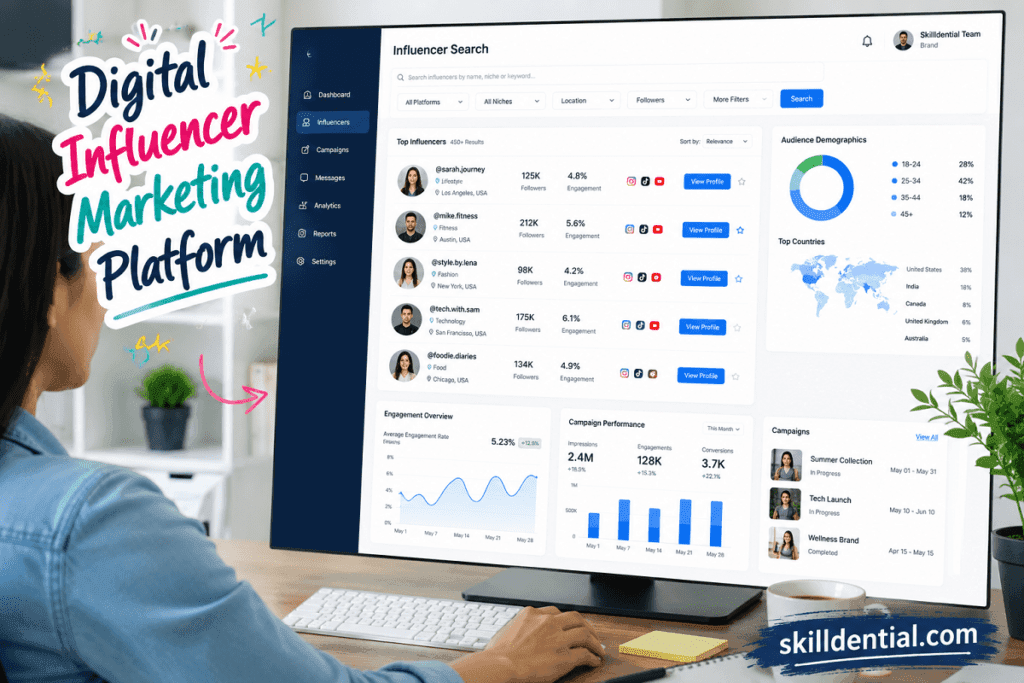
By integrating directly with social media APIs, these platforms provide data-driven insights that help brands scale their influencer marketing strategy efficiently.
Core Capabilities
Most influencer marketing platforms provide the following functional pillars:
- Influencer Discovery: Advanced search engines equipped with filters for audience demographics, niche, engagement rates, and platform-specific metrics. This allows brands to identify creators whose audience closely matches their ideal customer profile.
- Relationship & Campaign Management: Centralized hubs for managing the entire campaign lifecycle, including outreach, sending briefs, contract negotiation, content approval workflows, and automated communication.
- Performance Analytics: Real-time dashboards that aggregate data across various social channels. They track essential KPIs such as reach, clicks, conversion rates, and ROI to determine the effectiveness of influencer-generated content.
- Advanced Operations: Optional, high-value features such as affiliate link and promo code tracking, product seeding logistics, whitelisting for paid amplification, and management of legal content rights.
The Value for Small Businesses
For small businesses, the primary value of using an influencer marketing platform is time compression. By automating the “busy work” of manual prospecting and reporting, these tools allow smaller teams to:
- Reduce Friction: Eliminate the inefficiencies of managing disparate partnerships manually.
- Improve Matching: Find high-quality, relevant creators quickly rather than relying on guesswork.
- Justify Spend: Use clear, unified reporting to accurately track ROI and prove the value of influencer partnerships against their marketing budget.
How Do Influencer Marketing Platforms Work for Small Businesses?
For a small business, an influencer marketing platform acts as a centralized “control center.” It replaces the chaos of manual spreadsheets and fragmented DMs with a structured environment where you can define goals, shortlist creators, manage collaborations, and monitor results in one place.
Most platforms follow a repeatable five-stage lifecycle that turns influencer marketing from a high-effort experiment into a scalable growth channel.
The Typical Workflow
- Goal Setting: Define the campaign’s purpose—whether it is generating brand awareness, sourcing authentic creative content (UGC), or driving direct sales via affiliate links.
- Strategic Discovery: Use granular search filters to find creators who match your target persona. Small businesses often prioritize micro-creators (5k–100k followers), who typically offer higher engagement rates and better cost-efficiency than larger celebrity accounts.
- Collaborative Execution: Manage the partnership within the platform. Send standardized campaign briefs, negotiate terms, and handle content approvals in a single dashboard to ensure brand consistency.
- Performance Tracking: Monitor active campaigns in real-time. Use built-in tools to track specific posts, Stories, referral links, and unique coupon code usage to see exactly what is working.
- Relationship Building: Build an internal “creator CRM.” By storing historical data on past collaborations, you can quickly re-activate high-performing creators for future campaigns rather than starting from zero each time.
Strategic Advantages for Small Budgets
Small businesses often face constraints that make manual processes unsustainable. Platforms mitigate these by:
- Time Compression: Automating outreach and reporting removes the manual bottleneck of tracking partners, allowing lean teams to focus on strategy rather than administration.
- Flexible Models: Many platforms support gifting-only or pay-per-use/commission-based campaigns, allowing brands to avoid heavy upfront retainers or agency fees.
- Risk Mitigation: Vetted creator databases and fraud detection features help you avoid “fake” influencers who inflate follower counts, ensuring your budget is spent on genuine reach and real engagement.
By shifting from manual, reactive outreach to a data-driven platform approach, small businesses can effectively scale their influencer program alongside their growth.
What are the 13 best influencer marketing platforms for small businesses?
Finding the right influencer marketing platform for a small business requires balancing enterprise-grade power with accessible pricing and manageable workflows. The platforms listed below have been selected because they offer the best mix of discovery precision, operational automation, and ROI tracking for teams that need to maximize every marketing dollar.
The 13 Best Influencer Marketing Platforms for Small Businesses
| Platform | Primary Strength | Best For |
| Aspire | Ambassador & community building | DTC brands wanting long-term creator relationships. |
| Influencity | Deep audience analytics | Brands needing granular demographic and affinity data. |
| GRIN | CRM-style relationship management | DTC brands focused on scaling influencer-driven revenue. |
| Upfluence | E-commerce integration | Shopify/WooCommerce stores blending influencer and affiliate marketing. |
| CreatorIQ | Enterprise-grade infrastructure | Growing teams needing rigorous data and multi-market scale. |
| Impact.com (Creator) | Affiliate & partnership automation | Brands prioritizing performance-based, scalable partnerships. |
| Sprout Social | All-in-one social management | Teams already using Sprout for scheduling and engagement. |
| Brandwatch | Social listening & intelligence | Brands that want to find influencers based on brand sentiment. |
| Collabstr | Rapid, transparent marketplace | Smaller teams wanting a fast, vetted, pay-per-project model. |
| Trend.io | UGC-first workflows | Businesses needing high-quality content without high retainers. |
| Modash | Reliable discovery & compliance | Mid-sized brands focusing on performance and ad disclosure. |
| Shopify Collabs | Native e-commerce workflow | E-commerce brands needing a low-friction, built-in solution. |
| HypeAuditor | Audience quality & fraud detection | Teams heavily focused on vetting influencer authenticity. |
How to Select the Right Platform
Before committing to any of these influencer marketing platforms, evaluate them against your specific operational constraints:
- Pricing Transparency: Avoid “Contact for Pricing” traps if you are a lean team. Prioritize platforms with clear tiers or pay-per-use models like Collabstr or Shopify Collabs.
- Implementation “Weight”: Some platforms, such as CreatorIQ or GRIN, are powerful but require a dedicated “influencer manager” to fully utilize. If you are a founder or solo marketer, start with lighter, workflow-optimized tools like Trend.io or Aspire.
- Integration Compatibility: If you are an e-commerce brand, prioritize platforms like Upfluence or Shopify Collabs that sync directly with your sales data to provide accurate ROI reporting.
- Contract Flexibility: Small businesses often fluctuate in campaign activity. Favor platforms that offer monthly or usage-based pricing over those requiring significant annual commitments.
Choosing the right tool is not just about the number of creators in the database; it is about how much time you save by automating the friction between discovering a partner and measuring their impact on your bottom line.
Which influencer marketing platform is best for my budget and business size?
To determine which influencer marketing platform best aligns with your business, map your current operational stage against the specific constraints of your budget and team capacity. As observed in Skilldential audits, small e-commerce founders often suffer from “feature bloat,” paying for enterprise capabilities they cannot effectively manage, thereby diverting capital from actual creator collaborations.
The Decision Framework
| Budget Tier | Operational Focus | Recommended Platforms | Strategic Rationale |
| Under $100/mo | Testing & Gifting | Shopify Collabs, Collabstr | Zero/low platform fees; prioritize pay-per-performance or free native integration. |
| $100–$500/mo | Discovery & Workflow | Modash, Trend.io | Targeted discovery and streamlined UGC workflows; avoids enterprise complexity. |
| $500+/mo | Scaling & CRM | Aspire, GRIN | Requires dedicated management to handle long-term ambassador CRM and deep analytics. |
Strategic Selection Criteria
Selecting an influencer marketing platform requires moving beyond a simple feature checklist. To maximize your ROI and minimize software waste, evaluate potential tools through a strategic lens that prioritizes financial proof, operational scalability, and objective alignment with your specific business goals.
Avoid “Contact for Pricing” Traps
For a lean team, transparency is a competitive advantage. Prioritize platforms that let you start immediately, without a sales call.
- Shopify Collabs: Completely free for Shopify merchants. It is the highest-leverage starting point for e-commerce, allowing you to link affiliate performance directly to your store’s backend.
- Collabstr: Ideal for brands that want to bypass subscriptions entirely. You pay only for the collaborations you execute, effectively moving your software budget directly into content creation.
Match Tool Complexity to Internal Capacity
One of the most common inefficiencies is over-investing in “full-stack” tools (e.g., CreatorIQ, Upfluence) before your team is ready to manage them.
- The 80/20 Rule: If you are a founder-led team, you have limited hours to manage partnerships. If a platform requires more than 5 hours per week of setup and administrative maintenance, it is too heavy for your current stage.
- Leaner Alternatives: Use Modash for high-accuracy discovery and audience vetting. It provides professional-grade data on influencers without forcing you into an enterprise-level campaign management system that you won’t use.
Prioritize Performance over “Enterprise” Features
Small businesses gain the most ROI from platforms that provide immediate feedback loops:
- Affiliate Integration: Can you track sales in real-time? (Platforms like Shopify Collabs or Upfluence excel here).
- UGC Rights: Does the platform include usage rights for your paid ads? (Platforms like Trend.io and Collabstr are built to make content reusable).
Recommendation for Your Next Step
If you are currently early in your scaling phase, do not sign an annual contract. Start with a platform that offers a monthly, usage-based, or performance-based model. This limits your downside risk and allows you to “buy” software access only as you increase your campaign frequency.
How many campaigns are you planning to run per quarter, and is your primary goal product gifting, affiliate sales, or pure brand awareness?
Comparison matrix: best influencer marketing platforms for small businesses
This matrix provides a high-level view of platforms, categorized by their core strengths and operational fit for small businesses. Use this to shortlist 2–3 candidates, then prioritize validating trial access and onboarding support before making a long-term commitment.
| Platform | Best For | Core Strength (Small Biz View) | Commitment Level | Notable Trade-off |
| Aspire | Growing brands | End-to-end CRM & UGC workflows | Higher | Can be overkill for low budgets |
| Influencity | SMBs | Scalable search & analytics | Moderate | Moderate learning curve |
| GRIN | E-commerce | Affiliate & creator integration | Higher | Best at high volume |
| Upfluence | Omnichannel | Cross-platform data | Higher | Often requires an annual contract |
| CreatorIQ | Fast-scaling startups | Enterprise-grade infrastructure | High | Enterprise-heavy feature set |
| Impact.com | Performance-driven | Strong attribution & tracking | Moderate-High | Complex initial setup |
| Sprout + Tagger | Social-led teams | Unified reporting/management | Moderate | Optimized for current Sprout users |
| Brandwatch | Data-heavy teams | Listening & influencer insights | Moderate-High | Advanced features may exceed needs |
| Collabstr | Solopreneurs | Simple marketplace model | Low | Less automation/manual selection |
| Trend.io | UGC focus | High-quality content at scale | Low-Moderate | Limited multi-wave campaign tools |
| Modash | Small DTC | Affordable discovery & vetting | Low-Moderate | Lighter on full CRM features |
| Shopify Collabs | Shopify stores | Native gifting & affiliate links | Low | Tied to Shopify ecosystem |
| HypeAuditor | Quality-focused | Fraud detection & analytics | Moderate | Not a full-stack CRM |
Selection Strategy
To refine your shortlist, apply these two filters before scheduling any sales calls:
- Audit Your Constraints: If you are a solo operator or a lean team of two, prioritize “Low” to “Moderate” commitment platforms (e.g., Collabstr, Modash, or Shopify Collabs). These tools minimize administrative friction and allow you to pivot quickly.
- Validate the “Last Mile”: Most platforms excel at finding influencers, but fewer excel at managing the payout and content rights workflow. Ensure your top choice includes the specific automation your team lacks most—whether that is contract signing, product seeding, or affiliate link tracking.
How do pricing and ROI typically work for influencer marketing platforms?
Understanding the cost-to-return dynamic is critical to avoiding the “feature bloat” that traps many small business founders. Influencer marketing platforms generally structure their pricing by how much work they automate for you, while ROI is calculated by layering hard sales data over qualitative brand impact.
Pricing Models
Platforms typically fall into one of three pricing patterns. Choose based on your campaign frequency and administrative bandwidth:
- Self-Serve Subscriptions ($200–$1,500/mo): Best for consistent, monthly campaigns. You pay for software access to manage your own discovery, outreach, and contracts.
- Pay-Per-Use / Marketplace (Fees: 10%–20% or $30–$100 per collab): Best for low-frequency or pilot programs. You avoid recurring costs and pay only when you execute a specific collaboration.
- Managed Service ($3,000+/mo): Best for teams that need to scale content volume rapidly but lack the internal headcount to run the end-to-end process.
Calculating Your ROI
ROI is not just “sales minus cost.” For an accurate view, use the following formula:
$$\text{ROI} = \left( \frac{\text{Total Revenue from Campaign} – \text{Total Campaign Costs}}{\text{Total Campaign Costs}} \right) \times 100$$
- Total Campaign Costs: Include creator flat fees, commissions, product gifting costs, shipping, and any subscription or per-campaign platform fees.
- Attribution Methods: Use unique promo codes or UTM-tracked affiliate links for every creator. Without these, you are guessing which influencer drove the sale.
- Layered Evaluation: * Direct Sales: Last-click attribution, coupon redemptions, and revenue generated.
- Efficiency Gains: The “soft” ROI of hours saved by using a platform to automate manual tasks (e.g., contract sending, reporting) vs. the manual cost of doing it via spreadsheet.
- Asset Value: Calculate the cost you would have paid to a professional agency for the same volume of high-quality UGC (User Generated Content). If you own the usage rights, this is a significant ROI driver.
Strategic Recommendation
To defend your budget, treat financial proof as the primary requirement. Your platform should provide automated, exportable reports that map specific influencer activities to your KPIs. If a platform hides performance data behind manual effort, it is likely adding more cost than value.
Which influencer marketing platforms are best for finding influencers?
When discovery is your primary bottleneck, your goal is to move beyond simple “phone book” databases toward platforms that act as intelligent search engines. These tools do not just list creators; they use filters, AI-driven matching, and audience-quality scoring to narrow down millions of accounts to the few that fit your brand’s specific criteria.
Top Platforms for Advanced Discovery
| Platform | Best For | Why it excels at discovery |
| Modash | High-accuracy search | Extremely large database; excellent for micro-influencer discovery and reliable audience location/demographic filtering. |
| Influencity | Visual, data-rich search | Offers a balance of a vast database and highly granular audience insights; easy to visualize “lookalike” creators. |
| HypeAuditor | Auditing & vetting | Best-in-class for fraud detection and authenticity scoring; ensures the influencers you find are legitimate before you ever reach out. |
| Upfluence | E-commerce discovery | Unique strength in connecting your customer list to social profiles, allowing you to find brand fans who are already your customers. |
What to Look for in a Discovery Tool
To avoid “database bloat”—where you have access to millions of creators but cannot find any that are actually relevant—ensure your chosen platform provides the following:
- Granular Filtering: Do not settle for “niche” or “location” filters. Look for platforms that allow for city-level geography, language-matched audiences (not just the language the influencer posts in), and brand-affinity filtering.
- Authenticity Scoring: In 2026, fake engagement and bot-driven follower counts remain a significant risk. Prioritize platforms with proprietary “Authenticity” or “Quality” scores that automatically flag or hide suspicious accounts.
- Lookalike Discovery: The most efficient way to scale is to find one perfect creator and ask the platform to “find more like this.” This saves hours of manual search time.
- Data Coverage: Ensure the platform covers the specific networks where your audience lives. If your customers are on TikTok, ensure the platform’s TikTok discovery is as robust as its Instagram capabilities.
Strategic Selection Framework
Before committing to a discovery-focused platform, run these three diagnostic checks:
- The “Customer Match” Test: If you are an e-commerce brand, check if the platform can import your existing customer data (e.g., via Shopify integration) to identify influencers within your current customer base. This is the highest-ROI discovery method available.
- Database Scale vs. Precision: A platform with 400M+ profiles (like Modash or ViralMango) is generally superior for finding micro-influencers and local talent compared to “all-in-one” suites that may only index 3–5M “premium” creators.
- Integration with Your Workflow: Discovery is only the first step. If the platform has no way to save these searches into a CRM, export them to a list, or manage the subsequent outreach, you will be forced to manually track everything in a spreadsheet anyway. Prioritize tools that bridge the gap between “Search” and “Manage.”
Are you currently struggling more with the initial search (finding candidates) or with the vetting process (ensuring their audience is real and relevant)?
Which influencer marketing platforms offer the best ROI for small businesses?
The best ROI for a small business comes from platforms that prioritize predictable, low-barrier pricing and high-impact automation. By minimizing monthly software costs and avoiding enterprise-grade “feature bloat,” you ensure that the majority of your budget is directed toward creator compensation and content production, which are the primary drivers of growth.
ROI-Focused Platform Recommendations
For lean teams, prioritize tools that allow for a “pay-as-you-grow” approach:
| Platform | Best For | ROI Rationale |
| Elev8or | Early-stage testing | Offers a free plan for discovery; low monthly cost ($49) removes the risk of long-term lock-in. |
| Collabstr | One-off campaigns | Marketplace model; you pay only per collaboration (no monthly subscription), making it a variable, not fixed, cost. |
| Modash / Flinque | Data-driven growth | Affordable monthly pricing ($25–$50) with high-accuracy discovery, ensuring your budget is spent on real influencers, not bots. |
| Shopify Collabs | E-commerce ROI | Free for Shopify stores; links creator activity directly to store sales, making ROI attribution automatic. |
Three Pillars for Maximizing ROI
Small businesses often struggle with influencer marketing because they miscalculate total campaign costs or lack a clear attribution loop. Use these pillars to maintain a positive return:
Shift from Subscription to Variable Spend
Avoid high-cost, annual contracts that require a dedicated “influencer manager” to justify the expense. Instead, use platforms that charge per deal (Collabstr) or offer affordable monthly self-serve access (Elev8or, Flinque). This keeps your software cost below 10–15% of your total influencer budget.
Implement “Closed-Loop” Attribution
Never run a campaign without a clear way to track conversion. Layer these methods for a complete picture:
- Affiliate Links: The standard for performance tracking; ensures every sale is directly attributed to a specific creator.
- Unique Promo Codes: Simplest way to track direct revenue; creates a low-friction “win” for both the creator and the customer.
- UTM Tracking: Required for any content that directs traffic to your product or landing pages; captures data in your analytics dashboard (e.g., Google Analytics).
Focus on “High-Leverage” Outcomes
Treat influencers as more than just “ads.” Your ROI formula should include:
- Asset Repurposing: Do you have the right to use the creator’s content in your paid ads? High-quality UGC often performs better and costs less than professional agency-shot content.
- Creator CRM: Do not start from zero for every campaign. Build an internal list of “top-performing” creators and re-activate them. Reducing the time spent on new outreach is a direct increase in operational ROI.
Strategic Diagnostic
Before committing to any platform, ask: “Does this tool pay for itself through time saved or revenue generated within the first 30 days?” If the platform requires months of training or an annual contract, it is likely a liability for a small business, regardless of its feature set.
Influencer Marketing Platform FAQs
To further support your decision-making process, here are common questions that bridge the gap between initial interest and long-term strategy.
What is an influencer marketing platform in simple terms?
An influencer marketing platform is software that centralizes the discovery, management, and measurement of creator partnerships. It replaces fragmented workflows—like managing manual outreach via DMs or tracking collaborations in spreadsheets—with a structured, all-in-one system.
Do small businesses really need an influencer marketing platform?
You can start with manual outreach to test the waters. However, a platform becomes essential once you transition from “one-off experiments” to a recurring program.
If you are struggling with keeping track of status updates, content approvals, or payout logistics for more than 3–5 creators simultaneously, a platform provides the necessary infrastructure to scale without adding headcount.
What is the difference between an influencer marketplace and a full platform?
Marketplace: Acts like a directory or “dating app” for creators. You pay per collaboration, often with a small platform fee. It is perfect for short-term, campaign-based needs.
Full Platform: Includes the marketplace for discovery but adds a CRM, workflow automation, and deep analytics. It is designed for brands building “always-on” programs where long-term relationships and performance tracking are the primary goals.
How long does it take to see results from an influencer platform?
Most small businesses see actionable data within the first 1–3 campaigns, provided they implement proper tracking (links, codes, and UTMs). The most significant ROI often compounds over time as you build a “creator CRM,” allowing you to re-activate top performers rather than spending time scouting new talent for every launch.
Are free influencer marketing platforms reliable?
They are excellent for initial discovery and basic vetting. However, “free” tools often have limitations: smaller databases, restricted analytics, or caps on the number of active campaigns. Treat them as a starting point, but be prepared to transition to a paid tier if you need automated reporting or deeper audience-quality verification.
What should I ask before signing a contract?
Before committing to any platform, ask these three high-signal questions:
“How does your platform handle attribution for non-click conversions?” (e.g., promo codes, influencer-led search traffic).
“Can you demonstrate your fraud detection capabilities?” (Confirm they verify data via official social platform APIs rather than just scraping profiles).
“What are the specific requirements for integration with my current tech stack?” (Crucial if you need your Shopify or CRM data to sync automatically with campaign results).
In Conclusion
Influencer marketing platforms centralize discovery, campaign management, and performance tracking, effectively replacing manual, high-friction processes with data-driven workflows. By consolidating these functions, small businesses can shift from speculative outreach to scalable growth.
Strategic Summary
- Platform Utility: Choose based on your primary bottleneck. Discovery-focused tools (e.g., Modash, HypeAuditor) excel at vetting quality, while marketplace platforms (e.g., Collabstr, Trend.io) streamline content creation and one-off collaborations.
- Pricing & ROI: Align your software spend with your campaign maturity. Avoid enterprise-grade “feature bloat” if you are in the pilot phase; lean into usage-based or free native integrations (e.g., Shopify Collabs) to maximize your budget for creator compensation.
- Operational Execution: Do not rely on platform dashboards alone. Standardize your attribution using UTMs, unique promo codes, and affiliate links to ensure you are measuring true business impact rather than vanity metrics.
Recommended Action Plan
To identify your ideal tech stack, implement this 90-day testing framework:
- Shortlist Two: Select one low-cost marketplace/discovery tool and one more advanced platform aligned with your 12-month growth trajectory.
- Execute Structured Tests: Run at least two structured, tracked campaigns on each platform.
- Evaluate for ROI: After one full quarter, analyze which platform delivered the lowest cost-per-result. Select the winner as your primary “control center” and deprecate the other to eliminate software waste.
By treating these platforms as strategic assets—rather than simple directories—you turn your influencer program into a repeatable, high-leverage channel for growth.