How Do Free Apps Make Money Without Ads? 7 Key Methods
When building a high-retention software product, founders often face a core strategic dilemma: how do free apps make money without ads? Relying on intrusive ad networks can degrade user experience, slow down app performance, and cap lifetime value. Fortunately, profitable monetization doesn’t require compromising your user interface.
Free apps can generate sustainable revenue by leveraging alternative monetization engines—such as tiered freemium features, recurring subscriptions, transactional take-rates, native affiliate loops, brand sponsorships, and enterprise-grade business services. The ideal model depends entirely on your product’s core utility, usage frequency, and the specific economic value delivered to the end user.
For app founders and indie hackers, the primary objective is straightforward: drive scalable revenue while protecting a frictionless free tier that accelerates user acquisition. The most successful app business models follow a clear distribution principle: let users experience core value immediately at zero cost, then monetize advanced functionality that naturally justifies a paid upgrade.
In this comprehensive guide, you will discover:
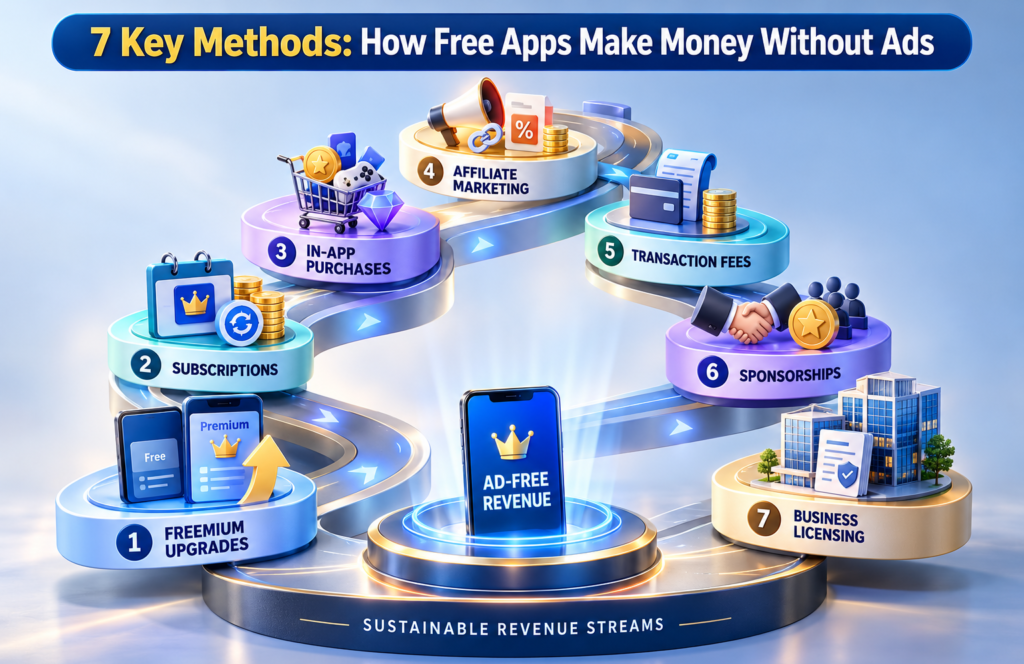
- 7 Core Monetization Methods: The exact frameworks top companies use to answer how do free apps make money without ads.
- Strategic Suitability: When each revenue model makes sense based on your target audience and product architecture.
- Execution Blueprint: How to select and implement a revenue model engineered for long-term margins and sustainable growth.
How Do Free Apps Make Money Without Ads? 7 Methods to Follow
Monetizing a free app without ads means building a sustainable revenue engine that does not rely on third-party ad networks, programmatic banners, or interrupted user attention.
An application remains free to download and provides core utility at zero upfront cost, yet generates income through alternative monetization channels such as:
- Freemium feature gating (locking advanced tools behind a paywall)
- Recurring software subscriptions (SaaS models)
- In-app transactions and digital goods
- B2B enterprise services or partnerships
The Economic Reality
As outlined in platform guidelines like Apple’s official developer documentation, a distinction exists between a non-commercial free app and a monetized free app. An application can be entirely free for end users to acquire while operating as a high-margin commercial asset for its creators through in-app purchases, digital services, or physical goods.
Core Principle: An app can be free for the user without being a free service for the founder to operate.
Real-World Architecture Example
Consider a freemium productivity application designed for daily task management:
- The Free Tier: Basic task creation, standard reminders, and simple lists remain completely free forever, lowering the barrier to entry and driving organic user acquisition.
- The Paid Tier: Advanced capabilities—such as cross-device team collaboration, deep productivity analytics, and automated workflow integrations—are locked behind a paid upgrade.
Casual users who only need basic utility continue using the product at no cost, while power users and teams that generate significant economic value become paying subscribers. This balances rapid user adoption with long-term revenue generation.
7 Ways Free Apps Make Money Without Ads
To build a sustainable software business without relying on banner ads, developers utilize alternative economic structures. The following monetization models allow you to generate predictable, high-margin revenue while keeping your core user experience entirely free of intrusive advertisements.
Freemium Features and Premium Upgrades
The freemium model allows users to access a software product for free while charging to unlock selected advanced features.
The free version drives user acquisition, demonstrates immediate product utility, and establishes a reliable retention loop. Premium upgrades then capture economic value from power users who require capabilities far beyond the baseline offering.
For example, a free photo-editing app might include basic cropping, resizing, and standard filters. A premium upgrade could unlock advanced background removal, batch processing, custom presets, and high-resolution raw exports. The app generates sustainable revenue whenever users decide that these additional capabilities are worth paying for.
How to Implement This Model
- Define the Free Core: Identify the essential task your app must perform flawlessly for free to ensure immediate user value.
- Isolate Premium Value: Determine advanced capabilities that are highly valuable to power users or professionals, but not strictly necessary for casual users.
- Establish Clear Boundaries: Make the functional differences between free and premium tiers intuitive and transparent within the user interface.
- Trigger Contextual Upgrades: Introduce upgrade prompts naturally when users encounter a specific functional limitation during their active workflow.
- Monitor Conversion and Retention: Track your free-to-paid conversion rate alongside long-term retention metrics to ensure the paywall is positioned correctly.
Platform ecosystems like Apple explicitly support freemium apps, providing native infrastructure for optional purchases, premium feature unlocks, additional content packages, and recurring subscriptions.
Strategic Trade-Offs
- Advantages: Eliminates upfront adoption friction for new users while capturing high-margin revenue from customers who require advanced functionality.
- Limitations: Requires careful feature balancing. If the free tier is overly restricted, users will churn; if the free tier provides too much utility, conversion rates will stall.
- Best For: Productivity tools, photo and video editors, design suites, educational platforms, and software applications featuring a clear distinction between basic utilities and advanced professional workflows.
Monthly and Annual Subscriptions
Subscriptions generate predictable recurring revenue by charging users ongoing fees for continuous access to a software product, service, or expanding library of features.
Instead of a one-time purchase, customers pay on a monthly, annual, or custom billing cycle. To prevent high churn, the app developer must continuously update and maintain the product, ensuring the ongoing value consistently justifies the recurring charge.
Consider a modern language-learning application: it might offer basic vocabulary lessons and beginner tiers for free, while charging active subscribers for personalized AI-driven learning paths, advanced conversation modules, detailed progress analytics, and unlimited offline practice exercises. This model thrives when an application delivers continuous utility rather than a one-time transactional benefit.
How to Implement This Model
- Maintain a Valuable Entry Tier: Keep a functional, baseline experience available for free to drive continuous user acquisition and trial.
- Identify Recurring Needs: Isolate the features, content updates, or cloud services that users require on a regular, habitual basis.
- Communicate Value First: Clearly display subscription benefits and feature differentiators before triggering the payment interface.
- Ensure Transparent Terms: State pricing, billing intervals, auto-renewal conditions, and the cancellation process explicitly to build consumer trust.
- Track Unit Economics: Measure key metrics including subscription conversion rates, monthly recurring revenue (MRR), renewal rates, voluntary/involuntary churn, and customer lifetime value (LTV).
Platform ecosystems support this architecture natively. Apple’s subscription guidelines recommend presenting value propositions clearly so users understand the investment before committing, while Google Play similarly supports recurring and prepaid subscription arrangements for eligible mobile apps.
Strategic Trade-Offs
- Advantages: Smooths cash flow, creates predictable recurring revenue, and provides sustainable funding for continuous engineering, feature expansion, and customer support.
- Limitations: Vulnerable to user churn if product updates stall. Subscription fatigue across the broader software market and miscalibrated pricing can also depress conversion rates.
- Best For: Cloud storage utilities, generative AI tools, fitness and wellness apps, continuous educational services, team collaboration platforms, and software products that receive frequent content or feature updates.
In-App Purchases and One-Time Payments
An app can generate revenue by selling standalone digital products, usage credits, or permanent feature unlocks without requiring a recurring subscription commitment from the user.
Unlike subscription models, a one-time purchase provides permanent access to a specific upgrade or asset. Alternatively, consumable purchases (such as AI generation credits or virtual currency) can be bought repeatedly whenever a user exhausts their current balance.
For instance, an AI writing application might provide a limited set of free text generations, then sell credit packs to power users who exceed their baseline allotment. Similarly, a design utility might sell specialized template bundles or effect packs, while mobile games monetize optional virtual goods.
Platform guidelines from both Apple and Google Play natively support this monetization structure, distinguishing clearly between non-consumable permanent upgrades and consumable items.
How to Implement This Model
- Isolate High-Value Units: Identify a specific digital item, feature extension, or measurable unit of usage (such as processing minutes or generation credits) that carries distinct economic value.
- Provide a Free Baseline: Allow users to experience the core application and test its utility before encountering prompts to purchase digital add-ons.
- Price for Cost and Value: Establish a price point that reflects the utility delivered while accounting for variable fulfillment costs (such as third-party API or cloud compute fees).
- Clarify Terms: Explicitly state what the customer receives and whether the item is a permanent non-consumable unlock or a consumable resource that depletes with use.
- Monitor Transaction Metrics: Track purchase conversion rates, repeat purchase frequency, refund requests, and customer feedback to optimize pricing.
Strategic Trade-Offs
- Advantages: Lowers psychological barriers for users who dislike recurring subscriptions, allowing them to pay strictly on an as-needed basis.
- Limitations: Revenue streams can be unpredictable compared to monthly recurring models. Furthermore, credit-based systems require rigorous unit-cost management—particularly when actions trigger expensive AI processing, LLM token usage, or heavy cloud computation.
- Best For: Generative AI applications, design and asset tools, utility apps with discrete feature packs, and digital content ecosystems.
Affiliate Marketing and Referral Commissions
Affiliate marketing allows a free application to generate revenue by earning a commission when users purchase or sign up for an eligible product or service through a tracked recommendation.
The app does not need to manufacture or sell the underlying product. Instead, it acts as a discovery and distribution bridge, connecting users with relevant external providers and capturing a referral fee when a qualifying conversion occurs.
For example, a free travel-planning app can embed hotel and flight booking links through affiliate networks, while a personal finance platform can recommend specialized banking or investing products (provided all recommendations strictly comply with applicable financial regulations). The foundational rule is contextual relevance: referral offers must genuinely assist users in completing tasks they are already trying to accomplish.
Regulatory bodies—such as the US Federal Trade Commission (FTC) and equivalent international authorities—mandate that any material financial relationship or affiliate commission must be disclosed clearly and conspicuously near the point of recommendation so consumers can evaluate the advice accurately.
How to Implement This Model
- Select Natural Complements: Identify external products or software services that logically extend your app’s core utility without creating friction.
- Partner with Reputable Networks: Source affiliate programs with reliable tracking infrastructure, prompt payout terms, and transparent brand alignment.
- Integrate Contextually: Place recommendations directly within the user workflow where they solve an immediate problem (e.g., booking software integrated into a project management itinerary).
- Maintain Regulatory Compliance: Display clear affiliate disclosures in close proximity to the links, adhering strictly to FTC guidelines and local consumer protection laws.
- Track Conversion Funnels: Monitor outbound click-through rates, conversion milestones, commission yields, and user sentiment to prevent commercial intrusion.
Strategic Trade-Offs
- Advantages: Unlocks monetization without requiring inventory management, physical fulfillment, or the development of complex secondary software products.
- Limitations: Revenue is subject to external conversion rates, partner program policy changes, and commission tier adjustments. Overloading an interface with commercial promotions can quickly erode user trust and increase churn.
- Best For: Travel planners, shopping assistants, product comparison tools, educational utilities, and discovery-focused applications.
Transaction Fees and Marketplace Commissions
Applications that connect buyers and sellers, service providers and clients, or hosts and guests can generate substantial revenue by charging a platform fee whenever a successful transaction occurs.
This economic model thrives when software solves the “cold start” and matching problems—making it effortless for two independent parties to discover each other, negotiate terms, securely exchange funds, and complete a transaction.
For instance, a peer-to-peer tutoring marketplace can allow students and parents to browse educators for free, then automatically deduct a marketplace commission when a lesson is booked and completed. Similarly, a service-booking platform can collect a percentage-based service fee or a flat booking charge from providers or customers.
Modern financial infrastructure simplifies this implementation. Tools like Stripe Connect provide native mechanisms for multi-party marketplaces to split payments, route funds securely, and automatically collect platform fees (subject to regional availability, payment gateway policies, and configuration requirements).
How to Implement This Model
- Identify the Core Exchange: Pinpoint the exact economic transaction your app facilitates, ensuring the software adds undeniable value by bridging the gap between buyer and seller.
- Determine Fee Structures: Decide whether fees will be absorbed by the buyer, deducted from the seller’s payout (take-rate), or split between both parties.
- Account for Operating Costs: Calculate your take-rate against third-party payment processing fees, chargeback risks, customer support overhead, dispute resolution costs, and refunds.
- Maintain Transparency: Display all service fees, taxes, and transaction costs clearly before users confirm their booking or purchase.
- Monitor Marketplace Metrics: Track gross merchandise value (GMV), transaction volume, take-rate yield, user retention on both sides of the platform, and unit contribution margins.
Strategic Trade-Offs
- Advantages: Revenue scales naturally alongside marketplace liquidity and the total volume of successful economic activity passing through the platform.
- Limitations: Requires solving the classic two-sided marketplace chicken-and-egg problem to attract sufficient supply and demand simultaneously. Additionally, fraud management, payment disputes, refunds, and complex regulatory obligations can increase operational overhead.
- Best For: Booking platforms, service marketplaces, freelance hubs, peer-to-peer rental apps, and applications connecting independent service providers with end customers.
Sponsorships and Brand Partnerships
An app can answer how free apps make money without ads by securing direct commercial partnerships with aligned enterprises that want to engage a highly targeted audience or underwrite a specific utility.
Unlike conventional, disruptive banner ads or pop-up interstitials, a sponsorship typically funds an entire feature set, educational module, community event, or high-value resource without cluttering the user interface.
For instance, a free career-development application might partner with an enterprise training provider to underwrite a specialized certification prep track. The app secures reliable upfront sponsorship revenue while everyday users access the core learning experience at zero cost.
However, sponsorship is not synonymous with complete commercial neutrality. Because sponsored content or co-branded features can subtly influence user perceptions, radical transparency is essential.
How to Implement This Model
- Define Your Audience Profile: Document your active user demographics, niche industry focus, and engagement metrics to demonstrate clear value to potential sponsors.
- Target True Brand Alignment: Partner exclusively with companies whose products, ethics, and long-term goals genuinely complement your user base.
- Structure Clear Sponsorship Proposals: Outline specific deliverables—such as co-branded UI elements, dedicated resource hubs, or splash-screen acknowledgments—and what the partner receives.
- Maintain Editorial Separation: Clearly distinguish sponsored assets from independent platform features to protect user trust.
- Disclose Commercial Relationships: Ensure all partnerships comply strictly with local advertising standards, consumer protection rules, and FTC-equivalent guidelines regarding sponsored content.
Strategic Trade-Offs
- Advantages: Secures substantial capital or recurring funding from institutional partners without forcing individual end-users to subscribe or pay out-of-pocket.
- Limitations: Sponsorship revenue can be volatile and seasonal, and over-relying on a handful of major corporate partners creates significant financial concentration risk. If commercial ties feel obscured, users may perceive a conflict of interest and churn.
- Best For: Niche educational apps, professional networking tools, community platforms, and specialized vertical software with a clearly defined, high-value audience.
Business Licensing and Paid Services
When figuring out how free apps make money without ads, software companies often look past the everyday consumer entirely. Instead, they leverage a B2B monetization engine: the application remains completely free for individual, everyday users, while commercial entities pay for institutional deployment.
Under this model, businesses pay for enterprise-grade capabilities such as team management, administrative controls, custom system integrations, dedicated support, data compliance guarantees, and site licenses.
For example, a task-management or collaboration application might offer robust personal workspaces for free. Simultaneously, a local business or enterprise team can upgrade to a paid organizational tier to access shared company workspaces, role-based access controls (RBAC), audit logs, centralized billing, and API integrations with internal software.
This approach solves a classic distribution hurdle: the free consumer tier drives rapid viral adoption and bottom-up brand awareness, while the enterprise licensing tier generates high-margin commercial revenue.
How to Implement This Model
- Identify Enterprise Pain Points: Isolate the specific needs that organizations possess—such as data security, compliance, team administration, and centralized management—that individual users do not care about.
- Architect Tier Boundaries: Clearly separate consumer-facing features from organizational capabilities within your app’s codebase and UI.
- Validate Commercial Demand: Interview business leaders and IT administrators to confirm their willingness to pay for specific administrative add-ons.
- Package Business Offerings: Bundle organizational features into structured annual licenses, service contracts, or tiered enterprise pricing plans.
- Factor in Enterprise Overhead: Account for the operational costs associated with B2B sales, security questionnaires, uptime SLAs, and ongoing enterprise customer support.
Strategic Trade-Offs
- Advantages: Secures high contract value (ACV) and predictable recurring revenue streams from organizations without placing a financial burden on individual consumer users.
- Limitations: Enterprise sales cycles are typically much longer, requiring rigorous security reviews, compliance documentation, and responsive technical support obligations.
- Best For: Productivity software, team collaboration apps, workflow tools, developer utilities, and specialized enterprise vertical software.
Which Monetization Method Should You Choose?
When determining how free apps make money without ads, there is no single universal model that guarantees success. The ideal revenue engine depends entirely on how your software application delivers economic value to its users.
Use the comparison framework below to evaluate your app’s architecture and narrow your options.
| Monetization Method | Works Best When | Main Trade-Off |
| Freemium Upgrades | Users need distinct tiers of functionality (casual vs. power users). | Free users may never convert to paid tiers. |
| Subscriptions | Value is delivered continuously over time (cloud storage, AI, content). | Users will churn if ongoing product value declines. |
| In-App Purchases | Users want discrete digital items, virtual goods, or usage credits on demand. | Revenue can fluctuate unpredictably compared to recurring streams. |
| Affiliate Commissions | Users naturally benefit from relevant third-party software or services. | Income depends entirely on partner conversion rates and program terms. |
| Transaction Fees | The app actively facilitates a valuable marketplace exchange between parties. | Requires managing payment processing, refunds, and support costs. |
| Sponsorships | The app serves a highly defined, niche audience that brands want to reach. | Carries financial risk if you depend on a small number of partners. |
| Business Licensing | Organizations require advanced security, administration, and team management. | Involves longer B2B sales cycles and demanding support obligations. |
Strategic Recommendation: Combining Models
For many modern software products, combining two compatible revenue streams is more practical and resilient than relying on a single source.
For example, a productivity or project-management app could offer monthly/annual subscriptions to individual power users while simultaneously offering business licensing for corporate teams. Similarly, a design utility could pair freemium feature upgrades with one-off in-app purchases for specialized asset packs.
However, layering multiple monetization channels also increases product and billing complexity. To avoid confusing your users, always start with the single model most closely connected to the core value your users already receive, and expand into complementary streams only as your product scales.
How to Design an Ad-Free App That Generates Revenue
Choosing a monetization model is only the foundation. To successfully build an ad-free application that generates predictable revenue, you must carefully architect your user experience, establish logical feature boundaries, and monitor financial unit economics.
Follow this five-step design framework to structure your product for long-term profitability:
Step 1: Identify the App’s Core Value
Define the primary problem your software solves and the exact result users expect when they open it.
- For a mobile note-taking app, the core value might be capturing and retrieving thoughts instantaneously.
- For an AI writing tool, it might be accelerating content drafting and refinement.
Keep the baseline experience sufficiently powerful and useful to demonstrate that value immediately. If users cannot experience your product’s core utility for free, acquisition metrics will stall.
Step 2: Identify the Value Trigger
A value trigger is the natural inflection point when a user encounters an advanced need that a paid upgrade can resolve. Effective value triggers include:
- A free user reaches a logical monthly usage threshold (e.g., generation limits).
- A creator requires professional-grade editing or export tools.
- A growing team needs to collaborate, share resources, and manage access permissions.
- A business requires automated reporting, API integrations, or advanced administration.
Crucial Rule: The trigger should reflect a genuine, escalating user need rather than an arbitrary, frustrating obstacle designed simply to force payment.
Step 3: Design the Free-to-Paid Boundary
Decide which capabilities remain permanently free and which justify financial compensation.
A high-converting boundary typically separates essential, everyday tasks from advanced convenience, expanded capacity, specialized professional functionality, or organizational controls.
- Never place a paywall in front of a feature you have marketed as free.
- Always explain usage limits and paid benefits transparently before users invest substantial time building workflows or data inside the app.
Step 4: Choose the Payment Structure
Match your chosen pricing mechanism directly to how your customers receive economic value:
- Subscriptions: Use for recurring access to continuously updated services, cloud infrastructure, or dynamic content.
- One-Time Purchases / Add-Ons: Use for discrete, permanent feature unlocks or static asset packs.
- Usage Credits: Use for products where consumption can be measured precisely and variable costs scale with each request.
- Transaction Fees: Use when your software directly facilitates bookings, marketplace exchanges, or financial transfers.
- Business Licences: Use when enterprise organizations require administrative control, security compliance, and dedicated support.
Infrastructure Warning
For applications that incur heavy variable costs—such as large language model (LLM) processing, API calls, or cloud compute—monitor usage limits closely. An unmetered free tier can quickly become financially unsustainable if power users consume massive backend resources without generating revenue.
Step 5: Test the Model Before Scaling
Never assume that high download volume automatically translates into net profit. To ensure your ad-free business model is sustainable, track core product and financial metrics rigorously:
- Activation and Retention: Measure how many new sign-ups activate the core product and return on a daily or weekly basis.
- Conversion Health: Track how many users encounter your premium upgrade prompts, convert to paying customers, and maintain their subscriptions over time.
- Unit Economics: Compare total revenue against customer acquisition costs (CAC), cloud infrastructure, third-party payment processing fees, customer support, and ongoing engineering expenses.
Continuously test variations in pricing tiers, feature gating, and upgrade prompt timing, ensuring you never make the free user experience unnecessarily frustrating.
How Can You Measure Whether Your Monetization Model Is Working?
A free mobile or web application can attract massive download volumes and still fail as a business if the revenue it generates cannot cover its operating expenses.
To determine whether your ad-free monetization model is economically viable, you must evaluate a holistic set of product and financial metrics rather than relying on vanity metrics like total downloads.
| Metric | What It Tells You |
| Activation Rate | The percentage of new sign-ups who successfully reach the app’s core value during their initial session. |
| Retention Rate | Whether users find long-term utility and continue returning to the product over days, weeks, and months. |
| Free-to-Paid Conversion | The share of eligible free users who cross the value trigger and become paying customers. |
| Average Revenue Per User (ARPU) | How much revenue each active or paying customer generates on average over a given timeframe. |
| Customer Acquisition Cost (CAC) | The total sales and marketing cost required to acquire a single paying customer. |
| Customer Lifetime Value (LTV) | The total projected net revenue a customer generates throughout their entire relationship with the app. |
| Churn Rate | The speed and frequency at which paying customers cancel their subscriptions or abandon the service. |
| Contribution Margin | The remaining revenue after subtracting variable costs (such as cloud hosting, AI token processing, and payment gateway fees). |
These metrics must be interpreted through the lens of your specific revenue architecture. For instance, a peer-to-peer marketplace must track gross merchandise value (GMV) and take-rate yield, whereas a SaaS application must analyze monthly recurring revenue (MRR), cohort retention, and net revenue retention (NRR).
A Simple Hypothetical Example
To understand how these metrics interact in practice, consider a free software application with 10,000 Monthly Active Users (MAU). Assume that 3% of those active users convert into subscribers paying $5 per month:
- Total Paying Subscribers: 300 users
- Monthly Subscription Revenue: $1,500
- Annualized Run-Rate (ARR): $18,000 (assuming static subscriber counts and pricing)
Important Caveat
This illustrative calculation assumes zero churn, no payment processing fees, no refunds, and no variable server costs. In reality, a founder must subtract gateway fees, customer support overhead, and server infrastructure costs to determine actual net profitability.
This example illustrates why conversion rate alone is never enough. A sustainable ad-free app requires a continuous balance: acquisition must feed the free tier, activation must drive utility, conversion must capture fair value, and customer lifetime value (LTV) must comfortably exceed customer acquisition cost (CAC).
Common Mistakes to Avoid When Monetizing Free Apps
Even a sophisticated monetization model can sabotage a high-utility product if it prioritizes aggressive short-term extraction over long-term user experience and unit economics. Watch out for these critical execution traps:
- Crippling the Free Tier: Making the free version completely useless destroys your acquisition funnel. If everyday users cannot experience the app’s core benefit without paying upfront, they will churn before ever discovering its value.
- Forcing Subscriptions for One-Time Needs: Imposing recurring charges on an application where users only require a single, isolated outcome creates immediate friction. Customers reject ongoing billing when an app delivers no continuous ongoing utility.
- Overcomplicating the Pricing Architecture: Offering too many confusing tiers, overlapping credits, micro-add-ons, and variable fees paralyzes decision-making. Paralysis leads directly to cart abandonment.
- Neglecting Variable Infrastructure Costs: Ignoring heavy backend overhead—such as generative AI inference, LLM token consumption, cloud storage, data egress, payment gateway fees, and support overhead—can make a popular, unmetered free tier financially unsustainable.
- Obscuring Commercial Relationships: Failing to disclose sponsorships, partnerships, or affiliate links damages brand credibility and routinely violates consumer protection regulations (such as FTC guidelines).
- Chasing Vanity Metrics: Relying on total download volume as proof of success is a fatal error. A massive audience means nothing if retention flatlines, churn outpaces acquisition, and margins are negative.
- Disregarding Platform Policies: Ignoring the strict billing, in-app purchase mandates, and disclosure requirements enforced by mobile ecosystems will result in app store rejection. Always audit current guidelines across Apple’s App Review Guidelines and Google Play’s developer policies before writing code.
Can free apps make money without ads or subscriptions?
Yes. Applications can generate robust revenue through one-time purchases, premium feature upgrades, affiliate marketing commissions, marketplace transaction fees, institutional sponsorships, B2B business licenses, or specialized professional services.
Certain products are also sustained directly by parent companies or external grants. The ideal mechanism depends entirely on the software’s architecture and user behavior.
Do app developers get paid for downloads?
Not automatically. A free download does not generate direct income simply because a user installs the application. To monetize that distribution, developers must implement an active revenue mechanism—such as in-app purchases, recurring subscriptions, affiliate commissions, brand sponsorships, or business-funded service tiers.
How do free AI apps make money without ads?
Free AI applications typically provide a capped number of complimentary generations, then charge users for additional usage credits, access to advanced foundation models, higher rate limits, professional workflows, or collaborative team features. Because LLM inference and cloud computing incur high variable costs, developers must carefully balance free usage quotas against sustainable backend margins.
Can an app remain completely free forever?
An app can remain permanently free for end-users, but only if its ongoing operating expenses are funded by external sources (such as foundational grants, donations, or corporate sponsorship) or if the creator subsidizes infrastructure costs out-of-pocket. Without a sustainable monetization model, server hosting, security updates, API maintenance, and customer support eventually become financially unviable.
Is freemium better than subscriptions?
Neither model is universally superior. “Freemium” describes a product structure that offers a free baseline with optional paid features, whereas “subscriptions” describe a recurring billing cycle. In practice, these models frequently intersect: a freemium app will often utilize a monthly or annual subscription as the payment vehicle to unlock its advanced tiers.
How many monetization methods should an app use?
Always launch with a single primary monetization method tightly aligned with your app’s core value. Introduce a second, complementary revenue stream only after gathering user data that proves it serves a distinct customer need without introducing excessive operational or billing complexity.
In Conclusion
Free apps do not need displayed advertisements to generate sustainable revenue. By leveraging alternative monetization engines—such as optional premium feature upgrades, recurring subscriptions, one-time purchases, affiliate referrals, marketplace transaction fees, brand sponsorships, or B2B business licenses—developers can build highly profitable software products while protecting the user experience.
The right strategic approach always begins with understanding how your application creates real economic value and identifying the specific user segments willing to pay for enhanced capabilities.
For founders, indie hackers, and product teams, the practical next steps are clear:
- Define and protect a robust, frictionless free core experience that drives rapid acquisition.
- Isolate the exact moment of value when a paid feature becomes indispensable.
- Select a primary revenue model aligned with your software architecture.
- Rigorously track unit economics, conversion rates, and retention to ensure long-term viability.
The central principle remains unchanged: true app monetization should grow organically out of real user value, never out of interruptions to it.